SUBSCRIBE TO OUR FREE NEWSLETTER
Daily news & progressive opinion—funded by the people, not the corporations—delivered straight to your inbox.
5
#000000
#FFFFFF
To donate by check, phone, or other method, see our More Ways to Give page.
Daily news & progressive opinion—funded by the people, not the corporations—delivered straight to your inbox.
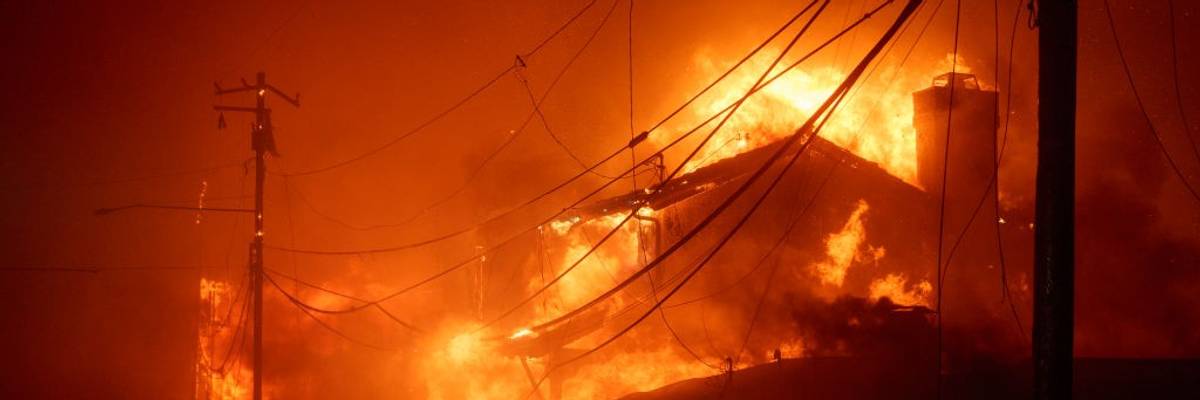
Flames from the Palisades Fire burn homes on January 7, 2025 in the Pacific Palisades neighborhood of Los Angeles, California.
We and a growing number of lawmakers are proposing legislation to ensure that the companies that helped drive the climate crisis help pay their fair share of the ensuing damage.
It's not just your rising bills for groceries and healthcare. For many Americans, the affordability crisis is now showing up in skyrocketing costs to keep their homes insured, as communities are battered by worsening weather disasters fueled by climate change.
Our states and our constituents are feeling this directly. Hawai’i is picking up the pieces after several weeks of historic flooding, which caused more than $1 billion in damage and led to widespread evacuations. These costs are sure to increase home insurance rates that have already spiked by as much as 50% since August 2023, when out of control wildfires—worsened by climate change-driven drought conditions—devastated Maui.
In California, communities are still trying to recover from wildfires that tore through Los Angeles in January 2025. These fires stand as the most expensive wildfires in world history—causing more than $65 billion in damage, much of which is being passed onto the public through rising insurance premiums.
Although New York’s insurance market is not yet seeing the levels of climate-driven distress seen in other parts of the country, the average homeowner is paying $1,000 more for coverage in the years since Hurricane Ida—supercharged by warming oceans—caused over $9 billion in flooding damage. And the frequency of highly destructive storms is growing fast.
If a power company is responsible for the spark that ignites a fire, why not the fossil fuel giants that are turning much of the country into a tinderbox?
The average American homeowner isn’t responsible for this climate chaos; why are they the ones picking up the tab for the billions of dollars of damage it leaves in its wake? We and a growing number of lawmakers are proposing a better model: ensuring that the companies that helped drive this crisis help pay their fair share of the ensuing damage.
Large multinational oil and gas giants knew as far back as the 1970s that their dirty fossil fuel products would make weather disasters more destructive, but spent the ensuing decades lying to the public about their contribution to the problem. The real world harms of their deception is becoming increasingly clear, but they’re paying nearly none of the financial consequences.
That’s why we’re working to build a fairer system in our states—one that could be a model for the rest of the country. One that protects people from perpetually rising home insurance premiums by holding Big Oil accountable for their contribution to weather disasters that are a core driver of the affordability crisis in this country.
Our legislation would empower state attorneys general to bring civil actions against the largest oil and gas companies after major climate-driven disasters. Revenue recovered through legal action would be used to reimburse people dealing with higher rates, stabilize “insurer of last resort” programs, and reimburse homeowners facing rising premiums. At a time when housing affordability is already under strain, the growing instability in home insurance markets is making it even harder for families to buy, keep, and protect their homes.
The stakes couldn’t be higher—for individuals, not to mention the broader American housing market. Uninsurable properties are often unsellable properties, as mortgage lenders generally require that home buyers secure insurance.
Last year, Federal Reserve Chair Jerome Powell told the US Senate Banking Committee that in “10 or 15 years there are going to be regions of the country where you can’t get a mortgage” due to climate change. That ominous prediction seems overly conservative given that realtors in California and Colorado are already reporting pending home sales falling through due to climate risk.
Even as extreme weather becomes more common, more and more Americans are risking financial ruin and going without a safety net altogether. A recent poll in California found that a shocking 1 in 5 California homeowners don’t have insurance, with rising costs the most often cited reason.
Holding polluters accountable for their contribution to a weather disaster isn’t a radical idea. Insurance companies already routinely take utilities to court—and win large settlements—when unmaintained power lines ignite wildfires. If a power company is responsible for the spark that ignites a fire, why not the fossil fuel giants that are turning much of the country into a tinderbox?
The status quo of worsening disasters, perpetual insurance premium increases, and more uninsured families is clearly untenable. But it’s likely to persist until Big Oil companies pay their fair share for the weather chaos they knowingly brought about. It’s time for the fossil fuel giants driving the home insurance crisis to shoulder the growing financial burden, not everyday Americans.
This country and this world are at a monumental crossroads. US voters have an opportunity to beat back the forces of fascism and confront the billionaires who are rigging the economy, our media system, and our democracy, making it increasingly impossible for ordinary people to get by. We’re not just talking about the election. We’re talking about what must be done once these fascist elements are vanquished from power. We need a bolder set of solutions than what either major party has so far been willing to offer and a working-class movement ready to fight like hell for it. Trump didn't emerge from nowhere. The conditions that fueled MAGA authoritarianism were created by decades of radical neoliberal economic policies and a corrupt political system dominated by corporate interests. They slashed taxes on the super-rich, promising that the benefits would trickle down. They said giveaways to the corporate titans would make life more affordable for the rest of us. It was all bullshit. And when a bitter, betrayed populace searches for someone to blame, right-wing demagogues have little trouble finding scapegoats. People know when they're being lied to, but you won't hear any of this from the corporate media. Only independent journalism—powered and funded by people who believe in building a better world—can deliver truly trustworthy daily news. If you share our vision, please contribute whatever you can to sustain our work. |
It's not just your rising bills for groceries and healthcare. For many Americans, the affordability crisis is now showing up in skyrocketing costs to keep their homes insured, as communities are battered by worsening weather disasters fueled by climate change.
Our states and our constituents are feeling this directly. Hawai’i is picking up the pieces after several weeks of historic flooding, which caused more than $1 billion in damage and led to widespread evacuations. These costs are sure to increase home insurance rates that have already spiked by as much as 50% since August 2023, when out of control wildfires—worsened by climate change-driven drought conditions—devastated Maui.
In California, communities are still trying to recover from wildfires that tore through Los Angeles in January 2025. These fires stand as the most expensive wildfires in world history—causing more than $65 billion in damage, much of which is being passed onto the public through rising insurance premiums.
Although New York’s insurance market is not yet seeing the levels of climate-driven distress seen in other parts of the country, the average homeowner is paying $1,000 more for coverage in the years since Hurricane Ida—supercharged by warming oceans—caused over $9 billion in flooding damage. And the frequency of highly destructive storms is growing fast.
If a power company is responsible for the spark that ignites a fire, why not the fossil fuel giants that are turning much of the country into a tinderbox?
The average American homeowner isn’t responsible for this climate chaos; why are they the ones picking up the tab for the billions of dollars of damage it leaves in its wake? We and a growing number of lawmakers are proposing a better model: ensuring that the companies that helped drive this crisis help pay their fair share of the ensuing damage.
Large multinational oil and gas giants knew as far back as the 1970s that their dirty fossil fuel products would make weather disasters more destructive, but spent the ensuing decades lying to the public about their contribution to the problem. The real world harms of their deception is becoming increasingly clear, but they’re paying nearly none of the financial consequences.
That’s why we’re working to build a fairer system in our states—one that could be a model for the rest of the country. One that protects people from perpetually rising home insurance premiums by holding Big Oil accountable for their contribution to weather disasters that are a core driver of the affordability crisis in this country.
Our legislation would empower state attorneys general to bring civil actions against the largest oil and gas companies after major climate-driven disasters. Revenue recovered through legal action would be used to reimburse people dealing with higher rates, stabilize “insurer of last resort” programs, and reimburse homeowners facing rising premiums. At a time when housing affordability is already under strain, the growing instability in home insurance markets is making it even harder for families to buy, keep, and protect their homes.
The stakes couldn’t be higher—for individuals, not to mention the broader American housing market. Uninsurable properties are often unsellable properties, as mortgage lenders generally require that home buyers secure insurance.
Last year, Federal Reserve Chair Jerome Powell told the US Senate Banking Committee that in “10 or 15 years there are going to be regions of the country where you can’t get a mortgage” due to climate change. That ominous prediction seems overly conservative given that realtors in California and Colorado are already reporting pending home sales falling through due to climate risk.
Even as extreme weather becomes more common, more and more Americans are risking financial ruin and going without a safety net altogether. A recent poll in California found that a shocking 1 in 5 California homeowners don’t have insurance, with rising costs the most often cited reason.
Holding polluters accountable for their contribution to a weather disaster isn’t a radical idea. Insurance companies already routinely take utilities to court—and win large settlements—when unmaintained power lines ignite wildfires. If a power company is responsible for the spark that ignites a fire, why not the fossil fuel giants that are turning much of the country into a tinderbox?
The status quo of worsening disasters, perpetual insurance premium increases, and more uninsured families is clearly untenable. But it’s likely to persist until Big Oil companies pay their fair share for the weather chaos they knowingly brought about. It’s time for the fossil fuel giants driving the home insurance crisis to shoulder the growing financial burden, not everyday Americans.