5
#000000
#FFFFFF
To donate by check, phone, or other method, see our More Ways to Give page.
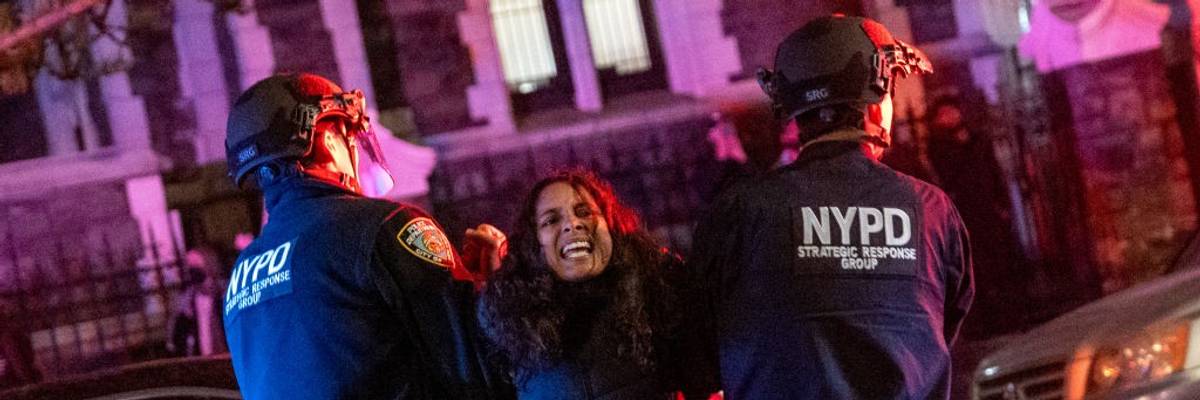
While the traumatic experiences of foreign-born scholars such as Mahmoud Khalil and Rümeysa Öztürk have drawn international headlines, a report released Wednesday by a pair of leading rights groups highlights how their arrests by immigration agents were part of a wider assault "on free speech and association on college campuses, particularly against students, faculty, and staff protesting Israel's war on Gaza and the US government’s political, economic, and military support of the war."
Titled "Student Speech Under Attack: Suppression of Pro-Palestine Speech and Dissent on Campus," the new report from the ACLU and Amnesty International USA catalogs university and law enforcement responses to protests and encampments, schools' actions to restrict speech, the Trump administration's crackdowns on institutions and foreign scholars, and how all of that has had a chilling effect.
The report also features case studies on six schools—City College of New York, Columbia University, Tulane University, University of Michigan, University of Texas at Austin, and University of California, Los Angeles—and various targeted scholars, including Khalil and Öztürk as well as Yunseo Chung, Badar Khan Suri, Leqaa Kordia, and Mohsen Mahdawi.
Like Khalil, Mahdawi was a Columbia student and lawful permanent resident of the United States. At his citizenship interview last year, masked US Immigration and Customs Enforcement (ICE) agents arrested and detained him for his advocacy in support of Palestinian rights. The Trump administration's attempt to deport Mahdawi, who was raised in the Israeli-occupied West Bank, is ongoing.
"At the time of his arrest and detention, he was an undergraduate student at Columbia University majoring in philosophy and planning to start a master's degree program at Columbia's School of International and Public Affairs. Mahdawi said he dedicated himself 'to understanding how to achieve a lasting peace for Palestinians and Israelis, particularly through the study of conflict resolution,'" the report notes.
"As a student at Columbia, Mahdawi was an outspoken critic of Israel's military campaign in Gaza and an activist and organizer in student protests on Columbia's campus until March 2024, after which he took a step back and was not involved in organizing," the document details. "Mahdawi attended protests opposing military escalations in the region and gave speeches at several of these protests advocating for Palestinian human rights and a permanent ceasefire. Mahdawi appeared in numerous televised interviews and print news articles regarding the military campaign in Gaza and related protests."
While Mahdawi was targeted by the Trump administration, not Columbia, the publication points out that he "had contacted university administrators asking for help in finding safe housing, stating that he feared abduction by ICE agents," and, according to him, the school "did nothing in response to his request."
The report also notes Columbia's decadeslong reputation as "the activist Ivy," and how "student activism in support of Palestinian rights began in October 2023... sparking a multiyear, nationwide movement of campus anti-war demonstrations calling for academic institutions to divest from what organizers and Amnesty International characterize as Israeli apartheid."
The ACLU and Amnesty laid out how Columbia suspended student groups that held peaceful demonstrations, refused to divest from Israel, threatened to expel students who joined an encampment, and had New York Police Department officers forcibly remove protesters who occupied a campus building and dubbed it "Hind's Hall" for a Palestinian child killed by Israeli forces.
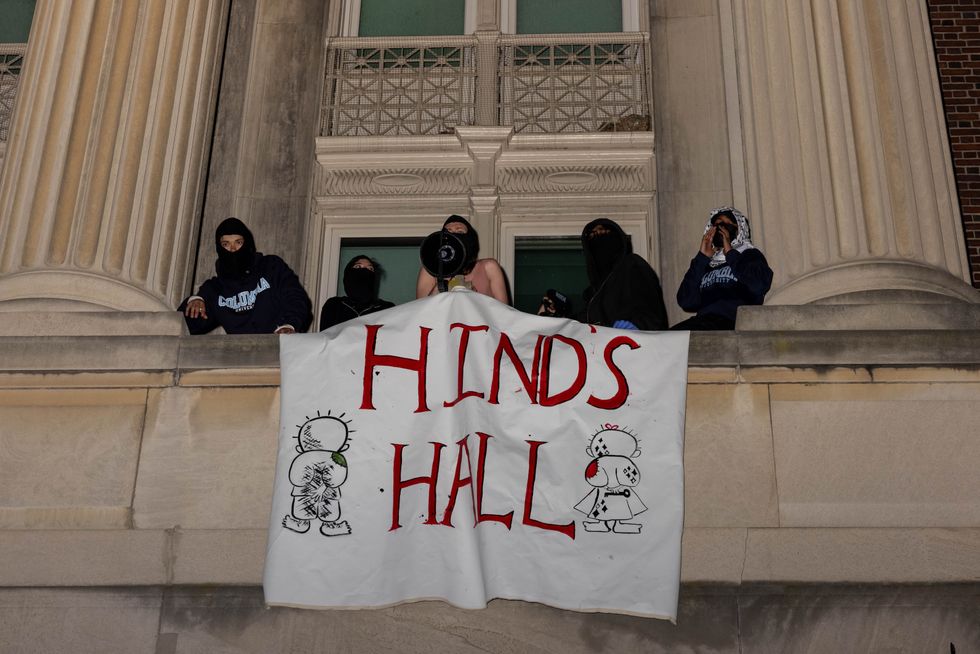 Columbia University student demonstrators unfurl a banner that reads "Hind's Hall" as they barricade themselves inside a campus building on April 30, 2024 in New York City. (Photo by Alex Kent/Getty Images)
Early last year, as Khalil was arrested outside his home and President Donald Trump threatened to pull $400 million in university funding, Columbia promised to the administration that it would add three dozen "special patrol officers" with arrest powers, and later announced that its University Judicial Board punished over 70 students.
However, as the report stresses, it's not just Columbia. After Israel began what many experts have called a genocidal assault on Gaza following the October 2023 Hamas-led attack, "students across more than 100 universities organized, calling for educational institutions to end their financial ties to corporations linked to the war," and their protests and encampments were often met with "university leaders' swift and punitive responses."
"Universities and colleges faced pressure from wealthy donors, trustees, and figures outside of university or college leadership, including members of Congress, to suppress pro-Palestinian protests and dismantle encampments," the publication acknowledges. "By restricting or banning protests outright, involving campus police and external law enforcement in the surveillance, intimidation, and repression of participants, and pursuing students with legal and administrative consequences, university and college administrators escalated tensions."
"During the disbandment of encampments, law enforcement forcefully pushed and arrested demonstrators, leading to concussions, cuts dislocations, and other severe injuries," the report continues. "In many instances, demonstrators posed no threat, did not resist arrest, and were sometimes attempting to deescalate or document the protest."
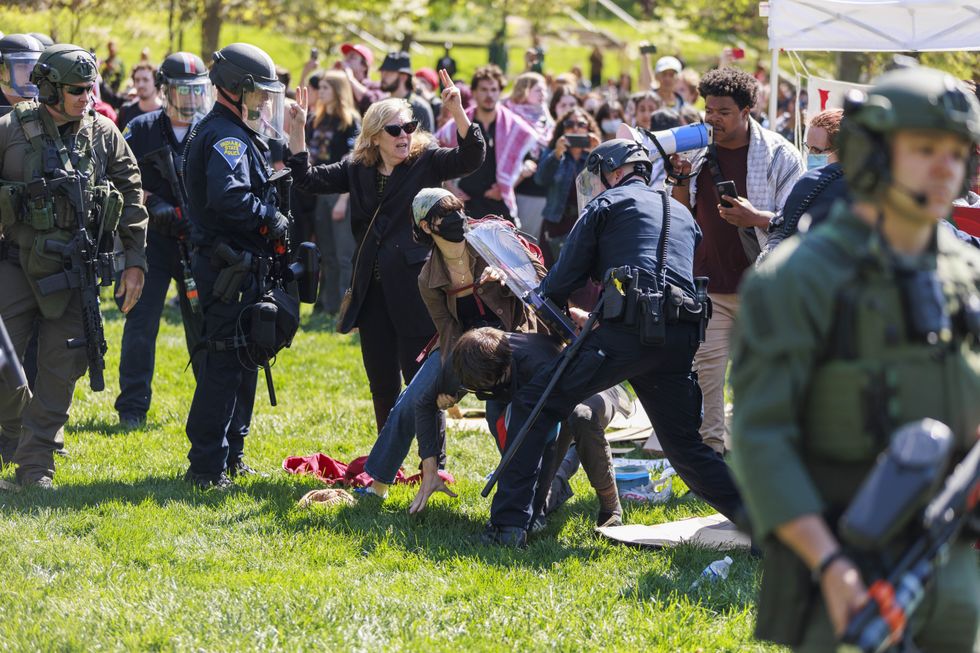 Police crack down on a pro-Palestinian protest at Indiana University in Bloomington on April 25, 2024. (Photo by Jeremy Hogan/SOPA Images/LightRocket via Getty Images)
Justin Mazzola, Amnesty's deputy director of research, said in a statement that "universities and colleges should prepare students for open discourse in a pluralistic society. Instead, campus leadership has suppressed free speech and peaceful protest while enabling the Trump administration to advance its anti-rights agenda and seek ideological control over higher education."
Mazzola also called out the Trump administration—which, as the report lays out, has issued related executive orders, conducted campus visits, abused Title VI investigations, conditioned funding on acquiescence, revoked student visas, targeted scholars for deportation for protected speech, and attempted to evade court reviews of deportations.
"The Trump administration's targeting of students and faculty who oppose Israel's ongoing genocide in Gaza is dangerously reminiscent of McCarthy-era censorship and a blatant violation of academic freedom," he asserted. "The Trump administration must stop stifling political expression on campus and end its relentless push for ideological conformity in higher education. Students' rights must be respected, protected, and fulfilled."
The report features recommendations for schools, campus and local law enforcement, the Trump administration, and Congress. It also details rights on campus, reminding students and educators that they "have the right to peacefully protest, and the government has a duty to respect, protect, and facilitate that right—not suppress it."
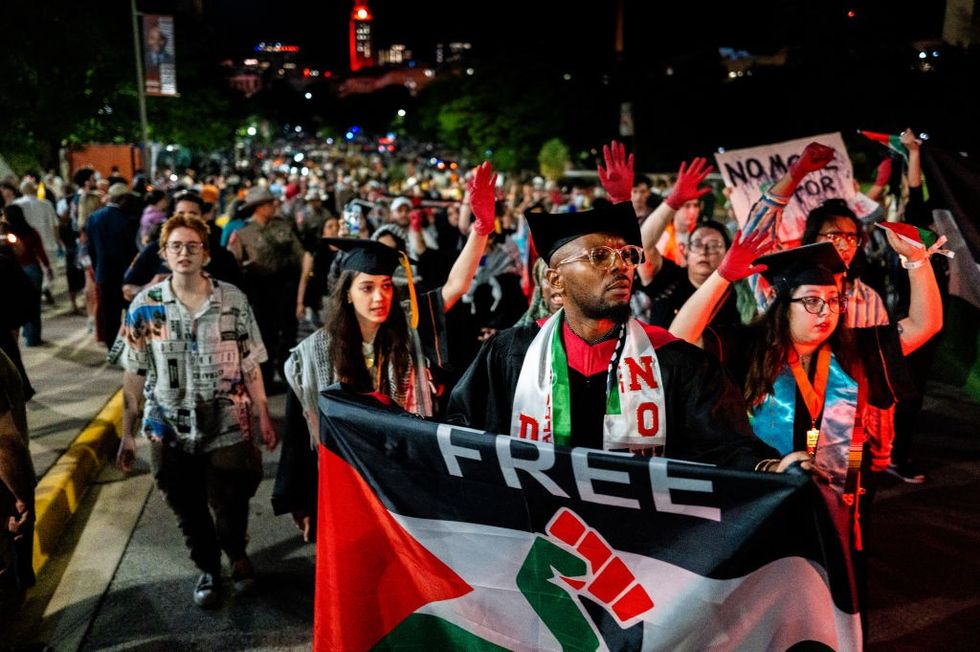 University of Texas at Austin graduate students, faculty, and demonstrators protest Israel's war on the Gaza Strip after walking out of commencement on May 11, 2024. (Photo by Brandon Bell/Getty Images)
As for US colleges and universities, they "must take all possible measures to ensure that their campuses are spaces where students may exercise their rights to freedom of speech and expression without fear of unwarranted punishment or retaliation regardless of viewpoint," said Jennifer Turner, principal researcher in the ACLU's Human Rights Program.
"Schools should resist the pressures placed on them to silence and punish students or faculty who engage in protest or advocacy for Palestinian rights," Turner added. "Instead, they should stand up to the federal government's intimidation tactics and defend the university's core mission of fostering free-flowing inquiry and debate."
The groups' report was released after Khalil and other Palestine defenders sued Columbia in federal court last week over what Khalil called "gross and systemic discrimination against Palestinian students." He vowed that "next, I will turn to the hateful individuals at Columbia who were also responsible for what we endured."
While the traumatic experiences of foreign-born scholars such as Mahmoud Khalil and Rümeysa Öztürk have drawn international headlines, a report released Wednesday by a pair of leading rights groups highlights how their arrests by immigration agents were part of a wider assault "on free speech and association on college campuses, particularly against students, faculty, and staff protesting Israel's war on Gaza and the US government’s political, economic, and military support of the war."
Titled "Student Speech Under Attack: Suppression of Pro-Palestine Speech and Dissent on Campus," the new report from the ACLU and Amnesty International USA catalogs university and law enforcement responses to protests and encampments, schools' actions to restrict speech, the Trump administration's crackdowns on institutions and foreign scholars, and how all of that has had a chilling effect.
The report also features case studies on six schools—City College of New York, Columbia University, Tulane University, University of Michigan, University of Texas at Austin, and University of California, Los Angeles—and various targeted scholars, including Khalil and Öztürk as well as Yunseo Chung, Badar Khan Suri, Leqaa Kordia, and Mohsen Mahdawi.
Like Khalil, Mahdawi was a Columbia student and lawful permanent resident of the United States. At his citizenship interview last year, masked US Immigration and Customs Enforcement (ICE) agents arrested and detained him for his advocacy in support of Palestinian rights. The Trump administration's attempt to deport Mahdawi, who was raised in the Israeli-occupied West Bank, is ongoing.
"At the time of his arrest and detention, he was an undergraduate student at Columbia University majoring in philosophy and planning to start a master's degree program at Columbia's School of International and Public Affairs. Mahdawi said he dedicated himself 'to understanding how to achieve a lasting peace for Palestinians and Israelis, particularly through the study of conflict resolution,'" the report notes.
"As a student at Columbia, Mahdawi was an outspoken critic of Israel's military campaign in Gaza and an activist and organizer in student protests on Columbia's campus until March 2024, after which he took a step back and was not involved in organizing," the document details. "Mahdawi attended protests opposing military escalations in the region and gave speeches at several of these protests advocating for Palestinian human rights and a permanent ceasefire. Mahdawi appeared in numerous televised interviews and print news articles regarding the military campaign in Gaza and related protests."
While Mahdawi was targeted by the Trump administration, not Columbia, the publication points out that he "had contacted university administrators asking for help in finding safe housing, stating that he feared abduction by ICE agents," and, according to him, the school "did nothing in response to his request."
The report also notes Columbia's decadeslong reputation as "the activist Ivy," and how "student activism in support of Palestinian rights began in October 2023... sparking a multiyear, nationwide movement of campus anti-war demonstrations calling for academic institutions to divest from what organizers and Amnesty International characterize as Israeli apartheid."
The ACLU and Amnesty laid out how Columbia suspended student groups that held peaceful demonstrations, refused to divest from Israel, threatened to expel students who joined an encampment, and had New York Police Department officers forcibly remove protesters who occupied a campus building and dubbed it "Hind's Hall" for a Palestinian child killed by Israeli forces.
Columbia University student demonstrators unfurl a banner that reads "Hind's Hall" as they barricade themselves inside a campus building on April 30, 2024 in New York City. (Photo by Alex Kent/Getty Images)
Early last year, as Khalil was arrested outside his home and President Donald Trump threatened to pull $400 million in university funding, Columbia promised to the administration that it would add three dozen "special patrol officers" with arrest powers, and later announced that its University Judicial Board punished over 70 students.
However, as the report stresses, it's not just Columbia. After Israel began what many experts have called a genocidal assault on Gaza following the October 2023 Hamas-led attack, "students across more than 100 universities organized, calling for educational institutions to end their financial ties to corporations linked to the war," and their protests and encampments were often met with "university leaders' swift and punitive responses."
"Universities and colleges faced pressure from wealthy donors, trustees, and figures outside of university or college leadership, including members of Congress, to suppress pro-Palestinian protests and dismantle encampments," the publication acknowledges. "By restricting or banning protests outright, involving campus police and external law enforcement in the surveillance, intimidation, and repression of participants, and pursuing students with legal and administrative consequences, university and college administrators escalated tensions."
"During the disbandment of encampments, law enforcement forcefully pushed and arrested demonstrators, leading to concussions, cuts dislocations, and other severe injuries," the report continues. "In many instances, demonstrators posed no threat, did not resist arrest, and were sometimes attempting to deescalate or document the protest."
Police crack down on a pro-Palestinian protest at Indiana University in Bloomington on April 25, 2024. (Photo by Jeremy Hogan/SOPA Images/LightRocket via Getty Images)
Justin Mazzola, Amnesty's deputy director of research, said in a statement that "universities and colleges should prepare students for open discourse in a pluralistic society. Instead, campus leadership has suppressed free speech and peaceful protest while enabling the Trump administration to advance its anti-rights agenda and seek ideological control over higher education."
Mazzola also called out the Trump administration—which, as the report lays out, has issued related executive orders, conducted campus visits, abused Title VI investigations, conditioned funding on acquiescence, revoked student visas, targeted scholars for deportation for protected speech, and attempted to evade court reviews of deportations.
"The Trump administration's targeting of students and faculty who oppose Israel's ongoing genocide in Gaza is dangerously reminiscent of McCarthy-era censorship and a blatant violation of academic freedom," he asserted. "The Trump administration must stop stifling political expression on campus and end its relentless push for ideological conformity in higher education. Students' rights must be respected, protected, and fulfilled."
The report features recommendations for schools, campus and local law enforcement, the Trump administration, and Congress. It also details rights on campus, reminding students and educators that they "have the right to peacefully protest, and the government has a duty to respect, protect, and facilitate that right—not suppress it."
University of Texas at Austin graduate students, faculty, and demonstrators protest Israel's war on the Gaza Strip after walking out of commencement on May 11, 2024. (Photo by Brandon Bell/Getty Images)
As for US colleges and universities, they "must take all possible measures to ensure that their campuses are spaces where students may exercise their rights to freedom of speech and expression without fear of unwarranted punishment or retaliation regardless of viewpoint," said Jennifer Turner, principal researcher in the ACLU's Human Rights Program.
"Schools should resist the pressures placed on them to silence and punish students or faculty who engage in protest or advocacy for Palestinian rights," Turner added. "Instead, they should stand up to the federal government's intimidation tactics and defend the university's core mission of fostering free-flowing inquiry and debate."
The groups' report was released after Khalil and other Palestine defenders sued Columbia in federal court last week over what Khalil called "gross and systemic discrimination against Palestinian students." He vowed that "next, I will turn to the hateful individuals at Columbia who were also responsible for what we endured."
While the traumatic experiences of foreign-born scholars such as Mahmoud Khalil and Rümeysa Öztürk have drawn international headlines, a report released Wednesday by a pair of leading rights groups highlights how their arrests by immigration agents were part of a wider assault "on free speech and association on college campuses, particularly against students, faculty, and staff protesting Israel's war on Gaza and the US government’s political, economic, and military support of the war."
Titled "Student Speech Under Attack: Suppression of Pro-Palestine Speech and Dissent on Campus," the new report from the ACLU and Amnesty International USA catalogs university and law enforcement responses to protests and encampments, schools' actions to restrict speech, the Trump administration's crackdowns on institutions and foreign scholars, and how all of that has had a chilling effect.
The report also features case studies on six schools—City College of New York, Columbia University, Tulane University, University of Michigan, University of Texas at Austin, and University of California, Los Angeles—and various targeted scholars, including Khalil and Öztürk as well as Yunseo Chung, Badar Khan Suri, Leqaa Kordia, and Mohsen Mahdawi.
Like Khalil, Mahdawi was a Columbia student and lawful permanent resident of the United States. At his citizenship interview last year, masked US Immigration and Customs Enforcement (ICE) agents arrested and detained him for his advocacy in support of Palestinian rights. The Trump administration's attempt to deport Mahdawi, who was raised in the Israeli-occupied West Bank, is ongoing.
"At the time of his arrest and detention, he was an undergraduate student at Columbia University majoring in philosophy and planning to start a master's degree program at Columbia's School of International and Public Affairs. Mahdawi said he dedicated himself 'to understanding how to achieve a lasting peace for Palestinians and Israelis, particularly through the study of conflict resolution,'" the report notes.
"As a student at Columbia, Mahdawi was an outspoken critic of Israel's military campaign in Gaza and an activist and organizer in student protests on Columbia's campus until March 2024, after which he took a step back and was not involved in organizing," the document details. "Mahdawi attended protests opposing military escalations in the region and gave speeches at several of these protests advocating for Palestinian human rights and a permanent ceasefire. Mahdawi appeared in numerous televised interviews and print news articles regarding the military campaign in Gaza and related protests."
While Mahdawi was targeted by the Trump administration, not Columbia, the publication points out that he "had contacted university administrators asking for help in finding safe housing, stating that he feared abduction by ICE agents," and, according to him, the school "did nothing in response to his request."
The report also notes Columbia's decadeslong reputation as "the activist Ivy," and how "student activism in support of Palestinian rights began in October 2023... sparking a multiyear, nationwide movement of campus anti-war demonstrations calling for academic institutions to divest from what organizers and Amnesty International characterize as Israeli apartheid."
The ACLU and Amnesty laid out how Columbia suspended student groups that held peaceful demonstrations, refused to divest from Israel, threatened to expel students who joined an encampment, and had New York Police Department officers forcibly remove protesters who occupied a campus building and dubbed it "Hind's Hall" for a Palestinian child killed by Israeli forces.
Columbia University student demonstrators unfurl a banner that reads "Hind's Hall" as they barricade themselves inside a campus building on April 30, 2024 in New York City. (Photo by Alex Kent/Getty Images)
Early last year, as Khalil was arrested outside his home and President Donald Trump threatened to pull $400 million in university funding, Columbia promised to the administration that it would add three dozen "special patrol officers" with arrest powers, and later announced that its University Judicial Board punished over 70 students.
However, as the report stresses, it's not just Columbia. After Israel began what many experts have called a genocidal assault on Gaza following the October 2023 Hamas-led attack, "students across more than 100 universities organized, calling for educational institutions to end their financial ties to corporations linked to the war," and their protests and encampments were often met with "university leaders' swift and punitive responses."
"Universities and colleges faced pressure from wealthy donors, trustees, and figures outside of university or college leadership, including members of Congress, to suppress pro-Palestinian protests and dismantle encampments," the publication acknowledges. "By restricting or banning protests outright, involving campus police and external law enforcement in the surveillance, intimidation, and repression of participants, and pursuing students with legal and administrative consequences, university and college administrators escalated tensions."
"During the disbandment of encampments, law enforcement forcefully pushed and arrested demonstrators, leading to concussions, cuts dislocations, and other severe injuries," the report continues. "In many instances, demonstrators posed no threat, did not resist arrest, and were sometimes attempting to deescalate or document the protest."
Police crack down on a pro-Palestinian protest at Indiana University in Bloomington on April 25, 2024. (Photo by Jeremy Hogan/SOPA Images/LightRocket via Getty Images)
Justin Mazzola, Amnesty's deputy director of research, said in a statement that "universities and colleges should prepare students for open discourse in a pluralistic society. Instead, campus leadership has suppressed free speech and peaceful protest while enabling the Trump administration to advance its anti-rights agenda and seek ideological control over higher education."
Mazzola also called out the Trump administration—which, as the report lays out, has issued related executive orders, conducted campus visits, abused Title VI investigations, conditioned funding on acquiescence, revoked student visas, targeted scholars for deportation for protected speech, and attempted to evade court reviews of deportations.
"The Trump administration's targeting of students and faculty who oppose Israel's ongoing genocide in Gaza is dangerously reminiscent of McCarthy-era censorship and a blatant violation of academic freedom," he asserted. "The Trump administration must stop stifling political expression on campus and end its relentless push for ideological conformity in higher education. Students' rights must be respected, protected, and fulfilled."
The report features recommendations for schools, campus and local law enforcement, the Trump administration, and Congress. It also details rights on campus, reminding students and educators that they "have the right to peacefully protest, and the government has a duty to respect, protect, and facilitate that right—not suppress it."
University of Texas at Austin graduate students, faculty, and demonstrators protest Israel's war on the Gaza Strip after walking out of commencement on May 11, 2024. (Photo by Brandon Bell/Getty Images)
As for US colleges and universities, they "must take all possible measures to ensure that their campuses are spaces where students may exercise their rights to freedom of speech and expression without fear of unwarranted punishment or retaliation regardless of viewpoint," said Jennifer Turner, principal researcher in the ACLU's Human Rights Program.
"Schools should resist the pressures placed on them to silence and punish students or faculty who engage in protest or advocacy for Palestinian rights," Turner added. "Instead, they should stand up to the federal government's intimidation tactics and defend the university's core mission of fostering free-flowing inquiry and debate."
The groups' report was released after Khalil and other Palestine defenders sued Columbia in federal court last week over what Khalil called "gross and systemic discrimination against Palestinian students." He vowed that "next, I will turn to the hateful individuals at Columbia who were also responsible for what we endured."