SUBSCRIBE TO OUR FREE NEWSLETTER
Daily news & progressive opinion—funded by the people, not the corporations—delivered straight to your inbox.
5
#000000
#FFFFFF
To donate by check, phone, or other method, see our More Ways to Give page.
Daily news & progressive opinion—funded by the people, not the corporations—delivered straight to your inbox.
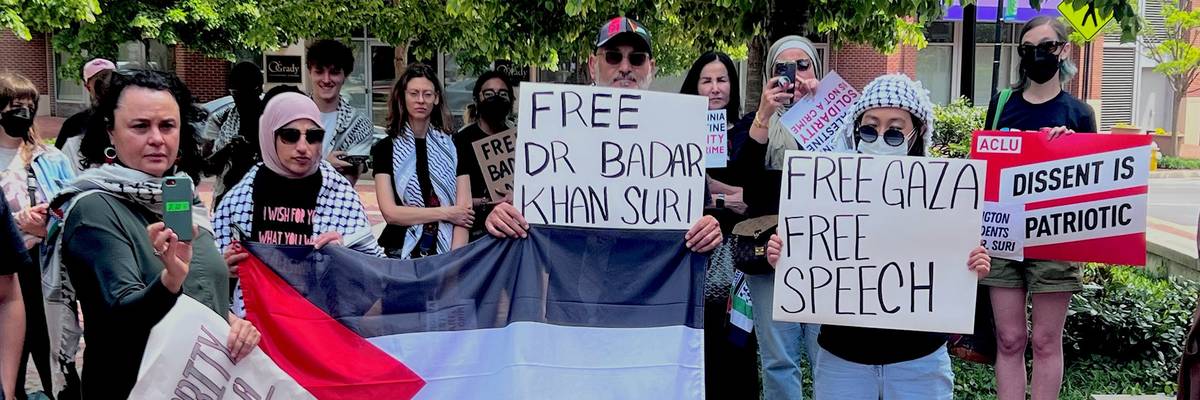
Supporters rally in support of Badar Khan Suri, an Indian national, outside the Albert V. Bryan United States Courthouse in Alexandria, Virginia May 1, 2025.
"My only 'crimes' making me a 'national security threat' are my marriage to a United States citizen of Palestinian origin and my support for the Palestinian cause," wrote Badar Khan Suri in an op-ed published on Tuesday.
After roughly two months of detention in a U.S. Immigration and Customs Enforcement facility, Georgetown University academic Badar Khan Suri is set to be released from custody following an order from a federal judge on Wednesday.
Khan Suri, an Indian national, was abducted by masked Department of Homeland Security (DHS) agents outside his home in Virginia in March—a scene similar to the arrests of foreign students who have supported Palestinian rights or criticized the U.S.-backed Israeli assault on the Gaza Strip.
In recent weeks, Mohsen Mahdawi, a Palestinian Columbia University student, and Rümeysa Öztürk, a Tufts University student, were both released from ICE detention after being arrested by federal immigration agents.
Judge Patricia Giles of the Eastern District of Virginia ordered Khan Suri's release on the condition that he attend other hearings in the case in person and continue living in Virginia, according to CNN.
Khan Suri, a postdoctoral fellow at Georgetown University, was teaching in the United States on a valid visa at the time of his arrest and is married to a U.S. citizen.
An attorney for Khan Suri, Hassan Ahmad, has indicated in media interviews that he believes Khan Suri was targeted because his father-in-law is Ahmed Yousef, a former adviser to the Hamas leader, Ismail Haniyeh. Yousef has publicly criticized Hamas' October 7, 2023 attack on Israel, according to The New York Times.
"My only 'crimes' making me a 'national security threat' are my marriage to a United States citizen of Palestinian origin and my support for the Palestinian cause," Khan Suri wrote in an op-ed published by Truthout on Tuesday.
"My beliefs do not allow me to ignore the pain of Palestinians. As a political prisoner, I face deprivation—of sleep, food, hygiene, and, worst of all, contact with my loved ones—but I take solace in knowing that I endure this ordeal for the children of Palestine, and I see my suffering as nothing compared to theirs," he wrote.
Dear Common Dreams reader, It’s been nearly 30 years since I co-founded Common Dreams with my late wife, Lina Newhouser. We had the radical notion that journalism should serve the public good, not corporate profits. It was clear to us from the outset what it would take to build such a project. No paid advertisements. No corporate sponsors. No millionaire publisher telling us what to think or do. Many people said we wouldn't last a year, but we proved those doubters wrong. Together with a tremendous team of journalists and dedicated staff, we built an independent media outlet free from the constraints of profits and corporate control. Our mission has always been simple: To inform. To inspire. To ignite change for the common good. Building Common Dreams was not easy. Our survival was never guaranteed. When you take on the most powerful forces—Wall Street greed, fossil fuel industry destruction, Big Tech lobbyists, and uber-rich oligarchs who have spent billions upon billions rigging the economy and democracy in their favor—the only bulwark you have is supporters who believe in your work. But here’s the urgent message from me today. It's never been this bad out there. And it's never been this hard to keep us going. At the very moment Common Dreams is most needed, the threats we face are intensifying. We need your support now more than ever. We don't accept corporate advertising and never will. We don't have a paywall because we don't think people should be blocked from critical news based on their ability to pay. Everything we do is funded by the donations of readers like you. When everyone does the little they can afford, we are strong. But if that support retreats or dries up, so do we. Will you donate now to make sure Common Dreams not only survives but thrives? —Craig Brown, Co-founder |
After roughly two months of detention in a U.S. Immigration and Customs Enforcement facility, Georgetown University academic Badar Khan Suri is set to be released from custody following an order from a federal judge on Wednesday.
Khan Suri, an Indian national, was abducted by masked Department of Homeland Security (DHS) agents outside his home in Virginia in March—a scene similar to the arrests of foreign students who have supported Palestinian rights or criticized the U.S.-backed Israeli assault on the Gaza Strip.
In recent weeks, Mohsen Mahdawi, a Palestinian Columbia University student, and Rümeysa Öztürk, a Tufts University student, were both released from ICE detention after being arrested by federal immigration agents.
Judge Patricia Giles of the Eastern District of Virginia ordered Khan Suri's release on the condition that he attend other hearings in the case in person and continue living in Virginia, according to CNN.
Khan Suri, a postdoctoral fellow at Georgetown University, was teaching in the United States on a valid visa at the time of his arrest and is married to a U.S. citizen.
An attorney for Khan Suri, Hassan Ahmad, has indicated in media interviews that he believes Khan Suri was targeted because his father-in-law is Ahmed Yousef, a former adviser to the Hamas leader, Ismail Haniyeh. Yousef has publicly criticized Hamas' October 7, 2023 attack on Israel, according to The New York Times.
"My only 'crimes' making me a 'national security threat' are my marriage to a United States citizen of Palestinian origin and my support for the Palestinian cause," Khan Suri wrote in an op-ed published by Truthout on Tuesday.
"My beliefs do not allow me to ignore the pain of Palestinians. As a political prisoner, I face deprivation—of sleep, food, hygiene, and, worst of all, contact with my loved ones—but I take solace in knowing that I endure this ordeal for the children of Palestine, and I see my suffering as nothing compared to theirs," he wrote.
After roughly two months of detention in a U.S. Immigration and Customs Enforcement facility, Georgetown University academic Badar Khan Suri is set to be released from custody following an order from a federal judge on Wednesday.
Khan Suri, an Indian national, was abducted by masked Department of Homeland Security (DHS) agents outside his home in Virginia in March—a scene similar to the arrests of foreign students who have supported Palestinian rights or criticized the U.S.-backed Israeli assault on the Gaza Strip.
In recent weeks, Mohsen Mahdawi, a Palestinian Columbia University student, and Rümeysa Öztürk, a Tufts University student, were both released from ICE detention after being arrested by federal immigration agents.
Judge Patricia Giles of the Eastern District of Virginia ordered Khan Suri's release on the condition that he attend other hearings in the case in person and continue living in Virginia, according to CNN.
Khan Suri, a postdoctoral fellow at Georgetown University, was teaching in the United States on a valid visa at the time of his arrest and is married to a U.S. citizen.
An attorney for Khan Suri, Hassan Ahmad, has indicated in media interviews that he believes Khan Suri was targeted because his father-in-law is Ahmed Yousef, a former adviser to the Hamas leader, Ismail Haniyeh. Yousef has publicly criticized Hamas' October 7, 2023 attack on Israel, according to The New York Times.
"My only 'crimes' making me a 'national security threat' are my marriage to a United States citizen of Palestinian origin and my support for the Palestinian cause," Khan Suri wrote in an op-ed published by Truthout on Tuesday.
"My beliefs do not allow me to ignore the pain of Palestinians. As a political prisoner, I face deprivation—of sleep, food, hygiene, and, worst of all, contact with my loved ones—but I take solace in knowing that I endure this ordeal for the children of Palestine, and I see my suffering as nothing compared to theirs," he wrote.