SUBSCRIBE TO OUR FREE NEWSLETTER
Daily news & progressive opinion—funded by the people, not the corporations—delivered straight to your inbox.
5
#000000
#FFFFFF
To donate by check, phone, or other method, see our More Ways to Give page.
Daily news & progressive opinion—funded by the people, not the corporations—delivered straight to your inbox.
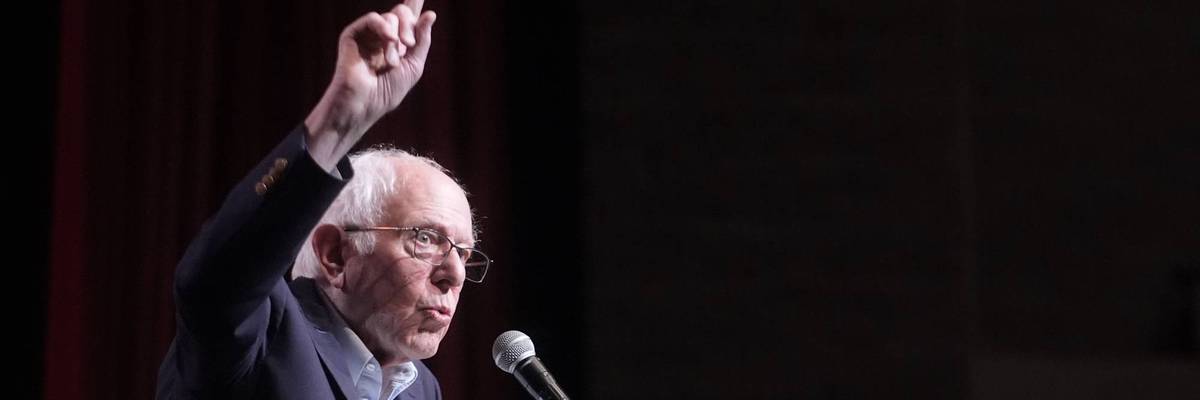
Sen. Bernie Sanders (I-Vt.) holds a "Tax the Rich" rally at Lehman College to press New York Gov. Kathy Hochul to raise taxes on millionaires in New York City on March 29, 2026.
“If my 5% wealth tax on billionaires was enacted, you’d owe $135 million more in taxes, and a family of four making $150,000 or less would receive a $12,000 payment. Oh, and you’d still be worth more than $2.5 billion."
As billionaires nationwide rally to stop tax increases on the wealthy, US Sen. Bernie Sanders stepped in to "clear things up" for one of Wall Street's top power brokers after he railed against the proposal.
Following in the footsteps of California, where a popular ballot initiative to impose a one-time 5% tax on the state's 200 billionaires has gained steam, Sanders (I-Vt.) and Rep. Ro Khanna (D-Calif.) introduced their own federal proposal earlier this month to tax those with net worths of more than $1 billion 5% of their annual household wealth.
The proposal is projected to raise $4.4 trillion over the next decade to provide direct payments to lower-income Americans, reverse Republicans' cuts to Medicaid and Affordable Care Act spending, expand Medicare, and build millions of affordable housing units, among many other expenditures.
Jamie Dimon, the CEO of JPMorgan Chase, who is worth about $2.8 billion according to Forbes, appeared on Fox News on Tuesday and was asked by anchor Brian Kilmeade about Sanders' frequent accusations that billionaires "don't pay their fair share" in taxes.
"I don't know what he means by fair share," Dimon said. "I've listened to that my whole life, and I don't know what he means."
The two did not address the facts that may have led Sanders to draw such a conclusion. For instance, the senator often notes that fewer than 1,000 billionaires own more wealth than the bottom half of the US, around 175 million people.
Those billionaires also manage to pay a lower effective tax rate than the average American by wielding loopholes that allow them to exempt large chunks of their fortunes.
Sanders took to social media to respond to Dimon's incredulity about his idea of "fairness."
"Ok, Jamie: Let me clear things up for you," the senator wrote. "If my 5% wealth tax on billionaires was enacted, you’d owe $135 million more in taxes, and a family of four making $150,000 or less would receive a $12,000 payment."
"Oh, and you’d still be worth more than $2.5 billion," Sanders added. "Seems pretty fair to me."
Dimon's remarks came as billionaires are in a full-blown panic over the proposal for a one-time 5% tax in California, which is projected to raise about $100 billion, mostly to cover the Medicaid funding shortfall caused by the massive cuts in last year's GOP budget law.
A poll earlier this month showed that the measure, which will be put to voters in November, has about 2-1 approval, despite a more than $80 million effort by the state's elite—most notably Google co-founders Sergey Brin and Larry Page—to stop it in its tracks.
Dimon himself is not known to have contributed to the effort. But during his Tuesday appearance on Fox, he echoed one of the movement's oft-used talking points: that raising taxes on the rich leads to an "exodus" of wealth from financial hubs like New York and California.
As Forbes senior contributor Teresa Ghilarducci explained late last year, "Decades of economic research show that billionaire 'flight' is rare, exaggerated, and often confused with tax avoidance through accounting maneuvers rather than physical relocation."
Christopher Marquis and Nick Romeo similarly said last month in a piece for TIME that “despite multiple debunkings, the ‘millionaire exodus’ panic remains a popular narrative,” even though it is “frequently based on biased or sloppy arguments where anecdote replaces systematic evidence, correlation poses as causation, and every modest redistributive proposal is framed as an existential threat to prosperity.”
Dear Common Dreams reader, It’s been nearly 30 years since I co-founded Common Dreams with my late wife, Lina Newhouser. We had the radical notion that journalism should serve the public good, not corporate profits. It was clear to us from the outset what it would take to build such a project. No paid advertisements. No corporate sponsors. No millionaire publisher telling us what to think or do. Many people said we wouldn't last a year, but we proved those doubters wrong. Together with a tremendous team of journalists and dedicated staff, we built an independent media outlet free from the constraints of profits and corporate control. Our mission has always been simple: To inform. To inspire. To ignite change for the common good. Building Common Dreams was not easy. Our survival was never guaranteed. When you take on the most powerful forces—Wall Street greed, fossil fuel industry destruction, Big Tech lobbyists, and uber-rich oligarchs who have spent billions upon billions rigging the economy and democracy in their favor—the only bulwark you have is supporters who believe in your work. But here’s the urgent message from me today. It's never been this bad out there. And it's never been this hard to keep us going. At the very moment Common Dreams is most needed, the threats we face are intensifying. We need your support now more than ever. We don't accept corporate advertising and never will. We don't have a paywall because we don't think people should be blocked from critical news based on their ability to pay. Everything we do is funded by the donations of readers like you. When everyone does the little they can afford, we are strong. But if that support retreats or dries up, so do we. Will you donate now to make sure Common Dreams not only survives but thrives? —Craig Brown, Co-founder |
As billionaires nationwide rally to stop tax increases on the wealthy, US Sen. Bernie Sanders stepped in to "clear things up" for one of Wall Street's top power brokers after he railed against the proposal.
Following in the footsteps of California, where a popular ballot initiative to impose a one-time 5% tax on the state's 200 billionaires has gained steam, Sanders (I-Vt.) and Rep. Ro Khanna (D-Calif.) introduced their own federal proposal earlier this month to tax those with net worths of more than $1 billion 5% of their annual household wealth.
The proposal is projected to raise $4.4 trillion over the next decade to provide direct payments to lower-income Americans, reverse Republicans' cuts to Medicaid and Affordable Care Act spending, expand Medicare, and build millions of affordable housing units, among many other expenditures.
Jamie Dimon, the CEO of JPMorgan Chase, who is worth about $2.8 billion according to Forbes, appeared on Fox News on Tuesday and was asked by anchor Brian Kilmeade about Sanders' frequent accusations that billionaires "don't pay their fair share" in taxes.
"I don't know what he means by fair share," Dimon said. "I've listened to that my whole life, and I don't know what he means."
The two did not address the facts that may have led Sanders to draw such a conclusion. For instance, the senator often notes that fewer than 1,000 billionaires own more wealth than the bottom half of the US, around 175 million people.
Those billionaires also manage to pay a lower effective tax rate than the average American by wielding loopholes that allow them to exempt large chunks of their fortunes.
Sanders took to social media to respond to Dimon's incredulity about his idea of "fairness."
"Ok, Jamie: Let me clear things up for you," the senator wrote. "If my 5% wealth tax on billionaires was enacted, you’d owe $135 million more in taxes, and a family of four making $150,000 or less would receive a $12,000 payment."
"Oh, and you’d still be worth more than $2.5 billion," Sanders added. "Seems pretty fair to me."
Dimon's remarks came as billionaires are in a full-blown panic over the proposal for a one-time 5% tax in California, which is projected to raise about $100 billion, mostly to cover the Medicaid funding shortfall caused by the massive cuts in last year's GOP budget law.
A poll earlier this month showed that the measure, which will be put to voters in November, has about 2-1 approval, despite a more than $80 million effort by the state's elite—most notably Google co-founders Sergey Brin and Larry Page—to stop it in its tracks.
Dimon himself is not known to have contributed to the effort. But during his Tuesday appearance on Fox, he echoed one of the movement's oft-used talking points: that raising taxes on the rich leads to an "exodus" of wealth from financial hubs like New York and California.
As Forbes senior contributor Teresa Ghilarducci explained late last year, "Decades of economic research show that billionaire 'flight' is rare, exaggerated, and often confused with tax avoidance through accounting maneuvers rather than physical relocation."
Christopher Marquis and Nick Romeo similarly said last month in a piece for TIME that “despite multiple debunkings, the ‘millionaire exodus’ panic remains a popular narrative,” even though it is “frequently based on biased or sloppy arguments where anecdote replaces systematic evidence, correlation poses as causation, and every modest redistributive proposal is framed as an existential threat to prosperity.”
As billionaires nationwide rally to stop tax increases on the wealthy, US Sen. Bernie Sanders stepped in to "clear things up" for one of Wall Street's top power brokers after he railed against the proposal.
Following in the footsteps of California, where a popular ballot initiative to impose a one-time 5% tax on the state's 200 billionaires has gained steam, Sanders (I-Vt.) and Rep. Ro Khanna (D-Calif.) introduced their own federal proposal earlier this month to tax those with net worths of more than $1 billion 5% of their annual household wealth.
The proposal is projected to raise $4.4 trillion over the next decade to provide direct payments to lower-income Americans, reverse Republicans' cuts to Medicaid and Affordable Care Act spending, expand Medicare, and build millions of affordable housing units, among many other expenditures.
Jamie Dimon, the CEO of JPMorgan Chase, who is worth about $2.8 billion according to Forbes, appeared on Fox News on Tuesday and was asked by anchor Brian Kilmeade about Sanders' frequent accusations that billionaires "don't pay their fair share" in taxes.
"I don't know what he means by fair share," Dimon said. "I've listened to that my whole life, and I don't know what he means."
The two did not address the facts that may have led Sanders to draw such a conclusion. For instance, the senator often notes that fewer than 1,000 billionaires own more wealth than the bottom half of the US, around 175 million people.
Those billionaires also manage to pay a lower effective tax rate than the average American by wielding loopholes that allow them to exempt large chunks of their fortunes.
Sanders took to social media to respond to Dimon's incredulity about his idea of "fairness."
"Ok, Jamie: Let me clear things up for you," the senator wrote. "If my 5% wealth tax on billionaires was enacted, you’d owe $135 million more in taxes, and a family of four making $150,000 or less would receive a $12,000 payment."
"Oh, and you’d still be worth more than $2.5 billion," Sanders added. "Seems pretty fair to me."
Dimon's remarks came as billionaires are in a full-blown panic over the proposal for a one-time 5% tax in California, which is projected to raise about $100 billion, mostly to cover the Medicaid funding shortfall caused by the massive cuts in last year's GOP budget law.
A poll earlier this month showed that the measure, which will be put to voters in November, has about 2-1 approval, despite a more than $80 million effort by the state's elite—most notably Google co-founders Sergey Brin and Larry Page—to stop it in its tracks.
Dimon himself is not known to have contributed to the effort. But during his Tuesday appearance on Fox, he echoed one of the movement's oft-used talking points: that raising taxes on the rich leads to an "exodus" of wealth from financial hubs like New York and California.
As Forbes senior contributor Teresa Ghilarducci explained late last year, "Decades of economic research show that billionaire 'flight' is rare, exaggerated, and often confused with tax avoidance through accounting maneuvers rather than physical relocation."
Christopher Marquis and Nick Romeo similarly said last month in a piece for TIME that “despite multiple debunkings, the ‘millionaire exodus’ panic remains a popular narrative,” even though it is “frequently based on biased or sloppy arguments where anecdote replaces systematic evidence, correlation poses as causation, and every modest redistributive proposal is framed as an existential threat to prosperity.”