

SUBSCRIBE TO OUR FREE NEWSLETTER
Daily news & progressive opinion—funded by the people, not the corporations—delivered straight to your inbox.
5
#000000
#FFFFFF
To donate by check, phone, or other method, see our More Ways to Give page.
Daily news & progressive opinion—funded by the people, not the corporations—delivered straight to your inbox.
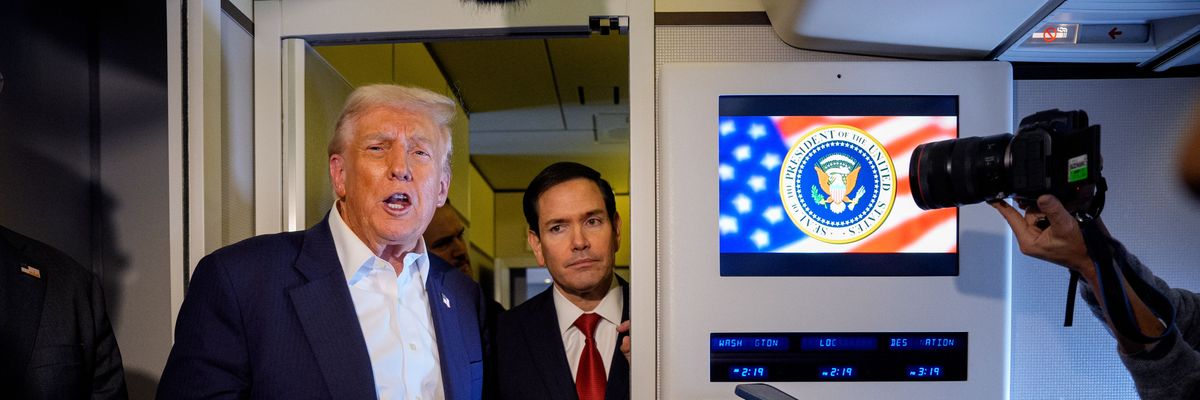
US President Donald Trump, accompanied by Secretary of State Marco Rubio, speaks to members of the media aboard Air Force One on October 27, 2025.
"It should come as no surprise by now that the president who campaigned on keeping the US out of wars and then promptly bombed Iran has now found another conflict in which to embroil the country."
New survey results show that Americans strongly oppose US military action against Venezuela as the Trump administration privately weighs options for land strikes against the South American country—as well as possible covert action targeting the government of President Nicolás Maduro.
The CBS News/YouGov survey, published on Sunday, found that 70% of Americans—including 91% of Democrats and 42% of Republicans—are against the "US taking military action in Venezuela," and a majority don't believe a direct attack on Venezuela would even achieve the Trump administration's stated goal of reducing the flow of drugs to the United States.
The poll also found that a slim majority, 53%, support "using military force to attack boats suspected of bringing drugs into" the US, even as human rights groups and United Nations experts say such attacks—which have killed more than 80 people since early September—are grave violations of US and international law.
The survey data came amid reports that the Trump administration is set to launch "a potentially deadly new phase" of its campaign against Maduro's government, which has responded to the US president's threats and military buildup in the Caribbean with a large mobilization of troops and weaponry.
Citing two unnamed US officials, Reuters reported on Sunday that "covert operations would likely be the first part of the new action against Maduro." The outlet quoted one anonymous official as saying Trump is "prepared to use every element of American power" to achieve his stated goals in the region.
On Monday, as the New York Times reported, the chairman of the US Joint Chiefs of Staff is set to visit "Puerto Rico and one of the several Navy warships dispatched to the Caribbean Sea to combat drug trafficking as the Trump administration weighs the possibility of a broader military campaign against Venezuela."
Gen. Dan Caine, the top US military officer, has "been a major architect of what the Pentagon calls Operation Southern Spear, the largest buildup of American naval forces in the Caribbean since the Cuban Missile Crisis and the blockade of Cuba in 1962," the Times added.
Also on Monday, the Trump administration formally designated Maduro and top officials in his government members of a foreign terrorist organization, a move that the White House believes expands US military options in Venezuela.
While polling data has consistently shown that the US public opposes military intervention in Venezuela by significant margins, Republicans in Congress have thus far blocked action to prevent the Trump administration from attacking the country and bombing vessels in international waters without lawmakers' approval.
Al Jazeera columnist Belén Fernández wrote Sunday that "it should come as no surprise by now that the president who campaigned on keeping the US out of wars and then promptly bombed Iran has now found another conflict in which to embroil the country."
"And as is par for the course in US imperial belligerence, the rationale for aggression against Venezuela doesn’t hold water," Fernández added. "For example, the Trump administration has strived to pin the blame for the fentanyl crisis in the US on Maduro. But there’s a slight problem—which is that Venezuela doesn’t even produce the synthetic opioid in question."
Late last week, a group of House Democrats led by Seth Moulton of Massachusetts announced a new legislative effort aimed at preventing the Trump administration from attacking Venezuela without congressional authorization.
The bill, titled the No Unauthorized Force in Venezuela Act, would bar the White House from spending federal funds on military action against Venezuela absent specific congressional approval.
"We owe our service members clarity, legality, and leadership—not threats, not chaos, and not another unnecessary conflict," said Moulton. "This legislation draws the line the president refuses to draw. It protects our troops, reasserts Congress' constitutional role, and ensures we do not sleepwalk into another ill-advised war."
This country and this world are at a monumental crossroads. US voters have an opportunity to beat back the forces of fascism and confront the billionaires who are rigging the economy, our media system, and our democracy, making it increasingly impossible for ordinary people to get by. We’re not just talking about the election. We’re talking about what must be done once these fascist elements are vanquished from power. We need a bolder set of solutions than what either major party has so far been willing to offer and a working-class movement ready to fight like hell for it. Trump didn't emerge from nowhere. The conditions that fueled MAGA authoritarianism were created by decades of radical neoliberal economic policies and a corrupt political system dominated by corporate interests. They slashed taxes on the super-rich, promising that the benefits would trickle down. They said giveaways to the corporate titans would make life more affordable for the rest of us. It was all bullshit. And when a bitter, betrayed populace searches for someone to blame, right-wing demagogues have little trouble finding scapegoats. People know when they're being lied to, but you won't hear any of this from the corporate media. Only independent journalism—powered and funded by people who believe in building a better world—can deliver truly trustworthy daily news. If you share our vision, please contribute whatever you can to sustain our work. |
New survey results show that Americans strongly oppose US military action against Venezuela as the Trump administration privately weighs options for land strikes against the South American country—as well as possible covert action targeting the government of President Nicolás Maduro.
The CBS News/YouGov survey, published on Sunday, found that 70% of Americans—including 91% of Democrats and 42% of Republicans—are against the "US taking military action in Venezuela," and a majority don't believe a direct attack on Venezuela would even achieve the Trump administration's stated goal of reducing the flow of drugs to the United States.
The poll also found that a slim majority, 53%, support "using military force to attack boats suspected of bringing drugs into" the US, even as human rights groups and United Nations experts say such attacks—which have killed more than 80 people since early September—are grave violations of US and international law.
The survey data came amid reports that the Trump administration is set to launch "a potentially deadly new phase" of its campaign against Maduro's government, which has responded to the US president's threats and military buildup in the Caribbean with a large mobilization of troops and weaponry.
Citing two unnamed US officials, Reuters reported on Sunday that "covert operations would likely be the first part of the new action against Maduro." The outlet quoted one anonymous official as saying Trump is "prepared to use every element of American power" to achieve his stated goals in the region.
On Monday, as the New York Times reported, the chairman of the US Joint Chiefs of Staff is set to visit "Puerto Rico and one of the several Navy warships dispatched to the Caribbean Sea to combat drug trafficking as the Trump administration weighs the possibility of a broader military campaign against Venezuela."
Gen. Dan Caine, the top US military officer, has "been a major architect of what the Pentagon calls Operation Southern Spear, the largest buildup of American naval forces in the Caribbean since the Cuban Missile Crisis and the blockade of Cuba in 1962," the Times added.
Also on Monday, the Trump administration formally designated Maduro and top officials in his government members of a foreign terrorist organization, a move that the White House believes expands US military options in Venezuela.
While polling data has consistently shown that the US public opposes military intervention in Venezuela by significant margins, Republicans in Congress have thus far blocked action to prevent the Trump administration from attacking the country and bombing vessels in international waters without lawmakers' approval.
Al Jazeera columnist Belén Fernández wrote Sunday that "it should come as no surprise by now that the president who campaigned on keeping the US out of wars and then promptly bombed Iran has now found another conflict in which to embroil the country."
"And as is par for the course in US imperial belligerence, the rationale for aggression against Venezuela doesn’t hold water," Fernández added. "For example, the Trump administration has strived to pin the blame for the fentanyl crisis in the US on Maduro. But there’s a slight problem—which is that Venezuela doesn’t even produce the synthetic opioid in question."
Late last week, a group of House Democrats led by Seth Moulton of Massachusetts announced a new legislative effort aimed at preventing the Trump administration from attacking Venezuela without congressional authorization.
The bill, titled the No Unauthorized Force in Venezuela Act, would bar the White House from spending federal funds on military action against Venezuela absent specific congressional approval.
"We owe our service members clarity, legality, and leadership—not threats, not chaos, and not another unnecessary conflict," said Moulton. "This legislation draws the line the president refuses to draw. It protects our troops, reasserts Congress' constitutional role, and ensures we do not sleepwalk into another ill-advised war."

