SUBSCRIBE TO OUR FREE NEWSLETTER
Daily news & progressive opinion—funded by the people, not the corporations—delivered straight to your inbox.
5
#000000
#FFFFFF
To donate by check, phone, or other method, see our More Ways to Give page.
Daily news & progressive opinion—funded by the people, not the corporations—delivered straight to your inbox.
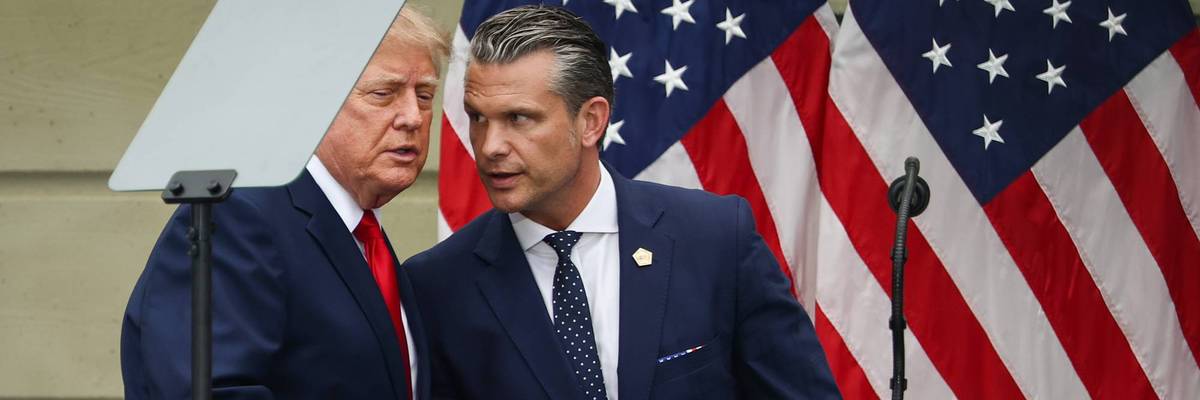
US President Donald Trump shakes hands with Defense Secretary Pete Hegseth during a ceremony commemorating the anniversary of the September 11th terrorist attacks September 11, 2026 in Arlington, Virginia.
"Even in countries where the presidents are supportive of Trump, they still face domestic political and legal constraints on US military actions in their territory," said one expert.
President Donald Trump's hopes for deploying the US military in Latin America to battle drug cartels has run into a major roadblock.
The New York Times reported on Wednesday that right-wing Colombian President Abelardo De La Espriella told US officials this week that he will not agree to a plan floated by the Trump administration of joint military operations in his country.
While De La Espriella has been sympathetic to Trump's desire to launch military strikes on cartels, he said that he did not have enough votes in the legislature to approve an agreement that would put US troops on Colombian soil, according to the Times.
"Despite the setback, cooperation between the two countries remains strong," the Times added. "The United States and Colombia recently completed a major training exercise. And last week, Gen. Dan Caine, the chairman of the Joint Chiefs of Staff, met in Bogotá with top Colombia military leaders."
US Defense Secretary Pete Hegseth visited Bogotá on Wednesday to discuss military cooperation.
Brian Finucane, a former State Department lawyer who now advises the US Program at the International Crisis Group, told the Times that the joint military operations would have been an expansion of the Trump administration's campaign of bombing suspected drug boats in international waters, which many legal experts have said are acts of murder.
"Since the boat strikes began, the Trump administration has signaled a desire for land strikes," Finucane explained. "Colombia shows that even in countries where the presidents are supportive of Trump, they still face domestic political and legal constraints on US military actions in their territory."
Colombia's rejection of Trump's plan, Finucane added, shows the administration isn't "going to have a free hand to do strikes willy-nilly in the territory of other states."
Some Trump administration officials, including White House Chief of Staff Stephen Miller, have reportedly been pushing for the president to launch US military incursions into Mexico to target cartels, even over the objections of its government.
This country and this world are at a monumental crossroads. US voters have an opportunity to beat back the forces of fascism and confront the billionaires who are rigging the economy, our media system, and our democracy, making it increasingly impossible for ordinary people to get by. We’re not just talking about the election. We’re talking about what must be done once these fascist elements are vanquished from power. We need a bolder set of solutions than what either major party has so far been willing to offer and a working-class movement ready to fight like hell for it. Trump didn't emerge from nowhere. The conditions that fueled MAGA authoritarianism were created by decades of radical neoliberal economic policies and a corrupt political system dominated by corporate interests. They slashed taxes on the super-rich, promising that the benefits would trickle down. They said giveaways to the corporate titans would make life more affordable for the rest of us. It was all bullshit. And when a bitter, betrayed populace searches for someone to blame, right-wing demagogues have little trouble finding scapegoats. People know when they're being lied to, but you won't hear any of this from the corporate media. Only independent journalism—powered and funded by people who believe in building a better world—can deliver truly trustworthy daily news. If you share our vision, please contribute whatever you can to sustain our work. |
President Donald Trump's hopes for deploying the US military in Latin America to battle drug cartels has run into a major roadblock.
The New York Times reported on Wednesday that right-wing Colombian President Abelardo De La Espriella told US officials this week that he will not agree to a plan floated by the Trump administration of joint military operations in his country.
While De La Espriella has been sympathetic to Trump's desire to launch military strikes on cartels, he said that he did not have enough votes in the legislature to approve an agreement that would put US troops on Colombian soil, according to the Times.
"Despite the setback, cooperation between the two countries remains strong," the Times added. "The United States and Colombia recently completed a major training exercise. And last week, Gen. Dan Caine, the chairman of the Joint Chiefs of Staff, met in Bogotá with top Colombia military leaders."
US Defense Secretary Pete Hegseth visited Bogotá on Wednesday to discuss military cooperation.
Brian Finucane, a former State Department lawyer who now advises the US Program at the International Crisis Group, told the Times that the joint military operations would have been an expansion of the Trump administration's campaign of bombing suspected drug boats in international waters, which many legal experts have said are acts of murder.
"Since the boat strikes began, the Trump administration has signaled a desire for land strikes," Finucane explained. "Colombia shows that even in countries where the presidents are supportive of Trump, they still face domestic political and legal constraints on US military actions in their territory."
Colombia's rejection of Trump's plan, Finucane added, shows the administration isn't "going to have a free hand to do strikes willy-nilly in the territory of other states."
Some Trump administration officials, including White House Chief of Staff Stephen Miller, have reportedly been pushing for the president to launch US military incursions into Mexico to target cartels, even over the objections of its government.