SUBSCRIBE TO OUR FREE NEWSLETTER
Daily news & progressive opinion—funded by the people, not the corporations—delivered straight to your inbox.
5
#000000
#FFFFFF
To donate by check, phone, or other method, see our More Ways to Give page.
Daily news & progressive opinion—funded by the people, not the corporations—delivered straight to your inbox.
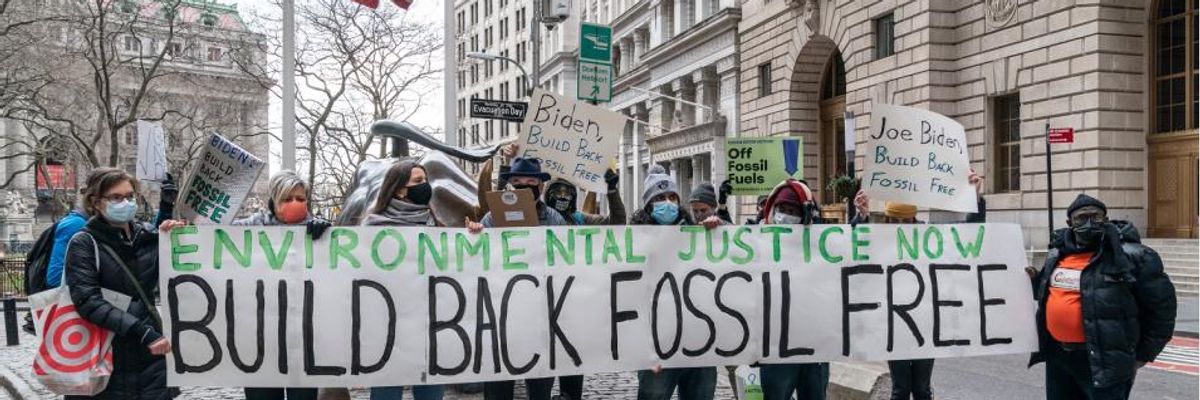
Activists rally on January 19, 2021 in New York City to demand that U.S. President Joe Biden take immediate executive action to "Build Back Fossil Free." (Photo: Lev Radin/Pacific Press/LightRocket via Getty Images)
While President Joe Biden's top climate envoy John Kerry told world leaders at a virtual climate summit that the U.S. will fulfill its commitment to provide financial support to developing countries as they grapple with the deadly consequences of a warming planet, campaigners are urging the U.S. to follow the lead of European Union officials who on Monday pledged to stop subsidizing fossil fuels and instead invest in a just transition toward clean energy.
"Globally, governments are still propping up fossil fuels with huge sums of public money, behavior that is incompatible with keeping global warming below 1.5oC."
--Laurie van der Burg, Oil Change International
"Ending government support for fossil fuels is a no-brainer," Laurie van der Burg of Oil Change International said Monday in a statement responding to the E.U.'s newly stated commitment to phasing out dirty energy subsidies and helping to fund a global push toward renewable energy. "Globally, governments are still propping up fossil fuels with huge sums of public money, behavior that is incompatible with keeping global warming below 1.5oC."
Oil Change International's Collin Rees said that "today's commitment by the E.U. to end overseas investment in oil, gas, and coal projects is yet another indication that the fossil fuel era is over. As a new administration takes power in Washington, this is a powerful signal that clean energy is ascendant and that the E.U. stands willing to work with President Biden and others to end all finance for dirty energy."
Noting that Biden "has committed to end fossil fuel subsidies and dirty energy finance," van der Burg pointed out that the U.K. in December "announced an end to their overseas public finance for fossil fuel."
According to van der Burg, "This creates a powerful opportunity for the E.U., U.K., and U.S. to collaborate to finally end government-backed finance for oil, gas, and coal ahead of the U.K.-hosted U.N. climate summit in November."
Rees argued that "Biden should act boldly on his campaign commitments to end finance for dirty energy projects."
"By building on past commitments to end coal finance and extending this to oil and gas," Rees added, "Biden can join the E.U. and U.K. in transforming international finance to address the challenges of the next century, not prop up the remnants of the last century's infrastructure."
Speaking at the Netherlands-hosted Climate Adaptation Summit just days after Biden issued an executive order re-entering the 2015 Paris agreement--the emissions reduction treaty the country had abandoned under former President Donald Trump--Kerry said the U.S. "was 'proud to be back' in the global climate discussion," Reuters reported Monday.
"We intend to make good on our climate finance pledge," Kerry said. According to Reuters, the U.S. "has delivered only $1 billion of the $3 billion it pledged under former President Barack Obama to the U.N. Green Climate Fund, set up to help vulnerable countries transition to clean energy and adapt to a warmer future."
Three billion dollars is a tiny fraction of what impoverished countries will need to shield their populations from the risks of heatwaves, droughts, fires, floods, and other disasters that have intensified as a result of global warming.
According to a U.N. report published earlier this month, developing countries alone will need to spend roughly $70 billion per year to combat the climate crisis, and those annual costs could surge to $140 billion to $300 billion by 2030 and $280 billion to $500 billion by 2050.
Kerry said the Biden administration "also intends to make significant investments in climate action" in the U.S. and abroad, Reuters reported. "He did not give details about those investments, but promised Washington would soon announce a new target for reducing U.S. greenhouse gas emissions that 'meets the urgency of the challenge.'"
Given that the world's most vulnerable people who have done the least to contribute to the climate emergency are likely to bear the brunt of the damage unless drastic steps are taken to transform society, as well as the disproportionate role played by rich nations--and especially the wealthy classes within them--in causing the crisis, climate justice advocates have called on affluent countries that are capable of doing more to step up.
Van der Burg emphasized the importance of wealthy nations taking action domestically--not just in the international arena of climate finance--to drastically reduce emissions and address the root causes of climate disruption.
Although referring specifically to the E.U., her message applies as well to the U.K. and the U.S.: "For effective diplomacy on this issue, the E.U. must take action at home, and close loopholes for continued E.U. support for fossil fuels, including for gas," she said. "For the E.U. to lead this agenda at the international level, it must set the right example and phase out all government support for fossil fuels."
In a letter to Kerry and other world leaders ahead of Monday's climate summit, a group of 3,000 scientists warned that if governments fail to adequately invest in climate change mitigation and adaptation now, "the results will be increasing poverty, water shortages, agricultural losses, and soaring levels of migration with an enormous toll on human life."
Dear Common Dreams reader, It’s been nearly 30 years since I co-founded Common Dreams with my late wife, Lina Newhouser. We had the radical notion that journalism should serve the public good, not corporate profits. It was clear to us from the outset what it would take to build such a project. No paid advertisements. No corporate sponsors. No millionaire publisher telling us what to think or do. Many people said we wouldn't last a year, but we proved those doubters wrong. Together with a tremendous team of journalists and dedicated staff, we built an independent media outlet free from the constraints of profits and corporate control. Our mission has always been simple: To inform. To inspire. To ignite change for the common good. Building Common Dreams was not easy. Our survival was never guaranteed. When you take on the most powerful forces—Wall Street greed, fossil fuel industry destruction, Big Tech lobbyists, and uber-rich oligarchs who have spent billions upon billions rigging the economy and democracy in their favor—the only bulwark you have is supporters who believe in your work. But here’s the urgent message from me today. It's never been this bad out there. And it's never been this hard to keep us going. At the very moment Common Dreams is most needed, the threats we face are intensifying. We need your support now more than ever. We don't accept corporate advertising and never will. We don't have a paywall because we don't think people should be blocked from critical news based on their ability to pay. Everything we do is funded by the donations of readers like you. When everyone does the little they can afford, we are strong. But if that support retreats or dries up, so do we. Will you donate now to make sure Common Dreams not only survives but thrives? —Craig Brown, Co-founder |
While President Joe Biden's top climate envoy John Kerry told world leaders at a virtual climate summit that the U.S. will fulfill its commitment to provide financial support to developing countries as they grapple with the deadly consequences of a warming planet, campaigners are urging the U.S. to follow the lead of European Union officials who on Monday pledged to stop subsidizing fossil fuels and instead invest in a just transition toward clean energy.
"Globally, governments are still propping up fossil fuels with huge sums of public money, behavior that is incompatible with keeping global warming below 1.5oC."
--Laurie van der Burg, Oil Change International
"Ending government support for fossil fuels is a no-brainer," Laurie van der Burg of Oil Change International said Monday in a statement responding to the E.U.'s newly stated commitment to phasing out dirty energy subsidies and helping to fund a global push toward renewable energy. "Globally, governments are still propping up fossil fuels with huge sums of public money, behavior that is incompatible with keeping global warming below 1.5oC."
Oil Change International's Collin Rees said that "today's commitment by the E.U. to end overseas investment in oil, gas, and coal projects is yet another indication that the fossil fuel era is over. As a new administration takes power in Washington, this is a powerful signal that clean energy is ascendant and that the E.U. stands willing to work with President Biden and others to end all finance for dirty energy."
Noting that Biden "has committed to end fossil fuel subsidies and dirty energy finance," van der Burg pointed out that the U.K. in December "announced an end to their overseas public finance for fossil fuel."
According to van der Burg, "This creates a powerful opportunity for the E.U., U.K., and U.S. to collaborate to finally end government-backed finance for oil, gas, and coal ahead of the U.K.-hosted U.N. climate summit in November."
Rees argued that "Biden should act boldly on his campaign commitments to end finance for dirty energy projects."
"By building on past commitments to end coal finance and extending this to oil and gas," Rees added, "Biden can join the E.U. and U.K. in transforming international finance to address the challenges of the next century, not prop up the remnants of the last century's infrastructure."
Speaking at the Netherlands-hosted Climate Adaptation Summit just days after Biden issued an executive order re-entering the 2015 Paris agreement--the emissions reduction treaty the country had abandoned under former President Donald Trump--Kerry said the U.S. "was 'proud to be back' in the global climate discussion," Reuters reported Monday.
"We intend to make good on our climate finance pledge," Kerry said. According to Reuters, the U.S. "has delivered only $1 billion of the $3 billion it pledged under former President Barack Obama to the U.N. Green Climate Fund, set up to help vulnerable countries transition to clean energy and adapt to a warmer future."
Three billion dollars is a tiny fraction of what impoverished countries will need to shield their populations from the risks of heatwaves, droughts, fires, floods, and other disasters that have intensified as a result of global warming.
According to a U.N. report published earlier this month, developing countries alone will need to spend roughly $70 billion per year to combat the climate crisis, and those annual costs could surge to $140 billion to $300 billion by 2030 and $280 billion to $500 billion by 2050.
Kerry said the Biden administration "also intends to make significant investments in climate action" in the U.S. and abroad, Reuters reported. "He did not give details about those investments, but promised Washington would soon announce a new target for reducing U.S. greenhouse gas emissions that 'meets the urgency of the challenge.'"
Given that the world's most vulnerable people who have done the least to contribute to the climate emergency are likely to bear the brunt of the damage unless drastic steps are taken to transform society, as well as the disproportionate role played by rich nations--and especially the wealthy classes within them--in causing the crisis, climate justice advocates have called on affluent countries that are capable of doing more to step up.
Van der Burg emphasized the importance of wealthy nations taking action domestically--not just in the international arena of climate finance--to drastically reduce emissions and address the root causes of climate disruption.
Although referring specifically to the E.U., her message applies as well to the U.K. and the U.S.: "For effective diplomacy on this issue, the E.U. must take action at home, and close loopholes for continued E.U. support for fossil fuels, including for gas," she said. "For the E.U. to lead this agenda at the international level, it must set the right example and phase out all government support for fossil fuels."
In a letter to Kerry and other world leaders ahead of Monday's climate summit, a group of 3,000 scientists warned that if governments fail to adequately invest in climate change mitigation and adaptation now, "the results will be increasing poverty, water shortages, agricultural losses, and soaring levels of migration with an enormous toll on human life."
While President Joe Biden's top climate envoy John Kerry told world leaders at a virtual climate summit that the U.S. will fulfill its commitment to provide financial support to developing countries as they grapple with the deadly consequences of a warming planet, campaigners are urging the U.S. to follow the lead of European Union officials who on Monday pledged to stop subsidizing fossil fuels and instead invest in a just transition toward clean energy.
"Globally, governments are still propping up fossil fuels with huge sums of public money, behavior that is incompatible with keeping global warming below 1.5oC."
--Laurie van der Burg, Oil Change International
"Ending government support for fossil fuels is a no-brainer," Laurie van der Burg of Oil Change International said Monday in a statement responding to the E.U.'s newly stated commitment to phasing out dirty energy subsidies and helping to fund a global push toward renewable energy. "Globally, governments are still propping up fossil fuels with huge sums of public money, behavior that is incompatible with keeping global warming below 1.5oC."
Oil Change International's Collin Rees said that "today's commitment by the E.U. to end overseas investment in oil, gas, and coal projects is yet another indication that the fossil fuel era is over. As a new administration takes power in Washington, this is a powerful signal that clean energy is ascendant and that the E.U. stands willing to work with President Biden and others to end all finance for dirty energy."
Noting that Biden "has committed to end fossil fuel subsidies and dirty energy finance," van der Burg pointed out that the U.K. in December "announced an end to their overseas public finance for fossil fuel."
According to van der Burg, "This creates a powerful opportunity for the E.U., U.K., and U.S. to collaborate to finally end government-backed finance for oil, gas, and coal ahead of the U.K.-hosted U.N. climate summit in November."
Rees argued that "Biden should act boldly on his campaign commitments to end finance for dirty energy projects."
"By building on past commitments to end coal finance and extending this to oil and gas," Rees added, "Biden can join the E.U. and U.K. in transforming international finance to address the challenges of the next century, not prop up the remnants of the last century's infrastructure."
Speaking at the Netherlands-hosted Climate Adaptation Summit just days after Biden issued an executive order re-entering the 2015 Paris agreement--the emissions reduction treaty the country had abandoned under former President Donald Trump--Kerry said the U.S. "was 'proud to be back' in the global climate discussion," Reuters reported Monday.
"We intend to make good on our climate finance pledge," Kerry said. According to Reuters, the U.S. "has delivered only $1 billion of the $3 billion it pledged under former President Barack Obama to the U.N. Green Climate Fund, set up to help vulnerable countries transition to clean energy and adapt to a warmer future."
Three billion dollars is a tiny fraction of what impoverished countries will need to shield their populations from the risks of heatwaves, droughts, fires, floods, and other disasters that have intensified as a result of global warming.
According to a U.N. report published earlier this month, developing countries alone will need to spend roughly $70 billion per year to combat the climate crisis, and those annual costs could surge to $140 billion to $300 billion by 2030 and $280 billion to $500 billion by 2050.
Kerry said the Biden administration "also intends to make significant investments in climate action" in the U.S. and abroad, Reuters reported. "He did not give details about those investments, but promised Washington would soon announce a new target for reducing U.S. greenhouse gas emissions that 'meets the urgency of the challenge.'"
Given that the world's most vulnerable people who have done the least to contribute to the climate emergency are likely to bear the brunt of the damage unless drastic steps are taken to transform society, as well as the disproportionate role played by rich nations--and especially the wealthy classes within them--in causing the crisis, climate justice advocates have called on affluent countries that are capable of doing more to step up.
Van der Burg emphasized the importance of wealthy nations taking action domestically--not just in the international arena of climate finance--to drastically reduce emissions and address the root causes of climate disruption.
Although referring specifically to the E.U., her message applies as well to the U.K. and the U.S.: "For effective diplomacy on this issue, the E.U. must take action at home, and close loopholes for continued E.U. support for fossil fuels, including for gas," she said. "For the E.U. to lead this agenda at the international level, it must set the right example and phase out all government support for fossil fuels."
In a letter to Kerry and other world leaders ahead of Monday's climate summit, a group of 3,000 scientists warned that if governments fail to adequately invest in climate change mitigation and adaptation now, "the results will be increasing poverty, water shortages, agricultural losses, and soaring levels of migration with an enormous toll on human life."