
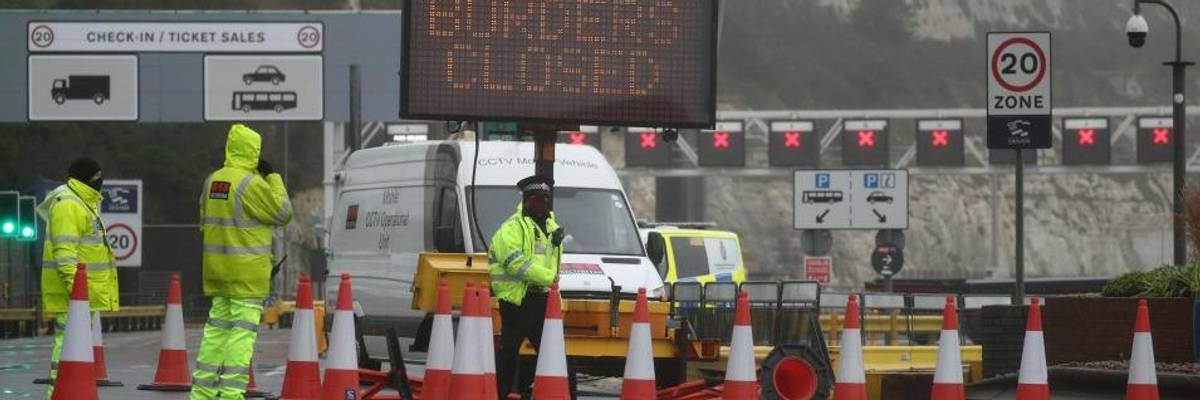
Police and port staff on December 21, 2020 at the Port of Dover in Kent, United Kingdom, which has been closed after the French government's announcement it will not accept any passengers arriving from the U.K. for the next 48 hours amid fears over the new mutant coronavirus strain. (Photo: Steve Parsons/PA Images via Getty Images)
With New Covid-19 Strain 70% More Transmissible, Nations Rush to Contain Spread From UK
"Scientists should watch and worry, yes, but the rest of us need not panic."
British government officials met on Monday to discuss the implications of strict new travel restrictions imposed by several countries, following reports of a highly virulent new strain of the coronavirus, which is driving a rapid spread of Covid-19 infections in the London area according to Prime Minister Boris Johnson.
Experts say the new strain does not appear to be more deadly than the novel coronavirus first detected in November 2019, and that they have no reason to believe the new vaccines developed by Pfizer, BioNTech, Moderna will not work against the mutation.
"The take-home message for right now is that we need to get more information. In the meantime, we all need to really double down on our public health measures--wearing masks, remaining physically distanced, avoiding crowds of people."
--Dr. Krutika Kuppalli
Because the strain--which has been named B.1.1.7. and appears to be 70% more transmissible--has been linked to an increase in hospitalizations in the U.K., nations are racing to shut down travel from Britain.
New York Gov. Andrew Cuomo on Sunday called on the Trump administration to suspend all flights from the U.K. to New York City, saying that while the mutation has not yet been detected in the U.S., it could currently be "getting on a plane and flying to J.F.K."
French officials on Monday announced it would not allow delivery trucks to travel from the U.K. to France for 48 hours while experts gather information. Canada, India, Germany, Italy, Spain, and Poland have also suspended flights from the U.K., and Eurotunnel is temporarily halting outbound train service from Britain.
France's truck ban raised some alarm in Britain over the supply chain, as much of the U.K.'s produce at this time of year are imported. Although French trucks are still permitted to enter the U.K., Johnson called an emergency meeting to discuss "the steady flow of freight into and out of the U.K.," a spokesperson told CNN.
"Further meetings are happening this evening and tomorrow morning to ensure robust plans are in place," the spokesperson said.
According to the European Center for Disease Prevention and Control, a small number of cases of the new coronavirus variant have been detected in Iceland, Denmark, the Netherlands, Belgium, and Italy. South African authorities on Sunday said 80 to 90% of coronavirus samples analyzed since mid-November have shown strains similar to the variant found in the London area.
Public health experts said that amid the news of a new strain, people in all countries simply to continue vigilantly following public health guidelines including wearing face masks, social distancing, and avoiding crowded places.
"Scientists should watch and worry, yes, but the rest of us need not panic," tweeted New York Times reported Apoorva Mandavilli, who interviewed several experts about the new strain over the weekend.
"The take-home message for right now is that we need to get more information," Dr. Krutika Kuppalli, an infectious-diseases specialist at the Medical University of South Carolina, told the Washington Post. "In the meantime, we all need to really double down on our public health measures--wearing masks, remaining physically distanced, avoiding crowds of people."
European countries are reportedly moving ahead with their plans to roll out the new vaccines, with Germany and others planning to begin inoculating their populations on December 27.
We are at a crossroads
This country and this world are at a monumental crossroads. In a few short weeks, US voters will have an opportunity to beat back the forces of fascism and confront the billionaires who are rigging the economy, our media system, and our democracy, making it increasingly impossible for ordinary people to get by. We’re not just talking about the election. We’re talking about what must be done once these fascist elements are vanquished from power. We need a bolder set of solutions than what either major party has so far been willing to offer and a working-class movement ready to fight like hell for it. Trump didn't emerge from nowhere. The conditions that fueled MAGA authoritarianism were created by decades of radical neoliberal economic policies and a corrupt political system dominated by corporate interests. They slashed taxes on the super-rich, promising that the benefits would trickle down. They said giveaways to the corporate titans would make life more affordable for the rest of us. It was all bullshit. And when a bitter, betrayed populace searches for someone to blame, right-wing demagogues have little trouble finding scapegoats. People know when they're being lied to, but you won't hear any of this from the corporate media. Only independent journalism—powered and funded by people who believe in building a better world—can deliver truly trustworthy daily news. Our Fall Campaign is underway, and we need your help. To power our newsroom through the rest of the year, we need to raise $125,000 by midnight on October 31. So if you share our vision, please contribute whatever you can to sustain our work. |
British government officials met on Monday to discuss the implications of strict new travel restrictions imposed by several countries, following reports of a highly virulent new strain of the coronavirus, which is driving a rapid spread of Covid-19 infections in the London area according to Prime Minister Boris Johnson.
Experts say the new strain does not appear to be more deadly than the novel coronavirus first detected in November 2019, and that they have no reason to believe the new vaccines developed by Pfizer, BioNTech, Moderna will not work against the mutation.
"The take-home message for right now is that we need to get more information. In the meantime, we all need to really double down on our public health measures--wearing masks, remaining physically distanced, avoiding crowds of people."
--Dr. Krutika Kuppalli
Because the strain--which has been named B.1.1.7. and appears to be 70% more transmissible--has been linked to an increase in hospitalizations in the U.K., nations are racing to shut down travel from Britain.
New York Gov. Andrew Cuomo on Sunday called on the Trump administration to suspend all flights from the U.K. to New York City, saying that while the mutation has not yet been detected in the U.S., it could currently be "getting on a plane and flying to J.F.K."
French officials on Monday announced it would not allow delivery trucks to travel from the U.K. to France for 48 hours while experts gather information. Canada, India, Germany, Italy, Spain, and Poland have also suspended flights from the U.K., and Eurotunnel is temporarily halting outbound train service from Britain.
France's truck ban raised some alarm in Britain over the supply chain, as much of the U.K.'s produce at this time of year are imported. Although French trucks are still permitted to enter the U.K., Johnson called an emergency meeting to discuss "the steady flow of freight into and out of the U.K.," a spokesperson told CNN.
"Further meetings are happening this evening and tomorrow morning to ensure robust plans are in place," the spokesperson said.
According to the European Center for Disease Prevention and Control, a small number of cases of the new coronavirus variant have been detected in Iceland, Denmark, the Netherlands, Belgium, and Italy. South African authorities on Sunday said 80 to 90% of coronavirus samples analyzed since mid-November have shown strains similar to the variant found in the London area.
Public health experts said that amid the news of a new strain, people in all countries simply to continue vigilantly following public health guidelines including wearing face masks, social distancing, and avoiding crowded places.
"Scientists should watch and worry, yes, but the rest of us need not panic," tweeted New York Times reported Apoorva Mandavilli, who interviewed several experts about the new strain over the weekend.
"The take-home message for right now is that we need to get more information," Dr. Krutika Kuppalli, an infectious-diseases specialist at the Medical University of South Carolina, told the Washington Post. "In the meantime, we all need to really double down on our public health measures--wearing masks, remaining physically distanced, avoiding crowds of people."
European countries are reportedly moving ahead with their plans to roll out the new vaccines, with Germany and others planning to begin inoculating their populations on December 27.