

SUBSCRIBE TO OUR FREE NEWSLETTER
Daily news & progressive opinion—funded by the people, not the corporations—delivered straight to your inbox.
5
#000000
#FFFFFF
To donate by check, phone, or other method, see our More Ways to Give page.
Daily news & progressive opinion—funded by the people, not the corporations—delivered straight to your inbox.
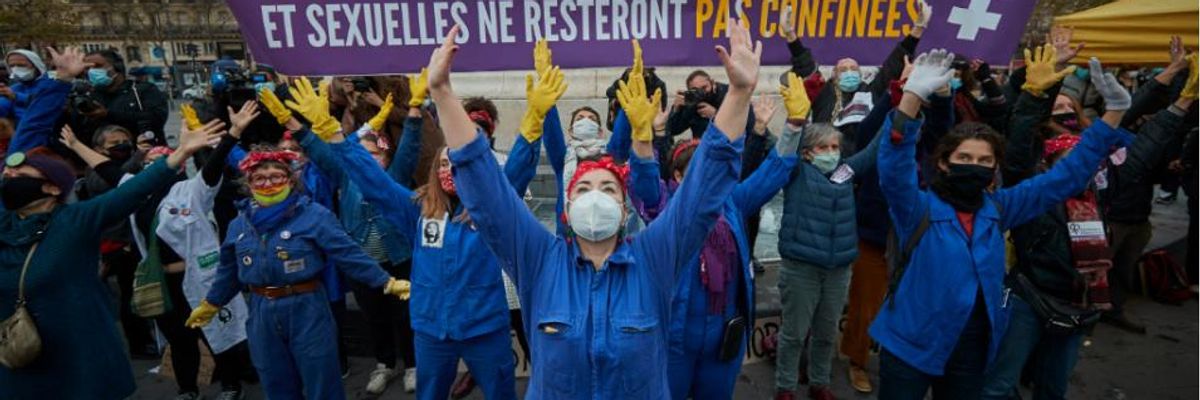
Women gather at Place de la Republique to mark the 20th International Day for the Elimination of Violence Against Women on November 25, 2020 in Paris, displaying a sign that reads, "The struggles against gender and sexual violence will not remain confined." Since the outbreak of Covid-19, charities and agencies have warned that all types of violence against women and girls has intensified, particularly domestic violence, straining services as shelters and helplines reach capacity. (Photo: Kiran Ridley/Getty Images)
Activists and policymakers around the world on Wednesday marked the International Day for the Elimination of Violence Against Women and kicked off 16 days of activism against gender-based violence, with advocates holding rallies as global leaders took steps toward fighting what many have called the "shadow pandemic" of violence against women.
The rallies were held as experts reiterated warnings that were first issued when economic shutdowns began in many countries around the world due to the coronavirus pandemic: As many families have been largely confined to their homes this year to mitigate the spread of Covid-19, reports of violence by men against women have skyrocketed.
"Because of the restrictions, we involuntarily created profound distress" for women suffering abuse from their intimate partners or other family members, Italian Prime Minister Giuseppe Conte told members of the country's Parliament on Wednesday.
Italy had one of the world's first major outbreaks of Covid-19 earlier this year, forcing officials to impose a near-total national lockdown for 10 weeks beginning in March. The Italian Health Ministry told the Associated Press that calls to domestic abuse hotlines skyrocketed by 75% during the lockdown compared to the same period the previous year. Earlier this month, the country was forced to introduce restrictions targeting four regions, raising the possibility of another uptick in violence at home.
Conte joined Spanish Prime Minister Pedro Sanchez in signing a joint declaration calling for more resources to be devoted to fighting violence against women, while protesters rallied in countries including France and Guatemala.
Indian social justice activist Abdul Hameed Lone recognized a demonstration held by a group of men in Kashmir, India.
In the U.S., Rep. Katie Porter (D-Calif.) and Vanita Gupta, president of the Leadership Conference on Civil and Human Rights, were among those who drew attention to the country's failure to protect women from violence, and pointed to the Republican-led Senate's refusal to pass legislation reauthorizing the Violence Against Women Act for more than a year.
While gender-based violence often goes unreported, officials around the world suggested Wednesday that the uptick in violence during Italy's Covid-19 lockdown was not an anomaly.
French Minister for Equal Rights Elisabeth Moreno told the AP that reports of violence against women rose 42% last spring during the country's first shutdown, and have now gone up 15% since a new lockdown began in recent weeks. The British Office for National Statistics said that between March and June, 18% more domestic abuse offenses were recorded than in the same period in 2018.
Earlier this week, the U.K.-based Femicide Census released its annual report, showing the number of women killed in gender-based violence in Britain each year between 2010 and 2018. In 2018, 154 women were killed due to their gender in the country--the third-highest number recorded by the group.
"Men's violence against women is also a pandemic--one that pre-dates the virus and will outlive it," Phumzile Mlambo-Ngcuka, executive director of the U.N. Women agency, told the AP. "Last year alone, 243 million women and girls experienced sexual or physical violence from their partner. This year, reports of increased domestic violence, cyberbullying, child marriages, sexual harassment, and sexual violence have flooded in."
The U.N. announced on Wednesday it will commit $25 billion from its emergency fund to fight what the International Rescue Committee called a "shadow pandemic" last month--gender-based violence against women who have been affected by conflict and disasters. The money will be divided between the U.N. Population Fund and U.N. Women, and at least 30% must go to local organizations that prevent violence and support survivors.
In the 12 months before the coronavirus crisis, U.N. Women says, 243 million women and girls were sexually or physically abused by an intimate partner--yet in 2018, less than 0.3% of aid from the world's 14 largest charitable donors went to addressing gender-based violence.
This country and this world are at a monumental crossroads. US voters have an opportunity to beat back the forces of fascism and confront the billionaires who are rigging the economy, our media system, and our democracy, making it increasingly impossible for ordinary people to get by. We’re not just talking about the election. We’re talking about what must be done once these fascist elements are vanquished from power. We need a bolder set of solutions than what either major party has so far been willing to offer and a working-class movement ready to fight like hell for it. Trump didn't emerge from nowhere. The conditions that fueled MAGA authoritarianism were created by decades of radical neoliberal economic policies and a corrupt political system dominated by corporate interests. They slashed taxes on the super-rich, promising that the benefits would trickle down. They said giveaways to the corporate titans would make life more affordable for the rest of us. It was all bullshit. And when a bitter, betrayed populace searches for someone to blame, right-wing demagogues have little trouble finding scapegoats. People know when they're being lied to, but you won't hear any of this from the corporate media. Only independent journalism—powered and funded by people who believe in building a better world—can deliver truly trustworthy daily news. If you share our vision, please contribute whatever you can to sustain our work. |
Activists and policymakers around the world on Wednesday marked the International Day for the Elimination of Violence Against Women and kicked off 16 days of activism against gender-based violence, with advocates holding rallies as global leaders took steps toward fighting what many have called the "shadow pandemic" of violence against women.
The rallies were held as experts reiterated warnings that were first issued when economic shutdowns began in many countries around the world due to the coronavirus pandemic: As many families have been largely confined to their homes this year to mitigate the spread of Covid-19, reports of violence by men against women have skyrocketed.
"Because of the restrictions, we involuntarily created profound distress" for women suffering abuse from their intimate partners or other family members, Italian Prime Minister Giuseppe Conte told members of the country's Parliament on Wednesday.
Italy had one of the world's first major outbreaks of Covid-19 earlier this year, forcing officials to impose a near-total national lockdown for 10 weeks beginning in March. The Italian Health Ministry told the Associated Press that calls to domestic abuse hotlines skyrocketed by 75% during the lockdown compared to the same period the previous year. Earlier this month, the country was forced to introduce restrictions targeting four regions, raising the possibility of another uptick in violence at home.
Conte joined Spanish Prime Minister Pedro Sanchez in signing a joint declaration calling for more resources to be devoted to fighting violence against women, while protesters rallied in countries including France and Guatemala.
Indian social justice activist Abdul Hameed Lone recognized a demonstration held by a group of men in Kashmir, India.
In the U.S., Rep. Katie Porter (D-Calif.) and Vanita Gupta, president of the Leadership Conference on Civil and Human Rights, were among those who drew attention to the country's failure to protect women from violence, and pointed to the Republican-led Senate's refusal to pass legislation reauthorizing the Violence Against Women Act for more than a year.
While gender-based violence often goes unreported, officials around the world suggested Wednesday that the uptick in violence during Italy's Covid-19 lockdown was not an anomaly.
French Minister for Equal Rights Elisabeth Moreno told the AP that reports of violence against women rose 42% last spring during the country's first shutdown, and have now gone up 15% since a new lockdown began in recent weeks. The British Office for National Statistics said that between March and June, 18% more domestic abuse offenses were recorded than in the same period in 2018.
Earlier this week, the U.K.-based Femicide Census released its annual report, showing the number of women killed in gender-based violence in Britain each year between 2010 and 2018. In 2018, 154 women were killed due to their gender in the country--the third-highest number recorded by the group.
"Men's violence against women is also a pandemic--one that pre-dates the virus and will outlive it," Phumzile Mlambo-Ngcuka, executive director of the U.N. Women agency, told the AP. "Last year alone, 243 million women and girls experienced sexual or physical violence from their partner. This year, reports of increased domestic violence, cyberbullying, child marriages, sexual harassment, and sexual violence have flooded in."
The U.N. announced on Wednesday it will commit $25 billion from its emergency fund to fight what the International Rescue Committee called a "shadow pandemic" last month--gender-based violence against women who have been affected by conflict and disasters. The money will be divided between the U.N. Population Fund and U.N. Women, and at least 30% must go to local organizations that prevent violence and support survivors.
In the 12 months before the coronavirus crisis, U.N. Women says, 243 million women and girls were sexually or physically abused by an intimate partner--yet in 2018, less than 0.3% of aid from the world's 14 largest charitable donors went to addressing gender-based violence.

