SUBSCRIBE TO OUR FREE NEWSLETTER
Daily news & progressive opinion—funded by the people, not the corporations—delivered straight to your inbox.
5
#000000
#FFFFFF
To donate by check, phone, or other method, see our More Ways to Give page.
Daily news & progressive opinion—funded by the people, not the corporations—delivered straight to your inbox.
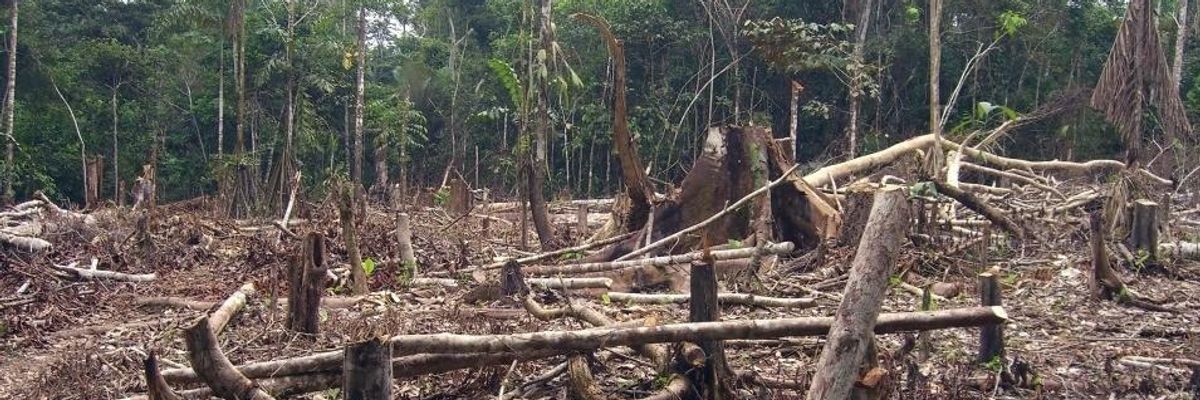
Deforestation is among the human activities which threaten to lead to another, more deadly pandemic, scientists say. (Photo: Matt Zimmerman/flickr/cc)
Warning that without a "seismic shift" in how world governments approach the treatment of wildlife, land conservation, and public health, the planet could be entering an "era of pandemics," a United Nations-backed report released Thursday emphasized that the ability to avoid more public health crises like Covid-19 is entirely within the human population's control.
Resulting from an urgent virtual workshop attended by 22 experts from around the world, the report by the Intergovernmental Science-Policy Platform on Biodiversity and Ecosystem Services notes that more than five new diseases emerge in people each year, and each of these has the potential to develop into a global pandemic as the coronavirus did.
"We have the increasing ability to prevent pandemics--but the way we are tackling them right now largely ignores that ability."
--Dr. Peter Daszak, EcoHealth Alliance
The novel coronavirus has origins in microbes detected in animal species and is believed to have "jumped" from an animal to the human population in Wuhan, China, and human activity has made it dangerously easy for this sort of jump to happen again and again.
Scientists estimate that 1.7 million unknown viruses currently exist in mammals and birds, and that up to 850,000 of them could potentially infect humans.
"There is no great mystery about the cause of the Covid-19 pandemic--or of any modern pandemic," said Dr. Peter Daszak, president of EcoHealth Alliance and chair of the IPBES workshop. "The same human activities that drive climate change and biodiversity loss also drive pandemic risk through their impacts on our environment. Changes in the way we use land; the expansion and intensification of agriculture; and unsustainable trade, production, and consumption disrupt nature and increase contact between wildlife."
To stop a new era of pandemics from emerging, the experts say, governments must work together to stop the exploitation of land and wildlife by profit-driven systems, which cause humans and animals to come into close enough contact for pathogens to jump to humans.
Unsafe contact between humans and wildlife would be reduced by conservation efforts to protect biodiversity and natural habitats, the promotion of "responsible consumption" and a reduction in "excessive consumption of meat from livestock production," and climate action, the report reads.
"Climate change has been implicated in disease emergence (e.g. tick-borne encephalitis in Scandinavia) and will likely cause substantial future pandemic risk by driving movement of people, wildlife, reservoirs, and vectors, and spread of their pathogens, in ways that lead to new contact among species, increased contact among species, or otherwise disrupts natural host-pathogen dynamics," the IPBES wrote.
According to the report, land-use change has been linked to the emergence of more than 30% of new diseases in the human population since 1960.
"Land-use change includes deforestation, human settlement in primarily wildlife habitat, the growth of crop and livestock production, and urbanization," the report reads.
"The solution here seems pretty clear," tweeted Dr. Scott Sampson, executive director of the California Academy of Sciences, in response to the report's section on land-use change.
The study includes a number of suggested reforms which could help to keep pathogens from spreading to humans, including:
The cost of confronting global public health emergencies after they've arrived--including damage to economies around the world, healthcare costs, and vaccine research--is roughly 100 times what it would cost to prevent another pandemic, the IPBES said.
"We have the increasing ability to prevent pandemics--but the way we are tackling them right now largely ignores that ability," said Daszak. "Our approach has effectively stagnated--we still rely on attempts to contain and control diseases after they emerge, through vaccines and therapeutics. We can escape the era of pandemics, but this requires a much greater focus on prevention in addition to reaction."
Dear Common Dreams reader, It’s been nearly 30 years since I co-founded Common Dreams with my late wife, Lina Newhouser. We had the radical notion that journalism should serve the public good, not corporate profits. It was clear to us from the outset what it would take to build such a project. No paid advertisements. No corporate sponsors. No millionaire publisher telling us what to think or do. Many people said we wouldn't last a year, but we proved those doubters wrong. Together with a tremendous team of journalists and dedicated staff, we built an independent media outlet free from the constraints of profits and corporate control. Our mission has always been simple: To inform. To inspire. To ignite change for the common good. Building Common Dreams was not easy. Our survival was never guaranteed. When you take on the most powerful forces—Wall Street greed, fossil fuel industry destruction, Big Tech lobbyists, and uber-rich oligarchs who have spent billions upon billions rigging the economy and democracy in their favor—the only bulwark you have is supporters who believe in your work. But here’s the urgent message from me today. It's never been this bad out there. And it's never been this hard to keep us going. At the very moment Common Dreams is most needed, the threats we face are intensifying. We need your support now more than ever. We don't accept corporate advertising and never will. We don't have a paywall because we don't think people should be blocked from critical news based on their ability to pay. Everything we do is funded by the donations of readers like you. When everyone does the little they can afford, we are strong. But if that support retreats or dries up, so do we. Will you donate now to make sure Common Dreams not only survives but thrives? —Craig Brown, Co-founder |
Warning that without a "seismic shift" in how world governments approach the treatment of wildlife, land conservation, and public health, the planet could be entering an "era of pandemics," a United Nations-backed report released Thursday emphasized that the ability to avoid more public health crises like Covid-19 is entirely within the human population's control.
Resulting from an urgent virtual workshop attended by 22 experts from around the world, the report by the Intergovernmental Science-Policy Platform on Biodiversity and Ecosystem Services notes that more than five new diseases emerge in people each year, and each of these has the potential to develop into a global pandemic as the coronavirus did.
"We have the increasing ability to prevent pandemics--but the way we are tackling them right now largely ignores that ability."
--Dr. Peter Daszak, EcoHealth Alliance
The novel coronavirus has origins in microbes detected in animal species and is believed to have "jumped" from an animal to the human population in Wuhan, China, and human activity has made it dangerously easy for this sort of jump to happen again and again.
Scientists estimate that 1.7 million unknown viruses currently exist in mammals and birds, and that up to 850,000 of them could potentially infect humans.
"There is no great mystery about the cause of the Covid-19 pandemic--or of any modern pandemic," said Dr. Peter Daszak, president of EcoHealth Alliance and chair of the IPBES workshop. "The same human activities that drive climate change and biodiversity loss also drive pandemic risk through their impacts on our environment. Changes in the way we use land; the expansion and intensification of agriculture; and unsustainable trade, production, and consumption disrupt nature and increase contact between wildlife."
To stop a new era of pandemics from emerging, the experts say, governments must work together to stop the exploitation of land and wildlife by profit-driven systems, which cause humans and animals to come into close enough contact for pathogens to jump to humans.
Unsafe contact between humans and wildlife would be reduced by conservation efforts to protect biodiversity and natural habitats, the promotion of "responsible consumption" and a reduction in "excessive consumption of meat from livestock production," and climate action, the report reads.
"Climate change has been implicated in disease emergence (e.g. tick-borne encephalitis in Scandinavia) and will likely cause substantial future pandemic risk by driving movement of people, wildlife, reservoirs, and vectors, and spread of their pathogens, in ways that lead to new contact among species, increased contact among species, or otherwise disrupts natural host-pathogen dynamics," the IPBES wrote.
According to the report, land-use change has been linked to the emergence of more than 30% of new diseases in the human population since 1960.
"Land-use change includes deforestation, human settlement in primarily wildlife habitat, the growth of crop and livestock production, and urbanization," the report reads.
"The solution here seems pretty clear," tweeted Dr. Scott Sampson, executive director of the California Academy of Sciences, in response to the report's section on land-use change.
The study includes a number of suggested reforms which could help to keep pathogens from spreading to humans, including:
The cost of confronting global public health emergencies after they've arrived--including damage to economies around the world, healthcare costs, and vaccine research--is roughly 100 times what it would cost to prevent another pandemic, the IPBES said.
"We have the increasing ability to prevent pandemics--but the way we are tackling them right now largely ignores that ability," said Daszak. "Our approach has effectively stagnated--we still rely on attempts to contain and control diseases after they emerge, through vaccines and therapeutics. We can escape the era of pandemics, but this requires a much greater focus on prevention in addition to reaction."
Warning that without a "seismic shift" in how world governments approach the treatment of wildlife, land conservation, and public health, the planet could be entering an "era of pandemics," a United Nations-backed report released Thursday emphasized that the ability to avoid more public health crises like Covid-19 is entirely within the human population's control.
Resulting from an urgent virtual workshop attended by 22 experts from around the world, the report by the Intergovernmental Science-Policy Platform on Biodiversity and Ecosystem Services notes that more than five new diseases emerge in people each year, and each of these has the potential to develop into a global pandemic as the coronavirus did.
"We have the increasing ability to prevent pandemics--but the way we are tackling them right now largely ignores that ability."
--Dr. Peter Daszak, EcoHealth Alliance
The novel coronavirus has origins in microbes detected in animal species and is believed to have "jumped" from an animal to the human population in Wuhan, China, and human activity has made it dangerously easy for this sort of jump to happen again and again.
Scientists estimate that 1.7 million unknown viruses currently exist in mammals and birds, and that up to 850,000 of them could potentially infect humans.
"There is no great mystery about the cause of the Covid-19 pandemic--or of any modern pandemic," said Dr. Peter Daszak, president of EcoHealth Alliance and chair of the IPBES workshop. "The same human activities that drive climate change and biodiversity loss also drive pandemic risk through their impacts on our environment. Changes in the way we use land; the expansion and intensification of agriculture; and unsustainable trade, production, and consumption disrupt nature and increase contact between wildlife."
To stop a new era of pandemics from emerging, the experts say, governments must work together to stop the exploitation of land and wildlife by profit-driven systems, which cause humans and animals to come into close enough contact for pathogens to jump to humans.
Unsafe contact between humans and wildlife would be reduced by conservation efforts to protect biodiversity and natural habitats, the promotion of "responsible consumption" and a reduction in "excessive consumption of meat from livestock production," and climate action, the report reads.
"Climate change has been implicated in disease emergence (e.g. tick-borne encephalitis in Scandinavia) and will likely cause substantial future pandemic risk by driving movement of people, wildlife, reservoirs, and vectors, and spread of their pathogens, in ways that lead to new contact among species, increased contact among species, or otherwise disrupts natural host-pathogen dynamics," the IPBES wrote.
According to the report, land-use change has been linked to the emergence of more than 30% of new diseases in the human population since 1960.
"Land-use change includes deforestation, human settlement in primarily wildlife habitat, the growth of crop and livestock production, and urbanization," the report reads.
"The solution here seems pretty clear," tweeted Dr. Scott Sampson, executive director of the California Academy of Sciences, in response to the report's section on land-use change.
The study includes a number of suggested reforms which could help to keep pathogens from spreading to humans, including:
The cost of confronting global public health emergencies after they've arrived--including damage to economies around the world, healthcare costs, and vaccine research--is roughly 100 times what it would cost to prevent another pandemic, the IPBES said.
"We have the increasing ability to prevent pandemics--but the way we are tackling them right now largely ignores that ability," said Daszak. "Our approach has effectively stagnated--we still rely on attempts to contain and control diseases after they emerge, through vaccines and therapeutics. We can escape the era of pandemics, but this requires a much greater focus on prevention in addition to reaction."