SUBSCRIBE TO OUR FREE NEWSLETTER
Daily news & progressive opinion—funded by the people, not the corporations—delivered straight to your inbox.
5
#000000
#FFFFFF
To donate by check, phone, or other method, see our More Ways to Give page.
Daily news & progressive opinion—funded by the people, not the corporations—delivered straight to your inbox.
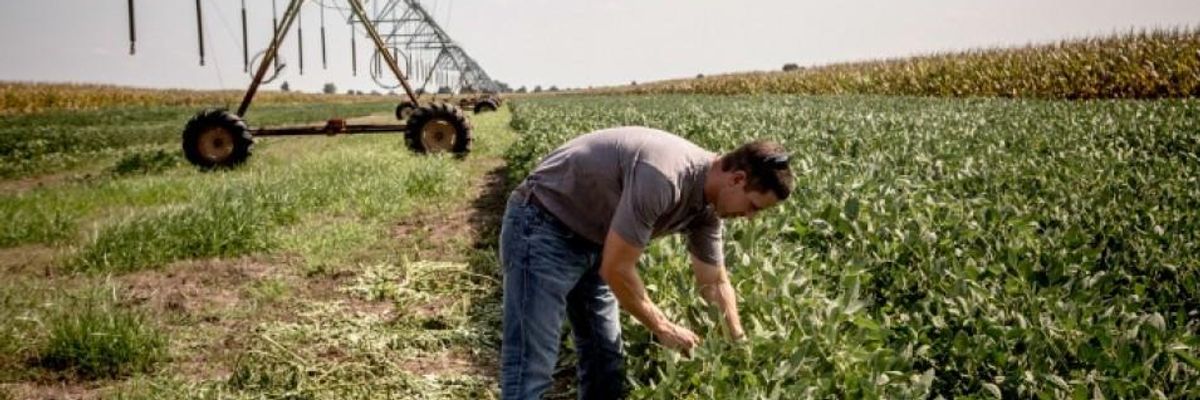
Brad Rose looks at rows of soybean plants that show signs of having been affected by dicamba use on August 9, 2017. He doesn't use it on his crops and he's assured by neighbors within a mile and a half that they haven't used it either. According to him, that means that the chemical had to travel about two miles to reach his crops. (Photo: The Washington Post)
Public health advocates and environmentalists on Tuesday sharply condemned the Environmental Protection Agency's approval of three dicamba products despite farmers' concerns about drift damage and a recent federal court ruling that found the EPA previously "substantially understated risks that it acknowledged and failed entirely to acknowledge other risks" related to the herbicide.
"It is clear that this decision is about protecting the market share of chemical companies and their corresponding genetically enhanced seed stock rather than providing farmers with choices for the tools they use to grow their crops."
--Rob Faux, PANEPA Administrator Andrew Wheeler announced at a Georgia farm that the agency had approved new five-year registrations for two "over-the-top" dicamba products--XtendiMax with VaporGrip Technology from Bayer (formerly Monsanto) and Engenia Herbicide from BASF--and extended until 2025 the registration of Syngenta's Tavium Plus VaporGrip Technology.
All three registrations are for use on dicamba-tolerant cotton and soybeans.
As Common Dreams reported in June, the U.S. Court of Appeals for the 9th Circuit overturned the EPA's 2018 approval of XtendiMax, Engenia, and Corteva's FeXapan. Days after that decision, the agency issued a guidance allowing for continued use of the products through July.
The advocacy groups behind that case--the Center for Food Safety, Center for Biological Diversity, National Family Farm Coalition, and Pesticide Action Network (PAN) North America--tried unsuccessfully to secure a court order halting the continued use of the products this summer. They responded with alarm to Wheeler's Tuesday announcement and vowed to fight back.
"Rather than evaluating the significant costs of dicamba drift as the 9th Circuit told them the law required, EPA rushed re-approval as a political prop just before the election, sentencing farmers and the environment to another five years of unacceptable damage," declared Center for Food Safety legal director George Kimbrell. "We will most certainly challenge these unlawful approvals."
"It is clear that this decision is about protecting the market share of chemical companies and their corresponding genetically enhanced seed stock rather than providing farmers with choices for the tools they use to grow their crops," PAN communications associate Rob Faux said in a statement. "Farmers who might want to select a different seed product and those who might want to pursue alternative crops or alternative cropping systems are simply left to wonder how much damage they must expect in the coming months to their fields."
Faux, who is also an Iowa farmer, explained:
As early as 2018, leading schools of agriculture were recommending that dicamba technologies be applied as a pre-emergent application rather than an over-the-top spray and the Bader Farms lawsuit revealed that Monsanto was fully aware that the product would cause problems even before they applied for dicamba's first provisional registration.
The past growing season simply provided more evidence that dicamba products (BASF's Engenia, Bayer/Monsanto's ExtendiMax, and Corteva's FeXipan) [are] not suitable for over-the-top application, especially during warmer months, when these products are prone to volatilization, resulting in drift damage as many as four days after application. The state of Iowa reported a record number of dicamba-related drift complaints and weed scientists noted that damage was worse than prior years, showing plant injury on a 'landscape level' throughout the state.
"To manage off-site movement of dicamba, EPA's 2020 registration features important control measures," according to the agency. They include:
However, "given EPA-approved versions of dicamba have already damaged millions of U.S. acres of crops and natural areas, there's no reason to trust that the agency got it right this time," Nathan Donley, senior scientist at the Center for Biological Diversity, said Tuesday. "As the judges who tossed out the EPA's previous approval stated, the agency wrongly dismissed many of dicamba's proven harms."
"At this point," Donley added, "the EPA has shown such callous indifference to the damage dicamba has caused to farmers and wildlife alike, and has been so desperate to appease the pesticide industry, it has zero credibility when it comes to pesticide safety."
In a statement Wednesday, Ken Cook, president of the nonprofit Environmental Working Group, also put the new registrations into the broader context of the current administration's pesticide agenda.
"Protecting the pesticide industry has been a top priority of the EPA during the Trump administration," Cook said. "Millions of acres of crops will continue to be damaged, and the health of farmworkers, children, and all those who live near farms where dicamba is used will be at risk--all in the name of appeasing chemical agriculture."
This post has been updated with comment from the Environmental Working Group.
This country and this world are at a monumental crossroads. US voters have an opportunity to beat back the forces of fascism and confront the billionaires who are rigging the economy, our media system, and our democracy, making it increasingly impossible for ordinary people to get by. We’re not just talking about the election. We’re talking about what must be done once these fascist elements are vanquished from power. We need a bolder set of solutions than what either major party has so far been willing to offer and a working-class movement ready to fight like hell for it. Trump didn't emerge from nowhere. The conditions that fueled MAGA authoritarianism were created by decades of radical neoliberal economic policies and a corrupt political system dominated by corporate interests. They slashed taxes on the super-rich, promising that the benefits would trickle down. They said giveaways to the corporate titans would make life more affordable for the rest of us. It was all bullshit. And when a bitter, betrayed populace searches for someone to blame, right-wing demagogues have little trouble finding scapegoats. People know when they're being lied to, but you won't hear any of this from the corporate media. Only independent journalism—powered and funded by people who believe in building a better world—can deliver truly trustworthy daily news. If you share our vision, please contribute whatever you can to sustain our work. |
Public health advocates and environmentalists on Tuesday sharply condemned the Environmental Protection Agency's approval of three dicamba products despite farmers' concerns about drift damage and a recent federal court ruling that found the EPA previously "substantially understated risks that it acknowledged and failed entirely to acknowledge other risks" related to the herbicide.
"It is clear that this decision is about protecting the market share of chemical companies and their corresponding genetically enhanced seed stock rather than providing farmers with choices for the tools they use to grow their crops."
--Rob Faux, PANEPA Administrator Andrew Wheeler announced at a Georgia farm that the agency had approved new five-year registrations for two "over-the-top" dicamba products--XtendiMax with VaporGrip Technology from Bayer (formerly Monsanto) and Engenia Herbicide from BASF--and extended until 2025 the registration of Syngenta's Tavium Plus VaporGrip Technology.
All three registrations are for use on dicamba-tolerant cotton and soybeans.
As Common Dreams reported in June, the U.S. Court of Appeals for the 9th Circuit overturned the EPA's 2018 approval of XtendiMax, Engenia, and Corteva's FeXapan. Days after that decision, the agency issued a guidance allowing for continued use of the products through July.
The advocacy groups behind that case--the Center for Food Safety, Center for Biological Diversity, National Family Farm Coalition, and Pesticide Action Network (PAN) North America--tried unsuccessfully to secure a court order halting the continued use of the products this summer. They responded with alarm to Wheeler's Tuesday announcement and vowed to fight back.
"Rather than evaluating the significant costs of dicamba drift as the 9th Circuit told them the law required, EPA rushed re-approval as a political prop just before the election, sentencing farmers and the environment to another five years of unacceptable damage," declared Center for Food Safety legal director George Kimbrell. "We will most certainly challenge these unlawful approvals."
"It is clear that this decision is about protecting the market share of chemical companies and their corresponding genetically enhanced seed stock rather than providing farmers with choices for the tools they use to grow their crops," PAN communications associate Rob Faux said in a statement. "Farmers who might want to select a different seed product and those who might want to pursue alternative crops or alternative cropping systems are simply left to wonder how much damage they must expect in the coming months to their fields."
Faux, who is also an Iowa farmer, explained:
As early as 2018, leading schools of agriculture were recommending that dicamba technologies be applied as a pre-emergent application rather than an over-the-top spray and the Bader Farms lawsuit revealed that Monsanto was fully aware that the product would cause problems even before they applied for dicamba's first provisional registration.
The past growing season simply provided more evidence that dicamba products (BASF's Engenia, Bayer/Monsanto's ExtendiMax, and Corteva's FeXipan) [are] not suitable for over-the-top application, especially during warmer months, when these products are prone to volatilization, resulting in drift damage as many as four days after application. The state of Iowa reported a record number of dicamba-related drift complaints and weed scientists noted that damage was worse than prior years, showing plant injury on a 'landscape level' throughout the state.
"To manage off-site movement of dicamba, EPA's 2020 registration features important control measures," according to the agency. They include:
However, "given EPA-approved versions of dicamba have already damaged millions of U.S. acres of crops and natural areas, there's no reason to trust that the agency got it right this time," Nathan Donley, senior scientist at the Center for Biological Diversity, said Tuesday. "As the judges who tossed out the EPA's previous approval stated, the agency wrongly dismissed many of dicamba's proven harms."
"At this point," Donley added, "the EPA has shown such callous indifference to the damage dicamba has caused to farmers and wildlife alike, and has been so desperate to appease the pesticide industry, it has zero credibility when it comes to pesticide safety."
In a statement Wednesday, Ken Cook, president of the nonprofit Environmental Working Group, also put the new registrations into the broader context of the current administration's pesticide agenda.
"Protecting the pesticide industry has been a top priority of the EPA during the Trump administration," Cook said. "Millions of acres of crops will continue to be damaged, and the health of farmworkers, children, and all those who live near farms where dicamba is used will be at risk--all in the name of appeasing chemical agriculture."
This post has been updated with comment from the Environmental Working Group.