
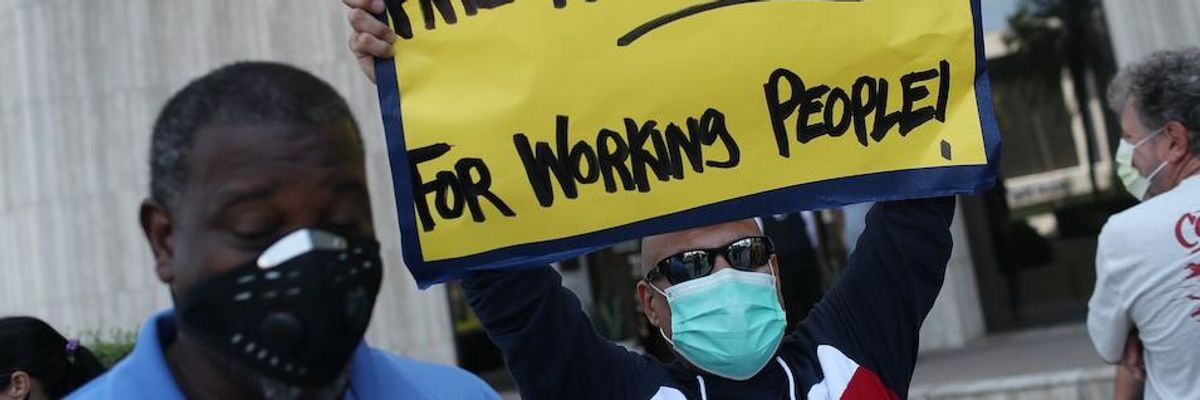
Carlos Ponce joins other demonstrators participating in a protest asking senators to support the continuation of unemployment benefits on July 16, 2020 in Miami Springs, Florida. (Photo: Joe Raedle/Getty Images)
As GOP Blocks Covid Relief, Experts Warn of 'Wave of Despair' and Devastating Anecdotes Show Crisis Already Here
"I feel truly abandoned by this country," one person posted on Reddit's unemployment page this week.
As millions of Americans grapple with the consequences of the refusal by the Trump administration and GOP lawmakers to extend the $600 weekly unemployment benefit or provide other urgent relief, experts warned Thursday that the coronavirus pandemic could directly lead to a "wave of despair"--including pervasive economic anxieties, increased suicides, and drug overdoses across the country.
The American Medical Association has already reported a rise in fatal opioid overdoses in at least 35 states during the pandemic, according to a Guardian report, and medical examiners in a number of states have reported a rise in suicides five months into the public health and economic crisis.
"The U.S. doesn't have a social safety net, like many countries in Europe. Instead we have the American myth of rugged individualism."
--Jonathan Singer, American Association of Suicidology
Fifty-eight suicides have been reported in Cook County, Illinois so far in 2020, compared with 56 total suicides in all of 2019. Low-income, predominantly Black neighborhoods, which have borne the brunt of the pandemic's effects, have seen the sharpest rise in suicides in the county. Officials in cities and counties in California, New Mexico, and Georgia have also been startled by rises in suicides there.
On social media, Washington Post journalist Jeff Stein has posted a number of anecdotes found on the online forum Reddit since the pandemic began, with people across the country this week describing the precarious circumstances they've been thrown into following Senate Republicans' refusal to extend a federal eviction moratorium for some Americans and the $600 benefit, claiming that doing so would keep unemployed people from seeking work--despite evidence to the contrary.
One Georgia resident wrote that they had $26 in their bank account and that the $600 benefit had helped to keep their fiance's medication in stock, while a person in Arizona wrote that their power was about to be shut off after the pandemic forced their extended family to move in with them.
"Doesn't even feel like I'm living in a first world country anymore, and it's been eye-opening losing everything and having to liquidate virtually everything in order to pay bills," the person wrote.
Some posts alluded to despair and suicidal ideation as the Reddit users described having nowhere to turn.
"I don't know what to do anymore," wrote a user from Michigan. "I'd get therapy if my [benefits] ever came through. Feels like they are just waiting for us to die or kill ourselves off. I feel truly abandoned by this country."
Among the tens of millions of Americans who have lost their jobs since March, at least 5.4 million lost their employer-sponsored health insurance, putting mental healthcare out of reach for many.
"The U.S. doesn't have a social safety net, like many countries in Europe," Jonathan Singer, president of the American Association of Suicidology, told The Guardian. "Instead we have the American myth of rugged individualism--that if you work hard enough you'll achieve what you want in life, and if you don't, it's because of a personal failure."
Last week, President Donald Trump issued an executive order partially reinstating a federal unemployment benefit, offering just $300 per week. The order was derided as "an unserious move of political theater" by the Economic Policy Institute.
"This inaction and ongoing uncertainty is causing significant economic pain for workers who have lost their job during the pandemic and their families," wrote EPI economic analyst Julia Wolfe on Thursday.
The White House and Congress are not expected to resume talks on another potential relief package until September when lawmakers return to session.
The pandemic has brought into sharp relief the precarious circumstances in which millions of Americans already lived before the coronavirus forced businesses across the country to shut down and lay off workers.
With one in four renters paying more than half their income to their landlords each month before the pandemic--meeting the federal government's definition of "severely burdened"--the U.S. economic system and its stagnant wages, high out-of-pocket healthcare costs, and student debt crisis left millions of Americans' daily lives in an even more fragile state immediately after the pandemic hit. Food banks reported reported drastic increases in demand in March, with 90% of inquiries at one Pittsburgh pantry coming from people who were newly unemployed.
The U.S. Census Bureau's most recent Household Pulse Survey, which was taken on a weekly basis in the first months of the pandemic and was suspended at the end of July, found that half of all U.S. adults were feeling "down," depressed, or hopeless in the previous week. Eleven percent of respondents to the survey reported relying on unemployment benefits to pay for basic living expenses, days before the $600 weekly benefit expired.
"The pandemic has already generated a combination of factors associated with increased risk, including economic recession, access to firearms, and a generalized sense of anxiety and depression. I would not be surprised if this leads to an increase in suicide deaths," Singer told The Guardian.
On social media, journalist Bryce Covert called the posts shared by Stein "excruciating to read" and indicative of "the human toll of the GOP refusing to keep enhanced unemployment going."
In the U.S., the National Suicide Prevention Lifeline is 1-800-273-8255, or you can text HOME to 741741 to connect with a crisis text line counselor. International suicide helplines can be found at www.befrienders.org.
We are at a crossroads
This country and this world are at a monumental crossroads. In a few short weeks, US voters will have an opportunity to beat back the forces of fascism and confront the billionaires who are rigging the economy, our media system, and our democracy, making it increasingly impossible for ordinary people to get by. We’re not just talking about the election. We’re talking about what must be done once these fascist elements are vanquished from power. We need a bolder set of solutions than what either major party has so far been willing to offer and a working-class movement ready to fight like hell for it. Trump didn't emerge from nowhere. The conditions that fueled MAGA authoritarianism were created by decades of radical neoliberal economic policies and a corrupt political system dominated by corporate interests. They slashed taxes on the super-rich, promising that the benefits would trickle down. They said giveaways to the corporate titans would make life more affordable for the rest of us. It was all bullshit. And when a bitter, betrayed populace searches for someone to blame, right-wing demagogues have little trouble finding scapegoats. People know when they're being lied to, but you won't hear any of this from the corporate media. Only independent journalism—powered and funded by people who believe in building a better world—can deliver truly trustworthy daily news. Our Fall Campaign is underway, and we need your help. To power our newsroom through the rest of the year, we need to raise $125,000 by midnight on October 31. So if you share our vision, please contribute whatever you can to sustain our work. |
As millions of Americans grapple with the consequences of the refusal by the Trump administration and GOP lawmakers to extend the $600 weekly unemployment benefit or provide other urgent relief, experts warned Thursday that the coronavirus pandemic could directly lead to a "wave of despair"--including pervasive economic anxieties, increased suicides, and drug overdoses across the country.
The American Medical Association has already reported a rise in fatal opioid overdoses in at least 35 states during the pandemic, according to a Guardian report, and medical examiners in a number of states have reported a rise in suicides five months into the public health and economic crisis.
"The U.S. doesn't have a social safety net, like many countries in Europe. Instead we have the American myth of rugged individualism."
--Jonathan Singer, American Association of Suicidology
Fifty-eight suicides have been reported in Cook County, Illinois so far in 2020, compared with 56 total suicides in all of 2019. Low-income, predominantly Black neighborhoods, which have borne the brunt of the pandemic's effects, have seen the sharpest rise in suicides in the county. Officials in cities and counties in California, New Mexico, and Georgia have also been startled by rises in suicides there.
On social media, Washington Post journalist Jeff Stein has posted a number of anecdotes found on the online forum Reddit since the pandemic began, with people across the country this week describing the precarious circumstances they've been thrown into following Senate Republicans' refusal to extend a federal eviction moratorium for some Americans and the $600 benefit, claiming that doing so would keep unemployed people from seeking work--despite evidence to the contrary.
One Georgia resident wrote that they had $26 in their bank account and that the $600 benefit had helped to keep their fiance's medication in stock, while a person in Arizona wrote that their power was about to be shut off after the pandemic forced their extended family to move in with them.
"Doesn't even feel like I'm living in a first world country anymore, and it's been eye-opening losing everything and having to liquidate virtually everything in order to pay bills," the person wrote.
Some posts alluded to despair and suicidal ideation as the Reddit users described having nowhere to turn.
"I don't know what to do anymore," wrote a user from Michigan. "I'd get therapy if my [benefits] ever came through. Feels like they are just waiting for us to die or kill ourselves off. I feel truly abandoned by this country."
Among the tens of millions of Americans who have lost their jobs since March, at least 5.4 million lost their employer-sponsored health insurance, putting mental healthcare out of reach for many.
"The U.S. doesn't have a social safety net, like many countries in Europe," Jonathan Singer, president of the American Association of Suicidology, told The Guardian. "Instead we have the American myth of rugged individualism--that if you work hard enough you'll achieve what you want in life, and if you don't, it's because of a personal failure."
Last week, President Donald Trump issued an executive order partially reinstating a federal unemployment benefit, offering just $300 per week. The order was derided as "an unserious move of political theater" by the Economic Policy Institute.
"This inaction and ongoing uncertainty is causing significant economic pain for workers who have lost their job during the pandemic and their families," wrote EPI economic analyst Julia Wolfe on Thursday.
The White House and Congress are not expected to resume talks on another potential relief package until September when lawmakers return to session.
The pandemic has brought into sharp relief the precarious circumstances in which millions of Americans already lived before the coronavirus forced businesses across the country to shut down and lay off workers.
With one in four renters paying more than half their income to their landlords each month before the pandemic--meeting the federal government's definition of "severely burdened"--the U.S. economic system and its stagnant wages, high out-of-pocket healthcare costs, and student debt crisis left millions of Americans' daily lives in an even more fragile state immediately after the pandemic hit. Food banks reported reported drastic increases in demand in March, with 90% of inquiries at one Pittsburgh pantry coming from people who were newly unemployed.
The U.S. Census Bureau's most recent Household Pulse Survey, which was taken on a weekly basis in the first months of the pandemic and was suspended at the end of July, found that half of all U.S. adults were feeling "down," depressed, or hopeless in the previous week. Eleven percent of respondents to the survey reported relying on unemployment benefits to pay for basic living expenses, days before the $600 weekly benefit expired.
"The pandemic has already generated a combination of factors associated with increased risk, including economic recession, access to firearms, and a generalized sense of anxiety and depression. I would not be surprised if this leads to an increase in suicide deaths," Singer told The Guardian.
On social media, journalist Bryce Covert called the posts shared by Stein "excruciating to read" and indicative of "the human toll of the GOP refusing to keep enhanced unemployment going."
In the U.S., the National Suicide Prevention Lifeline is 1-800-273-8255, or you can text HOME to 741741 to connect with a crisis text line counselor. International suicide helplines can be found at www.befrienders.org.