SUBSCRIBE TO OUR FREE NEWSLETTER
Daily news & progressive opinion—funded by the people, not the corporations—delivered straight to your inbox.
5
#000000
#FFFFFF
To donate by check, phone, or other method, see our More Ways to Give page.
Daily news & progressive opinion—funded by the people, not the corporations—delivered straight to your inbox.
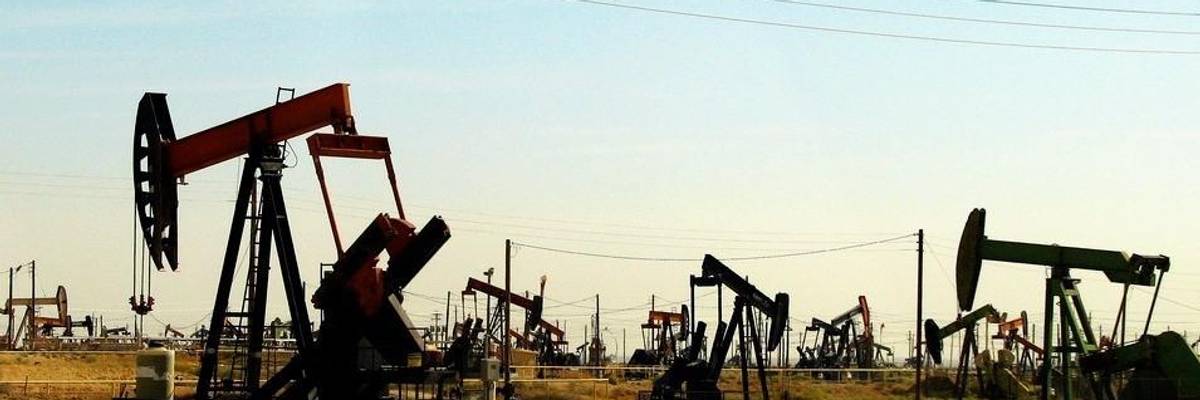
"We should be phasing out carbon as quickly as possible, and fracking is an excellent place to start." (Photo: CGP Grey/Flickr/cc)
Climate advocates are slamming banking interests after a report Thursday revealed that JPMorgan Chase, Wells Fargo, Bank of America, and Citigroup are planning to take over distressed oil and gas companies assets in the wake of an industry collapse, likely by using new access to federal bailout money included in the coronavirus relief package passed by Congress.
"If these banks want to get their hands even more bloody, so be it, we are taking tally."
--Dallas Goldtooth, Indigenous Environmental Network
"It's never been more obvious that fossil fuels are a bad investment, and yet rather than following their supposed commitments to climate action, these big banks are doubling down on their toxic investments and getting directly into the fossil fuel business," Sierra Club campaign representative Ben Cushing said in a statement.
As Reuters reported Thursday, the decision by the banks to look into taking over oil and gas companies comes in the wake of oil price drops in March that have led to the potential for fossil fuel companies to go bankrupt under the strain of the collapse of the fracking industry.
"This development exposes the central role of banks in fossil fuels and clearly illustrates the riskiness of fossil finance," said Rainforest Action Network senior campaigner Jason Opena Disterhoft.
According to Reuters:
Oil and gas companies working in shale basins from Texas to Wyoming are saddled with debt.
The industry is estimated to owe more than $200 billion to lenders through loans backed by oil and gas reserves. As revenue has plummeted and assets have declined in value, some companies are saying they may be unable to repay.
[...]
If banks do not retain bankrupt assets, they might be forced to sell them for pennies on the dollar at current prices. The companies they are setting up could manage oil and gas assets until conditions improve enough to sell at a meaningful value.
"So Chase and Wells Fargo want to cut out the middleman and go into the oil business, directly destroying the climate?" 350.org founder Bill McKibben said in a statement Friday. "Greed does weird things to your mind and your heart."
For banks to take over the oil and gas companies, economic journalist Doug Henwood told Common Dreams Friday, they will be using assurances of funding from the Federal Reserve included in the Coronavirus Aid, Relief, and Economic Security (CARES) Act passed in March to combat the COVID-19 outbreak. Henwood said he found it "appalling" that public money from the CARES Act could be used for bailing out oil and gas companies.
"Our bankruptcy laws have several purposes," said Henwood. "One is to save a business that is otherwise healthy that just has too much debt. Wipe out some of the debt, and the business can come back. But some businesses should just be wound down, and bankruptcy is an orderly way to do that. That's the case for fracking, which makes neither economic nor ecological sense. "
"Fracking requires huge, high-risk investments and the wells can run dry before all the bills are paid," Henwood continued. "It's a filthy business in itself, poisoning the groundwater. And when the fuel it yields is burned, it fills the air with carbon. We should be phasing out carbon as quickly as possible, and fracking is an excellent place to start. By all means, support displaced workers and communities, but let these monsters go under."
There is also a human element to the continuation of the industry's extraction, Dallas Goldtooth, Keep it in the Ground campaigner for the Indigenous Environmental Network said in a statement.
"Indigenous communities from Alaska to the Gulf Coast are in dire straits due to the destruction of fossil fuel corporations. Sexual violence is rampant with the fossil fuel industry in our communities," said Goldtooth. "If these banks want to get their hands even more bloody, so be it, we are taking tally, and best believe, all banks will be held accountable for the attacks on our nations, communities, bodies, and lands."
In a statement on the banks' plan Friday, Oil Change International senior campaigner Collin Rees said that the proposal "would be a catastrophic mistake for communities and climate."
"Any words JPMorgan Chase, Wells Fargo, Bank of America, and Citi have ever said about climate action would be instantly meaningless," said Rees. "The fossil fuel industry needs a just transition for workers and a swift phase-out of production, not a transfer of the keys to predatory financial institutions focused on profits for billionaires."
Bottom line, said Greenpeace USA senior climate campaigner Caroline Henderson, the purpose of the stimulus was not to allow big banks to take over the climate-killing fossil fuel industry.
"If the Fed and these banks rescue already failing oil and gas companies instead of winding their operations down, taking care of their workers, and retiring their unburnable reserves, they are deepening the risks of the COVID-19 crisis," said Henderson. "These financial institutions are fueling future public health threats and systemic financial risks that are the certain consequence of climate change."
"Taxpayers shouldn't be required to backstop oil and gas companies that were already in trouble prior to the pandemic," Henderson added.
Dear Common Dreams reader, It’s been nearly 30 years since I co-founded Common Dreams with my late wife, Lina Newhouser. We had the radical notion that journalism should serve the public good, not corporate profits. It was clear to us from the outset what it would take to build such a project. No paid advertisements. No corporate sponsors. No millionaire publisher telling us what to think or do. Many people said we wouldn't last a year, but we proved those doubters wrong. Together with a tremendous team of journalists and dedicated staff, we built an independent media outlet free from the constraints of profits and corporate control. Our mission has always been simple: To inform. To inspire. To ignite change for the common good. Building Common Dreams was not easy. Our survival was never guaranteed. When you take on the most powerful forces—Wall Street greed, fossil fuel industry destruction, Big Tech lobbyists, and uber-rich oligarchs who have spent billions upon billions rigging the economy and democracy in their favor—the only bulwark you have is supporters who believe in your work. But here’s the urgent message from me today. It's never been this bad out there. And it's never been this hard to keep us going. At the very moment Common Dreams is most needed, the threats we face are intensifying. We need your support now more than ever. We don't accept corporate advertising and never will. We don't have a paywall because we don't think people should be blocked from critical news based on their ability to pay. Everything we do is funded by the donations of readers like you. When everyone does the little they can afford, we are strong. But if that support retreats or dries up, so do we. Will you donate now to make sure Common Dreams not only survives but thrives? —Craig Brown, Co-founder |
Climate advocates are slamming banking interests after a report Thursday revealed that JPMorgan Chase, Wells Fargo, Bank of America, and Citigroup are planning to take over distressed oil and gas companies assets in the wake of an industry collapse, likely by using new access to federal bailout money included in the coronavirus relief package passed by Congress.
"If these banks want to get their hands even more bloody, so be it, we are taking tally."
--Dallas Goldtooth, Indigenous Environmental Network
"It's never been more obvious that fossil fuels are a bad investment, and yet rather than following their supposed commitments to climate action, these big banks are doubling down on their toxic investments and getting directly into the fossil fuel business," Sierra Club campaign representative Ben Cushing said in a statement.
As Reuters reported Thursday, the decision by the banks to look into taking over oil and gas companies comes in the wake of oil price drops in March that have led to the potential for fossil fuel companies to go bankrupt under the strain of the collapse of the fracking industry.
"This development exposes the central role of banks in fossil fuels and clearly illustrates the riskiness of fossil finance," said Rainforest Action Network senior campaigner Jason Opena Disterhoft.
According to Reuters:
Oil and gas companies working in shale basins from Texas to Wyoming are saddled with debt.
The industry is estimated to owe more than $200 billion to lenders through loans backed by oil and gas reserves. As revenue has plummeted and assets have declined in value, some companies are saying they may be unable to repay.
[...]
If banks do not retain bankrupt assets, they might be forced to sell them for pennies on the dollar at current prices. The companies they are setting up could manage oil and gas assets until conditions improve enough to sell at a meaningful value.
"So Chase and Wells Fargo want to cut out the middleman and go into the oil business, directly destroying the climate?" 350.org founder Bill McKibben said in a statement Friday. "Greed does weird things to your mind and your heart."
For banks to take over the oil and gas companies, economic journalist Doug Henwood told Common Dreams Friday, they will be using assurances of funding from the Federal Reserve included in the Coronavirus Aid, Relief, and Economic Security (CARES) Act passed in March to combat the COVID-19 outbreak. Henwood said he found it "appalling" that public money from the CARES Act could be used for bailing out oil and gas companies.
"Our bankruptcy laws have several purposes," said Henwood. "One is to save a business that is otherwise healthy that just has too much debt. Wipe out some of the debt, and the business can come back. But some businesses should just be wound down, and bankruptcy is an orderly way to do that. That's the case for fracking, which makes neither economic nor ecological sense. "
"Fracking requires huge, high-risk investments and the wells can run dry before all the bills are paid," Henwood continued. "It's a filthy business in itself, poisoning the groundwater. And when the fuel it yields is burned, it fills the air with carbon. We should be phasing out carbon as quickly as possible, and fracking is an excellent place to start. By all means, support displaced workers and communities, but let these monsters go under."
There is also a human element to the continuation of the industry's extraction, Dallas Goldtooth, Keep it in the Ground campaigner for the Indigenous Environmental Network said in a statement.
"Indigenous communities from Alaska to the Gulf Coast are in dire straits due to the destruction of fossil fuel corporations. Sexual violence is rampant with the fossil fuel industry in our communities," said Goldtooth. "If these banks want to get their hands even more bloody, so be it, we are taking tally, and best believe, all banks will be held accountable for the attacks on our nations, communities, bodies, and lands."
In a statement on the banks' plan Friday, Oil Change International senior campaigner Collin Rees said that the proposal "would be a catastrophic mistake for communities and climate."
"Any words JPMorgan Chase, Wells Fargo, Bank of America, and Citi have ever said about climate action would be instantly meaningless," said Rees. "The fossil fuel industry needs a just transition for workers and a swift phase-out of production, not a transfer of the keys to predatory financial institutions focused on profits for billionaires."
Bottom line, said Greenpeace USA senior climate campaigner Caroline Henderson, the purpose of the stimulus was not to allow big banks to take over the climate-killing fossil fuel industry.
"If the Fed and these banks rescue already failing oil and gas companies instead of winding their operations down, taking care of their workers, and retiring their unburnable reserves, they are deepening the risks of the COVID-19 crisis," said Henderson. "These financial institutions are fueling future public health threats and systemic financial risks that are the certain consequence of climate change."
"Taxpayers shouldn't be required to backstop oil and gas companies that were already in trouble prior to the pandemic," Henderson added.
Climate advocates are slamming banking interests after a report Thursday revealed that JPMorgan Chase, Wells Fargo, Bank of America, and Citigroup are planning to take over distressed oil and gas companies assets in the wake of an industry collapse, likely by using new access to federal bailout money included in the coronavirus relief package passed by Congress.
"If these banks want to get their hands even more bloody, so be it, we are taking tally."
--Dallas Goldtooth, Indigenous Environmental Network
"It's never been more obvious that fossil fuels are a bad investment, and yet rather than following their supposed commitments to climate action, these big banks are doubling down on their toxic investments and getting directly into the fossil fuel business," Sierra Club campaign representative Ben Cushing said in a statement.
As Reuters reported Thursday, the decision by the banks to look into taking over oil and gas companies comes in the wake of oil price drops in March that have led to the potential for fossil fuel companies to go bankrupt under the strain of the collapse of the fracking industry.
"This development exposes the central role of banks in fossil fuels and clearly illustrates the riskiness of fossil finance," said Rainforest Action Network senior campaigner Jason Opena Disterhoft.
According to Reuters:
Oil and gas companies working in shale basins from Texas to Wyoming are saddled with debt.
The industry is estimated to owe more than $200 billion to lenders through loans backed by oil and gas reserves. As revenue has plummeted and assets have declined in value, some companies are saying they may be unable to repay.
[...]
If banks do not retain bankrupt assets, they might be forced to sell them for pennies on the dollar at current prices. The companies they are setting up could manage oil and gas assets until conditions improve enough to sell at a meaningful value.
"So Chase and Wells Fargo want to cut out the middleman and go into the oil business, directly destroying the climate?" 350.org founder Bill McKibben said in a statement Friday. "Greed does weird things to your mind and your heart."
For banks to take over the oil and gas companies, economic journalist Doug Henwood told Common Dreams Friday, they will be using assurances of funding from the Federal Reserve included in the Coronavirus Aid, Relief, and Economic Security (CARES) Act passed in March to combat the COVID-19 outbreak. Henwood said he found it "appalling" that public money from the CARES Act could be used for bailing out oil and gas companies.
"Our bankruptcy laws have several purposes," said Henwood. "One is to save a business that is otherwise healthy that just has too much debt. Wipe out some of the debt, and the business can come back. But some businesses should just be wound down, and bankruptcy is an orderly way to do that. That's the case for fracking, which makes neither economic nor ecological sense. "
"Fracking requires huge, high-risk investments and the wells can run dry before all the bills are paid," Henwood continued. "It's a filthy business in itself, poisoning the groundwater. And when the fuel it yields is burned, it fills the air with carbon. We should be phasing out carbon as quickly as possible, and fracking is an excellent place to start. By all means, support displaced workers and communities, but let these monsters go under."
There is also a human element to the continuation of the industry's extraction, Dallas Goldtooth, Keep it in the Ground campaigner for the Indigenous Environmental Network said in a statement.
"Indigenous communities from Alaska to the Gulf Coast are in dire straits due to the destruction of fossil fuel corporations. Sexual violence is rampant with the fossil fuel industry in our communities," said Goldtooth. "If these banks want to get their hands even more bloody, so be it, we are taking tally, and best believe, all banks will be held accountable for the attacks on our nations, communities, bodies, and lands."
In a statement on the banks' plan Friday, Oil Change International senior campaigner Collin Rees said that the proposal "would be a catastrophic mistake for communities and climate."
"Any words JPMorgan Chase, Wells Fargo, Bank of America, and Citi have ever said about climate action would be instantly meaningless," said Rees. "The fossil fuel industry needs a just transition for workers and a swift phase-out of production, not a transfer of the keys to predatory financial institutions focused on profits for billionaires."
Bottom line, said Greenpeace USA senior climate campaigner Caroline Henderson, the purpose of the stimulus was not to allow big banks to take over the climate-killing fossil fuel industry.
"If the Fed and these banks rescue already failing oil and gas companies instead of winding their operations down, taking care of their workers, and retiring their unburnable reserves, they are deepening the risks of the COVID-19 crisis," said Henderson. "These financial institutions are fueling future public health threats and systemic financial risks that are the certain consequence of climate change."
"Taxpayers shouldn't be required to backstop oil and gas companies that were already in trouble prior to the pandemic," Henderson added.