SUBSCRIBE TO OUR FREE NEWSLETTER
Daily news & progressive opinion—funded by the people, not the corporations—delivered straight to your inbox.
5
#000000
#FFFFFF
To donate by check, phone, or other method, see our More Ways to Give page.
Daily news & progressive opinion—funded by the people, not the corporations—delivered straight to your inbox.
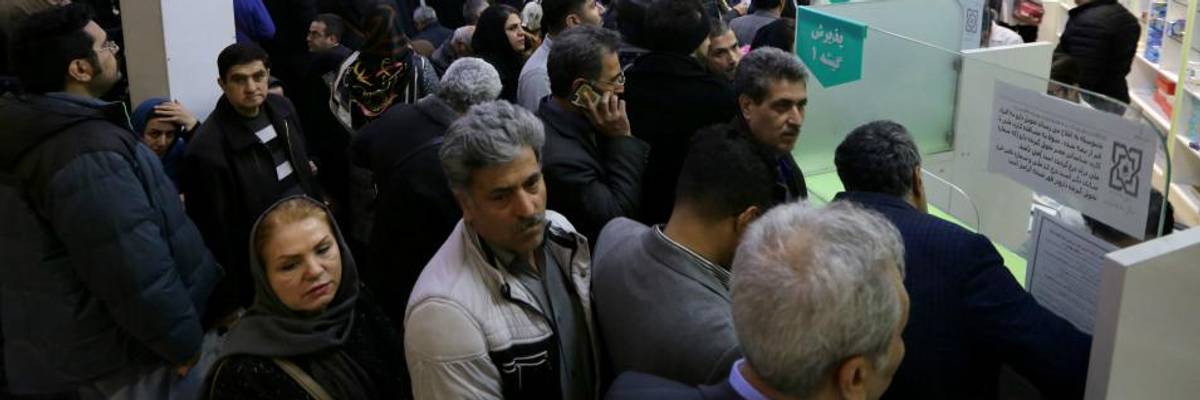
Iranians wait to get prescription drugs at the state-run "13 Aban" pharmacy in Tehran on Feb. 19, 2020. Iranians had been suffering from scarce medicine supplies even before the new coronavirus COVID-19 broke out in the central city of Qom and spread, claiming several lives and fostering panic amid a shortage of face masks. (Photo: Atta Kenare/AFP via Getty Images)
More than two dozen U.S. organizations came together Friday to pressure the Trump administration to recognize the coronavirus pandemic as a "shared threat" and temporarily ease economic sanctions on Iran, one of the countries hardest hit by the disease with nearly 20,000 COVID-19 cases and over 1,400 deaths.
"With hospitals overrun and Iranian doctors struggling to procure necessary equipment, the U.S. must be part of the solution rather than part of the problem." --Jamal Abdi, NIAC Action
The National Iranian American Council (NIAC) Action and 25 other groups sent a letter to U.S. President Donald Trump, Treasury Secretary Steven Mnuchin, and Secretary of state Mike Pompeo which emphasized the importance of "global solutions" and explained that "easing sanctions is one simple step that can be taken to serve the interests of the Iranian people and public health across the globe."
The Trump administration has increasingly ramped up sanctions on Iran since the president ditched the Iran nuclear deal in May 2018. Pompeo announced the most recent wave of U.S. sanctions on the country Wednesday amid reports about how previous sanctions had already devastated Iran's economy and healthcare system, hampering the Iranian government's response to the deadly outbreak.
"To help stem the continued spread of the virus inside Iran and beyond, we urge you to issue a time-bound suspension of those U.S. sanctions that make it harder for ordinary Iranians to secure basic goods and services to weather the crisis," the groups' letter says. "Doing so would not just serve U.S. interests in helping contain the further spread of the virus, but would also be a powerful humanitarian gesture to the more than 80 million Iranians suffering under the pandemic."
The letter acknowledges that "some limited steps have already been taken, including licensing humanitarian trade with the Central Bank of Iran and encouraging foreign banks and governments to establish humanitarian channels with Iran," but calls for greater action. Specifically, the groups suggest suspending many of the sanctions "for a period of at least 120 days, including those sanctions affecting Iran's financial and oil sectors and its civilian industries."
Along with NIAC Action, the letter's signatories include CodePink, Council on American-Islamic Relations (CAIR), Demand Progress Education Fund, Greenpeace USA, Institute for Policy Studies, Just Foreign Policy, MoveOn, Physicians for Social Responsibility, Ploughshares Fund, and Win Without War. Some organizations have been critical of U.S. sanctions on Iran more broadly and called for them to be permanently ended.
In a statement accompanying the letter, NIAC Action executive director Jamal Abdi said that "the Trump administration's current unwillingness to significantly ease sanctions on Iran during this time of crisis is like rubbing salt into a gaping wound. With hospitals overrun and Iranian doctors struggling to procure necessary equipment, the U.S. must be part of the solution rather than part of the problem."
"As COVID-19 rips through country after country, Iran's experience has been particularly devastating," Abdi noted. "While advanced medical systems across Western Europe seem to be collapsing under the weight of patients infected with the virus, Iranians have had to contend with both their own government's negligence and crushing sanctions that slow the response and punish ordinary Iranians."
He added that "humanitarian assistance shouldn't come with strings attached, and we are all at risk from the pandemic regardless of nationality. We call on the administration to ease its sanctions policy so that all resources are available to fight the pandemic in this dark hour for the Iranian people."
The organizations behind the letter aren't alone in calling for a suspension of the sanctions. Russia and China--along with some U.S. lawmakers--have publicly pressured the Trump administration, and the Guardian reported Wednesday that "the U.K. is privately pressing the U.S. to ease sanctions on Iran to help it fight the growing coronavirus outbreak."
This country and this world are at a monumental crossroads. US voters have an opportunity to beat back the forces of fascism and confront the billionaires who are rigging the economy, our media system, and our democracy, making it increasingly impossible for ordinary people to get by. We’re not just talking about the election. We’re talking about what must be done once these fascist elements are vanquished from power. We need a bolder set of solutions than what either major party has so far been willing to offer and a working-class movement ready to fight like hell for it. Trump didn't emerge from nowhere. The conditions that fueled MAGA authoritarianism were created by decades of radical neoliberal economic policies and a corrupt political system dominated by corporate interests. They slashed taxes on the super-rich, promising that the benefits would trickle down. They said giveaways to the corporate titans would make life more affordable for the rest of us. It was all bullshit. And when a bitter, betrayed populace searches for someone to blame, right-wing demagogues have little trouble finding scapegoats. People know when they're being lied to, but you won't hear any of this from the corporate media. Only independent journalism—powered and funded by people who believe in building a better world—can deliver truly trustworthy daily news. If you share our vision, please contribute whatever you can to sustain our work. |
More than two dozen U.S. organizations came together Friday to pressure the Trump administration to recognize the coronavirus pandemic as a "shared threat" and temporarily ease economic sanctions on Iran, one of the countries hardest hit by the disease with nearly 20,000 COVID-19 cases and over 1,400 deaths.
"With hospitals overrun and Iranian doctors struggling to procure necessary equipment, the U.S. must be part of the solution rather than part of the problem." --Jamal Abdi, NIAC Action
The National Iranian American Council (NIAC) Action and 25 other groups sent a letter to U.S. President Donald Trump, Treasury Secretary Steven Mnuchin, and Secretary of state Mike Pompeo which emphasized the importance of "global solutions" and explained that "easing sanctions is one simple step that can be taken to serve the interests of the Iranian people and public health across the globe."
The Trump administration has increasingly ramped up sanctions on Iran since the president ditched the Iran nuclear deal in May 2018. Pompeo announced the most recent wave of U.S. sanctions on the country Wednesday amid reports about how previous sanctions had already devastated Iran's economy and healthcare system, hampering the Iranian government's response to the deadly outbreak.
"To help stem the continued spread of the virus inside Iran and beyond, we urge you to issue a time-bound suspension of those U.S. sanctions that make it harder for ordinary Iranians to secure basic goods and services to weather the crisis," the groups' letter says. "Doing so would not just serve U.S. interests in helping contain the further spread of the virus, but would also be a powerful humanitarian gesture to the more than 80 million Iranians suffering under the pandemic."
The letter acknowledges that "some limited steps have already been taken, including licensing humanitarian trade with the Central Bank of Iran and encouraging foreign banks and governments to establish humanitarian channels with Iran," but calls for greater action. Specifically, the groups suggest suspending many of the sanctions "for a period of at least 120 days, including those sanctions affecting Iran's financial and oil sectors and its civilian industries."
Along with NIAC Action, the letter's signatories include CodePink, Council on American-Islamic Relations (CAIR), Demand Progress Education Fund, Greenpeace USA, Institute for Policy Studies, Just Foreign Policy, MoveOn, Physicians for Social Responsibility, Ploughshares Fund, and Win Without War. Some organizations have been critical of U.S. sanctions on Iran more broadly and called for them to be permanently ended.
In a statement accompanying the letter, NIAC Action executive director Jamal Abdi said that "the Trump administration's current unwillingness to significantly ease sanctions on Iran during this time of crisis is like rubbing salt into a gaping wound. With hospitals overrun and Iranian doctors struggling to procure necessary equipment, the U.S. must be part of the solution rather than part of the problem."
"As COVID-19 rips through country after country, Iran's experience has been particularly devastating," Abdi noted. "While advanced medical systems across Western Europe seem to be collapsing under the weight of patients infected with the virus, Iranians have had to contend with both their own government's negligence and crushing sanctions that slow the response and punish ordinary Iranians."
He added that "humanitarian assistance shouldn't come with strings attached, and we are all at risk from the pandemic regardless of nationality. We call on the administration to ease its sanctions policy so that all resources are available to fight the pandemic in this dark hour for the Iranian people."
The organizations behind the letter aren't alone in calling for a suspension of the sanctions. Russia and China--along with some U.S. lawmakers--have publicly pressured the Trump administration, and the Guardian reported Wednesday that "the U.K. is privately pressing the U.S. to ease sanctions on Iran to help it fight the growing coronavirus outbreak."