

SUBSCRIBE TO OUR FREE NEWSLETTER
Daily news & progressive opinion—funded by the people, not the corporations—delivered straight to your inbox.
5
#000000
#FFFFFF
To donate by check, phone, or other method, see our More Ways to Give page.
Daily news & progressive opinion—funded by the people, not the corporations—delivered straight to your inbox.
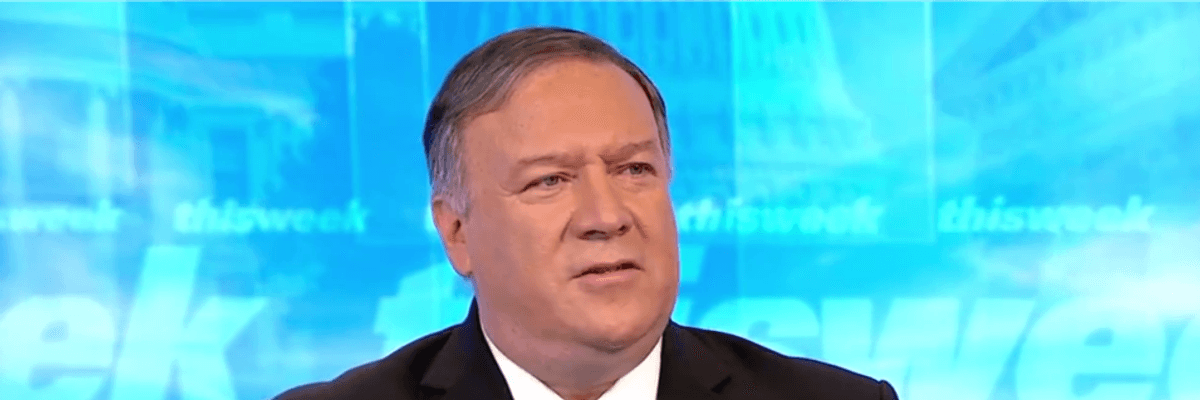
U.S. Secretary of State appearing on ABC's "This Week" on Sunday morning. "Attacking [Venezuela] for any reason," warned international law scholar Mary Ellen O'Connell earlier this year, "would violate the most fundamental of all international law -- the prohibition on the use of force. International law permits force in response to an armed attack in self-defense, but not for regime change, to secure oil or even to distribute food." (Photo: ABC/This Week)
After U.S. Secretary of State Mike Pompeo said Sunday morning that President Donald Trump has a "full range of options" when it comes to possible next moves against Venezuela, anti-war critics are wondering what the Democrats in Congress are prepared to do in order to curtail the administration's ongoing threat of using military force to overthrow the government of President Nicolas Maduro - an effort international legal experts say would be a violation of international law.
"We have a full range of options that we're preparing for," Pompeo said on ABC's "This Week."
Asked if the president believed he had the authority to attack Venezuela without the expressed approval of Congress, Pompeo said, "I don't want to speak to that," but added that the President Trump has "his full range of Article 2 authorities"--referring to the section of the Constitution that grants the president specific (yet not unlimited) powers--"and I'm very confident that any action we took in Venezuela would be lawful."
Watch:
The White House has been adamant that a military option remains on the table for Venezuela. Earlier this week--as the latest push to topple Maduro from within failed--Pompeo, as Common Dreams reported, said Trump was prepared to use military force "if that's what's required."
In the wake of Pompeo's latest comments on Sunday, journalist and political commentator Glenn Greenwald asked why Democratic leaders in the House were not acting with more urgency in terms of pushing back against the White House's aggressive posture and threats against Venezuela.
While leadership has not yet embraced it or made the bill a priority, Rep. David Cicilline (D-RI) has introduced a proposal that would specifically prevent the Trump administration from deploying U.S. military forces to Venezuela without congressional authorization.
In a statement early last week, Cicilline castigated Trump's national security advisor John Bolton for again threatening that the administration was willing to use military force in order to help overthrow the Maduro government.
"To be clear, there is no good military option for the U.S.," Cicilline said. "And if the President and his advisors want to go down that road, they will need to request authority from Congress. Only Congress has the power to declare war and we haven't done that. Any rhetoric to the contrary, like Mr. Bolton's comment today, is both dangerous and wrong."
Of course, as international law experts would be quick to point out, authority granted by the U.S. Congress might absolve Trump of constitutional violations, it would still not satisfy the legal standard for the use of military force by one nation against another.
As Trump made similar threats against Venezuela earlier this year, Mary Ellen O'Connell, Notre Dame Law School professor and renowned expert on international law, said there are serious concerns regarding the rhetoric of "all options remain on the table"--code for military action.
"Attacking [Venezuela] for any reason," O'Connell said in February, "would violate the most fundamental of all international law -- the prohibition on the use of force. International law permits force in response to an armed attack in self-defense, but not for regime change, to secure oil or even to distribute food."
O'Connell argued that "regardless of how odious Maduro is," that judgment alone cannot justify his overthrow by outside forces. "Under international law, he is treated as the head of government," she said. "The fact the U.S. and other states have recognized opposition leader Guaido as the legitimate president is irrelevant for these purposes. Guaido must win the support of the military and other Maduro backers to govern. It is governing that matters, not the preferences of outside states."
And she rejected the idea that even humanitarian arguments would warrant U.S. military action. "There are no 'humanitarian wars,'" she explained. "Nor is military confrontation a way to promote good governance and the rule of law. The U.S. has become so accustomed to using military force -- from full-scale invasions to constant drone attacks -- we don't seem to be able to think of anything else to do."
This country and this world are at a monumental crossroads. US voters have an opportunity to beat back the forces of fascism and confront the billionaires who are rigging the economy, our media system, and our democracy, making it increasingly impossible for ordinary people to get by. We’re not just talking about the election. We’re talking about what must be done once these fascist elements are vanquished from power. We need a bolder set of solutions than what either major party has so far been willing to offer and a working-class movement ready to fight like hell for it. Trump didn't emerge from nowhere. The conditions that fueled MAGA authoritarianism were created by decades of radical neoliberal economic policies and a corrupt political system dominated by corporate interests. They slashed taxes on the super-rich, promising that the benefits would trickle down. They said giveaways to the corporate titans would make life more affordable for the rest of us. It was all bullshit. And when a bitter, betrayed populace searches for someone to blame, right-wing demagogues have little trouble finding scapegoats. People know when they're being lied to, but you won't hear any of this from the corporate media. Only independent journalism—powered and funded by people who believe in building a better world—can deliver truly trustworthy daily news. If you share our vision, please contribute whatever you can to sustain our work. |
After U.S. Secretary of State Mike Pompeo said Sunday morning that President Donald Trump has a "full range of options" when it comes to possible next moves against Venezuela, anti-war critics are wondering what the Democrats in Congress are prepared to do in order to curtail the administration's ongoing threat of using military force to overthrow the government of President Nicolas Maduro - an effort international legal experts say would be a violation of international law.
"We have a full range of options that we're preparing for," Pompeo said on ABC's "This Week."
Asked if the president believed he had the authority to attack Venezuela without the expressed approval of Congress, Pompeo said, "I don't want to speak to that," but added that the President Trump has "his full range of Article 2 authorities"--referring to the section of the Constitution that grants the president specific (yet not unlimited) powers--"and I'm very confident that any action we took in Venezuela would be lawful."
Watch:
The White House has been adamant that a military option remains on the table for Venezuela. Earlier this week--as the latest push to topple Maduro from within failed--Pompeo, as Common Dreams reported, said Trump was prepared to use military force "if that's what's required."
In the wake of Pompeo's latest comments on Sunday, journalist and political commentator Glenn Greenwald asked why Democratic leaders in the House were not acting with more urgency in terms of pushing back against the White House's aggressive posture and threats against Venezuela.
While leadership has not yet embraced it or made the bill a priority, Rep. David Cicilline (D-RI) has introduced a proposal that would specifically prevent the Trump administration from deploying U.S. military forces to Venezuela without congressional authorization.
In a statement early last week, Cicilline castigated Trump's national security advisor John Bolton for again threatening that the administration was willing to use military force in order to help overthrow the Maduro government.
"To be clear, there is no good military option for the U.S.," Cicilline said. "And if the President and his advisors want to go down that road, they will need to request authority from Congress. Only Congress has the power to declare war and we haven't done that. Any rhetoric to the contrary, like Mr. Bolton's comment today, is both dangerous and wrong."
Of course, as international law experts would be quick to point out, authority granted by the U.S. Congress might absolve Trump of constitutional violations, it would still not satisfy the legal standard for the use of military force by one nation against another.
As Trump made similar threats against Venezuela earlier this year, Mary Ellen O'Connell, Notre Dame Law School professor and renowned expert on international law, said there are serious concerns regarding the rhetoric of "all options remain on the table"--code for military action.
"Attacking [Venezuela] for any reason," O'Connell said in February, "would violate the most fundamental of all international law -- the prohibition on the use of force. International law permits force in response to an armed attack in self-defense, but not for regime change, to secure oil or even to distribute food."
O'Connell argued that "regardless of how odious Maduro is," that judgment alone cannot justify his overthrow by outside forces. "Under international law, he is treated as the head of government," she said. "The fact the U.S. and other states have recognized opposition leader Guaido as the legitimate president is irrelevant for these purposes. Guaido must win the support of the military and other Maduro backers to govern. It is governing that matters, not the preferences of outside states."
And she rejected the idea that even humanitarian arguments would warrant U.S. military action. "There are no 'humanitarian wars,'" she explained. "Nor is military confrontation a way to promote good governance and the rule of law. The U.S. has become so accustomed to using military force -- from full-scale invasions to constant drone attacks -- we don't seem to be able to think of anything else to do."

