

SUBSCRIBE TO OUR FREE NEWSLETTER
Daily news & progressive opinion—funded by the people, not the corporations—delivered straight to your inbox.
5
#000000
#FFFFFF
To donate by check, phone, or other method, see our More Ways to Give page.
Daily news & progressive opinion—funded by the people, not the corporations—delivered straight to your inbox.
Climate activists have announced a major "People's Climate March" on April 29th in Washington, D.C. and throughout the country. The effort is being organized by the coalition formed out of 2014's People's Climate March, which brought over 400,000 people to the streets of New York City and many more around the world.
The April 29th march comes in response to widespread outrage against President Trump's disastrous anti-climate agenda - including his executive orders this week advancing the Keystone and Dakota Access pipelines - along with his attacks on health care, immigrants, and programs and policies that improve the lives of all Americans.
The march will cap off 100 days of action to fight back against Trump's proposals to reverse climate action, dismantle our government, and hand power over to the 1 percent.
More than 145 protests in local communities took place across the country in the first 100 hours of the Trump presidency, demonstrating widespread opposition to the administration's anti-environment and corporate agenda as part of an ongoing campaign organized by the People's Climate Movement.
"The climate crisis is an outcome of the long term disinvestment of low-income communities, and low-income communities of color," said Rae Breaux, lead climate justice organizer for People's Action Institute.
"President Trump's First 100 Days plan is a clear sign that he will fast-track profits for corporations before he invests in the needs of the American people.
"Now is the time to come together and build an economy where investments are made to benefit workers, communities of color and low-income folks - an economy that is structured to reflect the fact that black, brown and indigenous lives matter," she said.
Background and History: The People's Climate Movement grew out of the largest climate march in U.S. history in New York in September of 2014, creating a groundbreaking coalition of green and environmental justice groups, labor unions, faith, students, indigenous peoples and civil rights groups working to advance a climate agenda rooted in economic and racial justice.
With the 100 days of action and April march, this coalition will leverage their power once again, to resist the Trump administration and corporate leaders' efforts to thwart or reverse progress towards a more just America.
Now more than ever, it will take everyone to change everything. So, the People's Climate Movement is calling on everyone to join in resisting Trump, his crooked administration and the one percent who are running our country.
For more information on The People's Climate Movement and the mobilization on April 29th, please visit: https://peoplesclimate.org/
# # #
Here's what others are saying about Climate Action and standing up to President Trump:
Jeremiah Lowery, Environmental Justice Organizer, Washington, D.C.: "As a community member of the frontline, we must not be forgotten. The next 100 days are critical. Trump's policies will have devastating impact on communities directly impacted by climate change. Supporting local organizing efforts will be important in any effort to stop Trump's attack on our environment, health, and ultimately collective well-being"
Denise Abdul-Rahman, NAACP Indiana Executive Board Member and State Chair:
"The NAACP mantra is about advocating for civil rights. Our grassroots based organization has injected civil disobedience to oppose the current attorney general appointee, we are asserting our voices and calling for a more just and inclusive policies and appointees. We are strategizing at local, state and federal level to curtail the oppressive policies espoused by the Koch Brothers and Alec. These are policies that disproportionately impact our communities, such as criminal justice, voting rights, jobs, women's rights, health care, climate and education. We are with the People, and the People's Climate Movement."
Reverend Leo Woodbury, Kingdom Living Temple in Florence, South Carolina: "President Trump's issuing of executive orders rolling back President Obama's climate agenda in his first days of office and his efforts at dismantling the EPA is a serious threat to our communities. In South Carolina and across the country, communities of color and low-income people are on the front-lines of the climate crisis and we need to fight back. This year we are rebuilding our church for the second time in two years due to flooding from storms that were stronger due to climate change. In our communities, and others across the country, people are dealing with wells and drinking water contaminated with human waste, pesticides and toxic chemicals due to overflow from storms that are stronger than ever before as a result of global warming. We need to come together under the People's Climate Movement banner in Washington, D.C. on April 29th to say we are fighting for our planet and our communities."
Angela Adrar, Executive Director, Climate Justice Alliance: "For the next 100 days and as long as it will take, the Climate Justice Alliance is standing side by side across the U.S. in unity with the people-- in defiance of those who want to divide us. Women of color will not be sacrificed, our communities will not be sacrificed -- now is the time to fight for climate justice as it is key to our liberation and justice for all. Defenders of water, land, air, food, our bodies, and homes will unite across struggles to grow the resistance. Inauguration was just the beginning of a social movement uprising that is making Her-story."
Aura Vasquez, Director of Climate Justice, Center for Popular Democracy: "Around the country and the world, we agreed that climate change is real and affects those most vulnerable. We cannot afford to continue polluting our air and water. Our families deserve a healthy environment to live in. CPD is committed to continue pushing for climate justice with some of the strongest grassroots organizations in the country. We can't back down now. We need climate solutions that protect the most vulnerable from climate change-related damage while finding viable solutions to our current climate crisis."
Michelle Suarez, Florida Institute for Reform and Empowerment, (F.I.R.E.): "As the climate crisis worsens, it's clear that women, children, indigenous nations, low-income and communities of color must lead the way. Marginalized communities can no longer be ignored, instead, real solutions must come from more intentional relationships with one another, an intersectional approach as we empower, educate, and mobilize towards ensuring more resilient communities, justice and equity for all."
Chloe Jackson, Just Transition and Climate Justice Organizer, Missourians Organizing for Reform and Empowerment: "Communities across the country have been working for environmental and social justice for centuries. Now it's time for our struggles to unite and work together across borders to fight racism, sexism, xenophobia, and environmental destruction. We have a lot of work to do, and we are stronger together. Our vision for a better future can be achieved if we join hands in this struggle and support each other."
Mark Magana, President and CEO, GreenLatinos: "Latino communities and GreenLatinos members across this country will stand together with the People's Climate Movement and lift our voices for justice; the right to clean air and clean water; the right to a healthy, clean, and protected environment; the right to live. Latinos have a culture that is grounded in environmentalism and conservationism. It is a way of being for our community, and it is in our DNA. GreenLatinos members from across the country will join the People's Climate March in Washington, DC on April 29th to bring that collective culture and wisdom to bare on the most anti-environment administration and Congress in generations."
Jamie Henn, 350.org Strategic Communications Director: "As Trump's corrupt cabinet presents a dark and divisive vision for our world, we envision a world powered by renewable energy with an economy that works for all of us. For too long, a small few have exploited people and planet all in the name of profit. Now, we all must come together to fight for the world we know is possible."
Dr. Rachel Cleetus, Climate Policy Manager, Union of Concerned Scientists: "Climate change is contributing to an increase in extreme weather disasters. We're seeing more rains that come as deluges, stronger North Atlantic hurricanes, worsening droughts and heat waves, and a longer, more severe Western wildfire season. When disaster strikes, we see the same old pattern: low-income and minority communities are hit harder than others and have a much harder time recovering."
Patrick Carolan, Executive Director, Franciscan Action Network: "Pope Francis, in his encyclical on ecology, Laudato Si, calls on "every person living on this planet" (LS#3) to "move forward in a bold cultural revolution." (LS#114) It is our moral responsibility to enter in to dialogue with political and faith leaders and ardently work to care for our common home."
Dominique Browning, Senior Director, Moms Clean Air Force: "We represent a million moms--and dads--from across the country. Republican and Democrat, we want to see action to cut the carbon and methane emissions that are changing our climate to so dangerously, and so rapidly. Climate change threatens the health of our children. We are ready to march, to show elected officials that we expect them to respect science, respect medicine, and do the right thing."
Karina Castillo, Miami-based meteorologist and Moms Clean Air Force Organizer: "In Florida, Latinas understand that climate change is a major threat to our health, our livelihood, and our future. Our families and communities are on the line. We are going to make that loud and clear."
Kieran Suckling, Executive Director, Center for Biological Diversity: "From coast-to-coast, we've seen a massive movement building to resist Trump and any policies that would hurt wildlife, marginalize entire classes of people and drive the climate deeper into crisis," said Kieran Suckling, executive director of the Center for Biological Diversity, which just completed its 16-city Earth2Trump tour across the country. "People from all walks of life, are speaking with a single voice of resistance against Trump and his corrupt agenda to gut climate progress and dig fossil fuels from the ground. It's a powerful movement that will show its mighty political force at the People's Climate March in 2017 and over the next four years."
Margrete Strand Rangnes, Executive Vice President, Public Citizen: "Despite the Trump Administration's insistence to bury its head in the sand and deny the overwhelming scientific evidence, climate change is real and is impacting people's lives. Moving away from fossil fuels and toward energy efficiency and renewable energy will not only lower energy prices for consumers, but also save lives and improve the health of people and communities"
Sierra Club Executive Director Michael Brune: "On April 29th, it's going to be much clearer to Donald Trump that he won't drag America or the world backwards on climate without the fight of his life. Our planet is in crisis, and voices from around the nation must and will be heard."
Eva Lin (18 years old), Alliance for Climate Education (ACE) Fellow, San Francisco, CA: "As a young person, a woman, and an immigrant, Trump's presidency threatens my future career as an environmental activist, my bodily autonomy, and my right to simply exist in this country."
Gene Karpinski, President, League of Conservation Voters: "The Trump administration's agenda for the environment is a polluter's dream. It's one of the most dangerous we've seen yet. We must fight back -- but it's going to take all of us."
Ernesto Vargas, Deputy National Director, Chispa, League of Conservation Voters: "We must grow the resistance to this administration's disregard for our climate and our communities. We must organize to guarantee that the political power of communities of color is seen, heard and felt at the White House." (Chispa is a community organizing program building Latino leadership to influence policy makers and local leaders to take action on climate change.)
Alexa Aispuro, Volunteer, Chispa Nevada, League of Conservation Voters: "As a young woman, I believe now more than ever our communities are ready to stand up for Mother Earth. I want to ensure that future generations have access to clean air and water, hope for curbing climate change. That's why I look forward to joining the April 29th march and encouraging others in my state and around the country to do the same."
Mike Tidwell, Director, Chesapeake Climate Action Network: "This morning, Trump made clear that he is putting pipelines over people. We want to make clear: We will never stop fighting. In Trump's first 100 days of office, we will continue mobilizing a historic movement to protect our water, our climate, and our communities."
People's Action builds the power of poor and working people, in rural, suburban, and urban areas to win change through issue campaigns and elections.

“The rush to build more and more data centers is causing harm far beyond the data centers themselves."
A trio of green groups on Friday sued the US Environmental Protection Agency over its approval of two new chemicals for semiconductor manufacturing, arguing that the EPA allowed potentially dangerous substances to be sold despite acknowledging significant gaps in its understanding of their health risks.
CHIPS Communities United and the Sierra Club, represented by Earthjustice, filed suit in the US Court of Appeals for the 9th Circuit in San Francisco challenging the approvals. The groups contend that the EPA violated the Toxic Substances Control Act (TSCA) by permitting the chemicals’ use without adequately assessing their risks to employees in semiconductor plants and the communities in which they are located.
According to Earthjustice, the EPA identified potential hazards including cancer, neurological damage, and even sudden death, but also acknowledged that it lacked sufficient information to determine the full extent of those risks. The names of the chemicals are redacted in the complaint—in which they are identified by their EPA premanufacture notice numbers, P-26-0029 and P-26-0045—because the agency has designated their identities as confidential business information.
“The Trump administration is rushing dangerous chemicals to market without the review or the protection that the law requires,” Earthjustice senior attorney Jonathan Kalmuss-Katz said in a statement announcing the lawsuit. “Here, EPA admits that it has not evaluated the full extent of these chemicals’ health risks, yet it is still sending them into communities across the country and leaving the public to discover their effects one doctor’s visit at a time.”
CHIPS Communities United coalition director Judith Barish said: “Neighbors and workers are exposed to toxic chemicals in semiconductor factories. Over decades, workers in chip [factories] have been harmed by workplace exposure and residents of nearby communities have been impacted by hazardous air or water that is contaminated by these chemicals."
"We call on the EPA to stop approving chemicals that can harm public health without understanding the risks," Barish added.
As Earthjustice noted:
Semiconductor manufacturing is a major ongoing source of [per- and polyfluoroalkyl substances], a large class of toxic “forever chemicals,” along with other industrial manufacturing sources. PFAS don’t easily break down and can persist in our bodies and the environment for decades or more. Semiconductors are also foundational hardware for artificial intelligence (AI) data centers, affecting many communities in addition to those surrounding the massive polluting chip factories.
The groups' lawsuit comes over a month after the EPA under President Donald Trump—who campaigned on what critics say was a largely empty promise to "make America healthy again"—and agency Administrator Lee Zeldin approved a fifth “forever chemical” pesticide pushed by industry lobbyists.
"EPA’s approval of these unstudied chemicals is just the latest example of the Trump EPA refusing to follow the legal risk assessment processes under TSCA and prioritizing industry profits over public health," Earthjustice said on Friday. "Last year, the agency proposed shifts to how it conducts risk evaluations for chemicals already in use and on the market that would let it ignore the real-world risks posed by toxic chemicals."
Harmful chemicals associated with data center cooling, fire suppression, and production of semiconductors and other electronic components include refrigerants such as Freon and Opteon, Teflon coatings for cable insulation, Krytox for pumps and robotics, and Viton for sealing.
Additionally, as the Natural Resources Defense Council explained, data center cooling systems "can consume vast quantities of water and pollute large quantities of water, depending on the type of cooling system used. For example, evaporative cooling consumes large quantities of water while some immersion cooling techniques rely on harmful chemicals such as PFAS."
While much critical attention on the lack of guardrails on unchecked AI development has focused on the risks of the technology itself and its economic implications—which experts say includes the shorter-term danger of mass unemployment and the long-term threat that superintelligent machines could one day subjugate or even wipe out humanity—the green groups are highlighting environmental and health hazards amid the worsening climate emergency.
"The rush to build more and more data centers is causing harm far beyond the data centers themselves," Jane Williams, chair of the Grassroots Network National Clean Air Team at Sierra Club, said Friday.
“From the plants where toxic chemicals are used to make semiconductors, to the roads these chemicals are transported on, and finally to the incinerators where they are disposed, EPA’s approval of these dangerously unstudied chemicals places the public at risk," Williams added. "These chemicals are suspected to be persistent bioaccumulative toxins, a category of chemicals that contaminate breast milk, cord blood, and the next generation. This action is an assault on the future.”

"He absolutely needs to be impeached, removed, and locked up," said one progressive critic, calling the president "a completely unhinged lunatic."
In yet another remark that triggered alarm around the world, President Donald Trump said Friday that he planned to declare the Strait of Hormuz—which Iran has blockaded for much of the past five months over his and Israel's illegal war—a US territory.
Just two days after the latest inflation figures demonstrated, in the words of one expert, "Trump's catastrophic mismanagement of our economy," the president ignored the economic fallout from his war, which led Iran to restrict ship traffic through the strait, driving up fuel prices worldwide.
"We're bringing the prices way down," he told a Long Island crowd. Trump also said that "after we finish defeating Iran, which is being very badly defeated, pretty soon, I'll be declaring the Hormuz Strait a territory of the United States."
Some critics responded to clips of the comments on X by mocking Trump—an infamous liar. Congressman Ted Lieu (D-Calif.) quipped, "Awesome! And the Easter Bunny is real."
Ryan Costello, policy director at the National Iranian American Council, said that "this jingoism rings a bit hollow when most of the US bases near the strait have been essentially abandoned due to danger from Iranian missiles and drones."
Progressive political commentator Kyle Kulinski declared that "he absolutely needs to be impeached, removed, and locked up. He's a completely unhinged lunatic, and he's a sadistic violent menace to the world."
After high initial claims about lower prices, Trump admitted that gasoline has soared due to his war, but said: "For you to pay a tiny little bit more for your gasoline, just remember, you're doing it so that a very evil country cannot have a—a country, really it's the No. 1 state sponsor of terror in the world—we don't want to have them have a nuclear weapon. So, remember that when you have to pay a little bit more, you're at $4, it's OK. I'll never apologize. I did the right thing."
Trump's threat over the strait between the Persian Gulf and the Gulf of Oman came just before a monthlong ceasefire between the US and Iran is set to expire on Monday. A senior White House official told Politico that the situation is "static."
"It doesn't matter how close or how far we are," said the official, who has heard no mention of a potential extension of the ceasefire. "What matters is if Iran wants to come to the table and agree to a deal. Right now, they haven't done that."
The Associated Press reported Friday that "the Trump administration appears to be reaching out to a broader swath of countries that might be able to help pressure Tehran," and Ali Vaez, Iran project director at the International Crisis Group, told the outlet that "everyone is just urging both sides to stop this reckless game of chicken."
In addition to launching an illegal war on Iran in February, and invading Venezuela in January to abduct its president, Trump has made threats against various other nations during his second term, including Canada, Cuba, Colombia, Greenland, and Mexico. He's also threatened to seize the Panama Canal and killed hundreds of people by blowing up boats allegedly smuggling drugs.
This article has been updated with additional comment from President Donald Trump and Public Citizen.

“Countdown until this is used in an attack ad.”
President Donald Trump said on Friday that he wasn't concerned about reports of wretched conditions and possible suicide attempts by sailors aboard the USS Lincoln. He said their record-breaking deployment as part of his Iran War is "not nearly long enough."
Earlier this week, military publications detailed deteriorating mental health aboard the ship, where about 5,000 sailors and Marines have been deployed for more than 260 days and have gone roughly 200 days without returning to port.
Following earlier reports of food shortages, faulty plumbing, and grueling 12-16 hour workdays, the Military Times reported that multiple sailors have attempted to jump overboard.
The Navy has declined to say whether the incidents were suicide attempts and has said it has “not observed an increase in suicidal ideations or attempts aboard the ship."
Last week, more than 200 spouses and other family members met with senior Navy leaders in San Diego to raise concerns about conditions aboard the carrier, including sailors' mental health and risks of suicide and self-harm, according to Stars and Stripes.
The Navy did not fully detail how it was responding to family members’ concerns, though it said the ship had counselors, chaplains, medical professionals, and other support services. Family members also said officials told them additional mental health personnel were being sent.
As Democrats pressed the Pentagon for answers and oversight into conditions on the Lincoln, Trump was asked about the complaints as he prepared to board Air Force One on Friday.
"The family members of US service members are concerned about the conditions on the USS Lincoln," a reporter said.
"No, they're not," Trump interjected.
He noted that the ship was in the process of leaving its current Middle East deployment to be replaced with "a very similar ship," referring to the USS George Washington.
"Has the deployment gone on too long?" the reporter asked.
"No, no, no," Trump responded. "Not nearly long enough."
Democrats on the House Oversight Committee immediately seized on the remark, portraying it as another instance of Trump displaying callous disregard for soldiers "abandoned in a pointless war."
Trump has previously faced criticism for downplaying the harms Americans face as a result of his war in Iran. For those at home, he's emphasized that he was not worried "even a little bit" about the war's economic costs and has said it's "not possible" to take care of funding for daycare, Medicare, and Medicaid because "we’re fighting wars."
He's also been accused of disrespecting those who suffered and died in combat by using a photo of himself attending a fallen soldier’s dignified transfer in a political fundraising email and by claiming that four slain soldiers had endorsed his rationale to attack Iran and that their loved ones had begged him to "finish the job."
The administration has also been accused of underreporting the casualty numbers from the war, leading to calls for investigation from Democrats.
With midterm elections now less than three months away, Iran continues to be the least popular major war in modern history, with polls consistently showing that only around a third of Americans support it.
Responding to Trump's remarks about soldiers suffering aboard the Lincoln, Brian Finucane, senior adviser for the International Crisis Group's US program, said, "Countdown until this is used in an attack ad."

"Vote for James Talarico. He won't steal your pen."
A pilfered $1,000 Montblanc pen, courthouse security camera footage, and a man with a long memory have become unlikely stars of a new ad released on Friday in Texas' hotly contested US Senate race.
Democratic nominee James Talarico's campaign released the ad, which spotlights a 2012 incident in which his Republican opponent, Texas Attorney General Ken Paxton purloined the posh pen accidentally left behind by attorney Joe Joplin in the Collin County Courthouse, which the ad notes is "the same courthouse where Paxton would later be indicted for investment fraud" for allegedly scamming his own friends by convincing them to invest in a failing tech company while he made a commission.
"Paxton walked up to the trays next to the metal detectors, rummaged through them, and came across someone else's expensive Montblanc pen. He decided to take it for himself," the ad states, showing courthouse security video of the incident.
The pen, the ad's narrator continued, "was a special gift" from Joplin's wife.
"When Joe realized it was missing, he contacted courthouse security," the ad says. "This is the footage they pulled. Ken Paxton, on camera, stealing this man's pen. After the police got involved, Joe got his pen back. He could have pressed charges, but he decided against it."
"Because Joe's a nice guy, and he'd never take someone else's pen," the clip continues. "But he also hasn't forgotten who took his."
The ad then cuts to a shot of Joplin saying, "Hi, I'm Joe Joplin, and I endorse James Talarico for the United States Senate."
Then, this tagline: "Vote for James Talarico. He won't steal your pen."
While viewers undoubtedly got a good laugh out of the ad—and some may have ponied up $6 for a pen labeled "Not Ken Paxton's" for sale on Talarico's campaign website—the candidate's team is using it to illustrate the character of a man the Democrat has repeatedly called "the most corrupt politician in America."
🚨MERCH DROP🚨Get your very own "Not Ken Paxton's Pen" today:store.jamestalarico.com
[image or embed]
— Team Talarico (@teamtalaricohq.bsky.social) August 14, 2026 at 10:22 AM
In addition to Paxton's 2015 securities fraud indictment—a case that ultimately ended in a 2025 deal in which he pleaded no contest, received deferred adjudication, completed community service, and paid restitution—the Republican attorney general was impeached by the GOP-controlled Texas House in 2023 over allegations including bribery, abuse of office, and misuse of public resources. The state Senate subsequently acquitted him.
Dan Cogdell, the Houston attorney who represented Paxton during his impeachment, has endorsed Talarico.
Talarico has also argued that Paxton used the power of his office to enrich himself and wealthy political supporters, portraying him as a politician who puts personal and donor interests ahead of ordinary Texans. Talarico's campaign claims Paxton's net worth has increased by 7,000% since he entered office, and that he now owns 11 homes.
“He has taken bribes from wealthy donors and then turned around and blocked overtime pay for Texas workers and gutted our healthcare,” Talarico said during a campaign rally in late May. “This is why he was impeached by his fellow Republicans. That’s why he was indicted for fraud and defrauding investors.”
“The movement that we’re building is a lot bigger than any one politician or any one political party,” Talarico added. “We are running against this corrupt system. Ken Paxton embodies that system."

“Hiding the consumer narratives and concealing the wrongdoing of corporations and powerful interests—that’s what you do if you’re afraid of the truth,” said one advocate.
Consumer complaints against financial companies have skyrocketed over the past three years, and the trend drove President Donald Trump's Consumer Financial Protection Bureau to take action Friday—but not against the firms that have been accused of charging unfair fees, failing to resolve disputed credit card charges, attempting to wrongly collect debts, and other offenses.
Instead, the CFPB announced that it would no longer be publishing complaint "narratives"—the written description by a complainant of their interaction with the financial company—or data visualizations in the database of complaints, hiding from public view consumers' remarks on the institutions' business practices.
“Hiding the consumer narratives and concealing the wrongdoing of corporations and powerful interests—that’s what you do if you’re afraid of the truth,” said Diane Thompson, deputy director and chief advocacy officer at the National Consumer Law Center, in response to the bureau's announcement. “Nothing could be a clearer sign of the Trump CFPB’s choice to stand against ordinary people and for corporate power and predation.”
The CFPB asserted that "the utility" of the public database of complaint narratives has proven "minimal" since the bureau began publishing the complaints in 2015, four years after it began allowing consumers to submit the complaints, as required by law.
"By their very nature, complaint narratives reflect negative consumer experiences and present only one side of an issue," said the CFPB.
Christine Hines, senior policy director at the National Association of Consumer Advocates, suggested that presenting "only one side" of an interaction that a consumer has with a financial institution is the point of the database.
"Nearly 6 million consumers who have filed with the CFPB have received some kind of relief, such as getting money back or getting a mistake on a credit report fixed. That’s a real, tangible benefit the public database makes possible."
“As it shuts down narratives in the complaint database, this CFPB is disregarding its obligation to make the marketplace fair and transparent for everyday consumers, and instead, is helping big banks, lenders, debt collectors, credit bureaus, and others to evade public scrutiny and accountability,” said Hines.
Companies have 15 days to respond to a complaint before the CFPB makes the consumers' comments public. The bureau has published more than 17 million complaints that have been made since 2011, and in each of the last three years, the complaints have doubled annually.
The bureau received 6.6. million complaints in 2025, up from 3.2 million in 2024 and 1.6 million in 2023.
Erie Meyer, who served as chief technologist at the CFPB and helped build the complaint database, accused the Trump administration of "inventing excuses to hide credit reporting and Wall Street abuses from the public."
"More than 17 million people have filed complaints with the CFPB about their credit report, mortgage provider, student loan servicer, payment app, or bank account—and the CFPB in turn has worked diligently to resolve these problems, even saving people’s homes from foreclosure and cars from repossession," said Meyer. "Taking down this data doesn’t protect consumers from confusion, but it does protect companies from public transparency and scrutiny."
Meyer also pushed back against the administration's claim that the database is rife with "confusing or misleading information" submitted by complainants.
"The CFPB complaint database and its narratives are the earliest warning system we have for what’s breaking in the economy," said Meyer. "Before a single story is published, the CFPB confirms the person is a real customer of that company. The company gets two weeks to respond, on the record, in public. That’s not an anonymous internet review—that’s closer to due process than most Americans get anywhere else in their financial lives. Burying this information is an intentional decision to make corporate misconduct harder to see.”
The new rule was announced two months after former CFPB acting Director Russell Vought purged the bureau's backlog of complaints and made other changes that, the administration said, were aimed at eliminating artificial intelligence-generated and duplicative complaints.
The database, said Public Interest Research Network consumer campaign director Mike Litt, ensures that "companies have an incentive to respond to and fix problems precisely because complaints are made public."
“Hiding the ‘narratives’ or any other part of the CFPB’s Consumer Complaint Database would truly hurt consumers. Americans deserve user-friendly, searchable access to details about these issues, so they can make educated purchasing decisions," said Litt. "Nearly 6 million consumers who have filed with the CFPB have received some kind of relief, such as getting money back or getting a mistake on a credit report fixed. That’s a real, tangible benefit the public database makes possible."
Adam Rust, director of financial services at the Consumer Federation of America, added that law enforcement agencies, Congress, and the press have all been informed by complaint narratives "on what problems are occurring in their communities."
“These narratives, all published with consumer consent, convey the emotional hurt caused when companies act without regard for the law," said Rust. "It’s wrong, especially at a time when so many people are struggling to make ends meet, to blunt their voices.”

"These criminal actions by the settlers, supported or acquiesced to by Israel, the occupying power, are making life unbearable for these Palestinian families, and are clearly aimed at forcing them to leave."
"The horrors unfolding in Qusra are far from an isolated incident," a leader at Amnesty International declared Friday as the Israel Defense Forces and police failed to remove Israeli settlers who have besieged Palestinian homes in the illegally occupied West Bank since Sunday.
Erika Guevara Rosas, Amnesty's senior director for research, advocacy, policy, and campaigns, said that the events in the village over the past week "reflect the relentless escalation and expansion of an accelerating and well-documented pattern of coordinated and strategic settler terror, enabled, backed, and funded by the state of Israel, with the aim of displacing Palestinians across the occupied West Bank."
"The three families under siege have been threatened, harassed, and attacked by Israeli settlers from nearby outposts for several months," she stressed. With settlers having cut off the water and electricity, residents are "running out of food, and lack access to basic necessities," she added, and local activists have been unable to deliver supplies.
The Amnesty statement followed similar condemnation from the Office of the United Nations High Commissioner for Human Rights (OHCHR), which said Thursday that "these criminal actions by the settlers, supported or acquiesced to by Israel, the occupying power, are making life unbearable for these Palestinian families, and are clearly aimed at forcing them to leave their homes and land. Time is running out for these three families before they are forcibly displaced."
The Palestinian Ministry of Foreign Affairs also said Thursday that it "condemns in the strongest terms the dangerous escalation in settler terrorism," highlighting that the attack has involved "sabotage of electricity and water networks, shooting at houses, and attempts to burn children, in systematic assaults that can only be described as terroristic, aimed at the displacement and extermination of the Palestinian people."
The Israeli newspaper Haaretz reported Friday that "IDF and Border Police forces have attempted several times this week to evacuate the settlers, but they have remained at the site. The group initially put up a shade canopy there, despite the presence of soldiers. Border Police forces arrived at the site and dismantled the canopy, yet the settlers remained at a nearby location, waiting for the forces to leave."
Ziv Stahl, executive director of the Israeli rights group Yesh Din, told The Associated Press that "it's like a kids' game, like cat and mouse... It's clearly not a matter of capability but a matter of will."
Qusra resident Abdul Kareem Hassan similarly told Al Jazeera that "this is all a charade," and if the IDF "were serious, the whole operation would not take them one hour. We're talking about 20 settlers. If they would treat them the same way they treat Palestinians, they could finish in less than an hour."
IDF troops have long been accused of and documented not interfering with or even aiding in Israeli settler violence against Palestinians in the West Bank.
One of the besieged homes is owned by Palestinian-American Loui Ridi, who is based in Ohio. His brother and nephew are among those trapped.
US Ambassador to Israel Mike Huckabee said on social media Thursday that his embassy "has been VERY involved and the IDF and Israel police have gone at our request to remove the Israeli terrorists doing this. The actions of those doing this to this family’s home is criminal... Actions by those who carried out this horrific act of terror meant to intimidate and harass this family are disgusting. No excuse for such thuggish behavior."
Huckabee later shared a video from the scene, then claimed on Friday that Israeli "'settlers' are not the problem," and the violent ones are a "very small minority who do great damage to Palestinian families and to Israel." The ambassador also pointed to The Jerusalem Post's reporting on one settlement leader, Ysrael Ganz, condemning the outpost in Qusra.
Reuters reported that Ridi welcomed Huckabee's initial remarks but also said they were not enough. He told the news agency that "we need protection. We need supplies. We need to live freely in our house."
As Common Dreams reported Wednesday, Ramiz Alakbarov, the United Nations special coordinator for the Middle East peace process, told the UN Security Council the previous day that demolitions of civilian infrastructure, mass displacement of Palestinians, and illegal settlement expansion have brought the West Bank to a "breaking point."
While settler attacks were once concentrated in the Israeli-controlled Area C, Alakbarov said, settlers are increasingly behaving violently toward Palestinians in Areas A and B. Guevara Rosas noted that "the homes targeted in these attacks are located in Area B of the West Bank, supposedly under Palestinian administrative control and Israeli military control, according to the classification of the Oslo Accords."
"Yet Palestinian Red Crescent ambulances trying to deliver food and water to the homes were also attacked by settlers. Despite these violent attacks, Israeli forces allowed the settlers to remain [in] close proximity to the Palestinian families' homes," she said. Sources told Amnesty that for several hours on Thursday, the IDF forced two besieged families and six neighboring households to evacuate their homes.
Al Jazeera's Nida Ibrahim similarly reported that "Israeli soldiers initially tried to move the trapped families out of their homes while settlers remained camped outside. The families refused, not trusting that the Israeli soldiers would allow them back into their homes, and were eventually grouped together in one home."
Guevara Rosas argued that "for far too long, the world has ignored the immense, unfathomable suffering of Palestinians being uprooted and erased from land they have inhabited for generations. The international community must stop treating such incidents as ‘isolated’ and instead hold Israel accountable."
"Israel, as the occupying power, has a legal obligation to protect the Palestinian population under its control and not to stand by or worse, stand with settlers—while they lay siege to Palestinian homes and cut off families’ access to healthcare, electricity, and water for days on end" she continued.
"States must end any form of direct and indirect support for Israel's unlawful occupation of the occupied Palestinian territory and its brutal system of apartheid, including its illegal settlement enterprise," said the Amnesty leader, whose group has also joined advocates and experts around the world in denouncing Israel's ongoing violence against Palestinians in the Gaza Strip as genocide.
"This includes banning trade and investment that contribute to the maintenance of Israeli settlements, as well as ending any cooperation and assistance to entities and individuals involved in the settlement enterprise," Guevara Rosas said. "States should also show no further hesitation in imposing targeted sanctions on senior Israeli officials allegedly responsible for international crimes, including the crimes against humanity of apartheid, and forcible transfer of Palestinians in the unlawfully occupied West Bank."
She added that "it is imperative that states demonstrate unequivocal resolve by increasing protective measures for Palestinian communities at risk of displacement and using all their diplomatic and political leverage to secure the return of forcibly displaced Palestinians to their homes. Failure to act would further embolden Israel and state-backed Israeli settlers to continue their unlawful and violent actions against Palestinians, who are left unprotected and without any recourse to justice."
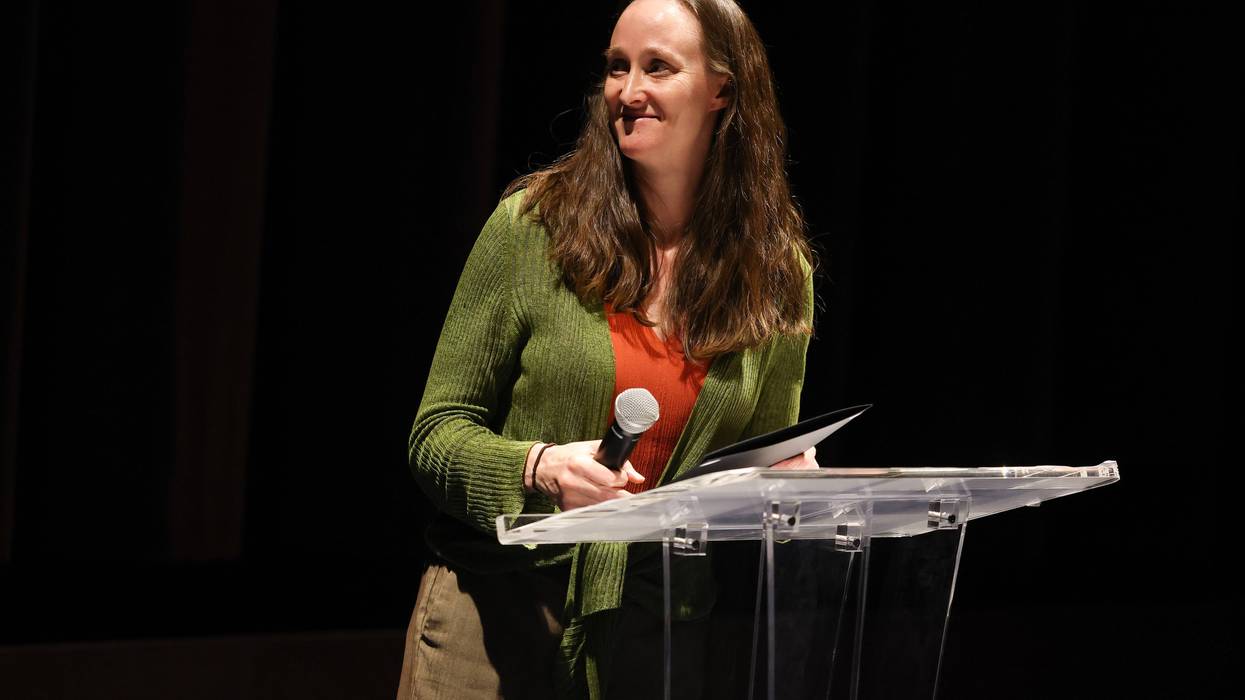
Seattle's City Council used a budget surplus to enact Wilson's proposal to provide free breakfast and lunch to 49,000 public school students.
Seattle's public school students will be eating for free this year after the City Council approved $3.6 million in funding for school breakfast and lunch this week.
It was the realization of a proposal made in April by Seattle's democratic socialist mayor, Katie Wilson, to expand the city's targeted school lunch program to cover all students.
The council had rejected the proposal earlier this summer in favor of an approach that delayed the school lunch program by a year and narrowly focused on expanding access for only the lowest-income students, which opponents argued still left many hungry kids with nothing.
That plan was met with immediate backlash, and the council swiftly changed course. On Tuesday, it voted unanimously to reallocate surplus funds from an affordable housing redevelopment project to fund a universal school meal program.
In addition to providing free breakfast and lunch to Seattle's roughly 49,000 public school students beginning next month, the new program will also provide more support to low-income students during weekends and school vacations.
The program is expected to extend well into the future, with funding in 2027-28 coming from an education levy voters approved in November. After that, Washington's new "high-earners" tax is expected to kick in, and students across the entire state will enjoy free meals, though that tax still faces legal challenges.
Wilson called the plan "a tremendous victory for families across our city that will make Seattle more affordable."
The plan fulfills a key campaign promise for Wilson, who came into office in November on the same wave of progressive enthusiasm as New York City's democratic socialist mayor, Zohran Mamdani.
Also on Tuesday, the City Council approved Wilson's legislation banning rental junk fees—including administrative service fees, pet rent, and package fees.

"We are feverishly fundraising and talking to the board about the need to provide grants, but in reality, we are limited," said the executive director of the Central Illinois Food Bank.
Food banks across the US, from New Mexico to Oregon to Illinois, are seeing massive increases in demand as the unprecedented federal nutrition aid cuts that President Donald Trump signed into law last summer take hold, stripping benefits from millions of Americans amid elevated grocery costs—a recipe for disaster.
"Our freezers are getting empty," Eddie Nelson, the manager of a food bank in Dallas, Oregon, told an Oregon Public Broadcasting reporter earlier this week. The outlet noted that the line for the food bank "stretches out the door and around the corner at the end of the month, when federal food stamp benefits dry up and families struggle to fill their pantries."
An estimated 4.5 million people, including roughly 1.5 million children, have lost Supplemental Nutrition Assistance Program (SNAP) benefits since the Trump-GOP budget law took effect last year, enshrining around $200 billion in cuts—the largest in the program's history—as well as new work reporting requirements that are expected to put millions more at risk of losing aid.
The large-scale loss of benefits and expectations of even more hardship in the near future have heavily strained local food banks.
Pam Molitoris, executive director of the Central Illinois Food Bank, said during a panel discussion last month that his organization "cannot absorb" the damage from the federal nutrition cuts, noting that "we are one meal to every nine meals provided by SNAP."
"We are feverishly fundraising and talking to the board about the need to provide grants, but in reality, we are limited," said Molitoris.
Roadrunner Food Bank in Albuquerque, New Mexico said it has seen a massive increase in demand this year as the combination of aid cuts and a worsening cost-of-living crisis forces families to seek out charities for assistance. More than 18,000 people lost SNAP benefits in New Mexico between July 2025 and April 2026, according to a tracker maintained by the Center on Budget and Policy Priorities.
“You could look at it like SNAP is the first line of defense against food insecurity in our country; food banks are the last line of defense," Jason Riggs, Roadrunner's director of advocacy, said earlier this week. "So the idea is we need both."
Feeding America, a nonprofit network of hundreds of food banks, says the Trump-GOP cuts to SNAP equate to up to 9 billion meals lost per year—"more than the entire Feeding America network of food banks, meal programs, and church pantries provided last year."
In the face of growing evidence of the damage their cuts have inflicted on communities across the US, Republican lawmakers have shown no inclination to seriously mitigate the impacts—much less reverse the funding reductions. GOP senators are currently working to advance a farm bill that would only delay for one year the Republican budget law's potentially catastrophic shift of a significant portion of SNAP costs to states.
Earlier this month, the Republican farm legislation failed to advance out of committee due to Democratic opposition and the absence of Sen. Mitch McConnell (R-Ky.).
"While it is a step in the right direction to give states more time to implement the benefit cost-share, increasing the SNAP cost for states in exchange for a one year delay only increases the unprecedented burden on states. Children will suffer as a result," said George Kelemen, senior vice president of the No Kid Hungry campaign. "Already, 4.5 million people, including over a million kids, have lost access to SNAP over the past year."
"Those families are now missing out on the nutritious food SNAP provides," Kelemen added, "and sadly that number will only grow under this proposal."
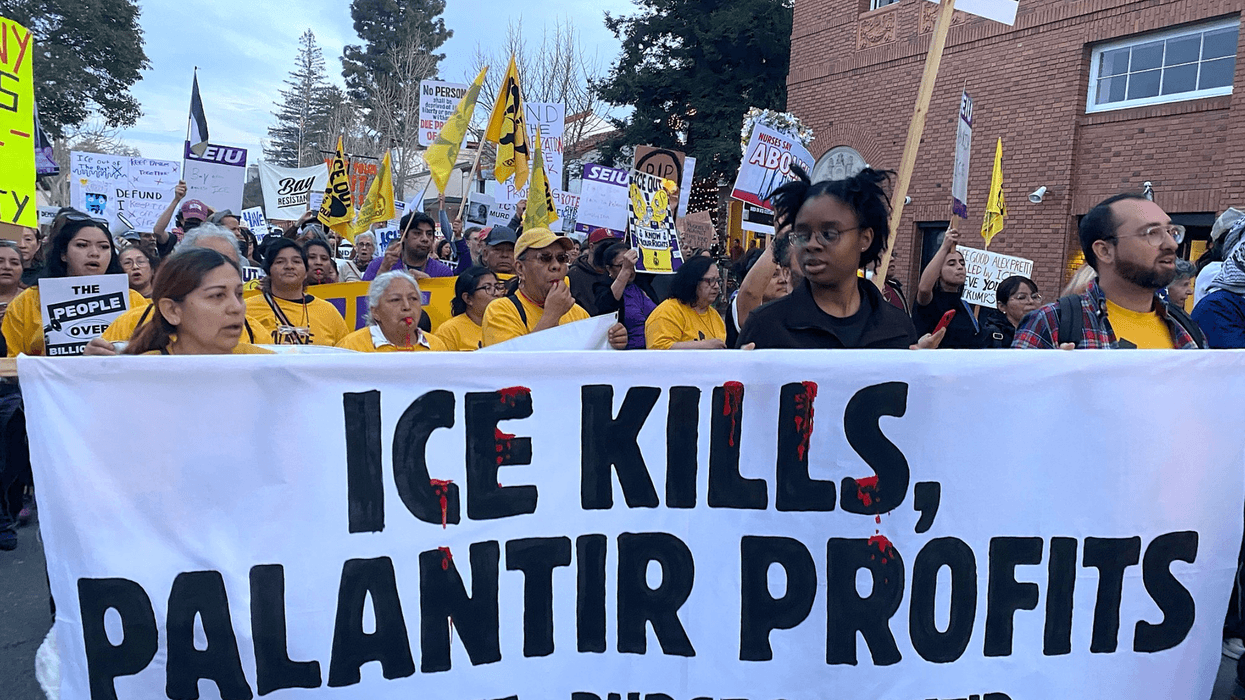
Not only does the partnership "create an inherent conflict of interest," it "fails the journalists who have been assaulted and falsely arrested while covering immigration enforcement actions and protests."
More than 800 unionized journalists and other media workers at USA Today Co. demanded this week that the nation’s largest newspaper chain abandon a newly announced partnership with surveillance tech giant Palantir to collect and analyze reader data, warning that the deal threatens privacy, public trust, and newsroom independence.
USA Today Co. chair Mike Reed told investors during an August 6 meeting that the company, formerly known as Gannett, is working with Palantir to “drive more effective and faster monetization across our platform" by using its software to collect and analyze reader data. Reed did not say how long USA Today had been using the software.
In a statement released earlier this week, workers represented by The NewsGuild-CWA said they were “shocked” by the company’s decision to partner with the controversial data analytics firm. Thirty-one unions representing employees across USA Today Co. publications have called on management to immediately terminate the agreement.
"We have significant ethical issues with Palantir, whose artificial intelligence (AI) software has been used to advance widespread surveillance and power immigration crackdowns," the union said. "Not only does partnering with Palantir, a major player in the news we cover, create an inherent conflict of interest, but it fails the journalists who have been assaulted and falsely arrested while covering immigration enforcement actions and protests."
Journalists are committed to upholding First Amendment principles to serve the democratic process. That’s in direct contrast with a company like Palantir, whose cofounder, Peter Thiel, once said freedom and democracy were not compatible. newsguild.org/usa-today-jo...
[image or embed]
— The NewsGuild-CWA (@newsguild.org) August 10, 2026 at 9:02 AM
"USA Today Co. has provided minimal details about this partnership and the parameters of its agreement with Palantir," the statement continues. "We have serious concerns and questions about how readers’ personal information and data will be used under this partnership and how their data would be protected. Without answers, how can journalists encourage readers to subscribe to our news outlets?"
The journalists noted that billionaire Palantir co-founder Peter Thiel—who "once said freedom and democracy were not compatible"—is responsible for products tied to human rights abuses and privacy violations.
"Technologists and even former employees have warned that it’s not far-fetched to imagine a future where Palantir’s AI technology is used to surveil American citizens and target dissidents," their statement notes. "And throughout history, journalists are often the first to be targeted."
"These concerns should be reason enough for USA Today Co. to steer clear," the journalists asserted. "This partnership with Palantir arrives as USA Today Co. executives dive headfirst into AI without sufficient regard for workers or the public after decimating newsrooms across the country."
"We will continue pushing back on ill-planned attempts to force AI into our newsrooms and onto our readers, who deserve quality, human-led journalism," they added. "We will advocate for the responsible use of new technologies when it emboldens our journalists and their work instead of shamelessly promoting AI to support profit-driven corporate edicts."
News organizations increasingly operate not just as publishers, but as data collection businesses. The USA Today journalists' concerns come against a backdrop of increasingly sophisticated tracking across digital news. USA Today Co.'s own public Data Collection Explorer shows that the company already operates an extensive system for collecting, routing, and analyzing user data across its publications and platforms, including through third-party analytics vendors.
Mike Davis, a reporter for the Asbury Park Press—a USA Today Co. newspaper in southern New Jersey—told NiemanLab that “part of the problem" with the Palantir partnership "is that we know very, very little" about how the company's software is being used.
“It’s pretty surprising that our company would unilaterally decide to bring in such a controversial partner like Palantir without providing a complete explanation to its employees, most of whom are naturally skeptical journalists," Davis said.
“An investigative reporter who keeps a ton of sensitive notes, source information, and confidential documents on their devices is going to be naturally concerned about protecting that information, and who could blame them?” he added. “It’s pretty hard to trust management’s intentions when the goalposts shift so often that there’s always a fear that what’s true today won’t be true in six months. We’ve all seen the years of disinvestment in local news, especially in the name of going all-in on AI.”

"I go after what I want, but maybe that’s what they don’t like," said the congresswoman.
It's been five days since US Rep. Alexandria Ocasio-Cortez, a potential 2028 presidential contender, went public with her decision to freeze her eggs.
But the response from right-wing influencers and operatives has already given her an opportunity to turn the discussion of her fertility into one that addresses Republican policies driving the affordability crisis, questions how committed the right really is to "freedom," and points out conservatives' hypocrisy when they urge women to "have babies younger"—while applying little of the same pressure to young men.
Ocasio-Cortez (D-NY) announced her decision to freeze her eggs last Sunday with the first in a series of Instagram videos in which her nearly 10 million followers have been able to follow along as she injects hormones and attends ultrasound appointments in preparation for the procedure—all while appearing on news programs to discuss foreign and domestic policy and talking to her followers about the side effects as well as the cost of fertility preservation treatment.
"I want you all to see that, because women can do anything,” Ocasio-Cortez, often known as AOC, told her followers. “And I think it’s badass that I’m going to be, you know, giving myself shots in the greenroom, get my glam on, roll out, talk about international events, domestic policy, elections, pop out, live my life, do my thing.”
Right-wing commentators who have bemoaned low birth rates and attacked liberal women for buying "into the feminist lie and spend[ing] their childbearing years climbing the career ladder," as podcaster Katie Miller said, immediately pounced on AOC's decision.
Allie Beth Stuckey, a popular right-wing podcaster and author of the books Toxic Empathy and You're Not Enough (And That's Okay), the latter of which warned against "the toxic culture of self-love," responded to the 36-year-old progressive congresswoman's videos with a list of reasons she should have already had children. She accused AOC of being "selfish and irresponsible" for potentially becoming a mother after 40 and said she was "glamorizing the lie that women can have it all."
Miller, the wife of President Donald Trump's homeland security adviser, Stephen Miller, allowed that "we should celebrate" a woman's efforts to have children in the future, but said that “more women should get married and have babies younger," while a spokesperson for Turning Point USA, the right-wing group founded by the late Charlie Kirk, said AOC's fertility decisions were a "cautionary tale" for women.
Meanwhile, conspiracy theorist Laura Loomer, who is said to have considerable influence in the White House, announced that AOC had "failed as a woman" and had “wasted her entire 30s living with a man pretending to be engaged when she could have gotten married and had a baby." (It was reported this week that AOC's long-term relationship had ended.)
Some conservatives questioned whether attacking the popular, social media-savvy lawmaker over her desire to have children was a wise move for the MAGA movement, with one former Office of the Director of National Intelligence official, Alexa Henning, telling The Times in the UK that "dunking on AOC for freezing her eggs is not a winning message with women voters."
On Thursday evening, Ocasio-Cortez suggested Henning was right to be concerned, as she posted her latest Instagram video on the topic.
She said she has found "the freak-out" around her egg-freezing process to be "pretty funny," because "my choice is a threat to them."
"Despite the rhetoric they use and the bald eagles that they plaster all over the place, they actually really do not believe in a free country," said AOC. "Very aggressively do not believe in a free country, because they attack everyone who exercises their freedom to choose all sorts of lives... They attack those who choose the life that they don't lead or a life that they don't approve of."
"And people say you’re peddling this 'dangerous lie that women can have it all.' You know, maybe in life you can’t have everything, but here’s the secret: You can have a hell of a lot. And I am very grateful for my life. I go after what I want, but maybe that’s what they don’t like either," she continued, before shrugging: "Too bad for them."
AOC: I also find the freakout around it pretty funny as well. I’m not gonna lie. A commentator that was like, “What she’s doing is peddling the dangerous lie that women can have it all.” Can you believe that?
What I find funny is that my choice is a threat to them. Despite the… pic.twitter.com/rwpPL8YH0F
— Acyn (@Acyn) August 14, 2026
She emphasized that the procedure "is not a guarantee" that she'll be able to use the eggs to have children later in life, but said the process had relieved "a certain amount of anxiety or stress that can come with feeling like you are in a race against biology that men simply don't have to engage in."
She then took aim at commentators like Stuckey and Miller for directing their pronatalist pressure campaigns disproportionately at young women.
"In straight relationships, who are you supposed to be having babies with?" said AOC. "They aren't pressuring men to be ready to have a baby young, as the way that they are pressuring women to have a baby when they're young."
AOC: For all of these right-wing people who are harping about women having to and needing to have families at a young age—and again, if that’s your choice, that’s amazing—but they are doing nothing to make sure that men in their culture respect and value women.
In fact, many of… pic.twitter.com/ox70tJzth1
— Acyn (@Acyn) August 14, 2026
The congresswoman then suggested that while Erika Kirk, Charlie Kirk's widow and now the CEO of Turning Point USA, recently told a crowd of young college graduates to "have more kids than you can afford," financial concerns may play a role in falling birthrates and delayed parenthood. Housing unaffordability has soared to record highs in recent years, while Trump's tariff policies and war in Iran have contributed to rising costs for groceries, gas, and other essentials. Republicans have also attacked government healthcare programs including Medicaid and Affordable Care Act subsidies, and about a third of Americans reported cutting back on spending in order to afford healthcare last year.
"The basics are more expensive than they've ever been," said Ocasio-Cortez. "For a lot of people, we would have kids at a much younger age if the conditions were right, if women got paid equally, and if people in general were paid enough and things were affordable enough that you feel like you could comfortably provide for a child."
With her series of videos, said Amanda Litman, executive director of the political action committee Run for Something, AOC had opened up "a larger conversation on women, ambition, family, gender politics, and so much more."
Journalist Zaid Jilani suggested right-wing commentators had fallen into a trap: "Intentionally or unintentionally she got the Republicans to act really weird."
The response from influential commentators on the right "is why her allies think she could run for the White House," wrote Katy Balls, Washington editor for The Times. "Her ability to set the terms of debate and trigger the right just as Trump does the left."