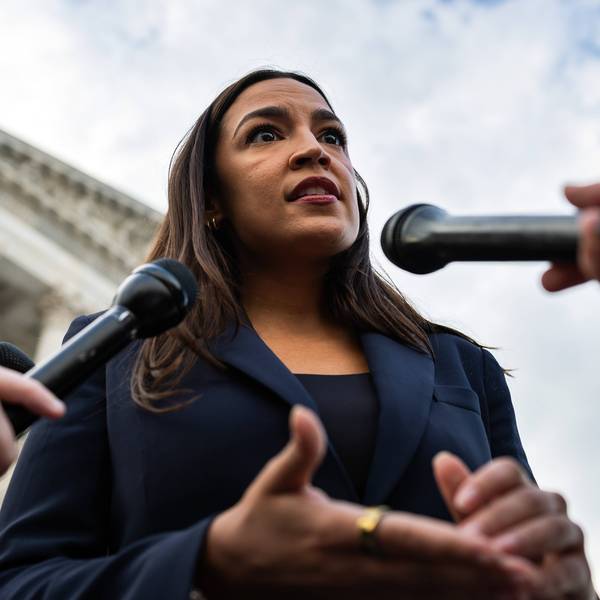


US Senate Minority Leader Chuck Schumer (D-NY) (L) and House Minority Leader (D-NY) attend a press conference on Department of Homeland Security (DHS) funding at the US Capitol on February 4, 2026 in Washington, DC.
Fresh Fury as Schumer, Jeffries Bend on Demand to Unmask ICE Agents in Funding Talks
"Schumer needs to get the hell out," said Rep. Delia Ramirez. "He continues to demonstrate to us that he can't meet the moment."
Democratic leaders in Congress are already backing down on one of their key demands in the fight to reform the federal immigration agencies terrorizing Minnesota and other parts of the country.
On Wednesday, Democrats laid out a list of 10 "guardrails" they said they wanted to see put in place to protect the public from abuses by Immigration and Customs Enforcement (ICE) and Customs and Border Protection (CBP) agents, before agreeing to a new round of funding for their parent agency, the Department of Homeland Security (DHS).
The list called to "prohibit ICE and immigration agents from wearing face coverings" to conceal their identities, which Democratic leaders have stressed as a key reform for weeks.
But during a press conference on Wednesday, House Minority Leader Hakeem Jeffries (D-NY) and Senate Minority Leader Chuck Schumer (D-NY) raised many eyebrows when they introduced a heap of caveats to their demand.
“I think there’s agreement that no masks should be deployed in an arbitrary and capricious fashion, as has been the case, horrifying the American people,” Jeffries said.
Schumer added that agents “need identification and no masks, except in extraordinary and unusual circumstances.”
When a HuffPost reporter attempted to ask Schumer if the party had changed its position on masks, Schumer sidestepped the question. But other top Democrats clarified that they were looking at certain exceptions.
Sen. Chris Murphy (D-Conn.) said that while masks should generally be "prohibited by law" as a part of everyday enforcement, there are "sometimes safety reasons why you may need a mask."
Rep. Rosa DeLauro (D-Conn.), who went against the majority of the party earlier this week to vote for two weeks of DHS funding to keep the government open, said they were discussing when to implement "narrow exceptions" with members of law enforcement and suggested that "dealing with a cartel" could be one of them.
Of course, the Trump administration has often asserted that all the immigrants they target are dangerous criminals—"the worst of the worst"—including cartel members, even when this is not the case, raising questions about who might be in charge of determining when masks are necessary.
Critics have been underwhelmed by many of the other demands on the list as well.
Journalist and commentator Adam Johnson said it was a collection of “mostly cosmetic, pointless, unenforceable, or actively harmful ‘reforms,’” with some—including the requirement for judicial warrants and a ban on racial profiling—already being mandated by the Constitution but flouted by agents regardless.
He described it as outrageous that Democrats were demanding "zero reduction in DHS’ obscene budget which... tripled, just 12 months ago."
Civil rights lawyer Alec Karakatsanis, the founder of the group Civil Rights Corps, called the list "one of the great political failures of our time" and said "it must be immediately denounced by all people of goodwill."
Meanwhile, Axios reported on Thursday that many rank-and-file members of the Democratic caucus are fuming over party leadership's refusal earlier this week to use the threat of a government shutdown to force reforms.
Rep. Pramila Jayapal, the CPC's chair emerita, pondered "'What are we going to get in 10 days that we didn't get?'"
"Every time that we are winning, we seem to somehow sabotage [it]," said Rep. Delia Ramirez (D-Ill.), a member of the Congressional Progressive Caucus (CPC).
She noted that House Speaker Mike Johnson (R-La.) has already ruled out several Democratic demands, including the requirement of judicial warrants.
ICE agents do not need a warrant to make arrests, but the Fourth Amendment prohibits them from entering private residences without a judicial warrant. An internal memo last month advised agents to ignore that law. Johnson said this week that requiring federal agents to obtain judicial warrants is "a road we cannot and should not go down.”
Other Democrats anonymously expressed their distrust in Schumer, who has caved in other hugely consequential fights in the second Trump era, most recently regarding the extension of Affordable Care Act subsidies during last fall’s record-breaking government shutdown, which left tens of millions of Americans facing doubled health insurance premiums.
"The main feeling among members is a lack of trust in his strength and ability to strike a hard bargain," one anonymous Democrat said.
Another said, “All those spending bills, that is the most leverage,” adding that “many folks in the [House] Democratic caucus wish that we had more confidence in Schumer’s ability to navigate a good, tough deal.”
Sixty votes will be required for a deal to pass the Senate, meaning at least seven Democrats will need to join Republicans for DHS to receive full funding and avoid shutting down on February 14.
While this still gives Democrats some leverage to push demands, Ramirez said previous fights give her zero confidence in Schumer's willingness to hold the line.
"I'm gonna continue to tell you that Schumer needs to get the hell out over and over and over until he does," Ramirez said. "He continues to demonstrate to us that he can't meet the moment."
We are at a crossroads
This country and this world are at a monumental crossroads. In a few short weeks, US voters will have an opportunity to beat back the forces of fascism and confront the billionaires who are rigging the economy, our media system, and our democracy, making it increasingly impossible for ordinary people to get by. We’re not just talking about the election. We’re talking about what must be done once these fascist elements are vanquished from power. We need a bolder set of solutions than what either major party has so far been willing to offer and a working-class movement ready to fight like hell for it. Trump didn't emerge from nowhere. The conditions that fueled MAGA authoritarianism were created by decades of radical neoliberal economic policies and a corrupt political system dominated by corporate interests. They slashed taxes on the super-rich, promising that the benefits would trickle down. They said giveaways to the corporate titans would make life more affordable for the rest of us. It was all bullshit. And when a bitter, betrayed populace searches for someone to blame, right-wing demagogues have little trouble finding scapegoats. People know when they're being lied to, but you won't hear any of this from the corporate media. Only independent journalism—powered and funded by people who believe in building a better world—can deliver truly trustworthy daily news. Our Fall Campaign is underway, and we need your help. To power our newsroom through the rest of the year, we need to raise $125,000 by midnight on October 31. So if you share our vision, please contribute whatever you can to sustain our work. |
Democratic leaders in Congress are already backing down on one of their key demands in the fight to reform the federal immigration agencies terrorizing Minnesota and other parts of the country.
On Wednesday, Democrats laid out a list of 10 "guardrails" they said they wanted to see put in place to protect the public from abuses by Immigration and Customs Enforcement (ICE) and Customs and Border Protection (CBP) agents, before agreeing to a new round of funding for their parent agency, the Department of Homeland Security (DHS).
The list called to "prohibit ICE and immigration agents from wearing face coverings" to conceal their identities, which Democratic leaders have stressed as a key reform for weeks.
But during a press conference on Wednesday, House Minority Leader Hakeem Jeffries (D-NY) and Senate Minority Leader Chuck Schumer (D-NY) raised many eyebrows when they introduced a heap of caveats to their demand.
“I think there’s agreement that no masks should be deployed in an arbitrary and capricious fashion, as has been the case, horrifying the American people,” Jeffries said.
Schumer added that agents “need identification and no masks, except in extraordinary and unusual circumstances.”
When a HuffPost reporter attempted to ask Schumer if the party had changed its position on masks, Schumer sidestepped the question. But other top Democrats clarified that they were looking at certain exceptions.
Sen. Chris Murphy (D-Conn.) said that while masks should generally be "prohibited by law" as a part of everyday enforcement, there are "sometimes safety reasons why you may need a mask."
Rep. Rosa DeLauro (D-Conn.), who went against the majority of the party earlier this week to vote for two weeks of DHS funding to keep the government open, said they were discussing when to implement "narrow exceptions" with members of law enforcement and suggested that "dealing with a cartel" could be one of them.
Of course, the Trump administration has often asserted that all the immigrants they target are dangerous criminals—"the worst of the worst"—including cartel members, even when this is not the case, raising questions about who might be in charge of determining when masks are necessary.
Critics have been underwhelmed by many of the other demands on the list as well.
Journalist and commentator Adam Johnson said it was a collection of “mostly cosmetic, pointless, unenforceable, or actively harmful ‘reforms,’” with some—including the requirement for judicial warrants and a ban on racial profiling—already being mandated by the Constitution but flouted by agents regardless.
He described it as outrageous that Democrats were demanding "zero reduction in DHS’ obscene budget which... tripled, just 12 months ago."
Civil rights lawyer Alec Karakatsanis, the founder of the group Civil Rights Corps, called the list "one of the great political failures of our time" and said "it must be immediately denounced by all people of goodwill."
Meanwhile, Axios reported on Thursday that many rank-and-file members of the Democratic caucus are fuming over party leadership's refusal earlier this week to use the threat of a government shutdown to force reforms.
Rep. Pramila Jayapal, the CPC's chair emerita, pondered "'What are we going to get in 10 days that we didn't get?'"
"Every time that we are winning, we seem to somehow sabotage [it]," said Rep. Delia Ramirez (D-Ill.), a member of the Congressional Progressive Caucus (CPC).
She noted that House Speaker Mike Johnson (R-La.) has already ruled out several Democratic demands, including the requirement of judicial warrants.
ICE agents do not need a warrant to make arrests, but the Fourth Amendment prohibits them from entering private residences without a judicial warrant. An internal memo last month advised agents to ignore that law. Johnson said this week that requiring federal agents to obtain judicial warrants is "a road we cannot and should not go down.”
Other Democrats anonymously expressed their distrust in Schumer, who has caved in other hugely consequential fights in the second Trump era, most recently regarding the extension of Affordable Care Act subsidies during last fall’s record-breaking government shutdown, which left tens of millions of Americans facing doubled health insurance premiums.
"The main feeling among members is a lack of trust in his strength and ability to strike a hard bargain," one anonymous Democrat said.
Another said, “All those spending bills, that is the most leverage,” adding that “many folks in the [House] Democratic caucus wish that we had more confidence in Schumer’s ability to navigate a good, tough deal.”
Sixty votes will be required for a deal to pass the Senate, meaning at least seven Democrats will need to join Republicans for DHS to receive full funding and avoid shutting down on February 14.
While this still gives Democrats some leverage to push demands, Ramirez said previous fights give her zero confidence in Schumer's willingness to hold the line.
"I'm gonna continue to tell you that Schumer needs to get the hell out over and over and over until he does," Ramirez said. "He continues to demonstrate to us that he can't meet the moment."
- 'This Is Authoritarianism': Lawmakers Demand Release of Abducted Tufts Student ›
- Schumer Accused of 'Downright Complicity' as ICE Reform Plan Draws Backlash ›
- Senate GOP Rejects Sanders Amendment to Give ICE's Extra $75 Billion to Medicaid ›
- Fury Grows Over Democrats Who Won't Back ICE Funding Freeze ›
- Opinion | Unmasking ICE | Common Dreams ›
- Opinion | The ICE Barbarians Are at the Gates | Common Dreams ›
Democratic leaders in Congress are already backing down on one of their key demands in the fight to reform the federal immigration agencies terrorizing Minnesota and other parts of the country.
On Wednesday, Democrats laid out a list of 10 "guardrails" they said they wanted to see put in place to protect the public from abuses by Immigration and Customs Enforcement (ICE) and Customs and Border Protection (CBP) agents, before agreeing to a new round of funding for their parent agency, the Department of Homeland Security (DHS).
The list called to "prohibit ICE and immigration agents from wearing face coverings" to conceal their identities, which Democratic leaders have stressed as a key reform for weeks.
But during a press conference on Wednesday, House Minority Leader Hakeem Jeffries (D-NY) and Senate Minority Leader Chuck Schumer (D-NY) raised many eyebrows when they introduced a heap of caveats to their demand.
“I think there’s agreement that no masks should be deployed in an arbitrary and capricious fashion, as has been the case, horrifying the American people,” Jeffries said.
Schumer added that agents “need identification and no masks, except in extraordinary and unusual circumstances.”
When a HuffPost reporter attempted to ask Schumer if the party had changed its position on masks, Schumer sidestepped the question. But other top Democrats clarified that they were looking at certain exceptions.
Sen. Chris Murphy (D-Conn.) said that while masks should generally be "prohibited by law" as a part of everyday enforcement, there are "sometimes safety reasons why you may need a mask."
Rep. Rosa DeLauro (D-Conn.), who went against the majority of the party earlier this week to vote for two weeks of DHS funding to keep the government open, said they were discussing when to implement "narrow exceptions" with members of law enforcement and suggested that "dealing with a cartel" could be one of them.
Of course, the Trump administration has often asserted that all the immigrants they target are dangerous criminals—"the worst of the worst"—including cartel members, even when this is not the case, raising questions about who might be in charge of determining when masks are necessary.
Critics have been underwhelmed by many of the other demands on the list as well.
Journalist and commentator Adam Johnson said it was a collection of “mostly cosmetic, pointless, unenforceable, or actively harmful ‘reforms,’” with some—including the requirement for judicial warrants and a ban on racial profiling—already being mandated by the Constitution but flouted by agents regardless.
He described it as outrageous that Democrats were demanding "zero reduction in DHS’ obscene budget which... tripled, just 12 months ago."
Civil rights lawyer Alec Karakatsanis, the founder of the group Civil Rights Corps, called the list "one of the great political failures of our time" and said "it must be immediately denounced by all people of goodwill."
Meanwhile, Axios reported on Thursday that many rank-and-file members of the Democratic caucus are fuming over party leadership's refusal earlier this week to use the threat of a government shutdown to force reforms.
Rep. Pramila Jayapal, the CPC's chair emerita, pondered "'What are we going to get in 10 days that we didn't get?'"
"Every time that we are winning, we seem to somehow sabotage [it]," said Rep. Delia Ramirez (D-Ill.), a member of the Congressional Progressive Caucus (CPC).
She noted that House Speaker Mike Johnson (R-La.) has already ruled out several Democratic demands, including the requirement of judicial warrants.
ICE agents do not need a warrant to make arrests, but the Fourth Amendment prohibits them from entering private residences without a judicial warrant. An internal memo last month advised agents to ignore that law. Johnson said this week that requiring federal agents to obtain judicial warrants is "a road we cannot and should not go down.”
Other Democrats anonymously expressed their distrust in Schumer, who has caved in other hugely consequential fights in the second Trump era, most recently regarding the extension of Affordable Care Act subsidies during last fall’s record-breaking government shutdown, which left tens of millions of Americans facing doubled health insurance premiums.
"The main feeling among members is a lack of trust in his strength and ability to strike a hard bargain," one anonymous Democrat said.
Another said, “All those spending bills, that is the most leverage,” adding that “many folks in the [House] Democratic caucus wish that we had more confidence in Schumer’s ability to navigate a good, tough deal.”
Sixty votes will be required for a deal to pass the Senate, meaning at least seven Democrats will need to join Republicans for DHS to receive full funding and avoid shutting down on February 14.
While this still gives Democrats some leverage to push demands, Ramirez said previous fights give her zero confidence in Schumer's willingness to hold the line.
"I'm gonna continue to tell you that Schumer needs to get the hell out over and over and over until he does," Ramirez said. "He continues to demonstrate to us that he can't meet the moment."
- 'This Is Authoritarianism': Lawmakers Demand Release of Abducted Tufts Student ›
- Schumer Accused of 'Downright Complicity' as ICE Reform Plan Draws Backlash ›
- Senate GOP Rejects Sanders Amendment to Give ICE's Extra $75 Billion to Medicaid ›
- Fury Grows Over Democrats Who Won't Back ICE Funding Freeze ›
- Opinion | Unmasking ICE | Common Dreams ›
- Opinion | The ICE Barbarians Are at the Gates | Common Dreams ›