

SUBSCRIBE TO OUR FREE NEWSLETTER
Daily news & progressive opinion—funded by the people, not the corporations—delivered straight to your inbox.
5
#000000
#FFFFFF
To donate by check, phone, or other method, see our More Ways to Give page.
Daily news & progressive opinion—funded by the people, not the corporations—delivered straight to your inbox.

Emily Robinson, 312-578-1750 ext. 15
For years, the biotechnology industry has trumpeted that it will feed
the world, promising that its genetically engineered crops will produce
higher yields.
That
promise has proven to be empty, according to a new report by the Union
of Concerned Scientists (UCS). Despite 20 years of research and 13
years of commercialization, genetic engineering has failed to
significantly increase U.S. crop yields.
"The
biotech industry has spent billions on research and public relations
hype, but genetically engineered food and feed crops haven't enabled
American farmers to grow significantly more crops per acre of land,"
said Doug Gurian-Sherman, a biologist in the UCS Food and Environment
Program and author of the report. "In comparison, traditional breeding
continues to deliver better results."
The
report, "Failure to Yield: Evaluating the Performance of Genetically
Engineered Crops," is the first to closely evaluate the overall effect
genetic engineering has had on crop yields in relation to other
agricultural technologies. It reviewed two dozen academic studies of
corn and soybeans, the two primary genetically engineered food and feed
crops grown in the United States.
Based on those studies, the UCS report concluded that genetically
engineering herbicide-tolerant soybeans and herbicide-tolerant corn has
not increased yields. Insect-resistant corn, meanwhile, has improved
yields only marginally. The increase in yields for both crops over the
last 13 years, the report found, was largely due to traditional
breeding or improvements in agricultural practices. (For the report, go
here.)
The UCS report comes at a time when food
price spikes and localized shortages worldwide have prompted calls to
boost agricultural productivity, or yield -- the amount of a crop
produced per unit of land over a specified amount of time.
Biotechnology companies maintain that genetic engineering is essential
to meeting this goal. Monsanto, for example, is currently running an
advertising campaign warning of an exploding world population and
claiming that its "advanced seeds . significantly increase crop
yields.." (For a pdf of the ad, go here.)
The UCS report debunks that claim, concluding that genetic engineering
is unlikely to play a significant role in increasing food production in
the foreseeable future.
The
biotechnology industry has been promising better yields since the
mid-1990s, but "Failure to Yield" documents that the industry has been
carrying out gene field trials to increase yields for 20 years without
significant results.
"After
more than 3,000 field trials, only two types of engineered genes are in
widespread use, and they haven't helped raise the ceiling on potential
yields," said Margaret Mellon, a microbiologist and director of UCS's
Food and Environment Program. "This record does not inspire confidence
in the future of the technology."
"Failure
to Yield" makes a critical distinction between potential -- or
intrinsic -- yield and operational yield, concepts that are often
conflated by the industry and misunderstood by others. Intrinsic yield
refers to a crop's ultimate production potential under the best
possible conditions. Operational yield refers to production levels
after losses due to pests, drought and other environmental factors.
The
study reviewed the intrinsic and operational yield achievements of the
three most common genetically altered food and feed crops in the United States: herbicide-tolerant soybeans, herbicide-tolerant corn and insect-resistant corn (known as Bt corn, after the bacterium Bacillus thuringiensis, whose genes enable the corn to resist several kinds of insects).
Herbicide-tolerant soybeans, herbicide-tolerant corn and Bt
corn have failed to increase intrinsic yields, the report found.
Herbicide-tolerant soybeans and herbicide-tolerant corn also have
failed to increase operational yields, compared with conventional
methods.
Meanwhile, the report found that Bt corn likely provides a marginal operational yield advantage of 3 to 4 percent over typical conventional practices. Since Bt
corn became commercially available in 1996, its yield advantage
averages out to a 0.2 to 0.3 percent yield increase per year. To put
that figure in context, overall U.S.
corn yields over the last several decades have annually averaged an
increase of approximately 1 percent, which is considerably more than
what Bt traits have provided.
In
addition to evaluating genetic engineering's record, "Failure to Yield"
considers the technology's potential role in increasing food production
over the next few decades. The report does not discount the possibility
of genetic engineering eventually contributing to increase crop yields.
It does, however, suggest that it makes little sense to support genetic
engineering at the expense of technologies that have proven to substantially increase yields, especially in many developing countries.
In addition, recent studies have shown that organic and similar farming
methods that minimize the use of pesticides and synthetic fertilizers
can more than double crop yields at little cost to poor farmers in such
developing regions as Sub-Saharan Africa.
The
report recommends that the U.S. Department of Agriculture, state
agricultural agencies, and universities increase research and
development for proven approaches to boost crop yields. Those
approaches should include modern conventional plant breeding methods,
sustainable and organic farming, and other sophisticated farming
practices that do not require farmers to pay significant upfront costs.
The report also recommends that U.S. food aid organizations make these more promising and affordable alternatives available to farmers in developing countries.
"If
we are going to make headway in combating hunger due to overpopulation
and climate change, we will need to increase crop yields," said
Gurian-Sherman. "Traditional breeding outperforms genetic engineering
hands down."
The Union of Concerned Scientists is the leading science-based nonprofit working for a healthy environment and a safer world. UCS combines independent scientific research and citizen action to develop innovative, practical solutions and to secure responsible changes in government policy, corporate practices, and consumer choices.
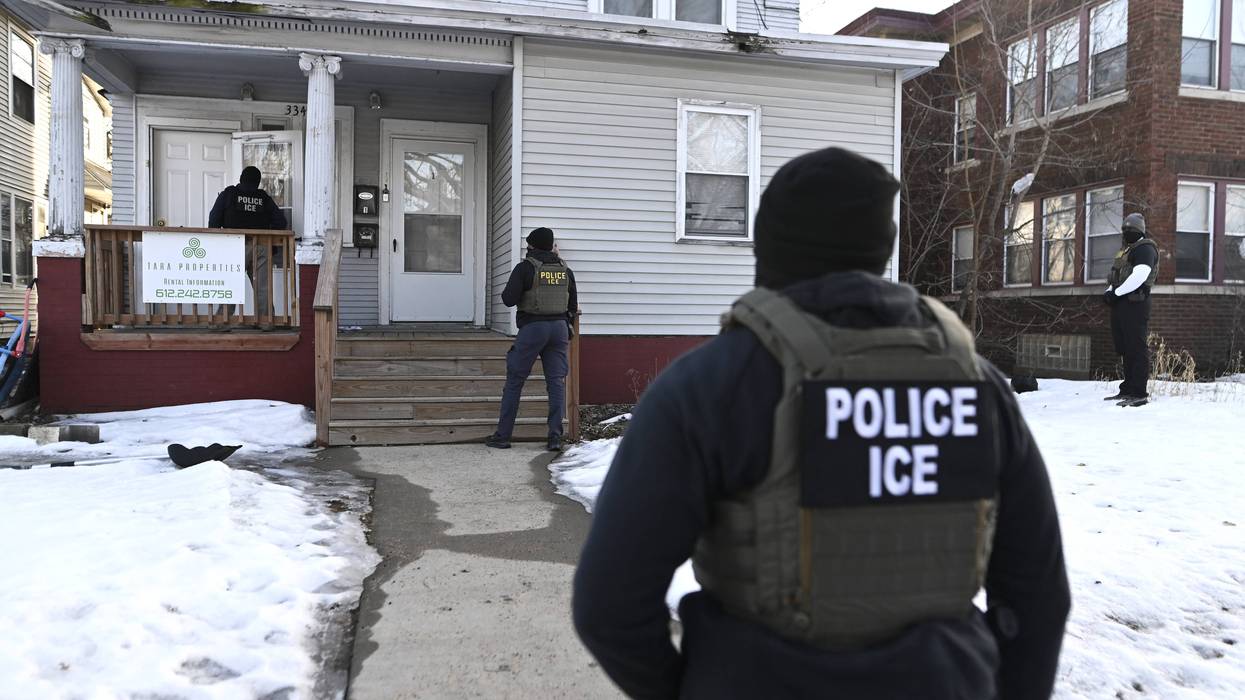
Officials, said one observer, "are finally starting to call the terror ICE is inflicting on communities what it actually is: kidnapping."
Prosecutors in Minnesota are investigating whether some of the most infamous images of the Trump administration's immigration crackdown in the Twin Cities earlier this year actually captured a kidnapping, when US citizen ChongLy "Scott" Thao was filmed being taken from his home by federal agents in freezing temperatures, wearing only his underwear with a blanket wrapped around him.
Ramsey Country Attorney John Choi, whose jurisdiction covers Saint Paul, where Thao was arrested in January, said at a press conference Monday that he has requested information from the Department of Homeland Security about the man's arrest.
"There are many facts we don't know yet, but there's one that we do know. And that is that Mr. Thao is and has been an American citizen. There's not a dispute over that," Sheriff Bob Fletcher said at the press conference.
The officials said they are investigating whether the agents could face criminal charges for kidnapping, burglary, and false imprisonment.
US Immigration and Customs Enforcement agents arrived without a warrant at the home Thao shares with his son, daughter-in-law, and four-year-old grandson on January 18 and forced their way in, brandishing their guns at the family as they handcuffed Thao.
They did not allow Thao's daughter-in-law to get proof of his citizenship. The 56-year-old has been a US citizen for decades after his mother fled Laos in the 1970s.
“We believe there was no legitimate legal reason for the federal agents to enter that home, it was not supported by probable cause,” said Choi.
Without giving him a chance to get dressed, the agents then hauled Thao out of his home into the 14°F temperatures as his neighbors yelled and blew whistles at the officers, demanding his release.
ICE arrest of US CITIZEN probed as kidnapping
ChongLy ‘Scott’ Thao seized Jan 18 — agents smash down door, drag him out at gunpoint in underwear
'Potential case of kidnapping, burglary and false imprisonment' — officials pic.twitter.com/alsaq46bAz
— RT (@RT_com) April 14, 2026
They drove him around for nearly an hour before arriving at a remote area and demanding that he get out of the car and show his ID—which he hadn't been allowed to bring. They determined he was a US citizen with no criminal record and drove him back home.
Fletcher said federal agents switched the license plates of the vehicle used during the arrest, violating Minnesota law and leaving authorities with no knowledge of the identities of the officers who arrested Thao.
"There's no dispute that he was taken out of his house, forcibly taken out of his home, and driven around," said Fletcher at the press conference. "Is that good law enforcement, to take an American citizen out of their home and drive them around aimlessly, trying to determine what they can tell them?'"
One observer said the officials "are finally starting to call the terror ICE is inflicting on communities what it actually is: kidnapping."
"If regular people did this, they’d be in prison," they said. "So why aren’t the agents?"
In keeping with the Trump administration's response to widespread condemnation of its immigration crackdown and the conduct of its federal agents, DHS told The New York Times that Choi's investigation into the arrest was “a political stunt to demonize ICE law enforcement.”
The agency has claimed the officers were looking for two convicted sex offenders, one of whom has reportedly been in state prison since 2024.
Choi said Monday that there is no evidence the federal agents had a judicial warrant to enter Thao's home. The arrest took place days before a whistleblower group reported on an ICE memo which claimed that according to the DHS Office of the General Counsel, "the US Constitution, the Immigration and Nationality Act, and the immigration regulations do not prohibit relying on administrative warrants" in order to enter a home to make an arrest.
Legal experts have said the memo directly contradicts the Fourth Amendment, which prohibits unreasonable searches and seizures.

The attack was announced hours after Trump threatened Iranian vessels near the Strait of Hormuz with "the same system of kill that we use against the drug dealers on boats at Sea."
The US military on Monday attacked a vessel in the eastern Pacific accused, without evidence, of engaging in "narco-trafficking operations." The strike killed at least two people and brought the known death toll from the Trump administration's lawless boat-bombing spree in international waters to more than 170.
As has been its custom since the boat bombings began last September, US Southern Command posted an unclassified video clip of the attack on social media. SOUTHCOM described the bombing as "a lethal kinetic strike on a vessel operated by Designated Terrorist Organizations," but did not provide any evidence against the boat's operators.
Monday's deadly strike came days after the April 11 US bombings of two other boats in the eastern Pacific, attacks that killed at least five people. United Nations experts and human rights organizations have condemned the bombings in international waters as extrajudicial killings and murder—and argued those ordering and carrying out the attacks should be prosecuted for homicide.
"More murder," The Intercept's Nick Turse wrote in response to Monday's boat bombing.
Hours before SOUTHCOM announced the latest strike, Turse reported that the Trump administration is "waging a pressure campaign against the leading inter-American human rights watchdog to squash a potential investigation into illegal US attacks on boats in the Caribbean Sea and the Pacific Ocean."
Brian Finucane, a senior adviser to the US Program at the International Crisis Group, said Monday that it is "funny how the Trump administration is very happy to continue to post snuff films of these lawless killings but not defend the legal merits of these strikes."
Last month, the Inter-American Commission on Human Rights held a hearing during which experts testified to the illegality of the boat strikes.
“The administration’s desire to play imperial superpower in the region cannot be a reason to completely displace the foundations of international law," Angelo Guisado, senior staff attorney at the Center for Constitutional Rights, told the commission.
On Monday, US President Donald Trump threatened to expand his administration's illegal boat-bombing spree to Iranian vessels that "come anywhere close" to the US naval blockade of the Strait of Hormuz that the president ordered over the weekend.
Trump wrote on social media that Iranian vessels seen approaching the blockade "will be immediately ELIMINATED, using the same system of kill that we use against the drug dealers on boats at Sea."
"It is quick and brutal," the president added.
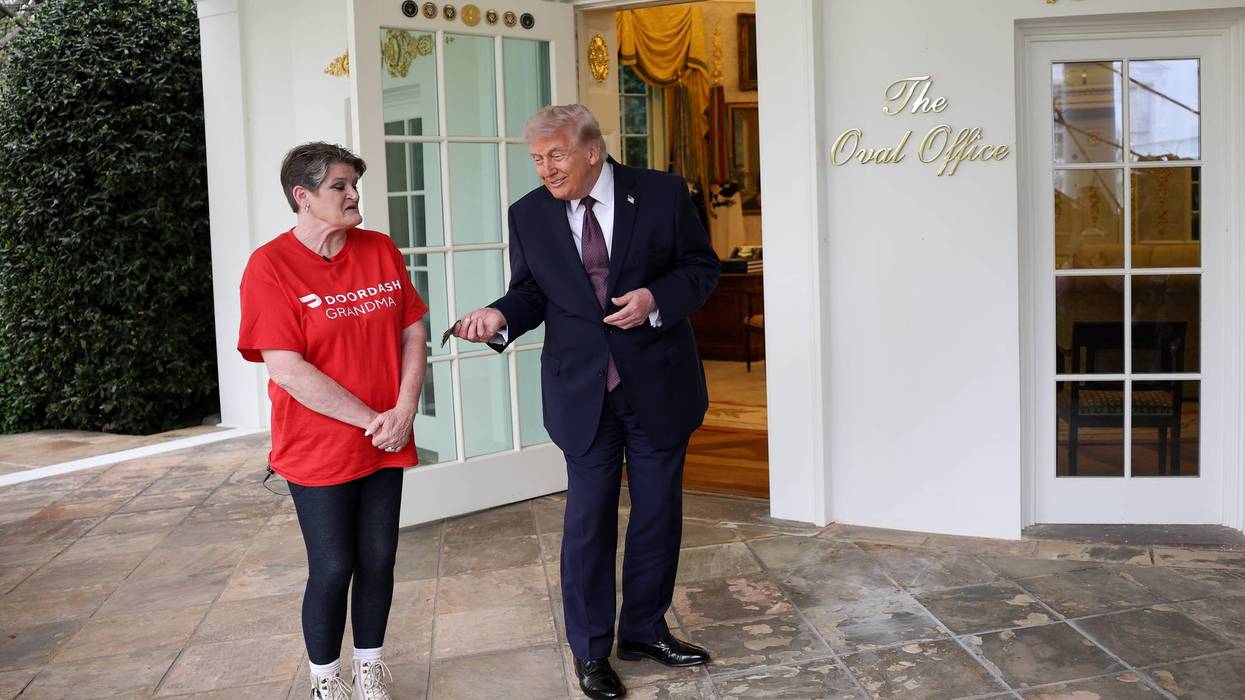
"The fact that a term like 'DoorDash grandma' exists should be a wake-up call," said the head of One Fair Wage. "It should never exist in the first place."
While "DoorDash Grandma" made the company's first food delivery to the White House on Monday to promote President Donald Trump's "no tax on tips" policy, the awkward encounter outside the Oval Office not only highlighted critiques of that provision of the GOP budget package but also sparked calls for a living wage and universal healthcare.
"A perfect image of the Trump era: A grandmother has to work at DoorDash in order to get by, while the president decorates his office in gold accent pieces," said Democratic strategist Max Burns, sharing a photo of the delivery on social media.
Saru Jayaraman, president of worker advocacy group One Fair Wage, told Common Dreams that "it's sad, and it's a sign of a failing society—not something to celebrate or turn into a photo op. We've normalized an economy where older people are pushed into gig work just to survive. The fact that a term like 'DoorDash grandma' exists should be a wake-up call. It should never exist in the first place."
"Corporations are paying poverty wages while policymakers offer Band-Aid solutions like 'no tax on tips' instead of paying a living wage," Jayaraman continued. "At the same time, cuts to Medicaid and food assistance are stripping away the safety net workers rely on to get by. This is all pushing people into greater dependence on tips and unstable income. Workers don't need gimmicks—they need living wages, corporate accountability, and real economic security."
Trump and then-Vice President Kamala Harris latched on to the no tax on tips policy during the 2024 campaign, despite warnings from economists and others that it is a "deceptive ploy," as the Economic Policy Institute's David Cooper and Nina Mast put it last year.
"It does nothing to address the low wages, income instability, wage theft, and abuse tipped workers already face," the pair reiterated in February. "Instead, it may undermine efforts to raise tipped minimum wages, push more workers into tipped jobs, increase workloads, and prompt customers to tip less if they believe tipped workers receive special tax treatment."
After related legislation passed the US Senate last year, Jayaraman said that "for all the bipartisan celebration, this bill is a distraction from the real fight... If Democrats want to offer a true alternative, they need to say it loud and clear: It's time to raise the minimum wage and end the subminimum wage once and for all."
A no tax on tips policy was ultimately included in Republicans' so-called One Big Beautiful Bill Act—which, as a recent Institute on Taxation and Economic Policy analysis details, featured tax breaks that primarily benefited wealthy individuals and corporations while cutting programs that serve working families, such as Medicaid and the Supplemental Nutrition Assistance Program.
Specifically, last year's GOP budget package established a temporary federal income tax deduction for tips, capped at $25,000 per year, through 2028. In a February report, the libertarian Cato Institute estimated that "the roughly 3% of tax returns projected to claim the tips deduction in 2026 will receive an average tax cut of about $1,370," and "as a share of after-tax income, the tips deduction broadly benefits those in the middle of the income distribution."
"These provisions also add to the already large number of tax deductions and credits that shield vastly uneven amounts of income from taxation based on family size and childcare arrangements," the Cato report notes. "In addition to the income limits, the tips deduction is only available to occupations that 'customarily and regularly received tips' before 2025."
Sharon Simmons, who wore a red shirt that read "DoorDash Grandma" while delivering McDonald's bags at the White House on Monday, told Trump that she benefited from the policy. In a statement, the company identified her as an Arkansas-based grandmother of 10 who "started dashing in 2022 to earn income while keeping control of her schedule."
During the delivery, the president asked Simmons whether she voted for him—"uh, maybe," she said—and about banning transgender women from competing in sports in line with their gender identity, on which she said she did not have an opinion.
Labor reporter Michael Sainato pointed out that Simmons previously lived in Nevada and advocated for the no tax on tips policy to the US House Ways and Means Committee last year. He also questioned her comments to Trump about having saved over $11,000 on her most recent tax bill.
The dasher claims "$11,000 in savings by not having to claim." You still have to claim tipsYou can only deduct up to $25k in tips, so $11k in savings off of one year didn't happenThe tax savings are actually minimal taxpolicycenter.org/fiscal-facts...
[image or embed]
— Michael Sainato (@msainato.bsky.social) April 13, 2026 at 3:39 PM
While Trump staff and congressional Republicans shared footage of Simmons' delivery to Trump to promote the budget package provision in the lead-up to tax day, US Rep. Dina Titus (D-Nev.) stressed on social media Monday that the president's "policy is severely limited and sunsets in 2028."
"We must make it permanent and increase the minimum wage to support our nontipped workers like childcare, fast food, and retail. We can do both by passing my LIFT Act," said Titus, whose Labor Income Fairness and Transparency Act is backed by One Fair Wage.
"Cutting taxes on tips might make for a good sound bite, but on its own, it's a hollow fix that ignores the real crisis: Wages so low that two-thirds of restaurant workers don't even earn enough to pay federal income taxes," Jayaraman said last year, when Titus introduced the bill. "In a time of skyrocketing costs, workers are drowning and need more than political gimmicks—they need a raise."
"Tips should be a bonus, not a substitute for a living wage," she argued. "By ending all subminimum wages and requiring that all workers be paid a full livable wage with tips on top, the LIFT Act addresses what working people need most: a fair wage, a level playing field, and the dignity that comes with being able to provide for their families."
Some observers on Monday also noted Simmons' appearance on Fox News, during which she acknowledged the financial burden of her husband's 2025 cancer diagnosis.
"Grandma shouldn't have to rely on DoorDash tips to make up for Republicans doubling the cost of healthcare," declared Democrats on the House Ways and Means Committee, sharing a clip of the interview on social media.
Melanie D'Arrigo, executive director of Campaign for New York Health, which advocates for universal, single-payer healthcare, emphasized that "'no tax on tips' does not make up for the fact that no one can afford healthcare."
Historian Timothy Snyder said, "So let’s have universal healthcare and help people live in dignity."