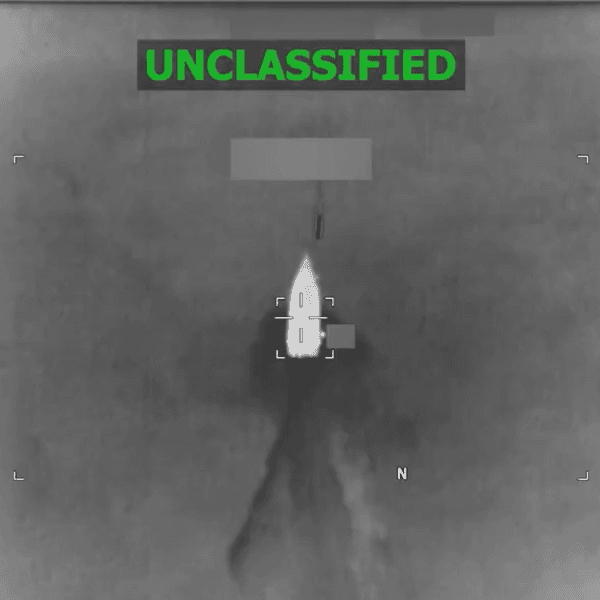

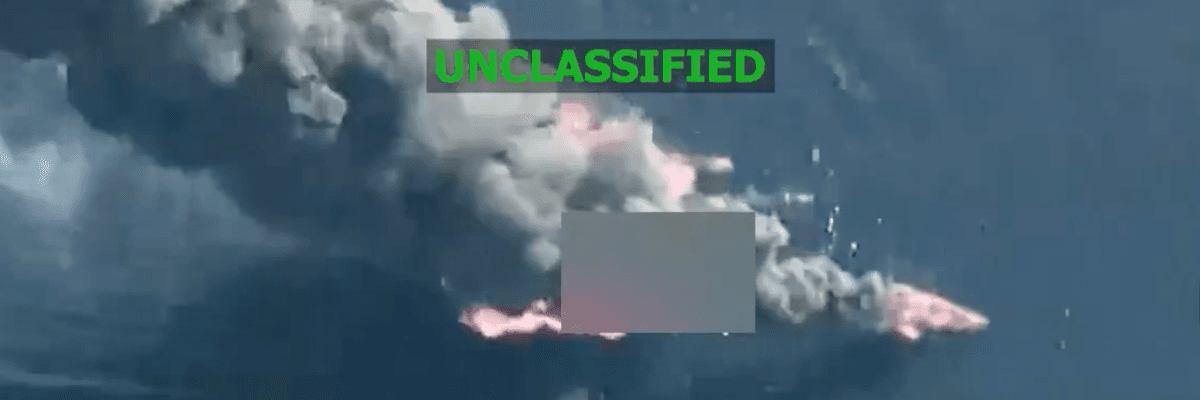
Surveillance footage shows some the US Department of Defense's latest strikes on boats in the Caribbean Sea and the eastern Pacific Ocean on February 16, 2026.
Trump ‘Murder Spree’ Continues With 11 More People Killed in US Boat Strikes
"The strikes are fading from public attention despite their illegality," warned one group. "This normalization poses dangers."
"No amount of terrorism talk renders this slaughter lawful," said one policy analyst Tuesday after the US Department of Defense announced it had killed 11 people on three boats in the Caribbean Sea and the eastern Pacific Ocean—bringing the total number of people killed by the Trump administration in the region to at least 145 as the White House claims to be combating drug trafficking at sea.
The US Southern Command reported that Joint Task Force Southern Spear conducted "lethal kinetic strikes" on boats operated by "Designated Terrorist Organizations" that were "engaged in narco-trafficking operations."
Two of the boats were in the eastern Pacific and one was in the Caribbean, and Southern Command reported that they were "transiting along known narco-trafficking routes."
As with the other strikes the Pentagon has conducted since September, the Trump administration did not release evidence of its claim that the boats or passengers were involved in drug trafficking.
In the case of one bombed boat last year, evidence showed it had been headed for Suriname, not the US. Past victims have been identified as fishermen—including one whose family filed a formal legal complaint against Defense Secretary Pete Hegseth—and a bus driver who had agreed to ferry narcotics, leading one expert to compare the strikes to “straight-up massacring 16-year-old drug dealers on US street corners.”
Legal analysts have stressed over the past five months that when the US government has previously identified drug trafficking vessels in international waters, federal agencies have boarded the boats, confiscated illegal substances, and detained people on board for breaking the law.
The strikes on Monday evening, in contrast, were a continuation of "an extrajudicial killing spree," said history professor Robert Crews.
The Washington Office on Latin America (WOLA) warned Tuesday that with President Donald Trump's intensified threats against Cuba and continued mass deportation and detention campaign at home in the US, "the strikes are fading from public attention despite their illegality."
"This normalization poses dangers: The justifications being used could extend to other victims in other contexts, and elements of the US military appear to be accepting unlawful orders," said Adam Isacson, director for defense oversight at WOLA, and John Walsh, the group's director for drug policy and the Andes.
Trump informed Congress in October, a month after his administration began bombing vessels in the region, that he viewed the US as being in an "armed conflict" with drug cartels in Latin America including in Venezuela, but international and domestic drug and crime agencies have not identified Venezuela as a major source of drug trafficking to the US—particularly not of fentanyl, which is responsible for a majority of overdoses in the US.
Isacson and Walsh emphasized Tuesday that despite Trump's claims, "there is no congressional authorization for military force against drug traffickers. Under international law, the United States is not engaged in an armed conflict with drug cartels—designating groups as foreign terrorist organizations does not confer wartime authorities."
Though the ongoing killings are being largely overshadowed by other news stories in the mainstream press, said Isacson, "February is on track to be the third-deadliest month of illegal US boat strikes, with 1.2 deaths per day so far, and 11 killed just yesterday."
Both Democrats and Republicans in Congress have introduced war powers resolutions to stop the Trump administration from continuing the boat bombings and attacking Venezuela, but the vast majority of Republican lawmakers have blocked the efforts.
The human rights group Amnesty International, which said in December that Trump's boat strikes "constitute murder," called on Congress to "do more to rein in this administration's lawless actions" and urged the public to put pressure on lawmakers.
"This murder spree," said Amnesty, "is unconscionable and illegal."
We are at a crossroads
This country and this world are at a monumental crossroads. In a few short weeks, US voters will have an opportunity to beat back the forces of fascism and confront the billionaires who are rigging the economy, our media system, and our democracy, making it increasingly impossible for ordinary people to get by. We’re not just talking about the election. We’re talking about what must be done once these fascist elements are vanquished from power. We need a bolder set of solutions than what either major party has so far been willing to offer and a working-class movement ready to fight like hell for it. Trump didn't emerge from nowhere. The conditions that fueled MAGA authoritarianism were created by decades of radical neoliberal economic policies and a corrupt political system dominated by corporate interests. They slashed taxes on the super-rich, promising that the benefits would trickle down. They said giveaways to the corporate titans would make life more affordable for the rest of us. It was all bullshit. And when a bitter, betrayed populace searches for someone to blame, right-wing demagogues have little trouble finding scapegoats. People know when they're being lied to, but you won't hear any of this from the corporate media. Only independent journalism—powered and funded by people who believe in building a better world—can deliver truly trustworthy daily news. Our Fall Campaign is underway, and we need your help. To power our newsroom through the rest of the year, we need to raise $125,000 by midnight on October 31. So if you share our vision, please contribute whatever you can to sustain our work. |
"No amount of terrorism talk renders this slaughter lawful," said one policy analyst Tuesday after the US Department of Defense announced it had killed 11 people on three boats in the Caribbean Sea and the eastern Pacific Ocean—bringing the total number of people killed by the Trump administration in the region to at least 145 as the White House claims to be combating drug trafficking at sea.
The US Southern Command reported that Joint Task Force Southern Spear conducted "lethal kinetic strikes" on boats operated by "Designated Terrorist Organizations" that were "engaged in narco-trafficking operations."
Two of the boats were in the eastern Pacific and one was in the Caribbean, and Southern Command reported that they were "transiting along known narco-trafficking routes."
As with the other strikes the Pentagon has conducted since September, the Trump administration did not release evidence of its claim that the boats or passengers were involved in drug trafficking.
In the case of one bombed boat last year, evidence showed it had been headed for Suriname, not the US. Past victims have been identified as fishermen—including one whose family filed a formal legal complaint against Defense Secretary Pete Hegseth—and a bus driver who had agreed to ferry narcotics, leading one expert to compare the strikes to “straight-up massacring 16-year-old drug dealers on US street corners.”
Legal analysts have stressed over the past five months that when the US government has previously identified drug trafficking vessels in international waters, federal agencies have boarded the boats, confiscated illegal substances, and detained people on board for breaking the law.
The strikes on Monday evening, in contrast, were a continuation of "an extrajudicial killing spree," said history professor Robert Crews.
The Washington Office on Latin America (WOLA) warned Tuesday that with President Donald Trump's intensified threats against Cuba and continued mass deportation and detention campaign at home in the US, "the strikes are fading from public attention despite their illegality."
"This normalization poses dangers: The justifications being used could extend to other victims in other contexts, and elements of the US military appear to be accepting unlawful orders," said Adam Isacson, director for defense oversight at WOLA, and John Walsh, the group's director for drug policy and the Andes.
Trump informed Congress in October, a month after his administration began bombing vessels in the region, that he viewed the US as being in an "armed conflict" with drug cartels in Latin America including in Venezuela, but international and domestic drug and crime agencies have not identified Venezuela as a major source of drug trafficking to the US—particularly not of fentanyl, which is responsible for a majority of overdoses in the US.
Isacson and Walsh emphasized Tuesday that despite Trump's claims, "there is no congressional authorization for military force against drug traffickers. Under international law, the United States is not engaged in an armed conflict with drug cartels—designating groups as foreign terrorist organizations does not confer wartime authorities."
Though the ongoing killings are being largely overshadowed by other news stories in the mainstream press, said Isacson, "February is on track to be the third-deadliest month of illegal US boat strikes, with 1.2 deaths per day so far, and 11 killed just yesterday."
Both Democrats and Republicans in Congress have introduced war powers resolutions to stop the Trump administration from continuing the boat bombings and attacking Venezuela, but the vast majority of Republican lawmakers have blocked the efforts.
The human rights group Amnesty International, which said in December that Trump's boat strikes "constitute murder," called on Congress to "do more to rein in this administration's lawless actions" and urged the public to put pressure on lawmakers.
"This murder spree," said Amnesty, "is unconscionable and illegal."
- Legal Experts Accuse Hegseth of 'War Crimes, Murder, or Both' After New Reporting on Boat Strike Order ›
- Retired General Says Hegseth Boat Strike on Shipwrecked Sailors Was a 'War Crime' ›
- Amnesty Condemns US 'Murder' of 6 More People After Latest Trump Boat Bombing | Common Dreams ›
- US Kills at Least 2 More People in Yet Another Illegal Boat Bombing | Common Dreams ›
- '3 More Murders at Sea': Trump Boat-Bombing Spree Continues | Common Dreams ›
- 'These Are Murders': Trump Killing Spree Hits At Least 185 | Common Dreams ›
- Opinion | Stop Trump's High Seas Killing Spree | Common Dreams ›
- Opinion | Trump Goes on a Global Killing Spree Then Insults His Victims | Common Dreams ›
- 'Now More Than 200 Trump Summary Executions' as US Bombs Another Boat | Common Dreams ›
- Opinion | Trump Murdering People in Boats Is Not Stopping the Flow of Drugs Into US | Common Dreams ›
"No amount of terrorism talk renders this slaughter lawful," said one policy analyst Tuesday after the US Department of Defense announced it had killed 11 people on three boats in the Caribbean Sea and the eastern Pacific Ocean—bringing the total number of people killed by the Trump administration in the region to at least 145 as the White House claims to be combating drug trafficking at sea.
The US Southern Command reported that Joint Task Force Southern Spear conducted "lethal kinetic strikes" on boats operated by "Designated Terrorist Organizations" that were "engaged in narco-trafficking operations."
Two of the boats were in the eastern Pacific and one was in the Caribbean, and Southern Command reported that they were "transiting along known narco-trafficking routes."
As with the other strikes the Pentagon has conducted since September, the Trump administration did not release evidence of its claim that the boats or passengers were involved in drug trafficking.
In the case of one bombed boat last year, evidence showed it had been headed for Suriname, not the US. Past victims have been identified as fishermen—including one whose family filed a formal legal complaint against Defense Secretary Pete Hegseth—and a bus driver who had agreed to ferry narcotics, leading one expert to compare the strikes to “straight-up massacring 16-year-old drug dealers on US street corners.”
Legal analysts have stressed over the past five months that when the US government has previously identified drug trafficking vessels in international waters, federal agencies have boarded the boats, confiscated illegal substances, and detained people on board for breaking the law.
The strikes on Monday evening, in contrast, were a continuation of "an extrajudicial killing spree," said history professor Robert Crews.
The Washington Office on Latin America (WOLA) warned Tuesday that with President Donald Trump's intensified threats against Cuba and continued mass deportation and detention campaign at home in the US, "the strikes are fading from public attention despite their illegality."
"This normalization poses dangers: The justifications being used could extend to other victims in other contexts, and elements of the US military appear to be accepting unlawful orders," said Adam Isacson, director for defense oversight at WOLA, and John Walsh, the group's director for drug policy and the Andes.
Trump informed Congress in October, a month after his administration began bombing vessels in the region, that he viewed the US as being in an "armed conflict" with drug cartels in Latin America including in Venezuela, but international and domestic drug and crime agencies have not identified Venezuela as a major source of drug trafficking to the US—particularly not of fentanyl, which is responsible for a majority of overdoses in the US.
Isacson and Walsh emphasized Tuesday that despite Trump's claims, "there is no congressional authorization for military force against drug traffickers. Under international law, the United States is not engaged in an armed conflict with drug cartels—designating groups as foreign terrorist organizations does not confer wartime authorities."
Though the ongoing killings are being largely overshadowed by other news stories in the mainstream press, said Isacson, "February is on track to be the third-deadliest month of illegal US boat strikes, with 1.2 deaths per day so far, and 11 killed just yesterday."
Both Democrats and Republicans in Congress have introduced war powers resolutions to stop the Trump administration from continuing the boat bombings and attacking Venezuela, but the vast majority of Republican lawmakers have blocked the efforts.
The human rights group Amnesty International, which said in December that Trump's boat strikes "constitute murder," called on Congress to "do more to rein in this administration's lawless actions" and urged the public to put pressure on lawmakers.
"This murder spree," said Amnesty, "is unconscionable and illegal."
- Legal Experts Accuse Hegseth of 'War Crimes, Murder, or Both' After New Reporting on Boat Strike Order ›
- Retired General Says Hegseth Boat Strike on Shipwrecked Sailors Was a 'War Crime' ›
- Amnesty Condemns US 'Murder' of 6 More People After Latest Trump Boat Bombing | Common Dreams ›
- US Kills at Least 2 More People in Yet Another Illegal Boat Bombing | Common Dreams ›
- '3 More Murders at Sea': Trump Boat-Bombing Spree Continues | Common Dreams ›
- 'These Are Murders': Trump Killing Spree Hits At Least 185 | Common Dreams ›
- Opinion | Stop Trump's High Seas Killing Spree | Common Dreams ›
- Opinion | Trump Goes on a Global Killing Spree Then Insults His Victims | Common Dreams ›
- 'Now More Than 200 Trump Summary Executions' as US Bombs Another Boat | Common Dreams ›
- Opinion | Trump Murdering People in Boats Is Not Stopping the Flow of Drugs Into US | Common Dreams ›