

SUBSCRIBE TO OUR FREE NEWSLETTER
Daily news & progressive opinion—funded by the people, not the corporations—delivered straight to your inbox.
5
#000000
#FFFFFF
To donate by check, phone, or other method, see our More Ways to Give page.
Daily news & progressive opinion—funded by the people, not the corporations—delivered straight to your inbox.

Juan Carlos Cantu Guzman, Defenders of Wildlife, 52-55-55-96-21-08
Peter Jenkins, Defenders of Wildlife, (202) 772-0293
Maria Elena Sanchez Saldana, Teyeliz, A.C., 52-55-52-51-60-96
President Felipe Calderon Hinojosa has signed
into law a bill to ban the capture and export of Mexican wild parrots. The bill,
introduced one year ago by the Environment Commission of the Deputy Chamber, was
passed in the Mexican Senate on 22 April,
2008 with near unanimous
support (66 votes in favor, 0 votes against, and 1 abstention).
The bill was originally
drafted after a presentation of the 2007 report "The Illegal Parrot Trade in
Mexico: A Comprehensive Assessment" by Defenders of
Wildlife and Teyeliz, A.C. The report revealed for the first time the volume of
the illegal trade of parrots within Mexico. An estimated 65,000 -78,500 wild parrots and
macaws are captured illegally each year, with more than 75 percent of the birds
dying before ever reaching a purchaser. Approximately 50,000 to 60,000 parrots
die this way each year in Mexico alone.
"Current levels of trade
in parrots are entirely unsustainable. This bill is a vital step to prevent the
loss of parrot species," said Roger Schlickeisen, president of Defenders of
Wildlife. "The bill will also help to safeguard the future of ecotourism in
Mexico. The United
States alone has 85 million birdwatchers, many of whom
are willing to travel to see unique birds like these native
parrots."
Mexico is home to 22 species of parrots and macaws, of
which six are found nowhere else in the world. Approximately 90 percent of all
parrots and macaws found in Mexico are in some category of risk. The latest Mexican
classification (yet to be published) lists 11 species as endangered, five as
threatened, four as requiring special protection, and two as unclassified.
"In 2007, only six
species of parrots in Mexico were listed as endangered. This new
classification almost doubles that number," said Juan Carlos Cantu Guzman,
director of Mexican programs for Defenders of Wildlife. "It is readily apparent
that unless we immediately halt the capture and trade in all parrots and macaws,
we could lose these species entirely. This bill signifies a milestone though
which we can finally address conservation and recovery of these unique
birds."
Although this bill marks an immense victory for
parrot conservation, much work is yet to be done.
"Defenders of Wildlife and Teyeliz will inform
people of the new capture ban and will seek their support to stop buying wild
parrots. If wild parrots are to survive, people must stop buying them for pets,
" noted Maria Elena Sanchez Saldana of Teyeliz, A.C.
Defenders of Wildlife and Teyeliz, A.C. are
already working on a bi-national education campaign with the
U.S. and Mexico, and will continue to address the need to find
adequate funding to solve the biological, economic and social challenges of the
illegal parrot trade.
Learn more about Defenders' work in Mexico.
Defenders of Wildlife is the premier U.S.-based national conservation organization dedicated to the protection and restoration of imperiled species and their habitats in North America.
(917) 363-4149
"This move undermines the integrity of nonpartisan election administration," said Arizona's secretary of state.
US President Donald Trump late Thursday forced out the remaining three members of an independent, bipartisan commission that assists state election officials across the country, a move that critics condemned as a "pathetic power grab" ahead of the 2026 midterms.
The two Democratic members of the Election Assistance Commission (EAC), Benjamin Hovland and Thomas Hicks, were fired, and Republican Commissioner Christy McCormick resigned at the White House's request, according to ProPublica. The agency, established by Congress more than two decades ago, now lacks leadership and any ability to make decisions, just months before the 2026 elections.
The EAC, as its website states, is "an independent, bipartisan commission whose mission is to help election officials improve the administration of elections and help Americans participate in the voting process." In an executive order last year, Trump ordered the EAC to implement proof-of-citizenship requirements in the federal voter registration process, along with other changes. The president's effort to impose his policy demands on the EAC was mostly blocked in federal court.
Trump, who has said he wants his administration to "take over" voting nationwide ahead of the 2026 midterms, has since taken other steps that watchdogs and Democratic lawmakers say amount to an attempt to preemptively subvert the coming elections, including a sweeping assault on mail-in voting—which is also facing legal challenges. Legislatively, Trump is pushing Republicans to pass the SAVE America Act, a bill that experts say would prevent millions of Americans from voting.
Michael Waldman, president and CEO of the Brennan Center for Justice, said Thursday's EAC firings "are deeply concerning in light of President Trump’s relentless efforts to try to interfere in elections."
"These removals leave the agency without leadership and unable to carry out its major responsibilities," said Waldman. "The guardrails Congress placed on this agency are clear and must be followed: The Election Assistance Commission was designed to be bipartisan with four members, no more than two of which can be from the same political party. The agency cannot make any significant decisions or take any significant actions unless three confirmed commissioners agree. Until bipartisan replacements are confirmed, the agency cannot lawfully make any decisions that affect how Americans vote."
Lisa Gilbert, co-president of Public Citizen, said Trump's termination of EAC commissioners underscores that "he’s scared of the voting power of the American people."
"This move is another pathetic attempt to sow doubt in our elections, which are safely and expertly run by states and localities," said Gilbert. "This agency deserves a steady hand and expert leadership. That said, it is important for voters to know that states and localities, not the EAC, run our elections. Even more importantly, it is the voters who decide who takes office."
The EAC firings came less than two weeks after the conservative-dominated US Supreme Court handed Trump the power to purge independent agencies at will with its Trump v. Slaughter ruling, erasing around 90 years of precedent.
Election law expert Rick Hasen warned in a blog post on Thursday that Trump "could try to direct the commissioner-less EAC to do his bidding, for example by stating that the EAC must amend the federal voter registration form that states must accept for federal elections to include documentary proof of citizenship."
"Trump’s first voting-related EO tried to do this, and he was stymied. But that was acting through the commissioners and before the Slaughter case," Hasen noted. "If he tries anything like this, it will be high-profile and very important litigation that will end up at the Supreme Court on the emergency docket over the summer."
Adrian Fontes, Arizona’s Democratic secretary of state, said in a statement late Thursday that the EAC purge was "irresponsible and dangerous," accusing the administration of remaining "dead set on causing chaos for our election officials across this country."
"This move undermines the integrity of nonpartisan election administration," Fontes added.
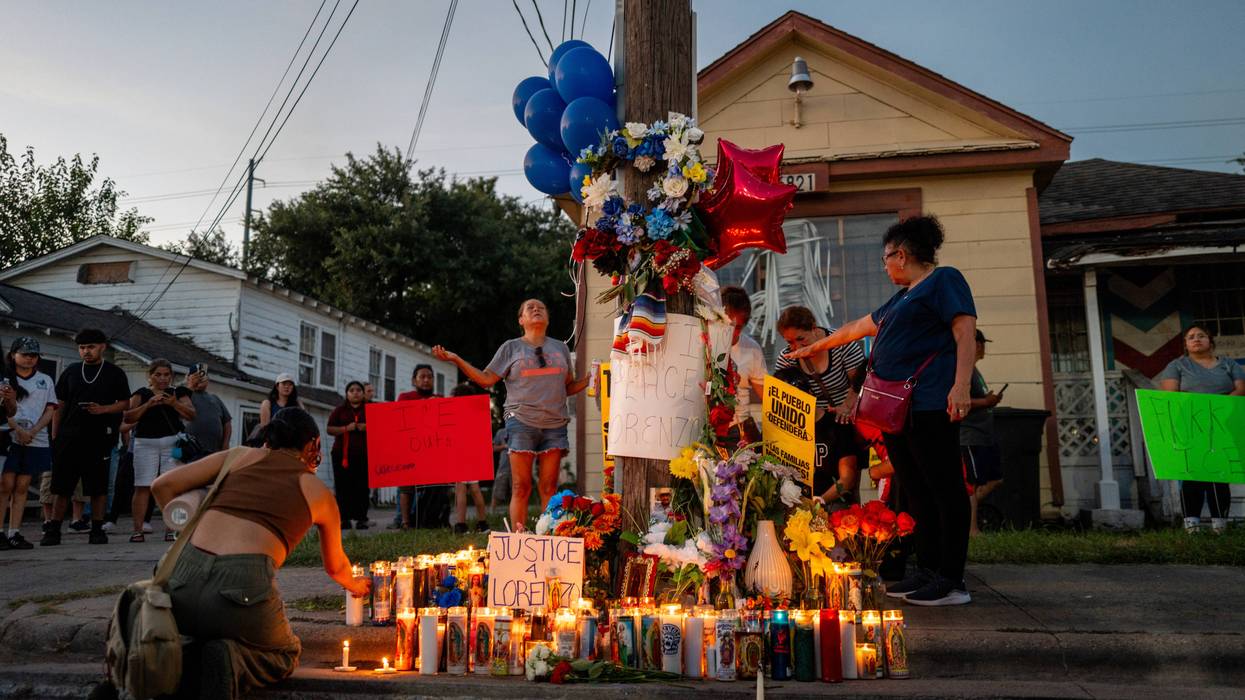
Salgado "called Houston home for 35 years," said New York's democratic socialist mayor. "On Tuesday, an ICE agent shot and killed him."
New York City Mayor Zohran Mamdani on Thursday renewed his call to "abolish ICE" after a US Immigration and Customs Enforcement agent fatally shot a man in Texas earlier this week.
"Lorenzo Salgado Araujo called Houston home for 35 years. On Tuesday, an ICE agent shot and killed him," Mamdani said on social media. "His family learned of his death from a video before anyone bothered to knock on their door."
"New York City stands with the Salgado family in demanding a full, independent investigation and real accountability," the mayor added. "To the Salgado family and any immigrant family in this city living in fear: We grieve with you, and we will continue to stand beside you in the pursuit of justice."
More than 1,000 people gathered in Houston's East End on Wednesday evening to denounce ICE and remember Salgado, a 52-year-old married father of three originally from Mexico who, according to relatives, was in the process of legalizing his status in the United States.
Salgado's son, school teacher Ronaldo Salgado, said that his father had "dedicated his life to giving his family the American dream."
Salgado was driving in the Magnolia Park neighborhood to pick up his construction crew on Tuesday morning when an unidentified ICE agent fatally shot him during an enforcement operation. ICE claimed that Salgado tried to evade arrest and threatened agents with his vehicle, but his family, civil rights advocates, and community leaders strongly dispute that account, pointing to surveillance footage and eyewitness accounts that they argue undermine the agency's narrative.
A Department of Homeland Security spokesperson told The New York Times late on Thursday that neither Salgado nor any of his three passengers were the targets of ICE enforcement, but that they drew agents' attention because one of them resembled a wanted man from Guatemala.
Democratic lawmakers and civil rights groups have joined Salgado's relatives in demanding an independent investigation of his killing.
Mexican President Claudia Sheinbaum announced Thursday that her government plans to file criminal complaints in the United States in connection with 14 Mexican nationals who died in ICE custody. Sheinbaum added that Salgado's killing "is not only sad and regrettable, but also appears to have been targeted."
On-duty officers from ICE and other Department of Homeland Security agencies have fatally shot at least four other people during President Donald Trump's deadly second-term crackdown on undocumented immigrants: Silverio Villegas González of Mexico and US citizens Ruben Ray Martinez, Renee Good, and Alex Pretti.
At least dozens of people have also died in ICE custody or shortly after being released during Trump's second term. Last month, ICE announced that it was rescinding a 2021 Biden administration policy requiring congressional notification and an investigation whenever a detainee died within 30 days of their release.

“Consumers are getting really screwed by all of this,” said one critic.
Political appointees installed by President Donald Trump are overruling career attorneys inside the Department of Justice's Antitrust Division, intervening to weaken or halt investigations into major corporate mergers in a way never seen before, MS NOW reported Thursday.
Three unnamed sources told the outlet "that DOJ staff have privately complained that the Trump administration is essentially deciding not to enforce antitrust laws that are critical to keeping companies from becoming single-source providers and being able to charge enormous sums for their product or service."
According to MS NOW:
The two mergers that DOJ leaders are ramming through include two low-cost Mexican air carriers, Viva Aerobus and Volaris, who announced their plans to merge last year, and the proposed merger of the Italian firm Saipem and UK firm Subsea7, who together control a sizable portion of sales for equipment used for subsea oil operations. Major oil companies, including ExxonMobil, Petrobras and TotalEnergies, have filed formal objections with federal regulators about the latter merger, arguing to antitrust regulators that the combined firms will create a subsea monopoly that will increase costs, delay critical projects and force clients into expensive, long-term contracts.
Experts say the aforementioned mergers are likely to drive up prices US consumers pay for airfare to Mexico and at the gas pump, yet again giving the lie to Trump's "America First" pledge.
Current and former DOJ officials described Trump's interference as without precedent.
“It’s unilateral surrender on antitrust enforcement; it’s absolutely unprecedented,” Bill Baer, the former assistant attorney general for the antitrust division during the Obama administration. “It’s definitely going to hurt consumers. It means prices will go up, concentration is going to increase—and quality often diminishes when you have only a few firms operating in the same market.”
The DOJ Antitrust Division was originally launched more than a century ago during the tail-end of the Progressive Era to combat monopolies and enforce antitrust legislation like the Clayton Antitrust Act and the Gilded Age-era Sherman Act. It was formally created during the Great Depression following weak enforcement of the Sherman and Clayton acts, as the Franklin D. Roosevelt administration viewed concentrated corporate power as a threat not only to consumers but to democracy itself.
While the postwar decades saw relatively aggressive antitrust enforcement by presidents of both major parties, the Reagan administration adopted a much more permissive merger philosophy that laid the groundwork for decades of consolidation across industries that has continued to this day, despite limited antitrust revivals during the Obama and Biden administrations.
Biden-era Federal Trade Commission Chair Lina Khan and DOJ officials pursued a more aggressive antitrust agenda that Trump has been rolling back in favor of deregulation. Critics have pointed out that Trump has sometimes used antitrust mechanisms selectively, targeting certain media or technology companies for political reasons rather than consistently applying a broad anti-monopoly approach.
According to an article published last month in The Wall Street Journal, Stanley Woodward, the senior DOJ official now overseeing antitrust enforcement, has told department lawyers that he favors resolving cases through settlements rather than taking corporations to trial. Some antitrust attorneys interpreted the remarks as a directive to avoid litigation and seek settlements in ongoing and future cases. Critics say Woodward’s posture could weaken the DOJ's ability to challenge monopolistic mergers in favor of fast-tracked settlements.
"He's taking litigation off the table, and you don’t get a settlement absent a litigation threat,” one person with knowledge of Woodward's actions told MS NOW. “I can’t think of an administration in history that would want to run antitrust policy like this.”
“Consumers are getting really screwed by all of this,” the person continued. “We’re talking 10 years of consumer harm that can’t be undone.”