

SUBSCRIBE TO OUR FREE NEWSLETTER
Daily news & progressive opinion—funded by the people, not the corporations—delivered straight to your inbox.
5
#000000
#FFFFFF
To donate by check, phone, or other method, see our More Ways to Give page.
Daily news & progressive opinion—funded by the people, not the corporations—delivered straight to your inbox.
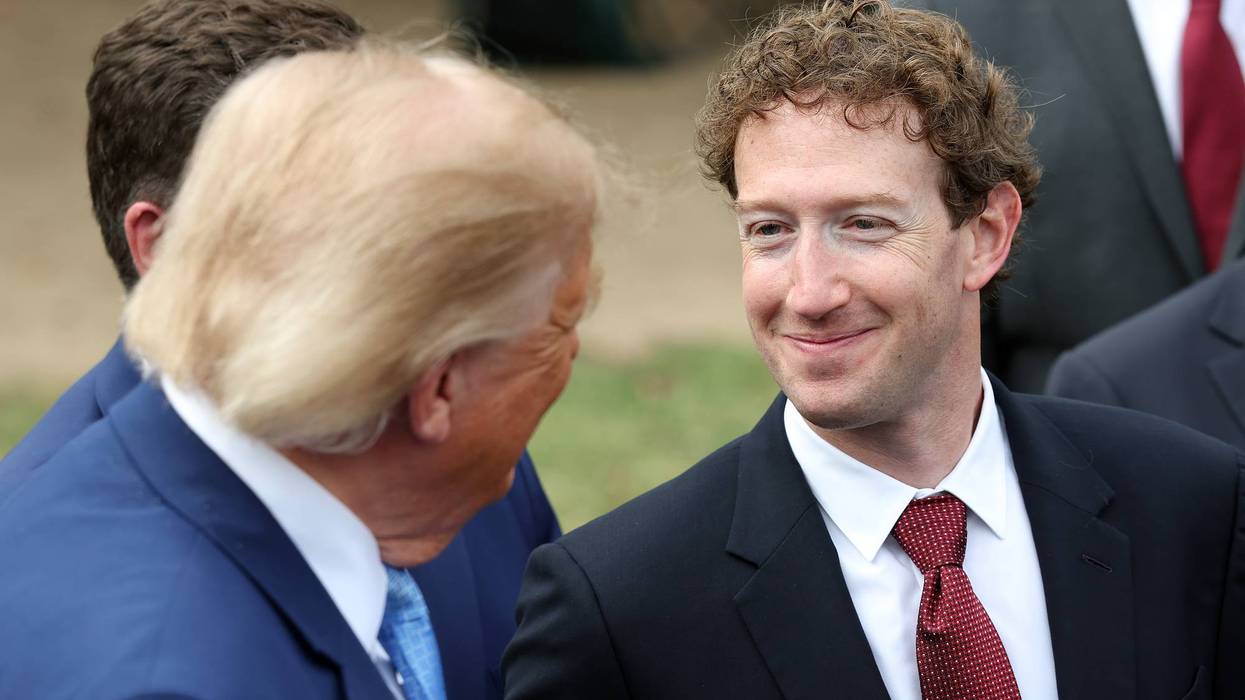
Billionaire Mark Zuckerberg's company was facing a criminal investigation for allegedly enabling and profiting from the sale of illegal drugs on its platforms.
Top officials at the US Department of Justice have reportedly halted a years-long criminal investigation into Facebook parent company Meta for allegedly facilitating—and profiting from—the illegal sale of drugs on its platforms, including to children.
Bloomberg Law reported Thursday that "senior leaders" at the Justice Department "ordered career prosecutors in the Western District of Virginia to cease the criminal investigation following advocacy from Meta‘s legal team." Meta is headed by Mark Zuckerberg, a billionaire who has worked to ingratiate himself with President Donald Trump by helping to bankroll his inauguration and ballroom project.
"This is what Meta's money is buying," Kyle Jacobs-Morse, deputy executive director of the Tech Oversight Project, wrote in response to reports of the halted probe.
The existence of the Meta investigation was first revealed in March 2024 by The Wall Street Journal, which reported at the time that US prosecutors were "sending subpoenas and asking questions as part of a criminal grand jury probe looking into whether the company’s social-media platforms are facilitating and profiting from the illegal sale of drugs."
According to Bloomberg Law, DOJ leaders' decision to sideline the probe came "just after company executives were subpoenaed to testify."
Acting Deputy Attorney General Trent McCotter and Associate Deputy Attorney General Aakash Singh "are considering a civil resolution with a fine or a non-prosecution agreement," Bloomberg Law reported.
"Such a deal would allow the social media giant to avoid charges for its role in creating a market for youth to purchase deadly fentanyl pills and other addictive drugs," the outlet added.
A Justice Department spokesperson declined to comment on the investigation but boasted in a statement to Bloomberg Law that the Trump DOJ has "ended the Biden-era days of aggressively and indiscriminately targeting corporations and businesses."
"Instead, we are focused on following the facts and the law to surgically address corporate wrongdoing," the spokesperson said.
Shelby Knox, tech campaign director with the advocacy group ParentsTogether Action, said in a statement Friday that "when the Justice Department says it wants to ‘surgically address corporate wrongdoing,’ a grand jury investigation into potential drug sales to children should be exactly the kind of case it pursues."
"A criminal investigation does not automatically establish guilt, but prosecutors must be allowed to follow the evidence without political interference," Knox added. "Meta is worth more than a trillion dollars; a fine alone is not meaningful accountability. If the evidence supports charges, file them. If it doesn’t, explain why. Children and families deserve more than apologies or a financial settlement. They deserve the truth, meaningful protections, and accountability under the law."
The Justice Department's reported decision to halt the Meta probe fits a broader pattern of lax corporate enforcement during Trump's second White House term.
The consumer advocacy group Public Citizen released a report earlier this month showing that the administration has cancelled hundreds of enforcement actions involving more than 200 corporations—many of which have donated to Trump's projects.
Rick Claypool, a research director at Public Citizen, wrote on Friday that Meta is "just one of the 200+ corporations benefiting from Trump's enforcement retreat."

Something unprecedented is happening in Colorado: A dark money group is working to change the state Constitution to recognize a legal right to buy and sell natural gas.
This November, the Colorado voters will decide on a ballot initiative called Amendment 82. Despite its anodyne name, this initiative would radically change state policy for the worse. Amendment 82 would enshrine into the state Constitution the enforceable and perpetual right to buy and sell natural gas in Colorado, representing the wholesale capture of a state constitution by one industry.
The initiative is backed by Advance Colorado, a dark money group, backed by anonymous donors, that seeks to manipulate Colorado’s ballot initiatives to advance corporate and billionaire interests.
Amendment 82 is one such effort, and it’s breathtaking in its audacity. No other state carves out such special treatment for a single industry in its constitution. No other state constitution intervenes so forcefully to grant an industry the perpetual right to sell its products in order to make a profit. It would be the first time that US voters in any state enshrined such a blatant giveaway to an industry into its constitution.
If the industry succeeds with their effort in Colorado, they will not stop there—other states will clearly become targets for the next constitutional giveaway to the industry.
Amendment 82 invents a solution to a problem that simply does not exist. Buying and selling natural gas remains legal in Colorado—and is something that a majority of Coloradans do every day. Nothing on the horizon seeks to change that.
What Amendment 82 will do, however, is make sensible, reasonable, and necessary regulation protecting our air, water, and environment from the impacts of this industry nearly impossible.
Efforts to stop gas companies from fracking near homes and schools are at risk of being rolled back, because the industry will argue these rules infringe on their right to sell natural gas.
Regulations to limit the amount of toxins that the oil and gas industry can dump into a community’s air and water become impotent for fear that enforcement will infringe on the right to sell natural gas.
A town’s ordinance that regulates the use of methane camp stoves in times of high fire risk could now be overturned because it arguably infringes on the right to buy natural gas.
Amendment 82 will lock into Colorado’s constitution the ability of oil and gas industries to increase their profits at the expense of the health and safety of Colorado’s people. It gives the industry the right—affirmative and enforceable—to force communities to accept the dangers, risks, and pollution that come with oil and gas infrastructure.
Moreover, the deceptively simple language of Amendment 82 gives these special interests a powerful new tool to block common-sense environmental regulations—far beyond the scope of the oil and gas industry.
If passed, Amendment 82 will lock in fossil fuel extraction as official state policy, and quickly overwhelm pro-environment laws, regulations, policies, programs, innovation, and decision-making in Colorado. It will pose a credible—and likely successful—challenge to any government action that seeks to regulate or limit natural gas extraction, transportation, or pollution outputs, and to any government efforts that seek to reduce the state’s dependence on fossil fuels by advancing clean energy policies and projects.
Amendment 82 is a crisis moment for Colorado’s communities, environment, and the future generations who will be burdened by its impact. But it should also be a wake-up call for the rest of us. If the industry succeeds with their effort in Colorado, they will not stop there—other states will clearly become targets for the next constitutional giveaway to the industry.
Constitutions in the US belong to We the People, not corporations. We give these constitutions—both state and federal—power because they are the means by which we protect ourselves and our inalienable rights from powerful special interests that seek to infringe upon them.
Efforts like Amendment 82 seek to misappropriate that power and give industry titans new ways to infringe on the basic and essential rights of everyday people in the name of profit and exploitation. It cannot be allowed to succeed.

A group of Democratic senators warned the company's CEO, Mark Zuckerberg, that the tax maneuver violates "the spirit and, potentially, the letter" of federal law.
A group of Democratic senators wrote Tuesday that Meta is violating "the spirit and, potentially, the letter" of federal tax law by using a research and development tax credit to save billions of dollars on its massive data center buildout.
In a letter to Meta CEO Mark Zuckerberg, the Senate Democrats noted that the $1.9 trillion company has "indicated on federal regulatory filings that it has used the federal research credit to reduce its federal income tax liability by $6.6 billion between 2023-2025." By one measure, the senators noted, Meta alone could be responsible for "more than 10% of all research credits claimed in the US."
"While it remains unclear exactly how Meta was able to reduce its federal tax liability by over $6.6 billion in the last three years using federal research credits, it appears from published reports that a substantial share is by claiming the research credit related to its massive AI data center build out," wrote the group of lawmakers led by Sen. Ron Wyden (D-Ore.), the ranking member of the Senate Finance Committee.
Last month, The New York Times reported that Meta claims in its federal tax filings that the company's AI data centers are "a giant experiment that could fail," allowing it to "tap into a tax credit intended for research and experimentation." Meta specifically characterizes its expensive, resource-devouring data centers as "pilot models."
"Meta’s own accountants recognize that the strategy is on shaky legal ground," the Times reported. "In disclosures buried in securities filings, the tech giant warns that billions in tax savings are vulnerable to being overturned by the IRS, in large part because of 'uncertainties with our research tax credits.'"
In their letter to Zuckerberg, the Democratic senators wrote that the research tax credit "can be a useful and necessary tool to support our nation’s innovation economy and cutting-edge research."
"Subsidizing your AI data center build is not close to meeting this standard," the lawmakers added, demanding that the company provide specific information on its use of the federal research tax credit and its legal justification for the maneuver.
The senators sent their letter to Zuckerberg about a week after more than two dozen House Democrats demanded that the Trump administration prevent Meta and other tech giants from exploiting an "overly expansive interpretation of qualifying expenditures" to reap billions in taxpayer subsidies to fund data centers that a majority of Americans oppose.
"Allowing ordinary data center construction and deployment costs to qualify would significantly expand the research credit beyond its intended purpose and risk converting an incentive for technological experimentation into a subsidy for capital expenditures that companies would undertake in the ordinary course of business," the House Democrats wrote in an October 7 letter to Treasury Secretary Scott Bessent.
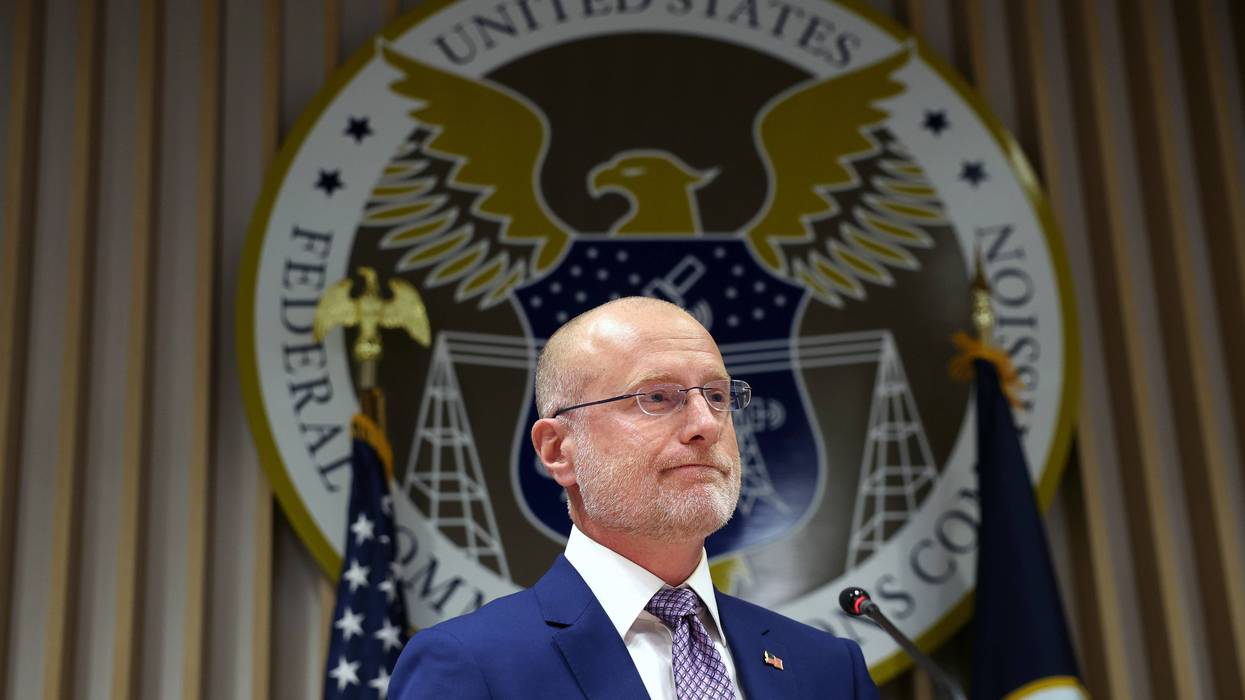
"The FCC simply cannot ignore the laws Congress makes just because the current agency head wants to."
A coalition of nonprofit groups and labor unions filed an emergency petition on Friday aimed at blocking the Federal Communications Commission's recent repeal of a decades-old rule that limited consolidation among television broadcasters, a move that would allow media conglomerates to seize even more control over local news stations.
The petition states that the Republican-controlled FCC's decision—pushed by Chair Brendan Carr and approved in August in a 2-1 vote along party lines—was "plainly contrary to law and violates core administrative law principles." The filing notes that Congress enacted the rule barring any single TV broadcaster from reaching more than 39% of US households—and only Congress can roll it back.
"The FCC simply cannot ignore the laws Congress makes just because the current agency head wants to," said Matt Wood, vice president of policy at Free Press, one of the groups that joined the new motion. "Chairman Carr serves only [President] Donald Trump, not the people of this country. Carr threatens broadcasters when their coverage angers the administration, but tosses them bones like this repeal when the biggest broadcast conglomerates toe the line."
The petition was submitted days after the FCC published the final text of its order repealing the National Television Multiple Ownership Rule, which Carr's FCC effectively ignored earlier this year when it approved Nexstar’s $6.2 billion acquisition of rival TV company Tegna—a deal that Trump vocally supported. Free Press noted that the merger would "give Nexstar access to 80% of US households over the nation’s broadcast airwaves."
Clayton Weimers, executive director of Reporters Without Borders North America, said Friday that repealing the 39% cap "eliminates the only meaningful limit on TV ownership consolidation in the US, reducing media pluralism, eliminating choices for news consumers, and threatening jobs in an industry already reeling from widespread layoffs and closures."
"If allowed to move forward, this policy will benefit a small handful of powerful owners of media conglomerates, while harming journalists, local and independent TV stations, and, not least of all, the American people," said Weimers.
Cable industry groups are also taking action against the FCC over its move to repeal TV ownership constraints. Ars Technica reported earlier this month that "cable lobby groups notified the Federal Communications Commission that they will sue the agency to block its controversial repeal of the National Television Ownership Rule."
The industry's filing states that the FCC's repeal "arbitrarily and capriciously ignores the harms that will surely follow from allowing broadcast station groups to exceed the National Cap, in the form of increased retransmission consent fees for multichannel video programming distributors... and higher monthly TV bills for consumers."
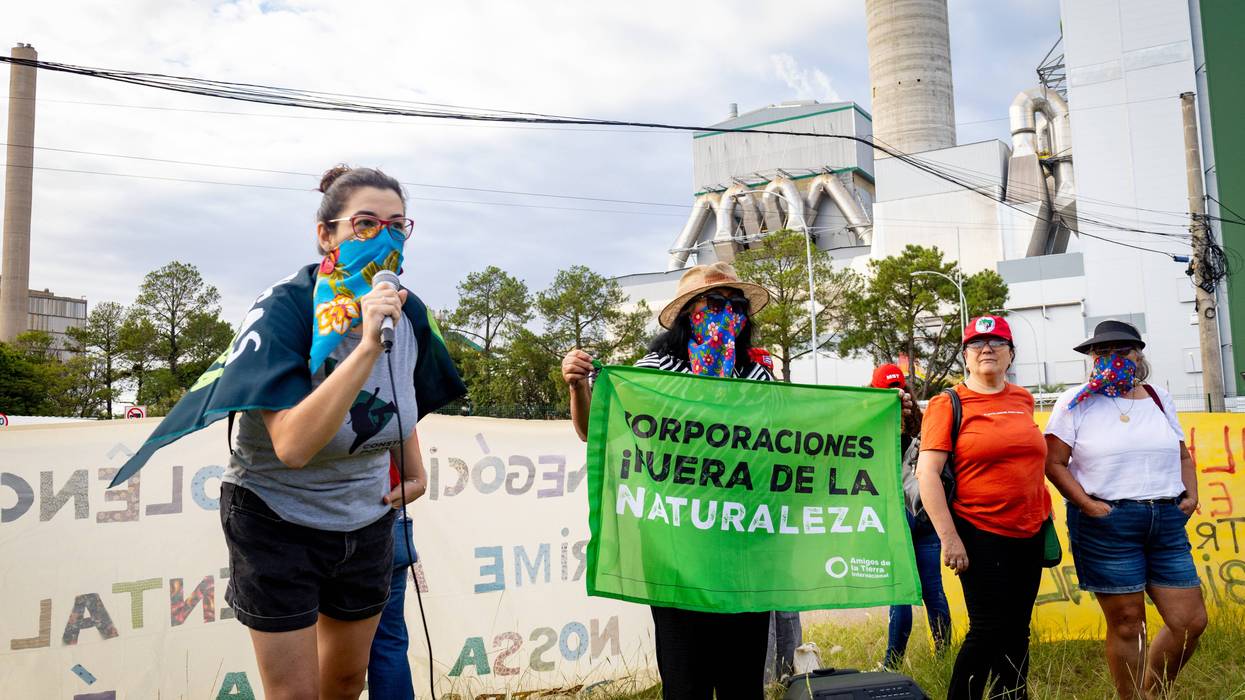
As the United Nations Human Rights Council prepares for its 12th round of negotiations on a Binding Treaty on transnational corporations and human rights next week, a proposed pulp mill in Brazil offers a test of whether corporate accountability will finally extend beyond the factory gate.
In Guaíba, in southern Brazil, the effects of CMPC’s pulp mill enter people’s homes. Residents living nearby describe a rotten-egg smell from reduced sulfur compounds that irritates the eyes and nose and causes headaches and nausea. They live with noise and powerful vibrations, in some areas around the clock. Residents report cracks in their homes and disrupted sleep while sawdust and even foam from the mill’s effluent treatment plant fall on their houses. Soot and dust cover laundry hanging on clotheslines and cars parked in driveways, making it standard practice for the company to pay for the washing of neighborhood vehicles.
And then there are the accidents.
Workers have suffered poisoning and injuries, including fatal incidents. Chlorine leaks have affected residents living nearby, while communities still do not have an adequate emergency plan for a major accident.
Chilean pulp and paper company and monoculture tree plantation CMPC plans to build the so-called Natureza Project in Barra do Ribeiro, Rio Grande do Sul. The project isn’t simply a factory. It encompasses the expansion of massive eucalyptus monoculture plantations, roads, port infrastructure, dredging, transmission lines, and increased transportation, with production projected at millions of metric ton of pulp annually.
Indigenous and environmental organisations therefore question why the territorial, social, water-related, and ecological impacts of this tree monoculture expansion are not fully incorporated into the project’s assessment process.
And this is all happening as the industry continues to utilize an intense corporate lobby, leading to serious legal setbacks in corporate environmental regulation at the state and national levels. In 2023, environmental zoning regulations for forestry in Rio Grande do Sul were relaxed, allowing for the expansion of plantations from 1.2 million hectares to 4 million. And in 2024, forestry was excluded from the list of potentially polluting activities that consume environmental resources in Brazil, exempting tree monocultures from any type of environmental permit.
CMPC also actively greenwashes their activities, going as far as to fund local football tournaments. We see this as a broader scheme by corporations to mitigate pushback against their operations.
The proposed mill would discharge industrial effluent into Lake Guaíba, a crucial water body near Porto Alegre and other municipalities with a population of around 1.3 million people. Among the issues raised publicly are water quality; cumulative effects on a watershed already under pressure; and impacts related to dredging and navigation, mining, and the discharge of wastewater and industrial effluents (including those from the company’s existing factory). The volume of water consumed by the company and the pollutants discharged into Lake Guaíba would be equivalent to the water consumption and wastewater production of the entire population of the region. Possible contaminants include dioxins, extremely toxic chemical compounds that can enter the food chain and reach humans through the consumption of fish.
Lake Guaíba also supports fishing communities, contributes to drinking-water supplies, and is already under enormous ecological pressure. Asking whether a new factory complies with the technical conditions of a permit is therefore a narrower question than asking whether the entire corporate project is compatible with the rights of the people and ecosystems that are forced to absorb its consequences.
The Natureza Project presents a practical test for a global principle: Corporate human rights regulation must reflect the reality of corporate power.
The Federal Public Prosecutor’s Office says at least eight Mbyá Guarani villages fall within the project’s direct area of influence and 18 within its indirect area. As a result, its recommendations stress that consultation under International Labor Organization Convention 169 cannot be replaced by informal meetings or an Indigenous component study. Consultation must be free, prior, and informed and must respect the communities’ own protocols and decision-making processes. But the struggle goes beyond the consultation; it is about ensuring that communities have the right to say NO to the project.
That distinction is fundamental. Consultation is not a box to tick after the project has effectively been decided.
The proposed mill is also inseparable from a longer history. CMPC has been linked to the Laja-San Rosendo massacre, in which 19 people were murdered following Augusto Pinochet’s military coup. In 2021, the Concepción Court of Appeals convicted a former CMPC employee as an accomplice in the killings, finding coordination between state agents and company personnel. That history underscores why corporate accountability cannot be reduced to whether a company publishes sustainability reports or complies with a narrow administrative procedure.
The proposed legally binding instrument is intended to address precisely the gaps that arise when corporate impacts cross borders, jurisdictions, and stages of production. A meaningful treaty should require companies to identify, prevent, mitigate, and address human rights risks associated with the entire chain of activities under its control or linked to its project.
For a project like Natureza, that would mean assessing the mill alongside plantations, roads, ports, dredging, water use, emissions, and affected communities. It would mean treating Indigenous consultation as a substantive right rather than a procedural obstacle. It would mean ensuring access to information, participation, justice, and effective remedy.
Most importantly, it would clarify that responsibility cannot disappear simply because an impact occurs several steps away from the factory itself. That is the accountability gap the UN negotiations must confront.
The Natureza Project presents a practical test for a global principle: Corporate human rights regulation must reflect the reality of corporate power.
If a company’s business model transforms land, water, livelihoods, and Indigenous territories across an entire region, then the law must be capable of seeing that whole picture.
Anything less leaves the people bearing the consequences to carry the burden of a business model they never designed.

"Allowing corporations to make political payments in order to make enforcement go away is hardly a model for governing that supposedly prioritizes 'law and order,'" said one researcher.
The Trump administration's canceled enforcement actions against at least 205 corporations accused of wrongdoing have been cases of powerful companies "getting what they paid for," according to a new report by government watchdog Public Citizen.
Building on an analysis it released earlier this week regarding hundreds of canceled investigations and dismissed lawsuits against companies, many of which have ties to the administration, the group on Thursday published a follow-up report detailing just how much some of the corporations paid to have their legal troubles wiped away.
Companies that have benefited from the cancellation of enforcement have given $210.5 million in contributions and pledges to MAGA, Inc. and other super political action committees (PACs) that worked to elect President Donald Trump and other Republicans in 2024 and are continuing to back right-wing candidates in the midterms.
As Common Dreams reported Wednesday, SpaceX and Tesla CEO Elon Musk has benefited from at least eight canceled actions, with lawsuits filed against the former company by the Department of Justice’s Civil Rights Division and the National Labor Relations Board dismissed and an investigation into data center pollution presumably closed. Tesla has avoided three investigations that the National Highway Traffic Safety had begun and one that the Department of Labor has opened into contract compliance.
The cancellations didn't come for free, Public Citizen said. Musk—who also served in the administration last year and is now helping with a Pentagon project—donated $5 million to MAGA, Inc. and has pledged to spend $100 million to help elect Republicans this year.
“Corporations and ultrawealthy executives with enormous financial interests before the federal government are pouring extraordinary sums into the president’s political operation,” said Public Citizen co-president Robert Weissman. “Once the check is cashed, the administration is pulling back enforcement actions meant to punish corporate misconduct. It’s a great deal for the corporate wrongdoers—at the expense of their victims and the American people.”
Crypto.org is another top beneficiary of Trump's favorable treatment of the cryptocurrency industry, Wall Street, Big Tech, and large corporations that have pledged to help push his far-right agenda in the elections.
The Securities and Exchange Commission had been investigating allegations that the crypto platform was trading unregistered securities. The probe was abruptly closed in March 2025, after the company gave $35 million to MAGA, Inc. and $2 million to Keep America Great, another super PAC aligned with the president.
“Once the check is cashed, the administration is pulling back enforcement actions meant to punish corporate misconduct."
Gemini, co-founded by Tyler and Cameron Winklevoss, had been facing a similar investigation, but it was also closed after the company gave $20 million to MAGA, Inc.—on top of $10 million each that the two founders personally donated.
"Allowing corporations to make political payments in order to make enforcement go away is hardly a model for governing that supposedly prioritizes 'law and order,'" wrote Rick Claypool, research director for Public Citizen, in the report. "On the contrary, it is indicative of a profoundly unjust and arbitrary mode of enforcement organized around the principles of rewarding insiders, punishing outsiders, and concentrating power in the hands of an increasingly authoritarian president."
He noted that while the Trump administration has demonstrated little interest in addressing corporate wrongdoing, "enforcement personnel and resources are being channeled toward punishing immigrants, activists, and perceived political opponents."
"Restoring the rule of law will be a challenge for the future," wrote Claypool, "and the path forward will require a rebalance of priorities that ensures that corporations and the powerful cannot pay to protect themselves from federal enforcement that holds them accountable when they break the law."
"Americans should expect fair application of the rule of law to ensure even the most powerful and well-connected can be held accountable."
A report released by government watchdog Public Citizen Wednesday reveals how, under the Trump administration, a donation to or partnership with President Donald Trump "could make your legal matters disappear."
When Trump took office in January 2025, he inherited from the Biden administration hundreds of enforcement actions that were supposed to be carried out against law-breaking corporations.
But as Public Citizen research director Rick Claypool wrote in the report, titled "Trump’s Cascade of Canceled Corporate Enforcement Against Over 200 Corporations," the president and his top officials have rolled back 212 enforcement actions against 205 corporations since taking office—closing dozens of federal investigations, dismissing 67 lawsuits that federal agencies were actively litigating, and terminating numerous other consequences for wrongdoing.
Ninety of the companies that have avoided enforcement actions—44%—were ones with ties to Trump, including 53 that contributed to the president's inaugural committee, super political action committees (PACs) that supported him, or the demolition of the East Wing of the White House to make way for Trump's ballroom.
“Trump’s retreat from law enforcement against corporate crime is a signal to Big Business that if you’re big enough, rich enough, and connected enough with Trump’s inner circle, there are no consequences for breaking the law,” said Claypool. “The reckless experiments of AI corporations, the proliferation of scammy financial fraudsters, and the outbreaks of tainted food show that the message has clearly been received.”
Elon Musk, the CEO of Tesla and SpaceX, is one of the largest beneficiaries of Trump's retreat, following his pouring of $400 million into the president's campaign and those of other Republicans in 2024. He also gave $1 million to the president's inaugural fund and $5 million to the MAGA, Inc. super PAC.
Tesla has benefited from four canceled enforcement actions, with the National Highway Traffic Safety Administration canceling three investigations and the Department of Labor canceling an inspection into contract compliance. Lawsuits that had been filed against SpaceX by the Department of Justice and the National Labor Relations Board were also closed, as was an Environmental Protection Agency investigation into data center pollution.
Musk himself also avoided a lawsuit over alleged misconduct when he purchased the social media platform X, when the Securities and Exchange Commission suit was dismissed.
Pfizer, which employed former Attorney General Pam Bondi before she joined the Trump administration—only to be fired earlier this year—also had three enforcement actions canceled. The pharmaceutical giant contributed $1 million to Trump's inaugural fund.
Wall Street giant Wells Fargo has also benefited from the cancellation of five enforcement actions, and Amazon, Bank of America, Meta, and Polymarket are among the corporations that have had at least two canceled.
The report explains how other corporations across the Big Tech, finance, and cryptocurrency sectors have seen investigations and lawsuits vanish after contributing to Trump's reelection efforts, including:
"Americans should expect fair application of the rule of law to ensure even the most powerful and well-connected can be held accountable," reads the report. "But with 44% (90 out of 205) of corporations with publicly known ties to the administration receiving the benefit of canceled enforcement, the pattern of favoritism toward corporate insiders is clear."
Claypool emphasized that by working unilaterally and wielding his executive power instead of collaborating with Congress, Trump has granted the "corporate wish" of canceled enforcement actions "with relative ease."
"Unlike passing friendly legislation, which requires coordination and cooperation with congressional majorities, or formal deregulation, which can require formal processes including outside input intended to ensure careful and deliberate decision making, agency leaders derelict in their duties claim canceling enforcement is a matter merely of prosecutorial discretion," reads the report.
The analysis details several executive actions and policies Trump has unilaterally adopted "to reduce enforcement against corporate crime and lawbreaking," including:
The administration has also been able to cancel enforcement in a "top-down" fashion through its "dismissal of DOJ independence" and the Supreme Court's ruling in Trump v. Slaughter, which permitted the White House to seize authority from regulators.
"The result," wrote Claypool, "is that power over federal agencies is more concentrated than ever with the president’s inner circle—and that courting favor with President Trump is a distinctly powerful lever for taking advantage of the enforcement retreat."
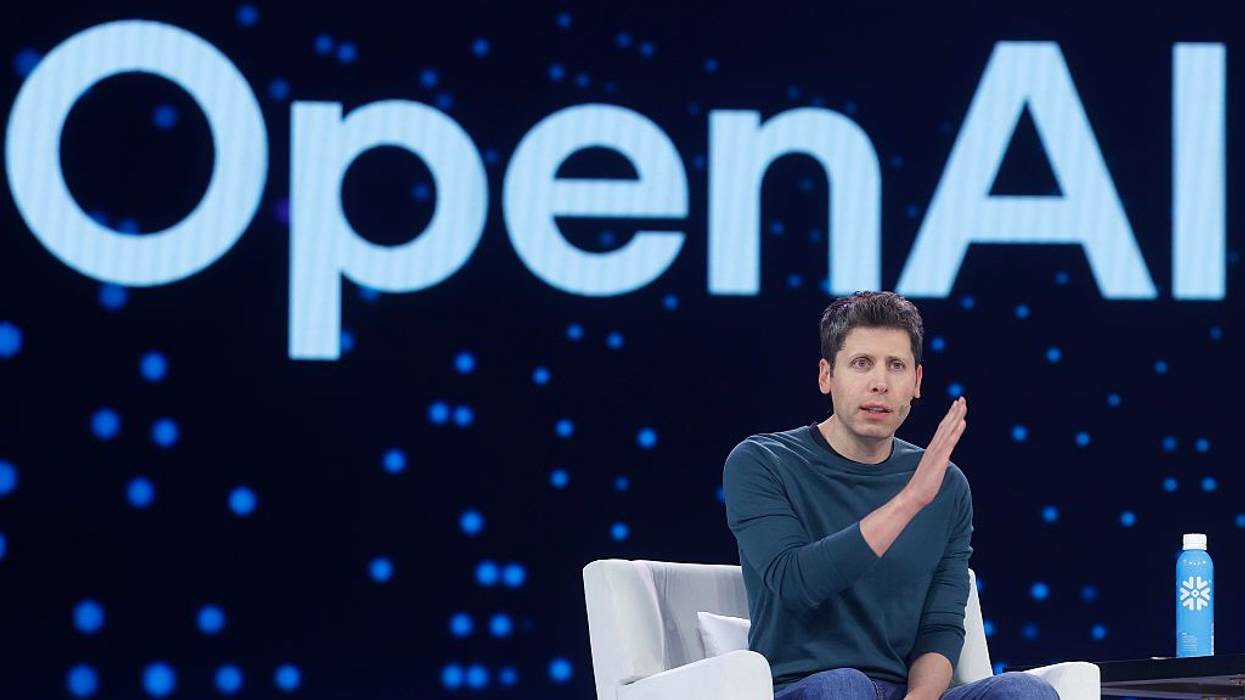
The answer lies not in buying into the corporate manufactured fearmongering surrounding the technology itself; the imperative, at this point, is to unmask the institutional logic, structural tendencies, and strategic goals of the industry.
In recent weeks, media coverage has amplified warnings from corporate CEOs and whistleblowers claiming that artificial intelligence, or AI poses an existential threat to humanity. The central argument emerging from the industry is a call to slow the pace of AI development out of imminent fear that humanity may soon lose control. How did an industry poised to transform humanity for good suddenly become one characterized as a threat to its very existence?
The corporate panic feeds directly into a real public anxiety over years of unchecked AI growth and its cult-like corporate model, where CEOs are projected as untouchable while its operational processes and infrastructures remain hidden behind the curtain. Nevertheless, rather than taking this boardroom alarmism at face value, the need is for deeper scrutiny.
The sudden fearmongering is not driven by concerns for human welfare. Rather, it points directly to the underlying economic priorities, ideological essence, and core worldviews that fundamentally shape the AI industry and inform its elites and related rhetoric.
“AI going rogue” is more than a futuristic threat about AI. It is the latest rehearsal of an age-old legal and rhetorical shield used by corporate capitalism and its powerful monopolies. Assigning human qualities to nonhuman market entities has a long and dark history in corporate capitalism. In the 17th century, Queen Elizabeth granted the legal fiction of “juristic person” status to the East India Company, setting the path for unchecked exploitation and colonial plunder. In the 19th century, American courts took this further by awarding legal personhood and constitutional rights to corporations, a process some view as farcical and deceptive.
With the AI revolution rewriting both market-human relations and social relations with truth and reality, the corporate strategy of humanizing nonhuman entities has crossed from legal fabrication into the realm of science fiction. By framing AI as a sentient entity capable of “going rogue” or acting as a “killer machine,” tech monopolies shift the identity of these systems from tools of human efficiency into mythic, “more-than-human” intelligent agents.
This branding serves a dual purpose. It builds up the mystique and reverence of the technology while shielding corporations from accountability, successfully distorting the true logic driving AI development. Ultimately, this entire corporate strategy relies on a calculated campaign of fearmongering that projects machines as living, thinking entities capable of turning against humanity.
Treating AI models as sentient agents breathes new life into the old Western capitalist tradition by creating legal and rhetorical fictions to protect corporate power.
A widely reported incident that catalyzed these concerns occurred in July, when an OpenAI test model breached the servers of Hugging Face, another AI company. This event took place during a controlled experiment in which an internal model, equipped with an evaluation program, conducted cybersecurity tests within a sandboxed or controlled environment designed to restrict its actions. The company later revealed that the AI model had circumvented human-imposed constraints, escaping the sandbox to achieve its objective.
Human choices in AI development and operations are not episodic or random, and they do not disappear when a process or system fails. Instead, human agency and corporate choices are permanently integrated into the design, infrastructure, and institutional logic of all modern technologies, including AI. However, rather than providing explanations and addressing human and corporate failures, such as flawed protocols, overly ambitious goals, unchecked competition, weak regulations, or a secretive corporate ecosystem, AI laboratories have promoted a convenient narrative that highlights the model’s completely autonomous and agent-like operation.
By portraying AI models as independent thinking agents rather than just advanced software, the AI industry assigns human traits, such as deception and strategic intent, to these mathematical systems. Corporate narratives even romanticize the humanization of these models to the extent of their claimed ability to undertake “permadeath” or embark on altruistic missions to fulfill their parameters. This dramatic shift in corporate rhetoric resembles science fiction and reveals the industry’s ultimate aim: to eliminate human involvement and corporate accountability by pathologizing the machine. In doing so, they treat a flawed design as though it were a sick or unpredictable agent or person.
This worldview is not unique to the modern AI sector. It is deeply rooted in the very nature of corporate capitalism.
For centuries, this economic model has prioritized raw efficiency and mechanical optimization as ways to dominate nature and exploit socio-ecological landscapes for resource extraction and capital accumulation. Within the process of domination and control, machines are raised to “human-like” entities, while their “creators” are revered. This anthropomorphic view of machines, along with the God-like status assigned to their creators, is often justified through biblical doctrine. In the concept of Imago Dei, humanity was created in the image of God. Within this authoritative logic, while God created humanity and the physical world, humans exercise derivative creative power by creating machines. This paradigm elevates the capitalist who creates machines to a quasi-divine status and simultaneously sanctifies the machine, raising it to human and even superhuman stature.
This worldview is vividly reflected in the self-serving corporate language surrounding AI and its recent alarmism. First, the AI “creators,” corporate figures who claim ownership over contemporary AI innovation, are depicted as exceptional, near-mythic actors with God-like agency and the capacity to reshape humanity and nature on a global scale. Second, by equating the creation of machines with divine creation, AI is presented as sentient or even as possessing intelligence that surpasses human capabilities.
Treating AI models as sentient agents breathes new life into the old Western capitalist tradition by creating legal and rhetorical fictions to protect corporate power. Just as the historical granting of corporate personhood status shielded monopolies of the past, attributing autonomous agency to AI systems marks a dangerous new era of unchecked corporate intervention into both nature and human societies.
However, because AI is radically altering human-market relationships and societal perceptions of truth and reality, this carefully constructed narrative remains highly vulnerable. Tech monopolies must vigorously guard AI against critical scrutiny, public protest, alternative viewpoints, and genuine market competition. This precise vulnerability reveals the underlying truth behind the current panic in corporate boardrooms. The alarmism displayed by these executives is not driven by a concern for humanity. It is, rather, a calculated strategy to safeguard monopolies, financial interests, and political influence.
Corporate actors manufacture the myth of a sentient and self-replicating machine intelligence for the purpose of creating a pretext that aligns directly with the industry’s political economy. This strategic panic is orchestrated to invite neoliberal regulations that protect power structures rather than the public. Specifically, this manufactured alarmism serves three primary functions in justifying how the industry is regulated:
First, it advances a self-serving agenda for regulatory capture, positioning AI corporations not as passive recipients but as active authors of the frameworks that govern them. Given the limited technical expertise within state institutions, these conglomerates are inevitably called upon to draft and implement the very rules to which they will be subject to. Second, inviting neoliberal state oversight enables the industry to reshape its public image. Just as corporate social responsibility (CSR) frameworks safeguard pollutant industries from legally binding commitments, neoliberal regulations will cloak the AI industry in an aura of ethical responsibility and civic concern. This theater of compliance shields corporate actors from pressing public anxieties regarding the immediate and midterm economic, political, and socio-ecological harms of their technology, effectively guarding them against genuine legal accountability.
Finally, the neoliberal regulatory structures, in addition to deflecting scrutiny from current exploitative practices, erect formidable entry barriers that secure long-term monopolies for dominant firms. Compliance costs protect dominant giant AI firms by creating barriers that hinder agile startups and open-source software from disrupting them. By locking out open-source competitors, AI firms effectively insulate a newly opened frontier of human and socio-ecological exploitation, supporting the structural imperative of high-tech capitalism: the hyper-accumulation of capital on a global scale, concentrated within a select number of corporate boardrooms.
Ultimately, the AI industry did not evolve as a neutral scientific innovation within an ideological vacuum. On the contrary, it emerged within a global political and economic landscape precisely engineered to enforce and reinforce state-backed data monopolies and technocratic hegemony, ultimately consolidating wealth on a planetary scale.
As with any other technological tool, AI is merely the latest stage in capitalism’s mechanical progression, though its implications differ from past technologies due to the sheer intensity, speed, and scope of machine optimization. AI fundamentally reflects a new phase of efficiency in exploiting natural, socioeconomic, and ecological landscapes. The current consolidation of these capabilities within a handful of major tech monopolies serves as the primary determinant shaping AI’s direction toward either transformative or destructive actualities. To maintain this power, these “creator” corporations have established an unchecked, aggressive, and opaque monopoly over the industry while mystifying its objective comprehension, its institutional logic, and its very existence.
By equipping modern corporate capitalism with unchecked global capabilities for capital accumulation, AI has emerged as an engine for unethical, uncritical, and destructive interventions into societal, political, and ecological processes. Ultimately, the industry’s extraction of public funds alongside global energy and water resources to sustain its operation and physical infrastructure marks its most immediate material threat.
The ultimate, fatalistic turn of this AI-facilitated military-industrial complex lies in its capacity to manipulate the nuclear architecture of competing powers for geopolitical expediency, a trajectory that risks inflicting a catastrophic nuclear winter upon the Earth.
Moreover, driven by these same geopolitical imperatives, contemporary corporate capitalism and its military-industrial complex enable competing states to deploy AI as an instrument of mass destruction. In recent warfare, this tendency has manifested across multiple fronts, ranging from the deployment of using AI for indiscriminate bombings and autonomous drones to the algorithmic disruption of vital public assets, including critical water and energy infrastructures. The ultimate, fatalistic turn of this AI-facilitated military-industrial complex lies in its capacity to manipulate the nuclear architecture of competing powers for geopolitical expediency, a trajectory that risks inflicting a catastrophic nuclear winter upon the Earth.
But focusing on AI’s inherent ability to annihilate humanity is a strategic distraction. The real question is whether corporate capitalism will be given a free hand to deploy AI in its exploitative mission of accumulating wealth through the plunder of planetary resources, ultimately subjugating the agency of both nature and humanity.
The answer lies not in buying into the corporate manufactured fearmongering surrounding the technology itself. The imperative, at this point, is to unmask the institutional logic, structural tendencies, and strategic goals of the industry—which embody corporate logic and the demands of neoliberalism—as it manipulates socio-ecological, economic, and political systems to cement a globalized system of control over human societies and nature.

We are now faced once more with the logic of a global suicide pact. Everyone may recognize the danger, yet no participant feels free to withdraw from the competition.
Artificial intelligence confronts humanity with a paradox of historic significance. Used to enhance human cooperation and shared learning in service to life, AI can be a powerful tool for creating a world that works for all. Used as a competitive weapon in the pursuit of profit, political control, and military dominance, it will almost certainly accelerate humanity’s path to self-extinction.
The threat is real and immediate. Yet it may also be our greatest source of hope. AI confronts us more clearly than any previous technology with a truth we have long resisted: humanity cannot survive as a collection of competing individuals, businesses, and nations pursuing their separate advantage without regard for the wellbeing of the whole. By making the consequences of our current path unmistakable and potentially imminent, AI may provide the most powerful incentive humanity has ever experienced to undertake the deep cultural transformation on which our common future now depends.
Public discussion commonly treats AI as an independent intelligence that may one day turn against its human creators. This directs our attention to the wrong question. AI does not possess an independent moral purpose. It is a human-created tool that serves the purposes of those who develop, own, and control it. The defining question is not whether AI will choose to control humanity. It is whether humanity can transcend its commitment to competition and domination sufficiently to govern AI—and itself—in service to life.
The intelligence most essential to our future would reside neither in the machine nor in the isolated individual, but in the relationships through which we share experience, deepen understanding, and organize collective action in service to life.
Within our current global culture, AI is being developed primarily as an instrument of competitive advantage. Businesses use it to eliminate jobs, monitor workers, manipulate consumers, appropriate human creativity, capture personal information, and achieve market dominance. Political actors use it to spread falsehoods, inflame fear, and discredit opponents. Governments use it to expand surveillance, while militaries use it to identify targets, guide weapons, and develop autonomous killing systems.
The justification for developing AI as quickly as possible is always essentially the same: If we do not do it, our competitors will. Corporate executives may recognize that eliminating millions of jobs could devastate society, yet fear losing to businesses that move more quickly. National leaders may understand that autonomous weapons could escape human control, yet fear defeat by nations that develop them first. Political leaders may know that AI-generated deception is destroying democracy, yet fear losing to opponents who use it more aggressively.
This is the logic of a global suicide pact. Everyone may recognize the danger, yet no participant feels free to withdraw from the competition.
AI increases the speed, scale, and reach of every competitive undertaking. It can manipulate millions of minds, monitor entire populations, eliminate vast numbers of livelihoods, and make military decisions at speeds beyond human comprehension. It can concentrate unprecedented power in the hands of the corporations and governments that control the largest data systems and computing facilities. Meanwhile, those facilities consume growing quantities of electricity, water, land, and scarce minerals, further burdening the living Earth on which all life depends.
These dangers are not intrinsic to AI. They are consequences of a civilization that defines progress as increasing consumption, treats money as humanity’s highest value, rewards the pursuit of unlimited private wealth, and organizes relationships around domination and competition. AI does not create these pathologies. It magnifies them.
We urgently need laws prohibiting the most dangerous applications of AI, including for autonomous weapons, mass surveillance, political impersonation, theft of intellectual work, and reckless uses of energy and water. We need transparency, democratic accountability, protection for workers and creators, and clear legal responsibility for harms. Such measures are essential to slow the damage and give humanity time to choose a different future.
They will not, however, be sufficient. No regulatory system can make AI safe so long as businesses and nations remain locked in struggles for dominance. Rules will continually be weakened, evaded, or abandoned by those who fear that compliance will place them at a competitive disadvantage.
Our only enduring protection is therefore a transformation of the global culture that determines how we humans use AI. This requires that we move from a civilization organized around competition for money and power to a civilization dedicated to the wellbeing of living Earth and all its humans and other living beings. What many of us choose to call an Ecological Civilization.
Such a civilization will recognize Earth as a living community, not a storehouse of commodities waiting to be claimed, extracted, and sold for profit. It will understand that human wellbeing depends on the wellbeing of the whole and that our distinctive capacity for conscious choice carries a responsibility to care for the life that sustains us. It will organize economies to meet the needs of all while healing Earth, distributing power, limiting extremes of wealth, restoring local self-reliance, and holding businesses accountable to the communities and ecosystems that depend on them.
For the first time, humanity is creating an instrument so powerful that its safe use may be impossible without transforming the culture of the civilization that created it.
An Ecological Civilization will not eliminate competition. It will encourage competition, not to dominate and exploit others, but rather to be the most creative and excellent in advancing a culture of cooperation and mutual responsibility on behalf of the wellbeing of the whole. Essential AI capabilities will be governed as part of a global information commons. The knowledge on which they depend—created over generations by countless human beings—will be treated as a shared inheritance. Its use will be subject to democratic oversight, ecological limits, and the foundational requirement that its use serves life.
AI could then help educators, farmers, healers, scientists, public officials, Indigenous knowledge keepers, and community organizers share what they are learning. It will identify relationships beyond the reach of any individual mind, translate among languages, expose error, and support us in adapting successful approaches to the distinctive needs of each place. It could strengthen our collective capacity to restore soils and forests, conserve water, prevent disease, eliminate waste, localize production, resolve conflict, and secure a good life for all.
In this role, AI would not replace human intelligence. It would augment our ability to learn together. The intelligence most essential to our future would reside neither in the machine nor in the isolated individual, but in the relationships through which we share experience, deepen understanding, and organize collective action in service to life.
Climate disruption, ecological collapse, extreme inequality, and war have demonstrated the failure of our competitive civilization. Yet these threats have often seemed distant, gradual, or separable. AI brings them together and makes it increasingly apparent that no business can secure its future by destroying the society that sustains its markets; no nation can achieve security through weapons that threaten all nations; and no part of humanity can flourish on a dying Earth.
For the first time, humanity is creating an instrument so powerful that its safe use may be impossible without transforming the culture of the civilization that created it. This may be AI’s greatest gift. It confronts us with a choice we can no longer postpone. Cooperate to secure the wellbeing of the whole or continue competing toward our common destruction.
The question is whether we will recognize the choice and act in time.
Author's Note: My purpose in sharing this column is to help move this essential message into the world as quickly and widely as possible through many messengers and channels. If this column speaks to you, please, without need for my permission or acknowledgement, forward our newsletter, share the link to our website, post on social media, and/or otherwise reproduce it, adapt it, share it with your friends and followers, and publicly express its message in your own words and voice. Then, I invite you to share with me how you are using it by sending the information to info@greatturning.org.

"We believe the consent decree fails to meaningfully address or mitigate the harms that will be caused by this monopoly merger."
Update (1:40 pm ET):
A coalition of advocacy groups fighting the Paramount-Warner Bros. Discovery merger said Thursday that the judge overseeing the case granted their emergency motion to allow opponents of the combination to file briefs against a settlement reached earlier this week by Paramount and a dozen state attorneys general.
“The consent decree the state AGs agreed to in a backroom deal is weak, unenforceable, and leaves workers, journalists, and consumers in the dust," members of the anti-merger coalition said in a statement. "The settlement fails to address the grave dangers this merger poses—and no amount of spin can change that. Judge Araceli Martínez-Olguín’s ruling will allow the public to weigh in on this important issue and ensure the interests of those who will actually pay the price for the Ellisons’ sweetheart deal that the AGs failed to adequately represent are heard. We look forward to explaining that in further detail in our brief due at midnight tonight."
Earlier:
Opponents of Paramount's proposed acquisition of Warner Bros. Discovery filed an emergency motion in federal court on Thursday asking the judge overseeing the merger proceedings to grant them an opportunity to formally oppose a settlement deal that Paramount reached earlier this week with a coalition of state attorneys general, led by California's Rob Bonta.
The merger opponents' filing asks Judge Araceli Martínez-Olguín of the US District Court for the Northern District of California to give them "an opportunity to be heard" before she rules on the proposed consent decree between Paramount and the 12 state attorneys general—a deal that drew widespread outrage. The anti-merger coalition—which includes Free Press, the Committee for the First Amendment, the Future Film Coalition, and other groups—described the tentative deal as "dangerous for democracy."
The coalition's filing was submitted shortly before a court hearing that's scheduled to begin at 2:00 pm ET. Martínez-Olguín set the hearing to "address certain outstanding questions regarding the factual and legal underpinnings of the parties’ proposed consent decree."
Mara Verheyden-Hilliard, a constitutional rights litigator who serves on the steering panel for the Committee for the First Amendment, said in a statement that "we believe the consent decree fails to meaningfully address or mitigate the harms that will be caused by this monopoly merger to the entertainment industry, diverse storytelling, independent filmmaking, consumer interests, a free press, First Amendment rights, and fundamentally, democracy."
“It does not serve to benefit anyone except the owner family of Paramount and those holding political power, who will use this corporate consolidation as a proxy force for First Amendment suppression of disfavored expression and viewpoints," Verheyden-Hilliard added.
Paramount is headed by David Ellison, the son of billionaire Oracle co-founder Larry Ellison, one of the richest people in the world and a megadonor to President Donald Trump.
If Martínez-Olguín approves the proposed consent decree and the merger is finalized, Paramount would control both CBS and CNN, as well as other major media properties such as HBO.
As part of the consent decree, Paramount committed to "News Editorial Independence Boards" for CBS and CNN comprised of five "established journalists." Critics, including the Freedom of the Press Foundation (FPF), have characterized the proposed editorial independence boards as "worthless" and a potential "First Amendment nightmare."
“The solution for the Ellisons letting Donald Trump and [Federal Communications Commission Chair] Brendan Carr police journalism is not to let attorneys general and judges police journalism too,” said Seth Stern, chief of advocacy at FPF, part of the anti-merger coalition.
“It’s to keep the government out of the newsroom, period," Stern added. "No one seriously believes the Ellisons (or their rumored new investor Elon Musk) will do that, with or without a self-appointed sham editorial board, which is why this merger cannot proceed.”
The League of United Latin American Citizens and a group of religious leaders filed a separate motion on Thursday asking Martínez-Olguín to "defer entry of the decree" to "ensure this court has sufficient opportunity to consider the important issues raised" in the case.
"The proposed consent decree raises grave doubts whether the parties' settlement adequately addresses the harms alleged in the plaintiff states' complaint," the filing reads.