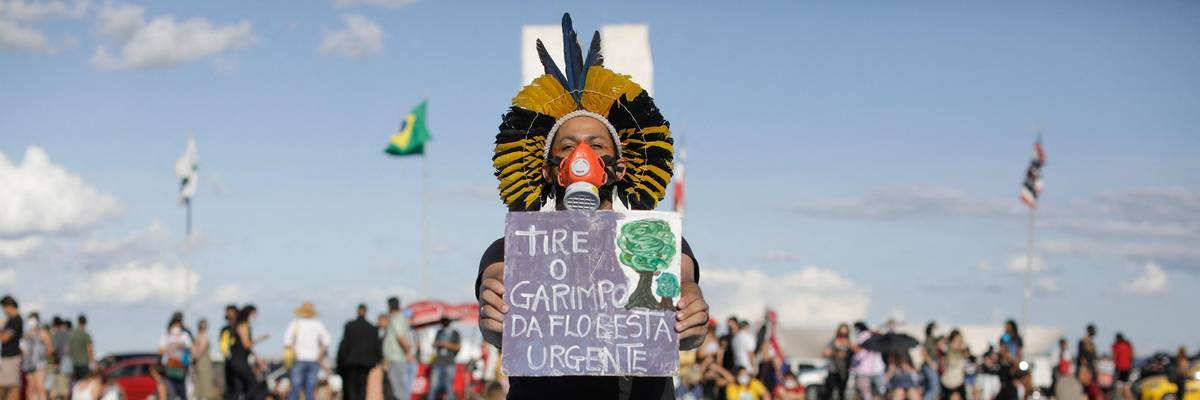
An indigenous man holds a sign reading Get mining out of the forest urgently during a demo led by Brazilian musician Caetano Veloso (out of frame) in defense of Earth and the environment and against the environmental policies of Brazilian President Jair Bolsonaro, outside the Congress building in Brasilia, on March 9, 2022, as pro-government deputies prepare to analyse controversial bills that affect indigenous lands. (Photo: Sergio Lima / AFP)
Why Global News Is Essential for Individual and Social Well Being
The hope required for social struggles and social gains, doesn't blossom from avoiding the news. Instead, it comes from understanding how economic and political forces work.
The US midterms just took place, and the whole world knows about it. But how many people in the US are aware of other country's major elections, let alone midterms or state elections for example? There was a coup and a new president in Burkina Faso recently, with significant implications for violence, hundreds of thousands facing starvation, and millions of displaced people, but few know this happened, let alone the details.
One study looking at newscasts and headlines over a period of 13 years, found that only a small proportion of the news was topically and geographically global. Typically, around 7.5% of the BBC's and CNN's broadcasts were global in nature. In 2019, CNN only mentioned 30 countries in its headlines at least once, during the entire year.
Likewise, a study of the UK Guardian's world news showed just how much more coverage the US and Europe are given compared to the rest of the world. Maps illustrating the study's results showed the US and Europe both magnified to 10 times the size of Latin America, as a representation of "how the world looks through the eyes of the British people."
The more we understand what the world is going through, the more committed we are to ensuring it is okay.
Readers and viewers understand quantity as an indicator of importance. When a global news site has ten consecutive articles on various aspects of a non-lethal building fire in New York, but just one story about a massacre in Sudan, readers absorb the idea that what happened in New York is of greater importance. Over time, people learn that richer countries and the people in them are much more important than poorer countries.
Such Euro- and US-centric coverage causes extensive emotional and social damage. It cements a colonialist mentality, and makes some wars and some poverty permissible. The poor majority world is only covered (only matters) if there are economic benefits for wealthy countries, or if the US wants to intervene or overthrow a government. Then, suddenly, the whole world cares about the inflation crisis in Venezuela, while turning a blind eye to 152 other countries facing extensive poverty.
Truly global news, on the other hand, not only challenges the paradigm of dominant rich countries subordinating the poorer ones, it has important benefits for individual mental health and for society. During the pandemic, a lot of content was published about excessive news consumption causing mental health problems. But anything in excess is problematic, and what most of these articles downplayed was that it is sensationalist news, inward-focused, and decontextualized news that is harmful.
The individual benefits of global news
Meanwhile, regular consumption of well-written and compiled global news actually fosters important social skills like understanding, acceptance, connection, empathy and appreciation of diversity. As countries come out of the depths of darkness and a complex local politics with real people is revealed, our world becomes bigger, along with our potential for being big-hearted.
While apathy and naivety rot away at the soul and prevent empowerment, the empathy and connectedness that global news consumption facilitates, is integral to our well being and our dignity. Even if a lot of the news saddens us, being able to understand and value others enriches us.
Meaningful connections aren't limited to romance and family. Knowing what is going on in the world nurtures a broader attachment to humanity, and a sense of belonging to it. Later, that type of caring can be emotionally rough, but it is also essential motivation for solidarity and sustained resistance.
The more we understand what the world is going through, the more committed we are to ensuring it is okay. Suddenly, the blase way Coca Cola steels water from Indigenous communities in poor countries, is no longer a random and distant fact, but a horrendous act of cruelty against friends.
The empathy, information, and political literacy gained from global news all aid us in strengthening a moral code and behaviour (including not being racist or classist) that quite simply makes us nicer, happier, and freer people.
Further, a regular global context can aid us in perspective and clarity regarding local events, as well as helping us to appreciate our own culture, identity, and place in the world. When valuing the immense variety of experiences and struggles globally, we see things differently. Languages become philosophies with long histories, and we learn to be truly open minded. That is, we finally understand that there are many ways to do collective decision making other than the Western democracy system of two big-business parties, or that the simple ritual of community meetings or of mourning, can be done in so many ways. There are more possibilities, and that means, actually, more hope and creativity.
The broader social benefits of truly global news
When more people are literate in global politics and have a global perspective, human-made borders stop making sense and abandoning drowning refugees in the Mediterranean becomes the human rights violation that it is. The spun justifications for war are harder to swallow, and it becomes morally corrupt for the wealthy countries to get vaccines months and years before everyone else. That is, the more people have a critical global mentality, the less of a free pass injustice has.
Global news gives climate change its context. And that gives us a better chance of halting it or diminishing it. Stereotypes about poorer regions become flimsy in light of real information. The narco and violence tropes about Latin America seem ridiculous when the US's military intervention and the economic abuse by multinational countries is evidenced more often in global headlines. When the bulk of people understand the conditions refugees are fleeing from, it is harder to dismiss, so quickly, their search for safety.
Comprehension empowers people. The hope required for social struggles and social gains, doesn't blossom from avoiding the news. Instead, it comes from understanding how economic and political forces work.
And extremely important; a global perspective counters centering one powerful country and its greedy, deadly interests. Instead, one's home country is part of something bigger, part of history, and part of change.
Avoiding global news fosters the inward mindset that we saw strengthened everywhere during the pandemic. That is, a focus almost exclusively on oneself or one's country, while being blind to the needs of others. Those outside one's country are background noise at the most. Whether individual or at a country level, the inward mindset involves a lot of blame, shirking of responsibility, defensiveness, fear-based thinking, isolation, closed mindedness, and joyless languishing. It is a raging blind-spot to the global nature of our collective mental and physical health and our environment.
As a journalist with 22 years of experience--15 of those in Latin America, covering social issues, resistance, and US intervention in the region--I have been constantly frustrated by the disparity between our lived experiences and the way the mainstream media covers them, if it bothers to at all. So, considering many people's time constraints, I am now producing a newsletter and podcast called Excluded Headlines, which is a weekly summary of poor majority world news that has been overlooked or downplayed by mainstream English-language media.
We are at a crossroads
This country and this world are at a monumental crossroads. In a few short weeks, US voters will have an opportunity to beat back the forces of fascism and confront the billionaires who are rigging the economy, our media system, and our democracy, making it increasingly impossible for ordinary people to get by. We’re not just talking about the election. We’re talking about what must be done once these fascist elements are vanquished from power. We need a bolder set of solutions than what either major party has so far been willing to offer and a working-class movement ready to fight like hell for it. Trump didn't emerge from nowhere. The conditions that fueled MAGA authoritarianism were created by decades of radical neoliberal economic policies and a corrupt political system dominated by corporate interests. They slashed taxes on the super-rich, promising that the benefits would trickle down. They said giveaways to the corporate titans would make life more affordable for the rest of us. It was all bullshit. And when a bitter, betrayed populace searches for someone to blame, right-wing demagogues have little trouble finding scapegoats. People know when they're being lied to, but you won't hear any of this from the corporate media. Only independent journalism—powered and funded by people who believe in building a better world—can deliver truly trustworthy daily news. Our Fall Campaign is underway, and we need your help. To power our newsroom through the rest of the year, we need to raise $125,000 by midnight on October 31. So if you share our vision, please contribute whatever you can to sustain our work. |
The US midterms just took place, and the whole world knows about it. But how many people in the US are aware of other country's major elections, let alone midterms or state elections for example? There was a coup and a new president in Burkina Faso recently, with significant implications for violence, hundreds of thousands facing starvation, and millions of displaced people, but few know this happened, let alone the details.
One study looking at newscasts and headlines over a period of 13 years, found that only a small proportion of the news was topically and geographically global. Typically, around 7.5% of the BBC's and CNN's broadcasts were global in nature. In 2019, CNN only mentioned 30 countries in its headlines at least once, during the entire year.
Likewise, a study of the UK Guardian's world news showed just how much more coverage the US and Europe are given compared to the rest of the world. Maps illustrating the study's results showed the US and Europe both magnified to 10 times the size of Latin America, as a representation of "how the world looks through the eyes of the British people."
The more we understand what the world is going through, the more committed we are to ensuring it is okay.
Readers and viewers understand quantity as an indicator of importance. When a global news site has ten consecutive articles on various aspects of a non-lethal building fire in New York, but just one story about a massacre in Sudan, readers absorb the idea that what happened in New York is of greater importance. Over time, people learn that richer countries and the people in them are much more important than poorer countries.
Such Euro- and US-centric coverage causes extensive emotional and social damage. It cements a colonialist mentality, and makes some wars and some poverty permissible. The poor majority world is only covered (only matters) if there are economic benefits for wealthy countries, or if the US wants to intervene or overthrow a government. Then, suddenly, the whole world cares about the inflation crisis in Venezuela, while turning a blind eye to 152 other countries facing extensive poverty.
Truly global news, on the other hand, not only challenges the paradigm of dominant rich countries subordinating the poorer ones, it has important benefits for individual mental health and for society. During the pandemic, a lot of content was published about excessive news consumption causing mental health problems. But anything in excess is problematic, and what most of these articles downplayed was that it is sensationalist news, inward-focused, and decontextualized news that is harmful.
The individual benefits of global news
Meanwhile, regular consumption of well-written and compiled global news actually fosters important social skills like understanding, acceptance, connection, empathy and appreciation of diversity. As countries come out of the depths of darkness and a complex local politics with real people is revealed, our world becomes bigger, along with our potential for being big-hearted.
While apathy and naivety rot away at the soul and prevent empowerment, the empathy and connectedness that global news consumption facilitates, is integral to our well being and our dignity. Even if a lot of the news saddens us, being able to understand and value others enriches us.
Meaningful connections aren't limited to romance and family. Knowing what is going on in the world nurtures a broader attachment to humanity, and a sense of belonging to it. Later, that type of caring can be emotionally rough, but it is also essential motivation for solidarity and sustained resistance.
The more we understand what the world is going through, the more committed we are to ensuring it is okay. Suddenly, the blase way Coca Cola steels water from Indigenous communities in poor countries, is no longer a random and distant fact, but a horrendous act of cruelty against friends.
The empathy, information, and political literacy gained from global news all aid us in strengthening a moral code and behaviour (including not being racist or classist) that quite simply makes us nicer, happier, and freer people.
Further, a regular global context can aid us in perspective and clarity regarding local events, as well as helping us to appreciate our own culture, identity, and place in the world. When valuing the immense variety of experiences and struggles globally, we see things differently. Languages become philosophies with long histories, and we learn to be truly open minded. That is, we finally understand that there are many ways to do collective decision making other than the Western democracy system of two big-business parties, or that the simple ritual of community meetings or of mourning, can be done in so many ways. There are more possibilities, and that means, actually, more hope and creativity.
The broader social benefits of truly global news
When more people are literate in global politics and have a global perspective, human-made borders stop making sense and abandoning drowning refugees in the Mediterranean becomes the human rights violation that it is. The spun justifications for war are harder to swallow, and it becomes morally corrupt for the wealthy countries to get vaccines months and years before everyone else. That is, the more people have a critical global mentality, the less of a free pass injustice has.
Global news gives climate change its context. And that gives us a better chance of halting it or diminishing it. Stereotypes about poorer regions become flimsy in light of real information. The narco and violence tropes about Latin America seem ridiculous when the US's military intervention and the economic abuse by multinational countries is evidenced more often in global headlines. When the bulk of people understand the conditions refugees are fleeing from, it is harder to dismiss, so quickly, their search for safety.
Comprehension empowers people. The hope required for social struggles and social gains, doesn't blossom from avoiding the news. Instead, it comes from understanding how economic and political forces work.
And extremely important; a global perspective counters centering one powerful country and its greedy, deadly interests. Instead, one's home country is part of something bigger, part of history, and part of change.
Avoiding global news fosters the inward mindset that we saw strengthened everywhere during the pandemic. That is, a focus almost exclusively on oneself or one's country, while being blind to the needs of others. Those outside one's country are background noise at the most. Whether individual or at a country level, the inward mindset involves a lot of blame, shirking of responsibility, defensiveness, fear-based thinking, isolation, closed mindedness, and joyless languishing. It is a raging blind-spot to the global nature of our collective mental and physical health and our environment.
As a journalist with 22 years of experience--15 of those in Latin America, covering social issues, resistance, and US intervention in the region--I have been constantly frustrated by the disparity between our lived experiences and the way the mainstream media covers them, if it bothers to at all. So, considering many people's time constraints, I am now producing a newsletter and podcast called Excluded Headlines, which is a weekly summary of poor majority world news that has been overlooked or downplayed by mainstream English-language media.
The US midterms just took place, and the whole world knows about it. But how many people in the US are aware of other country's major elections, let alone midterms or state elections for example? There was a coup and a new president in Burkina Faso recently, with significant implications for violence, hundreds of thousands facing starvation, and millions of displaced people, but few know this happened, let alone the details.
One study looking at newscasts and headlines over a period of 13 years, found that only a small proportion of the news was topically and geographically global. Typically, around 7.5% of the BBC's and CNN's broadcasts were global in nature. In 2019, CNN only mentioned 30 countries in its headlines at least once, during the entire year.
Likewise, a study of the UK Guardian's world news showed just how much more coverage the US and Europe are given compared to the rest of the world. Maps illustrating the study's results showed the US and Europe both magnified to 10 times the size of Latin America, as a representation of "how the world looks through the eyes of the British people."
The more we understand what the world is going through, the more committed we are to ensuring it is okay.
Readers and viewers understand quantity as an indicator of importance. When a global news site has ten consecutive articles on various aspects of a non-lethal building fire in New York, but just one story about a massacre in Sudan, readers absorb the idea that what happened in New York is of greater importance. Over time, people learn that richer countries and the people in them are much more important than poorer countries.
Such Euro- and US-centric coverage causes extensive emotional and social damage. It cements a colonialist mentality, and makes some wars and some poverty permissible. The poor majority world is only covered (only matters) if there are economic benefits for wealthy countries, or if the US wants to intervene or overthrow a government. Then, suddenly, the whole world cares about the inflation crisis in Venezuela, while turning a blind eye to 152 other countries facing extensive poverty.
Truly global news, on the other hand, not only challenges the paradigm of dominant rich countries subordinating the poorer ones, it has important benefits for individual mental health and for society. During the pandemic, a lot of content was published about excessive news consumption causing mental health problems. But anything in excess is problematic, and what most of these articles downplayed was that it is sensationalist news, inward-focused, and decontextualized news that is harmful.
The individual benefits of global news
Meanwhile, regular consumption of well-written and compiled global news actually fosters important social skills like understanding, acceptance, connection, empathy and appreciation of diversity. As countries come out of the depths of darkness and a complex local politics with real people is revealed, our world becomes bigger, along with our potential for being big-hearted.
While apathy and naivety rot away at the soul and prevent empowerment, the empathy and connectedness that global news consumption facilitates, is integral to our well being and our dignity. Even if a lot of the news saddens us, being able to understand and value others enriches us.
Meaningful connections aren't limited to romance and family. Knowing what is going on in the world nurtures a broader attachment to humanity, and a sense of belonging to it. Later, that type of caring can be emotionally rough, but it is also essential motivation for solidarity and sustained resistance.
The more we understand what the world is going through, the more committed we are to ensuring it is okay. Suddenly, the blase way Coca Cola steels water from Indigenous communities in poor countries, is no longer a random and distant fact, but a horrendous act of cruelty against friends.
The empathy, information, and political literacy gained from global news all aid us in strengthening a moral code and behaviour (including not being racist or classist) that quite simply makes us nicer, happier, and freer people.
Further, a regular global context can aid us in perspective and clarity regarding local events, as well as helping us to appreciate our own culture, identity, and place in the world. When valuing the immense variety of experiences and struggles globally, we see things differently. Languages become philosophies with long histories, and we learn to be truly open minded. That is, we finally understand that there are many ways to do collective decision making other than the Western democracy system of two big-business parties, or that the simple ritual of community meetings or of mourning, can be done in so many ways. There are more possibilities, and that means, actually, more hope and creativity.
The broader social benefits of truly global news
When more people are literate in global politics and have a global perspective, human-made borders stop making sense and abandoning drowning refugees in the Mediterranean becomes the human rights violation that it is. The spun justifications for war are harder to swallow, and it becomes morally corrupt for the wealthy countries to get vaccines months and years before everyone else. That is, the more people have a critical global mentality, the less of a free pass injustice has.
Global news gives climate change its context. And that gives us a better chance of halting it or diminishing it. Stereotypes about poorer regions become flimsy in light of real information. The narco and violence tropes about Latin America seem ridiculous when the US's military intervention and the economic abuse by multinational countries is evidenced more often in global headlines. When the bulk of people understand the conditions refugees are fleeing from, it is harder to dismiss, so quickly, their search for safety.
Comprehension empowers people. The hope required for social struggles and social gains, doesn't blossom from avoiding the news. Instead, it comes from understanding how economic and political forces work.
And extremely important; a global perspective counters centering one powerful country and its greedy, deadly interests. Instead, one's home country is part of something bigger, part of history, and part of change.
Avoiding global news fosters the inward mindset that we saw strengthened everywhere during the pandemic. That is, a focus almost exclusively on oneself or one's country, while being blind to the needs of others. Those outside one's country are background noise at the most. Whether individual or at a country level, the inward mindset involves a lot of blame, shirking of responsibility, defensiveness, fear-based thinking, isolation, closed mindedness, and joyless languishing. It is a raging blind-spot to the global nature of our collective mental and physical health and our environment.
As a journalist with 22 years of experience--15 of those in Latin America, covering social issues, resistance, and US intervention in the region--I have been constantly frustrated by the disparity between our lived experiences and the way the mainstream media covers them, if it bothers to at all. So, considering many people's time constraints, I am now producing a newsletter and podcast called Excluded Headlines, which is a weekly summary of poor majority world news that has been overlooked or downplayed by mainstream English-language media.