

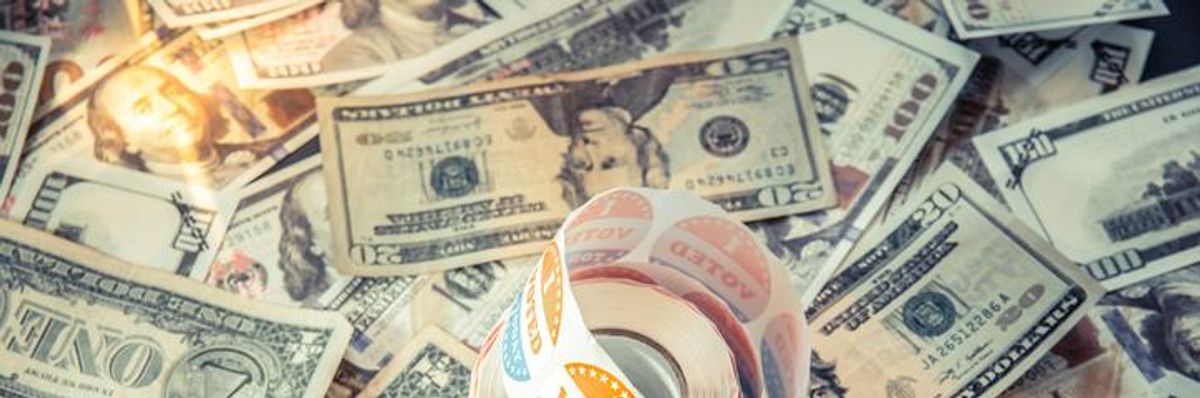
For years, big corporations have been assaulting democracy with big money, drowning out the voices and needs of ordinary Americans. (Photo: Joaquin Corbalan/Getty)
Condemning Insurrectionists Is Easy, But If Corporate America Cared About Democracy It Would Support the 'For the People Act'
If they were actually committed to democracy, CEOs of big corporations would permanently cease corporate donations to all candidates.
The sudden lurch from Trump to Biden is generating vertigo all over Washington, including the so-called fourth branch of government--CEOs and their army of lobbyists.
Notwithstanding Biden's ambitious agenda, dozens of giant corporations have said they will not donate to the 147 members of Congress who objected to the certification of Biden electors on the basis of Trump's lies about widespread fraud, which rules out most Republicans on the Hill.
After locking down Trump's account, social media giants like Twitter and Facebook are policing against instigators of violence and hate, which hobbles Republican lawmakers trying to appeal to Trump voters.
For years, big corporations have been assaulting democracy with big money, drowning out the voices and needs of ordinary Americans and fueling much of the anger and cynicism that opened the door to Trump in the first place.
As a result of moves like these, CEOs are being hailed--and hailing themselves--as guardians of democracy. The New York Times praises business leaders for seeking "stability and national unity." Ed Bastian, CEO of Delta Airlines, says "our voice is seen as more important than ever." A recent study by Edelman finds the public now trusts business more than nonprofit organizations, the government or the media.
Give me a break. For years, big corporations have been assaulting democracy with big money, drowning out the voices and needs of ordinary Americans and fueling much of the anger and cynicism that opened the door to Trump in the first place.
Their assault hasn't been as dramatic as the Trump thugs who stormed the Capitol, and it's entirely legal--although more damaging over the long term.
A study published a few years ago by two of America's most respected political scientists, Princeton professor Martin Gilens and Northwestern's Benjamin Page, concluded that the preferences of the average American "have only a minuscule, near-zero, statistically nonsignificant impact upon public policy." Instead, lawmakers respond almost exclusively to the moneyed interests - those with the most lobbying prowess and deepest pockets to bankroll campaigns.
The capture of government by big business over the last several decades has infuriated average Americans whose paychecks have gone nowhere even as the stock market has soared.
The populist movements that fueled both Bernie Sanders and Trump began in the 2008 financial crisis when Wall Street got bailed out and no major bank executive went to jail, although millions of ordinary people lost their jobs, savings and homes.
So now, in wake of Trump's calamitous exit and Biden's ascension, we're to believe CEOs care about democracy?
"No one thought they were giving money to people who supported sedition," explained Jamie Dimon, CEO of JPMorgan Chase and chairman of the Business Roundtable, referring to the disgraced Republicans.
Yet Dimon has been a leader of the more insidious form of sedition. He piloted the corporate lobbying campaign for the Trump tax cut, deploying a vast war chest of corporate donations.
For more than a decade Dimon has driven Wall Street's charge against stricter bank regulation, opening bipartisan doors in the Capitol with generous gifts from the Street. (Dimon calls himself a Democrat.)
When Facebook's Mark Zuckerberg shut Trump's Facebook account, he declared "you just can't have a functioning democracy without a peaceful transition of power."
Where was Zuckerberg's concern for a "functioning democracy" when he amplified Trump's lies for four years?
After taking down Trump's Twitter account, CEO Jack Dorsey expressed discomfort about "the power an individual or corporation has over a part of the global public conversation."
Spare me. Dorsey has fought off all attempts to limit Twitter's power over the "global conversation." He shuttered Trump only after Democrats secured the presidency and control of the Senate.
Look, I'm glad CEOs are penalizing the 147 Republican seditionists and that Big Tech is starting to police social media content.
But don't confuse the avowed concerns of these CEOs about democracy with democracy itself. They aren't answerable to democracy. At most, they're accountable to big shareholders and institutional investors who don't give a fig as long as profits keep rolling in.
If they were committed to democracy, CEOs of big corporations would permanently cease corporate donations to all candidates, close their PACs, stop giving to secretive "dark money" groups, and discourage donations by their executives.
They'd stop placing ads in media that have weaponized disinformation--including Fox News, Infowars, Newsmax and websites affiliated with right-wing pundits. Social media giants would start acting like publishers and take responsibility for what they promulgate.
If corporate America were serious about democracy it would throw its weight behind the "For the People Act," the first bills of the new Congress, offering public financing of elections among other reforms.
Don't hold your breath.
Joe Biden intends to raise corporate taxes, increase the minimum wage, break up Big Tech, and strengthen labor unions.
The fourth branch is already amassing a war chest for the fight.
We are at a crossroads
This country and this world are at a monumental crossroads. In a few short weeks, US voters will have an opportunity to beat back the forces of fascism and confront the billionaires who are rigging the economy, our media system, and our democracy, making it increasingly impossible for ordinary people to get by. We’re not just talking about the election. We’re talking about what must be done once these fascist elements are vanquished from power. We need a bolder set of solutions than what either major party has so far been willing to offer and a working-class movement ready to fight like hell for it. Trump didn't emerge from nowhere. The conditions that fueled MAGA authoritarianism were created by decades of radical neoliberal economic policies and a corrupt political system dominated by corporate interests. They slashed taxes on the super-rich, promising that the benefits would trickle down. They said giveaways to the corporate titans would make life more affordable for the rest of us. It was all bullshit. And when a bitter, betrayed populace searches for someone to blame, right-wing demagogues have little trouble finding scapegoats. People know when they're being lied to, but you won't hear any of this from the corporate media. Only independent journalism—powered and funded by people who believe in building a better world—can deliver truly trustworthy daily news. Our Fall Campaign is underway, and we need your help. To power our newsroom through the rest of the year, we need to raise $125,000 by midnight on October 31. So if you share our vision, please contribute whatever you can to sustain our work. |
The sudden lurch from Trump to Biden is generating vertigo all over Washington, including the so-called fourth branch of government--CEOs and their army of lobbyists.
Notwithstanding Biden's ambitious agenda, dozens of giant corporations have said they will not donate to the 147 members of Congress who objected to the certification of Biden electors on the basis of Trump's lies about widespread fraud, which rules out most Republicans on the Hill.
After locking down Trump's account, social media giants like Twitter and Facebook are policing against instigators of violence and hate, which hobbles Republican lawmakers trying to appeal to Trump voters.
For years, big corporations have been assaulting democracy with big money, drowning out the voices and needs of ordinary Americans and fueling much of the anger and cynicism that opened the door to Trump in the first place.
As a result of moves like these, CEOs are being hailed--and hailing themselves--as guardians of democracy. The New York Times praises business leaders for seeking "stability and national unity." Ed Bastian, CEO of Delta Airlines, says "our voice is seen as more important than ever." A recent study by Edelman finds the public now trusts business more than nonprofit organizations, the government or the media.
Give me a break. For years, big corporations have been assaulting democracy with big money, drowning out the voices and needs of ordinary Americans and fueling much of the anger and cynicism that opened the door to Trump in the first place.
Their assault hasn't been as dramatic as the Trump thugs who stormed the Capitol, and it's entirely legal--although more damaging over the long term.
A study published a few years ago by two of America's most respected political scientists, Princeton professor Martin Gilens and Northwestern's Benjamin Page, concluded that the preferences of the average American "have only a minuscule, near-zero, statistically nonsignificant impact upon public policy." Instead, lawmakers respond almost exclusively to the moneyed interests - those with the most lobbying prowess and deepest pockets to bankroll campaigns.
The capture of government by big business over the last several decades has infuriated average Americans whose paychecks have gone nowhere even as the stock market has soared.
The populist movements that fueled both Bernie Sanders and Trump began in the 2008 financial crisis when Wall Street got bailed out and no major bank executive went to jail, although millions of ordinary people lost their jobs, savings and homes.
So now, in wake of Trump's calamitous exit and Biden's ascension, we're to believe CEOs care about democracy?
"No one thought they were giving money to people who supported sedition," explained Jamie Dimon, CEO of JPMorgan Chase and chairman of the Business Roundtable, referring to the disgraced Republicans.
Yet Dimon has been a leader of the more insidious form of sedition. He piloted the corporate lobbying campaign for the Trump tax cut, deploying a vast war chest of corporate donations.
For more than a decade Dimon has driven Wall Street's charge against stricter bank regulation, opening bipartisan doors in the Capitol with generous gifts from the Street. (Dimon calls himself a Democrat.)
When Facebook's Mark Zuckerberg shut Trump's Facebook account, he declared "you just can't have a functioning democracy without a peaceful transition of power."
Where was Zuckerberg's concern for a "functioning democracy" when he amplified Trump's lies for four years?
After taking down Trump's Twitter account, CEO Jack Dorsey expressed discomfort about "the power an individual or corporation has over a part of the global public conversation."
Spare me. Dorsey has fought off all attempts to limit Twitter's power over the "global conversation." He shuttered Trump only after Democrats secured the presidency and control of the Senate.
Look, I'm glad CEOs are penalizing the 147 Republican seditionists and that Big Tech is starting to police social media content.
But don't confuse the avowed concerns of these CEOs about democracy with democracy itself. They aren't answerable to democracy. At most, they're accountable to big shareholders and institutional investors who don't give a fig as long as profits keep rolling in.
If they were committed to democracy, CEOs of big corporations would permanently cease corporate donations to all candidates, close their PACs, stop giving to secretive "dark money" groups, and discourage donations by their executives.
They'd stop placing ads in media that have weaponized disinformation--including Fox News, Infowars, Newsmax and websites affiliated with right-wing pundits. Social media giants would start acting like publishers and take responsibility for what they promulgate.
If corporate America were serious about democracy it would throw its weight behind the "For the People Act," the first bills of the new Congress, offering public financing of elections among other reforms.
Don't hold your breath.
Joe Biden intends to raise corporate taxes, increase the minimum wage, break up Big Tech, and strengthen labor unions.
The fourth branch is already amassing a war chest for the fight.