SUBSCRIBE TO OUR FREE NEWSLETTER
Daily news & progressive opinion—funded by the people, not the corporations—delivered straight to your inbox.
5
#000000
#FFFFFF
To donate by check, phone, or other method, see our More Ways to Give page.
Daily news & progressive opinion—funded by the people, not the corporations—delivered straight to your inbox.
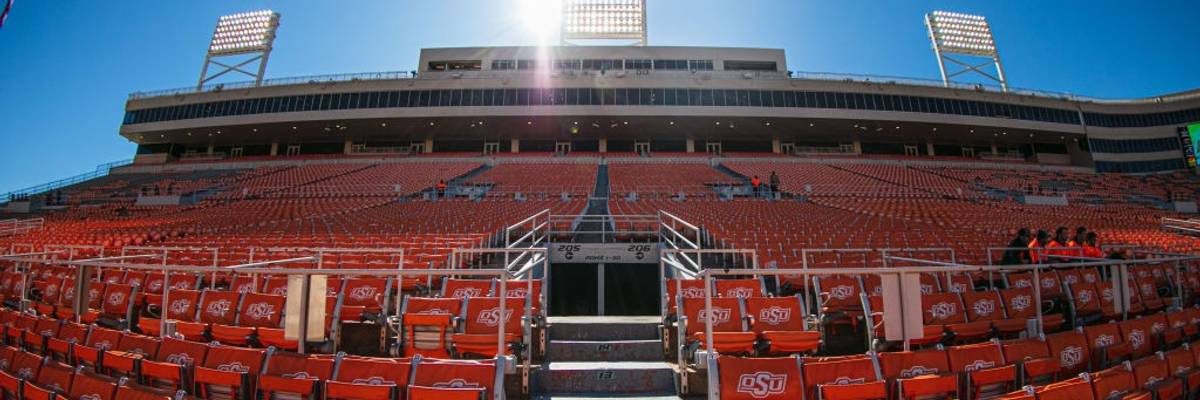
Oklahoma State Cowboys stadium sits empty prior to the Big 12 football game between the Oklahoma State Cowboys and the TCU Horned Frogs on November 2, 2019 at Boone Pickens Stadium in Stillwater, Oklahoma.
House Democrats shouldn't help Trump market limits on athletes' bargaining power as a win for the same people those limits hold back.
House Democrats can stand with college athletes, or they can help Donald Trump score a win at those athletes' expense. There isn't much middle ground here.
The Senate has passed the Protect College Sports Act, a bill that would make it harder for college athletes to set the terms of their own endorsement deals. Now the president wants Congress to put it on his desk.
Democrats should say no. Passing it hands him a win and gives powerful schools even more control over the young people whose labor keeps college sports running in the first place.
There's still time for Democrats to hold out for a better bill. They should keep the scholarship and health protections, protect women's and Olympic sports, and give athletes real bargaining rights and a way to fight unfair restrictions.
In its September 28 statement, the White House cast Trump as a champion of college athletes and pushed lawmakers to bring stability to the system. It's a tidy story. Democrats ought to ask the obvious follow-up, though. Stability for whom?
For decades, college sports ran on the idea of amateurism. The rivalries got the headlines, and players were told they were out there for the love of the game. Funny how that love never kept the schools from cashing in. By 1952, college football was already a TV property. That year, NBC paid the National Collegiate Athletic Association (NCAA) $1.14 million for the rights to broadcast one game a week.
Then came 1984, when individual schools and conferences won the right to cut their own TV deals, and the value went through the roof. That's a big part of how college sports grew into the multibillion-dollar business it is today. Schools and conferences fought each other for TV money, all while capping what the athletes bringing in that money could make. Nobody turned on the TV to watch an athletic director. They tuned in for the players.
A lot of the athletes shut out of that money came from families without much wealth to pass down. Black athletes, in particular, filled the rosters of the football and basketball programs that drew the biggest TV checks. Colleges and networks made money off every game, yet the players couldn't earn a dime from their own names or faces. Their work built wealth for just about everyone but them.
That began to change in 2021, when the Supreme Court ruled in NCAA v. Alston that the NCAA couldn't cap certain education-related benefits for athletes. Days later, state name, image, and likeness (NIL) laws took effect, and the NCAA set aside the rules that had kept athletes from profiting off their names, images, and likenesses. For the first time, a player could get paid for an endorsement or a video game appearance and still keep their eligibility.
To Democrats, this ought to read as a labor fight, plain and simple. Athletes finally got some room to negotiate what their names and talents are worth. Coaches, networks, and universities have been doing that forever. Yes, a scholarship is worth something. So is the work of the person who earns it. We can't champion workers' bargaining power in every other industry and then act like it's a problem once it shows up on a football field.
Sen. Ted Cruz (R-Texas), who has spent years preaching about free markets, is now one of the people leading the charge to limit what athletes can earn. So I guess competition only becomes a crisis when the young people doing the work finally have some leverage over the schools paying them. Nick Saban insisted last month that player pay and coach pay are "totally different markets," but when the Senate had a chance to cap coaches' salaries, that amendment failed, so apparently the only market that needs a ceiling is the one where the players get paid.
Congress has no business giving schools more power over the terms of players' endorsement deals. Athletes deserve protections, and they shouldn't have to give up their leverage to get them.
Collective bargaining belongs at the center of this fight. Athletes need to be able to negotiate as a group over pay, working conditions, and medical care for injuries that can stick with them for years after their eligibility runs out. Giving them a seat on some committee doesn't come close. Democrats should insist on a bargaining framework with real teeth, not punt the question to some future commission.
For Black athletes, the stakes are even higher. An NIL deal might cover a family's bills, chip away at debt, or start a savings account. Cap what players can earn or where they can go, and you shrink those chances during a career that's short to begin with. The NAACP has opposed this legislation, warning that it puts institutional interests ahead of athletes' economic rights. Democrats would be smart to listen.
And now Trump wants his name on it. Why would Democrats help him market limits on athletes' bargaining power as a win for the same people those limits hold back? We tell voters we'll fight for workers and help Black families build wealth. We should remember that when rich universities and conferences show up asking for protection.
There's still time for Democrats to hold out for a better bill. They should keep the scholarship and health protections, protect women's and Olympic sports, and give athletes real bargaining rights and a way to fight unfair restrictions. What they shouldn't do is give Trump a win paid for with Black athletes' economic freedom. The people doing the work have earned a win of their own.
Dear Common Dreams reader, It’s been nearly 30 years since I co-founded Common Dreams with my late wife, Lina Newhouser. We had the radical notion that journalism should serve the public good, not corporate profits. It was clear to us from the outset what it would take to build such a project. No paid advertisements. No corporate sponsors. No millionaire publisher telling us what to think or do. Many people said we wouldn't last a year, but we proved those doubters wrong. Together with a tremendous team of journalists and dedicated staff, we built an independent media outlet free from the constraints of profits and corporate control. Our mission has always been simple: To inform. To inspire. To ignite change for the common good. Building Common Dreams was not easy. Our survival was never guaranteed. When you take on the most powerful forces—Wall Street greed, fossil fuel industry destruction, Big Tech lobbyists, and uber-rich oligarchs who have spent billions upon billions rigging the economy and democracy in their favor—the only bulwark you have is supporters who believe in your work. But here’s the urgent message from me today. It's never been this bad out there. And it's never been this hard to keep us going. At the very moment Common Dreams is most needed, the threats we face are intensifying. We need your support now more than ever. We don't accept corporate advertising and never will. We don't have a paywall because we don't think people should be blocked from critical news based on their ability to pay. Everything we do is funded by the donations of readers like you. When everyone does the little they can afford, we are strong. But if that support retreats or dries up, so do we. Will you donate now to make sure Common Dreams not only survives but thrives? —Craig Brown, Co-founder |
House Democrats can stand with college athletes, or they can help Donald Trump score a win at those athletes' expense. There isn't much middle ground here.
The Senate has passed the Protect College Sports Act, a bill that would make it harder for college athletes to set the terms of their own endorsement deals. Now the president wants Congress to put it on his desk.
Democrats should say no. Passing it hands him a win and gives powerful schools even more control over the young people whose labor keeps college sports running in the first place.
There's still time for Democrats to hold out for a better bill. They should keep the scholarship and health protections, protect women's and Olympic sports, and give athletes real bargaining rights and a way to fight unfair restrictions.
In its September 28 statement, the White House cast Trump as a champion of college athletes and pushed lawmakers to bring stability to the system. It's a tidy story. Democrats ought to ask the obvious follow-up, though. Stability for whom?
For decades, college sports ran on the idea of amateurism. The rivalries got the headlines, and players were told they were out there for the love of the game. Funny how that love never kept the schools from cashing in. By 1952, college football was already a TV property. That year, NBC paid the National Collegiate Athletic Association (NCAA) $1.14 million for the rights to broadcast one game a week.
Then came 1984, when individual schools and conferences won the right to cut their own TV deals, and the value went through the roof. That's a big part of how college sports grew into the multibillion-dollar business it is today. Schools and conferences fought each other for TV money, all while capping what the athletes bringing in that money could make. Nobody turned on the TV to watch an athletic director. They tuned in for the players.
A lot of the athletes shut out of that money came from families without much wealth to pass down. Black athletes, in particular, filled the rosters of the football and basketball programs that drew the biggest TV checks. Colleges and networks made money off every game, yet the players couldn't earn a dime from their own names or faces. Their work built wealth for just about everyone but them.
That began to change in 2021, when the Supreme Court ruled in NCAA v. Alston that the NCAA couldn't cap certain education-related benefits for athletes. Days later, state name, image, and likeness (NIL) laws took effect, and the NCAA set aside the rules that had kept athletes from profiting off their names, images, and likenesses. For the first time, a player could get paid for an endorsement or a video game appearance and still keep their eligibility.
To Democrats, this ought to read as a labor fight, plain and simple. Athletes finally got some room to negotiate what their names and talents are worth. Coaches, networks, and universities have been doing that forever. Yes, a scholarship is worth something. So is the work of the person who earns it. We can't champion workers' bargaining power in every other industry and then act like it's a problem once it shows up on a football field.
Sen. Ted Cruz (R-Texas), who has spent years preaching about free markets, is now one of the people leading the charge to limit what athletes can earn. So I guess competition only becomes a crisis when the young people doing the work finally have some leverage over the schools paying them. Nick Saban insisted last month that player pay and coach pay are "totally different markets," but when the Senate had a chance to cap coaches' salaries, that amendment failed, so apparently the only market that needs a ceiling is the one where the players get paid.
Congress has no business giving schools more power over the terms of players' endorsement deals. Athletes deserve protections, and they shouldn't have to give up their leverage to get them.
Collective bargaining belongs at the center of this fight. Athletes need to be able to negotiate as a group over pay, working conditions, and medical care for injuries that can stick with them for years after their eligibility runs out. Giving them a seat on some committee doesn't come close. Democrats should insist on a bargaining framework with real teeth, not punt the question to some future commission.
For Black athletes, the stakes are even higher. An NIL deal might cover a family's bills, chip away at debt, or start a savings account. Cap what players can earn or where they can go, and you shrink those chances during a career that's short to begin with. The NAACP has opposed this legislation, warning that it puts institutional interests ahead of athletes' economic rights. Democrats would be smart to listen.
And now Trump wants his name on it. Why would Democrats help him market limits on athletes' bargaining power as a win for the same people those limits hold back? We tell voters we'll fight for workers and help Black families build wealth. We should remember that when rich universities and conferences show up asking for protection.
There's still time for Democrats to hold out for a better bill. They should keep the scholarship and health protections, protect women's and Olympic sports, and give athletes real bargaining rights and a way to fight unfair restrictions. What they shouldn't do is give Trump a win paid for with Black athletes' economic freedom. The people doing the work have earned a win of their own.
House Democrats can stand with college athletes, or they can help Donald Trump score a win at those athletes' expense. There isn't much middle ground here.
The Senate has passed the Protect College Sports Act, a bill that would make it harder for college athletes to set the terms of their own endorsement deals. Now the president wants Congress to put it on his desk.
Democrats should say no. Passing it hands him a win and gives powerful schools even more control over the young people whose labor keeps college sports running in the first place.
There's still time for Democrats to hold out for a better bill. They should keep the scholarship and health protections, protect women's and Olympic sports, and give athletes real bargaining rights and a way to fight unfair restrictions.
In its September 28 statement, the White House cast Trump as a champion of college athletes and pushed lawmakers to bring stability to the system. It's a tidy story. Democrats ought to ask the obvious follow-up, though. Stability for whom?
For decades, college sports ran on the idea of amateurism. The rivalries got the headlines, and players were told they were out there for the love of the game. Funny how that love never kept the schools from cashing in. By 1952, college football was already a TV property. That year, NBC paid the National Collegiate Athletic Association (NCAA) $1.14 million for the rights to broadcast one game a week.
Then came 1984, when individual schools and conferences won the right to cut their own TV deals, and the value went through the roof. That's a big part of how college sports grew into the multibillion-dollar business it is today. Schools and conferences fought each other for TV money, all while capping what the athletes bringing in that money could make. Nobody turned on the TV to watch an athletic director. They tuned in for the players.
A lot of the athletes shut out of that money came from families without much wealth to pass down. Black athletes, in particular, filled the rosters of the football and basketball programs that drew the biggest TV checks. Colleges and networks made money off every game, yet the players couldn't earn a dime from their own names or faces. Their work built wealth for just about everyone but them.
That began to change in 2021, when the Supreme Court ruled in NCAA v. Alston that the NCAA couldn't cap certain education-related benefits for athletes. Days later, state name, image, and likeness (NIL) laws took effect, and the NCAA set aside the rules that had kept athletes from profiting off their names, images, and likenesses. For the first time, a player could get paid for an endorsement or a video game appearance and still keep their eligibility.
To Democrats, this ought to read as a labor fight, plain and simple. Athletes finally got some room to negotiate what their names and talents are worth. Coaches, networks, and universities have been doing that forever. Yes, a scholarship is worth something. So is the work of the person who earns it. We can't champion workers' bargaining power in every other industry and then act like it's a problem once it shows up on a football field.
Sen. Ted Cruz (R-Texas), who has spent years preaching about free markets, is now one of the people leading the charge to limit what athletes can earn. So I guess competition only becomes a crisis when the young people doing the work finally have some leverage over the schools paying them. Nick Saban insisted last month that player pay and coach pay are "totally different markets," but when the Senate had a chance to cap coaches' salaries, that amendment failed, so apparently the only market that needs a ceiling is the one where the players get paid.
Congress has no business giving schools more power over the terms of players' endorsement deals. Athletes deserve protections, and they shouldn't have to give up their leverage to get them.
Collective bargaining belongs at the center of this fight. Athletes need to be able to negotiate as a group over pay, working conditions, and medical care for injuries that can stick with them for years after their eligibility runs out. Giving them a seat on some committee doesn't come close. Democrats should insist on a bargaining framework with real teeth, not punt the question to some future commission.
For Black athletes, the stakes are even higher. An NIL deal might cover a family's bills, chip away at debt, or start a savings account. Cap what players can earn or where they can go, and you shrink those chances during a career that's short to begin with. The NAACP has opposed this legislation, warning that it puts institutional interests ahead of athletes' economic rights. Democrats would be smart to listen.
And now Trump wants his name on it. Why would Democrats help him market limits on athletes' bargaining power as a win for the same people those limits hold back? We tell voters we'll fight for workers and help Black families build wealth. We should remember that when rich universities and conferences show up asking for protection.
There's still time for Democrats to hold out for a better bill. They should keep the scholarship and health protections, protect women's and Olympic sports, and give athletes real bargaining rights and a way to fight unfair restrictions. What they shouldn't do is give Trump a win paid for with Black athletes' economic freedom. The people doing the work have earned a win of their own.