SUBSCRIBE TO OUR FREE NEWSLETTER
Daily news & progressive opinion—funded by the people, not the corporations—delivered straight to your inbox.
5
#000000
#FFFFFF
To donate by check, phone, or other method, see our More Ways to Give page.
Daily news & progressive opinion—funded by the people, not the corporations—delivered straight to your inbox.
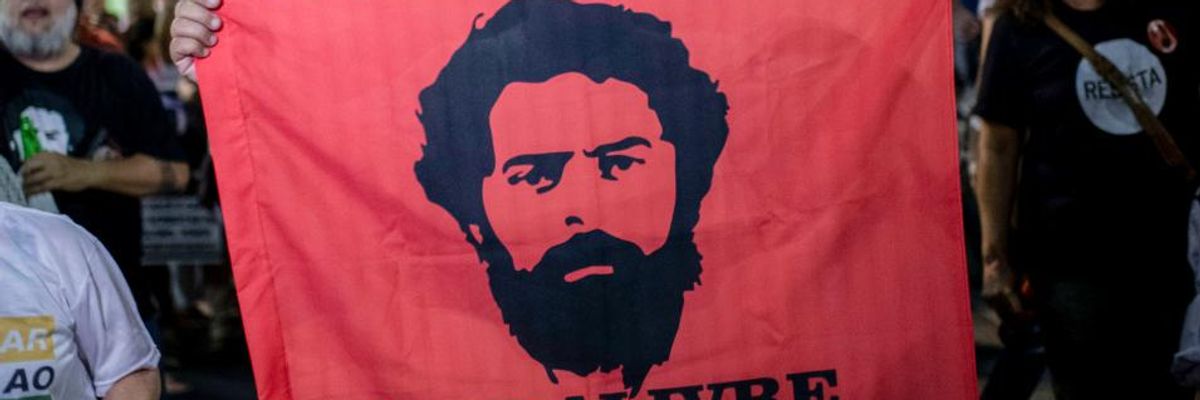
A supporter of the former Brazilian president Luis Inacio Lula da Silva holds a flag during a national strike protest called by unions and students against the Brazilian President Jair Bolsonaro's pension reform in Rio de Janeiro, Brazil, on June 14, 2019. (Photo: Mauro Pimentel/AFP/Getty Images)
On April 7th last year, Brazil's former president Luiz Inacio Lula da Silva was arrested in a Sao Paulo suburb and taken to Federal Police offices in the southern town of Curitiba. It was the culmination of a campaign, waged jointly by the mainstream media and part of the judiciary, that had begun two years earlier with a series of maneuvers that led to the impeachment of president Dilma Rousseff. The underlying objective, in both cases, was to roll back a progressive political project; one repeatedly endorsed by voters and that focused on bringing greater justice and equality to Brazilian society.
In May 2018, in what was widely understood as a reference to these events, Pope Francis spoke of a new form of "coup d Etat." Later, as he addressed magistrates from all over the Americas, the Pope spoke of the danger that "lawfare" poses to democracy.
The trial leading to Lula's imprisonment was acutely flawed from the beginning. The sentence given by Judge Sergio Moro states Lula was convicted for "undetermined acts" related to an infamous Sao Paulo beach condominium, without proof that Lula benefited from any sort of illicit exchange. In fact, all available evidence demonstrates that the apartment never belonged to Lula or anyone in his family.
"Given the credibility he has among the great majority of the population, only Lula can reestablish dialogue among all sectors of society, which is indispensable for Brazil to return to a path of peace and development."
The power of the media campaign against Lula, and the naive worshipping of the fight against corruption by any means, sowed doubts in the minds of even the most skeptical individuals. But this began to change with the appointment of Judge Moro as minister of justice under current president Jair Bolsonaro--a move widely seen as a reward for Moro keeping Lula, the top-polling candidate, from participating in last year's presidential election. This was followed by revelations in The Intercept proving what careful observers already knew: Lula was the object of political persecution, conducted by a biased judge and fanatical prosecutors obsessed with their personal project to amass power.
The growing awareness of these facts recently led seventeen jurists (including renowned law professors, members of constitutional courts, and former ministers of justice) from Europe, the United States, and Latin America to publish a statement demanding annulment of the process by which Lula was convicted and stripped of his freedom.
Lula has recently told the media that he believes the U.S. government was involved in his persecution. This belief is based in the fact that Department of Justice officials worked with Judge Moro and the Brazilian prosecutors that targeted Lula. The former president is not alone in wondering what role the U.S. may have played in his persecution: on August 20, thirteen members of the U.S. Congress sent a letter to Attorney General William Barr asking for details regarding DOJ involvement in the case against Lula.
On the day of his arrest, Lula, in a spontaneous and highly emotional speech, affirmed that while his enemies could arrest an individual, they could not imprison the dreams of a people. The spectacle of cruelty we have seen lately, with the outrageous and alarming actions of Brazil's highest dignitary, who climbed to power thanks to Lula's imprisonment, leaves us wondering whether this hopeful assertion will prevail.
In today's Brazil, the dreams have turned to nightmares: the poor are increasingly deprived of their rights; censorship, often veiled and insidious, restrains freedom of expression; numbing fear prevents good people from taking action; prejudice and stupidity have launched a full-scale assault on reason and science; and, as a consequence of all this, Brazil has become an object of shame in the world, a real international pariah. We live an environment of abnormality without precedent.
For normalcy to return to our country and for hope to be recovered, Lula's freedom, along with annulment of the faulty process by which he was condemned, is essential. Given the credibility he has among the great majority of the population, only Lula can reestablish dialogue among all sectors of society, which is indispensable for Brazil to return to a path of peace and development.
Even before Lula's imprisonment, Nobel laureate Adolfo Perez-Esquivel spearheaded a movement to honor him with the Nobel Peace Prize. In the next weeks, the commission in charge in Norway will make a decision. We hope it takes into consideration the work of a labor leader, elevated to the presidency, who lifted millions of Brazilians from poverty, who contributed to peace in South America and around the world, who took courageous measures to protect the environment and the rights of Black and indigenous people, and who defended democracy in a developing country of continental dimensions, whose destiny will not cease to impact the region and the world as a whole.
Dear Common Dreams reader, It’s been nearly 30 years since I co-founded Common Dreams with my late wife, Lina Newhouser. We had the radical notion that journalism should serve the public good, not corporate profits. It was clear to us from the outset what it would take to build such a project. No paid advertisements. No corporate sponsors. No millionaire publisher telling us what to think or do. Many people said we wouldn't last a year, but we proved those doubters wrong. Together with a tremendous team of journalists and dedicated staff, we built an independent media outlet free from the constraints of profits and corporate control. Our mission has always been simple: To inform. To inspire. To ignite change for the common good. Building Common Dreams was not easy. Our survival was never guaranteed. When you take on the most powerful forces—Wall Street greed, fossil fuel industry destruction, Big Tech lobbyists, and uber-rich oligarchs who have spent billions upon billions rigging the economy and democracy in their favor—the only bulwark you have is supporters who believe in your work. But here’s the urgent message from me today. It's never been this bad out there. And it's never been this hard to keep us going. At the very moment Common Dreams is most needed, the threats we face are intensifying. We need your support now more than ever. We don't accept corporate advertising and never will. We don't have a paywall because we don't think people should be blocked from critical news based on their ability to pay. Everything we do is funded by the donations of readers like you. When everyone does the little they can afford, we are strong. But if that support retreats or dries up, so do we. Will you donate now to make sure Common Dreams not only survives but thrives? —Craig Brown, Co-founder |
On April 7th last year, Brazil's former president Luiz Inacio Lula da Silva was arrested in a Sao Paulo suburb and taken to Federal Police offices in the southern town of Curitiba. It was the culmination of a campaign, waged jointly by the mainstream media and part of the judiciary, that had begun two years earlier with a series of maneuvers that led to the impeachment of president Dilma Rousseff. The underlying objective, in both cases, was to roll back a progressive political project; one repeatedly endorsed by voters and that focused on bringing greater justice and equality to Brazilian society.
In May 2018, in what was widely understood as a reference to these events, Pope Francis spoke of a new form of "coup d Etat." Later, as he addressed magistrates from all over the Americas, the Pope spoke of the danger that "lawfare" poses to democracy.
The trial leading to Lula's imprisonment was acutely flawed from the beginning. The sentence given by Judge Sergio Moro states Lula was convicted for "undetermined acts" related to an infamous Sao Paulo beach condominium, without proof that Lula benefited from any sort of illicit exchange. In fact, all available evidence demonstrates that the apartment never belonged to Lula or anyone in his family.
"Given the credibility he has among the great majority of the population, only Lula can reestablish dialogue among all sectors of society, which is indispensable for Brazil to return to a path of peace and development."
The power of the media campaign against Lula, and the naive worshipping of the fight against corruption by any means, sowed doubts in the minds of even the most skeptical individuals. But this began to change with the appointment of Judge Moro as minister of justice under current president Jair Bolsonaro--a move widely seen as a reward for Moro keeping Lula, the top-polling candidate, from participating in last year's presidential election. This was followed by revelations in The Intercept proving what careful observers already knew: Lula was the object of political persecution, conducted by a biased judge and fanatical prosecutors obsessed with their personal project to amass power.
The growing awareness of these facts recently led seventeen jurists (including renowned law professors, members of constitutional courts, and former ministers of justice) from Europe, the United States, and Latin America to publish a statement demanding annulment of the process by which Lula was convicted and stripped of his freedom.
Lula has recently told the media that he believes the U.S. government was involved in his persecution. This belief is based in the fact that Department of Justice officials worked with Judge Moro and the Brazilian prosecutors that targeted Lula. The former president is not alone in wondering what role the U.S. may have played in his persecution: on August 20, thirteen members of the U.S. Congress sent a letter to Attorney General William Barr asking for details regarding DOJ involvement in the case against Lula.
On the day of his arrest, Lula, in a spontaneous and highly emotional speech, affirmed that while his enemies could arrest an individual, they could not imprison the dreams of a people. The spectacle of cruelty we have seen lately, with the outrageous and alarming actions of Brazil's highest dignitary, who climbed to power thanks to Lula's imprisonment, leaves us wondering whether this hopeful assertion will prevail.
In today's Brazil, the dreams have turned to nightmares: the poor are increasingly deprived of their rights; censorship, often veiled and insidious, restrains freedom of expression; numbing fear prevents good people from taking action; prejudice and stupidity have launched a full-scale assault on reason and science; and, as a consequence of all this, Brazil has become an object of shame in the world, a real international pariah. We live an environment of abnormality without precedent.
For normalcy to return to our country and for hope to be recovered, Lula's freedom, along with annulment of the faulty process by which he was condemned, is essential. Given the credibility he has among the great majority of the population, only Lula can reestablish dialogue among all sectors of society, which is indispensable for Brazil to return to a path of peace and development.
Even before Lula's imprisonment, Nobel laureate Adolfo Perez-Esquivel spearheaded a movement to honor him with the Nobel Peace Prize. In the next weeks, the commission in charge in Norway will make a decision. We hope it takes into consideration the work of a labor leader, elevated to the presidency, who lifted millions of Brazilians from poverty, who contributed to peace in South America and around the world, who took courageous measures to protect the environment and the rights of Black and indigenous people, and who defended democracy in a developing country of continental dimensions, whose destiny will not cease to impact the region and the world as a whole.
On April 7th last year, Brazil's former president Luiz Inacio Lula da Silva was arrested in a Sao Paulo suburb and taken to Federal Police offices in the southern town of Curitiba. It was the culmination of a campaign, waged jointly by the mainstream media and part of the judiciary, that had begun two years earlier with a series of maneuvers that led to the impeachment of president Dilma Rousseff. The underlying objective, in both cases, was to roll back a progressive political project; one repeatedly endorsed by voters and that focused on bringing greater justice and equality to Brazilian society.
In May 2018, in what was widely understood as a reference to these events, Pope Francis spoke of a new form of "coup d Etat." Later, as he addressed magistrates from all over the Americas, the Pope spoke of the danger that "lawfare" poses to democracy.
The trial leading to Lula's imprisonment was acutely flawed from the beginning. The sentence given by Judge Sergio Moro states Lula was convicted for "undetermined acts" related to an infamous Sao Paulo beach condominium, without proof that Lula benefited from any sort of illicit exchange. In fact, all available evidence demonstrates that the apartment never belonged to Lula or anyone in his family.
"Given the credibility he has among the great majority of the population, only Lula can reestablish dialogue among all sectors of society, which is indispensable for Brazil to return to a path of peace and development."
The power of the media campaign against Lula, and the naive worshipping of the fight against corruption by any means, sowed doubts in the minds of even the most skeptical individuals. But this began to change with the appointment of Judge Moro as minister of justice under current president Jair Bolsonaro--a move widely seen as a reward for Moro keeping Lula, the top-polling candidate, from participating in last year's presidential election. This was followed by revelations in The Intercept proving what careful observers already knew: Lula was the object of political persecution, conducted by a biased judge and fanatical prosecutors obsessed with their personal project to amass power.
The growing awareness of these facts recently led seventeen jurists (including renowned law professors, members of constitutional courts, and former ministers of justice) from Europe, the United States, and Latin America to publish a statement demanding annulment of the process by which Lula was convicted and stripped of his freedom.
Lula has recently told the media that he believes the U.S. government was involved in his persecution. This belief is based in the fact that Department of Justice officials worked with Judge Moro and the Brazilian prosecutors that targeted Lula. The former president is not alone in wondering what role the U.S. may have played in his persecution: on August 20, thirteen members of the U.S. Congress sent a letter to Attorney General William Barr asking for details regarding DOJ involvement in the case against Lula.
On the day of his arrest, Lula, in a spontaneous and highly emotional speech, affirmed that while his enemies could arrest an individual, they could not imprison the dreams of a people. The spectacle of cruelty we have seen lately, with the outrageous and alarming actions of Brazil's highest dignitary, who climbed to power thanks to Lula's imprisonment, leaves us wondering whether this hopeful assertion will prevail.
In today's Brazil, the dreams have turned to nightmares: the poor are increasingly deprived of their rights; censorship, often veiled and insidious, restrains freedom of expression; numbing fear prevents good people from taking action; prejudice and stupidity have launched a full-scale assault on reason and science; and, as a consequence of all this, Brazil has become an object of shame in the world, a real international pariah. We live an environment of abnormality without precedent.
For normalcy to return to our country and for hope to be recovered, Lula's freedom, along with annulment of the faulty process by which he was condemned, is essential. Given the credibility he has among the great majority of the population, only Lula can reestablish dialogue among all sectors of society, which is indispensable for Brazil to return to a path of peace and development.
Even before Lula's imprisonment, Nobel laureate Adolfo Perez-Esquivel spearheaded a movement to honor him with the Nobel Peace Prize. In the next weeks, the commission in charge in Norway will make a decision. We hope it takes into consideration the work of a labor leader, elevated to the presidency, who lifted millions of Brazilians from poverty, who contributed to peace in South America and around the world, who took courageous measures to protect the environment and the rights of Black and indigenous people, and who defended democracy in a developing country of continental dimensions, whose destiny will not cease to impact the region and the world as a whole.