SUBSCRIBE TO OUR FREE NEWSLETTER
Daily news & progressive opinion—funded by the people, not the corporations—delivered straight to your inbox.
5
#000000
#FFFFFF
To donate by check, phone, or other method, see our More Ways to Give page.
Daily news & progressive opinion—funded by the people, not the corporations—delivered straight to your inbox.
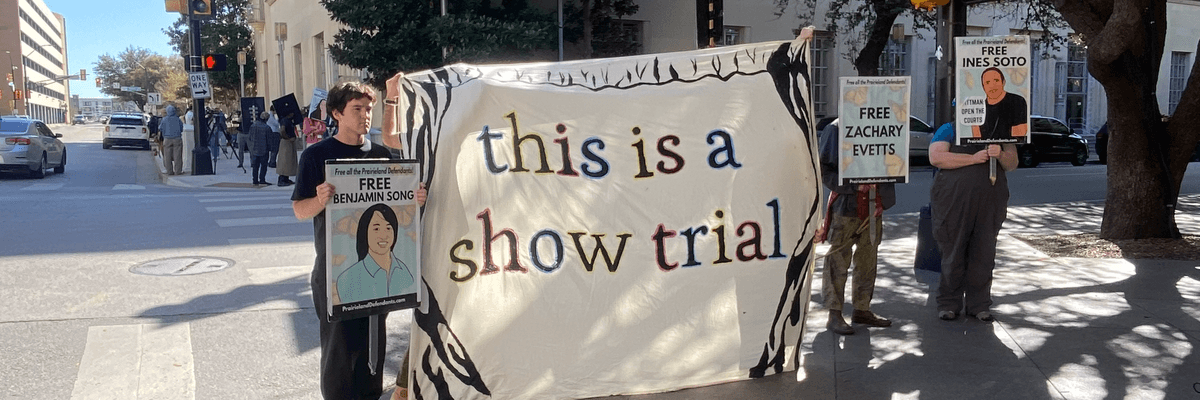
People show support for protesters facing trial for allegedly being part of a nonexistent "North Texas Antifa Cell," outside the Eldon B. Mahon United States Courthouse in Fort Worth on March 13, 2026.
“Now anyone engaged in basic protests with the wrong political beliefs can be labeled a domestic terrorist, when they have no intention of violence," said one attorney.
Alarm and outrage mounted this week following a federal judge's lengthy prison sentences for a group of activists falsely accused by the Trump administration of being members of a nonexistent "North Texas Antifa Cell," with some observers calling the extreme punishments—including 30 years for moving a box of constitutionally protected pamphlets—a test case for criminalizing dissent.
Eight members of the "Prairieview Nine"—part of a larger group of activists who staged a July 4, 2025 protest outside a US Immigration and Customs Enforcement (ICE) detention center in Alvarado, Texas—were sentenced Tuesday in the US District Court for the Northern District of Texas in Fort Worth to between 30-100 years imprisonment.
Benjamin Song, who was convicted of shooting Alvarado Police Lt. Thomas Gross, was sentenced to 100 years for attempted murder of a law enforcement officer and lesser offenses, including discharging a firearm during a violent crime, conspiracy to use and using an explosive, and rioting. Song, a former US Marine, contends that he shot Gross in self-defense after the officer drew his gun first.
The “explosives” in question were fireworks brought to the July 4 protest to show solidarity with people detained by ICE.
Savanna Batten, Zachary Evetts, Autumn Hill, Bradford Morris, and Elizabeth Soto got 50 years each for rioting, providing material support to terrorists, and conspiracy to use and using an explosive.
Maricela Rueda was sentenced to 70 years for rioting, providing material support to terrorists, conspiracy to use and using an explosive, and conspiracy to conceal documents. Those documents were leftist pamphlets protected by the First Amendment.
Rueda's husband, Daniel “Des” Rolando Sanchez Estrada, was hit with a 30-year prison sentence for conspiracy to conceal documents for moving a box full of the pamphlets after speaking with his wife. He did not attend the protest.
Judge Reed O’Connor, an appointee of former President George W. Bush and a favorite of right-wing judge shoppers, told the court that the lengthy sentences are meant to “send a message to anyone who shares a similar ideology” with the defendants, according to one observer of Tuesday’s proceedings.
The Prairieland sentences were more severe than the longest prison term for the average US murderer or rapist, as well as for the January 6, 2021 Capitol insurrectionists—all of whom were later pardoned by President Donald Trump—as well as for convicted child sex trafficker and Jeffrey Epstein co-conspirator Ghislaine Maxwell.
"What happened on Tuesday, it’s shocking to all of us, devastating to the families, 50- to 100-year sentences," Sufia Khalid, deputy director of the National Security Criminal Defense Center at the Muslim Legal Fund of America and lawyer to one of the Prairieland defendants, told Democracy Now! on Thursday. "Those are essentially life sentences for all of the young people in this case, largely of whom were engaged in nonviolent protest at an ICE detention facility."
A group of anti-ICE protesters in Texas were sentenced to 30 to 100 years in jail on Tuesday, after federal prosecutors accused them of being an "antifa terror cell."
The activists attended a protest and noise demonstration outside the Prairieland ICE jail in Alvarado, Texas.… pic.twitter.com/QxFMPaGsvj
— Democracy Now! (@democracynow) June 25, 2026
Khalid noted that the Department of Justice (DOJ) invoked a rarely used "material support for terrorism" statute that "does not require any connection to a domestic terrorist organization or any kind."
"Any American can be targeted that way now. It does not require ties to antifa or to any domestic terrorist organization," she said. "That’s a dangerous precedent, and what allowed them to stack these charges so high on Tuesday."
The DOJ hailed “the first sentencing of defendants affiliated with antifa following... Trump’s executive order designating the group as a domestic terrorist organization in September 2025" in the wake of the assassination of white supremacist influencer Charlie Kirk—which had nothing to do with antifa, a decentralized and leaderless international ideology opposing fascism that's more of a mindset than a movement.
Later that month, Trump also signed National Security Presidential Memorandum 7 (NSPM-7), a directive titled “Countering Domestic Terrorism and Organized Political Violence,” that focuses exclusively on left-wing activities and mandates a “national strategy to investigate and disrupt networks, entities, and organizations that foment political violence so that law enforcement can intervene in criminal conspiracies before they result in violent political acts.”
Khalid pointed to the pardoned January 6 insurrectionists, who "were involved in rioting, carrying massive arsenals of weapons, lots of discussions ahead of time—that didn’t exist in this case—about targeting law enforcement, wanting to kill members of Congress, [and] actually storming the Capitol."
"So, we have a massive, unwarranted sentencing disparity here," she said. "What happened in the court in Fort Worth was unconstitutional and should concern everybody in this country in the direction that it is taking us."
Mark Osler, a law professor and sentencing expert at the University of St. Thomas in Minneapolis, told The Guardian on Friday that "the 30-year sentence for Estrada is probably the one that for most people will come closest to shocking the conscience, simply because this is an activity that took place after the harm occurred."
"What happened in the court in Fort Worth was unconstitutional and should concern everybody in this country in the direction that it is taking us."
Seth Stern, chief of advocacy at the Freedom of the Press Foundation, underscored during a Friday interview in an episode of Fairness and Accuracy in Reporting's Counterspin podcast titled "Criminalizing Dissent" that Estrada "wasn't even at the protest."
"He's somebody who allegedly transported a box of pamphlets because his wife was at the protest," Stern said. "And he believed, according to prosecutors, that the box of pamphlets might implicate his wife... so he was concealing evidence."
"Evidence of what?" he continued. "This wasn't a how-to manual... They were zines. They said nothing about this protest, about the Prairieland detention facility, about shooting this police officer... So when they say that he concealed evidence by moving these zines, evidence of what? It's evidence of an ideology. It's evidence of somebody's reading habits."
"And now they're on the same plane as terrorists, as [Islamic State], according to this administration," Stern added. "It's all pretty absurd. But at the end of the day, we have a Constitution that prohibits people from being locked up for what they think, write, or read, as long as they are not inciting imminent violence. So hopefully the appellate courts will reverse these convictions. But the law is only as good as the people who enforce it."
Jeremy Busby, an incarcerated journalist, wrote on the eve of Estrada's trial that the "homespun zines at issue contain no plans for any shooting, and under normal circumstances, they would clearly be deemed constitutionally protected speech under the First Amendment."
"But the government’s concealment theory only makes sense if it views merely having the literature as criminal," he argued. “Criminalizing possession of literature is a miscarriage of justice, whether in prison or at a protester’s husband’s parents’ house. If the Trump administration is allowed to send Estrada to prison for the crime of possessing literature, members of society at large can be subjected to the same pernicious rules as the incarcerated.”
Amber Lowrey, the sister of Prairieland defendant Savanna Batten—who was sentenced to 50 years behind bars for material support for terrorism and conspiracy to use and using "explosives" (fireworks)—told The Guardian before Batten's trial that the Trump administration just wants "to make an example of people and silence anyone who... opposes the government."
"They want to silence dissent, criminalize dissent," she added.
Trump administration prosecutors have also invoked NSPM-7 in the case of 15 organizers with the groups Direct Action Minnesota and Black Cat Workers, who are accused of impeding the Department of Homeland Security’s anti-immigrant crackdown in Minneapolis, where US citizens Renee Good and Alex Pretti were separately killed earlier this year by ICE and Border Patrol officers.
"We live under a fascist state where ICE agents can murder us with impunity, yet we can go to prison for 50 years for protesting," socialist commentator and journalist Ryan Knight said Thursday on X. "The unjust sentences of the Prairieland protesters violate the First Amendment and infringe on our rights to fight back against a tyrannical government."
Dear Common Dreams reader, It’s been nearly 30 years since I co-founded Common Dreams with my late wife, Lina Newhouser. We had the radical notion that journalism should serve the public good, not corporate profits. It was clear to us from the outset what it would take to build such a project. No paid advertisements. No corporate sponsors. No millionaire publisher telling us what to think or do. Many people said we wouldn't last a year, but we proved those doubters wrong. Together with a tremendous team of journalists and dedicated staff, we built an independent media outlet free from the constraints of profits and corporate control. Our mission has always been simple: To inform. To inspire. To ignite change for the common good. Building Common Dreams was not easy. Our survival was never guaranteed. When you take on the most powerful forces—Wall Street greed, fossil fuel industry destruction, Big Tech lobbyists, and uber-rich oligarchs who have spent billions upon billions rigging the economy and democracy in their favor—the only bulwark you have is supporters who believe in your work. But here’s the urgent message from me today. It's never been this bad out there. And it's never been this hard to keep us going. At the very moment Common Dreams is most needed, the threats we face are intensifying. We need your support now more than ever. We don't accept corporate advertising and never will. We don't have a paywall because we don't think people should be blocked from critical news based on their ability to pay. Everything we do is funded by the donations of readers like you. When everyone does the little they can afford, we are strong. But if that support retreats or dries up, so do we. Will you donate now to make sure Common Dreams not only survives but thrives? —Craig Brown, Co-founder |
Alarm and outrage mounted this week following a federal judge's lengthy prison sentences for a group of activists falsely accused by the Trump administration of being members of a nonexistent "North Texas Antifa Cell," with some observers calling the extreme punishments—including 30 years for moving a box of constitutionally protected pamphlets—a test case for criminalizing dissent.
Eight members of the "Prairieview Nine"—part of a larger group of activists who staged a July 4, 2025 protest outside a US Immigration and Customs Enforcement (ICE) detention center in Alvarado, Texas—were sentenced Tuesday in the US District Court for the Northern District of Texas in Fort Worth to between 30-100 years imprisonment.
Benjamin Song, who was convicted of shooting Alvarado Police Lt. Thomas Gross, was sentenced to 100 years for attempted murder of a law enforcement officer and lesser offenses, including discharging a firearm during a violent crime, conspiracy to use and using an explosive, and rioting. Song, a former US Marine, contends that he shot Gross in self-defense after the officer drew his gun first.
The “explosives” in question were fireworks brought to the July 4 protest to show solidarity with people detained by ICE.
Savanna Batten, Zachary Evetts, Autumn Hill, Bradford Morris, and Elizabeth Soto got 50 years each for rioting, providing material support to terrorists, and conspiracy to use and using an explosive.
Maricela Rueda was sentenced to 70 years for rioting, providing material support to terrorists, conspiracy to use and using an explosive, and conspiracy to conceal documents. Those documents were leftist pamphlets protected by the First Amendment.
Rueda's husband, Daniel “Des” Rolando Sanchez Estrada, was hit with a 30-year prison sentence for conspiracy to conceal documents for moving a box full of the pamphlets after speaking with his wife. He did not attend the protest.
Judge Reed O’Connor, an appointee of former President George W. Bush and a favorite of right-wing judge shoppers, told the court that the lengthy sentences are meant to “send a message to anyone who shares a similar ideology” with the defendants, according to one observer of Tuesday’s proceedings.
The Prairieland sentences were more severe than the longest prison term for the average US murderer or rapist, as well as for the January 6, 2021 Capitol insurrectionists—all of whom were later pardoned by President Donald Trump—as well as for convicted child sex trafficker and Jeffrey Epstein co-conspirator Ghislaine Maxwell.
"What happened on Tuesday, it’s shocking to all of us, devastating to the families, 50- to 100-year sentences," Sufia Khalid, deputy director of the National Security Criminal Defense Center at the Muslim Legal Fund of America and lawyer to one of the Prairieland defendants, told Democracy Now! on Thursday. "Those are essentially life sentences for all of the young people in this case, largely of whom were engaged in nonviolent protest at an ICE detention facility."
A group of anti-ICE protesters in Texas were sentenced to 30 to 100 years in jail on Tuesday, after federal prosecutors accused them of being an "antifa terror cell."
The activists attended a protest and noise demonstration outside the Prairieland ICE jail in Alvarado, Texas.… pic.twitter.com/QxFMPaGsvj
— Democracy Now! (@democracynow) June 25, 2026
Khalid noted that the Department of Justice (DOJ) invoked a rarely used "material support for terrorism" statute that "does not require any connection to a domestic terrorist organization or any kind."
"Any American can be targeted that way now. It does not require ties to antifa or to any domestic terrorist organization," she said. "That’s a dangerous precedent, and what allowed them to stack these charges so high on Tuesday."
The DOJ hailed “the first sentencing of defendants affiliated with antifa following... Trump’s executive order designating the group as a domestic terrorist organization in September 2025" in the wake of the assassination of white supremacist influencer Charlie Kirk—which had nothing to do with antifa, a decentralized and leaderless international ideology opposing fascism that's more of a mindset than a movement.
Later that month, Trump also signed National Security Presidential Memorandum 7 (NSPM-7), a directive titled “Countering Domestic Terrorism and Organized Political Violence,” that focuses exclusively on left-wing activities and mandates a “national strategy to investigate and disrupt networks, entities, and organizations that foment political violence so that law enforcement can intervene in criminal conspiracies before they result in violent political acts.”
Khalid pointed to the pardoned January 6 insurrectionists, who "were involved in rioting, carrying massive arsenals of weapons, lots of discussions ahead of time—that didn’t exist in this case—about targeting law enforcement, wanting to kill members of Congress, [and] actually storming the Capitol."
"So, we have a massive, unwarranted sentencing disparity here," she said. "What happened in the court in Fort Worth was unconstitutional and should concern everybody in this country in the direction that it is taking us."
Mark Osler, a law professor and sentencing expert at the University of St. Thomas in Minneapolis, told The Guardian on Friday that "the 30-year sentence for Estrada is probably the one that for most people will come closest to shocking the conscience, simply because this is an activity that took place after the harm occurred."
"What happened in the court in Fort Worth was unconstitutional and should concern everybody in this country in the direction that it is taking us."
Seth Stern, chief of advocacy at the Freedom of the Press Foundation, underscored during a Friday interview in an episode of Fairness and Accuracy in Reporting's Counterspin podcast titled "Criminalizing Dissent" that Estrada "wasn't even at the protest."
"He's somebody who allegedly transported a box of pamphlets because his wife was at the protest," Stern said. "And he believed, according to prosecutors, that the box of pamphlets might implicate his wife... so he was concealing evidence."
"Evidence of what?" he continued. "This wasn't a how-to manual... They were zines. They said nothing about this protest, about the Prairieland detention facility, about shooting this police officer... So when they say that he concealed evidence by moving these zines, evidence of what? It's evidence of an ideology. It's evidence of somebody's reading habits."
"And now they're on the same plane as terrorists, as [Islamic State], according to this administration," Stern added. "It's all pretty absurd. But at the end of the day, we have a Constitution that prohibits people from being locked up for what they think, write, or read, as long as they are not inciting imminent violence. So hopefully the appellate courts will reverse these convictions. But the law is only as good as the people who enforce it."
Jeremy Busby, an incarcerated journalist, wrote on the eve of Estrada's trial that the "homespun zines at issue contain no plans for any shooting, and under normal circumstances, they would clearly be deemed constitutionally protected speech under the First Amendment."
"But the government’s concealment theory only makes sense if it views merely having the literature as criminal," he argued. “Criminalizing possession of literature is a miscarriage of justice, whether in prison or at a protester’s husband’s parents’ house. If the Trump administration is allowed to send Estrada to prison for the crime of possessing literature, members of society at large can be subjected to the same pernicious rules as the incarcerated.”
Amber Lowrey, the sister of Prairieland defendant Savanna Batten—who was sentenced to 50 years behind bars for material support for terrorism and conspiracy to use and using "explosives" (fireworks)—told The Guardian before Batten's trial that the Trump administration just wants "to make an example of people and silence anyone who... opposes the government."
"They want to silence dissent, criminalize dissent," she added.
Trump administration prosecutors have also invoked NSPM-7 in the case of 15 organizers with the groups Direct Action Minnesota and Black Cat Workers, who are accused of impeding the Department of Homeland Security’s anti-immigrant crackdown in Minneapolis, where US citizens Renee Good and Alex Pretti were separately killed earlier this year by ICE and Border Patrol officers.
"We live under a fascist state where ICE agents can murder us with impunity, yet we can go to prison for 50 years for protesting," socialist commentator and journalist Ryan Knight said Thursday on X. "The unjust sentences of the Prairieland protesters violate the First Amendment and infringe on our rights to fight back against a tyrannical government."
Alarm and outrage mounted this week following a federal judge's lengthy prison sentences for a group of activists falsely accused by the Trump administration of being members of a nonexistent "North Texas Antifa Cell," with some observers calling the extreme punishments—including 30 years for moving a box of constitutionally protected pamphlets—a test case for criminalizing dissent.
Eight members of the "Prairieview Nine"—part of a larger group of activists who staged a July 4, 2025 protest outside a US Immigration and Customs Enforcement (ICE) detention center in Alvarado, Texas—were sentenced Tuesday in the US District Court for the Northern District of Texas in Fort Worth to between 30-100 years imprisonment.
Benjamin Song, who was convicted of shooting Alvarado Police Lt. Thomas Gross, was sentenced to 100 years for attempted murder of a law enforcement officer and lesser offenses, including discharging a firearm during a violent crime, conspiracy to use and using an explosive, and rioting. Song, a former US Marine, contends that he shot Gross in self-defense after the officer drew his gun first.
The “explosives” in question were fireworks brought to the July 4 protest to show solidarity with people detained by ICE.
Savanna Batten, Zachary Evetts, Autumn Hill, Bradford Morris, and Elizabeth Soto got 50 years each for rioting, providing material support to terrorists, and conspiracy to use and using an explosive.
Maricela Rueda was sentenced to 70 years for rioting, providing material support to terrorists, conspiracy to use and using an explosive, and conspiracy to conceal documents. Those documents were leftist pamphlets protected by the First Amendment.
Rueda's husband, Daniel “Des” Rolando Sanchez Estrada, was hit with a 30-year prison sentence for conspiracy to conceal documents for moving a box full of the pamphlets after speaking with his wife. He did not attend the protest.
Judge Reed O’Connor, an appointee of former President George W. Bush and a favorite of right-wing judge shoppers, told the court that the lengthy sentences are meant to “send a message to anyone who shares a similar ideology” with the defendants, according to one observer of Tuesday’s proceedings.
The Prairieland sentences were more severe than the longest prison term for the average US murderer or rapist, as well as for the January 6, 2021 Capitol insurrectionists—all of whom were later pardoned by President Donald Trump—as well as for convicted child sex trafficker and Jeffrey Epstein co-conspirator Ghislaine Maxwell.
"What happened on Tuesday, it’s shocking to all of us, devastating to the families, 50- to 100-year sentences," Sufia Khalid, deputy director of the National Security Criminal Defense Center at the Muslim Legal Fund of America and lawyer to one of the Prairieland defendants, told Democracy Now! on Thursday. "Those are essentially life sentences for all of the young people in this case, largely of whom were engaged in nonviolent protest at an ICE detention facility."
A group of anti-ICE protesters in Texas were sentenced to 30 to 100 years in jail on Tuesday, after federal prosecutors accused them of being an "antifa terror cell."
The activists attended a protest and noise demonstration outside the Prairieland ICE jail in Alvarado, Texas.… pic.twitter.com/QxFMPaGsvj
— Democracy Now! (@democracynow) June 25, 2026
Khalid noted that the Department of Justice (DOJ) invoked a rarely used "material support for terrorism" statute that "does not require any connection to a domestic terrorist organization or any kind."
"Any American can be targeted that way now. It does not require ties to antifa or to any domestic terrorist organization," she said. "That’s a dangerous precedent, and what allowed them to stack these charges so high on Tuesday."
The DOJ hailed “the first sentencing of defendants affiliated with antifa following... Trump’s executive order designating the group as a domestic terrorist organization in September 2025" in the wake of the assassination of white supremacist influencer Charlie Kirk—which had nothing to do with antifa, a decentralized and leaderless international ideology opposing fascism that's more of a mindset than a movement.
Later that month, Trump also signed National Security Presidential Memorandum 7 (NSPM-7), a directive titled “Countering Domestic Terrorism and Organized Political Violence,” that focuses exclusively on left-wing activities and mandates a “national strategy to investigate and disrupt networks, entities, and organizations that foment political violence so that law enforcement can intervene in criminal conspiracies before they result in violent political acts.”
Khalid pointed to the pardoned January 6 insurrectionists, who "were involved in rioting, carrying massive arsenals of weapons, lots of discussions ahead of time—that didn’t exist in this case—about targeting law enforcement, wanting to kill members of Congress, [and] actually storming the Capitol."
"So, we have a massive, unwarranted sentencing disparity here," she said. "What happened in the court in Fort Worth was unconstitutional and should concern everybody in this country in the direction that it is taking us."
Mark Osler, a law professor and sentencing expert at the University of St. Thomas in Minneapolis, told The Guardian on Friday that "the 30-year sentence for Estrada is probably the one that for most people will come closest to shocking the conscience, simply because this is an activity that took place after the harm occurred."
"What happened in the court in Fort Worth was unconstitutional and should concern everybody in this country in the direction that it is taking us."
Seth Stern, chief of advocacy at the Freedom of the Press Foundation, underscored during a Friday interview in an episode of Fairness and Accuracy in Reporting's Counterspin podcast titled "Criminalizing Dissent" that Estrada "wasn't even at the protest."
"He's somebody who allegedly transported a box of pamphlets because his wife was at the protest," Stern said. "And he believed, according to prosecutors, that the box of pamphlets might implicate his wife... so he was concealing evidence."
"Evidence of what?" he continued. "This wasn't a how-to manual... They were zines. They said nothing about this protest, about the Prairieland detention facility, about shooting this police officer... So when they say that he concealed evidence by moving these zines, evidence of what? It's evidence of an ideology. It's evidence of somebody's reading habits."
"And now they're on the same plane as terrorists, as [Islamic State], according to this administration," Stern added. "It's all pretty absurd. But at the end of the day, we have a Constitution that prohibits people from being locked up for what they think, write, or read, as long as they are not inciting imminent violence. So hopefully the appellate courts will reverse these convictions. But the law is only as good as the people who enforce it."
Jeremy Busby, an incarcerated journalist, wrote on the eve of Estrada's trial that the "homespun zines at issue contain no plans for any shooting, and under normal circumstances, they would clearly be deemed constitutionally protected speech under the First Amendment."
"But the government’s concealment theory only makes sense if it views merely having the literature as criminal," he argued. “Criminalizing possession of literature is a miscarriage of justice, whether in prison or at a protester’s husband’s parents’ house. If the Trump administration is allowed to send Estrada to prison for the crime of possessing literature, members of society at large can be subjected to the same pernicious rules as the incarcerated.”
Amber Lowrey, the sister of Prairieland defendant Savanna Batten—who was sentenced to 50 years behind bars for material support for terrorism and conspiracy to use and using "explosives" (fireworks)—told The Guardian before Batten's trial that the Trump administration just wants "to make an example of people and silence anyone who... opposes the government."
"They want to silence dissent, criminalize dissent," she added.
Trump administration prosecutors have also invoked NSPM-7 in the case of 15 organizers with the groups Direct Action Minnesota and Black Cat Workers, who are accused of impeding the Department of Homeland Security’s anti-immigrant crackdown in Minneapolis, where US citizens Renee Good and Alex Pretti were separately killed earlier this year by ICE and Border Patrol officers.
"We live under a fascist state where ICE agents can murder us with impunity, yet we can go to prison for 50 years for protesting," socialist commentator and journalist Ryan Knight said Thursday on X. "The unjust sentences of the Prairieland protesters violate the First Amendment and infringe on our rights to fight back against a tyrannical government."