SUBSCRIBE TO OUR FREE NEWSLETTER
Daily news & progressive opinion—funded by the people, not the corporations—delivered straight to your inbox.
5
#000000
#FFFFFF
To donate by check, phone, or other method, see our More Ways to Give page.
Daily news & progressive opinion—funded by the people, not the corporations—delivered straight to your inbox.
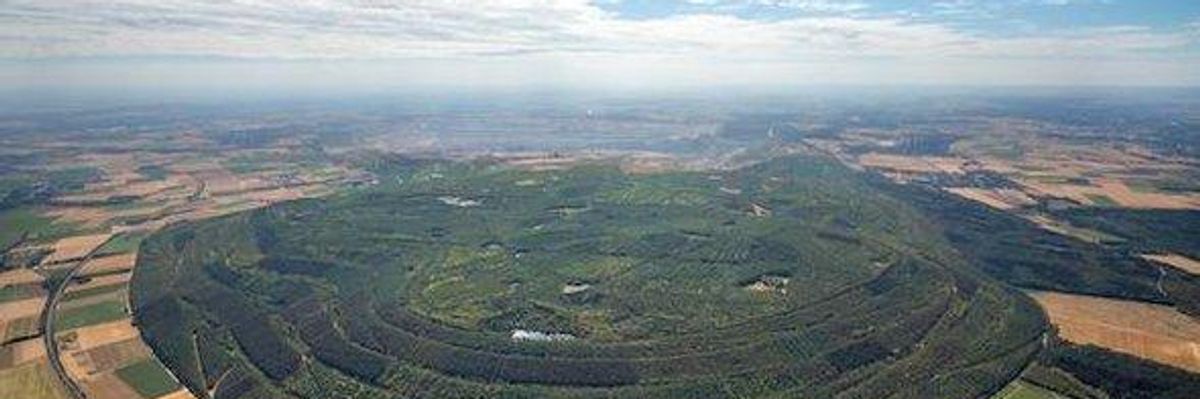
A forest planted on an abandoned open-pit coal mine, Germany. (Photo: Hans Blossey Getty Images)
The latest IPCC report does not mince words about the state of our planet: we must act now to achieve global change at a scale that has "no documented historical precedent" in order to avoid the climate catastrophe that would result from a 2 degree C rise in average global temperature. Climate change already disproportionately affects the world's most vulnerable people including poor rural communities that depend on the land for their livelihoods and coastal communities throughout the tropics. Indeed, we have already seen the stark asymmetry of suffering resulting from extreme weather events, such as hurricanes, floods, droughts, wildfires and more.
So far, advocates and politicians have tended to focus on reducing fossil fuel consumption through technology and/or policy, such as a steep carbon tax, as climate solutions. These proposals are, of course, essential to reducing manmade carbon emissions--71 percent of which are generated by just 100 fossil fuel companies. For this reason, fossil-fuel-related emissions reductions rightly figure heavily in the national climate commitments of the 181 nations that signed the global Paris Agreement.
Recent scientific research confirms that forests and other "natural climate solutions" are absolutely essential in mitigating climate change, thanks to their carbon sequestering and storage capabilities.
Yet the international focus on fossil fuels has overshadowed the most powerful and cost-efficient carbon-capture technology the world has yet seen: forests. Recent scientific research confirms that forests and other "natural climate solutions" are absolutely essential in mitigating climate change, thanks to their carbon sequestering and storage capabilities. In fact, natural climate solutions can help us achieve 37 percent of our climate target, even though they currently receive only 2.5 percent of public climate financing.
Forests' power to store carbon dioxide through the simple process of tree growth is staggering: one tree can store an average of about 48 pounds of carbon dioxide in one year. Recent research shows intact forests are capable of storing the equivalent of the carbon dioxide emissions of entire countries such as Peru and Colombia.
For this reason, policy makers and business leaders must create and enforce ambitious policies and incentives to prevent deforestation, foster reforestation of degraded land, and support the sustainable management of standing forests in the fight against climate change. Protecting the world's forests ensures they can continue to provide essential functions aside from climate stability, including producing oxygen, filtering water and supporting biodiversity. Not only do all the world's people depend on forests to provide clean air, clean water, oxygen, and medicines, but 1.6 billion people rely on them directly for their livelihoods.
Unfortunately, we are fighting a crisis of deforestation, much of it driven by conversion to agricultural lands to produce a handful of resource-intensive commodities, despite zero-deforestation commitments from companies and governments. With increasing atmospheric carbon dioxide, insufficient emissions reductions and continued high rates of deforestation, urgent action is needed to avoid the worst effects of climate change.
Now is the time to increase investment in and attention to forest protection and restoration. In doing so, we will also address a number of other pressing global issues. For example, increasing tree cover can help address the problem of food security in many areas. Trees can enhance farm productivity and provide farmers with another source of revenue through the sale of fruits, nuts or timber--all while storing carbon dioxide. It is estimated that increased investment in the multi-strata agroforestry area could help sequester up to 9.28 gigatons of carbon dioxide, while saving a net $709.8 billion by 2050. In production landscapes where large-scale tree cover increases are difficult, agroforestry serves as an attractive compromise.
And in less-developed, rural areas--especially in the tropics--community-based sustainable forest management programs can provide pathways out of poverty. In the Peten region of Guatemala, for instance, community-managed forests have boasted a near-zero deforestation rate over the past 14 years, as compared to 12 percent in nearby protected areas and buffer zones. These communities have built low-impact, sustainable forest-based businesses that have bolstered the economy of the region enough to fund the creation of local schools and health services. Their success is especially poignant in a region otherwise besieged by deforestation; outside the community-managed zones, deforestation rates increase by 20x.
Finally, landscape restoration promises an unparalleled return on investment, in terms of ecosystem services and carbon sequestered and stored. Landscape restoration could potentially sequester up to 1.7 gigatons of carbon dioxide every year, according to the International Union for Conservation of Nature. Reforestation projects can also intersect neatly and positively with human systems--restored forests provide a renewed resource base and new economic opportunities for communities.
There is good work being done on this front already. The Bonn Challenge, issued by world leaders with the goal of reforestation and restoration of 150 million hectares of degraded landscapes by 2020, has been adopted by 56 countries. Many governments and groups pledged to halve global deforestation by 2020 through the New York Declaration on Forests. And in an exemplary display of public-private sector cooperation, the Cocoa and Forests Initiative in Cote d'Ivoire and Ghana aims to end deforestation from cocoa cultivation.
With world leaders gathering in December for their yearly U.N. climate talks, the time is ripe for concrete action on forests and natural climate solutions. World leaders now have the opportunity to make big gains on climate by dramatically ramping up their investment in proven, natural solutions. More trees in the ground. More reforestation projects. More sustainable forestry. More avoided deforestation through sustainable agriculture and certified crops.
Dear Common Dreams reader, It’s been nearly 30 years since I co-founded Common Dreams with my late wife, Lina Newhouser. We had the radical notion that journalism should serve the public good, not corporate profits. It was clear to us from the outset what it would take to build such a project. No paid advertisements. No corporate sponsors. No millionaire publisher telling us what to think or do. Many people said we wouldn't last a year, but we proved those doubters wrong. Together with a tremendous team of journalists and dedicated staff, we built an independent media outlet free from the constraints of profits and corporate control. Our mission has always been simple: To inform. To inspire. To ignite change for the common good. Building Common Dreams was not easy. Our survival was never guaranteed. When you take on the most powerful forces—Wall Street greed, fossil fuel industry destruction, Big Tech lobbyists, and uber-rich oligarchs who have spent billions upon billions rigging the economy and democracy in their favor—the only bulwark you have is supporters who believe in your work. But here’s the urgent message from me today. It's never been this bad out there. And it's never been this hard to keep us going. At the very moment Common Dreams is most needed, the threats we face are intensifying. We need your support now more than ever. We don't accept corporate advertising and never will. We don't have a paywall because we don't think people should be blocked from critical news based on their ability to pay. Everything we do is funded by the donations of readers like you. When everyone does the little they can afford, we are strong. But if that support retreats or dries up, so do we. Will you donate now to make sure Common Dreams not only survives but thrives? —Craig Brown, Co-founder |
The latest IPCC report does not mince words about the state of our planet: we must act now to achieve global change at a scale that has "no documented historical precedent" in order to avoid the climate catastrophe that would result from a 2 degree C rise in average global temperature. Climate change already disproportionately affects the world's most vulnerable people including poor rural communities that depend on the land for their livelihoods and coastal communities throughout the tropics. Indeed, we have already seen the stark asymmetry of suffering resulting from extreme weather events, such as hurricanes, floods, droughts, wildfires and more.
So far, advocates and politicians have tended to focus on reducing fossil fuel consumption through technology and/or policy, such as a steep carbon tax, as climate solutions. These proposals are, of course, essential to reducing manmade carbon emissions--71 percent of which are generated by just 100 fossil fuel companies. For this reason, fossil-fuel-related emissions reductions rightly figure heavily in the national climate commitments of the 181 nations that signed the global Paris Agreement.
Recent scientific research confirms that forests and other "natural climate solutions" are absolutely essential in mitigating climate change, thanks to their carbon sequestering and storage capabilities.
Yet the international focus on fossil fuels has overshadowed the most powerful and cost-efficient carbon-capture technology the world has yet seen: forests. Recent scientific research confirms that forests and other "natural climate solutions" are absolutely essential in mitigating climate change, thanks to their carbon sequestering and storage capabilities. In fact, natural climate solutions can help us achieve 37 percent of our climate target, even though they currently receive only 2.5 percent of public climate financing.
Forests' power to store carbon dioxide through the simple process of tree growth is staggering: one tree can store an average of about 48 pounds of carbon dioxide in one year. Recent research shows intact forests are capable of storing the equivalent of the carbon dioxide emissions of entire countries such as Peru and Colombia.
For this reason, policy makers and business leaders must create and enforce ambitious policies and incentives to prevent deforestation, foster reforestation of degraded land, and support the sustainable management of standing forests in the fight against climate change. Protecting the world's forests ensures they can continue to provide essential functions aside from climate stability, including producing oxygen, filtering water and supporting biodiversity. Not only do all the world's people depend on forests to provide clean air, clean water, oxygen, and medicines, but 1.6 billion people rely on them directly for their livelihoods.
Unfortunately, we are fighting a crisis of deforestation, much of it driven by conversion to agricultural lands to produce a handful of resource-intensive commodities, despite zero-deforestation commitments from companies and governments. With increasing atmospheric carbon dioxide, insufficient emissions reductions and continued high rates of deforestation, urgent action is needed to avoid the worst effects of climate change.
Now is the time to increase investment in and attention to forest protection and restoration. In doing so, we will also address a number of other pressing global issues. For example, increasing tree cover can help address the problem of food security in many areas. Trees can enhance farm productivity and provide farmers with another source of revenue through the sale of fruits, nuts or timber--all while storing carbon dioxide. It is estimated that increased investment in the multi-strata agroforestry area could help sequester up to 9.28 gigatons of carbon dioxide, while saving a net $709.8 billion by 2050. In production landscapes where large-scale tree cover increases are difficult, agroforestry serves as an attractive compromise.
And in less-developed, rural areas--especially in the tropics--community-based sustainable forest management programs can provide pathways out of poverty. In the Peten region of Guatemala, for instance, community-managed forests have boasted a near-zero deforestation rate over the past 14 years, as compared to 12 percent in nearby protected areas and buffer zones. These communities have built low-impact, sustainable forest-based businesses that have bolstered the economy of the region enough to fund the creation of local schools and health services. Their success is especially poignant in a region otherwise besieged by deforestation; outside the community-managed zones, deforestation rates increase by 20x.
Finally, landscape restoration promises an unparalleled return on investment, in terms of ecosystem services and carbon sequestered and stored. Landscape restoration could potentially sequester up to 1.7 gigatons of carbon dioxide every year, according to the International Union for Conservation of Nature. Reforestation projects can also intersect neatly and positively with human systems--restored forests provide a renewed resource base and new economic opportunities for communities.
There is good work being done on this front already. The Bonn Challenge, issued by world leaders with the goal of reforestation and restoration of 150 million hectares of degraded landscapes by 2020, has been adopted by 56 countries. Many governments and groups pledged to halve global deforestation by 2020 through the New York Declaration on Forests. And in an exemplary display of public-private sector cooperation, the Cocoa and Forests Initiative in Cote d'Ivoire and Ghana aims to end deforestation from cocoa cultivation.
With world leaders gathering in December for their yearly U.N. climate talks, the time is ripe for concrete action on forests and natural climate solutions. World leaders now have the opportunity to make big gains on climate by dramatically ramping up their investment in proven, natural solutions. More trees in the ground. More reforestation projects. More sustainable forestry. More avoided deforestation through sustainable agriculture and certified crops.
The latest IPCC report does not mince words about the state of our planet: we must act now to achieve global change at a scale that has "no documented historical precedent" in order to avoid the climate catastrophe that would result from a 2 degree C rise in average global temperature. Climate change already disproportionately affects the world's most vulnerable people including poor rural communities that depend on the land for their livelihoods and coastal communities throughout the tropics. Indeed, we have already seen the stark asymmetry of suffering resulting from extreme weather events, such as hurricanes, floods, droughts, wildfires and more.
So far, advocates and politicians have tended to focus on reducing fossil fuel consumption through technology and/or policy, such as a steep carbon tax, as climate solutions. These proposals are, of course, essential to reducing manmade carbon emissions--71 percent of which are generated by just 100 fossil fuel companies. For this reason, fossil-fuel-related emissions reductions rightly figure heavily in the national climate commitments of the 181 nations that signed the global Paris Agreement.
Recent scientific research confirms that forests and other "natural climate solutions" are absolutely essential in mitigating climate change, thanks to their carbon sequestering and storage capabilities.
Yet the international focus on fossil fuels has overshadowed the most powerful and cost-efficient carbon-capture technology the world has yet seen: forests. Recent scientific research confirms that forests and other "natural climate solutions" are absolutely essential in mitigating climate change, thanks to their carbon sequestering and storage capabilities. In fact, natural climate solutions can help us achieve 37 percent of our climate target, even though they currently receive only 2.5 percent of public climate financing.
Forests' power to store carbon dioxide through the simple process of tree growth is staggering: one tree can store an average of about 48 pounds of carbon dioxide in one year. Recent research shows intact forests are capable of storing the equivalent of the carbon dioxide emissions of entire countries such as Peru and Colombia.
For this reason, policy makers and business leaders must create and enforce ambitious policies and incentives to prevent deforestation, foster reforestation of degraded land, and support the sustainable management of standing forests in the fight against climate change. Protecting the world's forests ensures they can continue to provide essential functions aside from climate stability, including producing oxygen, filtering water and supporting biodiversity. Not only do all the world's people depend on forests to provide clean air, clean water, oxygen, and medicines, but 1.6 billion people rely on them directly for their livelihoods.
Unfortunately, we are fighting a crisis of deforestation, much of it driven by conversion to agricultural lands to produce a handful of resource-intensive commodities, despite zero-deforestation commitments from companies and governments. With increasing atmospheric carbon dioxide, insufficient emissions reductions and continued high rates of deforestation, urgent action is needed to avoid the worst effects of climate change.
Now is the time to increase investment in and attention to forest protection and restoration. In doing so, we will also address a number of other pressing global issues. For example, increasing tree cover can help address the problem of food security in many areas. Trees can enhance farm productivity and provide farmers with another source of revenue through the sale of fruits, nuts or timber--all while storing carbon dioxide. It is estimated that increased investment in the multi-strata agroforestry area could help sequester up to 9.28 gigatons of carbon dioxide, while saving a net $709.8 billion by 2050. In production landscapes where large-scale tree cover increases are difficult, agroforestry serves as an attractive compromise.
And in less-developed, rural areas--especially in the tropics--community-based sustainable forest management programs can provide pathways out of poverty. In the Peten region of Guatemala, for instance, community-managed forests have boasted a near-zero deforestation rate over the past 14 years, as compared to 12 percent in nearby protected areas and buffer zones. These communities have built low-impact, sustainable forest-based businesses that have bolstered the economy of the region enough to fund the creation of local schools and health services. Their success is especially poignant in a region otherwise besieged by deforestation; outside the community-managed zones, deforestation rates increase by 20x.
Finally, landscape restoration promises an unparalleled return on investment, in terms of ecosystem services and carbon sequestered and stored. Landscape restoration could potentially sequester up to 1.7 gigatons of carbon dioxide every year, according to the International Union for Conservation of Nature. Reforestation projects can also intersect neatly and positively with human systems--restored forests provide a renewed resource base and new economic opportunities for communities.
There is good work being done on this front already. The Bonn Challenge, issued by world leaders with the goal of reforestation and restoration of 150 million hectares of degraded landscapes by 2020, has been adopted by 56 countries. Many governments and groups pledged to halve global deforestation by 2020 through the New York Declaration on Forests. And in an exemplary display of public-private sector cooperation, the Cocoa and Forests Initiative in Cote d'Ivoire and Ghana aims to end deforestation from cocoa cultivation.
With world leaders gathering in December for their yearly U.N. climate talks, the time is ripe for concrete action on forests and natural climate solutions. World leaders now have the opportunity to make big gains on climate by dramatically ramping up their investment in proven, natural solutions. More trees in the ground. More reforestation projects. More sustainable forestry. More avoided deforestation through sustainable agriculture and certified crops.