SUBSCRIBE TO OUR FREE NEWSLETTER
Daily news & progressive opinion—funded by the people, not the corporations—delivered straight to your inbox.
5
#000000
#FFFFFF
To donate by check, phone, or other method, see our More Ways to Give page.
Daily news & progressive opinion—funded by the people, not the corporations—delivered straight to your inbox.
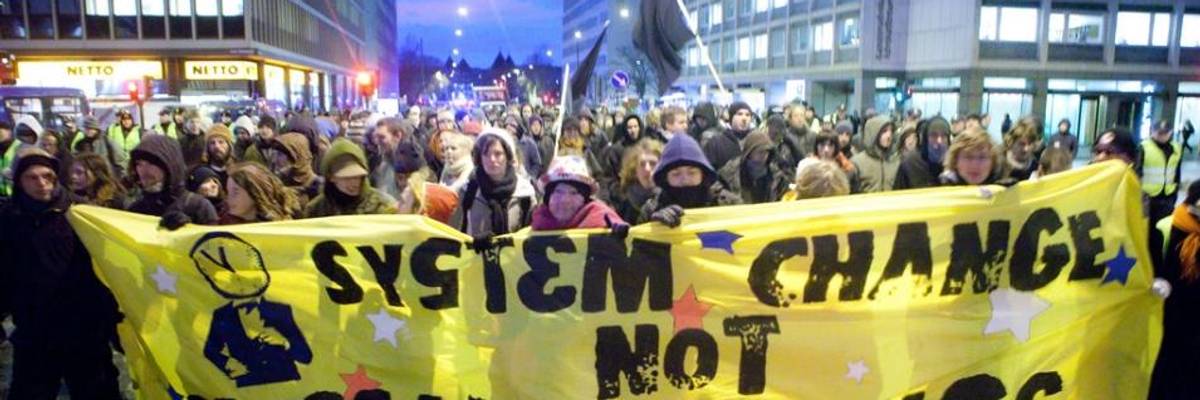
Campaigners at the UN climate summit in Copenhagen, Denmark in 20009. (Photo: Kris Krug/flickr/cc)
We are facing deep-rooted climate, social, and environmental crises. The current dominant economic system cannot provide solutions. It is time for system change.
For Friends of the Earth International this means creating societies based on peoples' sovereignty and environmental, social, economic, and gender justice. We must question and deconstruct the capitalist logic of accumulation.
The climate catastrophe is interwoven with many social and environmental crises, including oppression, corporate power, hunger, water depletion, biodiversity loss and deforestation.
At its heart sits an unsustainable economic system, the sole aim of which is endless growth and profit. This system concentrates wealth, power, and obscene privilege with the few.
Corporations and national elites are empowered by that very system to exploit people and their livelihoods with impunity.
We must tackle climate change and the associated social and environmental crises by taking rapid and bold action to address the common root causes; privatization, financialization and commodification of nature and societies, and unsustainable production and consumption systems.
The magnitude of the crises we face demands system change.
That system change will result in the creation of sustainable societies and new relations between human beings, and between human beings and nature, based on equality and reciprocity.
But we cannot create these societies and assert people's rights without increasing people's power. We need to reclaim politics.
This means creating genuine, radical, and just democracies centered around people's sovereignty and participation.
International law must put people above corporate profit, ensuring binding rules for business and mechanisms that guarantee access to justice for victims of transnational corporations.
System change calls for an articulation of the struggles against oppression; that is, patriarchy, racism, colonialism, and class and capitalist exploitation.
It demands commitment to the struggle against the exploitation of women's bodies and work. We are witnessing how the expansion of capital over the territories leads to increased violence against women alongside the violation of their rights.
Gender justice will only be possible when we recognize women as political subjects, stop violence against women, strengthen women's autonomy, advance the principles of feminist economy, deconstruct the sexual division of labor, and reorganize care work.
A transformation of the energy system is fundamental to system change. It entails democratic answers to the fundamental questions: for whom and what is energy produced? And a total departure from fossil fuel reliance and corporate control.
This must be a just transition, founded on workers' and community rights. It is not only about changing technologies and renewable energy, but about public and community ownership and control, therefore addressing the root problems of a system that turns energy into a commodity and denies the right to energy for all.
It requires equity and justice, especially for those already impacted by the changing climate in the global South.
Genuine system change would radically transform the food system toward food sovereignty and agroecology: valuing local knowledge, promoting social and economic justice and people's control over their territories, guaranteeing the right to land, water and seeds, nurturing social relations founded on justice and solidarity, and recognizing the fundamental role of women in food production, to provide an effective way to feed the world, and a counter to destructive industrial agriculture.
Biodiversity and forests are best protected by the communities who live in them. Protecting forests can address climate change by maintaining natural carbon stores and reducing the amount of carbon released through deforestation, while providing communities with food, fibers, shelter, medicines, and water. Just eight per cent of the world's forests are managed by communities; it is vital we secure community rights over forests and livelihoods.
System change must address people's individual and collective needs and promote reciprocity, redistribution, and sharing.
Solutions include public services achieved through tax justice, social ownership and co-operativism, local markets and fair trade, community forest management, and valuing the wellbeing of people and the planet.
People all over the world are already living or implementing thousands of initiatives which embody justice and challenge the capitalist logic. Now we must expand them.
And that requires commensurate international and national public policies that empower people to fight for a democratic state that ensures rights and provides environmentally and socially just public services, and active popular participation; a state that guarantees peoples' rights to water, land and the territories, food, health, education, housing, and decent jobs.
We all need to support local and international resistance, engage in popular mobilization, strive for policy change and upscale the real solutions, the solutions of the people. This is system change.
Dear Common Dreams reader, It’s been nearly 30 years since I co-founded Common Dreams with my late wife, Lina Newhouser. We had the radical notion that journalism should serve the public good, not corporate profits. It was clear to us from the outset what it would take to build such a project. No paid advertisements. No corporate sponsors. No millionaire publisher telling us what to think or do. Many people said we wouldn't last a year, but we proved those doubters wrong. Together with a tremendous team of journalists and dedicated staff, we built an independent media outlet free from the constraints of profits and corporate control. Our mission has always been simple: To inform. To inspire. To ignite change for the common good. Building Common Dreams was not easy. Our survival was never guaranteed. When you take on the most powerful forces—Wall Street greed, fossil fuel industry destruction, Big Tech lobbyists, and uber-rich oligarchs who have spent billions upon billions rigging the economy and democracy in their favor—the only bulwark you have is supporters who believe in your work. But here’s the urgent message from me today. It's never been this bad out there. And it's never been this hard to keep us going. At the very moment Common Dreams is most needed, the threats we face are intensifying. We need your support now more than ever. We don't accept corporate advertising and never will. We don't have a paywall because we don't think people should be blocked from critical news based on their ability to pay. Everything we do is funded by the donations of readers like you. When everyone does the little they can afford, we are strong. But if that support retreats or dries up, so do we. Will you donate now to make sure Common Dreams not only survives but thrives? —Craig Brown, Co-founder |
We are facing deep-rooted climate, social, and environmental crises. The current dominant economic system cannot provide solutions. It is time for system change.
For Friends of the Earth International this means creating societies based on peoples' sovereignty and environmental, social, economic, and gender justice. We must question and deconstruct the capitalist logic of accumulation.
The climate catastrophe is interwoven with many social and environmental crises, including oppression, corporate power, hunger, water depletion, biodiversity loss and deforestation.
At its heart sits an unsustainable economic system, the sole aim of which is endless growth and profit. This system concentrates wealth, power, and obscene privilege with the few.
Corporations and national elites are empowered by that very system to exploit people and their livelihoods with impunity.
We must tackle climate change and the associated social and environmental crises by taking rapid and bold action to address the common root causes; privatization, financialization and commodification of nature and societies, and unsustainable production and consumption systems.
The magnitude of the crises we face demands system change.
That system change will result in the creation of sustainable societies and new relations between human beings, and between human beings and nature, based on equality and reciprocity.
But we cannot create these societies and assert people's rights without increasing people's power. We need to reclaim politics.
This means creating genuine, radical, and just democracies centered around people's sovereignty and participation.
International law must put people above corporate profit, ensuring binding rules for business and mechanisms that guarantee access to justice for victims of transnational corporations.
System change calls for an articulation of the struggles against oppression; that is, patriarchy, racism, colonialism, and class and capitalist exploitation.
It demands commitment to the struggle against the exploitation of women's bodies and work. We are witnessing how the expansion of capital over the territories leads to increased violence against women alongside the violation of their rights.
Gender justice will only be possible when we recognize women as political subjects, stop violence against women, strengthen women's autonomy, advance the principles of feminist economy, deconstruct the sexual division of labor, and reorganize care work.
A transformation of the energy system is fundamental to system change. It entails democratic answers to the fundamental questions: for whom and what is energy produced? And a total departure from fossil fuel reliance and corporate control.
This must be a just transition, founded on workers' and community rights. It is not only about changing technologies and renewable energy, but about public and community ownership and control, therefore addressing the root problems of a system that turns energy into a commodity and denies the right to energy for all.
It requires equity and justice, especially for those already impacted by the changing climate in the global South.
Genuine system change would radically transform the food system toward food sovereignty and agroecology: valuing local knowledge, promoting social and economic justice and people's control over their territories, guaranteeing the right to land, water and seeds, nurturing social relations founded on justice and solidarity, and recognizing the fundamental role of women in food production, to provide an effective way to feed the world, and a counter to destructive industrial agriculture.
Biodiversity and forests are best protected by the communities who live in them. Protecting forests can address climate change by maintaining natural carbon stores and reducing the amount of carbon released through deforestation, while providing communities with food, fibers, shelter, medicines, and water. Just eight per cent of the world's forests are managed by communities; it is vital we secure community rights over forests and livelihoods.
System change must address people's individual and collective needs and promote reciprocity, redistribution, and sharing.
Solutions include public services achieved through tax justice, social ownership and co-operativism, local markets and fair trade, community forest management, and valuing the wellbeing of people and the planet.
People all over the world are already living or implementing thousands of initiatives which embody justice and challenge the capitalist logic. Now we must expand them.
And that requires commensurate international and national public policies that empower people to fight for a democratic state that ensures rights and provides environmentally and socially just public services, and active popular participation; a state that guarantees peoples' rights to water, land and the territories, food, health, education, housing, and decent jobs.
We all need to support local and international resistance, engage in popular mobilization, strive for policy change and upscale the real solutions, the solutions of the people. This is system change.
We are facing deep-rooted climate, social, and environmental crises. The current dominant economic system cannot provide solutions. It is time for system change.
For Friends of the Earth International this means creating societies based on peoples' sovereignty and environmental, social, economic, and gender justice. We must question and deconstruct the capitalist logic of accumulation.
The climate catastrophe is interwoven with many social and environmental crises, including oppression, corporate power, hunger, water depletion, biodiversity loss and deforestation.
At its heart sits an unsustainable economic system, the sole aim of which is endless growth and profit. This system concentrates wealth, power, and obscene privilege with the few.
Corporations and national elites are empowered by that very system to exploit people and their livelihoods with impunity.
We must tackle climate change and the associated social and environmental crises by taking rapid and bold action to address the common root causes; privatization, financialization and commodification of nature and societies, and unsustainable production and consumption systems.
The magnitude of the crises we face demands system change.
That system change will result in the creation of sustainable societies and new relations between human beings, and between human beings and nature, based on equality and reciprocity.
But we cannot create these societies and assert people's rights without increasing people's power. We need to reclaim politics.
This means creating genuine, radical, and just democracies centered around people's sovereignty and participation.
International law must put people above corporate profit, ensuring binding rules for business and mechanisms that guarantee access to justice for victims of transnational corporations.
System change calls for an articulation of the struggles against oppression; that is, patriarchy, racism, colonialism, and class and capitalist exploitation.
It demands commitment to the struggle against the exploitation of women's bodies and work. We are witnessing how the expansion of capital over the territories leads to increased violence against women alongside the violation of their rights.
Gender justice will only be possible when we recognize women as political subjects, stop violence against women, strengthen women's autonomy, advance the principles of feminist economy, deconstruct the sexual division of labor, and reorganize care work.
A transformation of the energy system is fundamental to system change. It entails democratic answers to the fundamental questions: for whom and what is energy produced? And a total departure from fossil fuel reliance and corporate control.
This must be a just transition, founded on workers' and community rights. It is not only about changing technologies and renewable energy, but about public and community ownership and control, therefore addressing the root problems of a system that turns energy into a commodity and denies the right to energy for all.
It requires equity and justice, especially for those already impacted by the changing climate in the global South.
Genuine system change would radically transform the food system toward food sovereignty and agroecology: valuing local knowledge, promoting social and economic justice and people's control over their territories, guaranteeing the right to land, water and seeds, nurturing social relations founded on justice and solidarity, and recognizing the fundamental role of women in food production, to provide an effective way to feed the world, and a counter to destructive industrial agriculture.
Biodiversity and forests are best protected by the communities who live in them. Protecting forests can address climate change by maintaining natural carbon stores and reducing the amount of carbon released through deforestation, while providing communities with food, fibers, shelter, medicines, and water. Just eight per cent of the world's forests are managed by communities; it is vital we secure community rights over forests and livelihoods.
System change must address people's individual and collective needs and promote reciprocity, redistribution, and sharing.
Solutions include public services achieved through tax justice, social ownership and co-operativism, local markets and fair trade, community forest management, and valuing the wellbeing of people and the planet.
People all over the world are already living or implementing thousands of initiatives which embody justice and challenge the capitalist logic. Now we must expand them.
And that requires commensurate international and national public policies that empower people to fight for a democratic state that ensures rights and provides environmentally and socially just public services, and active popular participation; a state that guarantees peoples' rights to water, land and the territories, food, health, education, housing, and decent jobs.
We all need to support local and international resistance, engage in popular mobilization, strive for policy change and upscale the real solutions, the solutions of the people. This is system change.