

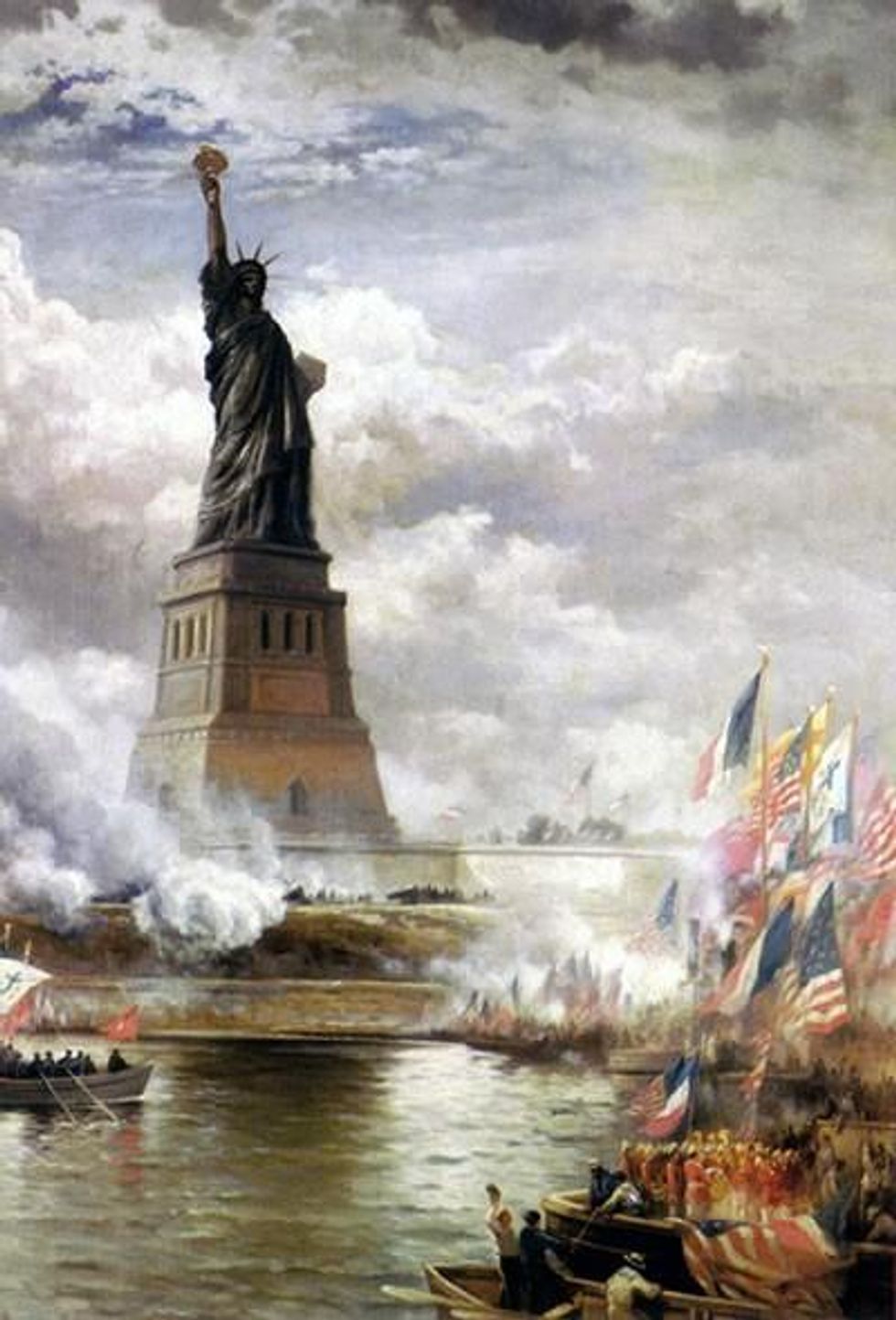
"Give me your tired, your poor, your huddled masses...I lift my lamp beside the golden door!" These words, from poet Emma Lazarus, were inscribed on the Statue of Liberty over 100 years ago. Today the golden door has a lock on it, paid for with record profits from the health care, education, and financial industries.
1. We're near the bottom of the developed world in children's health and safety
According to a 2007 UNICEF report, the U.S. ranked last among 21 OECD nations in an assessment of child health and safety. The assessment measured infant mortality, immunization, and death from accidents and injuries.
A related 2009 OECD study generally agreed, placing the U.S. 24th out of 30 OECD countries for children's health and safety. It also showed the devastating effects of inequality in our country. Despite having the second-highest average income for children among the 30 OECD countries, the U.S. ranked 27th out of 30 for child poverty (percentage of children living in households that are below 50% of the median income).
2. We've betrayed the young people who were advised to stay in school
Over 40% of recent college graduates are living with their parents, dealing with government loans that average $27,200. The unemployment rate for young people is about 50%. More than 350,000 Americans with advanced degrees applied for food stamps in 2010.
As Washington lobbyists endeavor to kill a proposed bill to reduce the interest rates on student debt, federal loans remain readily available, and so colleges go right on increasing their tuition.
Meanwhile, corporations hold $2 trillion in cash while looking for investments and employees in foreign countries, and American students are forced to accept menial positions. Yet delusions persist about our new generation of would-be workers. Conservatives are all bubbly about today's young entrepreneurs creating their own jobs -- jobs that "don't yet exist."
3. The main source of middle-class wealth has been largely wiped out
American homeowners owe almost as much as the students, with $700 billion of debt over and above the value of their homes.
This removes the only source of wealth for middle America, especially for blacks and Hispanics. Remarkably, for every dollar of NON-HOME wealth owned by white families, people of color have only one cent.
So when minority families were specifically targeted for high-risk, subprime loans that could be re-packaged and sold for a quick short-term profit, most of their assets were erased. Median wealth fell 66% for Hispanic households and 53% for black households. For whites the decline was 16%.
With a disturbing note of irony, Sanford Weill, the banker largely responsible for the reversal of the mortgage-protecting Glass-Steagall Act, was elected to the American Academy of Arts & Sciences for "extraordinary accomplishment and a call to serve."
4. We give prison sentences for smoking marijuana, but not for billion-dollar fraud
About half of our world-leading prison population is in jail for non-violent drug offenses. Americans have also been arrested for handing out free food in a park. Mothers in Ohio and Connecticut were jailed for enrolling their kids in out-of-district schools. As of 2003 in California there were 344 individuals serving sentences of 25 years or more for shoplifting as a third offense, in many cases after two non-violent offenses.
How does the market deal with this steady tide of petty crime? It strives for more. The new trend of private prisons is dependent on maintaining a sizable prison population to guarantee profits, with no incentive for rehabilitation.
As the number of inmates has surged, the people who devastated countless American lives "get out of jail free." The savings and loan fraud cost the nation between $300 billion and $500 billion, about 100 times more than the total cost of burglaries in 2010. The financial system bailout has already cost the country $3 trillion. Goldman Sachs packaged bad debt, sold it under a different name, persuaded ratings services to label it AAA, and then bet against their own financial creation by selling it short. Other firms accused of fraud and insider trading were Morgan Stanley, Bear Stearns, Bank of America, Countrywide Financial, and Wells Fargo. The New York Times reported in 2008 that the Justice Department had postponed the bribery or fraud prosecutions of over 50 corporations, choosing instead to enter into agreements involving fines and 'monitoring' periods.
5. You can have health care, if you pay for it
A recent Commonwealth Fund study compared U.S. health care spending to 12 other OECD countries. The data shows that reducing our costs to the median level of spending among the OECD countries would save us $1.5 trillion a year, more than our entire deficit.
Unfortunately, insurance companies and pharmaceutical companies and hospital administrators won't hear of it. There's too much money to be made. Bypass surgery in the U.S. costs 2 to 3 times more than in Great Britain, Canada, France, and Germany. Cataract surgery costs 4 times more.
That's if you can pay for it. There are currently about 50 million uninsured Americans. At the other extreme are $2,400 oxymoronic penthouse hospital suites complete with butler and grand piano. Or, for those who don't get out much, emergency rooms in the home, with private cell-phone access to "concierge doctors."
Inequality in our country is so severe that 120,000 health care workers could have been hired with the salary paid to one man. That's a $40,000 salary for 40 health care workers for every one of the 3,000 counties in the United States. Instead, $5 billion dollars went to one man who reportedly made his first big haul ($4 billion, in 2007) by conspiring with Goldman Sachs in the above-mentioned short sale subterfuge.
The result of ignoring the health needs of the greater population, according to a report in the Annual Review of Public Health, is that "the health rankings of the United States have declined substantially when compared with other nations."
Conclusion
Privatization simply hasn't worked for health care, mortgage banking, higher education, or prison management. There is little incentive for profit-motivated firms to invest in disadvantaged or underemployed Americans. That's why taxes are necessary -- to provide for the common good, and to return some of the gains from 60 years of productivity to the great majority of Americans who contributed to our growth. Unfortunately, the golden door on the Statue of Liberty seems to have an invisible hand holding it shut.
"Give me your tired, your poor, your huddled masses...I lift my lamp beside the golden door!" These words, from poet Emma Lazarus, were inscribed on the Statue of Liberty over 100 years ago. Today the golden door has a lock on it, paid for with record profits from the health care, education, and financial industries.
1. We're near the bottom of the developed world in children's health and safety
According to a 2007 UNICEF report, the U.S. ranked last among 21 OECD nations in an assessment of child health and safety. The assessment measured infant mortality, immunization, and death from accidents and injuries.
A related 2009 OECD study generally agreed, placing the U.S. 24th out of 30 OECD countries for children's health and safety. It also showed the devastating effects of inequality in our country. Despite having the second-highest average income for children among the 30 OECD countries, the U.S. ranked 27th out of 30 for child poverty (percentage of children living in households that are below 50% of the median income).
2. We've betrayed the young people who were advised to stay in school
Over 40% of recent college graduates are living with their parents, dealing with government loans that average $27,200. The unemployment rate for young people is about 50%. More than 350,000 Americans with advanced degrees applied for food stamps in 2010.
As Washington lobbyists endeavor to kill a proposed bill to reduce the interest rates on student debt, federal loans remain readily available, and so colleges go right on increasing their tuition.
Meanwhile, corporations hold $2 trillion in cash while looking for investments and employees in foreign countries, and American students are forced to accept menial positions. Yet delusions persist about our new generation of would-be workers. Conservatives are all bubbly about today's young entrepreneurs creating their own jobs -- jobs that "don't yet exist."
3. The main source of middle-class wealth has been largely wiped out
American homeowners owe almost as much as the students, with $700 billion of debt over and above the value of their homes.
This removes the only source of wealth for middle America, especially for blacks and Hispanics. Remarkably, for every dollar of NON-HOME wealth owned by white families, people of color have only one cent.
So when minority families were specifically targeted for high-risk, subprime loans that could be re-packaged and sold for a quick short-term profit, most of their assets were erased. Median wealth fell 66% for Hispanic households and 53% for black households. For whites the decline was 16%.
With a disturbing note of irony, Sanford Weill, the banker largely responsible for the reversal of the mortgage-protecting Glass-Steagall Act, was elected to the American Academy of Arts & Sciences for "extraordinary accomplishment and a call to serve."
4. We give prison sentences for smoking marijuana, but not for billion-dollar fraud
About half of our world-leading prison population is in jail for non-violent drug offenses. Americans have also been arrested for handing out free food in a park. Mothers in Ohio and Connecticut were jailed for enrolling their kids in out-of-district schools. As of 2003 in California there were 344 individuals serving sentences of 25 years or more for shoplifting as a third offense, in many cases after two non-violent offenses.
How does the market deal with this steady tide of petty crime? It strives for more. The new trend of private prisons is dependent on maintaining a sizable prison population to guarantee profits, with no incentive for rehabilitation.
As the number of inmates has surged, the people who devastated countless American lives "get out of jail free." The savings and loan fraud cost the nation between $300 billion and $500 billion, about 100 times more than the total cost of burglaries in 2010. The financial system bailout has already cost the country $3 trillion. Goldman Sachs packaged bad debt, sold it under a different name, persuaded ratings services to label it AAA, and then bet against their own financial creation by selling it short. Other firms accused of fraud and insider trading were Morgan Stanley, Bear Stearns, Bank of America, Countrywide Financial, and Wells Fargo. The New York Times reported in 2008 that the Justice Department had postponed the bribery or fraud prosecutions of over 50 corporations, choosing instead to enter into agreements involving fines and 'monitoring' periods.
5. You can have health care, if you pay for it
A recent Commonwealth Fund study compared U.S. health care spending to 12 other OECD countries. The data shows that reducing our costs to the median level of spending among the OECD countries would save us $1.5 trillion a year, more than our entire deficit.
Unfortunately, insurance companies and pharmaceutical companies and hospital administrators won't hear of it. There's too much money to be made. Bypass surgery in the U.S. costs 2 to 3 times more than in Great Britain, Canada, France, and Germany. Cataract surgery costs 4 times more.
That's if you can pay for it. There are currently about 50 million uninsured Americans. At the other extreme are $2,400 oxymoronic penthouse hospital suites complete with butler and grand piano. Or, for those who don't get out much, emergency rooms in the home, with private cell-phone access to "concierge doctors."
Inequality in our country is so severe that 120,000 health care workers could have been hired with the salary paid to one man. That's a $40,000 salary for 40 health care workers for every one of the 3,000 counties in the United States. Instead, $5 billion dollars went to one man who reportedly made his first big haul ($4 billion, in 2007) by conspiring with Goldman Sachs in the above-mentioned short sale subterfuge.
The result of ignoring the health needs of the greater population, according to a report in the Annual Review of Public Health, is that "the health rankings of the United States have declined substantially when compared with other nations."
Conclusion
Privatization simply hasn't worked for health care, mortgage banking, higher education, or prison management. There is little incentive for profit-motivated firms to invest in disadvantaged or underemployed Americans. That's why taxes are necessary -- to provide for the common good, and to return some of the gains from 60 years of productivity to the great majority of Americans who contributed to our growth. Unfortunately, the golden door on the Statue of Liberty seems to have an invisible hand holding it shut.