

SUBSCRIBE TO OUR FREE NEWSLETTER
Daily news & progressive opinion—funded by the people, not the corporations—delivered straight to your inbox.
5
#000000
#FFFFFF
To donate by check, phone, or other method, see our More Ways to Give page.
Daily news & progressive opinion—funded by the people, not the corporations—delivered straight to your inbox.
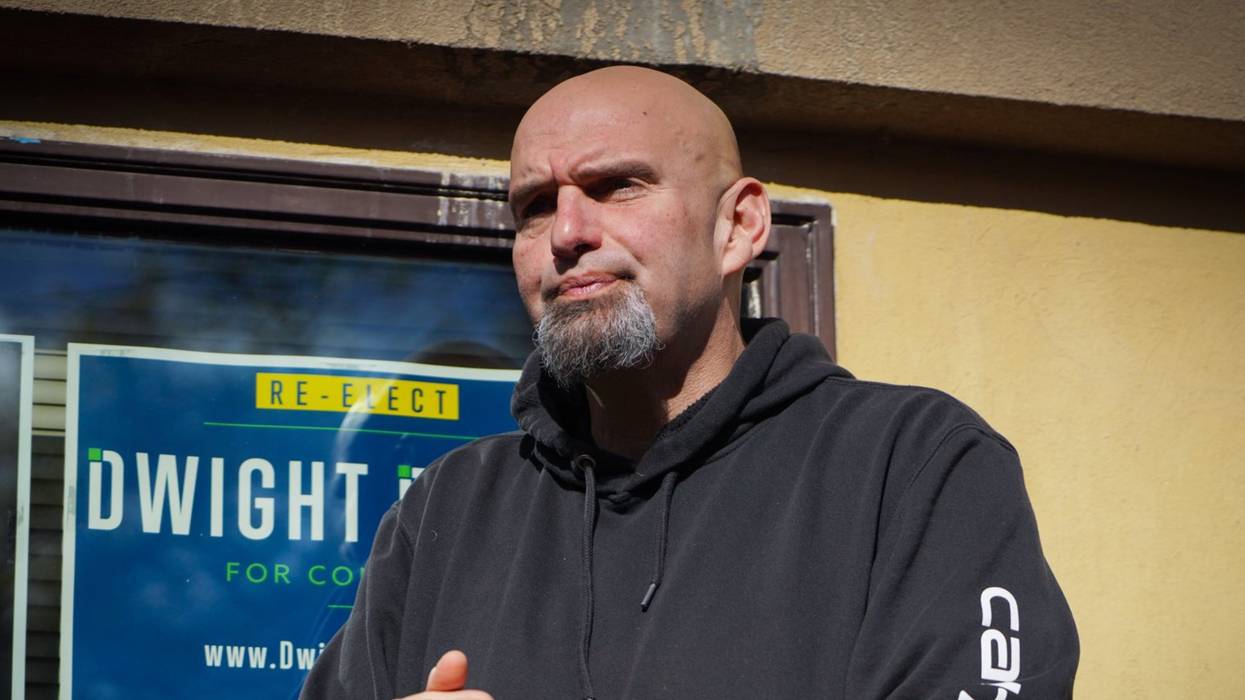
"It's time to finally hold Norfolk Southern and the big rail companies accountable for the harm they have caused in East Palestine and Darlington Township, and the harm they continue to cause with this dangerous, reckless, and selfish behavior."
U.S. Sen. John Fetterman on Thursday demanded accountability for Norfolk Southern and other railroad companies following Wednesday night's freight train derailment in Lawrence County, Pennsylvania.
Local media report nine out of more than 200 cars on a Norfolk Southern train went off the track just before midnight in the town of New Castle, 50 miles north of Pittsburgh and about 10 miles east of the Ohio border.
"This has got to end."
Fire officials said that salt, soybeans, and paraffin wax—used to make candles—spilled from the derailed cars, none of which were carrying hazardous materials. A statement from Norfolk Southern said no one was injured in the accident.
New Castle is also located about 20 miles from East Palestine, Ohio, the site of the fiery Norfolk Southern derailment and chemical burn disaster that spilled cancer-causing dioxin and vinyl chloride into the air, soil, and waterways in the vicinity of the accident.
"It's the same shit, different day from Norfolk Southern," Fetterman (D-Pa.) said in a statement on Thursday afternoon.
"It's time to finally hold Norfolk Southern and the big rail companies accountable for the harm they have caused in East Palestine and Darlington Township, and the harm they continue to cause with this dangerous, reckless, and selfish behavior," the freshman senator continued. Darlington Township, Pennsylvania is located about nine miles east of East Palestine.
"I'm thankful that no one was hurt and no toxic material was spilled in New Castle, but this derailment looks way too similar to the ones we've said can't happen again," Fetterman said. "This has got to end."
"I'm proud that my bipartisan bill, the Railway Safety Act, advanced out of committee yesterday," added Fetterman, who has also introduced the Railroad Accountability Act.
"This bill will finally enact commonsense rail safety procedures that would have prevented last night's derailment," the lawmaker asserted of the measure advanced Wednesday. "It's time to pass this bill on the floor and finally hold Norfolk Southern accountable."
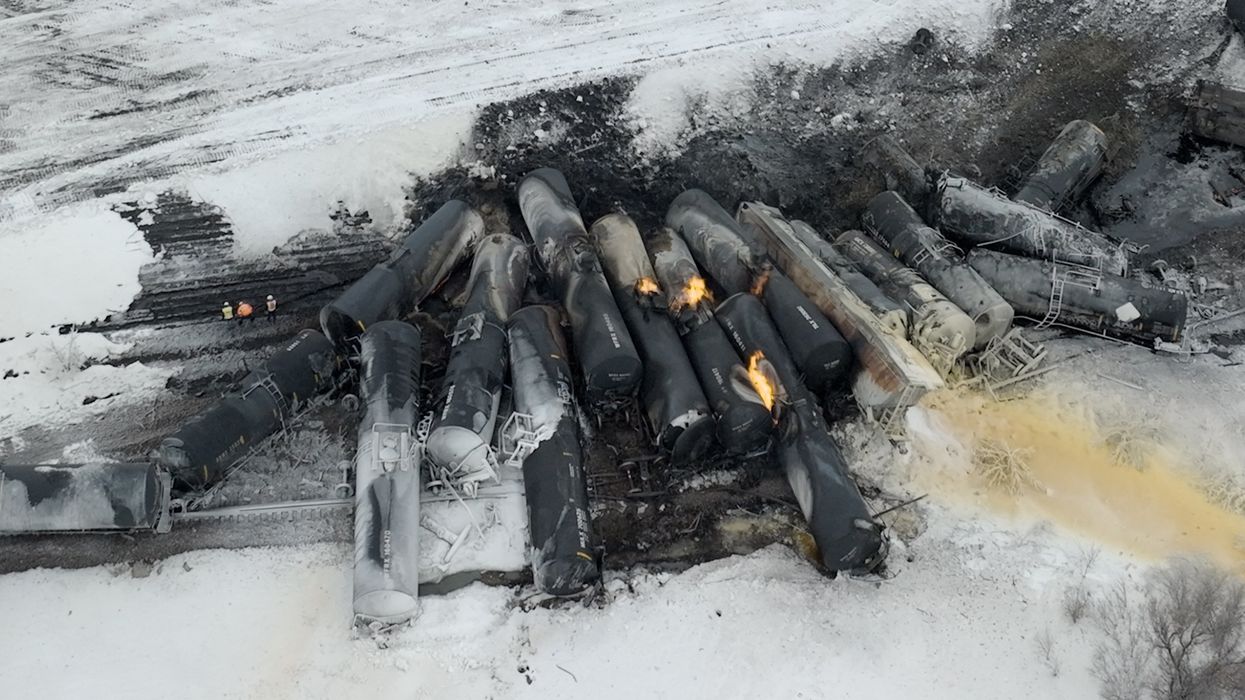
"These companies siphon billions into share buybacks, dividends, and bonuses rather than into the vital maintenance and infrastructure growth we need to build a safe, modern, and thriving rail industry," said one worker.
After at least six major freight train derailments occurred across the United States over the past week, the need for stronger rail safety rules couldn't be clearer, an interunion alliance of rail workers said Monday.
"The recent uptick in derailments across the U.S. highlights the dire need for stricter regulations on the length and weight of trains, as well as a focus on preventing unsafe operational practices such as precision scheduled railroading (PSR) which prioritizes short-term financial gains for Wall Street over the safety of communities and railroad workers," Jason Doering, a locomotive engineer and general secretary of Railroad Workers United (RWU), said in a statement.
The past week "was not a good one" for the nation's Class 1 rail carriers, RWU observed.
On Sunday, March 26, a Canadian Pacific train carrying hazardous materials careened off the tracks outside Wyndmere, North Dakota, spilling liquid asphalt and ethylene glycol and releasing propylene vapor.
Last Monday, a Union Pacific iron ore train reached 118 miles per hour as it ran away down Cima Hill in the Mojave Desert before wrecking on a curve, destroying two locomotives and 55 cars in San Bernardino County, California.
On Wednesday, a Canadian National iron ore train derailed in Butler County, Pennsylvania.
On Thursday, a BNSF train carrying ethanol and corn syrup crashed near Raymond, Minnesota, causing a fire that forced local residents to flee.
On Friday, a Norfolk Southern train went off the tracks in Irondale, Alabama.
One day ago, a train operated by the Class 2 regional Montana Rail Link—soon to be owned by BNSF—derailed on the banks of the Clark Fork River in Paradise, Montana.
"The recent uptick in derailments across the U.S. highlights the dire need for stricter regulations on the length and weight of trains, as well as a focus on preventing unsafe operational practices such as precision scheduled railroading."
"Rail workers are not surprised to see the dramatic increase in rail incidents following the widespread cuts to the industry," said locomotive engineer and RWU steering committee member Paul Lindsey.
"Each year these companies siphon billions into share buybacks, dividends, and bonuses rather than into the vital maintenance and infrastructure growth we need to grow a safe, modern, and thriving rail industry," Lindsey added.
Norfolk Southern has become the poster child for freight industry greed as the toxic aftermath of February's fiery train derailment and ensuing chemical spill and burnoff continues to unfold in East Palestine, Ohio.
Questioned last month at a U.S. Senate hearing about the ongoing public health and environmental disaster, Norfolk Southern president and CEO Alan Shaw refused to commit to giving workers seven days of paid sick leave or halting stock buybacks.
More Perfect Union has calculated that payouts to Norfolk Southern's shareholders soared by more than 4,500% over the past 20 years, from $101 million in stock repurchases and dividend bumps in 2002 to $4.7 billion in 2022.
Shaw also refused to commit to ending PSR, the profit-maximizing scheduling system that forces fewer workers to manage longer trains in less time, even though unions and progressive lawmakers argue the Wall street-endorsed model makes the U.S. rail system more dangerous and contributes to the 1,500-plus derailments seen nationwide each year.
Although Norfolk Southern epitomizes how railroad executives prioritize profits above all else, the corporation is far from alone in pushing for deregulation and implementing anti-worker, pro-investor policies.
An OpenSecrets analysis published last month found that the rail industry spent more than $713 million lobbying against enhanced rail safety rules at the federal and state levels between 2002 and 2022. Top spenders include the Association of American Railroads trade group, CSX, Union Pacific, Norfolk Southern, and BNSF's parent company Berkshire Hathaway, which is owned by billionaire Warren Buffett.
While RWU has made the case for nationalizing the railroads, it has also outlined a plan for reforms that can be quickly implemented in the absence of such a sweeping transformation. Specific provisions the alliance has called for include sufficient staffing; limits on train length and weight; adequate maintenance and inspections; and better training and employee benefits.
Last week, Sens. John Fetterman (D-Pa.), Bob Casey (D-Pa.), and Sherrod Brown (D-Ohio) introduced the Railway Accountability Act, which includes some of the measures sought by RWU and is supported by unions including the Transport Workers of America (TWU), the National Conference of Firemen & Oilers (NCFO), and the International Association of Sheet Metal, Air, Rail, and Transportation Workers-Mechanical Division (SMART-MD).
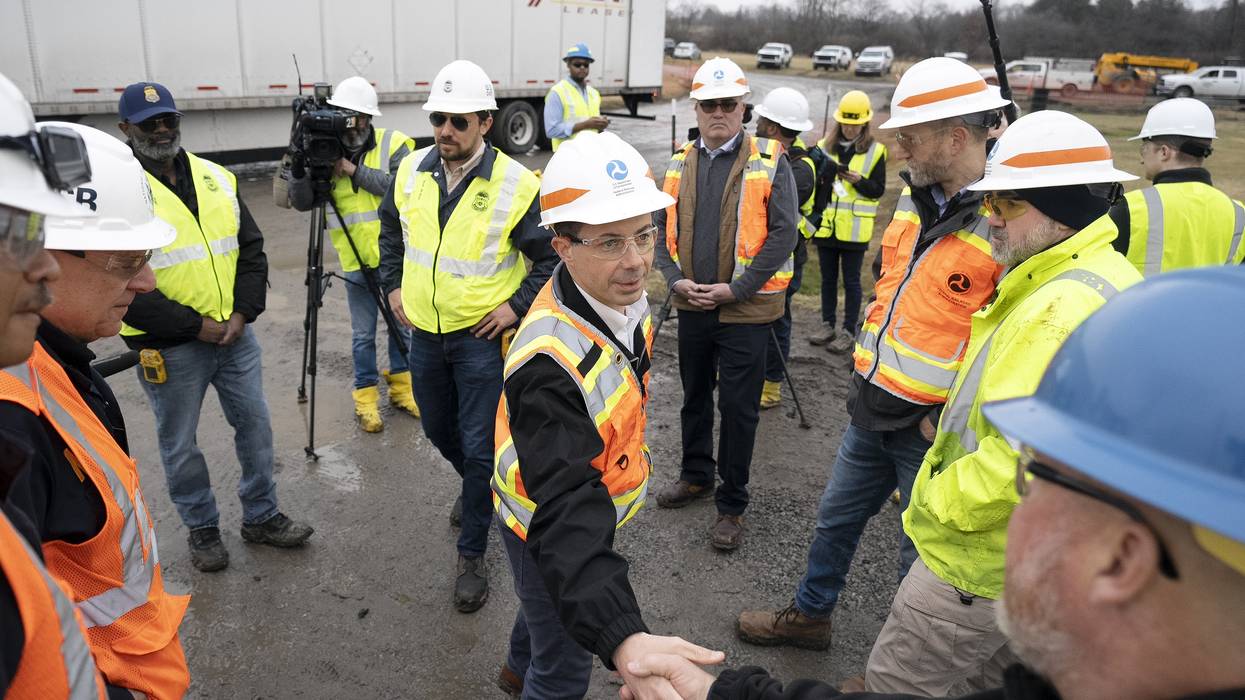
"While the serious health impacts of the derailment in East Palestine have only just begun to emerge, we know that toxic spills like these can be devastating to communities and families for decades," said one advocate.
As industry employees push for improvements to bipartisan railway safety legislation and reject efforts by rail companies to introduce new safety rules on their own, one public health advocacy group on Thursday called on the Biden administration to do everything in its power to make trains safer for workers and American communities.
Last month's train derailment in East Palestine, Ohio—which sent toxic chemicals into the environment as officials conducted a controlled release of the vinyl chloride that was carried by the train—was the result of successful lobbying by the rail industry against safety regulations, said Wenonah Hauter, executive director of Food & Water Watch.
U.S. Transportation Secretary Pete Buttigieg and President Joe Biden have the power to reinstate crucial Obama-era regulations that could prevent further accidents, said the group.
"Secretary Buttigieg and this administration must act immediately to reduce the risks of these horrific derailments by first reestablishing the commonsense rail freight safety standards implemented by [former President Barack] Obama and unconscionably rolled back by [former President Donald] Trump," said Hauter.
The Trump administration in 2018 rolled back regulations mandating the use of highly responsive electronic braking systems for trains carrying oil and other flammable materials.
A preliminary report by the National Transportation Safety Board (NTSB) found that an overheated wheel bearing rather than the brake system was likely behind the derailment of the Norfolk Southern train in East Palestine, but a number of other derailments in recent weeks have prompted calls for the regulations to be reinstated immediately.
On Thursday, just before the CEO of Norfolk Southern testified before the Senate Environment and Public Works Committee and apologized for the accident, another train owned by the company left the tracks in Alabama. CEO Alan Shaw was informed of the accident by Sen. Sheldon Whitehouse (D-R.I.), who said, "You may need to look into that."
On Wednesday, a train owned by freight company CSX derailed in Sandstone, West Virginia and released an "unknown" quantity of diesel fuel and oil into the New River.
"While the serious health impacts of the derailment in East Palestine have only just begun to emerge, we know that toxic spills like these can be devastating to communities and families for decades," said Hauter. "All trains carrying dangerous toxic chemicals should be classified as 'high-hazard flammable trains,' which would require more stringent safety requirements and notice to state and local officials of their contents."
"These are actions," she added, "that Secretary Buttigieg and the administration can and must make immediately."
"Voters across party lines are in favor of increased safety measures," according to think tank Data for Progress.
Almost half of U.S. voters surveyed by progressive think tank Data for Progress blame rail company Norfolk Southern for the February 3 train derailment in East Palestine, Ohio which forced 1,500 residents to evacuate, contaminated soil and water, and has been blamed for causing a number of symptoms even as officials claim air and water monitoring hasn't shown dangerous levels of pollution.
Forty-nine percent of the 1,243 people surveyed by Data for Progress from February 17-22 said they believed Norfolk Southern was responsible for the crash, including 50% of Democrats, 52% of Independents, and 47% of Republicans.
Nineteen percent said they didn't know who to blame, while 10% blamed the U.S. Department of Transportation.
The poll was taken as the National Transportation Safety Board (NTSB) released its preliminary assessment of the derailment of the train, which was carrying hazardous materials including vinyl chloride. As Common Dreams reported Thursday, the report found the crash was likely caused by a wheel bearing failure due to overheating.
Eddie Hall, national president of the Brotherhood of Locomotive Engineers and Trainmen (BLET), pointed out after the report was released that rail companies have aggressively pushed to loosen safety regulations, spending "nearly a half billion dollars lobbying Congress" in the past two decades as they attempt to reduce train crews to just one person and pushed back as the Obama administration sought to require more modern braking systems on trains carrying hazardous materials.
Rail workers have also blamed major rail companies' use of Precision Scheduled Railroading (PSR), which requires train to run on strict schedules and cuts back on equipment and train crews, for the crash and others like it.
NTSB Chair Jennifer Homendy said Thursday the board is now examining Norfolk Southern's use of "wayside defect detectors," which did not alert the train crew quickly enough to the overheated wheel bearing, and said the board could issue safety recommendations to regulators or the rail company.
ProPublica reported on Wednesday that Norfolk Southern has at times instructed train crews "to ignore alerts from train track sensors designed to flag potential mechanical problems"—a policy union leaders say is "emblematic" of PSR. The NTSB did not suggest that was the case with the derailment in East Palestine.
Fifty-eight percent of respondents to the Data for Progress survey said they believe there are not enough safety regulations in place for railroad companies that transport hazardous material.
"Voters across party lines are in favor of increased safety measures, including 89% of voters who support setting higher standards for maintenance on railroads and strengthening safety regulations on railroad cars carrying explosive substances," reported the group. "Eighty-six percent of voters support placing limits on the length and weight of freight trains carrying hazardous materials."
The poll results were released as Rail Workers United (RWU), an inter-union caucus of rail workers, demanded that regulators and lawmakers take action to stop companies like Norfolk Southern from prioritizing speed and profits over safety.
"Every day we go to work, we have serious concerns about preventing accidents like the one that occurred in Ohio," RWU general secretary Jason Doering said. "As locomotive engineers, conductors, signal maintainers, car inspectors, track workers, dispatchers, machinists, and electricians, we experience the reality that our jobs are becoming increasingly dangerous due to insufficient staffing, inadequate maintenance, and a lack of oversight and inspection."
"It should not take another exploding train to get DOT's attention."
With progressive lawmakers and rail workers condemning the profit-driven railway scheduling policies that employees say are to blame for the February 3 train derailment in East Palestine, Ohio, environmental advocates on Friday called on the U.S. Department of Transportation to reinstate safety rules to prevent similar crashes.
Representing Waterkeeper Alliance, Sierra Club, Riverkeeper, Washington Conservation Action, and Stand, environmental law group Earthjustice wrote to Transportation Secretary Pete Buttigieg, demanding a response to an administrative appeal the organizations originally put forward in 2018, after the agency repealed electronic braking system requirements for trains carrying hazardous material.
After the Trump administration repealed the rule—with the strong support of rail companies including Norfolk Southern, the operator of the train that crashed in East Palestine—the groups warned that the Department of Transportation (DOT) had not conducted mandatory safety tests and did not allow the public to provide input into the change.
Following more than four years of "silence" from the federal government, including the Biden administration, the groups wrote, it has taken "a tragedy... to turn attention to this issue again."
"The Biden administration must do everything in its power to protect the people in East Palestine and other rail-adjacent communities from the devastating impacts of train accidents and explosions."
Two weeks after the disaster, the agency "has not moved to reinstate an Obama-era rail safety rule aimed at expanding the use of better braking technology," reported The Lever last week.
"We seek an assurance that the department will provide an expeditious response, albeit long overdue, to our administrative appeal," wrote the groups. "If we do not hear from you with a timeline for such a response, we will consider taking legal action."
Earthjustice's original appeal of the DOT's braking system decision pertained specifically to trains that carry large amounts of crude oil, while the 150-car Norfolk Southern train that crashed in East Palestine, Ohio was carrying hazardous materials including vinyl chloride, which has been linked to liver cancer and other cancers.
During a "controlled release" of chemicals that officials began after the crash to prevent an explosion, the burning of the vinyl chloride sent into the air hydrogen chloride, which can irritate the throat, eyes, and skin; and phosgene, a colorless gas that can cause vomiting and difficulty breathing and was used as a weapon during World War I.
"Railroads crisscross the nation running along our waterfronts, bridging our rivers, and rolling through our neighborhoods," said Sean Dixon, executive director at Puget Soundkeeper. "Reliance on century-old braking technology is unacceptably negligent; the DOT cannot continue to delay modernization of this vital aspect of rail safety. Hazardous, flammable cargos of dangerous chemicals and volatile hydrocarbons present an undeniable threat to public health and the environment—a threat that must be mitigated, immediately."
Since the derailment, East Palestine residents—who have been told by officials that it's safe for them to return to their homes following a brief evacuation—have reported nausea, shortness of breath, dizziness, and headaches.
"It is not clear whether the Norfolk Southern train carrying hazardous and cancer-causing chemicals in Ohio would have been covered by DOT's repealed brake system requirement," said Earthjustice. "What is clear, however, is that the agency has failed to require up-to-date, modern brake systems for most trains carrying explosively toxic materials."
As Common Dreams reported Thursday, another train operated by Norfolk Southern derailed outside Detroit. The train was carrying liquid chlorine, but officials said the substance was not near the cars that overturned and a railroad representative told a local NBC affiliate that no hazardous materials were spilled.
"It's troubling that the revised safety regulations clearly do not go far enough to prevent such disasters, and the government's ability to respond and provide essential disclosures to the community is far from adequate," said Devorah Ancel, senior attorney at the Sierra Club. "The Biden administration must do everything in its power to protect the people in East Palestine and other rail-adjacent communities from the devastating impacts of train accidents and explosions."
Earthjustice demanded that Buttigieg take immediate action instead of waiting for yet another accident to endanger a community, where attorney Kristen Boyles noted residents have no control over what chemicals trains that pass through are carrying or what safety measures railroad companies are taking.
"It should not take another exploding train to get DOT's attention," said Boyles. "Communities can't keep trains out, can't get safety measures, can't know what trains are carrying, and yet are left with the human health and environmental problems when there's an accident."

"When rail companies reduced their workforce by 30% under orders from Wall Street, bad things happen—like the dangerous derailments in Ohio and Michigan," said Sen. Bernie Sanders.
Sen. Bernie Sanders on Thursday connected the spate of recent train derailments in the United States to Wall Street-backed cost-cutting and other policy decisions that have decimated the rail industry's workforce and compromised safety for the sake of larger profits.
"When rail companies reduced their workforce by 30% under orders from Wall Street, bad things happen—like the dangerous derailments in Ohio and Michigan," Sanders (I-Vt.), the chair of the Senate Health, Education, Labor, and Pensions Committee, wrote on social media. "Rail companies not only must provide seven days of paid sick leave to workers, they must stop skimping on safety measures."
The toxic crash in East Palestine, Ohio has drawn greater scrutiny to a widely adopted model known as
Precision Scheduled Railroading (PSR), which rail workers have said is at least partially to blame for the derailment and broader crises across the industry. Under PSR, The New York Times explains, rail companies focus on "running rigid, consistent schedules, streamlining processes and routes, and cutting back on equipment and employees."
According to the
U.S. Surface Transportation Board, Class I railroads—including Norfolk Southern, the company at the center of the derailments in Ohio and Michigan—have collectively slashed their workforces by 29% over the past six years, terminating roughly 45,000 employees including safety personnel.
An
analysis conducted by USA Today earlier this month found that while "catastrophic events involving trains and chemicals may be uncommon, [hazardous material] cargo violations caught during inspections of rail shippers and operators appear to be climbing."
"Over the last five years, federal inspectors have flagged 36% more hazmat violations compared with the five years prior—and fines for those are up 16%.," the outlet noted.
One Norfolk Southern employee
told Motherboard this week that train derailments and other rail disasters are "going to keep happening if regulators continue to allow this business model to ravage our nation's freight rail system in the pursuit of profit."
"My fear is that these corporations have so much money and political influence that nothing is going to change," the worker added.
"Secretary Pete Buttigieg must heed rail workers' calls and implement common-sense regulations to ensure this never happens again."
In addition to fighting to deny their increasingly exhausted workers paid sick leave, Norfolk Southern and other hugely profitable Class I rail carriers have lobbied aggressively against regulatory changes aimed at enhancing industry safety practices.
The Norfolk Southern train cars that derailed in East Palestine were not being regulated as hazardous, despite carrying a known carcinogen that was later released into the air.
"After rail industry donors delivered more than $6 million to GOP campaigns, the Trump administration—backed by rail lobbyists and Senate Republicans—rescinded part of [a] rule aimed at making better braking systems widespread on the nation's rails," The Lever reported earlier this month. "Specifically, regulators killed provisions requiring rail cars carrying hazardous flammable materials to be equipped with electronic braking systems to stop trains more quickly than conventional air brakes."
In the wake of the East Palestine derailment, progressive lawmakers have ramped up pressure on U.S. Transportation Secretary Pete Buttigieg to take steps to more strictly regulate railroads as he suggests—incorrectly—that federal law is preventing him from doing so.
"The train derailment in East Palestine is an ecological and humanitarian disaster caused by a predatory rail industry that constantly puts profit over people," Rep. Cori Bush (D-Mo.) said Thursday. "Secretary Pete Buttigieg must heed rail workers' calls and implement common-sense regulations to ensure this never happens again."
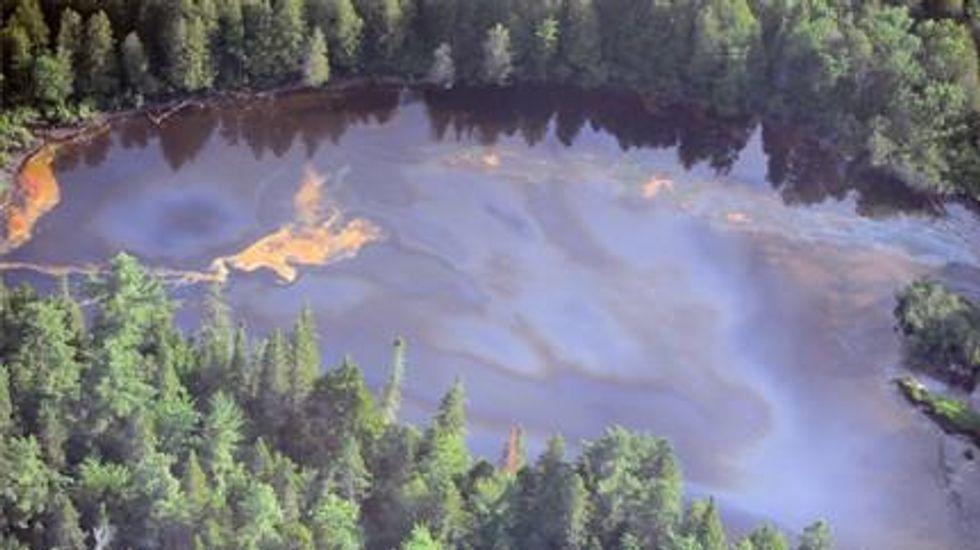
Frustrated by the Canadian government's failure to disclose the environmental impact of the July 6 train derailment and explosion in the town of Lac-Megantic, Quebec, an independent environmental group took it upon themselves to undergo a survey of the devastation.
"Confirm[ing] the fears" of the groups, the review revealed Tuesday the presence of carcinogens in nearby surface waters were nearly 400,000 times the prescribed limit, denoting a "severe impact" on water quality and soil where roughly 5.7 million liters (about 48,000 fluid barrels) of crude oil spilled from the derailed train.
Undertaken by the Quebec environmental group Societe pour Vaincre la Pollution (SVP) in collaboration with Greenpeace, the study tested surface samples drawn from the Chaudiere River, which runs through town, a week after the train derailment.
According to the Canadian Press, which reviewed the analysis, the rate of carcinogenic polycyclic aromatic hydrocarbons in the region is 394,444 times the acceptable amount for surface waters mandated by the provincial government.
Further, the study found the concentration of arsenic detected on the water's surface is said to exceed the government's acceptable standard by 28 times.
"The toxicity of this oil is quite high," said Daniel Green, co-president of the SVP, adding that the ecosystem could face long-term consequences.
There was no hiding the devastating human toll of the oil train accident which killed 47 people and leveled the small downtown. However, critics are charging the Canadian government with downplaying the environmental cost and being suspiciously guarded about the extent of the damage.
"I was surprised to see them minimize the spill," said Greenpeace coordinator Keith Stewart in a telephone interview. "This is one of the largest spills in Canadian history. It will take considerable effort to clean up."
And CBC added in their reporting on the study results:
So far, information about the exact chemical makeup of the oil has not been made public.
The Transportation Safety Board and the Environment Ministry have yet to release the results of their tests.
CBC News contacted the office of Environment Minister Yves-Francois Blanchet, but the ministry was not willing to comment on the findings.
"They've done extensive sampling -- air, water and soil, and we've yet to see any results from the government on this environmental catastrophe," added SVP's Daniel Green.
Reports last week revealed that the Montreal, Maine and Atlantic Railway (MM&A), the company behind the disaster, had an insurance policy that would only cover $25 million of the hundreds of millions of dollars in anticipated damage and clean-up costs.
These videos by SVP of the environmental group taking samples reveal evidence of oil slicks and contaminated mud following the spill.
LAC-MÉGANTIC VRAC 03 Société pour Vaincre la PollutionDéversement de 7,5 millions de litres de pétrole de schiste au Lac-Mégantic, Québec, C Canada. Le Ministère de l'environnement ...
Mégantic 01 - Vrac - SVPLe plus grand déversement de pétrole terrestre de l'Amérique du Nord et le premier de pétrole de schiste. La Société pour ...
_____________________
Cargo Train Derailed in Baltimore Area After Colliding With Tractor Trailer
A CSX cargo train derailed in the Baltimore area on Tuesday afternoon after colliding with a tractor trailer, sparking a loud explosion felt miles away, and sending plumes of smoke into the air from a fire set to burn into the night.
According to the Baltimore County Police and Fire Department, 15 cars derailed and one person, the driver of the truck, has been taken to shock trauma but is in stable condition.
Plumes of white and black smoke were seen billowing from the site.
The CSX train was carrying chemicals, which officials are now reporting as flourocyclic acid and teraphaelic acid and say are not toxic inhalants. The wreckage is still smoldering.
Officials say there is no mandatory evacuation area, though the Baltimore Police Department advised people within 20 blocks of the incident to shelter in place as a precaution.
The Baltimore Sun reports that hazardous material teams are heading to the scene, and that nearby buildings were damaged in the explosion.
The Baltimore County Police and Fire Department tweeted reports of several buildings collapsing at the derailment site.
One person who was working across the street from the derailment scene told the Baltimore Sun that the explosion "felt like a bomb going off."
Dale Walston, who lives about a half mile from the scene, told the Associated Press that the explosion shook his house "pretty violently," and that there was a strong smell of chemicals.
The National Transportation Safety Board (NTSB) has launched a "go-team" to investigate the incident.