
SUBSCRIBE TO OUR FREE NEWSLETTER
Daily news & progressive opinion—funded by the people, not the corporations—delivered straight to your inbox.
5
#000000
#FFFFFF
To donate by check, phone, or other method, see our More Ways to Give page.


Daily news & progressive opinion—funded by the people, not the corporations—delivered straight to your inbox.
US President Donald Trump complained that his envoys' planned trip to Pakistan's capital would be "too much work."
US President Donald Trump on Saturday abruptly canceled a planned visit by two of his administration's negotiators to the Pakistani capital for diplomatic talks to end his illegal war on Iran, complaining that the trip would be "too much work."
The president announced his decision after Iranian Foreign Minister Abbas Araghchi left Islamabad on Saturday, writing in a social media post that he relayed to Pakistani officials "Iran's position concerning a workable framework to permanently end the war on Iran." Araghchi added that he has "yet to see if the US is truly serious about diplomacy."
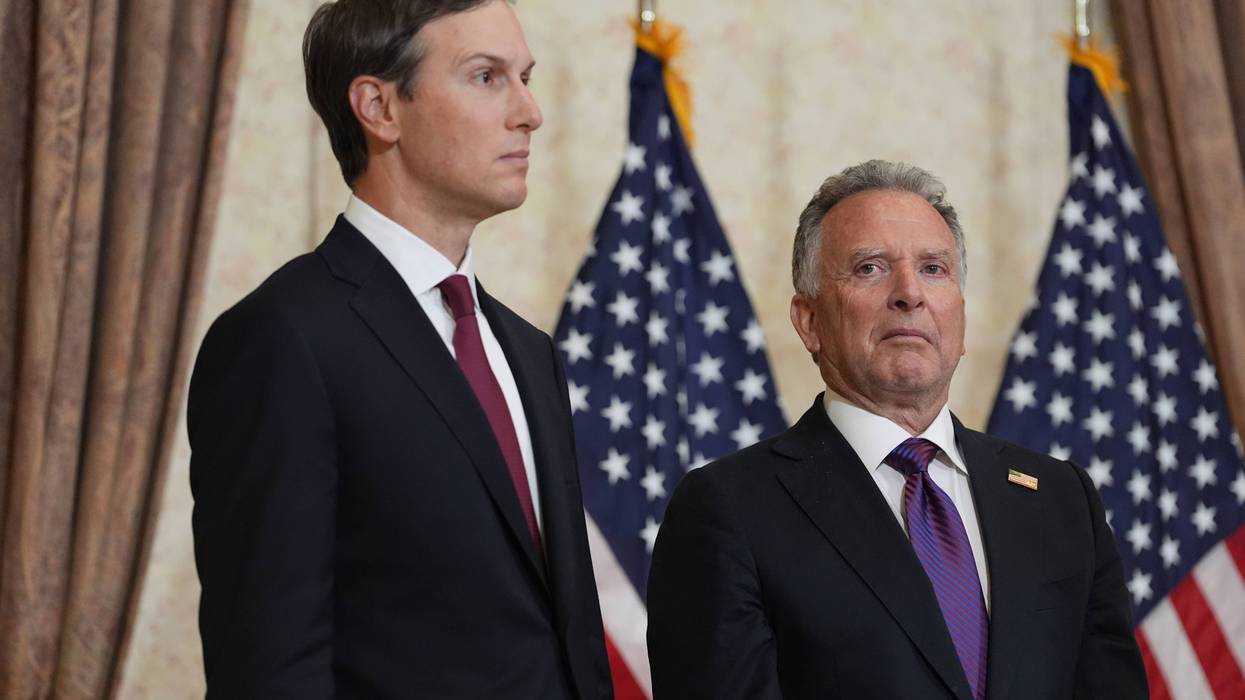
Iranian officials said repeatedly in recent days that they had no intention of engaging in direct talks with the Trump administration this weekend as long as the US naval blockade remained in effect. Despite clear statements from Iran's leadership, the Trump White House insisted that special envoys Jared Kushner and Steve Witkoff would be holding another round of direct negotiations with Iranian officials in Islamabad after earlier talks ended without a deal.
"This has happened repeatedly: Trump claims the Iranians are begging for talks, Iran says it is false," observed Drop Site's Jeremy Scahill. "The US says Iran is lying, and then it becomes clear Iran meant what it said."
In an assessment published before Trump canceled his envoys' trip, Scahill wrote that "there is no question it is the US that is seeking direct talks right now, not Iran."
"Iran still believes it is likely the US and Israel will resume the war and has indicated it has prepared new forms of retaliatory strikes and other actions, including in the Strait of Hormuz," Scahill added. "Its military commanders have said that while the US has moved more military assets into the region during the 'ceasefire,' Tehran has also taken this period to prepare its own weapons systems for more fighting."
Trump insisted Saturday that his administration—whose deeply unpopular and deadly war of choice has sparked a global economic disaster—holds "all the cards" and that Iranian leadership is in turmoil. But Sina Toossi, a senior fellow at the Center for International Policy, wrote that "Trump can’t hide exuding desperation for a deal."
"So he invents 'fractures' in Tehran to explain being repeatedly stood up," Toossi added. "Iran’s line is unchanged: demanding the blockade be lifted and holding on to its core red lines. They’re playing hardball. He’s spinning."
Trump's cancellation of the Kushner-Witkoff trip came hours after NBC News reported that "American military bases and other equipment in the Persian Gulf region suffered extensive damage from Iranian strikes that is far worse than publicly acknowledged and is expected to cost billions of dollars to repair."
"The Iran war was a tactical and strategic disaster," said Toossi. "Despite heavy efforts to control the narrative, it’s becoming clear just how much US bases and equipment in the region were damaged or destroyed. The war backfired and inflicted far more damage than its proponents want to admit."
"This was a bribe," said one critic.
A bombshell Saturday report from the Wall Street Journal revealed that a member of the Abu Dhabi royal family secretly backed a massive $500 million investment into the Trump family's cryptocurrency venture months before the Trump administration gave the United Arab Emirates access to highly sensitive artificial intelligence chip technology.
According to the Journal's sources, lieutenants of Abu Dhabi royal Sheikh Tahnoon bin Zayed Al Nahyan signed a deal in early 2025 to buy a 49% stake in World Liberty Financial, the startup founded by members of the Trump family and the family of Trump Middle East envoy Steve Witkoff.
Documents reviewed by the Journal showed that the buyers in the deal agreed to "pay half up front, steering $187 million to Trump family entities," while "at least $31 million was also slated to flow to entities affiliated with" the Witkoff family.
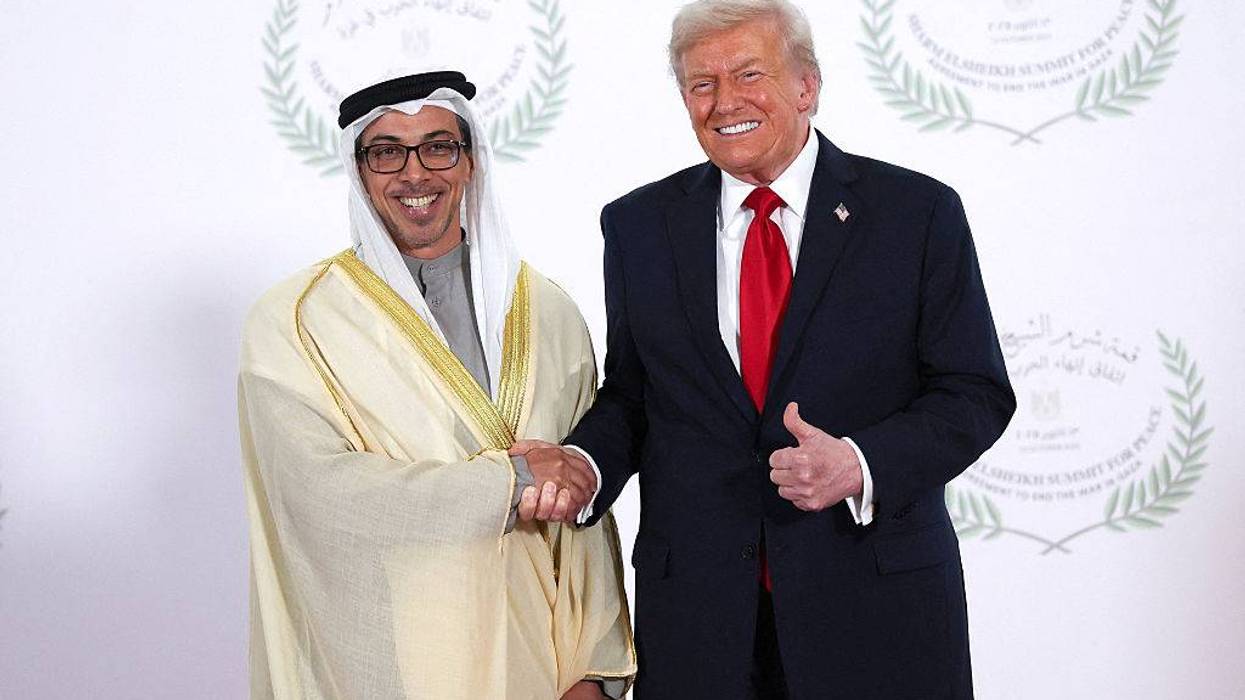
Weeks after green lighting the investment into the Trump crypto venture, Tahnoon met directly with President Donald Trump and Witkoff in the White House, where he reportedly expressed interest in working with the US on AI-related technology.
Two months after this, the Journal noted, "the administration committed to give the tiny Gulf monarchy access to around 500,000 of the most advanced AI chips a year—enough to build one of the world’s biggest AI data center clusters."
Tahnoon in the past had tried to get US officials to give the UAE access to the chips, but was rebuffed on concerns that the cutting-edge technology could be passed along to top US geopolitical rival China, wrote the Journal.
Many observers expressed shock at the Journal's report, with some critics saying that it showed Trump and his associates were engaging in a criminal bribery scheme.
"This was a bribe," wrote Melanie D’Arrigo, executive director of the Campaign for New York Health, in a social media post. "UAE royals gave the Trump family $500 million, and Trump, in his presidential capacity, gave them access to tightly guarded American AI chips. The most powerful person on the planet, also happens to be the most shamelessly corrupt."
Jesse Eisinger, reporter and editor at ProPublica, argued that the Abu Dhabi investment into the Trump cypto firm "should rank among the greatest US scandals ever."
Democratic strategist David Axelrod also said that the scope of the Trump crypto investment scandal was historic in nature.
"In any other time or presidency, this story... would be an earthquake of a scandal," he wrote. "The size, scope and implications of it are unprecedented and mind-boggling."
Tommy Vietor, co-host of "Pod Save America," struggled to wrap his head around the scale of corruption on display.
"How do you add up the cost of corruption this massive?" he wondered. "It's not just that Trump is selling advanced AI tech to the highest bidder, national security be damned. Its that he's tapped that doofus Steve Witkoff as an international emissary so his son Zach Witkoff can mop up bribes."
Former Rep. Tom Malinkowski (D-NJ) warned the Trump and his associates that they could wind up paying a severe price for their deal with the UAE.
"If a future administration finds that such payments to the Trump family were acts of corruption," he wrote, "these people could be sanctioned under the Global Magnitsky Act, and the assets in the US could potentially be frozen."
"If this is true, this is the largest public corruption scandal in the history of the United States and it's not even close," said one critic.
The New York Times on Monday published a blockbuster report detailing how US President Donald Trump's administration gave the United Arab Emirates access to high-powered artificial intelligence chips just days after receiving a massive investment in Trump's cryptocurrency startup.
As the Times report documented, Sheikh Tahnoon bin Zayed Al Nahyan, a member of the United Arab Emirates' (UAE) ruling family, had one of his investment firms deposit $2 billion into World Liberty Financial, the startup founded by members of the Trump family and the family of Trump Middle East envoy Steve Witkoff.
Just two weeks later, wrote the Times, "the White House agreed to allow the UAE access to hundreds of thousands of the world’s most advanced and scarce computer chips, a crucial tool in the high-stakes race to dominate artificial intelligence," despite national security concerns about these chips being shared with China.
The Times, which interviewed more than 75 people in its investigation of the deals, did not present direct evidence that the two deals were explicitly linked, and the White House denied any connection between the massive investment in the Trump family's crypto firm and the decision to grant UAE access to the chips.
However, the paper interviewed three ethics lawyers who said that "the back-to-back deals violate longstanding norms in the United States for political, diplomatic, and private dealmaking among senior officials and their children."
Other political observers were stunned by the Times' report.
"If this is true, this is the largest public corruption scandal in the history of the United States and it's not even close," commented Ryan Cummings, chief of staff at the Stanford Institute for Economic Policy Research.
US foreign policy journalist Laura Rozen questioned whether Witkoff's dealings with the UAE and other countries were impacting his ability to do his job in other areas.
"Maybe Witkoff is too busy pushing deals to enrich his and Trump’s families to focus on getting an Israel-Gaza hostage deal over the line, recognizing the Russians are not interested in ending the war on Ukraine, etc.," she speculated.
Alasdair Phillips-Robins, a fellow in the Technology and International Affairs Program at the Carnegie Endowment for International Peace, marveled at the reporting that Trump's negotiation team appeared to be willing to grant UAE access to the chips without forcing any major geopolitical tradeoffs.
"This sounds like the world's weakest negotiation: telling the UAE they'll get unlimited chips before they've agreed to a single concession in return," he wrote.
Independent journalist Jacob Silverman, who has written extensively on the politics of the US tech industry, remarked that the Trump administration's actions exposed in the Times report were "impeachable" and smacked of "incredible corruption."
In addition to his cryptocurrency-related dealings with UAE, Trump has also come under scrutiny for accepting a luxury jet from the government of Qatar that he plans to use for the remainder of his term in office and that will be given to his official presidential library after he leaves the White House.