

SUBSCRIBE TO OUR FREE NEWSLETTER
Daily news & progressive opinion—funded by the people, not the corporations—delivered straight to your inbox.
5
#000000
#FFFFFF
To donate by check, phone, or other method, see our More Ways to Give page.
Daily news & progressive opinion—funded by the people, not the corporations—delivered straight to your inbox.
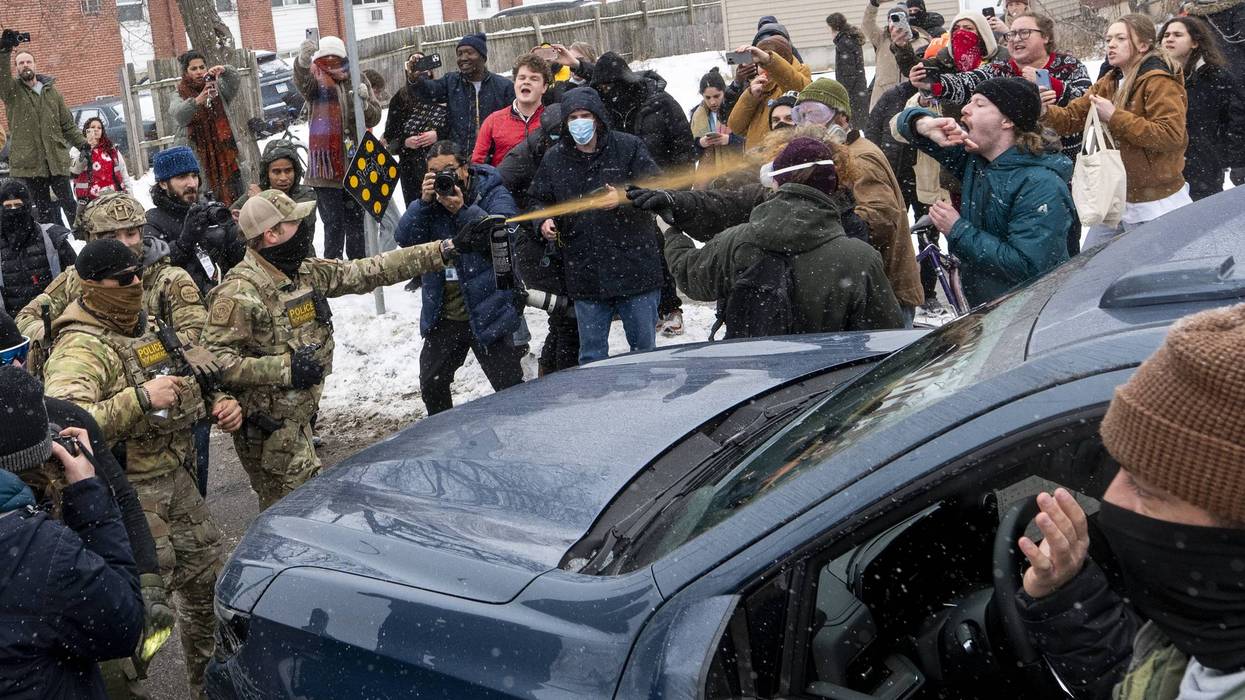
A letter from business leaders about the uprising against Donald Trump's lawless tactics in Minneapolis is remarkable not for what it says, but for what it refuses to acknowledge.
One of the many remarkable and lasting ideas the Rev. Dr. Martin Luther King Jr. placed into the national conversation was the concept of something he called “negative peace.”
Although the phrase began appearing in the writings of the civil rights leader in the late 1950s, King made the idea famous in his 1963 “Letter From Birmingham Jail,” where he was locked up for fighting segregation in Alabama’s largest city. He was annoyed by a letter from eight local white clergymen, titled a “Call for Unity,” that begged King to end a civil disobedience crusade for racial integration and seek progress through negotiations and the courts.
When an aide smuggled the newspaper into King’s cell, he began furiously scribbling his response in the margins of the ad before writing more on any scrap of paper he could find. His key passage argues that the white moderate was a greater threat to Black freedom than the KKK, because he was someone “more devoted to ‘order’ than to justice; who prefers a negative peace which is the absence of tension to a positive peace which is the presence of justice,” and who wants African Americans to wait for a “more convenient season.”
Flash-forward 63 years, and the grand pooh-bahs of US capitalism have learned nothing from this. On Sunday, 60 major corporations based in Minnesota — feeling caught in the crossfire of the federal immigration raids tearing apart Greater Minneapolis and the growing resistance movement — issued a cowardly and pathetic call for a negative peace to reduce the tensions.
The open letter that was released through the Minnesota Chamber of Commerce was signed by the CEOs or equivalents of almost every major Gopher State brand that you could think of — including Target, 3M, General Mills, Hormel, UnitedHealth (yes, that UnitedHealth), and all five major sports franchises. Some of these firms are beginning to see real economic fallout from the U.S. Immigration and Customs Enforcement raids and protest activities, which have kept some frightened Black and brown workers at home and triggered a large general strike last Friday.
The letter reads little differently from the Birmingham ministers’ “Call for Unity.”
“With yesterday’s tragic news”—a vague, bloodless reference to the 10 shots fired by federal officers into a 37-year-old intensive care nurse named Alex Pretti—“we are calling for an immediate deescalation of tensions and for state, local and federal officials to work together to find real solutions,” the letter states. It notes that Minnesota business leaders have been in touch with Gov. Tim Walz, the Donald Trump White House, and others in pleading for what it hopes would be a solution to the state’s crisis.
Pretti is never mentioned in the letter. Neither is Renee Nicole Good, the 37-year-old mother of three who was gunned down behind the wheel of her family SUV by an ICE agent as she attempted to drive away from a confrontation. In fact, ICE is never mentioned, nor are the federal agency’s most outrageous tactics, such as the seizure of a 5-year-old boy as “bait” to detain him and his father, or dragging a barely dressed Hmong refugee who is a U.S. citizen out of his home in frigid weather.
The entire letter is remarkable not for what it says—since it says very little beyond praying this whole mess somehow goes away so they can go back to making money without thinking about such dreadful things—than for what it doesn’t say.
There is no condemnation of the murders of two U.S. citizens who did nothing beyond legally monitoring the federal officers and their activities while on public streets. There is no condemnation of the ICE tactics in seizing hardworking migrants with no criminal records who are the backbone of the Minnesota community. There is nothing about what MLK would have called “positive peace”—a desire for real justice.
That’s probably because positive peace requires bold choices and displays of real courage—qualities that modern corporate America seems to have misplaced in a giant warehouse somewhere.
Exhibit A would have to be Target, the large national retailer that, with its hundreds of stores and its name slapped on the NBA’s Timberwolves’ arena, is now to many Americans the corporate face of Minnesota. Under pressure from demonstrators, including more than 100 clergy who protested outside Target’s Minneapolis headquarters on Friday, the retailer still said nothing — before the tepid group letter — about the ongoing ICE raids, or why agents have been allowed to stage operations in its parking lots and even inside stores.
There’s a bleak history here. In 2020, Minnesota became the epicenter of the fight for racial justice when the Minneapolis police murder of George Floyd was captured on video. That time, the state’s CEOs not only expressed moral outrage but pledged to spend heavily on diversity initiatives. Five years later, the local news site Racket reported many of these firms had backtracked, and that barely a third of the pledged $550 million had been spent.
This time, the business leaders just want the “tension” to disappear. That’s not so easy. Just ask Target. Its early 2025 move to end its diversity initiatives as Trump took office sparked calls from Black leaders for a boycott that has cut into store traffic and lowered Target’s stock price. It seems that moral surrender actually does have a price.
Also on Sunday, the team chaplain for the Timberwolves—ironically, one of the teams that signed onto the corporate letter—issued a personal statement with loud echoes of the “Letter from Birmingham Jail,” calling out any churches that had prayed that morning for peace and unity but not for justice.
“Peace is what the powerful ask for when they don’t want to be interrupted,” Matt Moberg wrote in a short piece that went viral on social media, adding, “Unity that refuses to name violence is just loyalty to the ones holding the weapons.”
This wouldn’t be the first time corporate America misread the room. Sunday’s statement suggested a continued deer-in-the-headlights reaction from the shock of Trump’s return to office—even as the CEOs ignore not just the power of the Target boycotts but the recent success of economic justice campaigns against firms from Disney to Avelo Airlines, not to mention the solidarity that drove the Minneapolis general strike.
Already, there is growing talk of a national general strike or expanded boycotts by millions of citizens who are also consumers, and who are both furious over the Good and Pretti murders and now flabbergasted by the corporate cone of silence. America’s business leaders don’t understand that cowardice has a steep cost attached.

What is unfolding in Minneapolis is frightening, but the response of its people has been inspiring.
In 1965, as excessive state violence was being unleashed against the Black citizens in Selma, Alabama, Rev. Dr. Martin Luther King Jr. sent out a nationwide call to faith leaders: “The people of Selma will struggle on for the soul of the nation, but it is fitting that all America help to bear the burden.”
Dr. King’s call for others to join him in leading a march to Montgomery was answered by clergy from across the country, marking a turning point in the Civil Rights Movement.
Sixty-six years later, in the same spirit and with the same clarity as King’s 1965 call, clergy in Minneapolis asked faith activists from across the country to join them in praying with their feet against the atrocities being committed by Immigration Customs and Enforcement against the good people of their state.
Upon hearing that my presence might be helpful, I immediately packed my tallit (Jewish prayer shawl), and on behalf of the Rainbow PUSH Coalition, I jumped on an airplane. Arriving in Minneapolis on Thursday, here’s what I witnessed:
Images of Luis Ramos, a terrified and bewildered five-year-old in a tiny plaid coat and blue knit bunny hat, were dominating local media coverage. Coming home from school, just steps away from his front door, ICE agents took Luis from his father’s car using him as bait to lure his pregnant mother out of their home.
By the time I arrived in Minneapolis, only two days later, Luis and his father had already been whisked away to a detention facility in Texas.
Like Selma, Minneapolis has become this generation’s frontline in the struggle for freedom and justice.
Thursday night, as we were preparing for the next day’s mobilization with nonviolence training, a person with a distressed look on their face asked to make an announcement. Along with informing us that a car full of children had been tear gassed today, they had just received a message from one of the local schools warning people not to be deceived by flyers offering “food assistance” since this was one of the tactics being used by ICE to lure parents from their homes. There were other examples of ICE’s cruelty. Immigrants injured by ICE agents have been taken to hospitals and registered using false names so that their families couldn't find them.
In the face of this inhumane behavior, and given Minnesota’s expected below zero temperatures, it would have been easy to remain home, feeling depressed and yet powerless to help. But I recalled Rev. Jesse Jackson’s words, “both tears and sweat are salty, but they render a different result. Tears will get you sympathy; sweat will get you change.”
With this in mind, on the coldest day the Twin Cities area had experienced in seven years, I joined hundreds of other clergy and faith leaders at the Minneapolis St. Paul International (MSP) airport to protest Delta airlines complicity in over 2,000 deportations.
The designated “free speech zone” for legal protest was bursting at the seams with more than a thousand bundled-up Minnesotans who had turned out to support those of us who were to engage in civil disobedience.
Our action consisted of over 100 faith leaders kneeling down blocking the terminal, holding signs picturing the detained and disappeared. We prayed and we sang: “everybody’s got a right to live/love/learn and “before this campaign fails, we’ll all go down to jail.” The assembled supporters chanted “Justice for Renee Good!”
With the bottom half of my face tucked into the bundles of warm clothing, I closed my eyes, and began quietly humming a nigun (wordless melody sung in a repetitive circular manner) to myself.
The man kneeling next to me, who I soon learned was the Community Engagement Organizers (CEO) program at Macalister College, asked if I was okay. He was grateful for our presence and wanted to make sure how we were handling the frigid temperatures.
The police lined up behind us with long clubs and chemical agents they had threatened to use. They arrest us. One by one, many in religious stoles, we stood and offered our bulky mitted wrists for handcuffing.
The crowd’s chants turned from “Justice for Renee Good!” to “Let them pray! Let them pray!” and we began to realize the significance. Our prayers were both exposing and healing the rot to which our country has been subjected for the past year that is now festering like an open infected wound.
While prayer can sometimes be meaningless, hypocritical, or even damaging. There are other times, when it can have a profound impact. As the Jewish siddur (prayerbook) Mishkan T’Filah says “prayer Invites God’s Presence to suffuse our spirits. Prayer may not bring water to parched fields,” but it ”can water an arid soul." The souls and spirits of the people of Minneapolis certainly need watering at this time.
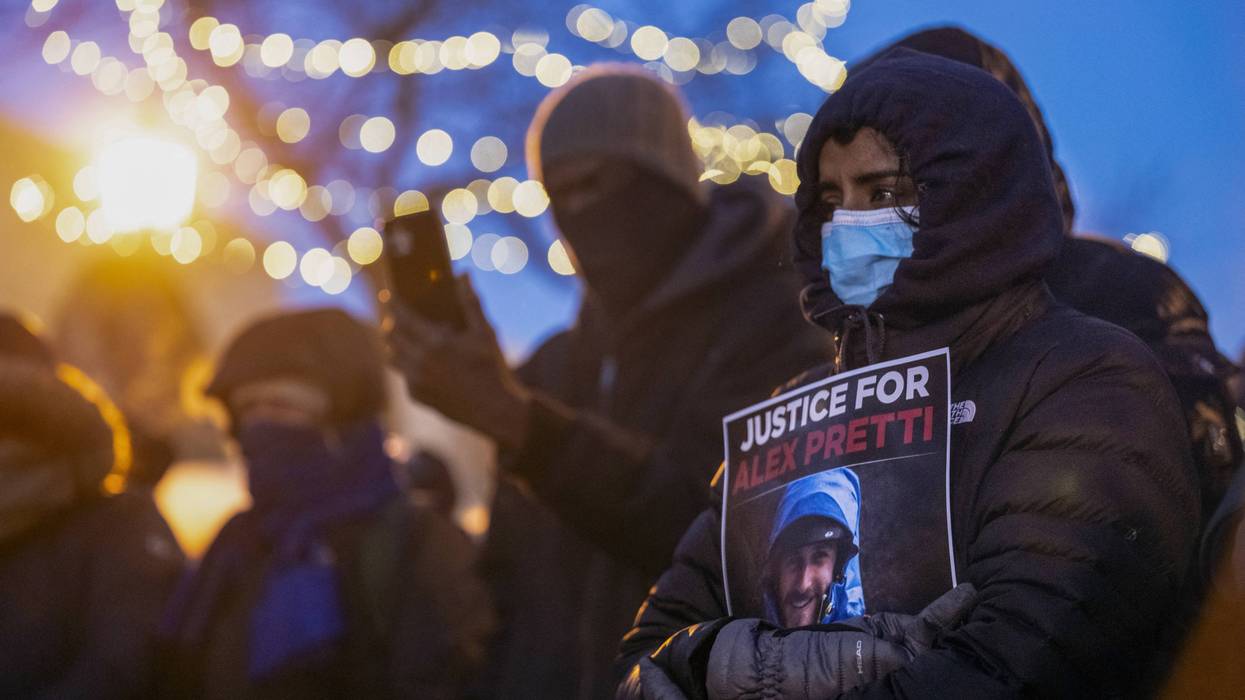
On Saturday, I was preparing to leave Minneapolis when we received the news that Alex Pretti, a 37-year-old nurse, had been beaten and shot to death by federal agents. I traveled instead to the site of this murder to join with others who were holding a vigil and turning the crime scene into a holy site. I took the tallit I have been wearing over the last year to mourn the passing of my father off my shoulders and laid it on the pine branches among the crosses, candles, sage brush bundles, mala beads, and kuffiyehs. As the crowd circling the site wiped tears from their eyes, “Somali aunties,” who momentarily felt safe to leave their homes, to provide hot food from their kitchens to their fellow mourners.
Riding the city bus back to my hotel, I noticed that my fellow passengers were carrying gas masks and eye goggles for the tear gas that wafts through the city’s freezing air and one knew not when they might get tackled to the ground and sprayed directly in the face with a chemical agent. It felt more like being in the Occupied West Bank than in an American city.
Picking up a quick lunch, I had to knock on the door to be admitted to the restaurant. In order to check into my hotel, I had to use the doorbell to be let in, and to get into Ubers, I had to show a code. Because everyone is aware that ICE agents could barge in at any moment, they are taking extra precautions trying to keep themselves and their neighbors safe.
Many of the Uber drivers in Minneapolis are of Somali ethnicity. One driver, a US citizen who has been in the country for over 20 years, told me about having to show his naturalization papers (he now keeps them with him at all times) while trying to do his job. Another, a young Somali-American woman, told me that she has just spent days too afraid to leave her house, but then today had to get back to work because she needs to pay her rent.
What is unfolding in Minneapolis is frightening, but the response of its people has been inspiring. Between delivering groceries and supplies to those afraid to leave their homes, to roaming the streets with whistles strung around their necks so they can alert others when ICE is spotted, to rabbis and Jewish activists, including myself this past Sunday, keeping watch outside churches so Latinx communities can worship together, to providing emotional support—the work of care, mutual aid, and resistance, week after week, should fill us all with pride. And what was so moving to encounter was the degree to which everyone—from hotel staff, to restaurant workers, to Uber drivers—all expressed gratitude that so many of us had traveled to support them as they defend democracy for the entire country.
Like Selma, Minneapolis has become this generation’s frontline in the struggle for freedom and justice. And like Selma, it will be the disciplined, caring, and prayerful response of Minneapolis' people and their supporters that will win out in the end.
“The border between democracy and authoritarianism is the least protected border in the world.”
Ivan Krastev, Bulgarian chair of the Centre for Liberal Strategies, dropped that assessment on Jon Stewart’s weekly blog last week.
Four days later, that stark reality took a quantum leap with the brutal murder of registered nurse Alex Pretti by a member of President Donald Trump’s paramilitary army in Minneapolis. Pretti is not the first killing by an agent of ICE (Immigration and Customs Enforcement) or CBP (Customs and Border Patrol) in recent weeks.
Renee Nicole Good was maliciously shot through a car window by an ICE agent earlier in Minneapolis. Keith Porter was shot and killed while celebrating on New Year’s Eve by an off-duty ICE agent in a Los Angeles suburb. At least six others have died in ICE detention facilities, including Luis Gustavo Nunez Caceres, who was strangled in what an El Paso autopsy has ruled a homicide.
Yet the Twin City murders of Good followed so soon by Pretti, two white US citizen observers who were appalled by the violent ICE invasion of their city, has transformed the dialogue on whether our country has crossed the road to authoritarian rule.
Neither could be easily demonized by the administration despite desperate attempts by HHS Secretary Kristi Noem, Vice President JD Vance, Press Secretary Karoline Leavett and other administration attack dogs to label them as “domestic terrorists” and justify their murders.
The violence has escalated as Trump, Miller, Vance, and Noem seek to secure and expand their power through what they believe will intimidate and force consent for their authoritarian rule. But they are also afraid of the growing popular resistance.
The usually compliant major media rapidly rejected the administration's lies and cover-up efforts. Almost immediately, the media rejected the excuse that Pretti was planning a “massacre” of ICE agents with a firearm he had a legal permit to carry under Minnesota law. That was especially hypocritical considering the administration’s regular celebration of those on the far right who bring lethal weapons to protests from Kyle Rittenhouse to militia seeking to kidnap Michigan Governor Gretchen Whitmer to the January 6, 2021 insurrectionists pardoned by Trump.
“Videos Contradict Federal Accounts of Federal Shooting,” blared a New York Times headline, as the Times had pioneered video documentation exposing the lies on Good’s murder. The footage, the Times wrote, shows Pretti “stepping between a woman and an agent pepper spraying her. Other agents then pepper spray Mr. Pretti who is holding a phone in one hand and nothing in the other. His concealed weapon is found and only after he is restrained on the sidewalk …and taken from him before the agents opened fire.” He was killed with 10 shots then, and the agents blocked a physician who saw the shooting from providing medical aid.
The Washington Post presented the clearest video evidence in a report labeled “Federal agent secured gun from Minn. man before fatal shooting, videos show.” Even the Murdoch owned Wall Street Journal called the shooting “the worst … to date in what is becoming a moral and political debacle for the Trump Presidency.” A Journal editorial dismissed administration “spin” saying it “simply isn’t believable.”
Few missed that the Pretti shooting occurred just a hours after tens of thousands of Minnesota residents marched through the streets of Minneapolis in minus 10 degree weather in a general strike and economic boycott to send a message of overwhelming public opposition to Trump’s Minneapolis invasion.
“I do believe that the real problem is that the border between democracy and authoritarianism is the least protected border in the world,” Ivan Krastev, also a founding board member of the European Council on Foreign Relations, said, prompting Stewart to proclaim, “you can't just drop that in the middle of a podcast and expect me not to stand up and applaud. Say that again.”
State sponsored violence is the clearest signpost of a regime that has embraced autocratic rule, whether the dictatorship is appointed following an election, as in the case of Hitler or Suharto, marched on the capital by his paramilitary troops like Mussolini, imposed by a military coup like Pinochet and the Argentine “dirty war” generals, or through a bloody civil war like Franco.
ICE and CPB agents most resemble Hitler’s SA Brown Shirts, his paramilitary troops who engaged in violent assaults on political opponents even before Hitler was appointed chancellor by fading democratic Weimar Republic leaders. Two months before Hitler was anointed, a document was leaked in one Nazi sympathetic state that ordered “all orders of the SA or other paramilitary force were to be obeyed under pain of death,” as Benjamin Carter Hett points out in The Death of Democracy.
“While the junta’s national project had several ideological pillars—neoliberalism, social conservatism, and Pinochet’s authority – violence fueled it and made it possible,” writes Ruth Ben-Ghiat in Strongmen.
Social media posts from the White House and several executive departments have begun borrowing Nazi slogans and translating them to justify the ICE campaign. “One People, One Realm, One Leader,” posted the US Department of Labor this month, echoing the Nazi slogan "Ein Volk, ein Reich, ein Führer." Just days after assuming office, Hitler declared “There can be only one victor: either Marxism or the German Volk,” notes Peter Fritzsche in Hitler’s First Hundred Days.
On Ezra Klein’s podcast, Atlantic journalist Caitlin Dickerson describes how after passage of Trump’s massive bill to extend the tax breaks to the super rich and nearly doubling the number of agents for the anti-immigrant campaign, there was a rush to fill the new ICE spots with “lots of people, it seems, within this new workforce who have absolutely no experience, who are learning how to enforce the law, how to carry a weapon, how to interact with the public, just starting from square one right now.”
“But we're also seeing a lot of explicit references to white nationalist ideas and the kind of dog whistles that we've all become used to when Trump is president. The fact is that if you're a member of the Proud Boys or you're a follower of QAnon, you recognize these exact phrases that are being used as a kind of call to action and to apply for a job as an ICE agent.”
They’ve all received a message, Dickerson continues, from anti-immigrant campaign leader Stephen Miller, who said on TV: “To all ICE officers, you have federal immunity in the conduct of your duties, and anybody who lays a hand on you or tries to stop you or tries to obstruct you, is committing a felony. You have immunity to perform your duties, and no one, no city official, no state official, no illegal alien, no leftist agitator or domestic insurrectionist can prevent you from fulfilling your legal obligations and duties. And the Department of Justice has made clear that if officials cross that line into obstruction, into criminal conspiracy against the United States or against ICE officers, then they will face justice.”
“Obstruction” to Miller and company has become a license to threaten, assault, and arrest anyone bearing witness—especially filming—ICE violence and brutality. Legal citizens have been dumped far away from where they were picked up, even in unsafe conditions. Agents are now also using technology to identify observers for economic retaliation, an escalation of the goal of intimidation and seeking to silence observation and dissent.
Miller, Dickerson emphasized, “is just underscoring that argument that you're not going to get in trouble for being too aggressive. And in fact, the only thing you will get in trouble for is not being aggressive enough.”
The violence has escalated as Trump, Miller, Vance, and Noem seek to secure and expand their power through what they believe will intimidate and force consent for their authoritarian rule. But they are also afraid of the growing popular resistance symbolized by the massive march in Minneapolis in horrific freezing conditions, and the solidarity protests from coast to coast in red states and blue.
In Jacobin, Aru Shiney-Ajay, executive director of Twin Cities Sunrise Movement, described the increasingly effective fightback campaign in her state. Their tactics have focused on targeting corporations like Hilton, and Home Depot to stop collaborating with ICE, and have been especially successful in tormenting ICE agents in hotels at all hours with noise intended to drive out the agents and create conditions where “ICE agents won’t want to stay there, and hotels won’t want to house them.”
“I think about it as leverage and power looking everywhere ordinary people have leverage and seeing where we can pull those levers. Under a functioning democracy, you play the game of public opinion," said Shiney-Ajay. "If you convince the majority, then you can get legislation or win an election. But what we’re living under right now is not a democracy.”
“A lot of establishment advocacy groups seem to be hoping we’ll show America that Trump is really bad, then in the midterms we’ll take back power… I don’t think that’s accurate,” Shiney-Ajay says. “Just look at what Trump is doing now and how similar it is to how authoritarians in other countries have grabbed power.”
“You have to look at what ways ordinary people are directly upholding a regime’s ability to logistically function, and switch from purely persuasion campaigns to the logic of non-cooperation. It’s like building a muscle of solidarity across race, across class. It’s something the Left talks about a lot, but I’ve never experienced it like this. And it’s truly ordinary people—it’s not majority organizers or activists. It’s people who’ve never organized a day in their lives but know something wrong is happening and want to do something.”
We all need to do something. That includes non-cooperation, continuing to bear witness; recording the abuses; pressuring media to report and expose the ICE lawlessness; organizing national economic boycotts and general strikes; mobilizing to win elections, and more. No one leader or political party will save us from fascism. We have to do it ourselves.
The threats and the invasion have come home. We are all Minnesotans now.
Do Americans who engage in lawful and peaceful protest enjoy the protection of the United States Constitution? Not any more, the Trump regime says in authorizing the shameless misconduct and lethal violence ICE agents are perpetrating against citizens in Minnesota.
ICE has invaded the state of Minnesota to show America that nothing can restrain Trump’s army of thugs. Not the Constitution. Not the laws which make it a crime to commit assault and murder. Not public opinion. And not thousands of citizens exercising their rights.
Although far from the first instance of ICE brutality, the slaying of Renee Nicole Good shocked the nation as a clear case of murder in cold blood.
The killing was not in “self-defense”—if a car is really hurtling toward you, you don’t pause to take out your gun, aim and shoot, because you know shooting won’t stop the car. You run. Good’s autopsy confirms that it was murder: the fatal bullet was the one fired into the victim’s left temple, when the ICE agent shot through the driver’s side window from alongside the car.
In response to the homicide, President Trump false asserted the agent had been run over, and charged the victim with the “crime” of having been “very, very disrespectful to law enforcement”; the chief of Homeland Security called Good a “domestic terrorist,” supposedly “stalking” ICE (meaning she followed them to observe their conduct); and the Department of Justice launched an investigation, not of the killing, but of the victim’s widow.
Meanwhile, the Vice President proclaimed ICE impunity. Speaking of Renee Good’s killer, Vance stated, “That guy’s protected by absolute immunity.”
The claim is legally baseless, but ICE agents got the message they can brutalize and even summarily execute at will, without consequences. And now, within weeks, ICE agents have committed another murder, this time of Alex Pretti, a citizen who was an ICU nurse, with a burst of bullets in the victim’s back while he lay defenseless on the ground.
Since the Supreme Court approved of ICE stopping individuals based on racial profiling, ICE agents have seized and frequently assaulted individuals simply because they appeared to be Hispanic—or Hmong or Somali or Native American. They are freely employing the same tactics in Minnesota.
Do you carry proof of citizenship with you? Neither do I. But in an echo of Nazi Germany, ICE agents demand to “see your papers,” particularly if you are non-white.
Targeting journalists and citizen observers. An official policy of breaking into homes without a judicial warrant. Detaining children. Handcuffing individuals until they come up with proof of identity. Dragging people out of their cars without probable cause to think they committed a crime. Assault on suspected “illegals.” Attacking nonviolent, peaceful demonstrators with pepper balls, tear gas, rubber bullets. Threatening with guns, shooting at cars, and now, actual murders.
These are the abuses of a conquering army, inflicted upon an occupied nation.
ICE and Border Patrol, the entities now inflicting these wounds on our democracy, are no more law enforcement agencies than was Hitler’s Gestapo. ICE is an unrestrained, racist, violence-craving gang, trying to impose Trump’s will on a state. It should be disbanded.
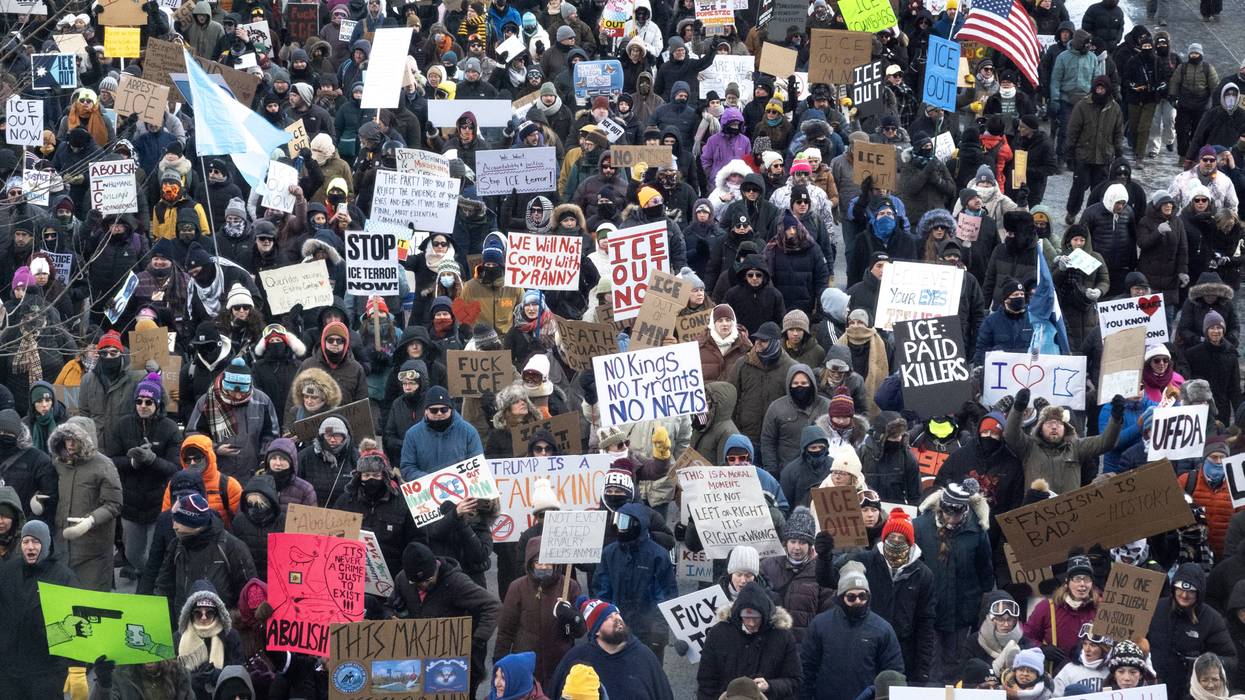
Hundreds of thousands of Minnesotans have taken to the streets to bravely defy ICE’s intimidation and violence, to insist on their rights under law, and to express solidarity with their neighbors who are ICE victims. And across the nation, many thousands came out in support.
In other places where liberty has been challenged, Americans and our leaders identified with a threatened people. “I am a Berliner,” President John F. Kennedy affirmed at the Berlin Wall in 1963. “I am a Greenlander,” some now say in response to President Trump’s threats to invade an ally’s territory.
The threats and the invasion have come home. If our constitutional rights are not to be erased, we must act with the courage displayed by Minnesotans. “I am a Minnesotan.” So are we all.