

SUBSCRIBE TO OUR FREE NEWSLETTER
Daily news & progressive opinion—funded by the people, not the corporations—delivered straight to your inbox.
5
#000000
#FFFFFF
To donate by check, phone, or other method, see our More Ways to Give page.
Daily news & progressive opinion—funded by the people, not the corporations—delivered straight to your inbox.
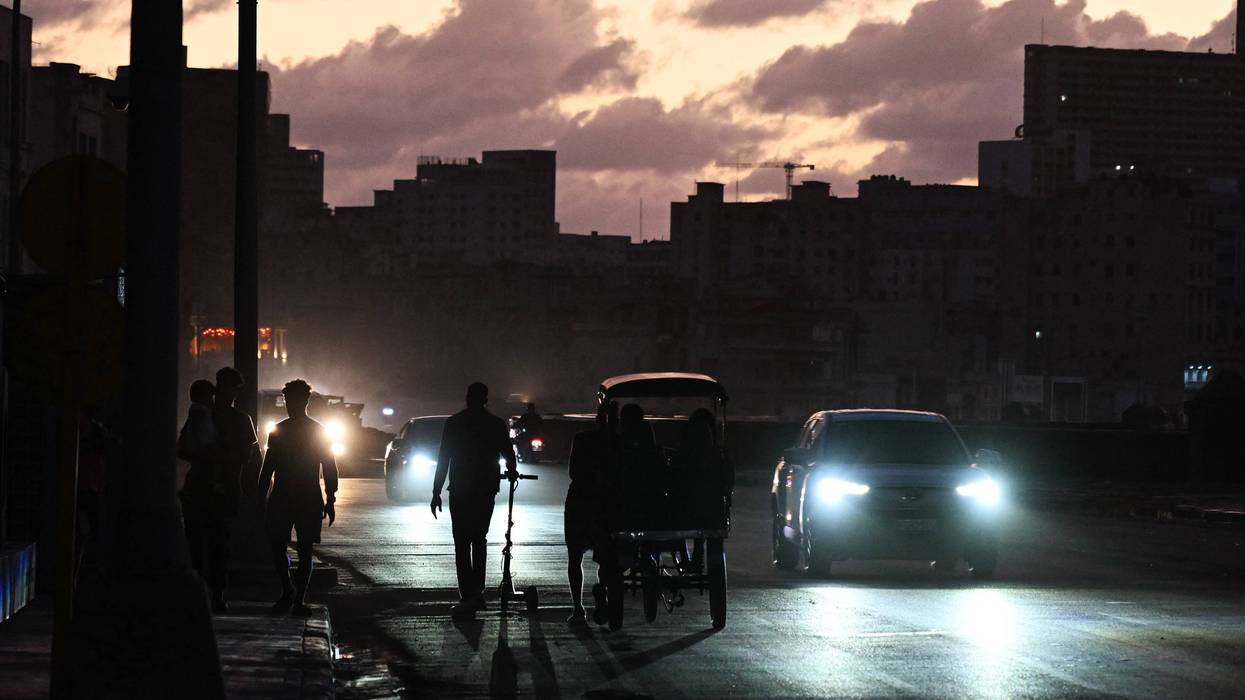
What the United States is doing to Cubans is equivalent to waterboarding them into submission, and all CBS could seem to talk about is Castro.
The CBS Sunday Morning program, “Next: Cuba?” which aired on April 26, presented a discussion of the recent intensification of sanctions on and threats against Cuba. I am disappointed that this program, and several other shorter recent segments on CBS News, did not cover some essential points that must be stated about what is happening in Cuba now. My own experience in Cuba, including the recent delivery of humanitarian aid directly to Cubans, contradicts some perspectives presented by CBS.
Fidel Castro is dead. And, he has been dead for a while. He was a fascinating character who still inspires polemic discussions. Stories of Fidel are legendary on the scale of Paul Bunyan. But we think the choice of focus of these eight minutes on Fidel’s legacy is unjust to the Cuban people. The news of the moment is that Cuba is underwater. The CBS Sunday Morning program, instead of engaging in a discussion of a crisis on the island, entertained us with old, mostly obsolete stories about Castro.
Cubans are suffering currently. The US sanctions on Cuba are enormous, by any measure. We find it remarkable that Cuba has withstood for decades sanctions that would bring down any other country of its size and reach within weeks. The recent fossil fuel blockade on the island, however, has placed the people of the island in a choke hold. Cuba’s economy, like those around the world, is dependent on petroleum products for most of its electricity generation, vehicle use, and cooking. Food is rotting in the fields because of a lack of fuel to connect products to markets, and it is rotting in homes because the refrigerators are disconnected.
The recent military blockade prohibiting oil shipments disrupted Cuba’s economy on a level that frightened people, in a way that we would compare to drowning; If something is not done quickly, disaster will occur. The blockade was challenged successfully by a Russian oil tanker, but the sabers from the US State Department continue to rattle loudly.
Cuba deserves to make its path without undue pressure from the US.
A health crisis is happening in real time. The impacts of the sanctions on health are huge. Cubans are accustomed to excellent health services, but hospitals are less able to provide services than ever. Infants who were once saved from preventable risks are now dying, even in the best hospitals. Surgeries are postponed, simply because there are not sufficient provisions, made acute by the recent oil blockade. Let’s be clear: The oil blockade has provoked an epidemiological disaster.
The current suffering has a psychological dimension. A refrigerator that won’t keep food fresh, a stove that won’t cook, darkness all day and night, no transport to the workplace or market, overflowing trash piles every few blocks because the garbage trucks have no fuel, no running water, are not the same as a fun camping trip. Cubans are humiliated as the system they depend on spiraled downward from weakly working to a horror show. The people of Cuba are frightened, in our opinion, not only by the capacity of the US government to cause mayhem, but by their own vulnerability. All Cubans heard President Donald Trump say that he will “take Cuba." Cubans know what happened in Iran, Gaza, and Venezuela, and these words are designed to make them think they are next. The psychological impact of this pressure compounds the physical hardship.
The intent of the current administration can’t be missing the mark—the effect of the fuel blockade, on top of so many, layered, sanctions and complications, is the same as waterboarding a person. By strengthening the intensity and increasing the duration, a waterboarded subject will eventually stop resisting and walk calmly to the next waterboarding session. That waterboarding may have occurred in Guantánamo, on the same island as the 10 million victims of these sanctions, is ironic. Even now, with a Russian tanker arriving to provide only a portion of the Cuban needs, the US government continues the horror of a tightened blockade to convert Cuba into a compliant state.
Cuban voices should be heard. The positions of Cuban Americans regarding the US sanctions on the island are not unanimous, as the news segment might lead one to believe. Americans should realize that Cuban Americans hold diverse positions on how representative the Cuban government is and how responsive it is to the changing situations regarding the needs of Cubans. This is not reflected in the mentioned segment.
More importantly, not a single Cuban citizen on the island spoke in the CBS Sunday Morning program. Even when including the other recent CBS News segments, very little expression of sentiment on the island is found. The viewers may be surprised, not only by the diversity of positions held among Cubans, but also by their sophistication in the analysis of the role of the Cuban government and the US government in their lives. Cubans don’t need to be represented by a few voices from inside Miami: They can speak for themselves, but the mentioned news item definitely cut them out of the conversation.
Cuba deserves sovereignty. The mentioned program made no mention of the overwhelming castigation of the US sanctions against Cuba that have occurred around the world. The United Nations votes against US sanctions have been occurring yearly for a few decades. Numerous countries are pushing back against the US line on Cuba. Russia dared the US to stop its fuel tankers from supplying the island. Small and large countries alike, ranging from Sri Lanka to Brazil, from Belgium to China, are speaking out against the US sanctions against Cuba. Many are putting their money where their mouth is, with donations and technical assistance, including many organizations and individuals from the US. Their message is simple: Cuba deserves self-determination, not intervention from abroad. They do not deserve the web of financial, travel, commercial, and diplomatic punishments imposed on Cuba and on any business or country that dares to conduct some kinds of business with Cuba.
Cuba is not a threat to any other country or people. It is amply evident that Cuba is not a danger to any group or people or nation outside its country. Even the most stridently anti-communist Cuban Americans travel to Cuba freely. The State Sponsor of Terrorism designation of Cuba, one of the pillars justifying US sanctions, is neither accurate nor helpful. Discussion of this was absent from the mentioned news article, leaving the viewer with a deficient view of why Cubans and their government face our collective wrath.
There are problems inside the country. There are serious problems in both Cuba and the US, both of which need sober, thoughtful discussions. Let’s all be clear: Discontent rages in the US, too. However, no yardstick exists that makes Cuba look like an outlier in either internal human rights or international threats. What does exist is the cry of “but they are communists,” coming from South Florida, and this has no place as a criterion for US foreign policy any longer. And recently, the Cuban government has called for frank discussions with the US government, hopefully, where all issues could be discussed in a framework of sovereignty and the intentions of being good neighbors.
Cubans are capable of handling their own problems, with our cooperation instead of imposition. We all would like to see Cubans happier. We have varying levels of knowledge about Cuba, ranging from first-time visitors to Cuba to citizens and former residents of the island. Our political opinions vary along a wide range, but we are unanimous in one aspect that was left out of the CBS Sunday Morning program: Cuba needs and deserves an end to the US-imposed sanctions.
Cuba deserves to make its path without undue pressure from the US. The CBS Sunday Morning article left out the voices of Cubans, which would have expressed their anxious desire for what now seems impossible: that Cubans be able to conduct their business without undue pressure from the US. Practically no Cuban alive is old enough to know what normal diplomacy from the US is. Let’s give them the most revolutionary present of all—a decent, respectful foreign policy, just like all the rest of the countries in the world.
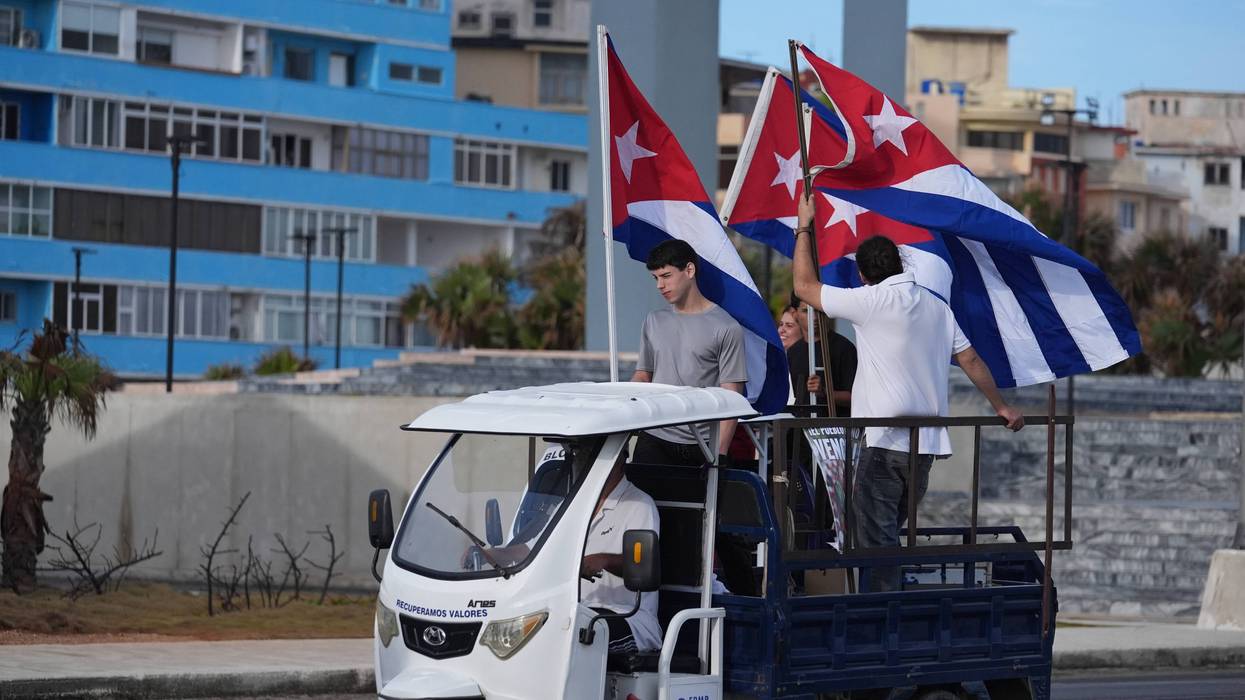
“The continued use of Guantánamo Bay, which has an extensive history of abuse and torture, is horrific and unconscionable."
Dozens of human rights organizations sent a letter to Congress on Friday, decrying threats by US military officials to detain Cubans who flee to the US to escape President Donald Trump's crushing economic blockade at Guantánamo Bay.
The 86 groups, which include the Center for Constitutional Rights, the Center for Victims of Torture, the International Refugee Assistance Project, and Refugees International, zeroed in on remarks made by US Marine Corps Gen. Francis Donovan, the commander of the US Southern Command (SOUTHCOM), during a Senate Armed Services Committee hearing last month about how the military would respond to the mass influx of Cuban refugees to the United States.
The risks of a refugee exodus from Cuba were sparked in January after Trump tightened the already brutal regime of economic sanctions by threatening to slap harsh tariffs on any nation that provided oil to Cuba. The result has been a crippling fuel shortage that has caused routine blackouts and disrupted every facet of daily life, from hospital care to food cultivation.
Trump enacted the fuel blockade in what he has described as an effort to coerce the government to step down from power and make way for one more amenable to the interests of American companies. With Cuba in a weakened state, he has threatened to "take" the island outright using American military force.
The United Nations has warned that if the blockade is prolonged, it could bring about a total "humanitarian collapse.”
Asked by Sen. Tom Cotton (R-Ark.) about what would be done if this caused a mass influx of Cuban refugees to the US, Donovan said they had an executive order that would involve coordinating with the Department of Homeland Security to handle a "mass migration event."
Donovan said it would include using the US military base at Guantánamo Bay, “where we would set up a camp to deal with those migrants or any overflow from any situation in Cuba itself.”
“Given the well-documented history of abusive and unlawful detention at Guantánamo, any proposal to use the base for additional detention is deeply troubling and unacceptable," the organizations wrote on Friday,
They note the prison’s history as a site used for extrajudicial torture during the global War on Terror and as a holding facility for other migrant groups, including Haitian refugees and asylum seekers who fled a military coup in the 1990s, many of whom were subjected to substandard living conditions.
"Time and again, we have seen the US government try to use Guantánamo as a legal black hole to mistreat migrants, subjecting them to inhumane conditions and interfering with both their right to seek protection in the United States and their right to counsel," said Pedro Sepulveda, a litigation fellow for the International Refugee Assistance Project.
Despite pledges from multiple presidents to close the camp for good, it remains open more than two decades after former President George W. Bush began using it to detain hundreds of terrorism suspects without trial.
Trump has expanded its use during his second term, using it to temporarily hold more than 700 migrants since February 2025—including dozens of Cubans rounded up by immigration agents.
Trump’s use of the camp marks the first time it has been used to hold people detained in the continental United States. A Washington Post investigation from February found that those in the facility were subject to weeks-long periods of isolation, invasive strip searches, and denied contact with lawyers.
The human rights groups called on Congress to block any funding that could be used to detain Cubans fleeing Trump's blockade and to shut down Guantánamo Bay for good.
"The president has held Guantánamo detention as a threat over the heads of migrants in the United States and now threatens the same over Cubans who may be forced to flee their homes as a result of his own actions," said Yumna Rizvi, a senior policy analyst for the Center for Victims of Torture.
Michael Galant, the senior research and outreach associate at the Center for Economic and Policy Research, said, “If the Trump administration is worried about Cuban migration, the solution is simple: Stop intentionally impoverishing the Cuban people through an embargo and fuel blockade.”
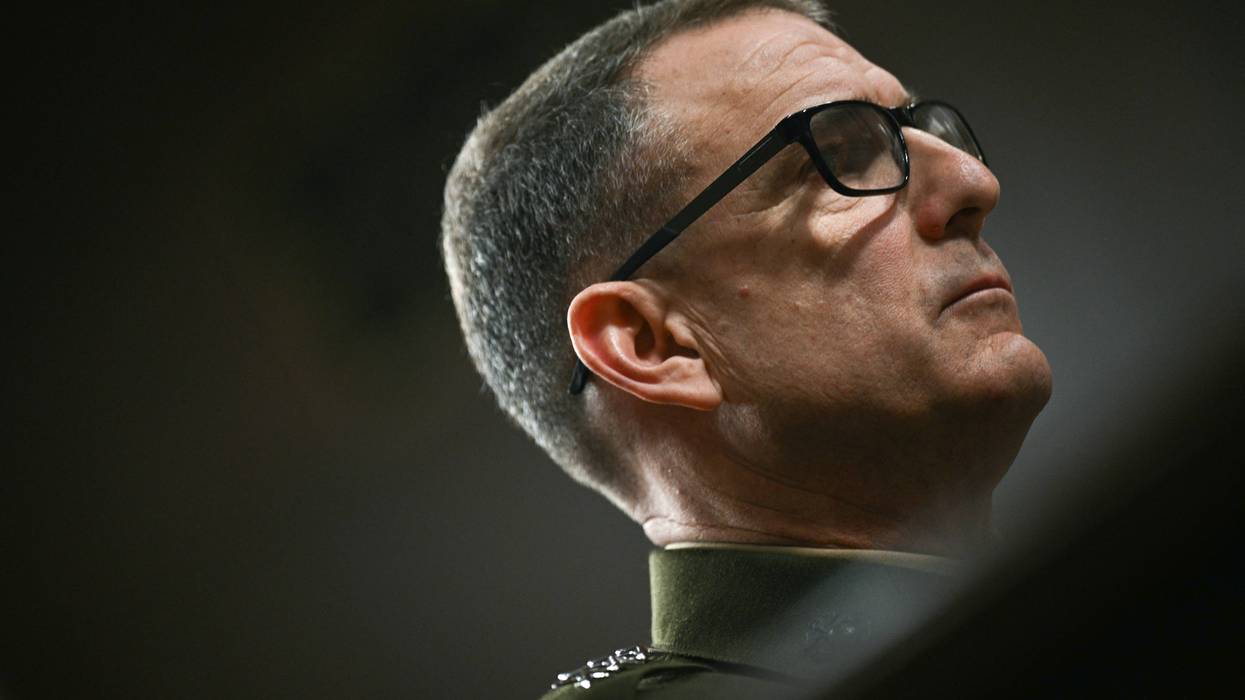
One foreign policy expert noted that fears of a "mass exodus" of refugees come "as the US starves Cuba of energy and food."
As the Trump administration sows chaos with a crushing fuel blockade of Cuba, a general told Congress that the military will "set up a camp" at Guantánamo Bay to detain those who try to flee the humanitarian crisis inflicted by the United States.
The phrase "humanitarian crisis" was used by Sen. Tom Cotton (R-Ark.) to describe the situation in Cuba during a Senate Armed Services Committee hearing on Thursday, as he questioned US Marine Corps Gen. Francis Donovan, the commander of the US Southern Command (SOUTHCOM).
Donovan, a 37-year Marine veteran, took command of SOUTHCOM in February after being tapped by President Donald Trump. His predecessor, Adm. Alvin Holsey, abruptly resigned in December reportedly after he'd raised concerns about the Trump administration's bombings of alleged drug trafficking boats in the Caribbean, which have been widely described as illegal under international law.
On Thursday, Cotton asked Donovan, "Are we prepared for any kind of humanitarian crisis in Cuba—the possible flow of refugees, other civil disorder that may threaten our interests, especially if the decrepit, corrupt Castro regime finally falls or flees?"
"Senator, yes we are," Donovan responded. "SOUTHCOM... We have an [executive] order to be prepared to support [the Department of Homeland Security] (DHS) in a mass migration event. They would take the lead, we would follow."
Donovan said this would include using the US military base at Guantánamo Bay, "where we would set up a camp to deal with those migrants or any overflow from any situation in Cuba itself."
Trump signed an executive order during his first month in office last year directing DHS and the Pentagon to “expand the Migrant Operations Center at Naval Station Guantánamo Bay to full capacity," which the administration said meant scaling the facility up to more than 30,000 beds.
The base, which houses a prison infamous for the extrajudicial torture of detainees during the global War on Terror, was designated under Trump's order to hold "high‑priority criminal aliens unlawfully present in the United States.”
But Donovan suggested it may now be used to hold Cubans fleeing chaos and deprivation following Trump's own acts of economic warfare.
Cotton's question followed a warning that same day from Republican Florida Gov. Ron DeSantis of a "possible mass exodus out of Cuba," which experienced an island-wide electricity blackout earlier this week following the Trump administration's blockade of fuel entering the island, which a group of UN rapporteurs said in January was “a serious violation of international law and a grave threat to a democratic and equitable international order.”
DeSantis, whose state is home to about 1.6 million Cuban-Americans, said, "[W]e don’t want to see a massive armada of people showing up on the shores of the Florida Keys."
He said he believed the Trump administration "would rather see people in Florida go help… hopefully get a new government going" in Cuba, possibly referring to the long-held hope of some right-wing Cuban exiles to take over the island.
Following more than 60 years of an embargo that has strangled Cuba's economic development, the Trump administration tightened the noose even more in January, signing an executive order that would slap harsh tariffs on any country that provides oil to Cuba.
As a result of the blockade, explained Juanita Goebertus, Americas director at Human Rights Watch, "people don’t have reliable access to drinking water, hospitals can’t operate safely, basic goods are becoming increasingly difficult to obtain, and garbage is piling up in the streets.”
Trump first described his blockade as part of an effort to carry out regime change against Cuba's Communist Party leadership, but this week, he made the imperialist declaration that he may seek to outright "take" the island and that he could "do anything I want" with the "weakened nation."
Erik Sperling, the executive director of Just Foreign Policy, emphasized that the possible "mass migration event" described by Donovan was only coming "as the US starves Cuba of energy and food."
"Trump and [Secretary of State Marco] Rubio are to blame for any refugee crisis from Cuba, as the US intentionally harms civilians with an oil blockade," said Just Foreign Policy in a social media post responding to Republican warnings of Cuban mass migration. "US sanctions and meddling in Latin America have always been a leading cause of migrant flows."
Immigration journalist Arturo Dominguez explained that "What [Donovan] essentially said was, 'We're ready to accommodate the flow of refugees by putting them in camps.'" He added that "the way these military goons jump right in to 'accommodate' atrocity is beyond the pale."
Trump's blockade of Cuba is unpopular with the American public, according to a YouGov poll released earlier this week. Just 28% of adult US citizens said they approved of the US blocking oil shipments to the country, while 46% said they opposed it. The same survey found that just 13% want the US to use military force to attack Cuba, while 61% would oppose it.
Just Foreign Policy said, "The American people do not want their government to starve Cubans and cause a 'mass migration event.'"
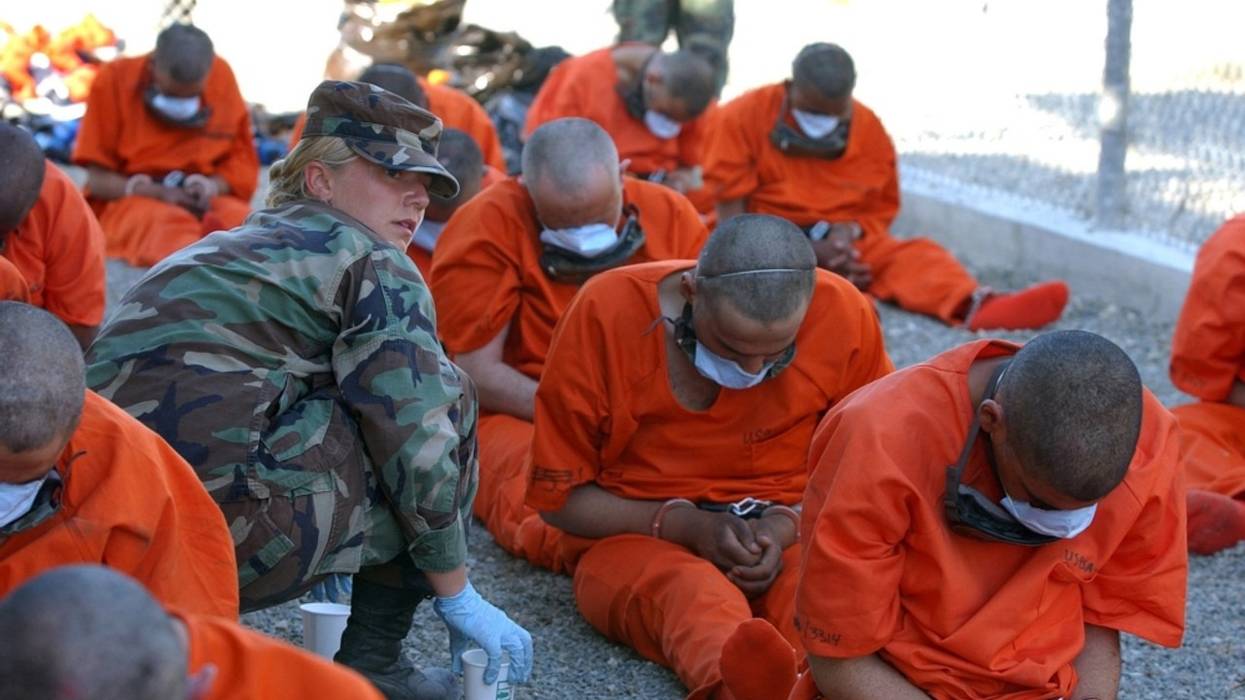
"This decision will ensure nothing but a continued lack of justice and accountability for everyone involved in the 9/11 military trial at Guantánamo," said one critic.
Human rights defenders on Friday condemned a federal appellate panel's decision upholding former U.S. Defense Secretary Lloyd Austin's withdrawal of pretrial plea agreements for three men accused of plotting the September 11, 2001 attacks on the United States.
Austin, who served under former President Joe Biden, "indisputably had legal authority to withdraw from the agreements; the plain and unambiguous text of the pretrial agreements shows that no performance of promises had begun," the D.C. Court of Appeals panel ruled in a 2-1 decision.
Under the proposed deal, accused 9/11 mastermind Khalid Sheikh Mohammed and alleged co-conspirators Mustafa al-Hawsawi and Walid bin Attash would have been spared execution in return for pleading guilty. The agreement came amid years of stalled legal proceedings in a case complicated by the U.S. government's torture of the defendants and efforts to cover it up.
Austin withdrew the plea agreements last August, explaining that he "long believed that the families of the victims, our service members, and the American public deserves the opportunity to see military commission trials carried out in this case."
However, attorneys for the defendants called the legally dubious military commission regime established at the Guantánamo Bay prison—notorious for detainee torture and indefinite detention—during the George W. Bush administration "obviously corrupt and rigged." During the 2000s, several military prosecutors resigned from the commissions in protest over what some of them called a rigged system designed to ensure there were no acquittals.
"The 9/11 case will never be resolved through a contested trial because the defendants were tortured by the CIA."
Last November, Air Force Col. Matthew McCall, a military judge, ruled that Lloyd "did not have the authority to do what he did, asserting that the plea deals "remain valid, and are enforceable," prompting the government's appeal. The following month, a military appeals court also ruled against Austin's bid to ditch the plea deals.
The Center for Constitutional Rights (CCR)—which has long represented Guantánamo detainees—called Friday's decision "a betrayal of justice."
"This decision will ensure nothing but a continued lack of justice and accountability for everyone involved in the 9/11 military trial at Guantánamo," CCR senior staff attorney Wells Dixon said in a statement. "The Biden administration's invalidation of plea agreements that would have resulted in convictions and life sentences for the 9/11 defendants is a painful betrayal of 9/11 victims' families."
"The 9/11 case will never be resolved through a contested trial because the defendants were tortured by the CIA," Dixon added. "The only way to resolve this case is for the Trump administration to succeed where every prior administration has failed and negotiate new deals with the 9/11 defendants that will finally close the 'War on Terror' prison at Guantánamo."
There are still 15 men currently imprisoned in Guantánamo, which is located on Cuban land leased to the U.S. in perpetuity by a dictatorship overthrown in 1959. Multiple detainees have been cleared for release, one of them for 15 years.
Some legal experts doubted whether the U.S. government would ever be able to try, let alone convict, the 9/11 suspects. Military judges and prosecutors have cited defendants' torture in declining to proceed with cases against them. Many men and boys were tortured at CIA "black sites," Guantánamo, and military prisons including Abu Ghraib. At least dozens of detainees died.
The three co-defendants were all captured in Pakistan during late 2002 and early 2003. After being turned over the United States, they were sent to CIA black sites, including the notorious "Salt Pit" outside Kabul, Afghanistan, where suspected militant Gul Rahman was tortured to death in November 2002. In 2006, the men were transferred to Guantánamo.
Mohammed was subjected to interrupted drowning, commonly called "waterboarding," 183 times, as well as other torture and abuse approved under the Bush administration's "enhanced interrogation" program. Hawsawi suffered a shredded rectum resulting from sodomization during so-called "rectal hydration" and has had to manually reinsert parts of his anal cavity to defecate. Bin Attash said he was placed in stress positions for extended periods, beaten, and doused in cold water.
The co-defendants must now decide whether to appeal the ruling to the full D.C. appeals court, the U.S. Supreme Court, or both.
"Putting aside the fantasy that this case is ever going to go to trial—assuming it does go to trial and that there's a conviction—you get to sentencing, and they have a right to put forward evidence... that they were tortured," Dixon told CNN Friday. "That's never going to happen."

Sending more undocumented people there, one lawyer said, would be a "natural extension of the crimes committed at Gitmo for two decades, and also wildly, wildly illegal."
Citing government documents and unnamed officials, Politico and The Washington Post reported Tuesday that President Donald Trump's administration is preparing to potentially transfer up to thousands of undocumented immigrants to the U.S. naval station in Guantánamo Bay, Cuba—though the White House denies it.
"This story is Fake News. Not happening," White House press secretary Karoline Leavitt said on social media Wednesday, sharing a link to the Post. Far-right Congresswoman Marjorie Taylor Greene (R-S.C.) suggested Trump should sue the newspaper.
Rights advocates last week filed a federal lawsuit against the Trump administration for sending migrants to the "notorious" military base where the U.S. government held and tortured foreigners as part of the so-called War on Terror.
Now, at least 9,000 people are "being vetted for transfer," which "would be an exponential increase from the roughly 500 migrants who have been held for short periods at the base since February," according to Politico.
As the Post detailed:
The foreign nationals under consideration hail from a range of countries. They include hundreds from friendly European nations, including Britain, Italy, France, Germany, Ireland, Belgium, the Netherlands, Lithuania, Poland, Turkey, and Ukraine, but also other parts of the world, including many from Haiti. Officials shared the plans with The Washington Post, including some documents, on the condition of anonymity because the matter is considered highly sensitive.
The administration is unlikely to inform the foreigners' home governments about the impending transfers to the infamous military facility, including close U.S. allies such as Britain, Germany, and France, the officials said.
Politico noted that U.S. State Department officials who deal with Europe are trying to persuade the Department of Homeland Security to ditch the plan. One of them said: "The message is to shock and horrify people, to upset people... But we're allies."
Responding to the Post's reporting on social media, former U.S. diplomat William Gill said that "this is a clear violation of international law. A foreign detainee's government must immediately be notified via its local consulate and has right of access to the detainee to provide assistance/arrange legal representation. Failure to respect this jeopardizes Americans abroad."
Alka Pradhan, an attorney who has represented Guantánamo detainees, said: "Please understand both that this is [a] natural extension of the crimes committed at Gitmo for two decades, and also wildly, wildly illegal. This is not 'complex' or 'difficult' or related to security or defensible in any way."
In the case filed in Washington, D.C. last week on behalf of two Nicaraguan men and other noncitizens now at Guantánamo, rights groups are asking U.S. District Judge Carl Nichols, a Trump appointee, to rule that detaining these migrants there violates the Immigration and Nationality Act, Administrative Procedure Act, and Fifth Amendment to the U.S. Constitution.
"The government's real reason for holding immigration detainees at Guantánamo is to instill fear in the immigrant population," the complaint declares. "That is not conjecture; it is government policy."
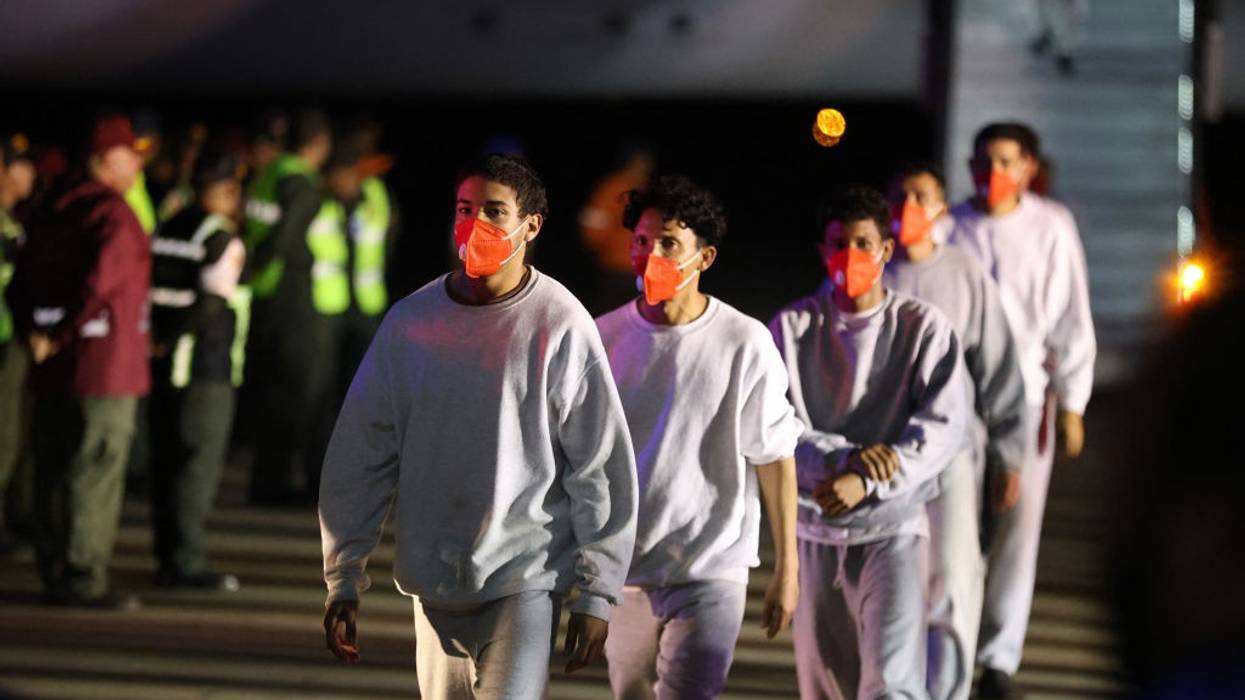
Migrants at the infamous torture site "are surrounded by military officials, deprived of in-person contact with legal counsel, and subject to punitive conditions of confinement," the suit says.
Immigrant rights advocates on Wednesday launched a federal lawsuit against the Trump administration for detaining migrants at the U.S. naval station in Guantánamo Bay, Cuba—the site of a "notorious" prison where several foreign men and boys were indefinitely held and tortured as part of the so-called War on Terror.
The class action suit was filed in the District of Columbia by the ACLU's national and D.C. arms, the Center for Constitutional Rights, and the International Refugee Assistance Project against the secretaries of defense, homeland security, and state, as well as their departments, Immigration and Customs Enforcement, and ICE's acting director.
The coalition brought the case on behalf of two Nicaraguan men previously detained a facilities in Virginia and Louisiana—Yamil Luna Gutierrez and Rafael Angel Lopez Ocon—and other noncitizens the Trump administration is now holding under the Immigration and Nationality Act (INA) in "disturbing" conditions at Guantánamo.
"Immigration detention outside the United States is straightforwardly illegal."
Rather than keeping these migrants in the United States "while making arrangements to effectuate their removal, the government has flown them hundreds of miles away to detention facilities at Guantánamo Bay, Cuba, for no legitimate purpose," the complaint states. "Plaintiffs are surrounded by military officials, deprived of in-person contact with legal counsel, and subject to punitive conditions of confinement, including in facilities previously used by the military to hold law-of-war detainees."
The plaintiffs, the filing says, "do not challenge the government's authority to detain them on U.S. soil or to directly remove them to their home country or to another statutorily authorized country. What they challenge is the government's unprecedented and unlawful decision to hold them in a detention facility at Guantánamo—which, under the INA, and for purposes of the application of that statute, is not the United States. Immigration detention outside the United States is straightforwardly illegal under the statute."
"Moreover," the document argues, "the government's use of Guantánamo for immigration detention is arbitrary and capricious, lacks any legitimate purpose, and imposes punitive detention conditions on immigration detainees in violation of their constitutional rights."
"Never before this administration has the federal government moved noncitizens apprehended and detained in the United States on civil immigration charges to Guantánamo, or to any other facility outside the United States, for the purpose of civil immigration detention. Nor is there any legitimate reason to do so," the document notes. "The government has ample detention capacity inside the United States, which is far less costly and poses none of the logistical hurdles attendant to detaining people at Guantánamo."
Specifically, according to the complaint, "since February 4, 2025, the government has held approximately 500 people in immigration detention at Guantánamo, at a reported cost of more than $40 million, or approximately $100,000 per day per detainee. In contrast, immigration detention at a U.S.-based detention facility costs, on average, $165 per day per detainee."
Previewing the Trump administration's likely arguments in court, the suit says that "in attempting to justify the transfers, the government has claimed that the individuals it is sending to Guantánamo are members of gangs and dangerous criminals—the 'worst of the worst.' That characterization has been proven wrong. Regardless, it is legally irrelevant."
The filing also stresses that "the government's real reason for holding immigration detainees at Guantánamo is to instill fear in the immigrant population. That is not conjecture; it is government policy."
The coalition is asking the court to rule that detaining these migrants at Guantánamo violates the INA, Administrative Procedure Act, and Fifth Amendment to the U.S. Constitution, and to block the Trump administration from continuing to do so.
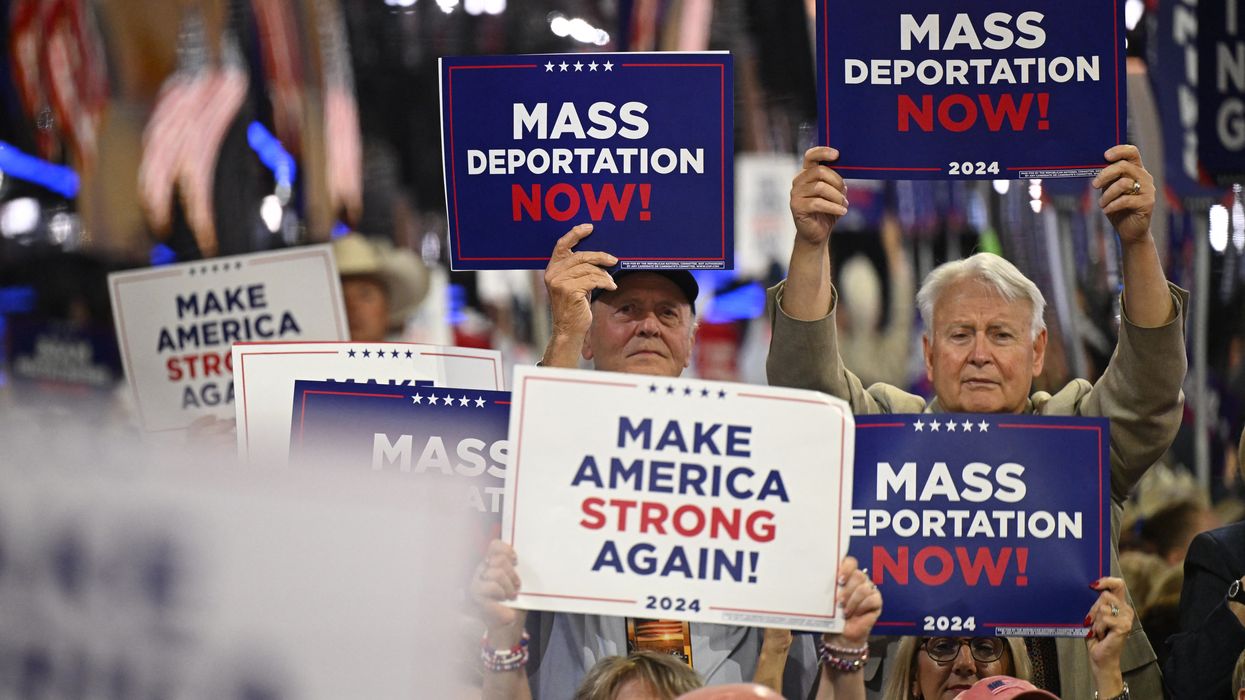
Such an apparatus has a potentially fatal flaw: In order to function effectively, millions and millions of people must be willing to go along with it.
“Flights to Guantánamo Bay have begun. The worst of the worst have no place in our homeland.”
With those words the U.S. government announced the fate awaiting “criminal aliens” in its custody.
On a military base in El Paso, Texas, masked men in combat fatigues paraded a group of young Venezuelan immigrants, their hands cuffed and their ankles shackled, in front of the cameras, before loading them onto a waiting Air Force C-17, which was to deliver its human cargo to Naval Station Guantánamo Bay overnight.
This is the fate envisioned by the architects of the deportation machine for America’s “tired,” its “poor,” its “huddled masses yearning to breathe free.”
Once there, they were to be incarcerated in the infamous Camp 6, held incommunicado in the same cells where al Qaeda suspects were once held in indefinite detention, and guarded by the 1st Battalion, 6th Marine Regiment. Meanwhile, a tent city, which could ultimately house as many as 30,000 detainees, rises around the prison.
Though most of those immigrants have since been returned to Venezuela, the Pentagon has pledged to continue using the base for the “temporary detention of illegal aliens who are pending return.”
Back on the mainland, the Department of Defense (DOD) is deploying thousands of troops to “seal the borders”; the Department of Justice (DOJ) is deputizing its agents to round up undocumented immigrants; Immigration and Customs Enforcement (ICE) is mobilizing to meet its daily quota of 1,200 to 1,500 arrests, armed with target lists, surveillance technology, and “less-lethal” weapons; and immigration detention facilities are to be built on military bases across the country.
And that’s not all either. Entire families are set to be detained, and the grim family-separation policy of the first Trump administration revived. Humanitarian parole is to be revoked, refugees rejected, and asylum-seekers returned. And cities, counties, and states that dare to defy the deportation regime are to be punished.
The machinery of mass deportation has been set in motion in a nightmarish fashion. It is meant to be impossible to stop—or at least to appear that way. Still, history teaches us that such a machine, like any other, can be brought to a halt, if only we understand how the apparatus actually works.
Here, then, is a simple, step-by-step guide to how the Trump administration plans to build the machinery necessary to “complete the largest deportation operation in American history.”
“Today, I will sign a series of historic executive orders,” Trump pledged in his Inaugural Address. “With these actions, we will begin the complete restoration of America and the revolution of common sense.”
That “revolution” in immigration enforcement did indeed begin with a barrage of such orders, many lifted directly from the Project 2025 playbook.
First among them was the declaration of a state of emergency in this country’s borderlands. According to the National Emergencies Act of 1976, this allows the military to be called up for domestic duties, whether to the southern border, Guantánamo Bay, or anywhere else the president sees fit.
“I have determined that the current situation at the southern border qualifies as an invasion,” reads another order signed on January 20, citing Article IV of the Constitution.
“Accordingly,” the order continues, “I hereby suspend the physical entry of any alien engaged in the invasion.” It goes on to authorize operations to “repel, repatriate, or remove” noncitizens.
This is the logical conclusion of years of far-right propaganda about a “Third World,” “Hispanic,” or “alien” “invasion” of the United States, which, over time, has spread from the stuff of 8chan manifestos to the preambles of presidential proclamations.
The architecture of ICE is slated to expand to levels not seen since its founding in 2003.
The agency reportedly made more than 14,000 arrests in the first three weeks of Trump’s second term. With it still supposedly failing to meet its quotas, however, officials want to double the size of the force.
Now, Senate Republicans are proposing no less than $175 billion in new spending on immigration enforcement, while the House GOP is looking to fund that spending spree with billions of dollars in cuts to Medicaid and other essential social services.
ICE is no longer to bear its burden alone. Since Trump’s inauguration, the DOJ, including the U.S. Attorney’s Offices, the Federal Bureau of Investigation (FBI), and the Drug Enforcement Administration (DEA), have been pressed into the service of the deportation machine.
The FBI, for instance, has been tasked with finding “identifying information and/or biometric data relating to noncitizens located illegally in the US”—data that will fuel the detention-to-deportation pipeline.
“We’ve got special agents, intelligence analysts, and more, supporting DHS [Department of Homeland Security] teams across the country,” said then-Acting FBI Director Brian Driscoll, “from New York and Chicago to El Paso, Newark, and Denver.”
ICE has also partnered with local police departments, county sheriff’s offices, and departments of correction through a program known as 287(g) to “identify and remove incarcerated criminal aliens” before they can be freed.
In New York City, Mayor Eric Adams has typically promised to reopen an ICE office on Rikers Island, purportedly as part of a quid pro quo with the Trump administration.
And in February, Florida became the first state to sign a statewide 287(g) agreement, which would train officers of the Florida Highway Patrol and State Guard to “interrogate any suspected alien or person believed to be an alien.”
When White House Press Secretary Katherine Leavitt was asked how many of those arrested since January 20 had a criminal record and how many were “just in the country illegally,” she replied, “All of them. Because they illegally broke our nation’s laws, and therefore, they are criminals.”
Tellingly, fewer than half of the 8,200 people arrested in the first two weeks of the Trump administration had criminal convictions of any kind. And of the approximately 4,400 detained in the first two weeks of February, more than 1,800 had never been charged with a crime.
“Police, open the door! Policía, abra la puerta!”
Those words echoed across a Denver apartment complex, as ICE agents with long guns backed by BearCat tactical vehicles went door-to-door, asking residents for identification. Twenty-nine members of the Cedar Run community were rounded up in one go.
But ICE and its partners are not just hunting for undocumented immigrants in their homes. Thanks to a rule change instituted by DHS, federal agents are also pursuing their prey in locations previously deemed too “sensitive” for immigration enforcement purposes like schools, hospitals, courtrooms, and churches (though a federal judge in Maryland has already forbidden the Trump administration from carrying out such actions in certain houses of worship).
Another of Trump’s executive orders announced his intention to reauthorize the DOJ and DHS to collect DNA samples from all detained “non-United States persons.”
This DNA collection program is just one part of a vast surveillance apparatus that has been built up over the years, which now requires vast troves of biometric and biographic data to be collected, stored, and analyzed.
Increasingly, that task has fallen to for-profit firms. Since 2020, the federal government has spent an estimated $7.8 billion on such surveillance technologies, including a $96 million contract with Peter Thiel’s data-mining firm Palantir.
The most recent data shows that America’s immigrant detention centers are already over capacity, with 41,500 beds and 43,759 inmates. ICE is now seeking to more than triple that capacity.
Trump pledged, on Day One, that he would allocate “all legally available resources” to immigrant detention, evidently including America’s prisons. In February, the Federal Bureau of Prisons took in the first ICE detainees at facilities in Atlanta, Los Angeles, Miami, Philadelphia, and elsewhere.
The policy also embraces military bases. The Northern Command is currently “providing facilities at Buckley Space Force Base… to enable [ICE] to stage and process criminal aliens within the US.”
More than 90% of such detainees are already overseen by private contractors. Now, ICE is planning to warehouse thousands more by leasing mobile structures from a shipping container company.
And a new plan, floated by former Blackwater CEO Erik Prince, would sell the government “outside assistance” in the form of privatized “processing camps,” along with a “small army” of private citizens with the power to arrest and detain immigrants.
For the prison industry, the deportation drive has proven to be a profitable enterprise indeed. “This is truly one of the most exciting periods in my career,” said CoreCivic’s CEO on a recent call with investors.
During the first Trump administration, America was haunted by the specter of immigrant children in cages. Now, the architect of the president’s “zero-tolerance” policy and recently appointed “border czar” Tom Homan plans to revive family detention on a whole new scale.
Family detention centers, according to the Detention Watch Network, have a “well-documented history of negligence and abuse.” Despite that sordid history, ICE is reportedly readying a “Request for Proposal” (RFP) for “detention facilities intended specifically for families.”
At the same time, the administration is making it harder for sponsors of immigrant children to free them from detention.
The deportation machine is no longer simply an American enterprise. It is now an international affair, with Costa Rica, El Salvador, Guatemala, Honduras, and Panama already taking in thousands of “third-country deportees.”
“We have offered the USA the opportunity to outsource part of its prison system,” says El Salvadoran President Nayib Bukele, whose prisons are rife with human rights violations.
In Panama, hundreds of deportees of Central and East Asian origin were recently locked in a hotel, then relocated to a makeshift camp in the middle of the jungle. “It looks like a zoo, there are fenced cages,” according to one eyewitness.
One of the president’s most egregious orders asserts that alleged gang affiliations are sufficient to warrant a “terrorist” designation.
Declaring it “time for America to wage war on the cartels,” Trump has specifically targeted Mexican, Central American, and Venezuelan nationals suspected of having ties to the drug cartels, Mara Salvatrucha (MS-13), or the Tren de Aragua gang, seeking their “expedited removal” or their “total elimination.”
The same order signals the president’s intention to invoke the Alien Enemies Act, a wartime law dating to 1798, which would subject “all natives, citizens, denizens, or subjects” of a “hostile” nation to being “apprehended, restrained, secured, and removed, as alien enemies.”
“To all the resident aliens who joined in the pro-jihadist protests, we put you on notice: come 2025, we will find you, and we will deport you.” So warned the statement accompanying the president’s January 29 executive order, which singled out supposedly “pro-Hamas aliens and left-wing radicals” in higher education for “removal.”
Authorities have evidently already begun implementing that order, with reports of Arab students facing deportation for participating in pro-Palestine protests. Over the weekend, ICE agents showed up at the door of Mahmoud Khalil, a Palestinian activist at Columbia University whose green card had reportedly been revoked by the Trump administration. While in government custody, Khalil was disappeared for several days.
“I’ve seen enough,” says Abed Ayoub, executive director of the American-Arab Anti-Discrimination Committee, “to know that targeting is happening.”
“Refugee arrivals to the United States have been suspended until further notice.” That was the message on January 21 from the Office of Refugee Resettlement, now under the leadership of a senior ICE official. With a stroke of the pen, President Trump has frozen America’s Refugee Admissions Program.
In so doing, he has left at least 10,000 refugees in legal limbo, while abandoning hundreds of thousands more to their fates in places like Afghanistan, the Congo, and Myanmar.
Ultimately, the president would make one exception to the rule—for white South Africans. An executive order signed on February 7 would “promote the resettlement of Afrikaner refugees” as a protected class.
Under the new administration’s policies, hundreds of thousands of Cubans, Haitians, Nicaraguans, Ukrainians, and Venezuelans, among others, are set to lose their Temporary Protected Status (TPS)—a form of humanitarian parole that permitted asylum-seekers from those countries to continue living and working in the U.S.
Citizenship and Immigration Services has announced an “administrative pause” on all pending parole requests, while DHS, claiming parole is a right “to which no alien is entitled,” has authorized its agents to strip immigrants of such protections.
ICE agents have already started making arrests of TPS holders in Texas.
Of all the president’s orders, the most consequential for citizens is the one that would rescind birthright citizenship, which would deny the rights guaranteed by the 14th Amendment to “persons born or naturalized in the U.S.”
In practice, it would mean stripping citizenship rights from children born here to mothers who are “unlawfully present” or whose presence is “lawful but temporary.”
For now, the order has been blocked by a Seattle judge’s injunction, but it will undoubtedly fall to the Supreme Court to decide its fate (and the fate of the Constitution of which it’s a part).
As it happens, immigrants and their American-born children are not the only ones in the crosshairs. Federal agents are now actively soliciting bids for “internet-based threat risk mitigation and monitoring services” in order to surveil suspected political enemies on social media.
That initiative is part of what could become a coast-to-coast crackdown. The Federal Communications Commission (FCC) has, ominously enough, launched a “formal investigation” into a local radio station, the San Francisco-based KCBS 740 AM, for reporting on the whereabouts of ICE agents.
And only recently, Tom Homan, designated the “border czar” by President Trump, invited the Department of Justice to investigate Rep. Alexandria Ocasio-Cortez (D-NY), reportedly in retaliation for a “Know Your Rights” training session held under the auspices of her office.
On Day One of the president’s second term, the White House announced that it was going on the warpath against “sanctuary” jurisdictions, where local laws place limits on the involvement of law enforcement in the business of immigration.
Since then, the Sanctuary Cities Enforcement Working Group within the Office of the Associate Attorney General has been engaged in an all-out lawfare campaign against cities, counties, and states suspected of being insufficiently cooperative.
And on February 19, Trump signed yet another executive order cutting off federal funding for such jurisdictions, so that “federal payments to States and localities do not, by design or effect, abet so-called ‘sanctuary’ policies.”
All the while, the deportation machine’s defenders have been seriously manipulating the truth.
First, ICE has turned images of inmates in captivity into a televised spectacle, with federal agents bringing film crews and TV celebrities with them for ride-alongs, even as they covered up evidence of their more controversial tactics.
Second, the agency has attempted to make itself look better by rewriting history and gaming the Google algorithm by manipulating the timestamps on thousands of press releases from the first Trump administration.
Finally, ICE has scrubbed all mention of the foreign nationals held in Guantanamo from its public communications. For days on end, 177 detainees effectively disappeared.
This is the fate envisioned by the architects of the deportation machine for America’s “tired,” its “poor,” its “huddled masses yearning to breathe free.”
In the end, however, such an apparatus has a potentially fatal flaw. In order to function effectively, millions and millions of people must be willing to go along with it.
The moment too many Americans cease to cooperate, that machinery will begin to break down in a serious fashion.
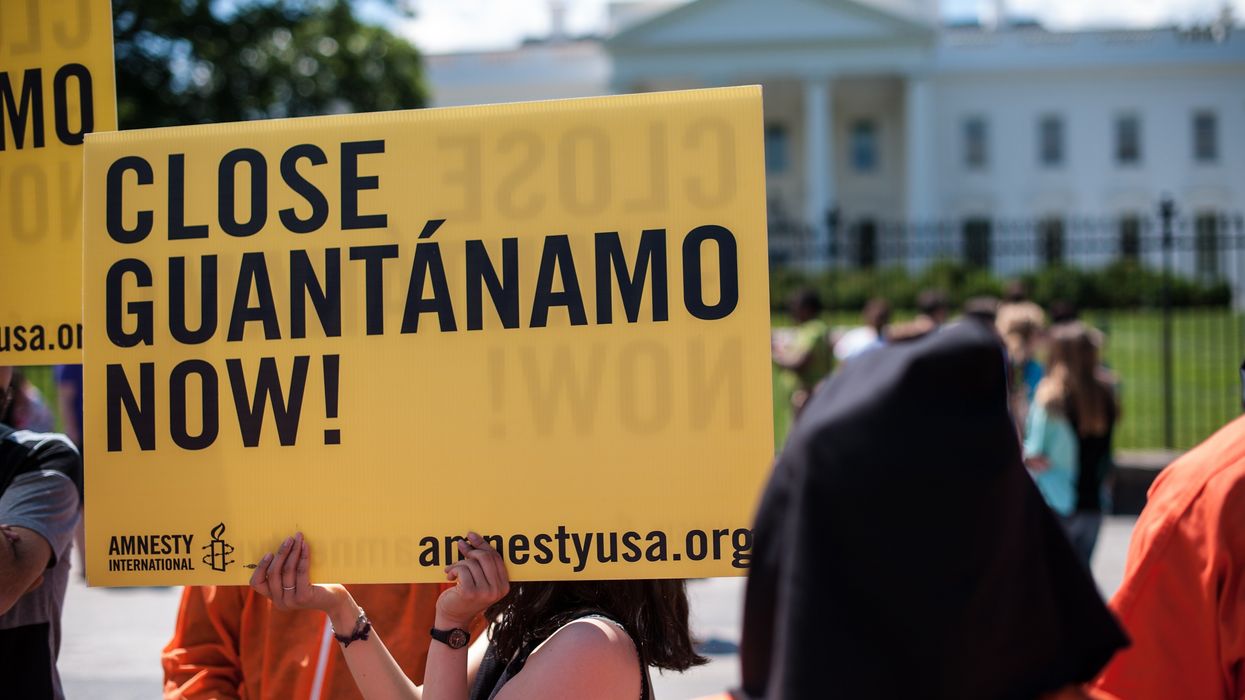
The mass deportation and detention of asylum-seekers is not only unlawful but cruel—and not a real immigration solution.
In a deeply disturbing and unprecedented move, the U.S. has begun transferring immigrant detainees to Guantánamo Bay, Cuba. They’re being held without access to their lawyers and families.
President Donald Trump has ordered up to 30,000 “high-priority” migrants to be imprisoned there as part of his larger mass deportation and detention campaign.
Trump claims these migrants are the “worst criminal aliens threatening the American people.” But recent investigations of those detainees have already challenged this narrative. And a large percentage of immigrants arrested in the U.S. have no criminal record.
We should also shut down the “War on Terror” prison at Guantánamo once and for all—and pursue accountability for its decades of abuses. Otherwise, it will only continue to expand.
Unfortunately, this isn’t the first time our government has invoked “national security” to deny marginalized communities their basic human rights. President George W. Bush created the infamous military prison at Guantánamo during the “War on Terror” to hold what his administration called the “worst of the worst.”
The prison has since become synonymous with indefinite detention—15 people still remain there today, over 20 years later. Notorious for its brutality and lawlessness, Guantánamo should be shut down, not expanded.
Of the 780 Muslim men and boys imprisoned there since January 2002, the vast majority have been held without charge or trial. Most were abducted and sold to the U.S. for bounty and “had no relationship whatsoever with the events that took place on 9/11,” reported the United Nation’s independent expert in 2023, who reiterated the global call to close Guantánamo.
The Bush administration designed the prison to circumvent the Constitution and the 1949 Geneva Conventions, refusing to treat the prisoners as either POWs or civilians. This legal fiction resulted in a range of human rights violations, including torture.
But the Constitution—and international law—still applies wherever the U.S. government operates. All prisoners, including immigrants, are still entitled to humane treatment, legal counsel, and due process.
“Never before have people been taken from U.S. soil and sent to Guantánamo, and then denied access to lawyers and the outside world,” said Lee Gelernt, the lead attorney in the ACLU case challenging Trump’s executive order.
However, the U.S. does have a sordid history of detaining migrants captured elsewhere at the base. As legal scholar Jeffrey S. Kahn points out, the U.S. has detained Haitians at Guantánamo on and off since the 1970s.
In the 1990s, thousands of Haitian refugees fleeing persecution following a military coup were captured at sea. The U.S. held them in horrific conditions at Guantánamo so they couldn’t reach U.S. shores to seek asylum—which is a fundamental human right long enshrined under U.S. law.
Shrouded in secrecy, the U.S. continues to capture and detain asylum-seekers fleeing Haiti, Cuba, and other Caribbean countries at Guantánamo. Last fall, the International Refugee Assistance Project reported that refugee families are kept in a dilapidated building with mold and sewage problems, suffer from a lack of medical care, and are “detained indefinitely in prison-like conditions without access to the outside world.”
Trump’s order would take these abuses to a horrifying new level.
Currently, the base’s existing immigration detention facility can hold up 120 people. Expanding it to 30,000 will require enormous resources. The “War on Terror” prison at Guantánamo already costs an estimated $540 million annually, making it one of the most expensive prisons in the world.
Then there are the moral costs.
The mass deportation and detention of asylum-seekers is not only unlawful but cruel—and not a real immigration solution. Instead, our government should prioritize meaningful immigration reform that recognizes the dignity of all people.
We should also shut down the “War on Terror” prison at Guantánamo once and for all—and pursue accountability for its decades of abuses. Otherwise, it will only continue to expand. “I can attest to the facility’s capacity for cruelty,” warned Mansoor Adayfi, who was subjected to torture and endured nearly 15 years at the prison.
Guantánamo’s legacy of injustice must end.
The U.S. government is using tattoos, sometimes nothing more than a name, a date, or even a tribute to a favorite athlete, as justification to label migrants as “gang-affiliated” and ship them off to Guantánamo Bay.
Imagine being forced to leave everything behind, your home, your family, your dreams, because U.S. sanctions have devastated your country’s economy, making day-to-day living increasingly unbearable. You endure a treacherous journey, risking everything for a chance at stability and to help your family back home, only to be met with handcuffs and an indefinite sentence in one of the world’s most infamous prisons.
This is the fate of many migrants, including Venezuelans, fleeing an economic war waged by U.S. policies. One of President Donald Trump’s first actions was to sign an executive order expanding the Migrant Operations Center at Guantánamo Bay to detain up to 30,000 migrants, labeling them as “criminal illegal aliens.” Following mounting legal challenges and international scrutiny, the U.S. government has now deported 177 Venezuelan migrants who were detained at the naval base.
According to U.S. officials, 126 of them had criminal charges or convictions, and 80 were accused of being part of the Tren de Aragua gang. Fifty-one had no criminal records. Human rights advocates raised concerns about the lack of transparency in the U.S. classification of detainees, especially given the cases where migrants were detained at Guantánamo based on nothing more than their tattoos.
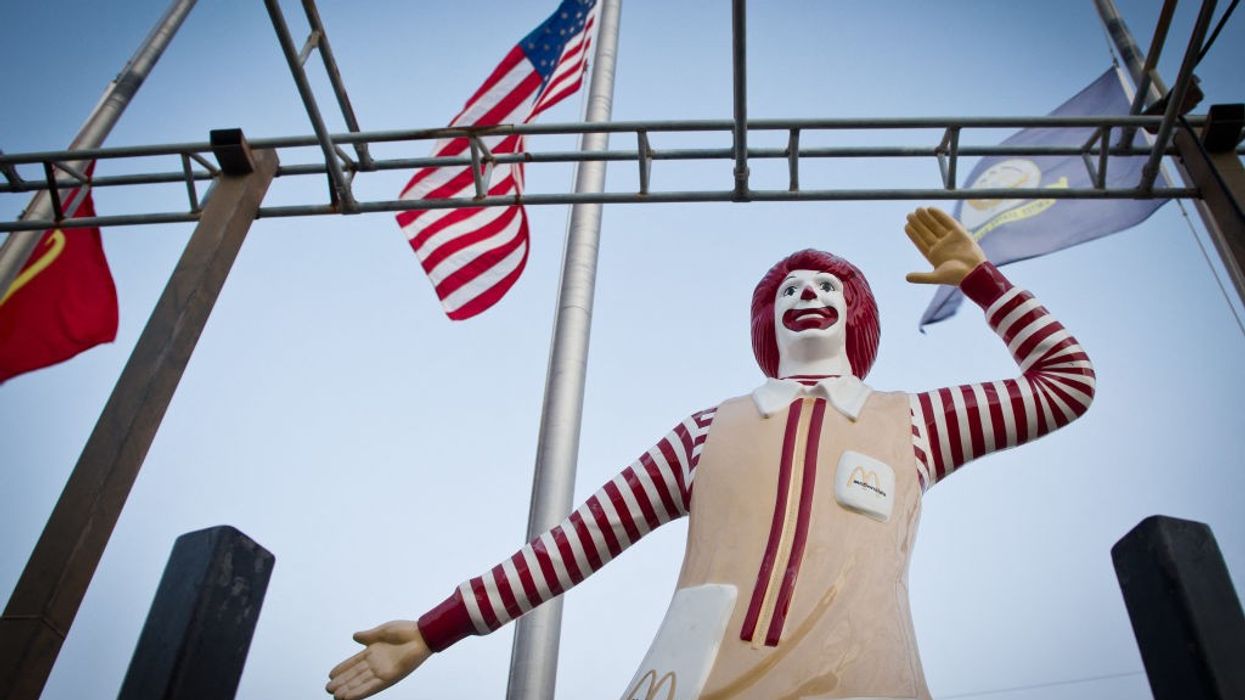
Locking up migrants on stolen land while troops sip Starbucks and grab a Big Mac isn’t security for the “homeland,” it’s a grotesque spectacle of unchecked power and horrific violation of human rights.
Yes, the U.S. government is using tattoos, sometimes nothing more than a name, a date, or even a tribute to a favorite athlete, as justification to label migrants as “gang-affiliated” and ship them off to Guantánamo Bay.
Take Luis Castillo, a 23-year-old Venezuelan asylum-seeker, who was detained at the border and later sent to Guantánamo simply because he had a Michael Jordan tattoo.
Let that sink in.
A Michael Jordan tattoo. Never mind that millions worldwide have the same logo inked on their skin or that it appears on bumper stickers, billboards, and sneakers everywhere. By this logic, half the country should be under surveillance. But when it comes to migrants, suddenly, a tattoo is a ticket to indefinite imprisonment.
Luis was detained, then abruptly sent to Guantánamo Bay on February 4, cut off from his family and legal representation. His sister, Yajaira Castillo, had been desperately trying to find out where he was, telling reporters, “He’s innocent. He just wanted a chance at life.”
Luis is not alone. Dozens of Venezuelans and other asylum-seekers have been flown to Guantánamo under vague security classifications, with no access to attorneys and no clear path to getting out of Guantanamo.
For decades, Guantánamo has been a legal black hole where the U.S. government detains people it does not want to acknowledge. It is a place built on stolen land, Cuban territory that the U.S. has occupied since 1903, against the will of the Cuban people and government.
Now, it is being repurposed yet again, this time to imprison desperate migrants, far from public scrutiny and without the legal protections guaranteed on U.S. soil.
Guantánamo is not just a prison; it’s a bizarre, dystopian military outpost where injustice coexists with American consumer culture. Just miles from where detainees are held indefinitely without trial, there is a McDonald’s, a Subway, a bowling alley, an escape room, and even a mini-golf course. The base has a recreation center, a movie theater, and a marina where troops and personnel can rent jet skis and go fishing! All within walking distance of a detention center infamous for torture.
And if that wasn’t surreal enough, the base also features a Starbucks, the only one on the island of Cuba, alongside a gift shop selling beer koozies, T-shirts, and shot glasses emblazoned with slogans like “Straight Outta GTMO” and “It Don’t GTMO Better Than This,” as if this were a quirky tourist attraction rather than a site dedicated to systemic human rights abuses.
By detaining migrants in Guantánamo, the U.S. government sidesteps legal obligations and publicity to create a system where people can be held indefinitely without due process.
The Cuban people have long demanded the closure of Guantánamo and the return of their land. Still, instead, the U.S. government continues to use it as a dumping ground for those it refuses to recognize as human beings. And in an absurd display of imperial arrogance, the U.S. still sends Cuba a check every year as “rent” for the base, money that the Cuban government refuses to cash, rejecting the illegal occupation.
Guantánamo should have been shut down long ago. Instead, it’s expanding because the U.S. government never misses an opportunity when it comes to cruelty. Locking up migrants on stolen land while troops sip Starbucks and grab a Big Mac isn’t security for the “homeland,” it’s a grotesque spectacle of unchecked power and horrific violation of human rights.
The expansion of Guantánamo Bay as a migrant detention center marks a dangerous escalation in U.S. immigration policy. Instead of addressing the root causes of migration, many driven by U.S. economic and foreign policies, the government is doubling down on militarized enforcement, turning a site infamous for human rights abuses into a holding cell for asylum-seekers.
By detaining migrants in Guantánamo, the U.S. government sidesteps legal obligations and publicity to create a system where people can be held indefinitely without due process.
Guantánamo is more than a prison. It’s a symbol of unchecked power. Today, it holds Venezuelan migrants, but tomorrow, it could hold anyone the government deems inconvenient.
Whatever the treatment of the “worst of the worst” at or near that infamous prison, now a recyclable holder for whoever is the enemy of the day, it will be hidden from public view.
President Donald Trump has made no secret of his disdain for immigrants, particularly the non-white variety from south of our border. His statements that immigrants are “poisoning the blood” of our country,” coupled with Fox News reports on Hispanic-appearing migrants who commit crimes, leave little doubt about what he and his allies think of (non-white) immigrants and their contributions to this country.
So it didn’t surprise me that he recently began to follow through on his own and his Department of Homeland Security (DHS) leadership’s earlier intentions (as far back as 2018) to detain immigrants—including unaccompanied children—at military posts. Earlier this month, the first deportation flight carried a few men from the American mainland to our naval base and Global War on Terror offshore prison site in Guantánamo Bay, Cuba. Trump’s spokesperson Karoline Leavitt referred to those migrants as “the worst criminal illegal aliens” and “the worst of the worst.” The flight apparently included members of a gang from Venezuela. Yet troops had already been ordered to ready the base in Cuba to house some 30,000 immigrants—a dramatic increase in its capacity—in military tent encampments meant to supplement existing detention facilities there.
The move is part of President Trump’s signature public policy initiative: to deport millions of immigrants living in the U.S. without clear legal status. Some 40% of those Trump deems “illegal” and has targeted for deportation actually have some sort of official permission to be here, whether because they already have temporary protected status, a scheduled date in immigration court, or refugee or asylum status.
The Trump administration isn’t planning to give the public the opportunity to critique the mistreatment of migrants deported to Guantánamo or any other military post or new detention center in an up-close-and-personal fashion.
Since none of them wear their immigration status on their shirts (thankfully!), it might prove unnerving indeed how officers from DHS will be selecting people for interrogation and detention. (It’s probably not the guy in front of you at Starbucks with a Scandinavian accent who just ordered a fancy drink.)
Everything from Ku Klux Klan flyers left in towns across the Midwest after the election to Trump’s order removing the protected status of schools, healthcare facilities, and places of worship when it comes to U.S. Immigration and Customs Enforcement (ICE) raids paints a dire picture. We haven’t seen profiling on this scale since the days after the 9/11 attacks in 2001, when the federal government ordered tens of thousands of men of Arab, Middle Eastern, and South Asian descent to register and be fingerprinted, subjecting them to increased surveillance and vigilante violence.
Since then, globally, the U.S. has detained hundreds of thousands of men (and, in some cases, boys) domestically and at that infamous prison in Guantánamo Bay, many without the ability to challenge their detentions and without the Red Cross surveillance that international law grants them.
Given the way legal standards for the treatment of people detained at federal facilities have eroded over the last two and a half decades, what may happen to tens of thousands of migrants at incarceration centers like Guantánamo in the years to come can only be a matter of grim speculation. However, one thing is clear: Whatever the treatment of the “worst of the worst” at or near that infamous prison, now a recyclable holder for whoever is the enemy of the day, it will be hidden from public view.
Such developments seem ever more real to me because my family lives about 40 miles from downtown Washington, D.C., where the Trump administration is churning out executive orders at breakneck speed. We live in a beautiful rural community in a county where about one-third of all residents are foreign-born. Those immigrant families bring cultural and linguistic richness to our schools, fuel the day-to-day operations of our many nearby military posts, run some of the most affordable supermarkets and tastiest restaurants around, and do the physically and emotionally demanding work of growing our local food. It’s hard for me to imagine how such immigrants are the worst of the worst.
Sure, some of them—like some of any other population you choose, including, of course, that convicted felon Donald Trump and crew—commit crimes. Yet rates of criminal activity among immigrants are much lower than among U.S. citizens. According to a 2020 study by the Bureau of Economic Research, immigrants are 60% less likely to be incarcerated than people born in this country.
I’m also a military spouse of more than 10 years and, in my family and community, it’s taken for granted that you’re going to be spending a lot of time with people who were born elsewhere, since immigrants of various stripes make up about 5% of our service members and are a significant part of military spouse communities as well. And believe me, many of the folks I know in those foreign-born subcategories of military communities are truly scared right now, even if for wealthier white families like mine, the suburbs and rural rolling hills around our nation’s capital offer opportunities to learn and a peacefulness that make them great places to raise kids.
That said, in the wake of President Trump’s recent orders, the landscape around me is already changing. Some children whose family members are immigrants or who themselves are foreign-born have been absent from local schools. One of my children came home upset earlier this week and has been complaining of an unsettled stomach since learning that a good friend will have to leave the country due to fear of harassment under Trump’s new policies. Nearby, a Maryland high school teacher has been placed on leave after boasting on social media that he would help ICE identify “illegals” among his students. School administrators are bracing for armed federal agents to show up, demanding access to kids.
This is the kind of mundane horror and sadness I see blooming around me these days, as the news starts to report similar developments elsewhere: the Syracuse restaurant workers who were called into an ICE office and left with ankle monitors; the Guatemalan-American father of four in Ohio who was told by an ICE agent during his annual check-in that he needs to book a flight back to the country he only remembers from his teenage years or be deported. And these are the “lucky” ones who at least have some forewarning. Others won’t and will simply be subjected to the whims of federal immigration agents like those in New York City, where a memo issued by Mayor Eric Adams informed city workers that they can allow ICE agents into municipal facilities if they “reasonably feel threatened or fear for your safety or the safety of others around you.”
I wish I could say that history has taught Americans about the human costs of war and the dangers of indifference to it.
At least, the Trump administration’s immigration policies and actions are still subject to criticism by plucky journalists and activists prepared to call out instances of abuse of executive power, racial profiling, and violations of the right to education and other human rights. Count on this, though: The Trump administration isn’t planning to give the public the opportunity to critique the mistreatment of migrants deported to Guantánamo or any other military post or new detention center in an up-close-and-personal fashion. Such areas will be closed to all but servicemembers and assigned workers.
Sometimes even military family members won’t have the special authorization to enter them. In order to get in, you’ll need to present an official ID, have a reason to enter, possibly have a military service member directly authorize your access, and abide by specific restrictions on movement and rules about whether you can photograph anything on the base. At that base in Guantánamo, restrictions are even tighter and there are no guarantees that journalists will ever have access to migrants and their living conditions there.
President Trump has undoubtedly chosen the U.S. military base at Guantánamo, Cuba not just because it has so much detention space or, in past times, was used to detain Haitian and other immigrants, but at least in part because the prison there that held so many tortured prisoners from this country’s war on terror is well known to rights groups and the general public as a nightmarish facility. A 2014 Senate report, along with numerous investigations by human rights groups, found that terror suspects, including in some cases boys, at that base had often been denied due process, detained indefinitely without charge, and subjected to inhumane or degrading treatment.
It’s a fact that people do poorly living in conditions of isolation from the rest of society. Our own military is a case in point. In the decades since fewer of us began to serve, thanks to the absence of a draft (even as the military budget ballooned), Americans generally know far less about what our military is like and what it does. In these same years, suicide rates among servicemembers and veterans have surpassed civilian rates, while violent crime and accidents have grown more common following post-9/11 deployments. Such problems are due, at least in part, to a culture of silence and isolation among military families, as well as a lack of access to military bases by journalists and the public. What we can’t know about or see, we naturally care so much less about.
Other examples of isolated populations, ranging from those in nursing homes during the Covid-19 pandemic (where there were staggering death rates) to closed mental institutions, remind us that isolation begets a lack of public accountability, indifference, and greater human pain.
Of course, the federal government has also had a deadly history of isolating people for national security reasons—from Indian reservations to the internment of Japanese- and German-Americans on military installations during World War II. Things have never ended well for such groups.
As our country’s next wave of abuse toward supposedly dangerous “others” begins, it’s possible to pay attention. Yet when I go out into my community and speak with neighbors, other parents, friends, and acquaintances, I’m reminded of how easy it is to do nothing in the face of what’s happening around us. When I urge people to write their representatives about the treatment of immigrants, they all too often look away and don’t respond, or say they’re afraid of violent retribution if they post a yard sign on their lawns about how “everyone is welcome here.” And I can’t blame them. After all, you bring kids into this world and your first loyalty is to their safety. By the same token, ignoring signals of growing authoritarianism in the interest of peace and continuity has its obvious problems.
In my area, populated by many federal employees recently ordered to return to full-time in-person work, daily life will soon be overflowing (with little room for anything else). Residents will commute two-plus hours each way to crowded office buildings in D.C. so that voters in red states can be happy. Possibly the only ones among us who will have no choice but to pay attention to what happens in their own backyards are those who have already lost their jobs; activists at local NGOs serving immigrants and other vulnerable groups; and schoolchildren who, by necessity, see the horrors of this administration through the eyes of their vulnerable friends and parents.
For us adults, especially parents occupied with the care of our children, I’m reminded of how easy it is to ignore or forget what happens right in our own backyards. Recently, I read a New York Times article about a house in Poland on the edge of what used to be the Nazi death camp of Auschwitz, where its wartime commandant once lived. It overlooks a former gallows and the gas chambers where more than a million civilians were murdered, even as many Poles then carried on with their daily lives. A widow who brought up two kids there in the post-war years called the house “a great place to raise children.”
I wish I could say that history has taught Americans about the human costs of war and the dangers of indifference to it. Yet, around here at least, as Donald Trump and his administration scapegoat immigrants to distract from the impunity of their own actions (particularly those of Elon Musk, perhaps the most prominent immigrant ever to work here “without a legal basis to remain in the United States”), the silence is deafening. It seems to matter not at all that the infamous all-American prison in Cuba from this country’s grim war on terror has now become the “homeland” for a new nightmare (and a half).