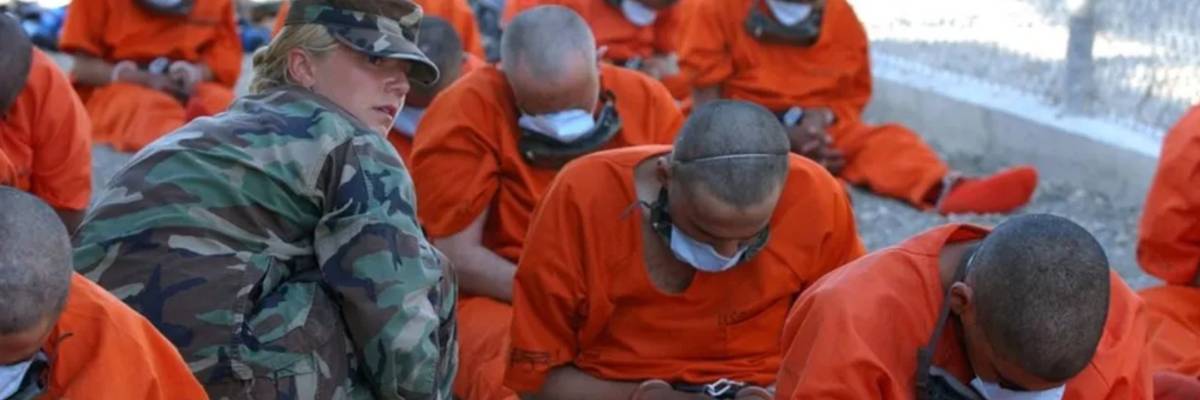
A U.S. servicewoman gives water to newly arrived prisoners at Camp X-Ray, Guantánamo Bay, Cuba on February 12, 2002.
'Corrupt and Rigged': 9/11 Defense Lawyer Say Austin Broke Rules by Blocking Plea Deals
"We have had an unprecedented act by a government official to pull back what was a valid agreement," said an attorney representing tortured 9/11 suspects imprisoned at Guantánamo Bay.
Attorneys representing alleged 9/11 planners imprisoned at Guantánamo Bay argued Wednesday that U.S. Defense Secretary Lloyd Austin's move to block plea deals for three defendants violated Pentagon rules and belied the corruption of the military commission system established during the George W. Bush administration.
"We have had an unprecedented act by a government official to pull back what was a valid agreement," Walter Ruiz, who represents defendant Mustafa al-Hawsawi, said at a hearing at Guantánamo, according to CNN.
"For us, it raises very serious questions about continuing to engage in a system that seems so obviously corrupt and rigged," Ruiz added.
Last week, the Department of Defense announced that Brig. Gen. Susan Escallier, the convening authority for the Guantánamo military commissions, "has entered into pretrial agreements" with al-Hawsawi, alleged 9/11 mastermind Khalid Sheikh Mohammed, and Walid bin Attash.
The long-anticipated agreement—under which the three men would be spared execution by pleading guilty—came amid years of stalled legal proceedings in a case complicated by the U.S.' torture of the defendants and government efforts to cover it up.
While welcomed by advocates of closing the prison and some victims' families, Escallier's move also sparked a firestorm of criticism from numerous U.S. lawmakers, 9/11 first responders, and victims' relatives.
Last Friday, Austin withdrew the plea agreements. Speaking at a press conference on Tuesday, he explained that he has "long believed that the families of the victims, our service members, and the American public deserves the opportunity to see military commission trials carried out in his case."
"I'm deeply mindful of my duty to all those whose lives were lost or changed forever on 9/11, and I fully understand that no measure of justice can ever make up for their loss," Austin added. "So this wasn't a decision that I took lightly."
Eugene Fidell, a military law professor at Yale University and co-founder of the National Institute of Military Justice, told CNN that Austin's move "was illegal."
According to the network:
One of the primary issues pointed to on Wednesday by defense counsel was a regulation laid out in the military's Manual for Military Commissions, which says the convening authority can withdraw a pretrial agreement before the accused begins "performance of promises" or if the accused does not hold up their end of the deal. Gary Sowards, a defense attorney for Mohammad, said in court that Austin did not have authority under that regulation because his client had "begun very important, substantive, specific performance.'"
Sowards acknowledged that motions for discovery on the issue of potential unlawful influence by Austin, which would "seek to explore how he was coerced and influenced," could take a year or two to litigate. But the issue of the Manual for Military Commissions regulation is "a simple reading of about 12 lines of text," he said, and a decision on it should be able to be expedited.
Prosecutor Clayton Trivett Jr. told the commission Wednesday that the government needed to "work through the issues raised in these motions" so that the prosecution's position can be "fully articulated."
Sowards retorted, "'We want to consult with people'—that sounds like, 'We want to get our stories together.'"
Some legal experts doubted whether the government would ever be able to try, let alone convict, the 9/11 suspects. Military judges and prosecutors have cited defendants' torture in declining to proceed with cases against them. Many men and boys were tortured at CIA "black sites," Guantánamo, and military prisons including Abu Ghraib. At least dozens of detainees died.
Wells Dixon, a lawyer with the Center for Constitutional Rights who represented convicted terrorist Majid Khan, told CNN that the prosecution's unwillingness "to allow evidence about the defendants' torture and abuse to be aired in court" will make it extremely difficult to secure death sentences for the men.
"If Secretary Austin says that a 9/11 case is going to proceed to trial, and a verdict, and possibly a sentencing, then he is either hopelessly ill-informed or is lying to victims' family members," he added.
Accusations of military commission corruption go back decades.
In 2004, three military prosecutors—Maj. Robert Preston, Capt. John Carr, and Capt. Carrie Wolf—requested transfers from the commissions after concluding they were rigged.
"They were told by the chief prosecutor at the time that they didn't need evidence to get convictions," Clive Stafford Smith, an attorney who represented more than 70 Guantánamo detainees, told The Nation in 2008.
That year, former Guantánamo chief prosecutor Col. Morris Davis said that then-Pentagon General Counsel William Haynes told him that "we can't have acquittals."
Atlantic staff writer Graeme Wood asserted this week that "there is a way to clean up this mess."
"Now that Austin has assumed the power of the convening authority, he can restore the agreement he tore up on Friday—to reverse the reversal and bring these sordid proceedings to the end they were until recently already destined for," he wrote. "If he instead wants to extend the life of the commissions, slouching toward a trial that will never happen, then the pointless sacrifice of money and time will continue."
"For the families in search of finality, each minute of delay is a minute stolen, and for the defendants, each is a minute gained," Wood added. "The defendants have already cheated the hangman. The best way to end their run is to take that bitter deal, and bring these commissions to a well-deserved end."
We are at a crossroads
This country and this world are at a monumental crossroads. In a few short weeks, US voters will have an opportunity to beat back the forces of fascism and confront the billionaires who are rigging the economy, our media system, and our democracy, making it increasingly impossible for ordinary people to get by. We’re not just talking about the election. We’re talking about what must be done once these fascist elements are vanquished from power. We need a bolder set of solutions than what either major party has so far been willing to offer and a working-class movement ready to fight like hell for it. Trump didn't emerge from nowhere. The conditions that fueled MAGA authoritarianism were created by decades of radical neoliberal economic policies and a corrupt political system dominated by corporate interests. They slashed taxes on the super-rich, promising that the benefits would trickle down. They said giveaways to the corporate titans would make life more affordable for the rest of us. It was all bullshit. And when a bitter, betrayed populace searches for someone to blame, right-wing demagogues have little trouble finding scapegoats. People know when they're being lied to, but you won't hear any of this from the corporate media. Only independent journalism—powered and funded by people who believe in building a better world—can deliver truly trustworthy daily news. Our Fall Campaign is underway, and we need your help. To power our newsroom through the rest of the year, we need to raise $125,000 by midnight on October 31. So if you share our vision, please contribute whatever you can to sustain our work. |
Attorneys representing alleged 9/11 planners imprisoned at Guantánamo Bay argued Wednesday that U.S. Defense Secretary Lloyd Austin's move to block plea deals for three defendants violated Pentagon rules and belied the corruption of the military commission system established during the George W. Bush administration.
"We have had an unprecedented act by a government official to pull back what was a valid agreement," Walter Ruiz, who represents defendant Mustafa al-Hawsawi, said at a hearing at Guantánamo, according to CNN.
"For us, it raises very serious questions about continuing to engage in a system that seems so obviously corrupt and rigged," Ruiz added.
Last week, the Department of Defense announced that Brig. Gen. Susan Escallier, the convening authority for the Guantánamo military commissions, "has entered into pretrial agreements" with al-Hawsawi, alleged 9/11 mastermind Khalid Sheikh Mohammed, and Walid bin Attash.
The long-anticipated agreement—under which the three men would be spared execution by pleading guilty—came amid years of stalled legal proceedings in a case complicated by the U.S.' torture of the defendants and government efforts to cover it up.
While welcomed by advocates of closing the prison and some victims' families, Escallier's move also sparked a firestorm of criticism from numerous U.S. lawmakers, 9/11 first responders, and victims' relatives.
Last Friday, Austin withdrew the plea agreements. Speaking at a press conference on Tuesday, he explained that he has "long believed that the families of the victims, our service members, and the American public deserves the opportunity to see military commission trials carried out in his case."
"I'm deeply mindful of my duty to all those whose lives were lost or changed forever on 9/11, and I fully understand that no measure of justice can ever make up for their loss," Austin added. "So this wasn't a decision that I took lightly."
Eugene Fidell, a military law professor at Yale University and co-founder of the National Institute of Military Justice, told CNN that Austin's move "was illegal."
According to the network:
One of the primary issues pointed to on Wednesday by defense counsel was a regulation laid out in the military's Manual for Military Commissions, which says the convening authority can withdraw a pretrial agreement before the accused begins "performance of promises" or if the accused does not hold up their end of the deal. Gary Sowards, a defense attorney for Mohammad, said in court that Austin did not have authority under that regulation because his client had "begun very important, substantive, specific performance.'"
Sowards acknowledged that motions for discovery on the issue of potential unlawful influence by Austin, which would "seek to explore how he was coerced and influenced," could take a year or two to litigate. But the issue of the Manual for Military Commissions regulation is "a simple reading of about 12 lines of text," he said, and a decision on it should be able to be expedited.
Prosecutor Clayton Trivett Jr. told the commission Wednesday that the government needed to "work through the issues raised in these motions" so that the prosecution's position can be "fully articulated."
Sowards retorted, "'We want to consult with people'—that sounds like, 'We want to get our stories together.'"
Some legal experts doubted whether the government would ever be able to try, let alone convict, the 9/11 suspects. Military judges and prosecutors have cited defendants' torture in declining to proceed with cases against them. Many men and boys were tortured at CIA "black sites," Guantánamo, and military prisons including Abu Ghraib. At least dozens of detainees died.
Wells Dixon, a lawyer with the Center for Constitutional Rights who represented convicted terrorist Majid Khan, told CNN that the prosecution's unwillingness "to allow evidence about the defendants' torture and abuse to be aired in court" will make it extremely difficult to secure death sentences for the men.
"If Secretary Austin says that a 9/11 case is going to proceed to trial, and a verdict, and possibly a sentencing, then he is either hopelessly ill-informed or is lying to victims' family members," he added.
Accusations of military commission corruption go back decades.
In 2004, three military prosecutors—Maj. Robert Preston, Capt. John Carr, and Capt. Carrie Wolf—requested transfers from the commissions after concluding they were rigged.
"They were told by the chief prosecutor at the time that they didn't need evidence to get convictions," Clive Stafford Smith, an attorney who represented more than 70 Guantánamo detainees, told The Nation in 2008.
That year, former Guantánamo chief prosecutor Col. Morris Davis said that then-Pentagon General Counsel William Haynes told him that "we can't have acquittals."
Atlantic staff writer Graeme Wood asserted this week that "there is a way to clean up this mess."
"Now that Austin has assumed the power of the convening authority, he can restore the agreement he tore up on Friday—to reverse the reversal and bring these sordid proceedings to the end they were until recently already destined for," he wrote. "If he instead wants to extend the life of the commissions, slouching toward a trial that will never happen, then the pointless sacrifice of money and time will continue."
"For the families in search of finality, each minute of delay is a minute stolen, and for the defendants, each is a minute gained," Wood added. "The defendants have already cheated the hangman. The best way to end their run is to take that bitter deal, and bring these commissions to a well-deserved end."
Attorneys representing alleged 9/11 planners imprisoned at Guantánamo Bay argued Wednesday that U.S. Defense Secretary Lloyd Austin's move to block plea deals for three defendants violated Pentagon rules and belied the corruption of the military commission system established during the George W. Bush administration.
"We have had an unprecedented act by a government official to pull back what was a valid agreement," Walter Ruiz, who represents defendant Mustafa al-Hawsawi, said at a hearing at Guantánamo, according to CNN.
"For us, it raises very serious questions about continuing to engage in a system that seems so obviously corrupt and rigged," Ruiz added.
Last week, the Department of Defense announced that Brig. Gen. Susan Escallier, the convening authority for the Guantánamo military commissions, "has entered into pretrial agreements" with al-Hawsawi, alleged 9/11 mastermind Khalid Sheikh Mohammed, and Walid bin Attash.
The long-anticipated agreement—under which the three men would be spared execution by pleading guilty—came amid years of stalled legal proceedings in a case complicated by the U.S.' torture of the defendants and government efforts to cover it up.
While welcomed by advocates of closing the prison and some victims' families, Escallier's move also sparked a firestorm of criticism from numerous U.S. lawmakers, 9/11 first responders, and victims' relatives.
Last Friday, Austin withdrew the plea agreements. Speaking at a press conference on Tuesday, he explained that he has "long believed that the families of the victims, our service members, and the American public deserves the opportunity to see military commission trials carried out in his case."
"I'm deeply mindful of my duty to all those whose lives were lost or changed forever on 9/11, and I fully understand that no measure of justice can ever make up for their loss," Austin added. "So this wasn't a decision that I took lightly."
Eugene Fidell, a military law professor at Yale University and co-founder of the National Institute of Military Justice, told CNN that Austin's move "was illegal."
According to the network:
One of the primary issues pointed to on Wednesday by defense counsel was a regulation laid out in the military's Manual for Military Commissions, which says the convening authority can withdraw a pretrial agreement before the accused begins "performance of promises" or if the accused does not hold up their end of the deal. Gary Sowards, a defense attorney for Mohammad, said in court that Austin did not have authority under that regulation because his client had "begun very important, substantive, specific performance.'"
Sowards acknowledged that motions for discovery on the issue of potential unlawful influence by Austin, which would "seek to explore how he was coerced and influenced," could take a year or two to litigate. But the issue of the Manual for Military Commissions regulation is "a simple reading of about 12 lines of text," he said, and a decision on it should be able to be expedited.
Prosecutor Clayton Trivett Jr. told the commission Wednesday that the government needed to "work through the issues raised in these motions" so that the prosecution's position can be "fully articulated."
Sowards retorted, "'We want to consult with people'—that sounds like, 'We want to get our stories together.'"
Some legal experts doubted whether the government would ever be able to try, let alone convict, the 9/11 suspects. Military judges and prosecutors have cited defendants' torture in declining to proceed with cases against them. Many men and boys were tortured at CIA "black sites," Guantánamo, and military prisons including Abu Ghraib. At least dozens of detainees died.
Wells Dixon, a lawyer with the Center for Constitutional Rights who represented convicted terrorist Majid Khan, told CNN that the prosecution's unwillingness "to allow evidence about the defendants' torture and abuse to be aired in court" will make it extremely difficult to secure death sentences for the men.
"If Secretary Austin says that a 9/11 case is going to proceed to trial, and a verdict, and possibly a sentencing, then he is either hopelessly ill-informed or is lying to victims' family members," he added.
Accusations of military commission corruption go back decades.
In 2004, three military prosecutors—Maj. Robert Preston, Capt. John Carr, and Capt. Carrie Wolf—requested transfers from the commissions after concluding they were rigged.
"They were told by the chief prosecutor at the time that they didn't need evidence to get convictions," Clive Stafford Smith, an attorney who represented more than 70 Guantánamo detainees, told The Nation in 2008.
That year, former Guantánamo chief prosecutor Col. Morris Davis said that then-Pentagon General Counsel William Haynes told him that "we can't have acquittals."
Atlantic staff writer Graeme Wood asserted this week that "there is a way to clean up this mess."
"Now that Austin has assumed the power of the convening authority, he can restore the agreement he tore up on Friday—to reverse the reversal and bring these sordid proceedings to the end they were until recently already destined for," he wrote. "If he instead wants to extend the life of the commissions, slouching toward a trial that will never happen, then the pointless sacrifice of money and time will continue."
"For the families in search of finality, each minute of delay is a minute stolen, and for the defendants, each is a minute gained," Wood added. "The defendants have already cheated the hangman. The best way to end their run is to take that bitter deal, and bring these commissions to a well-deserved end."