

SUBSCRIBE TO OUR FREE NEWSLETTER
Daily news & progressive opinion—funded by the people, not the corporations—delivered straight to your inbox.
5
#000000
#FFFFFF
To donate by check, phone, or other method, see our More Ways to Give page.
Daily news & progressive opinion—funded by the people, not the corporations—delivered straight to your inbox.
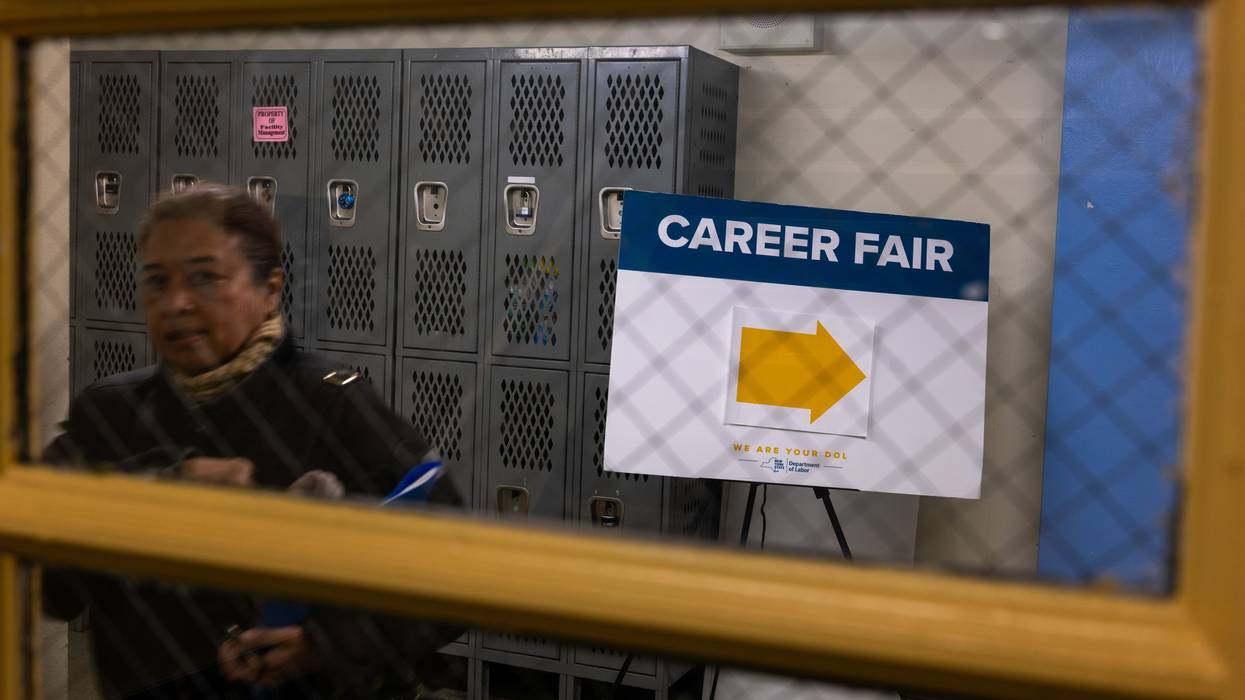
"It’s a stalled economy—and working families are stuck in it," said one economist.
A Friday report from the US Bureau of Labor Statistics showed that the American job market is running on fumes.
According to the BLS, the US economy added just 29,000 jobs in September, which was well below economists' forecasts of 90,000 jobs added on the month.
Additionally, employment numbers for previous months were revised downward by a total of 60,000 jobs, and BLS now estimates that the economy posted a net loss of 10,000 jobs in July and a net gain of 133,000 jobs in August.
In a Friday social media post, economist Bill McBride noted that the economy over the last year has only created 496,000 jobs, which averages to roughly 41,000 jobs per month. For comparison, the economy created an average of 186,000 jobs per month in the last year of former President Joe Biden's term.
Heather Long, chief economist at Navy Federal Credit Union, called the latest jobs numbers "mediocre," and pointed out that wage growth in September posted just a 3% yearly gain.
"That’s a new five-year low," Long remarked, "and it’s wiped out entirely by ~3.4% inflation."
Tahra Hoops, director of economic analysis at Chamber of Progress, also pointed to wage growth failing to keep up with inflation, which she said "gives credibility to the negative consumer sentiment" expressed in recent surveys.
Kyle Moore, chief economist at The Century Foundation, said that the weak wage growth on the month doesn't tell the full story of the stresses working-class Americans are facing because the numbers "leave out debt, all the bills families have to pay before they can spend any of their paycheck."
"A worker with debt often can’t afford to miss a paycheck, and therefore can’t afford to quit a bad job or push for a raise," Moore explained. "That is exactly what we see in today’s job market, with hiring stalled, the quit rate stuck at 1.9%, and wage growth falling as prices climb. Mounting debt, sluggish hiring and real wage growth, and weak social support all disempower workers."
Moore criticized President Donald Trump and his administration for trying to spin their economic policies as successes given the current numbers.
"Until the Trump administration confronts the reality that debt is eating into workers’ gains—wage gains that are now non-existent, in real terms, for the typical worker," said Moore, "the gulf between how this administration spins the economy and how working families actually experience it will continue to widen."
White House National Economic Council Director Kevin Hassett didn't heed Moore's advice on this matter, and continued boasting about the state of the economy during a Friday interview.
"If you look at the data from this week, it's proving that Trumponomics is really working," said Hassett, "and this is one reason why markets are celebrating so much."
Kevin Hassett responds to a bad September jobs report: "If you look at the data from this week, it's proving that Trumponomics is really working ... we're very very happy"
The Fox News host responds by saying "you're bullish and I expected that" pic.twitter.com/bVdTFnteHc
— Aaron Rupar (@atrupar) October 2, 2026
Breyon Williams, chief economist at Groundwork Collaborative, called the weak jobs report emblematic of how the economy as a whole has performed during Trump's second term.
"There’s a clear pattern in the Trump economy," Williams explained. "One sector is creating most of the new jobs, unemployed workers can’t find new jobs, and Americans are seeing their paychecks eaten up by the president’s high prices. When businesses are barely hiring and raises aren’t keeping up with rising prices, it’s a stalled economy—and working families are stuck in it."

"However the White House tries to spin these numbers, their talking points ring hollow for people who are actually experiencing Trump’s weak economy."
Federal data released Friday shows the US economy shed 23,000 jobs last month, but one analyst said that figure was "only the beginning of the bad news" for the country's job market under the leadership of President Donald Trump.
"This is a bleak jobs report," said Heather Long, the chief economist at Navy Federal Credit Union, noting that the unemployment rate fell slightly in July—but primarily because more people left the labor force—and year-over-year hourly wage growth slowed to 3.2%, not keeping up with inflation.
Breyon Williams, the Groundwork Collaborative's top economist, said in response to the new Labor Department numbers that "regardless of having a job or not, everyone is paying high prices from Trump’s chaotic tariffs and war with Iran."
"Today’s report shows a patchwork economy that is fraying at the seams," said Williams. "Trump’s economic mismanagement has injected so much uncertainty into the economy that employers are not confident enough to add more people, but also have not initiated massive layoffs, creating a frozen job market where those with jobs are afraid to leave them and those without are stuck on the sidelines."
Rep. Pramila Jayapal (D-Wash.) wrote on social media that "Trump is tanking the US economy."
In addition to the loss of 23,000 jobs last month—far worse than forecasters' expectation of an increase of 80,000 jobs—the Bureau of Labor Statistics (BLS) revised job growth downward for both May and June. BLS said job growth in May was actually 20,000 (down from the earlier estimate of 57,000), and job growth in June was 63,000 (down from 129,000). The healthcare sector has accounted for a disproportionate share of US employment growth this year.
"This economy is running on fumes," said Angela Hanks, a former Labor Department official who now works as chief of policy programs at The Century Foundation. "However the White House tries to spin these numbers, their talking points ring hollow for people who are actually experiencing Trump’s weak economy."
White House spin efforts began almost immediately after the release of the new figures.
Kevin Hassett, director of the National Economic Council, claimed during a Fox Business appearance that the dismal job numbers were a testament to the success of Trump's mass deportation campaign, even though the largest job losses in July occurred in state and local government.
"Because we have a tight border and because we've been deporting folks who aren't citizens, then that puts downward pressure on what the sort of breakeven job number is," said Hassett.
Speaking to reporters outside the White House, Hassett also blamed the "end of the World Cup," which "meant that a lot of hospitality workers were then laid off."
Kevin Hassett thinks Americans are very very stupid. This spin is ridiculous, transparent BS. pic.twitter.com/h0qX7c8fbI
— Aaron Rupar (@atrupar) August 7, 2026
"Is this the ‘Golden Age’ that Donald Trump and JD Vance keep talking about?" asked Kendall Witmer, the Democratic National Committee's rapid response director, following publication of the BLS report. "Trump’s disastrous economic agenda has caused irreparable damage to the job market, as layoffs mount and it’s nearly impossible to find a job."
"Working families are already drowning under the weight of skyrocketing costs on everyday goods like groceries, gas, and healthcare, and their paychecks aren’t keeping up," said Witmer. "Americans are barely keeping their heads above water—and Trump can’t even be bothered to care."
"The disdain this administration has for the very people living in rural America who helped bring it to power is staggering," wrote one critic.
National Economic Council Director Kevin Hassett on Friday drew sharp criticism after he claimed that energy-devouring artificial intelligence data centers are "good for towns" across the US.
During an appearance on Fox Business, Hassett made the case that Americans should welcome data centers into their communities because they would supposedly deliver real economic benefits.
"Data centers are very good for towns, because they create so many jobs and bring people in with high incomes that can buy houses and stuff like that," said Hassett. "So if you take a sleepy town that hasn't seen much in the last 20, 30 years and put a data center there, there are gonna be a whole bunch of happy residents in that town."
Hassett: "Data centers are very good for towns, because they create so many jobs and bring people in with high incomes that can buy houses and stuff like that. So if you take a sleepy town that hasn't seen much in the last 30 years and put a data center there, there are gonna be… pic.twitter.com/K1gymIK2Bw
— Aaron Rupar (@atrupar) July 31, 2026
A March Gallup poll found that 71% of Americans were opposed to building AI data centers in their local areas, with 48% registering strong opposition.
In the poll, many Americans cited concerns about data centers' uses of local water and electricity resources as their primary reason for opposition, as well as general concerns about their impact on the environment and the local quality of life.
Additionally, data centers have not proven to be a significant source of job creation in communities where they are built because their systems are so automated that they require very little staff to maintain.
Trump administration critics were quick to slam Hassett for peddling such outright falsehoods about data centers.
"Every single thing he says here is a lie," remarked Ben Collins, CEO of the satirical news website The Onion. "A Potemkin Village Imaginarium."
Jeffrey Vagle, professor at the Georgia State University College of Law, similarly saw little connection between Hassett's description of data centers and reality.
"Has Hassett ever been inside a data center?" Vagle asked. "He should do so then put together an employee per square foot analysis to compare with other businesses. Data centers are largely automated, operating with very few actual employees, none of them executives."
Vagle's analysis was echoed by journalist Philip Bump, who wondered "what high-paying long-term jobs do they pretend exist" when AI data centers move in.
"A data center isn't a place where execs come and do Big Deals," Bump explained. "Go to the server room at your workplace; are there lots of rich people in there spending money?"
Democratic pollster Stephen Clermont sarcastically encouraged Hassett to speak more about the purported virtues of data centers.
"The White House needs to keep with this messaging and keep using Hassett as a surrogate," Clermont wrote. "The Forgotten Man will be forgotten no more in the data center utopia."
Liberal Fox News personality Jessica Tarlov similarly argued that Hassett's happy talk about data centers could be good for Democrats.
"Take the opening Democrats!" she wrote. "Americans hate data centers. The utility bills. The noise. The pollution."
Glenn Elliott, former Democratic US Senate candidate in West Virginia, argued Hassett's pitch for data centers showed what the Trump administration really thinks of its core voting base.
"The disdain this administration has for the very people living in rural America who helped bring it to power is staggering," Elliott wrote.
Multiple consumer surveys have shown that Americans have never been more pessimistic about the state of the economy.
For the second time in a month, National Economic Council Director Kevin Hassett on Tuesday claimed that Americans spending more money on gasoline and other goods is a sign of strength for the US economy—rather than evidence of the Trump administration's inflationary policy decisions.
During an interview with Fox Business, Hassett tried to counter recent data showing US consumer sentiment hitting all-time lows during President Donald Trump's second term.
"The thing that I've seen when I look at credit card data," Hassett said, "is that while people have been spending more money at gas stations, they've been spending more money on everything else, which means that they're still very, very optimistic about the state of the economy, and they should be."
Hassett: "The thing I've seen is that while people have been spending more money at gas stations, they've been spending more money on everything else, which means they're still very very optimistic about the state of the economy"
(Consumer sentiment is actually at an all time… pic.twitter.com/oyWfsCGy8O
— Aaron Rupar (@atrupar) May 26, 2026
In fact, multiple consumer surveys have shown that Americans have never been more pessimistic about the state of the economy.
Last week, the University of Michigan's latest Surveys of Consumers showed consumer sentiment hitting the lowest level ever, driven primarily by concerns about the cost of living.
Gallup last week published new data showing that Americans’ economic confidence has fallen to its lowest level since October 2022, with just 16% of Americans rating the economy as excellent or good, and nearly half describing it as poor.
Fox Business host Maria Bartiromo asked Hassett about these surveys, and he said they should be dismissed because they only show negative sentiment from Democrats and independents, who combined make up the majority of US voters.
"They call it 'consumer sentiment' but I don't think those words mean what they think they mean anymore," Hassett said. "We find that basically the consumer sentiment indicator at the University of Michigan, it's just a political survey. And in fact, what the correlation between what Democrats say and what independents say... it's almost exactly perfectly correlated."
BARTIROMO: Consumer sentiment is a record low. What's the most important messaging you can put out there to help sentiment?
HASSETT: They call it 'consumer sentiment' but I don't think those words mean what they think they mean anymore. The correlation between what independents… pic.twitter.com/kAM3JyWUjD
— Aaron Rupar (@atrupar) May 26, 2026
In fact, consumer sentiment surveys taken during President Joe Biden's administration showed that independents joined with Republican voters to rate the economy significantly more poorly than Democratic voters, indicating that independents' views of the economy are not in lockstep with Democrats'.
Polling averages calculated by elections analyst Nate Silver currently show Trump's approval rating on his handling to the economy to be just 34%, with disapproval standing at 63%.
The numbers are even worse when it comes to the president's handling of inflation, where an average of 28% of Americans approve and 69% disapprove.
"Is this supposed to be a brag?" said Democratic US Rep. Mark Pocan.
National Economic Council Director Kevin Hassett on Wednesday tried to put a rosy spin on President Donald Trump's economy by highlighting the large credit card bills being racked up by US consumers.
During an interview on Fox Business, Hassett cited credit card spending as a purported sign of strength in the economy as a whole.
"I had the head of one of the Big Five banks in my office yesterday, going through credit card data," he said. "Credit card spending is through the roof! They're spending more on gasoline, but they're spending more on everything else too."
Hassett on American consumers: "Credit card spending is through the roof. They're spending more on gasoline, but they're spending more on everything else too." pic.twitter.com/zayCSaxhwr
— Aaron Rupar (@atrupar) May 6, 2026
The price of oil has been surging since Trump launched an illegal war with Iran in late February, and on Wednesday the average price for a gallon of gasoline in the US topped $4.50, a high not seen since 2022 in the wake of Russia's invasion of Ukraine.
As the Iran crisis persists, economists project that the price of energy will be reflected in increases in other consumer goods, most notably food.
Given this, many critics were astonished that Hassett decided to brag about consumer credit card spending as a way to reassure Americans concerned about the economy.
"Working-class Americans are maxing out their credit cards to pay for groceries and gas," wrote House Minority Leader Hakeem Jeffries (D-NY). "The Trump Cartel thinks this is something to celebrate. Shameful."
Hassett's claims about credit card spending also earned a swift rebuke from Warren Gunnels, staff director for Sen. Bernie Sanders (I-Vt.).
"Americans are putting more stuff on credit cards because they don’t have enough money to pay for the skyrocketing cost of virtually everything," Gunnels wrote. "Trump promised to put a 10% cap on credit card interest rates. Instead, the average credit card interest rate today is 22%. Obscene."
Fred Wellman, a Democratic candidate for the US House of Representatives in Missouri, could not hide his disgust at Hassett's performance.
"He’s smiling," Wellman observed. "He's celebrating that we are all maxing out our credit cards because they have torched the economy. He’s not smiling for working people. He’s happy for the corporations and billionaires. It's good for them. We can all die poor. This is why I'm running for Congress."
Rep. Mark Pocan (D-Wis.) expressed bewilderment at Hassett's argument.
"Is this supposed to be a brag?" Pocan asked.
Jon Favreau, former speechwriter for President Barack Obama and current co-host of Pod Save America, found Hassett's messaging so tone-deaf that "we must consider the possibility that Kevin Hassett is secretly working for the Democrats."
The Democratic House Majority Political Action Committee had a response similar to Favreau's, recommending that the GOP make Hassett "the spokesperson for the entire Republican Party."
"Everybody is hurt by what he's celebrating," one public employee union official told Common Dreams. "I guess it's just par for the course from this administration, but it's still a disgusting thing to hear."
President Donald Trump's top economic adviser boasted on Fox Business Thursday that the government had slashed more than 300,000 "high-paying" jobs from the federal payroll during the president's first year back in office.
Asked by anchor Maria Bartiromo about the administration's efforts to cut government spending, National Economic Council Director Kevin Hassett said it had made "a huge amount of progress."
"I think the biggest thing that we can point to is that we've cut government employment by 300,000 workers," he said. "Those are jobs that are very high-paying that are gone forever."
He claimed the cuts reduced government spending by "an unthinkable amount of money," perhaps $1 trillion over the next ten years.
He also said that the administration "reduced the deficit last year by $600 billion" through a combination of higher-than-expected economic growth, tariff revenues, and "supply side effects" of Trump's massive tax cut, which mostly benefited the wealthiest Americans while gutting the social safety net.
Dean Baker, a longtime collaborator of Hassett’s despite their opposing political beliefs, wrote on social media that Trump’s economic adviser was dramatically exaggerating the deficit reduction that occurred during the administration's first year.
According to the Congressional Budget Office (CBO), the deficit was about $1.8 trillion for fiscal year 2025, just $41 billion less than the previous year and $56 billion lower than the $1.9 trillion deficit CBO projected in its most recent baseline.
"In the real world, the deficit fell... less than one-tenth of what Kevin claims," Baker said.
Trump has touted the layoffs of hundreds of thousands of government employees from their "boring federal jobs" as one of his crowning achievements.
Among the agencies hit by mass layoffs were the Department of Veterans Affairs, where more than 12,700 employees got the axe; the Department of Health and Human Services, which lost more than 14,400 workers; the Social Security Administration, whose staff shrank by more than 6,600; and the Environmental Protection Agency, which lost more than 4,000 employees.
Jacqueline Simon, policy director at the American Federation of Government Employees (AFGE), the largest labor union representing federal workers, told Common Dreams that even if slashing jobs did reduce the deficit as Hassett claimed, the harm far outweighs any such benefit—not only for the fired employees, but for the millions of Americans who depend on services they provide.
"When you say 300,000 jobs, it is a nice round number, and you link it to deficit reduction, which he was lying about," Simon said. "The fact of the matter is, the disappearance of those 300,000 jobs means degraded healthcare for our veterans; slower or nonexistent service at the Social Security Administration for the elderly and disabled who rely on Social Security for their income; and the elimination of huge swaths of the Environmental Protection Agency (EPA) that help ensure we have clean air to breathe and clean water to drink."
"You have federal prisons absolutely overwhelmed by too many inmates and too few corrections officers, endangering public safety," she continued. "Consumer product safety has been eviscerated. There are also serious public health concerns involving substance abuse, childhood nutrition, and vaccinations."
She decried Hassett's comments as "ignorant" in light of his false claims about deficit reduction, but also "just demonstrably pretty cruel and disdainful" given the impact these job losses have on individuals, families, communities, and society as a whole.
"It's cruel," Simon said, "not only on the people who held those jobs—about a 100,000 of whom are military veterans—but the impact of the disappearance of those jobs also falls on children, the elderly, anybody who consumes agricultural products, breathes air, or relies on clean water."
"Everybody is hurt by what he's celebrating," she added. "I guess it's just par for the course from this administration, but it's still a disgusting thing to hear."
"Republicans don’t give a damn about the American people and will continue to make your life more expensive," said House Democratic leader Hakeem Jeffries (D-NY) in response.
White House National Economic Council Director Kevin Hassett caused a stir on Tuesday when he indicated that the prospect of US consumers getting hurt by a protracted conflict with Iran was not of particular concern to the administration.
During an interview on CNBC, Hassett dismissed concerns about the Iran war, which is now in its third week, dragging on indefinitely.
"The US economy is fundamentally sound," Hassett claimed. "And if [the war] were to be extended, it wouldn't really disrupt the US economy much at all. It would hurt consumers, and we'd have to think about, you know, if that continued, what we would have to do about that, but that's, like, really the last of our concerns right now... because we're very confident that this thing is going ahead of schedule."
Hassett: "If the war were to be extended, it wouldn't really disrupt the US economy very much at all. It would hurt consumers, and we'd have to think about what we'd have to do about that, but that's really the last of our concerns right now." pic.twitter.com/PVr63QO9Iv
— Aaron Rupar (@atrupar) March 17, 2026
In fact, US consumers are already hurting financially from the effects of the Iran war, which has caused the price of both oil and gasoline to skyrocket. Petroleum industry analyst Patrick De Haan reported on Tuesday that the average price of gas in the US has reached $3.80 per gallon, while the average price for diesel fuel has reached $5.03 per gallon.
The war's impact on oil and gas prices has been exacerbated by Iran closing down the Strait of Hormuz to shipping, and so far there is no indication that it will be reopening anytime soon.
Democratic lawmakers quickly pounced on Hassett's admission that pain for US consumers was "the last of our concerns right now."
"The Trump administration is saying the quiet part out loud," said Sen. Elizabeth Warren (D-Mass.), "the higher costs you're paying are the LAST of their concern."
"Trump's team of Epstein class advisors says it out loud more often than you’d think: 'consumers are the last of our concern right now,'" commented Sen. Chris Murphy (D-Conn.).
"Well I’m not some sort of political expert but this feels like an unhelpful thing to say," remarked Sen. Brian Schatz (D-Hawaii).
"Trump economic advisor says consumer pain is the last of their concerns," commented Sen. Ruben Gallego (D-Ariz.). "Tell that to Americans paying almost twice as much for gas as they were a month ago."
"The Trump administration has once again said the quiet part out loud," said House Democratic leader Hakeem Jeffries (D-NY). "Republicans don’t give a damn about the American people and will continue to make your life more expensive. You deserve better."