

SUBSCRIBE TO OUR FREE NEWSLETTER
Daily news & progressive opinion—funded by the people, not the corporations—delivered straight to your inbox.
5
#000000
#FFFFFF
To donate by check, phone, or other method, see our More Ways to Give page.
Daily news & progressive opinion—funded by the people, not the corporations—delivered straight to your inbox.

In this era of Donald Trump--with its widespread corruption and abuse of power--the world of journalism could use the voice of I.F. Stone, one of America's greatest muckraking reporters, who died 30 years ago today at 81 on June 18, 1989. From the 1930s through the early 1970s, Stone was an indefatigable researcher and an uncompromising critic of political oligarchy, crony capitalism, racism, and American militarism. He challenged mainstream journalism's conservative "he said/she said" approach to reporting and, in doing so, inspired several generations of investigative journalists to follow his example.
He was born Isidor Feinstein in 1907. His father, who ran a dry goods store, had immigrated to Philadelphia to escape anti-Semitic persecution in Russia. But the family found that racism and bigotry was deeply ingrained in the United States, too. One of his most formative experiences was witnessing a group of African Americans picketing the local movie theater at the 1915 opening of D. W. Griffith's film The Birth of a Nation, which glorified the Ku Klux Klan.
He began his journalism career began at age fourteen, when he published his own neighborhood newspaper, Progress. Though a lackluster high school student in Haddonfield, New Jersey--graduating forty-ninth out of a class of fifty-two, and more interested in his budding reporting career than his class work--he was an avid reader and became radicalized as a teenager.
While studying at the University of Pennsylvania, he worked part-time at the Philadelphia Inquirer, earning $40 a week--a good wage in 1928. He dropped out in his junior year, began working at the paper full-time, and was a journalist for the rest of his life. With newspaper work, he said, he never "felt compelled to compromise with my conscience." In 1937 he changed his last name to Stone to keep readers who were too prejudiced to get past his Jewish-sounding byline, but among friends and colleagues, he was always called Izzy.
After several short stints at papers in New Jersey and Pennsylvania, he worked as an editorial writer from 1932 to 1939 for the Philadelphia Record and the New York Post. In 1937, he wrote a series of editorials for the New York Post attacking the U.S. Supreme Court for knocking down key components of President Franklin D. Roosevelt's New Deal program as unconstitutional. In one he wrote, "Those safe, conservative majorities brought on the Civil War. Those safe, conservative majorities have stood in the path of almost every major piece of social legislation enacted by the elected representatives of the American people. To suit their ends, those safe, conservative justices have twisted the Constitution itself beyond recognition." Later that year he published his first book, The Court Disposes, in which he observed, "The Court can scent communism several centuries downwind, in a federal income tax or a minimum wage for chambermaids."
A few years later, the Post, concerned that Stone's left-wing editorials were costing the paper advertising dollars, forced him from the editorial department to the newsroom but gave him nothing to do. He soon resigned.
Stone and his wife, Esther, moved to Washington, DC, which became their permanent home. He covered the nation's capital initially as a freelancer for The Nation, then for PM (a leftist New York daily that lasted from 1940 to 1948 and whose staff included cartoonist Theodor Geisel, "Dr. Seuss"), the New York Star, the liberal New York Post, and the radical Compass. When the Compass folded in 1952, Stone was forty-five and had a family to support. But he was a pariah in the midst of the McCarthy era and could not find work.
Without a job, he began I. F. Stone's Weekly in 1953 and continued its publication through 1971. He never accepted advertisements for what he called his "four-page miniature journal of news and opinion," designed with a simple lay-out and without photographs.
As a publisher, Stone became "an independent capitalist, the owner of my own enterprise, subject to neither mortgager nor broker, factor nor patron." To get started, he used the mailing lists of the Compass and other publications, along with $3,500 he had received in severance pay and a $3,000 interest-free loan from a friend. He quickly had 5,000 subscribers, which had swelled to 70,000 by the 1960s. Charter subscribers included Albert Einstein, Eleanor Roosevelt, and Bertrand Russell. "In the fifties, to find his Weekly in the mail was to feel a breath of hope for mankind," playwright Arthur Miller recalled.
Stone researched, wrote, and edited the newsletter himself, helped only by his wife and an occasional student assistant. From the start, its influence was much greater than the size of its readership, because other journalists, politicians, and activists read it dutifully and picked up on his leads.
Reporters and editors admired Stone's ability to unearth facts, connect the dots, ferret out the truth, and uncover patterns of lying, cover-ups, and hypocrisy by politicians and government officials regarding civil rights, civil liberties, nuclear weapons, the Cold War, Cuba, foreign policy, and war.
Stone got his stories not by cozying up to the powerful, parroting official press releases, or currying access to high-level policymakers, but by methodical tracking, following like a bloodhound the paper trail of hearings, transcripts, government documents, newspapers (he read ten a day), and foreign-language publications. In part, his methodology was developed out of necessity. He had very poor vision and hearing, making it difficult for him to cover press conferences and speeches. He did all this, of course, long before the Internet, on-line newspaper archives, or personal computers.
He published original, critical articles about the Korean War, Senator Joe McCarthy, and FBI director J. Edgar Hoover, who despised Stone and read the Weekly compulsively. In 1953 Stone revealed that Pepsi-Cola had signed a $20,000 note for McCarthy when his bank account was overextended and that, at the same time, Pepsi was lobbying McCarthy's subcommittee to decontrol sugar.
He was unblushingly patriotic and believed, especially during the dark days of McCarthyism, that he was carrying out the Founders' desire for a truly free press. "I may be just a Red Jew son-of-a-bitch to them, but I'm keeping Thomas Jefferson alive," Stone said.
He wrote articles filled with his outrage over racial injustice, such as the murder trial of the killers of fourteen-year-old African American Emmett Till, who had been killed in Mississippi in 1955 after reportedly flirting with a white woman. "Basically all of us whites, North and South, acquiesce in white supremacy, and benefit from the pool of cheap labor," he wrote.
In 1941 he resigned from the National Press Club when it refused service to him and his African American guest, William Hastie, a former federal judge. When Stone tried to join again in 1956, after the club was integrated, he was blackballed.
During the nuclear test ban debate in 1957, Stone pieced together a story that reporters for major newspapers missed. To undermine support for a test ban, the Atomic Energy Commission (AEC) argued that there was no way to detect nuclear testing from a great distance and thus that there would be no way to verify the agreement. Stone found a government seismologist who told him that an underground Nevada test had been detected from as much as 2,600 miles away. The AEC was forced to claim it had made an "inadvertent" error. "No agency in Washington has a worse record than the AEC for these little 'errors,'" Stone wrote. Stone published the story in his tiny Weekly, and it was picked up by other reporters and politicians.
Stone used this method to investigate many issues, from military spending to worker uprisings in Hungary, free speech infringement, and American arrogance abroad. In 1964 he was the first American journalist to challenge President Lyndon B. Johnson's account of the Gulf of Tonkin incident, which LBJ used to justify going to war in Vietnam. Throughout the 1960s Stone exposed the government's lies about the Vietnam War with thorough documentation, providing ammunition for the antiwar movement.
In one stirring piece, written in 1965, he compared events in Selma, Alabama, and Saigon: "If the federal government handled Negro aspiration as it handles the revolt in South Vietnam, we would be sending 'counter-insurgency' teams from Fort Bragg into the South to kill civil rights agitators. We would be burning out with napalm the Negro neighborhoods in which we suspected that CORE or SNCC workers were hiding."
In 1967, with the war intensifying, he condemned the U.S. military's practice of destroying whole villages to get a handful of guerrillas. "Imagine 30,000 Chinese troops uprooting Iowa villagers to save them from Republicanism and you get some idea of how likely this is to win--as our sentimental generals say--the hearts of the people."
Stone wrote thirteen books, including Underground to Palestine (1946), This Is Israel (1948), The Hidden History of the Korean War (1952), and The Killings at Kent State: How Murder Went Unpunished (1971).
In declining health, Stone began publishing the newsletter on a biweekly basis in 1967 and gave it up entirely in 1971. He then taught himself Greek and wrote a nonfiction mystery-thriller, The Trial of Socrates, published in 1988. The book, a New York Times best seller for nine weeks, explored why ancient Greece, a civilization known for its embrace of free speech, would execute Socrates for what he thought and said.
Controversy hounded Stone even after he died. In 1992 the right-wing magazine Human Events charged that he had been a Soviet spy, based on newly released documents. Stone's FBI file, released in 1994, contained 2,000 pages. According to his biographer D. D. Guttenplan, "The FBI didn't find a single piece of evidence to suggest that I. F. Stone was anything other than he seemed--an unrepentant radical who concentrated his fire on his own government's failings."
During his career, Stone won the George Polk Award, the A.J. Liebling Award, and other honors from the ACLU, the Newspaper Guild, Columbia University, the National Press Club, and the Sidney Hillman Foundation. In 2008, Harvard University's Neiman Foundation for Journalism created the annual I.F. Stone Medal for Journalistic Independence and Ithaca College's Park School of Communications established the Izzy Award for "special achievement in independent media."
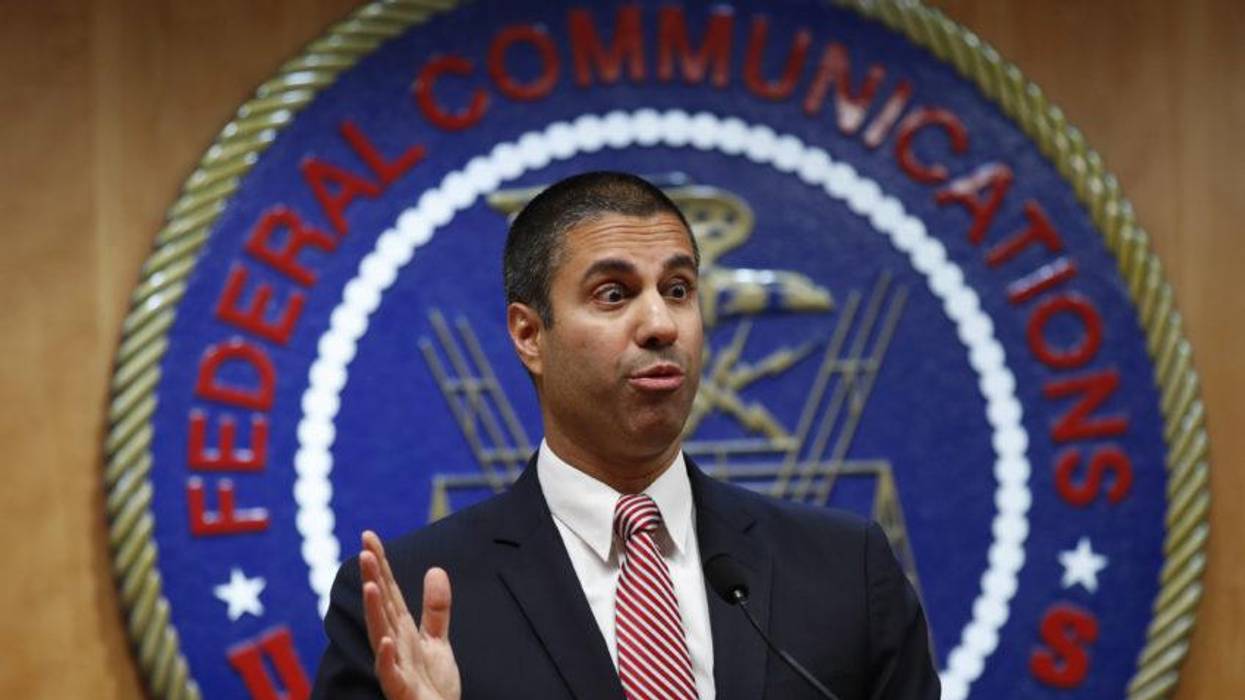
If you clicked this story, or have any desire to listen to the interview embedded within, odds are you're a consumer of independent media. Yet even as you're reading these words, your ability to do so in a timely manner is in grave jeopardy.
Since the repeal in June of Obama-era rules guaranteeing net neutrality, websites like Truthdig, Democracy Now!, Common Dreams and more risk being pushed into an internet slow lane that could severely hamper their readership, if not drive them out of business entirely. For Jeff Cohen, editor and co-founder of the media watchdog Fairness and Accuracy in Reporting (FAIR), it may be the most urgent threat to the First Amendment no one is talking about.
"The biggest issue of freedom of the press is not that Trump is mean to reporters, as he was last week with CNN's Jim Acosta and Yamiche Alcindor of "PBS NewsHour," he tells Robert Scheer. "The biggest freedom-of-the-press issue is that Trump is working with Comcast and AT&T and Verizon to end net neutrality. ... Ownership of the media and the ownership of the internet, the fact that these big internet providers are [a] few giant companies that also produce content--it's very, very dangerous."
In the latest installment of "Scheer Intelligence," Cohen plumbs a range of topics, including the myriad failures of our political press and the Blue Wave election that wasn't quite, as well as the future of the progressive movement. No matter how many congressional seats it ends up flipping, he contends, the Democratic Party is unlikely to change course until it replaces its leadership: "It's too indebted to the donor class. So they talk with mush in their mouths. 'We should have more accessibility to affordable housing'--no! What's popular is 'Medicare for all.' "
Cohen also expounds on the larger mission of FAIR and the kind of counterweight it can provide to an increasingly monolithic media industry. "We set up FAIR because progressive points of view were excluded from mainstream media," he says. "Typically in mainstream media ... the spectrum went from the center to the right. So I spent decades trying to get the progressive view there."
Between the Federalist Society's iron grip on the Supreme Court and the ever-encroaching dangers of global warming, the future--both for the country and the planet as a whole--looks impossibly bleak. Yet even in these dark, frenetic times, Cohen maintains we still have reason for optimism. "I study the polls," he says. "And the polls show that the most progressive demographic, by age, by far, are people under 30, under 35. They're the most anti-racist demographic, they're the most tax-the-rich demographic, [and] they're the most we-better-do-something-about-climate-change demographic."
Listen to Cohen's interview with Scheer or read a transcript of their conversation below:
Robert Scheer: Hi, this is Robert Scheer with another edition of Scheer Intelligence, where I hasten to add the intelligence comes from my guests. In this case, it's Jeff Cohen. I think I most recently had seen you in action at the Democratic Convention in Philadelphia, and you were organizing sort of a grassroots activity. Of course I've known you for years, you--way back in the 1980s you started a group called FAIR, Fairness and Accuracy in Reporting, one of the major media watchdog organizations. And then more recently, in 2011, you organized RootsAction.org, and this very effective million and a half people who can push for progressive things. But the reason I wanted to talk to you is, I'm interviewing you the day after the midterm election, here at USC at the Annenberg School for Communication and Journalism. We had a lot of activity at the school, a lot of screens going all last night. Then everyone woke up this morning and not quite sure--there certainly wasn't the blue wave, but there was blue impact; you get the House. And as I say, when I last saw you, it was a much more optimistic moment, in some sense, for progressives, but the tide was turning within the Democratic Party. And so take me back to the Philadelphia convention, and were you a Bernieite?
Jeff Cohen: I was a spokesperson for the Bernie Delegates Network, which was an independent group of--that represented and networked most of the Bernie delegates; it was independent of the campaign. Were we more optimistic? Of course we were. Because even though there was the disappointment of Bernie not getting the nomination and the Clinton machine winning out, there was a sense for a while that Hillary Clinton, representing the corporate center, or the corporate liberals, would become president. The right wing would be totally divided and in disarray, because Trump had taken over, and if they had lost and lost big they would have been fighting each other. And there would have been this strong, organized left pushing on Hillary while the right is in disarray. That was the scenario that seemed possible in the summer of 2016. But what we learned last night, and what we learned back then, is that you can't beat Trump with nothing. You can't beat Trump by just saying, "Trump's an ogre." You have to have a program; you have to have a program that excites people. You have to have a program that excites your base, which is young people, people of color, and is sellable to working-class whites. And Bernie Sanders had that program; I've just finished a documentary where we interviewed union workers, former union workers in Youngstown, Ohio. Voted for Obama twice, voted for Bernie over Hillary in the 2016 primary, and then voted for Trump. And there's lots of those people. So, what's so disappointing about last night--and you say, was it a blue wave; it was like a blue trickle, or a blue ripple. It should have been a blue wave, but the only way you can have a blue wave is if the party stands for something. And the party has to stand for the progressive agenda that will be able to forge a multiracial alliance that can win elections, in middle-class districts, in working-class districts. We don't have that, because of the leadership of the Democratic Party. It's too indebted to the donor class. So they talk with mush in their mouths: "We should have more accessibility to affordable housing"--no! What's popular is Medicare-for-all. A recent Pew poll showed that 51 percent of Republicans are for Medicare-for-all. Free, public college education, and pay for it by a transaction tax on Wall Street. The progressive domestic agenda--and I've just written a report on this with other people from RootsAction--it's extremely popular, not just with progressives! It's popular with people across the board. But the Democrats don't put that agenda forward, and that's why we had a trickle instead of a wave.
RS: OK. But let me just ask, get back to basics here. And I want to establish your credentials here.
JC: OK.
RS: Because you've been out there--and let me just say something about FAIR, and they still exist and they still do good---
JC: FAIR.org.
RS: Yeah. And you were a journalism professor at Ithaca College, and I think I met you that way, because you gave me an award at one point, the I.F. Stone award--
JC: The Izzy Award.
RS: Izzy Award. And for people listening who don't remember who Izzy was--go to journalism schools, as I say, we're here at Annenberg, we do have students who know about Izzy; up at Berkeley they do, at Columbia Journalism they do. And he was a legendary journalist, and he was a maverick; he was independent. And he felt, not only did all governments lie--a statement famously attributed to him--but also he felt all politicians lie, and his job was to cut through all of that. Now, I met you while you were doing that; you were also a lot on MSNBC, you were a lot with the sort of liberal euphoria, doing a lot of--I kept watching you on the screen. And you're a very bright, optimistic fellow; right now, even, you got a--
JC: I'm a talker.
RS: No, but you also have a good smile on your face. So I'm going to confess to you, as my priest. I had a very odd reaction this morning after, you know, the midterm election. Because I watched Donald Trump, and whatever you say about Donald Trump, he brought some energy and feeling to the situation. Now, you know, he'd gotten good news, bad news--you know, somehow there was, again as you suggest, a program. He was going to move ahead. And then I just now look at the screens, and he's fired [laughs] the attorney general, and he's going to move aggressively. And then they had Nancy Pelosi come on, and the question--you know, Trump actually endorsed her in his remarks. And I expected Nancy Pelosi to really stick it to this guy, you know? And--no! We've been empowered to come back here and really do something for ordinary people! And it was tepid at best, tepid. And it was like, oh, we're going to save a notion of affordable health care. And she seemed as tone-deaf as Hillary was in the election. My feeling is, what Bernie Sanders brought was the same sort of energy--only it was a left populism--the same sort of energy that Donald Trump has. A progressive populism, as opposed to a reactionary, scapegoating of minorities, vulnerable people, and so forth. And I wonder, you know, you've spent the last months in midterm elections and everything; do you, is the Democratic Party really capable of feeling that pain?
JC: No. Not in--not the current leadership. I mean, you're right; the problem is Pelosi, the problem is Clinton, the problem is Schumer. After the disaster of 2016--and you're right about my history, I go back decades in this. You know, we set up FAIR because progressive points of view were excluded from mainstream media. Typically in mainstream media--with some exceptions; you were one at the L.A. Times--typically, the spectrum went from the center to the right. So I spent decades trying to get the progressive view there. And I would tell executives, I'd have meetings with media executives, and I'd say: you know, if you had an unabashed progressive in some of these discussions, not only would it be good for democracy, but your ratings would go up. And so what was interesting with the Bernie campaign--and I've known Bernie since his first term in Congress--is for the first time, mainstream media was forced, because he had these huge rallies, to have the progressive agenda on the nightly news, every night, especially on cable news. And lo and behold, that progressive message connected with many voters, whether they know the term progressive or not. And again, talking to later Trump voters who voted for Bernie--I've met these people. So my whole life has been about trying to get progressive, the progressive message heard by the masses of people. And can the Democratic Party, as it's currently led, win and defeat Trump, and then after you win an election, govern in a way that you can maintain power? Not with the current leadership. There's two problems facing our country: one, you'll hear about on MSNBC every night. It's the extremism, the racism, the anti-science, the scapegoating of the Republicans. There's an equal, second problem, and that's the corporatism and the vacillation and the backpedaling of the Democratic Party. And if all you ever do is talk about that first problem, which is all they talk about hour after hour on MSNBC, you're giving your viewers half of the story. Because the two things go together. So after the disaster of 2016, when the leadership of the party--this was one of the big calamities in U.S. history, when Trump won--they would not do an autopsy on what they had done wrong. They refused to do it, so we did it. And we put out this report called DemocraticAutopsy.org. What the Democratic leadership and MSNBC was content to do, was look at external factors. So they tried to blame it on Russia, is why they lost in November [2016]; or the Comey intervention, 11 days before the election. These were small factors. But the major factor was within the control of the Democratic Party leadership, and that's who they chose as their candidate; how they ran that campaign, how they spent their money--and remember, the Clintonites spent more money than the Trumpites in November, in the November 2016 election. So what, our critique of the Democratic Party leadership, and why they need to be replaced--and there will soon be campaigns to replace Schumer and Pelosi and Tom Perez, the leader of the Democratic National Committee--the reason they need to be replaced is they keep making two errors. One is agenda; they don't have a progressive agenda, it's mush, it's tepid, as you said. And two, they don't spend their money the right way. What you need to do is have a progressive agenda that creates a lot of enthusiasm among young people, people of color, even white working-class people. And then you have to spend your money to get your base out to the polls--that's black people, Latinos, poor people, young people. Instead, they spend all this money on ads.
RS: But we're slipping into a language here of the Democrats as somehow being virtuous, if stumbling. And I just want to raise a question for you. Aren't they really more perfectly, on economic matters, the party of Wall Street? And the result is, even in the '16 election, they got more support from Wall Street, and they got it in the midterm now; I haven't done a clinical analysis of the stats. I want to ask you about this Democratic Party--maybe it is basically a con job, OK, that in fact, you're deluding people. Most of my friends, most of the people I know, they're part of the blue wave; I mean, in my own family everywhere, I have--I've got this all the time: we're going to win, we're going to resist. And the question is, isn't there a message of false consciousness here? If we're talking about a base that has working people, black people, brown people--those, that's the group. College-educated black and brown people were the people hardest hit in the Great Recession, engineered by Robert Rubin, Lawrence Summers, Bill Clinton. You know, they lost 60, 70 percent of their wealth because of these liar loans, swindles and everything. That's the base that you're now going to tell they should give the Democrats another chance?
JC: Well, you're right in--you and I identify the base, but the leadership of the party is, as you say, allied with Wall Street. The Clintonites, the Obama--Obama got more money from Wall Street when he ran for president in 2008 before, in that campaign, before he was the frontrunner. And there were two New York candidates running for president, Giuliani and Hillary Clinton, and Obama was out-fundraising them before he was a frontrunner. So he was well connected, too. So the base of the party--we don't have a parliamentary system, we don't have proportional representation. We, at national and statewide levels, we're reduced to two parties. And progressives need to take over the leadership of the Democratic Party. If it's left in the hands of the Pelosis and the Schumers and the Tom Perezes, it's hopeless.
RS: OK, but you know, I like to dig a little deeper in these interviews. And you know, last night--oh, I got in trouble, not just last night, teaching a couple of times. And everyone from my wife to my former dean here, and other people--I said, look, if there are any kids in the room, any students who don't feel they want to vote, you don't have to. Now--debatable proposition.
JC: Very debatable.
RS: Very debatable, but after all, we're at a university, we're supposed to do critical thinking, we're supposed to challenge. And I was making a point to develop discussion and argument, you know. And I myself last night had my "I Voted" sticker on; you know, I dutifully went to my polling thing. But I thought, you know, wait a minute; wait a minute. Is this really a game that should absorb so much of our attention? Now, I'm putting the question to you because when I was at the Democratic Convention, you were an important figure to me as a journalist. I wanted to be where you were, the meetings and so forth, because they were the most interesting delegates, the Bernie delegates. They came from all over the country, they were idealistic, they were in touch with their own communities. And, lo and behold, they were betrayed.
JC: Right, but if--you, I'm so glad you brought them up. If all they did was be Bernie delegates and work in the Bernie campaign, then yeah, I'd be disappointed. But the people you're referring to that I got to know so well in Philadelphia, from every race, every age group, every gender--they're movement-builders. These are people that work in organizations. They're union-organizers, they're tenant-organizers. So I don't believe you register anything by not voting. But if all you do is work in elections, or you only get active two months before an election, you're really not an activist. What you have to be doing is building independent organizations, and then also take those organizations and work electorally. But if all you do is electoral work, it's cyclical; that's not how you're going to build a movement that could take over the Democratic Party and take over the country. The important thing is, where do we go? Is there a way of putting forward a progressive agenda and raising money for a presidential campaign or a big campaign? And I think Bernie Sanders proved, you don't need Wall Street money. You don't need corporate money. You can get $27 donations. Beto O'Rourke proved it.
RS: When you say he proved it--
JC: He raised far more money than he needed. The problem with Bernie, between Bernie and Hillary had nothing to do with money. Same thing in Texas; Beto O'Rourke wouldn't take PAC money, wouldn't take corporate money. There's a new wave within the Democratic Party, and that's a--the progressive wave within the party is saying, if we have a progressive agenda, we can rebuild a multiracial alliance that will vote for us. And--thanks to the internet--we can raise money in small-dollar donations that we don't need Wall Street money anymore. And I think that's the way of the future; if people go to DemocraticAutopsy.org, you can see the critique we've made of the party leadership. And it was made by people--included in our writing team was the coordinator of the Bernie Delegates Network, Norman Solomon. It's Karen Bernal, who you met in Philadelphia; she's the head of the Progressive Caucus of the California Democratic Party, the biggest caucus. We have the chair of the New Mexico Progressive Caucus of the Democratic Party. So there is a wave within the Democratic Party that's trying to take leadership away from the Clintonites.
RS: Realistically speaking, when I think about American politics in general, there are two forces operating against what, say, Tom Paine--I'm not going to invoke the Founders. You had counterpower from the citizenry, counterpower, and that's what the Bill of Rights and everything was going to give voice to. Now, you have a very different situation; you have MSNBC, which is supposed to be center-progressive media, but it's owned by really one of the largest manipulative media companies, right, Comcast. Before that it was owned by a defense contractor and banker that was very instrumental in getting the whole banking meltdown, GE Capital. So they make a show of independence, but we all know there are limits, and when you work for those operations, what's left of your newspapers are increasingly dependent upon billionaires. So when we think of the quality of our society, the debate it can sustain, it's all very well and good to say, people are out there organizing movements and so forth. And I don't want to be negative here; I want to encourage people to do that. But the fact is, we are living increasingly in a 1984 world. We have a surveillance state; we have a very refined degree of social control, manipulation, spying and the ability to coop people. And then you got two guys like us sitting here, ruminating about this election, and I wonder if we're not burying the lede. The lede is, Donald Trump is not an accident; he is the norm in this manipulative society. He knows how to game the system, and, as Wall Street has shown with stock prices and everything else, they like it.
JC: Oh, yeah.
RS: They like it.
JC: Yeah. Well, I--look, I can't disagree with what you've been saying. I've been a leading critic of MSNBC; all they talk about is Russia, Russia, Mueller, Mueller, Mueller. Imagine if they talked about important things, like all the corporate corruption of Donald Trump. How that would have resonated with voters. He's violating the Constitution. So MSNBC is a disaster to me. The biggest issue of freedom of the press is not that Trump is mean to reporters, as he was today with the CNN reporter and the NBC reporter. The biggest freedom of the press issue is that Trump is working with Comcast and AT&T and Verizon to end net neutrality, which would push Truthdig and Truthout and Common Dreams and Democracy Now! and The Young Turks into the slow lane. He's working hand-in-glove with them. What issue do you never hear on Comcast-owned MSNBC about freedom of the press is the biggest freedom of the press debate going on now, which is saving net neutrality. They won't talk about it. So you are right that the ownership of the media and the ownership of the internet, and the fact that these big internet providers are these few giant companies that also produce content--it's very, very dangerous. But I've got to stay optimistic. What I'm optimistic about is, I study the polls. And the polls show that the most progressive demographic, by age, by far, are people under 30, under 35. They're the most anti-racist demographic, they're the most tax-the-rich demographic, they're the most we-better-do-something-about-climate-change demographic. And so the young people, whether they're college-educated or not, the polls I look at are all people under 30, are all people under 35. The problem is, do we have enough time left, given climate change and given Trump's instability with his finger near the button--do we have time for a new generation of people? You and I saw that generation in Philadelphia; these were the Bernie delegates. So many of them were under 30. Look at all the people that were elected yesterday, who are under 35. I mean, I'm from New York; Alexandria Ocasio-Cortez is electrifying, and she beat the fourth most powerful Democrat in a primary. There are exciting things happening in spite of Wall Street's influence over the Democratic Party. And, as you say, in spite of the billionaires dominating corporate media. If we can save net neutrality, we still have these alternative avenues by which young people, especially, are getting independent news information. The downside of the internet is Trump sends his crazy tweets, and Breitbart sends its divisive crap that isn't accurate or factual. You know, there's an up and a down side. But I've studied independent media, and you've been a big part of it for half a century. And independent media is more powerful today than probably anytime in the last century. And it won't be if Trump and Comcast, if they succeed in getting rid of the internet. You know, a free internet, an open internet.
RS: I certainly agree that it's important to fight the good fight. But we're doing this on, well, being done from a public radio station. And it's being done, we're recording at a university. Our job here is to actually think out loud. Because I think the game is rigged now to such a degree that what we need are some naysayers out there. And I think of Martin Luther King, and when I was the editor of Ramparts we published him when The New York Times denounced him in an editorial, when he at Riverside Church, a year before he was killed, said the United States, my government, is the major purveyor of violence in the world today. That was not a statement that a careful politician would ever even think about; you would be denounced. Yet the United States, today, is the major purveyor of violence in the world today. It has a military budget that is growing all the time, supported by Democrats and Republicans; it intervenes everywhere in the world. And yet, if those good candidates that you're talking about dared to say, my government is the major purveyor in the violence of the world today, they wouldn't be treated--you know, let's cut to the chase here.
JC: Yeah, I agree. But let me respond. You've raised the most important issue that liberals won't talk about, which is U.S. militarism. When Martin Luther King says the U.S. is the greatest purveyor of violence in the world today, if he were alive he'd be saying it, as you're saying it, today. We have 800 military bases, $717 billion National Defense Authorization Act for 2019. And Schumer's office, and Pelosi, sent out statements about how they were working with Trump to get him the money for our quote defense, unquote. Most Democrats, even progressive ones, on their websites--check out the issues I'm running on--they'll mention gay rights, they'll mention health care, they'll mention environment. They don't mention the military. They don't mention endless war. We've been involved in war since 2001. It's the longest war in U.S. history, and they won't talk about it. But here's the good news. Alexandria Ocasio-Cortez; Rashida Tlaib, who's the new congresswoman, a Palestinian-American from Detroit; Ilhan Omar, the Somali refugee, is the new congresswoman from Minnesota; Ayanna Pressley, she beat a 10-term Democrat in the primary, she's from Boston. On their websites, they talk about cutting the military budget and using that money for social good. If you don't cut the military budget, how can we provide free, public college education? How can we provide the kind of healthcare that the country needs? So you're right, you're right--it's the biggest issue that the mainstream media won't talk about, MSNBC doesn't talk about it. But some of these--obviously, Truthdig talks about it, Truthout talks about it, Democracy Now! talks about it. MSNBC--they don't talk about, there's no such thing as U.S. militarism or U.S. imperialism on those stations.
RS: So I'm going to wrap this up by saying I applaud--and I'm not being condescending here--your efforts, and people like Norman Solomon, and the candidates you mentioned. And as I've said, I ran as a Democrat for Congress, and I've worked in--I worked at the L.A. Times for 29 years, I believe in using whatever you got to get some thought out, some words, some criticism. I think we all have to fight the good fight. But--but--we also have an obligation to speak truth to power in the clearest way. And the odd thing is this right-wing--I would call it neofascist populist. I never minimize the danger of Trump, but the fact of the matter is, there's something incredibly authentic--
JC: Yes.
RS: About his campaigning. That he touches the pain out there. Now, he does it in an irresponsible way. But the fact of the matter is, it's not just that the economy is doing well; he's done some very effective negotiation on trade; NAFTA 2.0, that he negotiated, is a hell of a lot better than the ones that were negotiated under Democrats--
JC: And Obama had eight years to fix it himself and did not.
RS: Yeah. And for the first time, there's actually some consideration of what is fair wage, and actually letting the courts of Mexico and Canada have some, and America, have some say over whether the treaty is agreeing. I think--North Korea, and so forth. Where he's really quite dangerous, ironically, is the Russia stuff; he keeps putting sanctions on Russia, he doesn't take advantage of his conversation with Putin to actually have arms control; he's just ripped up--not one question today about, at a press conference, about his ripping up arms control on intermediate nuclear weapons. Very, very serious. But I want to end this by saying, none of the people you talk about will talk about the main foreign interference in this election, and it was Israel. And the pivot, the most dangerous thing Trump has done in foreign policy, the most dangerous thing he's done on domestic policy is the scapegoating of vulnerable people, particularly immigrants. It's horrible, and it has echoes, strong echoes of fascism, attacking the most vulnerable people. But on foreign policy, and they are related, the real danger is accepting this alliance between Saudi Arabia and Israel, and the idea that Iran, which did not attack the World Trade Center, that somehow Iran is the major problem, and we seem to be heading toward some kind of confrontation with Iran, despite the French, the Germans, the Russians, the Chinese all saying this is nuts, they are honoring the agreement. And you don't hear anybody talk about it. Now, the president brought it up at his press conference. He said, don't attack me; he said, Netanyahu has said I'm the greatest thing for world peace. That was the key thing he said at his most important press conference. No one in the media challenged him on that.
JC: Let me react. Yeah. Israel is an untouchable topic in the mainstream media. We know it. People have lost so many jobs over criticism of Israel. And it was a factor when I worked with Phil Donahue at MSNBC, why we got in trouble with management. Because we questioned Israel's actions. That's a given. But in terms of Trump, I think you've nailed it. I mean, he has an amazing ability to connect with his audience. It's a white audience; he tells him he loves them; he makes jokes; he'll talk in very non-politician-like ways. There's no doubt, he's got a mastery of mainstream media. He's got a mastery of television. I mean, when I look at the, who's to blame for the rise of Trump, you've got Jeff Zucker, was the president of NBC entertainment, that created "The Apprentice" for that ego known as Donald Trump. And then he moves over to CNN, and you remember in 2015 and the first months of 2016, at CNN they had basically an all-Trump-all-the-time policy. So Trump is a master of television, and I think he does have this connection to an audience that most Democratic politicians, with their vacillation and their talking with mush in their mouths, don't have. But you know, there's so many issues that you mentioned that should be in the national news, and on MSNBC and CNN it was Russia, Russia, Mueller, Mueller, Mueller. You know, FAIR did a survey and they found--this was in July of this year--not one segment on MSNBC on the U.S. role in the massacre in Yemen, the humanitarian crisis, U.S. and Saudi Arabia killing so many civilians. But while zero segments on Yemen, 465 segments mentioning Stormy Daniels. So I mean, we have a real failure in so-called liberal media and what they cover. And Iran and Israel--I mean, it's a powder keg. You're right, it's a common thing, even at The New York Times, which is, you know, can be a strong newspaper. But they have this cliche about Iran as the main state sponsor of terrorism in the world. We know that's not true, every expert knows it's not true. Saudi Arabia is the main sponsor. And as you say, we weren't attacked on September 11th by Iran; quite the contrary. So what I try to get people to do--and 10 years at Ithaca College, my field of study was independent media--divorce yourself from corporate, mainstream media and start really digging into the best independent outlets. We've really had a boom in independent media. But all of these critiques you're making of the political system, and the media system, I agree with. But I guess I have hope for a new generation, and a new generation with a new, independent media that's been booming.
RS: Well, on that note, I want to [laughs] thank, I guess, Jeff Cohen, who started FAIR, and then now, most recently, has been with RootsAction. And I saw you operate at the Democratic Convention, I know you're filled with optimism and insight. And you know, if it were your Democratic Party, I'd be much more--
JC: One day it's going to be someone's--yeah, one day it will be.
RS: Well, that's it for this edition of Scheer Intelligence. Our producers are Josh Scheer and Isabel Carreon. Our engineers at KCRW are Kat Yore and Mario Diaz. And here at the Annenberg School for Communication and Journalism at University of Southern California, Sebastian Grubaugh has been the man on the board. That's it, see you next week.

Throughout the day before the summit in Helsinki, the lead story on the New York Times home page stayed the same: "Just by Meeting With Trump, Putin Comes Out Ahead." The Sunday headline was in harmony with the tone of U.S. news coverage overall. As for media commentary, the Washington Post was in the dominant groove as it editorialized that Russia's President Vladimir Putin is "an implacably hostile foreign adversary."
Contempt for diplomacy with Russia is now extreme. Mainline U.S. journalists and top Democrats often bait President Trump in zero-sum terms. No doubt Hillary Clinton thought she was sending out an applause line in her tweet Sunday night: "Question for President Trump as he meets Putin: Do you know which team you play for?"
A bellicose stance toward Russia has become so routine and widespread that we might not give it a second thought -- and that makes it all the more hazardous. After President George W. Bush declared "You're either with us or against us," many Americans gradually realized what was wrong with a Manichean view of the world. Such an outlook is even more dangerous today.
The Russiagate frenzy is largely about punching up contrasts between the United States (angelic and victimized) and Russia (sinister and victimizer).
Since early 2017, the U.S. mass media have laid it on thick with the rough political equivalent of a painting technique known as chiaroscuro - "the use of strong contrasts between light and dark, usually bold contrasts affecting a whole composition," in the words of Wikipedia. The Russiagate frenzy is largely about punching up contrasts between the United States (angelic and victimized) and Russia (sinister and victimizer).
Countless stories with selective facts are being told that way. But other selectively fact-based stories could also be told to portray the United States as a sinister victimizer and Russia as an angelic victim. Those governments and their conformist media outlets are relentless in telling it either way. As the great journalist I.F. Stone observed long ago, "All governments lie, and nothing they say should be believed." In other words: don't trust, verify.
Often the biggest lies involve what remains unsaid. For instance, U.S. media rarely mention such key matters as the promise-breaking huge expansion of NATO to Russia's borders since the fall of the Berlin Wall, or the brazen U.S. intervention in Russia's pivotal 1996 presidential election, or the U.S. government's 2002 withdrawal from the Anti-Ballistic Missile Treaty, or the more than 800 U.S. military bases overseas -- in contrast to Russia's nine.
For human survival on this planet, an overarching truth appears in an open letter published last week by The Nation magazine: "No political advantage, real or imagined, could possibly compensate for the consequences if even a fraction of U.S. and Russian arsenals were to be utilized in a thermonuclear exchange. The tacit pretense that the worsening of U.S.-Russian relations does not worsen the odds of survival for the next generations is profoundly false."
The initial 26 signers of the open letter - "Common Ground: For Secure Elections and True National Security" -- included Pentagon Papers whistleblower Daniel Ellsberg, writer and feminist organizer Gloria Steinem, former UN ambassador Gov. Bill Richardson, political analyst Noam Chomsky, former covert CIA operations officer Valerie Plame, activist leader Rev. Dr. William Barber II, filmmaker Michael Moore, former Nixon White House counsel John Dean, Russia scholar Stephen F. Cohen, former U.S. ambassador to the USSR Jack F. Matlock Jr., Pulitzer Prize-winning writers Alice Walker and Viet Thanh Nguyen, The Nation editor Katrina vanden Heuvel, former senator Adlai Stevenson III, and former longtime House Armed Services Committee member Patricia Schroeder. (I was also one of the initial signers.)
Since its release five days ago, the open letter has gained support from a petition already signed by 30,000 people. The petition campaign aims to amplify the call for protecting the digital infrastructure of the electoral process that is now "vulnerable to would-be hackers based anywhere" -- and for taking "concrete steps... to ease tensions between the nuclear superpowers."
We need a major shift in the U.S. approach toward Russia. Clearly the needed shift won't be initiated by the Republican or Democratic leaders in Congress; it must come from Americans who make their voices heard. The lives -- and even existence -- of future generations are at stake in the relationship between Washington and Moscow.
Many of the petition's grassroots signers have posted comments along with their names. Here are a few of my favorites:
Yet a wide array of media outlets, notably the "Russiagate"-obsessed network MSNBC, keeps egging on progressives to climb toward peaks of anti-Russian jingoism. The line of march is often in virtual lockstep with GOP hyper-hawks like Senators John McCain and Lindsey Graham. The incessant drumbeat is in sync with what Martin Luther King Jr. called "the madness of militarism."
Meanwhile, as Dr. King said, "We still have a choice today: nonviolent coexistence or violent coannihilation."

After breaking his first big stories with the Associated Press, Bob moved on to Newsweek and then later PBS's Frontline. Frustrated with the limits and compromises of corporate media--he was once told that a story on Contra financial skullduggery had to be watered down because Newsweek owner Katharine Graham was having Henry Kissinger as a weekend guest (Media Beat, 4/23/98)--Bob launched his own online outlet, Consortium News.
"He was a pioneer in bringing maverick journalism to the Internet," FAIR founder Jeff Cohen wrote after Bob's death. "Bob was a refugee from mainstream media who, like Izzy Stone, went on to build an uncensored and uncensorable outlet."
Bob believed deeply in journalism, both as a vital force for shaping the world and as a moral imperative. In a moving tribute to his father, Nat Parry (Consortium News, 1/29/18) wrote that one of his earliest memories
was of my dad about to leave on assignment in the early 1980s to the war zones of El Salvador, Nicaragua and Guatemala, and the heartfelt good-bye that he wished to me and my siblings. He warned us that he was going to a very dangerous place and that there was a possibility that he might not come back.
I remember asking him why he had to go, why he couldn't just stay at home with us. He replied that it was important to go to these places and tell the truth about what was happening there. He mentioned that children my age were being killed in these wars and that somebody had to tell their stories. I remember asking, "Kids like me?" He replied, "Yes, kids just like you."
FAIR was blessed to have Bob not just as an inspiration and ally but as an occasional contributor. As a practitioner of journalism at its best, his insights into what happened when journalism went wrong were always valuable. In gratitude and fond memory, we offer some excerpts from a small part of an enduring body of work.
Even Nixon, the grand strategist, could never have guessed how well his plans would have worked out a quarter century later--and how much of his chip-on-the-shoulder paranoia would still resonate today in a powerful conservative press establishment.
In the 25 years since Nixon started "pushing" this project, the conservatives have constructed a truly intimidating media machine. It ranges from nationwide radio talk shows by Rush Limbaugh and scores of Limbaugh-wannabes, to dozens of attack magazines, newspapers, newsletters and right-wing opinion columns, to national cable television networks propagating hard-line conservative values and viewpoints, to documentary producers who specialize in slick character assassination, to mega-buck publishing houses that add footnotes to white-supremacist theories anti a veneer of respectability to journalistic fabrications, and even to narrowly focused organizations that exist simply to hurt the surviving mainstream journalists who still won't toe the line.
This conservative media machine now rivals--and may well surpass--the power and the influence of the old-line press. Both directly and indirectly, this right-wing media machine holds sway over much of the national agenda, deciding which ideas and individuals are accepted and which are marginalized.
--"The Rise of the Right-Wing Media Machine" (Extra!, 3-4/1995)
The [Wall Street] Journal editorial page, of course, was not alone in missing or misreporting aspects of Iran-Contra-connected investigations, nor in exaggerating the Whitewater affair. But the Journal's editorial page stands out as a master of journalistic hypocrisy in the two controversies. On Iran/Contra, the Journal exploited its national influence to hamper and harass investigators and journalists examining serious crimes, including--by the Journal's own belated admission--drug-trafficking, money-laundering and obstruction of justice. On Whitewater, conversely, the editorial page has served as the principal sounding board for baseless rumors.
--"Hast Seen the Whitewater Whale?" (Extra!, 9-10/1995)
[Colin] Powell's justification for the cold-blooded murder of unarmed Vietnamese civilians is chilling. It is not only "brutal"--no need for a question mark--to murder an unarmed civilian in the manner Powell described; it is a war crime. Further, the killing is not excused by the fact that American soldiers, including Powell's friends, were dying in combat. The death of American soldiers was exactly the rationale used by Lt. William Calley for the slaughter of hundreds of Vietnamese villagers, including babies, in My Lai.
The Powell memoirs offer similar defenses for the practice of applying Zippo lighters to the hooches of Vietnamese civilians during his first tour in Vietnam, as an adviser to South Vietnam's army, in 1963. But when journalists who yearned for Colin Powell read his memoirs, they took almost no note of Powell's stunning lack of compassion when civilians were dying: whether Vietnamese, Nicaraguan, Panamanian or Iraqi.
--"Powell Media Mania," with Norman Solomon (Extra!, 1-2/1996)
When Gary Webb revived the Contra/cocaine issue in August 1996 with a 20,000-word, three-part series entitled "Dark Alliance" (8/18-20/1996), editors at major newspapers already had a powerful self-interest to slap down a story that they had disparaged for the past decade.
The challenge to their earlier judgments was doubly painful because the [San Jose] Mercury News' sophisticated website ensured that Webb's series made a big splash on the Internet, which was just emerging as a threat to the traditional news media. Also, the African-American community was furious at the possibility that U.S. government policies had contributed to the crack-cocaine epidemic.
In other words, the mostly white, male editors at the major newspapers saw their preeminence in judging news challenged by an upstart regional newspaper, the Internet and common American citizens who also happened to be black. So even as the CIA was prepared to conduct a relatively thorough and honest investigation, the major newspapers seemed more eager to protect their reputations and their turf.
--"America's Debt to Gary Webb" (Extra!, 3-4/05)
Tactical retreats by "humbled" pro-war columnists focused on US ineptness in waging the war, not on the illegality, immorality and insanity of invading a major Arab country that wasn't threatening the United States. By failing to expand the criticism of Bush beyond success or failure, the mainstream US news media continued to embrace implicitly Bush's assertion of a special American right to attack wherever and whenever the president says.
It was still out of bounds to discuss how the Iraq invasion violated the Nuremberg principle against aggressive war and the United Nations Charter, which bars attacking another country except in cases of self-defense or with the approval of the UN Security Council. To one extent or another, nearly all major US news outlets had bought into the imperial neoconservative vision of an all-powerful United States that operates outside of international law
--"Journalists 'Humbled' but Unrepentant," with Sam and Nat Parry (Extra!, 11-12/07)
Ultimately, the GOP cover-up strategy proved highly effective, as Democrats grew timid and neoconservative journalists--then emerging as a powerful force in the Washington media--took the lead in decrying the October Surprise allegations as a "myth." The Republicans benefited, too, from a Washington press corps that had grown weary of the complex Iran/Contra scandal. Careerist reporters in the mainstream press had learned that the route to advancement lay more in "debunking" such complicated national security scandals than in pursuing them.
--"Debunking the Debunkers of the October Surprise" (Extra!, 3/13)

News that investigative journalist Robert Parry--who broke some of the key Iran/Contra stories as a reporter for the Associated Press and Newsweek in the 1980's--died over the weekend has been met with an outpouring of sadness among readers and a wave of reflections from fellow journalists who remembered him as an uncompromising seeker of facts who remained committed to his craft until the very end.
In addition to his groundbreaking work as a foreign corresponent for major outlets, Parry--who died Saturday, according to his family, after a series of strokes caused by pancreatic cancer that had gone undetected--continued his muckraking career as an independent journalist after establishing Consortium News in 1995. As editor and publisher, Parry wrote with penetrating analysis and grit on foreign policy issues and domestic affairs while also giving platform to an array of writers and experts who challenged conventional thinking and mainstream orthodoxies.
In a widely-shared tribute posted on Consortium News on Sunday, Nat Parry remembers his father as someone boundlessly committed to journalistic integrity, but also as a reporter inspired by deep humanitarian impulses. Recounting a childhood memory of his father leaving for a trip to cover ongoing civil wars in Central America, he writes:
I remember asking him why he had to go, why he couldn't just stay at home with us. He replied that it was important to go to these places and tell the truth about what was happening there. He mentioned that children my age were being killed in these wars and that somebody had to tell their stories. I remember asking, "Kids like me?" He replied, "Yes, kids just like you."
Later in the tribute, the younger Parry says of his father that besides a deeply- "held commitment to independent journalism, it should also be recalled that, ultimately, Bob was motivated by a concern over the future of life on Earth. As someone who grew up at the height of the Cold War, he understood the dangers of allowing tensions and hysteria to spiral out of control, especially in a world such as ours with enough nuclear weapons to wipe out all life on the planet many times over."
While Parry remained a journalist unafraid to deconstruct narratives and expose truths in ways that powerful elites, corrupt right-wingers, and comfortable liberals often found inconvenient, his journalism was often pushed aside by a corporate-driven media system often threatened by, and unfamiliar with, such an approach.
Among his journalistic peers, the grief was palpable as many shared their sense of loss and championed Parry's legacy:
In his final post on Consortium--one in which he actually apologized to his readers after a stroke on Christmas Eve slowed down his writing and publishing--Parry restated his commitment to challenging accepted narratives and said that if he "could change one thing about America and Western journalism, it would be that we all repudiate 'information warfare' in favor of an old-fashioned repect for facts and fairness -- and do whatever we can to achieve a truly informed electorate."
Amen.
Parry is survived by his wife Diane Duston, a former Associated Press newswoman; sons Sam Parry and Jeff Parry of Arlington and Nat Parry of Copenhagen, Denmark; daughter Elizabeth Parry of Alexandria, Virginia; and six grandchildren.
Editor's Note: In lieu of flowers, Parry's family asks anyone interested to please consider making a tax-deductible donation to the Consortium for Independent Journalism (CIJ).

It is with a heavy heart that we inform Consortiumnews readers that Editor Robert Parry has passed away. As regular readers know, Robert (or Bob, as he was known to friends and family) suffered a stroke in December, which - despite his own speculation that it may have been brought on by the stress of covering Washington politics - was the result of undiagnosed pancreatic cancer that he had been unknowingly living with for the past 4-5 years.
He unfortunately suffered two more debilitating strokes in recent weeks and after the last one, was moved to hospice care on Tuesday. He passed away peacefully Saturday evening. He was 68.
I remember asking him why he had to go, why he couldn't just stay at home with us. He replied that it was important to go to these places and tell the truth about what was happening there. He mentioned that children my age were being killed in these wars and that somebody had to tell their stories. I remember asking, "Kids like me?" He replied, "Yes, kids just like you."
Those of us close to him wish to sincerely thank readers for the kind comments and words of support posted on recent articles regarding Bob's health issues. We read aloud many of these comments to him during his final days to let him know how much his work has meant to so many people and how much concern there was for his well-being.
I am sure that these kindnesses meant a lot to him. They also mean a lot to us as family members, as we all know how devoted he was to the mission of independent journalism and this website which has been publishing articles since the earliest days of the internet, launching all the way back in 1995.
With my dad, professional work has always been deeply personal, and his career as a journalist was thoroughly intertwined with his family life. I can recall kitchen table conversations in my early childhood that focused on the U.S.-backed wars in Central America and complaints about how his editors at The Associated Press were too timid to run articles of his that - no matter how well-documented - cast the Reagan administration in a bad light.
One of my earliest memories in fact was of my dad about to leave on assignment in the early 1980s to the war zones of El Salvador, Nicaragua and Guatemala, and the heartfelt good-bye that he wished to me and my siblings. He warned us that he was going to a very dangerous place and that there was a possibility that he might not come back.
I remember asking him why he had to go, why he couldn't just stay at home with us. He replied that it was important to go to these places and tell the truth about what was happening there. He mentioned that children my age were being killed in these wars and that somebody had to tell their stories. I remember asking, "Kids like me?" He replied, "Yes, kids just like you."
Bob was deeply impacted by the dirty wars of Central America in the 1980s and in many ways these conflicts - and the U.S. involvement in them - came to define the rest of his life and career. With grisly stories emerging from Nicaragua (thanks partly to journalists like him), Congress passed the Boland Amendments from 1982 to 1984, which placed limits on U.S. military assistance to the contras who were attempting to overthrow the Sandinista government through a variety of terrorist tactics.
The Reagan administration immediately began exploring ways to circumvent those legal restrictions, which led to a scheme to send secret arms shipments to the revolutionary and vehemently anti-American government of Iran and divert the profits to the contras. In 1985, Bob wrote the first stories describing this operation, which later became known as the Iran-Contra Affair.
Contra-Cocaine and October Surprise
Parallel to the illegal arms shipments to Iran during those days was a cocaine trafficking operation by the Nicaraguan contras and a willingness by the Reagan administration and the CIA to turn a blind eye to these activities. This, despite the fact that cocaine was flooding into the United States while Ronald Reagan was proclaiming a "war on drugs," and a crack cocaine epidemic was devastating communities across the country.
Bob and his colleague Brian Barger were the first journalists to report on this story in late 1985, which became known as the contra-cocaine scandal and became the subject of a congressional investigation led by then-Senator John Kerry (D-Mass.) in 1986.
Continuing to pursue leads relating to Iran-Contra during a period in the late 80s when most of Washington was moving on from the scandal, Bob discovered that there was more to the story than commonly understood. He learned that the roots of the illegal arm shipments to Iran stretched back further than previously known - all the way back to the 1980 presidential campaign.
That electoral contest between incumbent Jimmy Carter and challenger Ronald Reagan had come to be largely dominated by the hostage crisis in Iran, with 52 Americans being held at the U.S. embassy in Tehran since the 1979 Iranian Revolution. The Iranian hostage crisis, along with the ailing economy, came to define a perception of an America in decline, with former Hollywood actor Ronald Reagan promising a new start for the country, a restoration of its status as a "shining city on a hill."
The hostages were released in Tehran moments after Reagan was sworn in as president in Washington on January 20, 1981. Despite suspicions for years that there had been some sort of quid pro quo between the Reagan campaign and the Iranians, it wasn't until Bob uncovered a trove of documents in a House office building basement in 1994 that the evidence became overwhelming that the Reagan campaign had interfered with the Carter administration's efforts to free the hostages prior to the 1980 election. Their release sooner - what Carter hoped would be his "October Surprise" - could have given him the boost needed to win.
Examining these documents and being already well-versed on this story - having previously travelled three continents pursuing the investigation for a PBS Frontline documentary - Bob became increasingly convinced that the Reagan campaign had in fact sabotaged Carter's hostage negotiations, possibly committing an act of treason in an effort to make sure that 52 American citizens continued to be held in a harrowing hostage situation until after Reagan secured the election.
Needless to say, this was an inconvenient story at a time - in the mid-1990s - when the national media had long since moved on from the Reagan scandals and were obsessing over new scandals, mostly related to President Bill Clinton's sex life and failed real estate deals. Washington also wasn't particularly interested in challenging the Reagan legacy, which at that time was beginning to solidify into a kind of mythology, with campaigns underway to name buildings and airports after the former president.
At times, Bob had doubts about his career decisions and the stories he was pursuing. As he wrote in Trick or Treason, a book outlining his investigation into the October Surprise Mystery, this search for historical truth can be painful and seemingly thankless.
"Many times," he wrote, "I had regretted accepting Frontline's assignment in 1990. I faulted myself for risking my future in mainstream journalism. After all, that is where the decent-paying jobs are. I had jeopardized my ability to support my four children out of an old-fashioned sense of duty, a regard for an unwritten code that expects reporters to take almost any assignment."
Nevertheless, Bob continued his efforts to tell the full story behind both the Iran-Contra scandal and the origins of the Reagan-Bush era, ultimately leading to two things: him being pushed out of the mainstream media, and the launching of Consortiumnews.com.
I remember when he started the website, together with my older brother Sam, back in 1995. At the time, in spite of talk we were all hearing about something called "the information superhighway" and "electronic mail," I had never visited a website and didn't even know how to get "on line." My dad called me in Richmond, where I was a sophomore at Virginia Commonwealth University, and told me I should check out this new "Internet site" he and Sam had just launched.
He explained over the phone how to open a browser and instructed me how to type in the URL, starting, he said, with "http," then a colon and two forward slashes, then "www," then "dot," then this long address with one or two more forward slashes if I recall. (It wasn't until years later that the website got its own domain and a simpler address.)
I went to the computer lab at the university and asked for some assistance on how to get online, dutifully typed in the URL, and opened this website - the first one I had ever visited. It was interesting, but a bit hard to read on the computer screen, so I printed out some articles to read back in my dorm room.
I quickly became a fan of "The Consortium," as it was called back then, and continued reading articles on the October Surprise Mystery as Bob and Sam posted them on this new and exciting tool called "the Internet." Sam had to learn HTML coding from scratch to launch this online news service, billed as "the Internet's First Investigative 'Zine." For his efforts, Sam was honored with the Consortium for Independent Journalism's first Gary Webb Freedom of the Press Award in 2015.
X-Files and Contra-Crack
At some point along the way, Bob decided that in addition to the website, where he was not only posting original articles but also providing the source documents that he had uncovered in the House office building basement, he would also take a stab at traditional publishing. He compiled the "October Surprise X-Files" into a booklet and self-published it in January 1996.
He was also publishing a newsletter to complement the website, knowing that at that time, there were still plenty of people who didn't know how to turn a computer on, much less navigate the World Wide Web. I transferred from Virginia Commonwealth University to George Mason University in the DC suburbs and started working part-time with my dad and Sam on the newsletter and website.
We worked together on the content, editing and laying it out with graphics often culled from books at our local library. We built a subscriber base through networking and purchasing mailing lists from progressive magazines. Every two weeks we would get a thousand copies printed from Sir Speedy and would spend Friday evening collating these newsletters and sending them out to our subscribers.
The launching of the website and newsletter, and later an even-more ambitious project called I.F. Magazine, happened to coincide with the publication in 1996 of Gary Webb's "Dark Alliance" series at the San Jose Mercury-News. Webb's series reopened the contra-cocaine controversy with a detailed examination of the drug trafficking networks in Nicaragua and Los Angeles that had helped to spread highly addictive crack cocaine across the United States.
The African-American community, in particular, was rightly outraged over this story, which offered confirmation of many long-standing suspicions that the government was complicit in the drug trade devastating their communities. African Americans had been deeply and disproportionately affected by the crack epidemic, both in terms of the direct impact of the drug and the draconian drug laws and mandatory minimum sentences that came to define the government's approach to "the war on drugs."
For a moment in the summer of 1996, it appeared that the renewed interest in the contra-cocaine story might offer an opportunity to revisit the crimes and misdeeds of the Reagan-Bush era, but those hopes were dashed when the "the Big Media" decided to double down on its earlier failures to cover this story properly.
Big Papers Pile On
The Los Angeles Times launched the attack on Gary Webb and his reporting at the San Jose Mercury-News, followed by equally dismissive stories at the Washington Post and New York Times. The piling on from these newspapers eventually led Mercury-News editor Jerry Ceppos to denounce Webb's reporting and offer a mea culpa for publishing the articles.
The onslaught of hostile reporting from the big papers failed to address the basic premises of Webb's series and did not debunk the underlying allegations of contra-cocaine smuggling or the fact that much of this cocaine ended up on American streets in the form of crack. Instead, it raised doubts by poking holes in certain details and casting the story as a "conspiracy theory." Some of the reporting attempted to debunk claims that Webb never actually made - such as the idea that the contra-cocaine trafficking was part of a government plot to intentionally decimate the African-American community.
Gary Webb and Bob were in close contact during those days. Bob offered him professional and personal support, having spent his time also on the receiving end of attacks by journalistic colleagues and editors who rejected certain stories - no matter how factual - as fanciful conspiracy theories. Articles at The Consortium website and newsletter, as well as I.F. Magazine, offered details on the historical context for the "Dark Alliance" series and pushed back against the mainstream media's onslaught of hostile and disingenuous reporting.
Bob also published the book Lost History which provided extensive details on the background for the "Dark Alliance" series, explaining that far from a baseless "conspiracy theory," the facts and evidence strongly supported the conclusion that the Reagan-Bush administrations had colluded with drug traffickers to fund their illegal war against Nicaragua.
But sadly, the damage to Gary Webb was done. With his professional and personal life in tatters because of his courageous reporting on the contra-cocaine story, he committed suicide in 2004 at the age of 49. Speaking about this suicide later on Democracy Now, Bob noted how painful it is to be ridiculed and unfairly criticized by colleagues, as his friend had experienced.
"There's a special pain when your colleagues in your profession turn on you, especially when you've done something that they should admire and should understand," he said. "To do all that work and then have the New York Times and the Washington Post and the Los Angeles Times attack you and try to destroy your life, there's a special pain in that."
In consultation with his family, Bob and the Board of Directors for the Consortium for Independent Journalism launched the Gary Webb Freedom of the Press Award in 2015.
The Disastrous Presidency of George W. Bush
The presidency of George W. Bush was surreal for many of us, and no one more so than my dad.
In covering Washington politics for decades, Bob had traced many stories to "Dubya's" father, George H.W. Bush, who had been implicated in a variety of questionable activities, including the October Surprise Mystery and Iran-Contra. He had also launched a war against Iraq in 1991 that seemed to be motivated, at least in part, to help kick "the Vietnam Syndrome," i.e. the reluctance that the American people had felt since the Vietnam War to support military action abroad.
As Bob noted in his 1992 book Fooling America, after U.S. forces routed the Iraqi military in 1991, President Bush's first public comment about the victory expressed his delight that it would finally put to rest the American reflex against committing troops to far-off conflicts. "By God, we've kicked the Vietnam Syndrome once and for all," he exulted.
The fact that Bush-41's son could run for president largely on name recognition confirmed to Bob the failure of the mainstream media to cover important stories properly and the need to continue building an independent media infrastructure. This conviction solidified through Campaign 2000 and the election's ultimate outcome, when Bush assumed the White House as the first popular-vote loser in more than a century.
Despite the fact that the U.S. Supreme Court had halted the counting of votes in Florida, thus preventing an accurate determination of the rightful winner, most of the national media moved on from the story after Bush was sworn in on Jan. 20, 2001. Consortiumnews.com continued to examine the documentary record, however, and ultimately concluded that Al Gore would have been declared the winner of that election if all the legally cast ballots were counted.
At Consortiumnews, there was an unwritten editorial policy that the title "President" should never precede George W. Bush's name, based on our view that he was not legitimately elected. But beyond those editorial decisions, we also understood the gravity of the fact that had Election 2000 been allowed to play out with all votes counted, many of the disasters of the Bush years - notably the 9/11 tragedy and the Iraq War, as well as decisions to withdraw from international agreements on arms control and climate change - might have been averted.
As all of us who lived through the post-9/11 era will recall, it was a challenging time all around, especially if you were someone critical of George W. Bush. The atmosphere in that period did not allow for much dissent. Those who stood up against the juggernaut for war - such as Phil Donahue at MSNBC, Chris Hedges at the New York Times, or even the Dixie Chicks - had their careers damaged and found themselves on the receiving end of death threats and hate mail.
While Bob's magazine and newsletter projects had been discontinued, the website was still publishing articles, providing a home for dissenting voices that questioned the case for invading Iraq in late 2002 and early 2003. Around this time, former CIA analyst Ray McGovern and some of his colleagues founded Veteran Intelligence Professionals for Sanity and a long-running relationship with Consortiumnews was established. Several former intelligence veterans began contributing to the website, motivated by the same independent spirit of truth-telling that compelled Bob to invest so much in this project.
At a time when almost the entire mainstream media was going along with the Bush administration's dubious case for war, this and a few other like-minded websites pushed back with well-researched articles calling into question the rationale. Although at times it might have felt as though we were just voices in the wilderness, a major groundswell of opposition to war emerged in the country, with historic marches of hundreds of thousands taking place to reject Bush's push for war.
Of course, these antiwar voices were ultimately vindicated by the failure to find weapons of mass destruction in Iraq and the fact that the war and occupation proved to be a far costlier and deadlier enterprise than we had been told that it would be. Earlier assurances that it would be a "cakewalk" proved as false as the WMD claims, but as had been so often the case in Washington, there was little to no accountability from the mainstream media, the think tanks or government officials for being so spectacularly wrong.
In an effort to document the true history of that era, Bob, Sam and I co-wrote the book Neck Deep: The Disastrous Presidency of George W. Bush, which was published in late 2007. The book traced the work of Consortiumnews, juxtaposing it against the backdrop of mainstream media coverage during the Bush era, in an effort to not only correct the record, but also demonstrate that not all of us got things so wrong.
We felt it was important to remind readers - as well as future historians - that some of us knew and reported in real time the mistakes that were being made on everything from withdrawing from the Kyoto Protocol to invading Iraq to implementing a policy of torture to bungling the response to Hurricane Katrina.
Obama Era
By the time Barack Obama was elected the 44th president, Consortiumnews.com had become a home to a growing number of writers who brought new perspectives to the website's content. While for years, the writing staff had been limited primarily to Bob, Sam and me, suddenly, Consortiumnews was receiving contributions from journalists, activists and former intelligence analysts who offered a wide range of expertise - on international law, economics, human rights, foreign policy, national security, and even religion and philosophy.
One recurring theme of articles at the website during the Obama era was the enduring effect of unchallenged narratives, how they shaped national politics and dictated government policy. Bob observed that even a supposedly left-of-center president like Obama seemed beholden to the false narratives and national mythologies dating back to the Reagan era. He pointed out that this could be at least partially attributed to the failure to establish a strong foundation for independent journalism.
In a 2010 piece called "Obama's Fear of the Reagan Narrative," Bob noted that Obama had defended his deal with Republicans on tax cuts for the rich because there was such a strong lingering effect of Reagan's messaging from 30 years earlier. "He felt handcuffed by the Right's ability to rally Americans on behalf of Reagan's 'government-is-the-problem' message," Bob wrote.
He traced Obama's complaints about his powerlessness in the face of this dynamic to the reluctance of American progressives to invest sufficiently in media and think tanks, as conservatives had been doing for decades in waging their "the war of ideas." As he had been arguing since the early 1990s, Robert insisted that the limits that had been placed on Obama - whether real or perceived - continued to demonstrate the power of propaganda and the need for greater investment in alternative media.
He also observed that much of the nuttiness surrounding the so-called Tea Party movement resulted from fundamental misunderstandings of American history and constitutional principles. "Democrats and progressives should be under no illusion about the new flood of know-nothingism that is about to inundate the United States in the guise of a return to 'first principles' and a deep respect for the U.S. Constitution," Bob warned.
He pointed out that despite the Tea Partiers' claimed reverence for the Constitution, they actually had very little understanding of the document, as revealed by their ahistorical claims that federal taxes are unconstitutional. In fact, as Bob observed, the Constitution represented "a major power grab by the federal government, when compared to the loosely drawn Articles of Confederation, which lacked federal taxing authority and other national powers."
Motivated by a desire to correct falsified historical narratives spanning more than two centuries, Bob published his sixth and final book, America's Stolen Narrative: From Washington and Madison to Nixon, Reagan and the Bushes to Obama, in 2012.
Along with revenues from book sales, growing donations from readers enabled Bob to not only pay writers but also to hire an assistant, Chelsea Gilmour, who began working for Consortiumnews in 2014. In addition to providing invaluable administrative support, Chelsea also performed duties including research, writing and fact-checking.
Political Realignment and the New McCarthyism
Although at the beginning of the Obama era - and indeed since the 1980s - the name Robert Parry had been closely associated with exposing wrongdoing by Republicans, and hence had a strong following among Democratic Party loyalists, by the end of Obama's presidency there seemed to be a realignment taking place among some of Consortiumnews.com's readership, which reflected more generally the shifting politics of the country.
In particular, the U.S. media's approach to Russia and related issues, such as the violent ouster in 2014 of Ukrainian President Viktor Yanukovych, became "virtually 100 percent propaganda," Bob said.
He noted that the full story was never told when it came to issues such as the Sergei Magnitsky case, which led to the first round of U.S. sanctions against Russia, nor the inconvenient facts related to the Euromaidan protests that led to Yanukovych's ouster - including the reality of strong neo-Nazi influence in those protests - nor the subsequent conflict in the Donbass region of Ukraine.
Bob's stories on Ukraine were widely cited and disseminated, and he became an important voice in presenting a fuller picture of the conflict than was possible by reading and watching only mainstream news outlets. Bob was featured prominently in Oliver Stone's 2016 documentary "Ukraine on Fire," where he explained how U.S.-funded political NGOs and media companies have worked with the CIA and foreign policy establishment since the 1980s to promote the U.S. geopolitical agenda.
Bob regretted that, increasingly, "the American people and the West in general are carefully shielded from hearing the 'other side of the story.'" Indeed, he said that to even suggest that there might be another side to the story is enough to get someone branded as an apologist for Vladimir Putin or a "Kremlin stooge."
This culminated in late 2016 in the blacklisting of Consortiumnews.com on a dubious website called "PropOrNot," which was claiming to serve as a watchdog against undue "Russian influence" in the United States. The PropOrNot blacklist, including Consortiumnews and about 200 other websites deemed "Russian propaganda," was elevated by the Washington Post as a credible source, despite the fact that the neo-McCarthyites who published the list hid behind a cloak of anonymity.
"The Post's article by Craig Timberg," Bob wrote on Nov. 27, 2016, "described PropOrNot simply as 'a nonpartisan collection of researchers with foreign policy, military and technology backgrounds [who] planned to release its own findings Friday showing the startling reach and effectiveness of Russian propaganda campaigns.'"
As Bob explained in an article called "Washington Post's Fake News Guilt," the paper granted PropOrNot anonymity "to smear journalists who don't march in lockstep with official pronouncements from the State Department or some other impeccable fount of never-to-be-questioned truth."
The Post even provided an unattributed quote from the head of the shadowy website. "The way that this propaganda apparatus supported [Donald] Trump was equivalent to some massive amount of a media buy," the anonymous smear merchant said. The Post claimed that the PropOrNot "executive director" had spoken on the condition of anonymity "to avoid being targeted by Russia's legions of skilled hackers."
To be clear, neither Consortiumnews nor Robert Parry ever "supported Trump," as the above anonymous quote claims. Something interesting, however, did seem to be happening in terms of Consortiumnews' readership in the early days of the Trump presidency, as could be gleaned from some of the comments left on articles and social media activity.
It did appear for some time at least that a good number of Trump supporters were reading Consortiumnews, which could probably be attributed to the fact that the website was one of the few outlets pushing back against both the "New Cold War" with Russia and the related story of "Russiagate," which Bob didn't even like referring to as a "scandal." (As an editor, he preferred to use the word "controversy" on the website, because as far as he was concerned, the allegations against Trump and his supposed "collusion" with Russia did not rise to the level of actual scandals such as Watergate or Iran-Contra.)
In his view, the perhaps understandable hatred of Trump felt by many Americans - both inside and outside the Beltway - had led to an abandonment of old-fashioned rules of journalism and standards of fairness, which should be applied even to someone like Donald Trump.
"On a personal note, I faced harsh criticism even from friends of many years for refusing to enlist in the anti-Trump 'Resistance,'" Bob wrote in his final article for Consortiumnews.
"The argument was that Trump was such a unique threat to America and the world that I should join in finding any justification for his ouster," he said. "Some people saw my insistence on the same journalistic standards that I had always employed somehow a betrayal."
He marveled that even senior editors in the mainstream media treated the unproven Russiagate allegations as flat fact.
"No skepticism was tolerated and mentioning the obvious bias among the never-Trumpers inside the FBI, Justice Department and intelligence community was decried as an attack on the integrity of the U.S. government's institutions," Bob wrote. "Anti-Trump 'progressives' were posturing as the true patriots because of their now unquestioning acceptance of the evidence-free proclamations of the U.S. intelligence and law enforcement agencies."
An Untimely End and the Future of Consortiumnews
My dad's untimely passing has come as a shock to us all, especially since up until a month ago, there was no indication whatsoever that he was sick in any way. He took good care of himself, never smoked, got regular check-ups, exercised, and ate well. The unexpected health issues starting with a mild stroke Christmas Eve and culminating with his admission into hospice care several days ago offer a stark reminder that nothing should be taken for granted.
And as many Consortiumnews readers have eloquently pointed out in comments left on recent articles regarding Bob's health, it also reminds us that his brand of journalism is needed today more than ever.
"Besides this deeply held commitment to independent journalism, it should also be recalled that, ultimately, Bob was motivated by a concern over the future of life on Earth."
"We need free will thinkers like you who value the truth based on the evidence and look past the group think in Washington to report on the real reasons for our government's and our media's actions which attempt to deceive us all," wrote, for example, "FreeThinker."
"Common sense and integrity are the hallmarks of Robert Parry's journalism. May you get better soon for you are needed more now then ever before," wrote "T.J."
"We need a new generation of reporters, journalists, writers, and someone always being tenacious to follow up on the story," added "Tina."
As someone who has been involved with this website since its inception - as a writer, an editor and a reader - I concur with these sentiments. Readers should rest assured that despite my dad's death, every effort will be made to ensure that the website will continue going strong.
Indeed, I think that everyone involved with this project wants to uphold the same commitment to truth-telling without fear or favor that inspired Bob and his heroes like George Seldes, I.F. Stone, and Thomas Paine.
That commitment can be seen in my dad's pursuit of stories such as those mentioned above, but also so many others - including his investigations into the financial relationship of the influential Washington Times with the Unification Church cult of Rev. Sun Myung Moon, the truth behind the Nixon campaign's alleged efforts to sabotage President Lyndon Johnson's Paris peace talks with Vietnamese leaders in 1968, the reality of the chemical attack in Syria in 2013, and even detailed examinations of the evidence behind the so-called "Deflategate" controversy that he felt unfairly branded his favorite football team, the New England Patriots, as cheaters.
Reviewing these journalistic achievements, it becomes clear that there are few stories that have slipped under Consortiumnews.com's radar, and that the historical record is far more complete thanks to this website and Bob's old-fashioned approach to journalism.
But besides this deeply held commitment to independent journalism, it should also be recalled that, ultimately, Bob was motivated by a concern over the future of life on Earth. As someone who grew up at the height of the Cold War, he understood the dangers of allowing tensions and hysteria to spiral out of control, especially in a world such as ours with enough nuclear weapons to wipe out all life on the planet many times over.
As the United States continues down the path of a New Cold War, my dad would be pleased to know that he has such committed contributors who will enable the site to remain the indispensable home for independent journalism that it has become, and continue to push back on false narratives that threaten our very survival.
Thank you all for your support.
In lieu of flowers, Bob's family asks you to please consider making a tax-deductible donation to the Consortium for Independent Journalism.

The third week of January in 2018 felt like a perfect time to join the "girther" movement. You know, the growing number of Americans who refuse to believe the official report from Washington, by way of enthusiastic and amiable White House physician Ronny Jackson, that President Trump is who he says he is ... a man who stands 6-foot-3 and weighs in at 239 pounds.
At first blush, how could anyone doubt this tale of the tape? After all, Jackson -- who served in the same role under Barack Obama, with rave reviews from Team Trump's Democratic predecessors -- came into Tuesday's no-holds-barred press briefing with a stellar reputation. The weird problem is this: No one has ever seen anyone else with Trump's seemingly expanding, um, girth -- fueled by a two-scoops diet of Fillet-O-Fish sandwiches and KFC -- who clocks in at that same height and weight. The comparisons quickly ping-ponged across Twitter
It was soon noticed that Trump's driver's license has always listed him as 6-foot-2 -- which matters because at that lower height, his weight of 239 pounds would have placed the president in the "obese" category. But other criticisms of Dr. Jackson's bizarrely obsequious performance -- in which he went out of his way to repeatedly say the health of this lifelong fast-food addict is "excellent" -- were more pointed. The New York Times spoke afterward with several top cardiologists who said that based on the actual numbers, including his high cholesterol count even after taking powerful medication to reduce it, Trump's heart health is nowhere near "excellent." The Times said these top doctors opined that the president "has a real risk of having a heart attack or stroke, especially considering his weight and lack of exercise."
In other words, who you gonna believe? The actual lab numbers, plus what you see with your own lyin' eyes? Or the smiling doctor in the white lab coat, appearing in high-def to praise the amazing (although not from Sweden) gene pool and stamina of our Dear Leader? The Trump medical follies arguably provided some slight comic relief at a time when the news was otherwise uniformly grim, from American "Dreamers" facing deportation and kids who can't get health insurance to the blatant racism of our president, despite his "great genes." But it also drove home the real crisis in American life: People don't know what to believe anymore.
To the brilliant 20th-century political thinker, and author of the always-too-relevant 1984, George Orwell, blowing up the fundamental meaning of truth was a bigger threat to humankind than the atom bomb. Here's what he wrote in an essay in 1943, at the peak of World War II:
Nazi theory indeed specifically denies that such a thing as "the truth" exists. ... The implied objective of this line of thought is a nightmare world in which the Leader, or some ruling clique, controls not only the future but the past. If the Leader says of such and such an event, "It never happened" - well, it never happened. If he says that two and two are five - well, two and two are five.This prospect frightens me much more than bombs.
America is having its "two and two are five" moment right now, and, frankly, it is every bit as frightening for the future of democracy as Orwell once imagined.
Let's back up for a split second. It's not as if Washington, D.C., has always been the beacon of truth. Personally, I've always adopted the mantra of the late great investigative journalist I.F. Stone, that all governments lie. And just in my lifetime, I've seen some doozies: The "credibility gap" over who was winning the Vietnam War (exposed by the Pentagon Papers, recounted in the new flick The Post), Richard "I am not a crook" Nixon's Watergate cover-up, Iraq's weapons of mass destruction that weren't. All terrible lies, some of them leading to death and misery. Each of them involving massive manipulating of the facts on the ground.
But there's a very real difference between twisting facts and blowing them up, to create a state where objective truth not only no longer matters but doesn't even really exist -- where if President Trump or his minions say that such-and-such-an-event never happened, then it never happened. That is the precarious precipice at which we stand as the Trump presidency crosses its one-year anniversary.
The Rand Corporation -- which, ironies of ironies, is where whistle-blower Daniel Ellsberg worked and purloined the Pentagon Papers -- just came out with a report that America is suffering from what it calls "Truth Decay," arguing that recent trends -- the rise of social media and the opinion bubbles that they can create, lack of trust in institutions (fostered by those earlier lies like the Iraq war) and increased partisan bickering -- have created a vacuum in which objective reality is in deep peril. And Team Trump is feeding on that void.
Consider the flap over Trump's shocking "shithole countries" slur against African nations, part of a larger Oval Office rant against immigrants from places where natives are mostly dark-skinned. The remarks were confirmed, essentially, by two U.S. senators in the room, not initially denied by the White House press office and, reportedly, even bragged upon by Trump himself as something his base would love. But when the fallout was worse than expected, supporters of The Donald stepped forward to tell America that two and two are five.
Two conservative senators who were at the Oval Office meeting raced to the Sunday shows to defend the president. "I didn't hear it," Arkansas Sen. Tom Cotton told CBS's "Face the Nation," adding: "And I was sitting no farther away from Donald Trump than Dick Durbin [the Democratic Illinois senator who confirmed Trump's remarks] was, and I know what Dick Durbin has said about the president's repeated statements is incorrect."
Later it was reported that what Cotton and Georgia Sen. David Perdue meant was simply that instead of calling African nations "shithole countries," he called them "shithouse countries." I'm sure that distinction, if true, has people dancing in the streets of Nairobi. (That was sarcasm.) The real purpose of the senators' remarks, of course, was to create a fog of uncertainty, to muddle any objective truth of what happened and to move forward on their broader goal of making American less welcoming to refugees and to other immigrants.
The senators soon got backup from a not-so-unlikely source: a Trump cabinet member, Homeland Security Secretary Kirstjen Nielsen, who told Congress that she, too, took issue with reports on the comment that had been widely attributed to the president. "I did not hear that word used," she told Vermont Democrat Sen. Pat Leahy during a Senate Judiciary Committee hearing. "No, sir." Leahy moved on to another comment attributed to Trump -- that desirable immigrants are ones from Norway -- and asked Nielsen if she knew that Norway is a mostly white nation.
"I actually do not know that, sir," Nielsen said, quickly adding that, OK, it probably is. What is even the point of all this lying and blatant know-nothingism? It's to show utter contempt for the very concept of facts -- much like when Trump himself, despite a well-documented history of racist remarks and acts, says, "I am the least racist person you will ever interview," or sends out a spokesman to boast about the size of the crowd at his inauguration, proven by photos to be much smaller than those of his predecessors. That disdain for an objective, provable truth -- as Orwell so correctly noted -- is the most powerful defining trait of authoritarian regimes.
Increasingly, Trump and his minions use lying as a bizarre way to bond him more closely to members of Congress like Perdue and Cotton, to his inner circle, and to his most loyal political base, the 36 Percent. Listen to what Xavier Marquez wrote in the Washington Post last January, that "lies can help ensure the loyalty of subordinates who are forced to repeat them. These kinds of lies need not be credible at all to people outside the regime. The more incredible a lie is, the more it can credibly signal loyalty to a political leader in conditions of low trust. When a subordinate repeats an obviously ridiculous claim he or she is degraded, and bound more closely to the leader."
That's not all. The Big Lies that increasingly are becoming the calling card of the Trump White House are meant not to win political debate but to destroy it, by discouraging all of those who are inclined to fight for the truth but who over time -- lie by lie by lie -- become so discouraged that they simply give up. And this is why it really matters, because that indifference is what drives good people to say nothing when political activists or sick children are rounded up for deportation, or when Congress acts to take health care away from the poor or from little kids at the same time there is plenty of money for billionaire tax cuts. When the people are too beaten down to fight back.
This weekend, thousands of women and their male allies take to the streets of America for a second Women's March, a statement of solidarity that organizers hope will keep the discouraged engaged one year into the Trump administration, to get folks to begin focusing on the November elections and the long-term goals of expanding justice, economic opportunity, good health and education. But any resistance to what's gone wrong in Washington needs to begin with a much more fundamental equation -- proving to America that two and two can again equal four.

Legendary independent journalist I.F. "Izzy" Stone often cautioned, "All governments lie." But even Izzy would have been dizzy with the deluge of lies pouring out of the Trump administration, including President Donald Trump's claim that human-induced climate change is a hoax perpetrated by the Chinese to hurt the U.S. economy. Global warming has exacerbated recent catastrophic events from Houston to Miami to Puerto Rico and the U.S. Virgin Islands, and, now, to raging fires sweeping across California. The corporate TV weather reporting aids and abets Trump's misinformation by consistently ignoring the role of climate change in this string of disasters.
This year's hurricanes have struck with historic force. On our warming planet, with rapidly warming oceans, hurricanes occur with more frequency and more strength. The 10th hurricane this year, Ophelia, has just been named. There have not been 10 hurricanes in one season since 1893.
At least 82 people died when Hurricane Harvey slammed into the Gulf Coast, inundating Houston. The storm also led to millions of pounds of pollutants being released into the air and water by Houston's sprawling petrochemical industries. Initial estimates for the rebuilding are currently about $190 billion.
Hurricane Irma killed at least 134 people, of whom 90 were in the United States, including 14 elderly residents who were trapped in a hot, flooded, blacked-out nursing home in Hollywood, Florida. AccuWeather's founder and president, Dr. Joel N. Myers, said, "Also unprecedented is that this particular storm, Irma, has sustained intensity for the longest period of time of any hurricane or typhoon in any ocean of the world since the satellite era began." His initial cost estimate for recovery from Irma, primarily in Florida, is $100 billion.
Hurricane Maria's devastation of Puerto Rico and the Caribbean has yet to be fully assessed. Puerto Rico had its entire power grid destroyed. After three weeks, at least 85 percent of the island remains without electricity. The Federal Emergency Management Agency reported that 63 percent of the island's 3.4 million residents have access to clean water, although that claim has not been independently verified. The official death toll on Puerto Rico alone at the time of this writing is 48, with scores still missing, but these are surely underestimates, as remote regions of the island have had very little contact with the outside world, and a new wave of serious infections related to poor sanitation are now afflicting people on the island. Even less is known about the Puerto Rican island of Vieques.
In the aftermath of the storm, San Juan Mayor Carmen Yulin Cruz waded chest-deep in floodwater, bullhorn in hand, helping people trapped in their homes and organizing rescue operations. Her repeated urgent calls for more help to stem the humanitarian crisis on Puerto Rico were rebuffed by FEMA chief Brock Long, who called her public cries "political noise." Trump himself accused the mayor of being "nasty," then engaged in a shockingly insensitive stunt during his short visit to the island, throwing rolls of paper towels into a crowd of hurricane survivors.
Across the United States, in California, over 20 wildfires are sweeping across the state. In Sonoma and Napa, fires have wiped out entire neighborhoods, turning thousands of homes into piles of smoldering ash and forcing the evacuation of tens of thousands. At the time of this writing, 21 people are confirmed dead from the fires, but hundreds are reported missing.
Scientists have found a direct link between climate change and the fires in California. Park Williams, bioclimatologist at Columbia University's Lamont-Doherty Earth Observatory, said on the "Democracy Now!" news hour, "The amount of area that has burned due to human-caused climate change ... is about half of the area of forest in the western U.S. that has burned over the last 35 years: the size of Massachusetts and Connecticut combined."
When asked about the failure of network TV meteorologists to make the connection between extreme weather and climate change, Williams said: "The terms 'global warming' and 'climate change' have been politicized. But in the circles that I work with, with real climatologists who are working on these issues every day, there is no hesitation to use those terms. As you put greenhouse gases into the atmosphere, the globe warms, whether it's the Earth or another planet. It's just the law of physics. And so, it is surprising to see trained meteorologists on TV steer away from those terms."
It is not only surprising. This massive omission reinforces the efforts of climate change deniers to confuse the American public and stall climate action. You have to ask, if we had state media in this country, how would it be any different?
President Trump has withdrawn from the Paris climate agreement. His Environmental Protection Agency administrator, Scott Pruitt, declaring, "The war on coal is over," signed an order intending to rescind President Barack Obama's Clean Power Plan, which would have curbed polluting power-plant emissions. The Trump administration's lies about climate change are having real impacts today. More devastatingly, the lies all but guarantee a future filled with more and more deadly disasters.

The current controversy over whether to dismantle statues of some prominent Confederate figures is a battle over whom we admire and consider as heroes. It is also a battle over who has power to shape how we view our history.
"Many of those people were there to protest the taking down of the statue of Robert E. Lee," President Donald Trump said last month after the struggle in the streets of Charlottesville, Virginia. "So this week, it is Robert E. Lee. I noticed that Stonewall Jackson is coming down. I wonder, is it George Washington next week? And is it Thomas Jefferson the week after?"
In May, the New Orleans City Council declared monuments of Lee, Confederate President Jefferson Davis and Confederate Gen. P.G.T. Beauregard public nuisances and had them removed. In August, Baltimore Mayor Catherine Pugh ordered Confederate monuments removed from the city's public spaces. Maryland Gov. Larry Hogan, a Republican, directed the dismantling of a statue in front of the State House of Roger Taney--a Supreme Court justice who was chief author of the 1857 Dred Scott decision that ruled that African-Americans could not be American citizens. Earlier this month, in response to student protests, Yale University renamed Calhoun College--a residential complex named for John C. Calhoun, a senator from South Carolina, vice president and influential advocate for slavery--Hopper College, after Rear Adm. Grace Murray Hopper, a computer pioneer and naval officer. To buttress the symbolism, Yale removed a portrait of Calhoun from a dining hall.
Shouldn't we also honor the organizers, activists, artists, writers, athletes, judges and occasional elected officials who fought to make the United States a more humane and inclusive country? The New York Times recently published a list of the Confederate monuments that are now subject of controversy in cities across the country.
Not surprisingly, most monuments celebrate political, business and military figures. You can criss-cross the country and find statues, schools, government and university buildings, museums, parks, and streets celebrating presidents, senators, governors, jurists, inventor-entrepeneurs, founders of major corporations, generals and fallen soldiers. But our veneration of them often comes at the expense of recognizing other citizens who had a major role in shaping our nation's history.
Shouldn't we also honor the organizers, activists, artists, writers, athletes, judges, and occasional elected officials who fought to make the United States a more humane and inclusive country? What about the pioneers who built movements and gave voice to the struggles for women's suffrage, protecting the environment and consumers, putting an end to lynching, giving workers the right to form unions, and pushing for a progressive income tax, a federal minimum wage, old-age insurance, the 8-hour workday and government-subsidized health care and housing?
When they first advanced their ideas, they were considered impractical idealists, utopian dreamers or dangerous radicals. Now we take these ideas for granted. We all stand on their shoulders.
To create a partial catalogue of monuments celebrating progressive figures, I've drawn on the people profiled in my book, The 100 Greatest Americans of the 20th Century: A Social Justice Hall of Fame. I've identified statues located in public places (but not busts of heads or paintings, parks or public buildings), celebrating these progressive figures.
The list focuses on people whose influence was primarily during the 20th century--so Tom Paine, Daniel Shays, Harriet Tubman, Frederick Douglass, William Monroe Trotter, William Lloyd Garrison, Mother Jones, Elizabeth Cady Stanton, Henry Demarest Lloyd, John Muir, Ida Wells, Terrence Powderly, Thorsten Veblen and Jacob Riis, among other radicals and reformers, are not included.
A Short Tour of Monuments to Progressives
A statue of Tom L. Johnson, the progressive mayor of Cleveland from 1901 to 1909, is located in Cleveland's Public Square.
A statue of Robert M. La Follette Sr., the progressive Wisconsin governor and senator, sits in National Statuary Hall in the US Capitol. A number of public schools throughout Wisconsin are named for La Follette.
Crusading lawyer and Supreme Court Justice Louis Brandeis adorns the campus of Brandeis University in Waltham, Massachusetts. Besides the university, many public schools--including high schools in New York City and San Antonio--are named for Brandeis.
Attorney Clarence Darrow spent most of his career defending radicals and labor activists, but he's most famous for defending evolution in the famous Scopes Monkey Trial. A statue of Darrow sits on the lawn in front of the Rhea County Court House in Dayton, Tennessee. It was dedicated on July 14, 2017 and sits opposite the statue of William Jennings Bryan, who beat Darrow in that controversial case.
This statue of Theodore Roosevelt on Roosevelt Island in the Potomac River across from Washington, D.C. is one of many statues and schools named for the trust-busting president. You call also visit three national parks in honor of the environmental president.
The name of progressive philosopher and school reformer John Dewey adorns public schools in Denver; New York City; Warrensville Heights, Ohio; Flint, Michigan and elsewhere, but there are no statues with Dewey's likeness.
A sculpture of urban reformer Jane Addams, the first American woman to be awarded the Nobel Peace Prize (1931), can be found on the campus of Cal State University in Fresno. Schools in Seattle; New York City; Bolingbrook and Moline, Illinois; Long Beach, California and other cities are named for the founder of modern social work.
Students in Sacramento can attend Hiram Johnson High School, and the public can visit the state office building in San Francisco named for the progressive governor, but there are no statues celebrating his life.
A statue of scholar and activist W.E.B. DuBois is located at his alma mater, Fisk University. The main library at the University of Massachusetts in Amherst, a physics building at Fisk University, and dormitories at the University of Pennsylvania and Hampton University are named for DuBois. Public schools is Chicago, Baltimore, Wake Forest, N.C., and elsewhere are named for him, too.
This statue of Alice Hamilton, a crusading physician who founded the modern field of occupational health, sits in Headwaters Park in Fort Wayne, Indiana.
A middle school in New York City is named for Robert F. Wagner, the progressive New Deal senator who led fights for workers' rights and public housing, but there are no statues erected to honor him.
These statues of Eleanor and Franklin Roosevelt at the Roosevelt National Historic Site in Hyde Park, New York are among the many statues and schools named in their honor. A stunning recent addition to the collection of memorials is The Franklin Delano Roosevelt Memorial along the Potomac in Washington, D.C.
A 12-foot-high, 4-ton statue of Albert Einstein is set at the entrance to the headquarters of the National Academy of Sciences in Washington, D.C. Einstein is holding a paper engraved with the equations for his major scientific contributions. There are dozens of other Einstein statues in the U.S. and around the world and many schools named after the famous scientist and socialist.
This statue of the pioneering and fearless birth control advocate Margaret Sanger, with a gag over her mouth, stands in Old South Meeting House in Boston. There are no schools named for the controversial socialist and feminist.
A monument to John L. Lewis--leader of the mine workers union and later the Congress of Industrial Orgnizations (CIO)--sits in Monongahela Township, Greene County, Pennsylvania, on a site where 37 coal miners lost their lives in a mine explosion in 1962. There's another statue of the brilliant orator and labor leader at the John L. Lewis Mining & Labor Museum in Lucas, Iowa.
Several statues of Helen Keller portray the socialist, feminist and pacifist as a young girl learning how to speak, like this one located in Tewksbury, Massachusetts, of Keller and her teacher, Anne Sullivan. The Keller statue in National Statutory Hall in the US Capitol in Washington, DC shows her at a pump, where she spoke her first word, "water." There are many schools around the country named for the founder of what is now called the disability rights movement.
There's no sculpture of consumer and labor activist Frances Perkins, but the US Department of Labor building and the Frances Perkins Academy in New York City are named for the first female Cabinet secretary and a crusading New Deal reformer. However, the governor of Maine recently tried to have the Frances Perkins Conference Room in the state capitol renamed in view of her pro-labor stance.
Famed New York City Mayor and congressman Fiorello La Guardia sits in the Greenwich Village section of New York City. New York's La Guardia High School is one of the premier arts high schools in the country.
Norman Thomas High School in Manhattan and the Norman Thomas '05 Library at Princeton University are named after the leader of the American Socialist Party and frequent presidential candidate, from the 1930s through the 1950s. A plaque at the Princeton library reads: "Norman M. Thomas, class of 1905. 'I am not the champion of lost causes, but the champion of causes not yet won.'"
Swarthmore College named a dormitory after suffragist leader Alice Paul, a graduate of the college. Montclair State University in New Jersey has also named a building in her honor. And you can pay homage to Alice Paul and other women's rights luminaries at the National Park Service's Belmont-Paul National Historic Site.
An apartment building in Philadelphia bears the name of Sidney Hillman, the founder and president of the Amalgamated Clothing Workers of America and a key backer of FDR's New Deal program.
A. Philip Randolph, civil rights and labor leader and leader of the Brotherhood of Sleeping Car Porters, sits in Boston's Back Bay Train Station. Another statue of Randolph was erected in the concourse of Union Station in Washington, D.C. Schools in Jacksonville, Florida; New York City; Philadelphia and Atlanta are named in his honor. Jacksonville renamed one of its streets A. Phillip Randolph Boulevard and an A. Philip Randolph Pullman Porter Museum is located in Chicago's Pullman Historic District.
Statues of the radical Minnesota Depression-era Farmer-Labor Party Gov. Floyd Olson, including one in front of the Minnesota State Capitol in St. Paul, have been constructed throughout state.
Dorothy Day, founder of the Catholic Worker movement, sits outside St. Mary's Catholic Church in Colts Neck, New Jersey. Another Day statue can be found in front of the Solanus Casey Center in Detroit. Dormitories at Lewis University in Romeoville, Illinois, the University of Scranton in Scranton, Pennsylvania, and Loyola University in Maryland are named in her honor. Broadway Housing Communities, a supportive housing project in New York City, opened the Dorothy Day Apartment Building at 583 Riverside Drive in 2003.
The name of actor, activist, singer and linguist Paul Robeson adorns public schools in Chicago, Philadelphia, New York City, and New Brunswick and Trenton, New Jersey. In 1976, the apartment building on Edgecombe Avenue in the Washington Heights section of Manhattan where Robeson lived during the early 1940s was officially renamed the Paul Robeson Residence, and the street was renamed Paul Robeson Boulevard. The main library at Rutgers University, Robeson's alma mater, is named for him. There are no statues, but many busts of Robeson, including this one at Central State University in Wilberforce, Ohio.
The people of Yakima, Washington honored their native son, Supreme Court Justice William O. Douglas, with a statue in front of Davis High School, his alma mater.
The Los Angeles Unified School District named a school in Wilmington after Harry Bridges, the longtime left-wing leader of the International Longshore and Warehouse Union. There's a bust of Bridges in San Pedro, Los Angeles' waterfront district, and the union is currently seeking a home for a newlycompleted statue.
A statue of Langston Hughes--poet, novelist, playwright, short story writer and columnist--sits in the Watkins Community Museum of History in Lawrence, Kansas. Schools in Lawrence; East Orange, New Jersey; Baltimore; Chicago; New Orleans and Fairburn, Georgia are named for Hughes.
New York City named a school after left-wing congressman Vito Marcantonio, who represented Harlem in Congress from 1934-50.
The Ella Baker School in Manhattan, serving pre-K to eighth-grade students, is named for the civil rights organizer.
There's a statue of Theodor Geisel--whose children's books, under the pen name Dr. Seuss, took aim at bullies, hypocrites and demagogues--on the campus of the University of California-San Diego, not far from the Geisel Library.
In 2010, fans of William J. Brennan, Jr., unveiled a statue of the Supreme Court justice in front of the Essex County Hall of Records in his hometown of Newark, New Jersey. William J. Brennan High School, named for the author of many far-reaching decisions including Roe v. Wade and the Miranda rulings, is located in San Antonio, Texas. The historic Hudson County Courthouse in Jersey City, New Jersey, which had opened in 1910, was named the William J. Brennan Court House in 1989.
Schools named for Rabbi Abraham Joshua Heschel, the theologian who was active in the civil rights and anti-war movements, are located in New York, Los Angeles and Toronto.
A statue of environmental crusader Rachel Carson was dedicated in Woods Hole on Cape Cod, Massachusetts in 2013. Schools named for Carson are located in New York City; Chicago; San Jose, California; Herndon, Virginia; Gaithersburg, Maryland; Sammamish, Washington and Beaverton, Oregon.
Riverfront Park in Wheeling, West Virginia is home to a statue of Walter Reuther, longtime president of the United Auto Workers and a founder of the modern labor movement. Walter Reuther High School is part of the public school system in Kenosha, Wisconsin and Walter Reuther Middle School is located in Rochester Hills, Michigan.
A statue of Thurgood Marshall--the courageous leader of the NAACP Legal Defense Fund, lead lawyer in the Brown v. Board of Education case and the first African-American justice on the U.S. Supreme Court, stands in front of the State House in Annapolis, Maryland. Another Marshall statue stands in front of the federal courthouse in Baltimore. High schools in San Francisco; Dayton, Ohio; and Missouri City, Texas are named for Marshall.
There's probably no progressive American with more monuments in his honor than Martin Luther King Jr. His name adorns many schools, streets, buildings and statues, including this one on the University of Texas campus in Austin. You can also visit the National Park Service memorial to Dr. King along the banks of the Potomac.
The West Chester (Pennsylvania) Area School District named its newest high school after native Bayard Rustin, a key organizer in the civil rights movement who coordinated the 1963 March on Washington.
Okemah, Oklahoma honored its most famous native, folk singer Woody Guthrie (who wrote "This Land Is Your Land") with a statue in its downtown area. Another Guthrie statue is located in Washington state near the Grand Coulee Dam, the subject of several Guthrie songs.
A statue of civil rights activist Fannie Lou Hamer was unveiled in her hometown of Ruleville, Mississippi in 2012. Fannie Lou Hamer Middle School and Fannie Lou Hamer Freedom High School are located in the Bronx section of New York City.
The Los Angeles Dodgers unveiled a statue of baseball legend and civil rights activist Jackie Robinson outside Dodger Stadium in April 2017. There are also statues in Brooklyn; Pasadena, California; Jersey City, New Jersey; Daytona Beach, Florida; and Los Angeles on the UCLA campus honoring the Hall of Fame player who broke baseball's color line in 1947. Schools in Milwaukee, New York City and elsewhere also are named after Robinson.
A statue of Malcolm X can be found in the former Audubon Ballroom in Harlem, the site of his 1965 assassination.
Chavez Plaza at California State University San Marcos includes a statue dedicated to Cesar Chavez as does the University of Texas at Austin. There are public schools named for the leader of the farmworkers movement in Portland, Oregon; Coachella, California; Phoenix and many other cities.
New York City is home to Harvey Milk High School, named after San Francisco supervisor and the first openly gay man to be elected to public office in the United States. A bust of Milkis located in San Francisco City Hall.
Missing Monuments
You won't find statues of some of the nation's most influential radicals and reformers. We may stand on their shoulders, but we can't stand on their statues, because they don't exist.
Here are just a few of those who aren't commemorated in any substantial way: Eugene V. Debs, Florence Kelley, Victor Berger, Charlotte Perkins Gilman, Lincoln Steffens, Bill Haywood, Emma Goldman, Lewis Hine, Upton Sinclair, Rose Schneiderman, Roger Baldwin, Myles Horton, Harry Hay, Saul Alinsky, Virginia Durr, Carey McWilliams, C. Wright Mills, I.F. Stone, Bella Abzug, Betty Friedan, Arthur Miller, Jane Jacobs, Jerry Wurf, Barry Commoner, Pete Seeger, Howard Zinn, Michael Harrington, William Sloane Coffin, Allard Lowenstein, John Kenneth Galbraith, Ted Kennedy, Muhammad Ali, Tom Hayden, and Paul Wellstone.
This Monday morning, shortly after the sun rises over the small city of Mandan, North Dakota, the award-winning journalist, and host ofDemocracy Now!, Amy Goodman will walk into theMorton County-Mandan Combined Law Enforcement and Corrections Center and turn herself in to the local authorities. Her crime: good, unflinching journalism.
Goodman had the audacity to commit this journalism on September 3, when she was in North Dakota covering what she calls "the standoff at Standing Rock": the months-long protests by thousands of Native Americans against the Dakota Access Pipeline. The $3.8 billion oil pipeline is slated to carry barrel after barrel of Bakken crude through sacred sites and burial grounds of the Standing Rock Sioux tribe, and tribe members fear it could pollute the Missouri River, the source not only of their water but of millions of others', should the pipe ever rupture. Their protests, which began in April and ballooned through the summer months, represent the largest mobilization of Native American activists in more than 40 years--and one of the most vital campaigns for environmental justice in perhaps as long.
Goodman's arrival at the main protest site, the Sacred Stone Spirit Camp, was significant. At the time, not a single one of the major American broadcast networks had sent a reporter to cover the Standing Rock mobilization; none had even bothered to mention it on the air. But there was Goodman, standing at the edge of a grassy plain that was in the process of being churned into gullies of dirt, reporting on one of the most significant stories of the day. Clutching a large microphone, she captured the scene as hundreds of protesters tried desperately to stop a crew of bulldozers from tearing up the earth--the earth, they said, that belongs to nobody--only to be confronted by a force of private security contractors wielding attack dogs and pepper spray.
Goodman captured the scene as protesters were confronted by private security contractors wielding attack dogs and pepper spray.
"People have gone through the fence, men, women, and children," Goodman reported, her voice taut, then rising, louder and more intense. "The bulldozers are still going, and they're yelling at the men in hard hats. One man in a hard hat threw one of the protesters down...!"
As Goodman narrated, a security contractor, burly in a deep blue shirt, could be seen belly-flopping a man onto the ground. Protesters streamed in to help him, stumbled over mounds of newly churned dirt, faced off with contractors whose faces were hidden behind oversized sunglasses. The scene was full of movement. Overhead, a helicopter hovered, circled, while back on the ground, protesters began to report burning eyes, and dogs--dogs lurching at protesters, dogs straining against their leashes, dogs with mouths open, mouths biting.
"Why are you letting the dog go after the protesters?" Goodman could be heard shouting at a security contractor as a woman screamed in the background. "It's covered in blood!"
Within hours of the attack, Democracy Now! had turned its footage into a seven-minute video that it released as a web exclusive. Three days later, Goodman followed up with an extensive report--"Dakota Access Pipeline Co. Attacks Native Americans with Dogs and Pepper Spray"--that she broadcast live on her show. The video quickly went viral, pinging across Twitter and Facebook (where it was viewed more than 14 million times) and landing, ultimately, on the same big news stations that, until that moment, hadn't bothered to cover the protests: CNN, CBS, NBC, MSNBC, NPR.
Goodman's report created a rare crack in the consensus of silence. And, as Rolling Stone's Matt Taibbi writes, the outrage it generated may well have influenced the Obama administration's decision to halt work on the pipeline several days later. This was journalism that mattered.
Yet, on September 8, Goodman received the news that Morton County, North Dakota, had issued a warrant for her arrest. The charge: riot, a misdemeanor punishable by jail time and a fine.
It should be noted that this was not the original charge leveled against Goodman; initially, she was tagged with criminal trespassing, also a misdemeanor. But in what would seem to be a clear sign of charge-shopping, the prosecutor, Ladd Erickson, switched up the crimes she had allegedly committed just days days before she was set to appear in court, because, he admitted in an email to Goodman's lawyer, there were "legal issues with proving the notice of trespassing requirements in the statute."
When asked to explain the grounds for arresting a working journalist, Erickson told the Grand Forks Herald that he did not, in fact, consider Goodman a journalist. "She's a protester, basically," Erickson told the newspaper. "Everything she reported on was from the position of justifying the protest actions." And in The Bismarck Tribune he later added, "I think she put together a piece to influence the world on her agenda, basically. That's fine, but it doesn't immunize her from the laws of her state."
It's worth pausing here for a moment to contemplate the full and chilling absurdity of this statement: According to Erickson, a woman who appeared at a protest carrying a microphone emblazoned with the name Democracy Now! and trailing a video crew; who can be heard in the resulting video report identifying herself to a security guard as a reporter; and who then broadcast the video on the daily news program she has hosted for 20 years is not actually a journalist. She is not a journalist, because she harbors a strong perspective, and that perspective clashes with his own. By the same distorted logic, every muckraking news gatherer from Ida Tarbell and Upton Sinclair on through I.F. Stone, and, yes, today's Matt Taibbi (whose work Erickson apparently admires) was not a journalist but an activist flirting with arrest.
This notion should disturb anyone who labors in the journalism trenches, particularly those who dedicate their days, and often nights, to covering stories that challenge the mighty and prick at the powerful. Engaging in serious journalism--journalism that captures a society's forbidden, or simply hidden, stories--is hard and scary, and it requires bravery, conviction, and determination, along with an abiding faith in the protective power of the First Amendment. When that faith is compromised, the possibility of serious journalism collapses--a reason, no doubt, the Committee to Protect Journalists came out forcefully on Goodman's behalf.
Goodman's report on the attack on the pipeline protesters created a rare crack in the consensus of silence.
"This arrest warrant is a transparent attempt to intimidate reporters from covering protests of significant public interest," Carlos Lauria, senior program coordinator for the Americas at CPJ, said in a statement. "Authorities in North Dakota should stop embarrassing themselves, drop the charges against Amy Goodman, and ensure that all reporters are free to do their jobs."
Thus far, the North Dakota authorities remain committed to their own embarrassment; the charges have not been dropped, which is why Goodman is going back to North Dakota to turn herself in--and then fight the charges.
A few weeks back, as I drove with Goodman to and from a memorial service (full disclosure: Goodman is a family friend whom I have known for a long time and once worked for), I overheard an admirer of hers ask what the public could do to support her as she faced arrest. Goodman was quick to respond: keep paying attention to the protesters in North Dakota, keep caring about their fight. She, in other words, was not the story.
Goodman was right, of course. The long struggle of the Standing Rock Sioux, which is a struggle against broken treaties, environmental injustice, and government-sanctioned kleptomania, is older than this country and as essential to its future as it is to its past. Yet, without someone to hold a microphone to the activists' lips or train a camera on their protests, the story often gets lost. We risk missing the message, uttered by a man with a raw voice and pained face, toward the end of Democracy Now!'s viral video: "No one owns this land. This land belongs to the earth. We are only caretakers. We're caretakers of the earth."