

SUBSCRIBE TO OUR FREE NEWSLETTER
Daily news & progressive opinion—funded by the people, not the corporations—delivered straight to your inbox.
5
#000000
#FFFFFF
To donate by check, phone, or other method, see our More Ways to Give page.

Daily news & progressive opinion—funded by the people, not the corporations—delivered straight to your inbox.
"With the country in turmoil over racial injustice, a public health crisis and devastating job losses, it should be no surprise that journalists are caught up in the tumult," Washington Post media writer Margaret Sullivan recently noted in a column headlined "What's a journalist supposed to be now--an activist? A stenographer? You're asking the wrong question." To Sullivan the "core question" is this: "What journalism best serves the real interests of American citizens?"
New York Times media writer Ben Smith also weighed in. America's "biggest newsrooms are trying to find common ground between a tradition that aims to persuade the widest possible audience that its reporting is neutral and journalists who believe that fairness on issues from race to Donald Trump requires clear moral calls," Smith noted, before declaring that this "shift in mainstream American media--driven by a journalism that is more personal, and reporters more willing to speak what they see as the truth without worrying about alienating conservatives--now feels irreversible."
It wasn't always this way...
Decades ago, pioneering journalists like Danny Schechter took a stance toward such then-controversial topics as apartheid in South Africa and human rights abuses around the world. It led to his being branded with a metaphoric scarlet letter--"A" for Advocate. As one of the first to marry the two, Schechter often faced scorn for combining journalistic endeavors with advocacy and activism in support of causes for the social good. While at CNN and later ABC News, he pushed against the constraints of cable and broadcast news. He left ABC to partner in the independent production company Globalvision and began producing programming about such controversial topics as apartheid in South Africa and human rights abuses around the world.
The growing acceptance of journalist as activists is one welcome outcome of the current protests. That's why the board of The Global Center, a non-profit educational foundation dedicated to developing socially responsible media, is proud to announce Native American leader Winona LaDuke as the recipient of the fifth DANNY Award, which honors the life and work of the late Danny "The News Dissector" Schechter. The DANNY is given each year to those who best emulate Schechter's practice of combining excellent journalism with committed social activism. Previous winners include Jose Antonio Vargas, Patrice O'Neill, the reporters and editors of the Eagle Eye, the student newspaper of Marjory Stoneman Douglas High School in Parkland, Florida, and Wikileaks founder Julian Assange. The award is bestowed annually by The Global Center and includes a $3,000 grant to support the honoree's work.
An environmentalist, economist, author and activist, LaDuke has already published six non-fiction books and has a new one, To be A Water Protector, coming out this fall. (She's also written Last Standing Woman, a novel about an American Indian reservation's struggle to restore its culture.) A graduate of Harvard University, LaDuke has long worked in Native and community-based organizing and groups. In 1985, for example, she helped establish the Indigenous Women's Network, dedicated to "generating a global movement that achieves sustainable change for our communities," and later, with the proceeds of a human rights award, founded the White Earth Land Recovery Project to help the Anishinaabeg Indians regain possession of their original land base.
In the 1990s LaDuke became involved with the Green Party and was presidential candidate Ralph Nader's running mate in both the 1996 and 2000 elections. Today she is the executive director of Honor the Earth, a Native environmental advocacy organization she co-founded in 1993 with the folk-rock duo, the Indigo Girls.The organization played an active role in the Dakota Access Pipeline protests and remains a key opponent to proposals by the Canadian multinational corporation Enbridge to bring more tar sands to the United States. LaDuke continues to write and speak in support of water protectors and in opposition to other pipelines and mega projects near Native land and waters.
Among her many previous honors and awards, LaDuke was chosen by TIME magazine as one of America's fifty most promising leaders under forty years of age; won a Reebok Human Rights Award and a Thomas Merton Award; was named the Ms. Magazine Woman of the Year for her work with Honor the Earth; and has been inducted into the National Women's Hall of Fame.
Whether or not activism and journalism should mix remains controversial, but in the face of allegations of "fake news," the invention of "alternative facts," charges that the news media is an "enemy of the people," and outright police assaults on reporters covering protests, it has increasingly become embraced by professional practitioners. As Matt Pearce of the Los Angeles Times noted, "Journalism *is* activism in its most basic form." Wesley Lowery, who quit his reporting job at the Washington Post in a dispute over his own activism, says the core value of news organizations "needs to be the truth, not the perception of objectivity." America's "view-from-nowhere, 'objectivity'-obsessed, both-sides journalism is a failed experiment," he believes. "We need to rebuild our industry as one that operates from a place of moral clarity." A NewsGuild spokesperson added, "When people in power are sowing doubt about basic facts, journalism looks like activism." And Lowery concludes, "Journalists perform acts of activism every day. Any good journalist is an activist for truth, in favor of transparency, on the behalf of accountability."
Danny Schechter knew from firsthand experience that the commercial media world was not open to such coverage. So he offered it instead to public television. Rather than being welcomed there, however, he was told by top PBS executives that opposition to the racist regime in South Africa was too controversial and that human rights was "an insufficient organizing principle" for a television program. The PBS reaction, combined with deceitful right-wing protests, led to being told that advocacy on behalf of human rights meant that he wasn't a journalist at all.
Sadly, such views are still prevalent in today's media world. But as the pace of change within the field of journalism continues to accelerate, many are raising questions about the role of advocacy and the concept of objectivity. More and more, journalists with strong points of view are giving us news and insights we can't find elsewhere. Should we even bother trying to distinguish between so-called "objective" journalism and advocacy? Many experts say the answer is no.
"I am enough of a traditionalist that I don't like to see mainstream reporters acting like partisans--for example, by working on political campaigns," says the WaPo's Sullivan. "But it's more than acceptable that they should stand up for civil rights--for press rights, for racial justice, for gender equity and against economic inequality."
"We might have passed the point where we can talk about objectivity in journalism with a straight face," Patricia Aufderheide, founder of the Center for Media & Social Impact at American University, has noted. "Objectivity was always a shortcut. It was a useful little shortcut of a concept to say you should be fair, you should be honest, you should have integrity, you should tell people accurately and responsibly what you think are the important things about what you saw or researched. If what we're doing is advocating for the public, that's our job."
And if a piece of journalism "isn't advocacy, it isn't journalism," declares Jeff Jarvis, Director of Tow-Knight Center for Entrepreneurial Journalism at CUNY's Craig Newmark Graduate School of Journalism. "Isn't advocacy on behalf of principles and the public the true test of journalism? The choices we make about what to cover and how we cover it and what the public needs to know are acts of advocacy on the public's behalf. Don't we believe that we act in their interest? After all, what is a journalist, if not an advocate on behalf of the public?"
Perhaps the last word for now should go to someone who epitomizes the so-called "mainstream media," Times publisher A. G. Sulzberger. While "we're not retreating from the principles of independence and objectivity," he told Ben Smith, "we don't pretend to be objective about things like human rights and racism."
Sounds like journalism and activism to me.
What I'll always remember most about Danny Schechter, besides his friendship, was his passionate commitment to democratic principles--in every field from politics and economics to journalism and culture--and his amazing energy for brainstorming creative ideas.
I met Danny in 1988, when I was working with a group of Rutgers University students to organize a national conference whose goal was to try to start a new SDS-type, mass-based, democratically structured, multi-issue national student activist group. The project's main advisor was the late, great activist Abbie Hoffman, an old friend of Danny's. It was Abbie who had suggested that our Rutgers group invite Danny to be a key panelist at the conference. Throughout the years since that conference, I saw Danny dozens or maybe hundreds of times at political and cultural events, most recently at a number of Occupy Wall Street rallies, and we kept in touch often by emails and occasional restaurant meals.
Well-known journalists have documented Danny's incredible influence on progressive media through the years, beginning with his years as a Boston radio DJ during the Vietnam era, critiquing the war and other events of the day using the poetic nickname, "Danny Schechter, the News Dissector." It was not surprising that Danny had a penchant for poetic phrasing. His mother, Ruth, had been a well-published poet with about 10 books out, and Danny used to enjoy sending me samples of his mother's poems through the years that he knew I would appreciate.
In all of his work, he combined an artistic and strategic sensibility toward the purpose of deepening democracy, both at home and abroad. The weekly news show that he produced from apartheid South Africa, "South Africa Now," shone a brilliant spotlight on that country's extreme injustice, including its overtly racist social policies and its explicit media censorship. Those weekly shows, broadcasting news not seen anywhere else in the U.S., usually ended with a culture segment, highlighting some of the best music and poetry from contemporary South Africa. Danny's anti-apartheid work was furthered when he worked with Steve van Zandt and Artists United Against Apartheid to help put together the powerful group video about Sun City--a idea for musical collaboration that would take off in future projects like "We Are the World--, and it was fitting that Danny became the main film-maker from the U.S. asked to help document Nelson Mandela's post-apartheid work, including Mandela's first trip to America. It is significant to note that, here in the example of the anti-apartheid movement, we can see a case where activists and artists, working together, in South Africa and in solidarity around the globe, were able to achieve a major political victory in toppling the racist apartheid system.
Danny's other TV and film work--from his weekly international human rights television show to his documentary film about the media's role in facilitating the Iraq war, "Weapons of Mass Deception," and to his film about the Chinese government's repression of the Falun Gong movement--were always first-rate; as were his books, including The More You Watch, The Less You Know. The latter was an inventive, genre-breaking mix of biography and media criticism, including critiques of a mainstream media that he had once worked with as a "20/20" producer and as part of the founding producers of CNN. With Danny's many independent film and TV projects after he left ABC and CNN, it was clear that the more you watched the more you knew.
Danny was as prolific as anyone I have ever met. Somehow, amid his many film and book projects, he even found the time to keep up with the evolving technology of the internet, helping to create mediachannel.org, where he wrote a daily News Dissector blog presenting some of the most incisive commentary found anywhere online or in print on contemporary politics, economics, and the media. (I was an occasional contributor of poems and letters to that site.) On that site, Danny was way ahead of the curve on a wide range of issues: from issues of war and peace to the Bush-era Wall Street economic bust and mortgage foreclosure crisis, about which he called for the busting of at least some of those executives responsible for the many ways in which average Americans were being robbed of their housing and savings because of Wall Street's endlessly grinding greed.
I'm not sure how many of Danny's journalist friends knew about his love for poetry, especially socially engaged poetry. Given his poetic upbringing, it was not surprising that Danny was also an old friend of the poet, Allen Ginsberg, who was a onetime teacher and longtime friend of mine. When I was working with Allen's assistants, Bob Rosenthal and Peter Hale, and the poet, Ed Sanders, to organize a large tribute for Allen at New York City's St. John the Divine Cathedral in 1998 (one year after Allen's death), Bob, Peter and I met with Danny several times to brainstorm ideas for the event, including to think about which activist groups we should invite to table at the event. The event itself, attended by over 2,500 people, coincidentally turned out to take place on the same night that the last episode of the TV show, "Seinfeld," was being aired. On the same late afternoon in which a long line of people were lining up outside St. John the Divine Cathedral to get into the Ginsberg tribute, another long line of people on a nearby block were lining up to get into Tom's Diner to watch that last episode from one of the show's popular filming locations. Danny, humorous and fast on his feet as always, took the occasion to add some improvisation to his prepared speech, including comparing Ginsberg, a poet who wrote about everything, to a TV show that was infamously self-billed as being about nothing (not that there's anything wrong with that).
Danny's political imagination was legendary. And sometimes, rumor had it, he had a legendary temper with his staff. Because of that temper, Danny might not win many elections to sainthood, but he was easily one of the most important media makers, media activists, and media critics of our time.
At idea-related meetings that I was part of, Danny would rarely limit his brainstorming creativity to the narrow subject at hand. One of the ideas that Danny suggested during our meetings about organizing a large public tribute event for Allen Ginsberg was that a documentary film should be made about Allen's signal poem, "Howl," in what would be the first major film that focused in on a single American poem. Danny's idea was that the film could explore the making and meaning of the poem, as well as the enormous influence of the poem on the culture and political activism of the 1960s and on all future generations since. In the end, Danny didn't find the time to make the film, but a film about "Howl" was indeed made by two well-known West Coast filmmakers. A docudrama with James Franco doing a good job of playing Allen, that film turned out to be a different kind of film than the documentary Danny had hoped to make, which would have looked at the poem's impact through ensuing decades, but it was still interesting and important as the first widely distributed full-length film about a U.S. writer's poem. Not very many people know the back-story that the film, "Howl: The Movie," originated as Danny's idea, and my guess is that there are probably at least dozens, if not hundreds, of other activist and cultural projects that sprang originally from Danny's inspiring imagination.
To advance a more deeply democratic politics and culture will require a wide variety of roles and contributions--some individual, some collective, some from behind a keyboard or a canvass or a movie camera and others from organizing meeting rooms and from the streets. As both an incredibly productive journalist and a highly strategic activist, Danny contributed in more roles than most--as a News Dissector, Democracy Projector, Rally Organizer, Culture Distributor, and more. Like so many around the world, I will really miss Danny Schechter's voice, his sense of humor, his friendship, and his unending passion for a deeper democracy.
[CD Editor's Note: While we mourn Thursday's passing of our friend and longtime contributor Danny Schechter, we celebrate his life and work today by offering this selection as a testimony to the power of his masterful ability to cut through current events with a wisdom honed by the past and an optimistic commitment to the future. If time allows in your day, dear reader, take the time to go through the scores of Schechter's other columns in our archive to see just a small portion of the wider body of work to which he dedicated his life. From his peristent role as a both a producer and critic of media to his commitment to peace and justice, Danny offered all of us an uncanny window into the mind of a person who chronicled the late 20th- and early 21st Century with equal shares of reverence for craft, rebelliousness of spirit, and deep caring for others. The following selection was originally published on March 30, 2014.]
Where are you, Temptations, when I need you most?
I needed that Motown spirit again to bolster me in this month of the missing American Spring of 2014. I am still barely singing along to their hit "My Girl:"
I've got sunshine on a cloudy day
When it's cold outside
I've got the month of May
The month of May is here and will soon be gone, with a May winter every other day here in New York following every occasional outbreak of seasonal warmth. We know the planet is warming, but I have yet to feel it with any regularity in my neighborhood.
Worse that that, the cold outside is not just the zigzagging temperatures, but the sense that we are stuck in a political Ice Age where change of the kind that we will soon be discussing, again and again, ad finitem, at yet another Left forum is more remote than ever. While the Left talks, the Right mobilizes, certainly in Europe, save austerity-devastated Greece.
Here, the Tea Party wing nuts have all but conquered the Repugs, bolstered by new court rulings that allow their funders to buy what's still on sale in our political oligarchy in this Republic of Fear.
The Obamanauts are done. They can't steer the ship of state. They are even website-challenged and health care-damaged. Their Ukraine adventure boomeranged, leaving only half a country that needs to render unto Putin more than chocolate. They have driven the bear into his own China pivot, far more lucrative than ours, with warning bells now ringing on every front as the president still yearns for an American "exceptionalism" that is anything but, if not a mirage.
Their co-optation was a willing one, part of the game, and no longer even apologized for. Forget the Hopium. There is always a threat from the right to justify their moving right.
Who, among us, still has illusions?
Even as the spying goes on, sucking up and storing all the big data it can find, the corporations are now out-hoovering the NSA, better to manipulate the marketplace, that is, if the consumertariat has any money left to spend.
We have just passed a turning point with student debt pulling past mortgage debt in the race to the bottom.
"I know all this easy is for me to say. All I seem to have these days is this keyboard to crank out more condemnations and calls to action, knowing full well, as I do it, that I don't know what else to do. I am compelled to make media, compelled to do what I can, thinking modestly that perhaps somewhere, in hearts I don't know, words or images can still stir souls to rise."
Now, even as Snowden boasts he was a spy, not a little guy, and wants to come home, the government is outing its own, beating Wikileaks to the punch.
You can't make this up.
Here, meet our super spook station chief.
Oops!
It's hard to keep a good conspiracy theory going when the espionage business seems to be having such hard times too, caught up in its own Dante-like circles of paranoia, unable to forecast much and doomed to making old mistakes.
There are more mathematicians on the payroll at Fort Meade spy central than ever but what is it adding up to: more scoops for Glenn Greenwald & Co. and more displays of craven collusion by his puffed up critics in the increasingly detestable press?
For a corrective, listen to James Howard Kuntsler, who likes to delve into what he calls the "Deep State:"
I like to say that I'm allergic to conspiracy theories because human beings are generally too inept to carry out schemes at the grand scale, as well as being poor secret-keepers. Insider knowledge is almost always swapped around, even in secretive organizations, often recklessly so, because doling it out confers status, tactical advantage, and sometimes money for the doler-outer. But the Deep State isn't a secret. It operates in plain sight...
It's worse than ever, especially having engaged in two major fiascos on Asian soil the past decade, pointless escapades that cost the lives of 8,000 soldiers in action, many more maimed for life, and in suicides of servicemen returning home in despair to a spavined economy and the manifold indignities of a cruel and incompetent veterans' bureaucracy completely unable to care for their needs.
Besides wishing I could write like that, I have to acknowledge that he sees how bad it is, and that it is becoming worse, especially when you factor in climate change and planetary peril. What problems are being solved? How many new operating systems do we need for our Iphones? What will Apple's acquisition of Beats do for our culture except give us new ways to surround our brains with richer sound to keep us from feeling the pain?
Whatever happened to technologies that liberate the human spirit?
I want to feel hopeful, but as I look around, it's harder and harder to feel optimistic, expert perhaps to cheer on what resistance we see among fast food workers, and others trying to save the internet from the deals that have gone down or are about to go down.
A wise man once asked, "What is to be done?" Good question, still.
We can't give up. We know the state, deep or not, is cracking, but will it crack before we do?
We know the ice is melting, and the politicians are lying, while so many of us are sighing, but with plenty of fight still in us.
As the surveillance state watches us, we have to return the favor and watch it more closely.
Has the time for a new upsurge come? Or was the Egypt Spring the ultimate warning of how easily the muscle men in the shadows can turn it all around, no matter the cost in lives and possibility?
Sometimes, the fight back doesn't happen until it's almost too late, until the obscenity of it all is too much to take, or rationalize.
I know all this easy is for me to say. All I seem to have these days is this keyboard to crank out more condemnations and calls to action, knowing full well, as I do it, that I don't know what else to do. I am compelled to make media, compelled to do what I can, thinking modestly that perhaps somewhere, in hearts I don't know, words or images can still stir souls to rise.
Somehow, even as I age, I've still got sunshine on a cloudy day.
It is impossible to fully explain media criticism - and media understanding - as it exists today without recognizing the remarkable contribution of Danny Schechter.
Two years before Ben Bagdikian took apart the fantasy that American media was liberal, with The Elite Conspiracy and Other Crimes by the Press (Harper & Row), more than a decade before Bagdikian exposed the corporate infrastructure of news-gathering with The Media Monopoly (Beacon Press), more than 15 years before Fairness and Accuracy in Reporting (FAIR) began its ongoing exploration of the abuses and excesses of that corporate media, and almost 20 years before Edward Herman and Noam Chomsky put it all together with Manufacturing Consent: The Political Economy of Mass Media (Pantheon), there was this news director on the coolest radio station in Boston, WBCN-FM, who started his daily show with the announcement "this is Danny Schechter, your news dissector."
Dissecting the news was Schechter's thing. He reported to listeners what was happening, then he explained why it was happening and then he revealed why other media outlets did not tell the whole story. It was bold and daring and the word of what Danny Schechter was doing on one progressive-rock station in Boston spread far and wide. "As 'News Dissector' on Boston radio," recalled Chomsky, "Danny Schechter literally educated a generation."
What distinguished Schechter, who was died too young at age 72, was his merging of a stark and serious old-school I.F. Stone-style understanding of media power and manipulation with a wild and joyous Yippie-infused determination to rip it up and start again.
Schechter was of his times. He marched for civil rights and against wars. He made common cause with Hippies and Yippies. He danced and sang and inhaled. He was, he recalled,."a participatory journalist, a down-with-the-movement reporter, a manic media maven."
But Schechter also came to recognize "how naive we were, how arrogant, how out-maneuvered" the movements of the 1960s and early 1970s were. And he made it his purpose over the ensuing decades to tell the whole story of the real stories of protest and power, and of how media and political and economic elites manipulate democracy.
Schechter did not always do so as an outsider. After his gig at WBCN, he went national, as a producer for the ABC newsmagazine 20/20, where he won two Emmy Awards. He helped to get CNN started, served as an executive producer for Globalvision and as executive editor for MediaChannel.org. He developed and served as executive producer for the remarkable South Africa Now news magazine, which played a critical role in revealing the true story of apartheid and of the global anti-apartheid movement. He used television and film and books and the Internet - where he was a pioneering blogger on media issues -- to reveal and challenge the failure of major media to expose human rights abuses abroad and corporate abuses at home.
Schechter always recognized that he had antecedents as a critic of corporate and stenographic media - George Seldes and I.F. Stone, among them - and he was always there to counsel, to cheer on, to poke and prod those who carried the critique forward.
We could do so because he had stood at the pivot point where media was getting more consolidated and less courageous, and he had recognized this as an affront to cherished premises of a free press and democracy itself. He finished his career as he began, fierce and fun, unrelenting in his critique yet optimistic about what might be made of media.
One of Schechter's great fights was to maintain local public-access television programming and new media interventions by citizen journalists. That wasn't a fight that many Emmy Award winners took on. But the guy who used to dissect the news on rock station out of Boston understood why it mattered.
"A growing segment of the public wants to be involved with new media. The boom in on-line computer networks and even radio talk shows demonstrates the demand and the need--which the media giants are unlikely to satisfy," he wrote for Newsday in 1993. "Let's hope that the Congressional watchdogs who are questioning the anti-trust implications of these new monopolies-in-the-making will speak out to preserve public access. In commercial television, everything is slick, but little matters. Its edges may be rough, but public access should matter to us--not only for what it is, but for what it can become."
One of my proudest moments as a journalist took place in Almaty, Kazakhstan, in the spring of 2009, when Danny Schechter and I both spoke out on behalf of Yevgeniya Plakhina, a young reporter who was fighting for freedom of speech on the Internet.
Danny and I were in Almaty to speak at the Eurasian Media Forum, an annual gathering of journalists and academics that is essentially sponsored by the government of President Nursultan Nazarbayev.
When Plakhina disrupted a panel to protest the arrest of several of her fellow activists, Danny started demanding answers. Sadly, what he wrote at the time is no longer online. But I interviewed Plakhina and wrote an article about it for The Guardian. (And in case you're wondering what happened to Plakhina, she is alive and well, according to her Facebook page.)
Danny died of pancreatic cancer in New York on Thursday at the age of 72. The news that Danny was gone hit me hard, as it did a lot of people I know. He was someone I had admired since I was a teenager and he was the "News Dissector" on WBCN Radio in Boston. Listening to Danny and reading alternative weeklies like The Boston Phoenix and The Real Paper were what led me to pursue a career in journalism.
We weren't especially close, but I considered him a friend. I interviewed him on occasion and reviewed a few of his books. (Here is an index of the posts I wrote about him for this blog.) In reading some of the tributes to him on Facebook last night, he seemed David Carr-like in how many lives he touched. He was certainly Carr-like in his energy, fearlessness and kindness toward others.
You can read all about his career in this obituary by Don Hazen at AlterNet.
Schechter was, among many other things, perhaps the leading Western journalist in reporting on South Africa and Nelson Mandela. Which leads to another story about Danny.
A few years ago Danny and I were talking about "Sun City," an anti-apartheid music video produced by Artists United Against Apartheid, founded by Steve Van Zandt and producer Arthur Baker. Schechter was deeply involved in the making of "Sun City." Everyone wanted Miles Davis to be included, but no one wanted to contact the notoriously difficult musician. Schechter agreed to do it, though not, he told me, without a considerable amount of trepidation. As it turned out, Miles agreed immediately -- and Danny was hugely relieved. (That and other stories about "Sun City" are told in this Wikipedia article. And if you've never seen "Sun City," stop what you're doing and click here.)
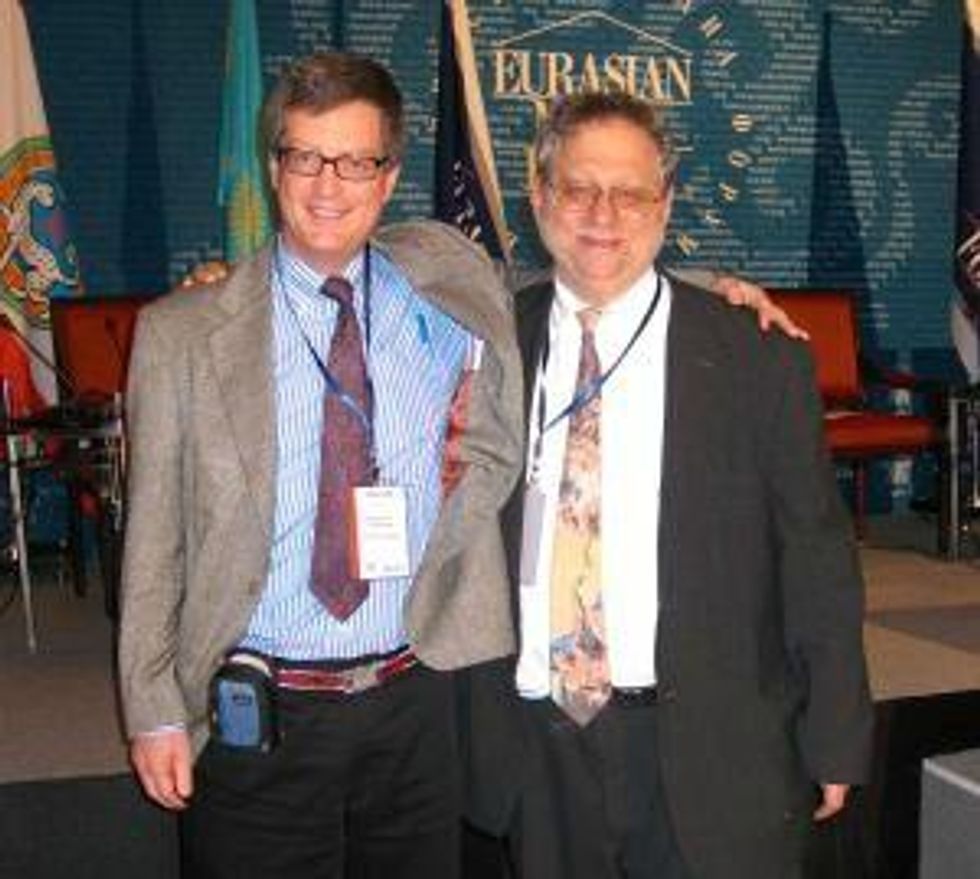
Back to Kazakhstan. It was because of Danny that I was invited to speak at the Eurasian Media Forum -- he'd attended previous forums, and he recommended me to moderate one panel and participate in another. It was what you might call a semi-legitimate event, held, it seemed, to bolster the image of the president's daughter, Dariga Nazarbayeva, who is in charge of the forum every year.
Some of the journalists who attended struck me as nauseatingly obsequious to their hosts, but not Danny. Taking his cheerful defiance as my inspiration, I left the hotel (something that was not encouraged by the organizers) to interview Adil Nurmakov, an editor for Global Voices Online and a member of the political opposition.
Danny was especially delighted at the outdoor party that ended the forum. As scantily clad young women danced to loud, vaguely Kazakh-sounding music, Danny yelled in my ear, "This is a nominally Muslim country!" He kept repeating something one of the Kazakh attendees told him about the display of female flesh: "Ach! This is nothing!"
Danny's father, Jerry, died just six years ago at the age of 90. Unlike Jerry Schechter, Danny was not granted the gift of longevity. But he packed a lot of living into his 72 years and touched many lives. Today my heart goes out to his family and friends, including his longtime business partner, Rory O'Connor.
Danny Schechter was a giant of journalism and of progressive politics, demonstrating that the two could be combined with passion and integrity. It's hard to believe that he's gone.
The progressive community in the U.S. and beyond is mourning the loss and celebrating the life of friend and colleague Danny Schechter on Friday after news broke that the veteran journalist, filmmaker, and warrior for social justice died on Thursday after a battle with pancreatic cancer.
A note posted late Thursday night on the Mediachannel website, which Schechter co-founded, said simply:
There's no easy way to say it.
Our friend Danny died earlier today.
He was, and is, loved.
Since his days on local radio in Boston in the 1960s and 70s--where he first became known as the "News Dissector"--Schechter was one of the key U.S.-based journalists and activists speaking out on the issue of Apartheid in South Africa and among the most consistent and insightful voices across the media landscape focused on unjust wars, racism, economic inequality, and the scourge of the corporate-dominated media outlets which persistently refused to cover such issues.
"No one who was in Boston during the days of 'Danny Schechter Your News Dissector' can ever forget the exhilaration of those marvelous broadcasts, their enlightenment and insight and humor, often in dark days. A wonderful person, a valued friend."
-- Noam Chomsky"Danny Schechter was a legend," said Jeff Cohen, founder of the media watchdog group FAIR and Ithaca College journalism professor, after hearing about the death of his mentor, friend and colleague. "Danny was a legend in the U.S. movement against South African apartheid and a legend in the independent media community since the late 1960s. He was a mentor to so many of us. He always had time for other journalists and activists. When I think of him, I think of the Jewish word 'mensch' - a good person, a person of honor and integrity."
"If there was a Godfather to the modern media-reform/media-democracy movement," Cohen continued, "it was Danny."
Noted social activist and MIT professor Noam Chomsky, in an email to Common Dreams, expressed sadness over the loss and said, "No one who was in Boston during the days of 'Danny Schechter Your News Dissector' can ever forget the exhilaration of those marvelous broadcasts, their enlightenment and insight and humor, often in dark days, a legacy that Danny left behind him when he went on to a remarkable career of critical analysis and breaking through media and doctrinal barriers. A wonderful person, a valued friend."
Annie Leonard, founder of the Story of Stuff project and executive director Greenpeace, declared on Twitter: "The good side is one man down tonight."
Journalist Jeremy Scahill, in a tweet tagged #RIP, called Schechter "one of the great innovators of the indy media movement."
"If there was a Godfather to the modern media-reform/media-democracy movement, it was Danny."
--Jeff CohenDan Kennedy, a friend and fellow Boston-based journalist, in a blog post on Friday celebrated Schechter's dual legacy as both chronicler and participant of contemporary struggles. "He was a giant of journalism and of progressive politics," writes Kennedy, "demonstrating that the two could be combined with passion and integrity. It's hard to believe that he's gone."
Schechter got his start as "The News Dissector" in 1970 at WBCN-FM in Boston. He went on to become a prolific television producer who won two Emmys. He was executive editor of MediaChannel.org, co-founder and executive producer of Globalvision production company, and the author of twelve books, including The More You Watch, The Less You Know.
Schechter made six non-fiction films about Nelson Mandela, including "Mandela in America." In January he had just published, When South Africa Called, We Answered: How the Media and International Solidarity Helped Topple Apartheid. In 1988 Schechter created and executive-produced the weekly news program "South Africa Now" that aired on 75 public and cable TV stations. He also co-produced "Rights & Wrongs: Human Rights Television."
Fellow journalist Rory O'Connor, Schechter's closest collaborator and business partner for decades, wrote this on Facebook: "RIP Brother Danny Schechter...What a long, strange trip it was! See you on the other side, partner."
"He was a giant of journalism and of progressive politics, demonstrating that the two could be combined with passion and integrity."
--Dan KennedyAnd in a later statement, O'Connor elaborated:
Danny always used to say that he got into making media because he wanted to do something about the problems of the world. ("It was until later," he would then add, "that I learned the media was one of the problems of the world.") He was the original "jactivist" -- part journalist, part activist, always involved.
And he did "do something" about the world's many problems, or at least tried. From Chile to South Africa to Vietnam to Bosnia and beyond, and from apartheid to human rights to the corporate media to the American economy "before the bubble burst," the world not only often heard it first, it also heard it right -- often years before they heard it anywhere else -- from the News Dissector.
I was proud to be his partner in Globalvision, the fiercely independent media firm we co-founded, and prouder still to be his friend. I'll miss him greatly -- but the world will miss his unique voice even more.
A longtime contributor to Common Dreams, Schechter's columns stretched the gamut but never strayed far from his core vision of cutting through bullshit, advocating on behalf of the vulnerable, and calling out injustice. Among scores and scores of others, some of the articles that stood out on a quick survey include:
A Facebook page set up by his daughter, Sarah Schechter, was acting as an online memorial where "people could share their memories of the one and only news dissector."
One contributor wrote, 'Today, we lost a journalist's journalist, the moral commander of investigative reporters from New York to Johannesburg.' Another said, 'He [knew] how to fight for what's right. He lived and breathed it and the world is a better place because he did. Hamba Kahle Danny. Thanks for everything.'
Tributes have so far appeared at Democracy Now!, The New York Daily News, Alternet, and by investigative journalist Greg Palast.
"One of the great original multi-taskers," wrote Alternet's Don Hazen, "Schechter was an independent filmmaker, author of a number of books, a blogger, and media critic whose insights about the failures of the global media system were incisive and widely appreciated. Later in his career he embraced new technology, creating the Media Channel where he called himself 'blogger-in-chief.' A brilliant speaker and strategist, Schechter was a true a global leader, traveling to dozens of countries, making connections, shooting footage and giving rousing speeches. Schechter was the special kind of leader-activist who had deep cultural roots, weaving music into his quest to improve human rights globally. He will be missed."
On Twitter, the sharing grief and celebrations of life, continued:
President Obama traveled to Soweto, South Africa this week for the memorial service for former president and anti-apartheid movement leader Nelson Mandela. Over 60 heads of state also attended the services, but only five were invited to speak - among them Cuban president Raul Castro, with whom Obama shook hands - the first such greeting between the presidents of the United States and Cuba since President Bill Clinton shook hands with Fidel Castro on the sidelines of a U.N. summit in 2000. Obama's handshake with Castro was condemned by a number of Republican members of Congress. Senator John McCain likened it to Neville Chamberlain shaking hands with Hitler, while perennial Cuba-hater Rep. Ileana Ros-Lehtinen - who in the past has openly called for Fidel Castro's assassination - called it "a propaganda coup for the tyrant [Castro]." Cruz made headlines for himself by walking out on Castro's speech at the ceremony, with a spokesperson saying that "Sen. Cruz very much hopes that Castro learns the lessons of Nelson Mandela."
But while Republicans have received attention for their criticism of the handshake - just as they did when Obama similarly greeted democratically-elected then-president of Venezuela Hugo Chavez in 2009 - Obama's speech at the event has been described by some as a rebuke of some foreign governments, including Cuba's. "There are too many of us who happily embrace Madiba's legacy of racial reconciliation, but passionately resist even modest reforms that would challenge chronic poverty and growing inequality," he said without apparent irony, while in Singapore a U.S. delegation was concluding (unsuccessfully) the latest round of efforts to get other countries to agree to a variety of controversial and potentially harmful measures in a proposed Trans Pacific Partnership (TPP) trade deal. As we have described in a research paper, most U.S. workers would lose out from the planned TPP in the form of reduced wages.
As many analysts, historians and observers have pointed out, the condemnation of the Obama-Castro handshake is also ironic considering Mandela's long appreciation for the Cuban government and its unwavering opposition to apartheid and similar racist regimes in Rhodesia (now Zimbabwe), Mozambique and South Africa. Most notably, Cuba provided 36,000 troops to beat back the efforts of the South African military to crush independence in Angola.
As the Huffington Post's Roque Planas points out, while Cuba provided Mandela, the African National Congress and South Africa with inspiration, guidance, resources, training and doctors, "The U.S. government, on the other hand, reportedly played a role in Mandela's 1962 arrest and subsequently branded him a terrorist -- a designation they only rescinded in 2008. In 1986, President Ronald Reagan vetoed the Anti-Apartheid Act." Then there's the small matter of U.S. and South African support for the counter-revolutionaries in Angola. As Piero Gleijeses, a professor of U.S. foreign policy at the Paul H. Nitze School of Advanced International Studies at Johns Hopkins University and author of several books including Visions of Freedom: Havana, Washington, Pretoria and the Struggle for Southern Africa, 1976-1991 said yesterday in an interview with "Democracy Now": "...the role of the United States as a country, as a government, past governments, in the struggle for liberation of South Africa is a shameful role. In general, we were on the side of the apartheid government. And the role of Cuba is a splendid role in favor of the liberation."
The Republican members of Congress are not alone in attempting to rewrite history and remake Mandela in their image. Notably, various world leaders past and present who supported apartheid and Mandela's imprisonment have gushed over what a great man he was now that he's passed on. But Mandela maintained integrity in his outspoken criticism of the U.S., saying that "If there's a country that has committed unspeakable atrocities in the world, it is the United States of America. They don't care." Such sentiments are reminiscent of Dr. Martin Luther King, Jr.'s statement that the U.S. is "the greatest purveyor of violence in the world," and his outspoken condemnation of the war in Vietnam, which earned him the wrath of the foreign policy establishment and the media - when he was still alive.
In contrast, British Deputy Prime Minister and leader of the Liberal Democrats Nick Clegg used the occasion of a Special Session honoring Nelson Mandela to call on the House of Commons to support human rights activists in Afghanistan and Honduras:
Right now, all over the world, there are millions of men, women and children still struggling to overcome poverty, violence and discrimination.
They do not have the fame or the standing of Nelson Mandela, but I'm sure that he would tell us that what they achieve and endure in their pursuit of a more open, equal and just society shapes all our lives.
Campaigners like Mary Akrami, who works to protect and empower the women of Afghanistan; Sima Samar, the Head of the Afghan Independent Human Rights Commission; or organisations like the Committee of Relatives of the Detained and Disappeared in Honduras which works in the shadow of threats and intimidation.
They are just 3 examples of the individuals and organisations who deserve our loyalty and support just as much as the British campaigners in the Anti-Apartheid movement in London showed unfailing loyalty and support towards Nelson Mandela in his bleakest days, and here I also want to pay tribute to the Rt. Hon Member for Neath and his fellow campaigners for what they did at the time.
U.S. Ambassador to Honduras Lisa Kubiske also made remarks on human rights in Honduras, Tuesday, International Human Rights Day. She condemned campesinos and others resisting murder and brutality in the Aguan Valley, and indigenous Lenca communities fighting the imposition of development projects on their land over their objections. In Honduras' context of political repression and rampant impunity for security forces who commit abuses, such comments further imperil some of Honduras' most vulnerable and historically disenfranchised communities.
WEST PALM BEACH, FLORIDA - In all of the economic issues we are dealing with, there is always a "back story, a deeper context" that is usually missing, "disappeared" like those Allende supporters in Chile in the 1970s who wanted to empower workers, not just rescue them when they get buried in a deep hole.
Most deeper issues go uncovered. Luis Campos, Director of the School of Anthropology at Chile's Universidad Academia de Humanismo Cristiano, points out, "more buried than the miners themselves, the demands and the rights of the indigenous population continue to be flouted and unrecognized in our country."
Many unsafe mines worldwide are still at risk from China to Zambia.
Who woulda thunk--certainly not the 1300 "journalists" on the scene-that this mine disaster had its origins in the era when Richard Nixon and Henry Kissinger helped snuff out an emerging popular democracy in the name of protecting what West Palm Beach-based writer and former economic "hit man," John Perkins, calls the corporatocracy.
Historian Juan Cole poses these questions:
"Are copper and gold mine owners stronger in relation to workers and have they escaped government regulation because the US engineered a coup in 1973 to destroy the Chilean Left?
"Was the San Esteban mining company's ability to marginalize the union and to disregard input from the workers rooted in American-imposed corporate privilege? In other words, was the trapping of these workers in the first place Richard Nixon and Henry Kissinger's fault?"
That deep hole in that Chile mine was caused in part by a gold rush there--triggered, in turn by, a global financial crisis MADE IN THE USA. It had its counterparts in the US and, not just among those 29 miners who perished in the Big Main mine in West Virginia, last April, a disaster that was supposed to lead to new safety rules that the Republicans have been insidiously blocking.
There is another hole we need to focus on. Millions of us are trapped in our own mines, "underwater" in homes that have lost value with bills we cannot afford, trapped in unemployment, in jobs that are gone and not coming back. Poverty is up and the noxious Newt Gingrich wants to end the food stamps that so many now depend on.
There is no rescue in sight, and the human plight of most of the millions affected takes part outside of media sight.
The gaggle of reporters that covered the mine rescue as a human-interest story--not a political issue--missed the back-story there, just as they miss our own here.
Far fewer reporters are covering this crisis?
Here in Floriduh, one epicenter of the housing catastrophe, homeowners were shell-shocked by the latest fraudclosure crime wave. Denise Richardson writes in the Sun Sentinel
"Last I knew, knowingly signing documents fraudulently and using them in a court of law is frowned on, right? It's criminal, isn't it? Or is it only criminal if you are a homeowner and not a bank? Seems we've gone to great lengths to create and then accept a double standard here.
Perhaps these financial crimes--yes, that's what they are, crimes--continue to happen because we never addressed the real problems to begin with. You can't fix a problem you don't acknowledge. Does anyone believe that was done to help protect the rights of homeowners? Let's call it what it is: fraud."
An attorney in Deerfield Beach Fla., representing 3000 foreclosure victims, has taken hundreds of depositions from Bank employees who admit they knew nothing about the details of the evictions they signed off on. Many are now being put down as "Burger King Kids" yet they know more about real whoppers than this lot knows about real estate. RealtyTrac reports that foreclosure and REO homes accounted for 24 percent of all residential sales during the second quarter? That is huge!
Here in relatively affluent Palm Beach County, homeowners are Number l in the state for the average number of loans in foreclosure that are delinquent. It has the fourth highest number of foreclosures, 45,829 with an average delinquency of 623 days. You will recall that Bernie Madoff once turned Palm Beach into a hunting ground for his ponzi scheme.
This situation is worse than we realize, and not just for the people most directly affected. No one knows how much the banks will lose in the class action suits, fines and legal actions to come. Some think it could be tens of billions suggesting another bailout may be in the offing, probably by the Federal Reserve Bank.
Paul Krugman questions whether the banks had the right to seize many of these homes, arguing, "The mortgage mess is making nonsense of claims that we have effective contract enforcement -- in fact, the question is whether our economy is governed by any kind of rule of law."
Buried in the Business section, on page B-8 of the New York Times, way down in an article saying the banks may be on the hook for billions, was this very revealing paragraph speaking to a problem that I have been raising for years making clear the fraud problem is not just with foreclosures.
"Inside the investment houses, several traders said nerves were frazzled further by worries that banks could face much bigger mortgage related losses, not from foreclosures, but because of questions about how the money was lent in the first place. If it turns out that mortgages were bundled together and sold improperly, more holders could sue the banks and force them to buy back tens of billions in mortgage-backed securities."
Frazzled nerves so far seem the worst punishment the banksters have tasted. They have just decided to reward themselves with a new round of raises and bonuses worth $144 billion with few criticisms. The Government has meanwhile just "settled" for $73 million with Countrywide, the leading predatory lender. That means that a prosecution of its top executives, the poster boys for mortgage criminality, will be dropped. Notes the website Housing Doom:
"Even having to pay $77.5 million, Mozilo still nets $61.5 million, just between November 2006 and October 2007. Maybe "crime doesn't pay," but one of the lessons of the housing bust is that fraud does."
What should be done? Webster Tarpley speaks for many in calling for a national moratorium on foreclosures, a course of action rejected by the White House:
"The current chaos in home foreclosures is once again the direct responsibility of the zombie bankers themselves, who have neglected all traditional legal and accounting standards concerning the necessary paper trails in their frenzied desire to securitize mortgage loans and make them into toxic derivatives in the form of asset-backed securities and mortgage backed securities. The zombie bankers, already the recipients of $24 trillion of public largess in the form of the various bailouts, have turned out to be incompetent even in the technical aspects of their own thieving racket.
But the chaos in the bankers' filing systems is nothing compared to the chaos created by the millions of foreclosures they have engineered, based on adjustable-rate mortgages and similar misleading contracts which never should have been legal in the first place. For some time, it has been evident that the defense of the American middle class requires a blanket, orderly, federal freeze (or moratorium) on all foreclosures on primary residences, similar to the New Deal protections offered to family farms by the landmark Frazier-Lemke Act of 1935-1949 during the previous depression."
Ellen Brown, author of Web of Debt, goes further in Yes Magazine, asking if it is "Time to Break Up the Too-Big-to-Fail Banks"
"Popular financial analysts, crippling bank losses from foreclosure flaws appear to be imminent and unavoidable. The defects prompting the "RoboSigning Scandal" are not mere technicalities but are inherent to the securitization process. They cannot be cured. This deep-seated fraud is already explicitly outlined in publicly available lawsuits.
There is, however, no need to panic, no need for TARP II, and no need for legislation to further conceal the fraud and push the inevitable failure of the too-big-to-fail banks into the future."
The faux populists of the Tea Party right have been silent on the issue. Glenn Beck dropped all populist pretensions by calling on followers to give money to the Chamber of Commerce so they can better pursue a corporate agenda. One Republican here assured me that Barney Frank caused the whole financial crisis and that he will be tossed out of office in the midterm election. (He didn't just blame him--he hates him!) At the same time, one right wing website did publish a detailed denunciation of housing fraud.
https://dailycaller.com/2010/10/14/thedc-op-ed-one-nation-under-fraud/
As depressing as the lack of any real ongoing mass-based populist movement of the left or the right is another reality that the Washington Post finally spills even as millions of Americans buy into the illusion that new politicians can save us while angry voters here in Florida prepare to vote the Tea Party in to office:
"Let us tell you an Ugly Truth about the economy, a truth that no one in power or who aspires to power wants to share with you, at least until after the midterm elections are over. It's this: There is nothing that the U.S. government or the Federal Reserve or tax cutters can do to make our economic pain vanish overnight."
So what will it be? More money for the banks to bring them under control, more illegal foreclosures, or some type of justice for homeowners? Will this crisis lead us to demand action to break up these financial behemoths or will we just sit by and watch a new crisis sweep us deeper into our own mines of despair?
There is a saying I may be twisting in the retelling to the effect of "what you do unto others will be done onto you." In Karmic terms, it boils down to what goes around comes around. These thoughts come to mind as I wrestle with a dilemma that seems to be worming its way out of the soil of a country at war overseas and with itself.
Earlier this week, I received a friend request on Facebook from one Abdullah Musafir. He identified himself as from the Islamic Emirate of Afghanistan. His wall was filled with Islamic proverbs and reports on the killing of Western forces and battles with "cowardly terrorists," i.e., NATO, Afghan soldiers and US Troops. There were reference to the destruction of "puppet" police vehicles and the use of IEDs.
Clearly it was Taliban propaganda, a side of the war we rarely get in any unfiltered form, as opposed to our propaganda that routinely comes our way on TV and in the press. Theirs is crude; ours is much slicker. Is any of it credible?
Yes, there are also some excellent and gutsy US correspondents there who try to tell the truth, and that truth seems to be we are not winning, which is a way of saying, without saying, that we are losing.
When reports from the battlefield appear in the print press, there is usually some background like reports that military units worry about hostility from the people they are ostensibly there to defend. (Over 80% of Afghans surveyed BEFORE the ongoing Khandahar surge were against it!)
General Petraeus speaks of facing an "industrial strength insurgency." He is reported to be welcoming reports that Taliban commanders want to talk with our Karzai regime. That is supposedly a good thing, maybe the only way out in Afghanistan. (Of course, we want them to talk only on our terms as in: lay down your arms, pledge loyalty to Karzai's corrupt government, and then, and only then, can we talk. This is, of course, a non-starter, especially when you are on the defensive.)
Now, Karzai has handpicked a 70-person "peace panel" stacked with anti-Taliban personalities. Independent Afghan analyst Maritine van Bijlert believes it will go nowhere, saying, "He is not interested in substantial talks." That is no doubt why Washington is said to be supporting this phony "initiative."
The Taliban has just denied they are talking to a government they claim has no support, so this whole effort may be a deception to try to boost world opinion and divert attention away from the pervasive corruption and a losing war, as in, see, 'we are trying negotiations too!'
At the same time, our corporate media just regurgitates the one-sided poop we have come to expect. You never hear from the other side or even international observers who are not gung-ho US backers. As Fairness & Accuracy In Reporting (FAIR) points out, "The escalation of the war in Afghanistan is treated as something that cannot be debated (see the Sunday chat shows) or as the only thing that might save the women of that country (see Time magazine's recent propagandistic cover)."
When these same stories air on TV, they become classic "bang-bang" war coverage of US troops shooting at the enemy and fighting bravely, The assessments of their performance often lacks background and context. One Afghan province looks like another. Our atrocities are rarely reported.
The assumption seems to be that if you get information from the "enemy," you become the enemy. Huh? Two Al Jazeera journalists were recently jailed for talking to the other side -- but then released. This shows the information control focus that is part of our "Perception Management" strategy.
It is not working with 60% of the American public now opposing the war.
Even as the Obama Administration expands the use of brutal drone attacks that so often kill civilians, over Pakistani objections, and Petraeus threatens to expand the war into Cambodia, oops, Pakistan, without Congressional approval, it's deja vu stalemate all over again.
But does that mean that American journalists like myself shouldn't talk with or write to or even "friend" someone on the other side? I recently asked this question on my Facebook "wall" seeking advice from the people who have opted to "follow me." (We all know this more a fiction than a platform for real friends.)
I was amazed when my request for advice triggered 58 comments. Many were genuinely concerned about my safety. Some thought I was going there; others worried that it could lead to an outrageous FBI raid, as is taking place in the Mid-West, or being put on the No Fly List. One suggested I could be in Gitmo by Christmas.
Apparently, guilt by association is alive and well. You can easily become an "enemy" if you have the wrong friends. Big Brother is back, if he ever left.
Many warned that we have no real online privacy especially with the Obama Administration threatening to monitor, and, when think necessary, shut down the Internet. (Wasn't Joe Lieberman the first to recommend the practice already followed in China and other countries?)
This paranoia and blow against freedom is being fed by what political scientist Michael Brenner calls a "phony war," writing,
"Warnings are sounding about the growing menace to the U.S. homeland from "homegrown terrorism." A recent Congressional Research Service purporting to quantify that increased risk has created a stir. All this angst needs to be placed in dispassionate perspective. America stills lives in an acutely anxious post-9/11 state...
"My personal judgment is that the war on terror, on balance, has had two dire effects: one, we are less safe as a consequence due to the great number of persons that our actions have recruited and motivated to support terrorist acts against the United States; and, two, we have seriously weakened our civil liberties.
"Moreover, the number of persons and institutions with vested interests in keeping the terrorism industry thriving ensures that these costs will mount over time."
I keep thinking of a book written about Saddam's Iraq called "Republic of Fear." That title could be applied to a book about the USA today.
So what to do about Abdullah, the holy warrior in Afghanistan and a wannabe "friend?" Is even looking at his post the equivalent of viewing porn yet? If I friend him, does that make me a Taliban supporter?
I decided to write him to tell him that rather than become "friends," he could send me his "news" via email and so he will be in the company of so many others like Newt Gingrich, the Tea Party, The Repugs, The Minutemen, The Birthers, The Birchers, The Israeli hardliners, the Mosque Marauders et al who just love to inundate/litter my in-box with their "urgent communiques" forcing me to waste time hitting delete.
He wrote back inviting me to visit their website, but warned that it is often hacked. I wonder who would have the means and the motive to do that?
We can't ignore what such a powerful force is saying.
Fascinating that this should occur as the new Facebook Movie opens nationwide.
I don't have to see it. I am living it.
In Washington, the Obama economic
team has sprung a leak. First, Budget Director Peter Orszag, the calculating
numbers savant, bailed. And now, "distinguished" economist Christina
Romer, the only woman in that inner circle boys club has quit too. (Would
you want to be around Larry Summers all day long?)
In Washington, the Obama economic
team has sprung a leak. First, Budget Director Peter Orszag, the calculating
numbers savant, bailed. And now, "distinguished" economist Christina
Romer, the only woman in that inner circle boys club has quit too. (Would
you want to be around Larry Summers all day long?)
Why this crew of losers wasn't
fired eludes me despite their claims of having prevented a worse collapse.
No doubt, they know more than they are saying, and, perhaps, now that
they are no longer selling, they may be willing to do some telling on
just how bad it is and what went wrong.
Who's next? Could Ben
Bernanke be leaving the Fed for Fed-Ex?
Economist Max Wolfe has none
of the political restraints of power. At the news of another 131, 000
jobs gone, at all the talk of permanent unemployment as the "new normal,"
he sighed with a tinge of optimism:
"We have been in the present
labor market swoon since December 2007. We are 30 months into the process.
Nearly everything is not getting worse fast. Most economic indicators
have seen slow, uneven progress. We are a weary nation and hope,
is running low. All lethality is dosage and we have received a massive
dosage- an overdose- of bad economic news since the winter of 2007.
Things are getting ever so slightly less bad in the aggregate."The sheriffs of this rough
economic neighborhood are running low and out of ammunition. The populace
is fed up. Our Sheriffs are The Treasury and The Fed and they have spent,
cut taxes, slashed rates, bought securities and ballooned their balance
sheets. They have made the bad less worse, but not appreciable better
enough for many. All that economic toxin still pumps the blood of this
economy. Now, the state is having a contractionary
direct impact on employment."
"Contractionary"? I am
a first-time contractionary word user so I will leave it to Stephen
Colbert to take that term apart, but it can't be a good thing.
The bigger surprise is being
buried. The more serious problem is more systemic and rooted in the
structure of our economy. These structural problems used to be referenced
to show how deep the rot goes and why more fundamental reforms are needed,
but now, as Paul Krugman has argued, this very idea is now being used
to encourage acceptance of the problems because they are beyond repair,
as in, "we can't change that because it is, so, um, 'structural'!")
Thus, the existing power relations can't be questioned because they
are the existing power relations
Makes sense, doesn't it?
Part of the problem is that
while the livelihoods of workers and homeowners are sinking, the economic
and political elite is doing just fine, as the Automatic Earth Website
explains:
"Perhaps
what we witness is an ongoing and deepening chasm that divides the world
of finance and politics on the one hand and the world of everyday people
on the other, as Rasmussen Reports indicates: 67% of Political
Class Say U.S. Heading in Right Direction, 84% of Mainstream Disagrees. This chasm was greatly
facilitated by governments relying on policies based on the notion that
too-big-to-fail -financial- institutions needed to be bailed out at
any cost. Later in the year, as a direct consequence of these policies,
we will see another round of insane banker and trader bonuses, just
as citizens' sentiments and incomes fall, and unemployment and poverty
keep rising."
When you
create and enable a casino economy, the public becomes a player too,
taking risks they shouldn't at the behest of bankers and finance companies
who assure them all is fine.
Last week,
Countrywide, the country's mortgage fraud factory, reached a settlement
with the SEC for more than Goldman Sachs settled its last complaint
for a whopping $600 million. Their shark-in-chief, Anthony Mozillo,
still facing a criminal investigation, later said he was pleased when
the federal regulators admitted that the investors were not defrauded,
because they knew what kind of projects they were funding. How reassuring!
So the circle
of complicity widens. We now learn that the companies and individuals
that invested in the subprime/subcrime mortgages KNEW people were being
ripped off but did it anyway because there was so much money to be made.
And because
security laws only protect investors, who were defrauded, many have
no case. What about the borrowers, the homeowners now facing foreclosure?
They are apparently not worthy of protection. This is comparable to
the Madoff investors who profited in his illegal scheme and knew his
returns were too good to be true but shoveled money to him anyway.
They became partners in the ponzi, not just "victims" trying to
be made whole.
Is anything
changing? The banks say they will not change the way they finance
mortgages so it is still buyer beware. The Wall Street Journal reports
another instant crash of the markets is possible. And General Motors
that was down and on the way out is back thanks to the government's
largesse but sniping at its rescuers, insisting an end to government
ownership would be good for their image and "employee morale." Huh?
"We want
the government out period," blusters GM's ungrateful CEO Edward
E. Whitacre Jr. This same company recently spent $3.5 billion buying
a new subprime lending company to replace GMAC, the GM lender whose
bad loans sunk GM. On top of that, these geniuses just produced The
Volt electric car that sells for $40,000, hardly a brilliant move in
this economy. Of course they blame all their problems on the government,
never themselves.
Like so many
others, they seem to be banging on Obama, everyone's target of choice.
If that's your inclination, let's blame him also for what he has
not done.
He hasn't
led a consistent push back against Wall Street, perhaps because he hopes
in vain that big business will create private sector jobs and wants
to show naysayers how pro-business he really is. This has turned him
into an inversion of FDR.
As Ezra Klein
of the Washington Post observed: "The reality is that America's
supposedly anti-business president has led an extremely pro-business
recovery.
Businesses
are sitting on about $2 trillion in cash reserves. Business spending
jumped 20 percent last quarter, and is up by 13 percent against 2009.
The Obama administration has dropped taxes for small businesses and
big ones alike."
So much
for that canard.
Is there anything
to be done? There is no shortage of proposals for jobs programs
and taxes on transactions, for tougher rules on derivatives, and imposed
compensation limits. In most cases the US, with pressure from
Wall Street and its political allies, has opted for easily maneuvered
around and malleable regulations.
One small reform
has been proposed by the much-maligned Ralph Nader for those of us who
live in the appropriately named "Empire State," one that currently
shelters a Wall Street where hedge fund managers make billions.
Nader notes, "Low-moderate and middle-income New
Yorkers already pay a higher percentage of family income in state and
local taxes than do the richest one percent of New Yorkers!
"Surprisingly, there is a simple
way to eliminate the state deficit and prevent tens of thousands of
layoffs and large service cutbacks.
What most New Yorkers do not
know is that for about a century there has been a state stock transfer
tax on purchases of securities. This year, this tax, similar to ones
imposed in 30 other countries, will amount to about $16 billion. Amazingly,
since 1979, this tax has been instantly rebated by New York State back
to the brokers or clearinghouses who paid it. A 100% rebate every year
for the bailed out industry that caused the recession and its immense
human damage."
Putting a stop this sleazy
practice could be as important in phasing out the Bush tax cuts but
so far it's not on anyone's agenda, Dems, Repugs or Media.
Maybe because they think of
it as "structural."