

SUBSCRIBE TO OUR FREE NEWSLETTER
Daily news & progressive opinion—funded by the people, not the corporations—delivered straight to your inbox.
5
#000000
#FFFFFF
To donate by check, phone, or other method, see our More Ways to Give page.
Daily news & progressive opinion—funded by the people, not the corporations—delivered straight to your inbox.
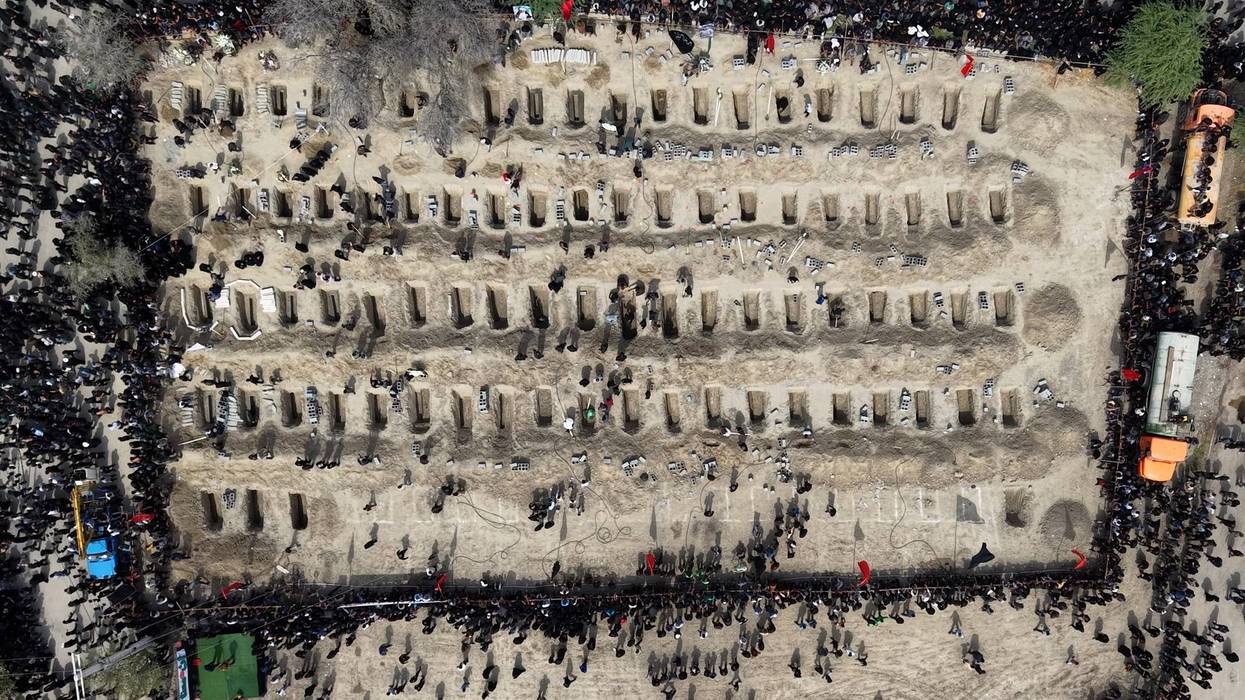
The massacre at a school in the city of Minab is not an isolated case, but rather an example of broader brutality and also a window into how the US systematically downplays civilian death and suffering.
After the breakdown of talks in Pakistan, the ceasefire between the US and Iran is more fragile than ever, and now seems likely to give way to a new phase of the war. The ceasefire and talks have failed to end Israel’s devastating attacks on Lebanon or to negotiate international access to the Strait of Hormuz, now under Iran’s control.
The world must use this pause in the war to push for a permanent ceasefire and peace agreement, but we must also start to assess the true human cost of the war–something the US is always reluctant to do in its wars, from Vietnam to Iraq to Afghanistan. While we always know the exact number of Americans killed in these wars, we never have an accurate tally of how many people we have killed–not only because it is often hard to get the data, but also because the US systematically downplays civilian casualties and treats their lives as less valuable.
We saw this from the very first day of this war. The US carried out a double-tap strike on a girls’ elementary school in Minab, killing 175, mostly young girls. Trump’s response was to blame Iran: “In my opinion, based on what I’ve seen, that was done by Iran,” he said, and later suggested that Iran might have gotten hold of a Tomahawk missile and used it to kill its own people.
Minab is not an isolated case—it is a window into a much broader failure by the US government and media, as well as the Iranian government and international media, to honestly reveal the human toll of this 40-day war.
The Iran Health Ministry’s casualty figures have not been updated in any detail since March 29, when it put Iranian casualties at 2,076 killed and 26,500 wounded, and there is an obvious mismatch between these two numbers. The ratio between them is much higher than in other wars, or even when compared with the Israeli assault on Lebanon in this war, where Lebanon’s Health Ministry reported 1,830 people killed and 4.927 wounded by April 10, a ratio of 2.7 to 1 between the wounded and the dead.
For further comparison, UN figures for civilian casualties in the war in Ukraine are 15,172 and 41,378 wounded, which is also a ratio of 2.7 to 1. These are certainly under-estimates, like civilian casualty counts in every war, but the ratio between deaths and injuries is realistic, unlike that in Tehran’s casualty figures.
If the Iran Health Ministry’s casualty figures were accurate, it would mean that only one person is being killed for every 13 people wounded. But if the figure of 26,500 people wounded was accurate, and the ratio between dead and wounded was similar to what is found in other wars, we would expect that around 10,000 people have probably been killed.
Looking at other sources, the UK-based Iran International website, on March 31, reported Iranian military, militia and police casualties of 4,770 killed and 20,880 wounded, but did not divulge its sources.
Two human rights groups, HRANA and Hengaw, have also published mortality estimates. HRANA, based in Fairfax, Virginia, in the US, is partly funded by the US government, the aggressor in this war. So its data on war casualties are as suspect as its data for casualties during protests in Iran in December and January that the US used as a pretext for the war.
The other human rights group, Hengaw, is based in Norway and Iranian Kurdistan. It reports a total of at least 7,650 people killed by the time of the ceasefire on April 8, of whom 6,620 were military personnel and 1,030 were civilians.
If the Iranian government’s figure of 26,500 people wounded is correct, Hengaw’s count of 7,650 war deaths would amount to a ratio of 3.5 people wounded for each person killed, which would be closer to what one would expect by comparison with other wars.
But the Health Ministry’s figure of 26,500 wounded is also suspect. The Pentagon claims that US and Israeli airstrikes have hit more than 13,000 “targets,” so 26,500 injuries would amount to only two people wounded for each target attacked. This suggests that the count of 26,500 people wounded is itself an undercount, and that the true numbers of casualties in Iran, killed and wounded, military and civilian, are therefore likely to be much higher than any of the numbers reported so far.
While it is easy to understand why the US government doesn’t want to talk about casualties, it seems that the Iranian government doesn’t want to either. If, as we suspect, the true casualty figures are much higher than the health ministry has reported, it may be hiding and downplaying them to prevent panic among the population and keep up the country’s morale, especially in light of the recent large protests in the country. That could also explain why it has not updated its casualty report since March 29.
The fact that our government and institutional media downplay the importance of accurate casualty figures and make no effort to discover them only makes it more urgent to find them, as we and others have tried to do during previous US wars.
We would encourage all sides, and independent groups, to cooperate in efforts to accurately count the dead and wounded. Why does this matter? In an illegal war, every death is a crime, while every person killed or maimed is somebody’s husband, wife, father, mother, son or daughter. They should all still be alive and whole. The US armed forces should not be killing or wounding any of them. So some might ask what difference it makes whether they’ve killed 2,000 people, 7,000 or even 70,000.
We would say that it is precisely because each life is precious, and because the pain and horror each person suffers in these violent deaths and injuries is so unacceptable, that each one deserves to be counted and considered. Americans, and our neighbors around the world, need to fully grasp the scale of the mass murder that the US government is committing, so that we can all respond appropriately.
The fact that our government and institutional media downplay the importance of accurate casualty figures and make no effort to discover them only makes it more urgent to find them, as we and others have tried to do during previous US wars.
In 2006, three years into the extraordinarily violent US military occupation of Iraq, public health experts from Johns Hopkins University in the US and Mustansiriya University in Baghdad conducted the second of two epidemiological studies of mortality in Iraq since the US invasion.
The study was published in the Lancet medical journal, and it estimated that, during just the first three years of war and occupation in Iraq, they had caused about 650,000 deaths, including 600,000 violent killings. That was more than ten times higher than previously published figures, which were based on compilations of western news reports and reports from the occupation government’s health ministry.
The study’s results were disputed by those responsible for the war and the mass casualties it caused, including US President George W. Bush and British Prime Minister Tony Blair.
But leaked emails revealed that the British government’s chief scientific adviser described the study’s methodology as “close to best practice,” and its design as “robust.” Emails from panicking British officials asked, “Are we really sure the report is likely to be right? That is certainly what the brief implies,” and “…the survey methodology used here cannot be rubbished. It is a tried and tested way of measuring mortality in conflict zones.”
In 2015, the Nobel Peace Prize-winning groups Physicians for Social Responsibility (PSR) and International Physicians for the Prevention of Nuclear War (IPPNW) published a report titled Body Count: Casualty Figures After 10 Years of the War on Terror. In discussing the widely varying mortality estimates for the war in Iraq, the report noted, “Despite the furious criticism it attracted, most experts see the second Lancet study of October 2006 as the most solid estimate of the number of casualties, up to the period of its publication.”
No such comprehensive studies were ever conducted in Afghanistan. The UN published annual civilian casualty figures, but these were only compilations of civilian casualties confirmed by the UN Human Rights Office as it followed up on reports of war crimes and human rights violations reported to its office in Kabul, which excluded any deaths not reported to its office, or that it did not have time to fully investigate.
As is happening with the Iran Health Ministry reports today, the UN’s fragmentary reports were uncritically repeated by the world’s media as if they were realistic estimates of total war deaths in Afghanistan.
Finally, in 2019, after 18 years of war and military occupation, Fiona Frazer, the head of the UN Human Rights office in Kabul, admitted to the BBC that the UN’s reports were not providing a full picture of civilian casualties in Afghanistan.
“United Nations data strongly indicates that more civilians are killed or injured in Afghanistan due to armed conflict than anywhere else on Earth,” Frazer said, but then added, “Although the number of recorded civilian casualties are disturbingly high, due to rigorous methods of verification, the published figures almost certainly do not reflect the true scale of harm."
Hundreds of thousands of Afghans were also killed fighting as combatants on both sides in that war. The world’s media were surprised when President Ghani revealed in January 2019 that 45,000 Afghan government troops had been killed since he took office in September 2014. But the US relied on Afghans to fight other Afghans throughout its failed 20-year war in their country.
Whatever the result of the current ceasefire and negotiations, and for however long the US and Israel keep waging war on Iran, the people of the United States and the world must demand a complete and truthful accounting for the human costs of this war, for which Americans and their government bear the prime moral and legal responsibility. At best, that should include the same kind of independent, scientifically-based epidemiological study conducted in Iraq in 2006.
But the demand for accountability starts with a skeptical public and media who can tell the difference between partial, fragmentary casualty reports and serious estimates of total deaths in a violent war zone, and who care enough to want to know how many people their armed forces are really killing and maiming in this illegal war.

"The American people don't want this war," said Sen. Chris Murphy of Connecticut. "Virtually nothing good happened from sending thousands of Americans to die in Iraq in the 2000s and if we don't learn that lesson then shame on every single one of us."
Sen. Chris Murphy of Connecticut offered immediate push back on Sunday when CNN anchorJake Tapper said a vote against an expected $50 billion request by President Donald Trump to fund his attack on Iran would be seen as "voting against the troops."
"Oh come on," said Murphy, incredulous. "I mean, the American people don't want this war. They don't want this war—they have seen what happens when American troops go into places like Iraq, places like Afghanistan. Ultimately we get a lot of people killed, we waste a lot of dollars. The one thing the people of the American people have been clear about is that they don't want the United States dragged into another long-term war in the Middle East."
Polling has shown that Murphy is correct, with only one out of four people—a mere 25%—in a Reuters/Ipsos poll released last week showing any kind of support for Trump's war of choice against Iran.
"If you support the troops," said Murphy, "then you should vote against this war so that we get our troops out of harm's way. Virtually nothing good happened from sending thousands of Americans to die in Iraq in the 2000s and if we don't learn that lesson then shame on every single one of us."
TAPPER: "You have said you're a 'hell no' on funding the war. We have seen this movie before. We know that vote will be cast as - especially if you run for higher office - you voting against the troops."
MURPHY: "Oh come on I mean, the American people don't want this war." pic.twitter.com/lTB5isM8I7
— State of the Union (@CNNSOTU) March 8, 2026
Trump has yet to make the formal request for the $50 billion in funding, but estimates for just one week of fighting have put the cost of the military operations thus far at something close to $1billion per day.
Murphy has said he is a "hell no" on any additional funding and other members of the Democratic caucus have echoed that message.
"Trump is already spending $1 BILLION PER DAY on his illegal regime change war of choice in Iran," said Sen. Chris Van Hollen (D-Md.) on Thursday. "Now, he's going to ask Congress to give him up to $50 BILLION MORE. My vote: hell NO."
"We could be lowering the cost of health care, but instead Trump is spending BILLIONS on his reckless war with Iran," said Sen. Patty Murray (D-Wash.) on Thursday. "Trump is blowing YOUR taxpayer dollars on war and causing gas prices to spike while he's at it."