
SUBSCRIBE TO OUR FREE NEWSLETTER
Daily news & progressive opinion—funded by the people, not the corporations—delivered straight to your inbox.
5
#000000
#FFFFFF
To donate by check, phone, or other method, see our More Ways to Give page.


Daily news & progressive opinion—funded by the people, not the corporations—delivered straight to your inbox.
"Erdoğan's victory will consolidate one-man rule and pave the way for horrible practices, bringing completely dark days for all parts of society," warned one Kurdish opposition leader.
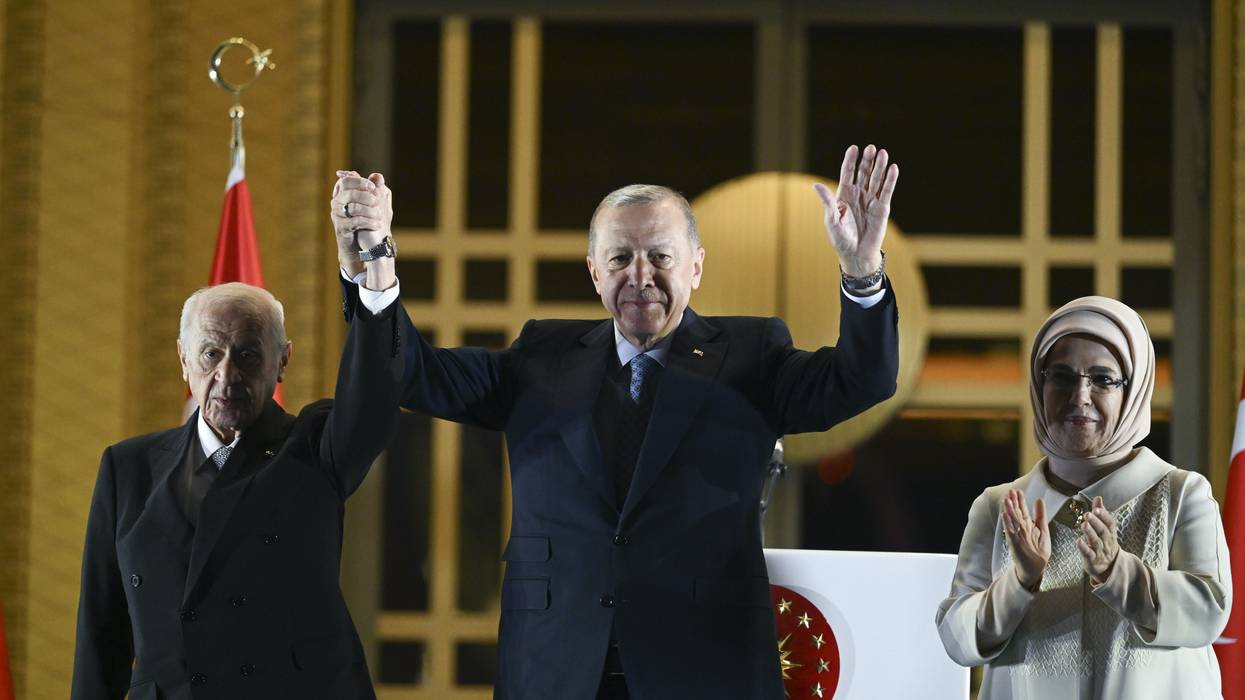
As supporters of Turkish President Recep Tayyip Erdoğan at home and abroad celebrated his win of Sunday's runoff election, human rights defenders and marginalized people including Kurds and LGBTQ+ activists voiced deep fears about how their lives will be adversely affected during the increasingly authoritarian leader's third term.
Turkey's Supreme Election Council confirmed Erdoğan's victory over Kemal Kılıçdaroğlu on Sunday evening. Erdoğan, the 69-year-old leader of the right-wing Justice and Development Party who has ruled the nation of 85 million people since 2014 and dominated its politics for two decades, won 52.18% of the vote. Kılıçdaroğlu, a 74-year-old social democrat who leads the left-of-center Republican People's Party, received 47.82%.
Erdoğan—who was seen handing out cash to supporters at a polling station in an apparent violation of Turkish election law—mocked his opponent's loss outside the president's home in Istanbul, saying, "Bye, bye, bye, Kemal" as the winner's supporters booed, according to Al Jazeera.
"The only winner today is Turkey," Erdoğan declared as he prepared for a third term in which his country faces severe economic woes—inflation has soared and the lira is at a record low against the U.S. dollar—and is struggling to recover from multiple devastating earthquakes earlier this year.
However, in Turkish Kurdistan—whose voters, along with a majority of people in most of Turkey's largest cities favored Kılıçdaroğlu—people expressed fears that the government will intensify a crackdown it has been waging for several years.
Ardelan Mese, a 26-year-old cafe owner in Diyarbakir, the country's largest Kurdish-majority city, called Sunday's election "a matter of life and death now."
"I can't imagine what he will be capable of after declaring victory," Mese said of Erdoğan in an interview with Reuters.
After initially courting the Kurds by expanding their political and cultural rights, Erdoğan returned to the repression that has long characterized Turkey's treatment of a people who make up one-fifth of the nation's population, while intensifying a war against the Kurdistan Workers' Party (PKK), a far-left separatist group that Turkey, the United States, and other nations consider a terrorist organization.
"Erdogan's victory will consolidate one-man rule and pave the way for horrible practices, bringing completely dark days for all parts of society," Tayip Temel, the deputy co-chair of Turkey's second-largest opposition party, the center-left and pro-Kurdish Peoples' Democratic Party (HDP)—which backed Kılıçdaroğlu—told Reuters.
Human rights defenders—many of whom have chosen or been forced into exile—also sounded the alarm over the prospect of a third Erdoğan term.
"If the opposition wins there will be space, even possibly limited, for discussions for a common future. With Erdoğan, there is no civic or political space for democracy and human rights," Murat Çelikkan, a journalist who founded human rights groups including Amnesty International Turkey, said in an interview with Civil Rights Defenders just before Sunday's runoff.
Çelikkan called Erdoğan a "very authoritarian, religious, pro-expansionist conservative."
"Turkey, according to judicial statistics, has the largest number of terrorists in the world, because the prosecutors and judges have an inclination to use anti-terror laws arbitrarily and lavishly," he continued. "There are tens of thousands of people who are being trialed or convicted by anti-terror laws. Thousands of people insulting the president."
"Nowhere in Turkey you can make a peaceful demonstration and protest," Çelikkan added. "The security forces directly attack and detain you. The minister of interior targets and criminalizes LGBTI+ people on a daily basis."
LGBTQ+ Turks voiced fears for their future following a campaign in which Erdoğan centered homophobia in his appeals to an overwhelmingly Muslim electorate and repeatedly accused Kılıçdaroğlu and other opposition figures of being gay. During his victory speech Sunday evening, Erdoğan again lashed out at the LGBTQ+ community while excoriating Kılıçdaroğlu for his campaign pledge to "respect everyone's beliefs, lifestyles, and identities."
Erdoğan vowed in his speech that gays would not "infiltrate" Turkey and that "we will not let the LGBT forces win." At one point during his address, an Al Jazeera interpreter stopped translating a 45-second portion when the president called members of the opposition gay.
Ilker Erdoğan, a 20-year-old university student and LGBTQ+ activist, told Agence France-Presse that "I feel deeply afraid."
"Feeling so afraid is affecting my psychology terribly. I couldn't breathe before, and now they will try to strangle my throat," he added. "From the moment I was born, I felt that discrimination, homophobia, and hatred in my bones."
Ameda Murat Karaguzu, a project assistant at an unnamed pro-LGBTQ+ group, told AFP that she has been "subjected to more hate speech and acts of hate than I have experienced in a long time."
Karaguzu blamed Erdoğan's government for the increasing hostility toward LGBTQ+ Turks, adding that bigots are keenly "aware that there will be no consequences for killing or harming us."
Ilker Erdoğan struck a defiant tone, telling AFP that "I am also part of this nation, my identity card says Turkish citizen."
"You cannot erase my existence," he added, "no matter how hard you try."
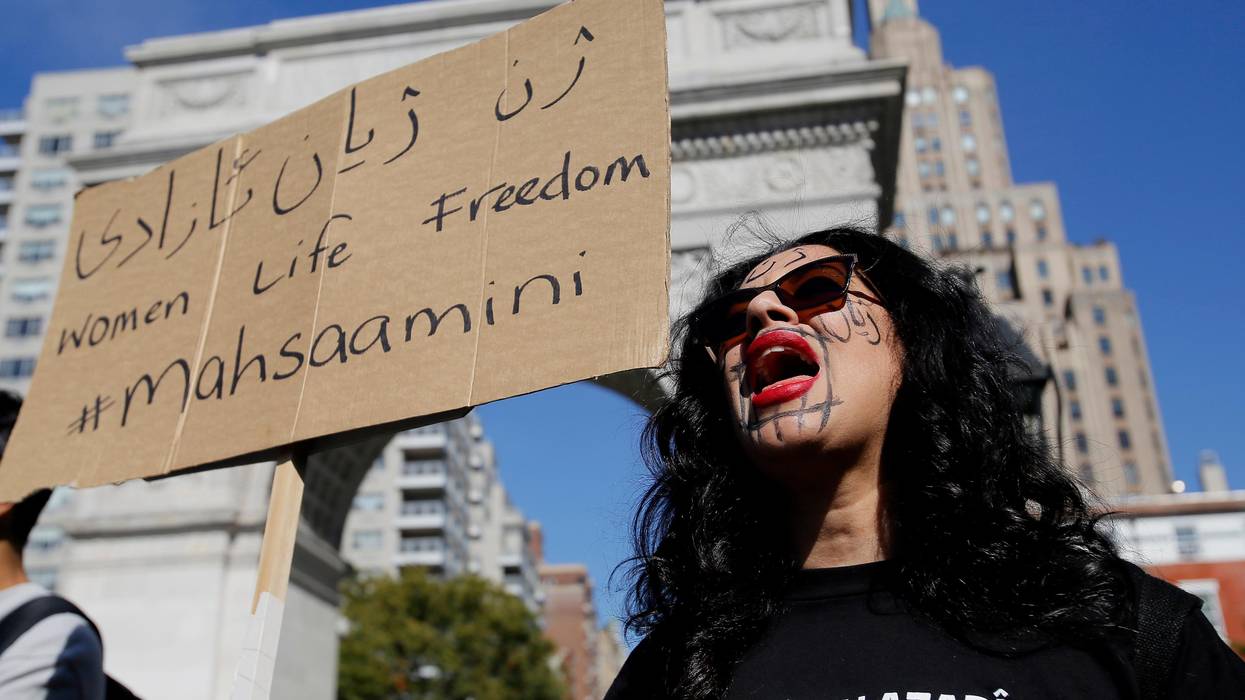
Nearly 40 progressive U.S. organizations on Wednesday expressed support for Iranians--especially women and girls--who are defiantly protesting Iran's oppressive theocracy, even at the cost of what rights groups say is hundreds of their lives.
"As U.S. organizations committed to women's rights and justice across the world, we stand in solidarity with the brave people of Iran, overwhelmingly Iranian women and girls, who are demonstrating for their basic rights and strongly condemn the outrageous, widespread, and systematic human rights violations of the Iranian government seeking to silence the Iranian people's demand," the 39 groups, led by the National Iranian American Council, said in a statement.
The signatories continued:
Since the killing of 22-year-old Mahsa (Jhina) Amini at the hands of Iran's so-called morality police, Iranian protesters have bravely demonstrated for an end to the nation's mandatory hijab laws and broader system of repression. Women's rights have been the catalyst of these youth-led protests: giving voice and momentum to deeply held grievances of many Iranians that go to the very core of a system that has failed to serve its people, which is why these protests have cut across Iranian society.
This injustice is compounded by the reaction of the state to protests, which have been met with internet shutdowns and brutal violence from the Iranian security forces, including beatings, mass arrests, and deadly force. More than two hundred have been killed--and that number is likely higher--and thousands have been arrested for voicing their demands and hopes for a brighter future.
"We steadfastly support the Iranian people's demands of 'Women, Life, Freedom,' condemn the decades of oppression at the hands of the Iranian authorities, and call on them to halt their outrageous violence against peaceful protesters, release all prisoners of conscience, and heed the rightful calls of Iranian people for change," the groups' statement affirmed.
Many of the victims of the Iranian crackdown have been members of ethnic minorities, including Baluchis, Kurds, and Azeris.
One Azeri, 16-year-old Asra Panahi, died after security forces stormed Shahed Girls High School in Ardabil on October 13 and brutally attacked students who refused to sing a song praising Iranian Supreme Leader Ayatollah Ali Khamenei. Iranian authorities dispute the cause of Panahi's death, claiming she suffered from a congenital heart condition.
In what many Iranians now call "Bloody Friday," regime forces shot dead at least 66 Baluchi people, including children, and wounded hundreds more during an attack on worshippers after Friday prayers in Zahedan on September 30.
Some Kurdish-Iranians have fled the country, risking being shot dead by Iranian security forces along one of the world's most militarized borders in a bid to find refuge in Iraqi Kurdistan. Those fleeing include women, some of whom have joined Kurdish armed forces.
One 19-year-old Kurdish-Iranian who made the perilous journey to take up arms in defense of her people described her treatment at the hands of Iranian forces in Sanandaj, a Kurdish-majority city that's seen the biggest protests outside the capital Tehran.
"They pulled my hair. They beat me. They dragged me," the woman, whose real name is not given to protect her safety, told CNN. "At the same time, I could see the same thing happening to many other people, including children."
"I want to fight for the rights of women," she added. "I want to fight for human rights."
Richard N. Ojeda, an Army vet and former West Virginia state representative tweeted out an observation that I would like to reinforce:
Amid the terminal amnesia of the U.S. media, it is refreshing to see someone remember the circumstances under which Trump pulled out of Syria, as a comparison to Biden's Afghanistan. Let us just review that situation.
The so-called Islamic State group in Iraq, ISI, had developed in reaction against the US occupation of that country. It was part of the al-Qaeda affiliate, "al-Qaeda in Mesopotamia," but began styling itself a "state" because it developed the ambition to be more than a terrorist organization, seeking to take and hold territory under the nose of the Americans in Sunni Arab strongholds that resisted the rule of the Shiite-dominated Baghdad government. ISI didn't have a lot of success in the zeroes of this century.
In 2011, when the Syrian revolution broke out, the government of Baathist strongman Bashar al-Assad decided to repress it with military force. Assad with his sniping and tank barrages maneuvered the youth revolutionaries into picking up a gun to fight back, so that he could brand them violent Sunni fundamentalist terrorists and keep the loyalty of the urban middle classes and the religious minorities.
Amid the fighting, ISI came over from northern Iraq into Syria, attracted by the collapse of the Baath government and army in some parts of the country. It declared itself the Islamic State of Iraq and the Levant or ISIL (it meant all of geographic Greater Syria, including Lebanon, Jordan and Israel-Palestine) It split in 2013 because ISIL was behaving in an opportunistic way, shooting fellow fundamentalist guerrillas in the back and poaching on their territory. Al-Qaeda leader Ayman al-Zawahiri kicked them out of al-Qaeda. ISIL predominated in eastern Syria, taking Raqqa province and making Raqqa city its capital. The rest of al-Qaeda,including Jabhat al-Nusra (The Support Front), predominated in northwest Syria where their remnants still are.
The US foolishly thought that ISIL would be a useful lever against Assad, and didn't interfere with it. In 2014 it used its east Syria power base to come across and take 40% of Iraq, launching a phony "caliphate" and declaring war on the West, using social media to encourage attacks on Paris and in the U.S.
The Obama administration finally understood the danger of the organization and mobilized to fight it. Obama did not want to put war-fighting troops on the ground but offered training and logistical and air support. In this model, you need troops on the ground willing to fight. They were easy to find in Iraq, where the Kurds and Shiites were angry about ISIL massacres of their members and both the Iraqi national army (which at first collapsed and had to be rebuilt by the US) and Iraqi Shiite militias allied with Qasem Soleimani's Iranian Revolutionary Guards Corps swung into action against ISIL.
In Syria, Obama couldn't initially find anyone to fight ISIL. The Sunni Arab fighters wanted to defeat Assad way more than they wanted to go against what were sometimes battlefield allies. The Saudis and other allies likewise wouldn't take on ISIL. Turkey wanted to fight the Kurds and did not prioritize the struggle against ISIL- in fact it was pouring arms and ammunition into the ranks of the Sunni rebels, some of which probably reached ISIL, and Ankara did not seem to care.
So Obama could ineffectually bomb ISIL in Raqqa until the cows came home to no good effect. You can't defeat a guerrilla movement from the air.
Then Obama and Secretary of Defense Ash Carter bit the bullet and enlisted Syria's Kurds in the struggle against ISIL. ISIL hates Kurds, who tend to reject its brand of brutal fundamentalism, and had massacred them. The Syrian Kurds had their own militia, the People's Protection Units or Yekineyen Parastina Gel (YPG), the paramilitary of the Democratic Union Party.
The DUP and the YPG had once been communists, but after the fall of the Soviet Union they adopted a cooperativist form of socialism thought up by Brooklyn intellectual Murray Bookchin. The YPG still wore a red star on their uniform in memory of their communist past. So they were strange bedfellows for the Neoliberal, capitalist U.S.
The US added some local Arab tribes to the YPG and called it the Syrian Democratic Forces, but it was basically the YPG.
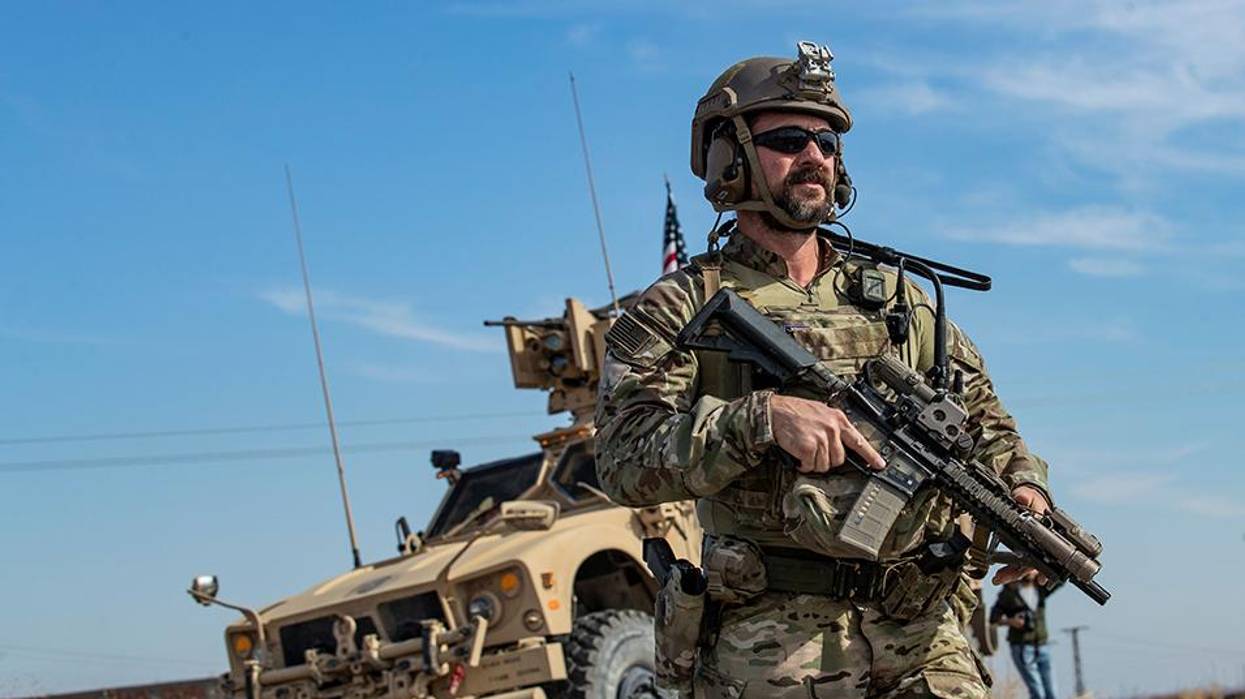
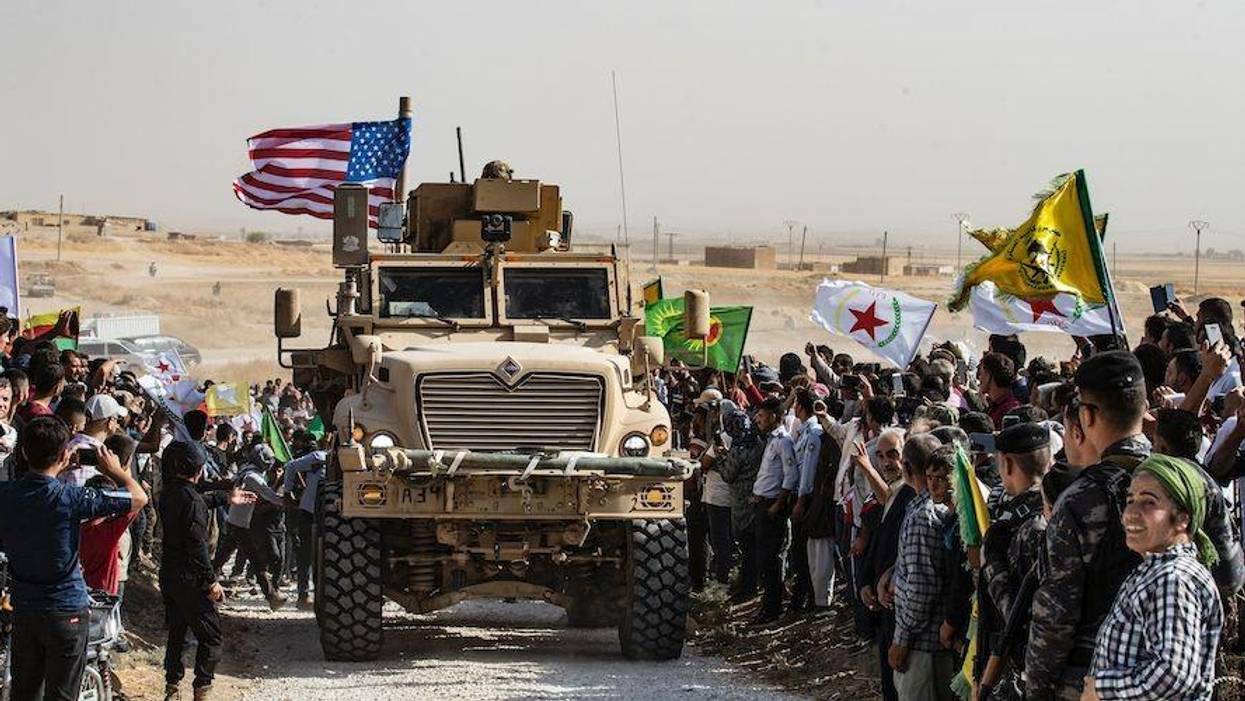
With US air support and 2,000 embedded US special operations personnel, the Syrian Kurds defeated ISIL, taking Raqqa by mid-October of 2017.
Turkey was furious about the US alliance with the Syrian Kurds, viewing them as terrorists and as a branch of the violent Kurdistan Workers Party (PKK) guerrilla movement against which Turkey's military fought a dirty war from in the 1970s.
The US does not view the YPG as at all like the PKK, making a distinction between the Syrian Kurdish Bookchinists and the Turkey-based PKK.
Turkey was fearful that the Syrian Kurds would use their US alliance to arm themselves even better and to consolidate a Kurdish mini-state across northern Syria right on the Turkish border, from which they could spread socialism and Kurdish separatism. (There isn't, however, good evidence of Syrian Kurdish terrorism against Turkey).
In fall of 2019 Donald Trump spoke to Turkish President Tayyip Erdogan and agreed to withdraw US troops from Syria and to allow Turkey to invade the Kurdish regions of northern Syria.
Why Trump did this is still not known, though he once admitted that his Istanbul hotel gave the Turkish government leverage over him.
Trump abruptly pulled out the 2,000 US troops, sending most of them to Iraq but keeping a couple hundred in southeast Syria "for the oil."
And he stood by as the Turkish military invaded the Kurdish regions of northern Syria, displacing thousands of Kurds. These people who lost their homes were the very ones who had supplied the young men to fight alongside the US and defeat ISIL.
ISIL prisoners being guarded by the Syrian Democratic Forces and the US troops sometimes were able to stage escapes in the chaos. There was a danger of ISIL reasserting itself.
Trump evacuated no Kurdish allies at all, as Mr. Ojeda pointed out. He left them to face the Turkish invasion, or the Syrian Arab Army of Assad, or the continued small ISIL terrorist cells. All this was after they had been the only allies on the ground the US could find to polish off ISIL.
Trump had not warned his allies or even Secretary of Defense James Mattis what he was planning to do, and Mattis resigned over it.
In contrast, Biden had announced a year before when he was campaigning for president that he would get out of Afghanistan, and the peace treaty Trump concluded with the Taliban and Trump's reduction of US forces to only 2500 in any case left Biden no choice but to get out. Unlike Trump, Biden arranged for the evacuation of 117,000 Afghan allies of the US.
Both withdrawals were chaotic and posed security challenges. But to see pro-Trump Republican politicians grandstanding and calling for Biden's resignation or even impeachment is a bit rich. None of them wants to remember what their guy did to the Syrian Kurds or the condition in which he left eastern Syria and its ISIL cells.
This was only 2 years ago. It isn't ancient history. What's with the amnesia?
President Trump has stated his intent to withdraw US troops from Syria on several occasions since March 2018. Each time politicians from both the Democratic and Republican parties, supported by the corporate-controlled media, have, based on US imperial interests, vehemently challenged the withdrawal proposal. These folks also based their opposition to withdrawal on their supposed concerns for the Syrian Kurds. Unfortunately, they have shown far less concern about the welfare of Iraqis, Libyans, Yemenis, Afghanis and Palestinians among many other populations suffering terribly due in part to US actions.
It is a telling commentary that few of the so-called elite US political/military/media leaders have raised any concerns about the immorality and blatant illegality of US interventions in Syria and elsewhere. These elite act to advance their own interests and the short-term interests of the US empire, actions that are really counterproductive in the long term. They believe the US can violate international law with impunity since they view it as being the exceptional nation. How has our nation descended to this immoral level?
The US corporate media has played a major role in this descent as it keeps the US public ignorant or misinformed about foreign affairs. For example, few Americans understand that the US and allies such as Saudi Arabia and Israel have long wanted to oust Syrian President Bashar al Assad whom they viewed as an ally of Iran.
U.S. General Wesley Clark, former Supreme Allied Commander Europe of NATO, said that when he was visiting the Pentagon a few weeks after 9/11 he was told of a plan to take out seven nations (Iraq, Syria, Lebanon, Libya, Somalia, Sudan and Iran) over five years. The US failures in Iraq certainly changed the timetable.
This U.S. goal regarding Syria was also openly discussed back in 2005 in an interview with President Assad by CNN host Christiane Amanpour. She said: "Mr. President, you know the rhetoric of regime change is headed towards you from the United States. They are actively looking for a new Syrian leader. They're granting visas and visits to Syrian opposition politicians. They're talking about isolating you diplomatically and, perhaps, a coup d'etat or your regime crumbling. What are you thinking about that?"
In late March 2007, McClatchy News reported the George W. Bush administration had instituted a campaign months earlier to isolate and embarrass Assad. Some officials feared that the campaign's goal was to destabilize Syria and possibly to overthrow the Syrian leader.
In 2011 the Washington Post reported that WikiLeaks provided US State Department cables showing US funding began as early as 2006 for forces inside and outside Syria working to oust Assad. The funding was allocated for this work until at least through September 2010. Clearly, the US was hardly an innocent bystander, but was meddling in the internal affairs of another nation, something that it condemns when another country is even rumored to do it here.
As stated above, the US was not alone in its desire to oust Assad. Qatar, Saudi Arabia, Turkey, and Israel also wanted to see Assad gone for their own reasons. In particular, Qatar was angry was Assad's 2009 rejection of a pipeline from Qatar reaching to the Mediterranean via Syria. The US also saw that this pipeline and Qatari gas could be used to lessen European reliance on Russian natural gas and thus weaken Russia. A dissolution of Syria would also fit well with the Israeli goal (the Yinon Plan) of breaking up surrounding Arab nations into smaller states that don't present any challenge to Israel's goal of regional hegemony.
Besides military means, the U.S. has used groups like the National Endowment for Democracy (NED) in Syria and elsewhere (e.g., Ukraine and Venezuela). For those not familiar with NED, in 1991 NED's first president, Allen Weinstein, said: "a lot of what we do today was done covertly 25 years ago by the CIA."
<>More detail about NED was provided by Jonah Gindin and Kirsten Weld who remarked in the January/February 2007 NACLA Report on the Americas: "Since [1983], the NED and other democracy-promoting governmental and non-governmental institutions have intervened successfully on behalf of 'democracy'--actually a very particular form of low-intensity democracy chained to pro-market economics--in countries from Nicaragua to the Philippines, Ukraine to Haiti, overturning unfriendly 'authoritarian' governments (many of which the United States had previously supported) and replacing them with handpicked pro-market allies."
During its war crimes in the Middle East, including the illegal effort to oust the Assad government, the US has shown little to no concern about the welfare of the Arab populations who have suffered incredibly. In addition, the fighting has devastated Iraq, Afghanistan, Libya, Yemen and Syria as well as the hopes for a decent life for their populations.
It's past time for the US elite to renounce US imperialism with its immorality, crimes against humanity, killing and destruction and to pay reparations to its victims. The US must also stop being a rogue state and join the community of nations.
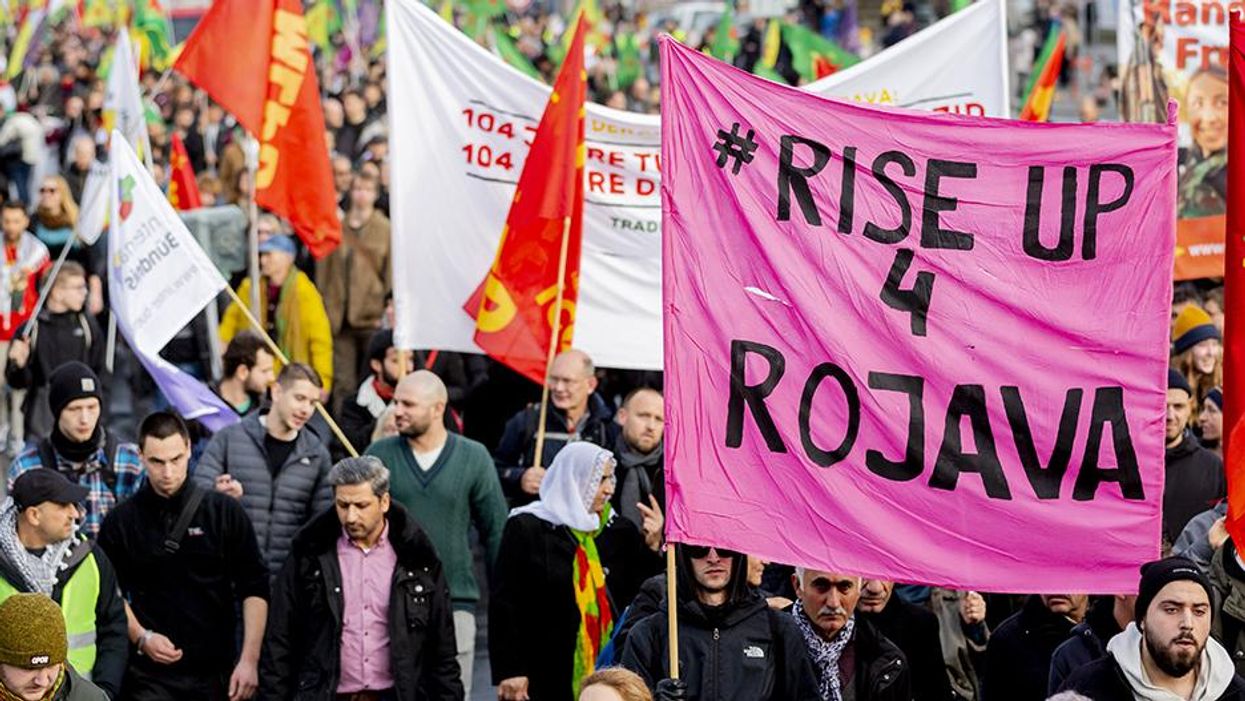
What is at stake in north-east Syria is more than the fate of the Kurdish people or the autonomous homeland of Rojava or even the fight against Isis. What is at stake is humanity's ability to survive our current civilizational crisis and to imagine new alternatives before it's too late.
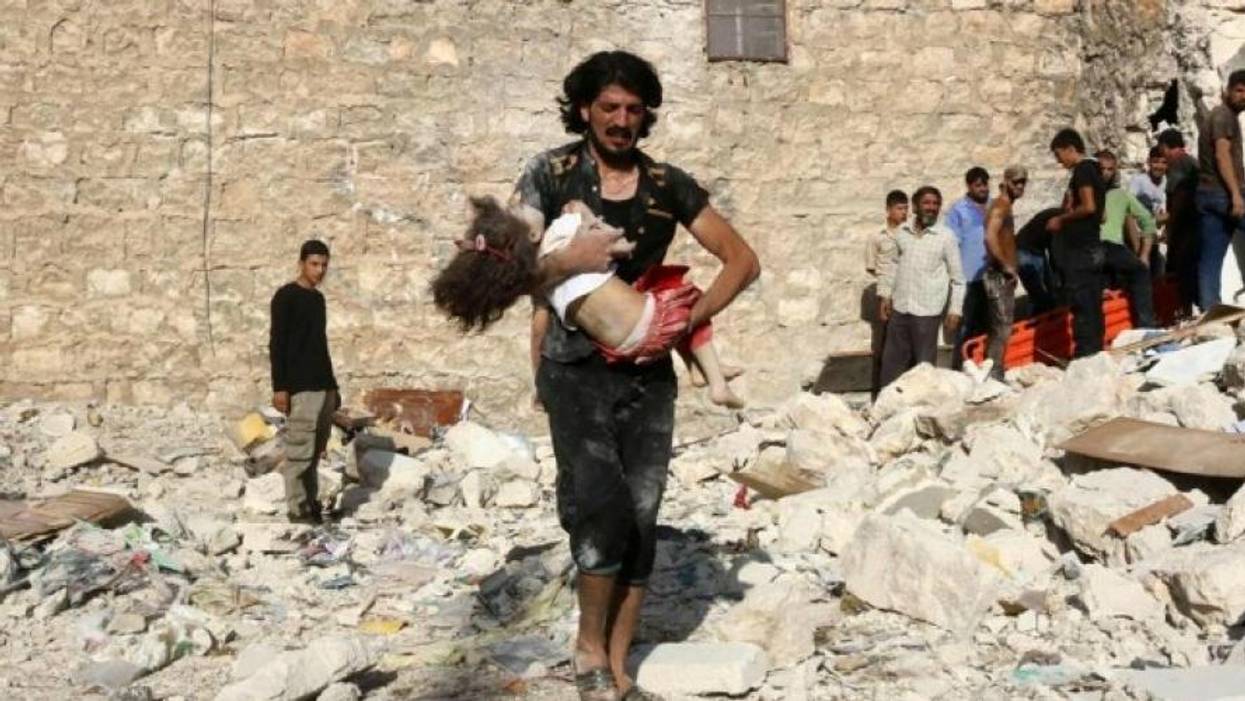
Turkish prime minister Recep Tayyip Erdogan's brutal invasion of Rojava is using 20th-century techniques of extreme violence and genocide, despite a proclaimed "ceasefire." Turkey's air force is raining down napalm and white phosphorus on innocent civilians. At the same time, jihadi squads are massacring fleeing civilians as retribution for Rojava's fight against Isis and their role as arguably the most important ally to the west in the region.
The US, the UK, France, Russia and other alleged superpowers are actively betraying both international law and the Geneva convention by allowing and facilitating the ethnic cleansing and occupation of Rojava. Turkey's aim is clear: to eradicate what all fascist powers fear most, a free people daring to create brave and successful experiments outside the globalized, extractive system.
Since 2012, around 5 million people - Kurds, Arabs, Assyrians, Turkmen, Yazidis and others - have built the autonomous region of Rojava, demonstrating how a multi-ethnic society can respectfully coexist beyond the constraints of nation state, patriarchy and capitalism. By promoting radically democratic and decentralised self-governance, equity between genders, regenerative agriculture, a justice system based on reconciliation and inclusion of minorities, the Rojava experiment has presented a living example of possibility under the most impossible of circumstances. We encourage readers to review the Rojavan Charter of the Social Contract for inspiration.
Western leaders are feigning empathy while American, German and British weapon manufacturers are actively selling weapons to Turkey. It is clear that the dominant system cannot and will not defend those seeking to explore other ways of knowing and being. As the imprisoned Kurdish leader Abdullah Ocalan writes: "The real power of capitalist modernity isn't its money and its weapons, [but] its ability to suffocate all utopias [...] with its liberalism."
However, a growing chorus of allies are rising up around the world. From Haiti to Lebanon, from Chile to Iraq, from Cameroon to the US, from the UK to Hong Kong, social revolutions are confronting the rise of fascism, short-termism, greed, climate destruction and warfare that are required to prop up our existing economic paradigm. The battle lines are becoming clearer. Domination versus cooperation, colonization versus autonomy, oppression versus freedom, patriarchy versus partnership - these values are the warp and weft of the defining struggle for the future of humanity.
For Rojava to survive and for justice to truly prevail, those rising up in their local context must stand together creatively with shared voice, values and visions for global systems change. Rojava is fighting for the same reasons as the awakening majority from around the world. It has shown that the way out of social and ecological crisis is not through GDP-focused "development," but rather with decentralized autonomous communities.
Making such communities work in more and more places, by regenerating ecosystems, healing our collective trauma and creating social structures of solidarity and trust, is the transformational work of our times. Once we see our struggles as inherently interdependent with each other, and with the web of life itself, no army on the planet will be able to stop the inevitable transition.
As leaders from social movements, communities and First Nations from around the world, we stand in solidarity with the vision and work of Rojava. We pray for their resilience, protection and perseverance. We pray that we will listen to and learn from the living Earth as she continues to show us how to create societies which live in cooperation with all beings. We pray that those in positions of power be reminded of their humanity and end this invasion immediately.
LaDonna Brave Bull Allard Standing Rock, Turtle Island (USA)
Salim Dara Rural Solidarity, Benin
Eve Ensler One Billion Rising, USA
Sabine Lichtenfels Tamera Peace Research Center, Portugal
Tiokasin Ghosthorse First Voices Indigenous Radio, Turtle Island (USA)
Alnoor Ladha The Rules, Canada
Gildardo Tuberquia Peace Community of San Jose de Apartado, Colombia
Yael Ronen Maxim Gorki Theater, Germany
Sami Awad Holy Land Trust, Palestine
Gigi Coyle Beyond Boundaries, USA
Joshua Konkankoh Better World, Cameroon
Stuart Basden Extinction Rebellion, UK
Aida Shibli Global Campus, Palestine
Claudio Miranda Favela da Paz, Brazil
Rajendra Singh Tarun Bharat Sangh, India
I stood on the wind-swept Kalowa Hill in the northern Iraqi city of Sulaimaniya as Pershan Hassan, a stocky 53-year-old woman, clambered quickly up the dirt track leading to where a mass grave was being excavated. She clutched a framed black-and-white picture of a boy. She pushed her way through the crowd that was looking down at the unearthed remains of dozens of bodies. Suddenly, she let out a gasp of pain and recognition as she saw the skeletal remains of her 13-year-old son, Shafiq. A faded blue blindfold was wrapped tightly around his skull. The casings from spent bullets were scattered around his dark brown bones.
"I know him by his clothes," she whispered, her voice breaking as she lifted the garments and kissed them. "I raised him without a father."
It was December 1991, after the first Iraq war. Saddam Hussein had ruthlessly crushed a Kurdish revolt in the aftermath of Iraq's defeat that spring by the United States and its allies. Two million refugees had fled toward Turkey and Iran in April 1991. Many froze to death in the snow-covered mountain passes as they tried to escape. The international community, responding to the heartbreaking images, created havens for their return in northern Iraq, forcing Baghdad to withdraw its troops.
I spent months with the Kurds as a reporter for The New York Times after the Iraqi withdrawal, including living and sleeping with seven Kurdish, or peshmerga, bodyguards after Baghdad offered bounties of $1,000 for the murder of Western reporters and aid workers in the Kurdish region. Several of my colleagues were killed or badly wounded.
Kurdistan, "land of the Kurds," is recorded as far back as the 15th century by European visitors. The Kurds, who speak Kurdish and are mostly Sunni Muslims, were promised a state by the victorious allies following World War I and the dismantling of the Ottoman Empire. Instead the Kurdish region was carved up among Turkey, Syria, Iran, Iraq and the Soviet Union. The Kurdish struggle for an independent state, an effort that has included numerous armed insurgencies, has lasted nearly a century. And so have the brutal waves of repression, extermination and betrayal to crush Kurdish aspirations.
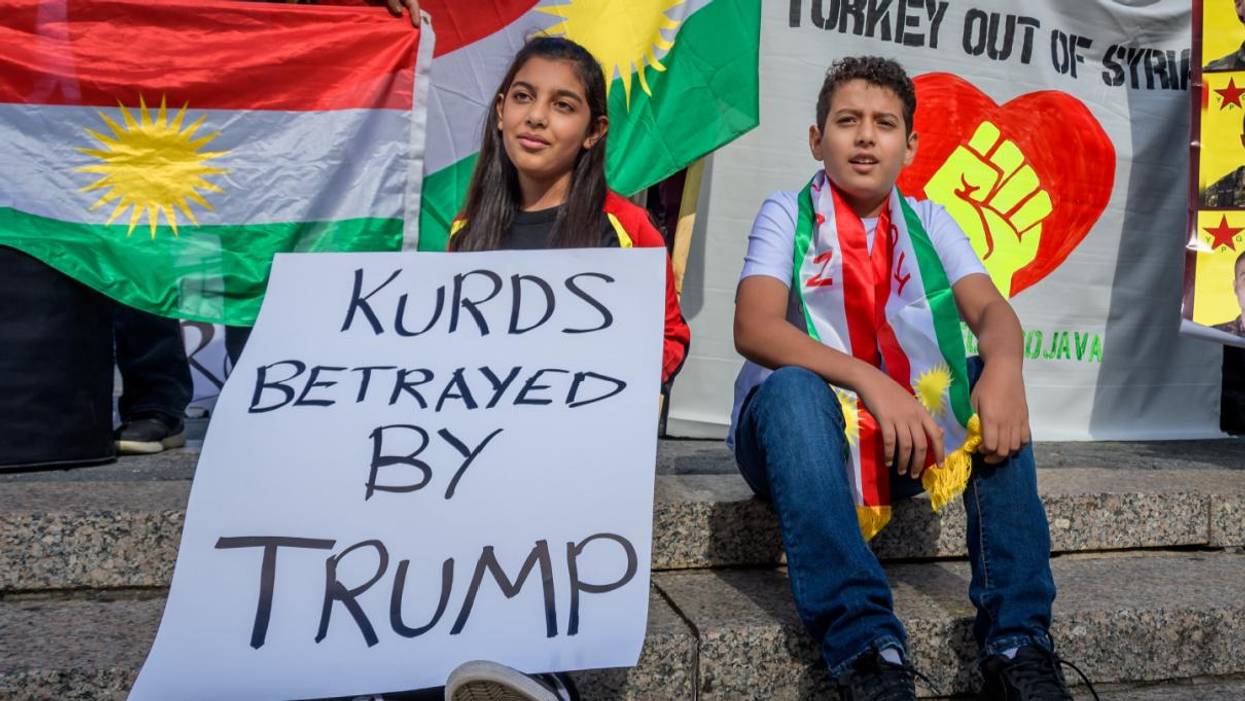
President Donald Trump's abandonment of the Kurdish-led Syrian Democratic Forces (SDF) in northern Syria is another chapter in a sad and heartless game, repeatedly replayed, in which Kurdish forces are armed and used to achieve the strategic aims of rival nation-states and then discarded. An estimated 11,000 Kurdish fighters died battling Islamic State (ISIS) in Syria. They were cannon fodder for the United States.
Turkey's recent incursion into northern Syria is aimed at weakening the ties between the SDF and the rebel Kurdistan Workers' Party (PKK), which has carried out an insurgency in southeastern Turkey since 1984. The PKK, whose popular backing has been bolstered by the brutal Turkish repression of the Kurds, has broad support and is a surprisingly effective insurgent force.
When I was with a PKK unit operating along the border between Turkey and Iraq I noted to the commander how well trained his unit appeared to be. "Oh," he said, "we tell our fighters to do their two years of compulsory Turkish army service before they join us."
There are between 25 million and 30 million Kurds who live in the swath of territory that stretches through northern Iraq into Turkey. It is the largest ethnic group in the world without a state of its own. Kurdish groups and clans, to survive, make ever-shifting alliances, including the latest decision by the SDF to unite with Damascus. Kurds have forged temporary alliances throughout their history with the U.S., the Soviet Union, Iraq, Iran, Syria and Turkey. These alliances have always disintegrated, usually when the Kurds were no longer considered useful. Shah Mohammad Reza Pahlavi and the United States' then-Secretary of State Henry A. Kissinger, for example, armed the Kurds in northern Iraq as a way to destabilize Baghdad. But the shah, in a secret deal with Baghdad, sold out his Kurdish allies, allowing Iraq to carry out a scorched-earth policy against the Kurds that created a humanitarian disaster and an exodus of Kurds in 1975 as devastating as the one resulting from the aborted Kurdish rebellion in 1991 after the Gulf War.
The counterinsurgency campaigns against the Kurds, often unseen or ignored by the outside world, have at times reached genocidal levels. Baghdad dropped poison gas on some 60 Kurdish villages in 1988 and razed 4,000 Kurdish villages in what was known as the Anfal campaign, an attempt to annihilate the Kurds in Iraq. As many as 200,000 Kurds were "disappeared," with tens of thousands rounded up and executed. I was present as mass graves each with more than a thousand bodies in northern Iraq were excavated, including one with 1,500 Kurdish soldiers in the Iraqi army who had apparently attempted to rebel. I passed village after village in northern Iraq that had been dynamited into rubble. There was no electricity or running water and little food. It was not uncommon to find families living like moles under the collapsed slabs of concrete of their former homes, the land around them littered with land mines.
The withdrawal of Iraq from the northern Kurdish areas following the 1991 Gulf War created a de facto Kurdish state, the third this century. But Turkey remains determined to destroy it once Turkish forces finish with the Kurdish enclave in northern Syria. If history is any guide, the autonomous Kurdish region in northern Iraq will be as short-lived as the other autonomous enclaves briefly carved out by the Kurds over the last century.
The absence of Iraqi authorities in northern Iraq allowed me to pore through stacks of police files, including photographs and videotapes of torture and executions. I saw the long, typewritten lists that chronicled killing after killing, sometimes for trivial offenses. One man was sentenced to death because he had a picture of a rebel Kurdish leader in his wallet. Eighteen tons of Iraqi intelligence files documenting decades of repression, torture and murder were eventually recovered.
The execution sites were often next to the mass graves. On Kalowa Hill five tires filled with concrete marked the spot where hundreds of people were shot to death. Earthen embankments bordered the site at the back and two sides. Prisoners were blindfolded and their hands were tied at their backs. They were bound to 10-foot poles. I watched videos, left behind in Iraqi detention centers, of many of these executions. I was once shown a picture of three Iraqi officials squatting like big-game hunters next to the slumped body of a man who had been shot to death. One of the Iraqis, wearing a beret, grinned as he held a knife to the corpse's neck.
Those who lived in the vicinity of Kalowa Hill, threatened with death if they tried to peer into the high-walled compound, said they often heard screams and volleys of shots. "The dogs used to come back with human bones, after getting inside the compound," Yasin Khader Hassan told me. "Then the guards began to shoot even the dogs."
Kalowa Hill is a metaphor for the tragic history of the Kurds. I remain haunted by the images of women searching frantically through skeletal remains in uncovered pits for their disappeared children or husbands. I can still feel in my hands the skulls with their blindfolds and bullet holes. While boys and men, the majority of the victims, were usually blindfolded and shot, girls and women were most often blindfolded and strangled.
"Sirwan, Sirwan," Bahia Khader, another mother, sobbed at Kalowa Hill, swaying over the bones and bits of clothing of her son, who disappeared in 1982 when he was 15. "By the hands of these criminals, you have been taken from me."
I walked one afternoon through the gloomy remains of a former Iraqi detention center with Jamal Aziz Amin, then a courtly 45-year-old headmaster. He stood in a soundproof room in the darkened basement of Sulaimaniya's central security prison, where he had spent a year in detention. Large metal hooks were suspended from the ceiling. The prisoners, stripped naked, were handcuffed behind their backs and hoisted from their wrists onto the hooks. They were questioned about Kurdish guerrilla groups, beaten, whipped and given electric shocks until they fell unconscious. A diet of watery soup, bread and thin tea left prisoners weak and emaciated.
"You would scream," Amin said, "and it would sound as if you were yelling from the bottom of a deep, deep well."
Kurdish fighters attacked the prison after the Gulf War. The 300 secret policemen and guards, including the warden, held out for three days until all were killed. Amin and other former prisoners stood over the bodies of their torturers. "We wanted them to all come back to life," he said, "so we could kill them again."
The cells of the prison were marked with crude drawings, scratched-out calendars and plaintive messages by those who sought to leave behind their names and a record of their suffering.
"These were my friends, arrested with me," wrote Ahmed Mohammed, one of those who left a message. He listed five names and scribbled, "All were executed."
"Oh, mother, in this dark room my dreams trouble me and I shake," one message read. "Then comes the kicking against my door and a voice telling me to get up. It is time for my interrogation. I awake to the unconscious."
Amin took me to the latrine, a hole in the concrete floor, at the end of a corridor of cells.
"I wanted to show you this," he said, pointing up at a small shaft of light streaming in from a tiny, barred window 14 feet above us. "Here is where we would come at night so we could pull ourselves up the walls to hear the sound of the dogs barking in the distance. To hear the dogs, this was everything for us."
Turkey, a U.S. ally in Syria, attacks another U.S. ally in Syria, the Syrian Democratic Forces, a Kurdish-led group of militias whose very existence is anathema to the Turkish government--and the Trump Administration does nothing to prevent it. Trump's indifference is appropriately denounced by the leadership of both political parties--Republican Senate Majority Leader Mitch McConnell opposes the planned "precipitous withdrawal of U.S. forces" from Syria, and Democratic House Speaker Nancy Pelosi calls upon the president to "reverse this dangerous decision." But is this bipartisan leadership consensus that American troops must remain in Syria really the only alternative? Is there no way to stop Turkey, other by interposing American troops? Well, at the least, there is one other obvious path as yet untread upon: Want to stop Turkey from attacking another ally? Take away their guns, and their tanks, and their planes, and their...
According to GlobalSecurity.org, Turkey has about 2550 armored personnel carriers, of which 99% are America made, as are all but two of its 170 fixed wing aircraft. Less than 1% of Turkey's 760 "towed" artillery are homemade; the rest, again, are manufactured here. 80% of its 990 "self-propelled" artillery pieces are made in the U.S.A. Less than 2% of Turkey's 3,250 "Main Battle Tanks" are manufactured there; 53% are American made; another 24% are joint U.S./Israel products. (The rest come from Germany.) In short, the Turkish military doesn't function without the U.S. weapons industry--and the approval of the U.S. government. Absent all the hardware bearing Made in America stickers sitting in Turkish military bases, we would probably not be fretting about what Turkey's government was doing to the Syrian Democratic Forces.
It would appear that the course of pulling the plug on the Turkish war machine is just unthinkable to them.
So, what if the U.S. government were to simply tell Turkey to desist? Yes, it's true that theoretically the Turkish government could opt to break with Washington and proceed with their attack using the equipment already on hand. But realistically, if it was told that there would be no replacements in the pipeline unless it called off this attack, it seems highly likely that we would see some serious behavior modification--pdq.
How does it not occur to our national leaders to at least promote such a commonsensical step? Trump we need not discuss, immersed as he is in the "alternative facts" that reign in his White House. But Pelosi and McConnell? It would appear that the course of pulling the plug on the Turkish war machine is just unthinkable to them. At this point, the idea of sending and maintaining American troops 6000 miles away to prevent an ally from carrying out an attack apparently seems the more reasonable and familiar option to them.
And, to be fair, we can see how they got to this point, since Congress annually appropriates funding for over 800 foreign military bases. Adding to the militarization of a situation and sending in the Marines is standard operating procedure for them. On the other hand, the interruption of the militarization of the situation by threatening to cut off the transfer of military equipment is so far out of the Capitol playbook that it no doubt now seems the more radical direction there--one with the potential to cause a genuine international crisis.
And there could, after all, also be serious implications for the "defense" industry, which would not be confined to the nation's capital, given that the industry has been carefully constructed to involve every region of the country. And it would certainly have grave implications for the current nameless, permanent state of war formerly known as the "War on Terror."
In short, placing American military personnel in harm's way apparently carries less political risk than endangering the profits of munitions manufacturers, or the careers of foreign policy experts. This is the mindset of war without end; war so ubiquitous that it remains largely unnoticed most of the time. It is but another example of why the bi-partisan Washington foreign policy consensus has got to go--along with the people who purvey it.
Turn on any US cable news network or click on any mainstream media news story about the Turkish offensive in Syria and you"ll see lots of worrying about civilian casualties. On the first day of the Turkish campaign, all the major networks covered the mass exodus of Kurds facing imminent bombing and invasion, with most also airing the first reports of Kurdish civilian casualties. Everywhere we see expressions of concern for the innocent Kurds caught in the path of Turkey"s onslaught.
There was no such concern in 2014 when the United States began its five-year bombing campaign against Islamic State (IS) in Syria and Iraq. Mainstream media outlets that regularly reported war crimes and mass slaughter when they were committed by IS fighters, Syrian government forces or Russian air strikes were suddenly silent as US and coalition bombing and, later, ground attacks killed thousands of Syrian and Iraqi men, women and children, to the point where for several months in 2017 US-led forces were killing more Syrian civilians than IS, Russian bombing or even Syrian President Bashar al-Assad"s forces. Even reliable alternative media outlets like Democracy Now only occasionally reported civilian casualties, even though they were happening almost every day.
While it is impossible to say exactly how many civilians have been killed by US-led bombing over the past five years, SOHR has counted 4,036 Syrian civilians killed by coalition forces since the bombing began.
Human rights monitors including Syrian Observatory for Human Rights (SOHR) and Airwars have been publishing daily reports of civilian casualties caused by all belligerents in Syria and Iraq for years. These groups compile casualty lists from local media and monitor groups and are highly credible sources. Their reports are, however, almost completely ignored by the US corporate media. With the exception of a relative handful of high-casualty incidents--like the time in March 17 when more than 200 people were killed when US warplanes bombed an apartment building in Mosul, Iraq--American media focus almost exclusively on US military casualties, with civilian deaths usually little more than an afterthought when they are mentioned at all.
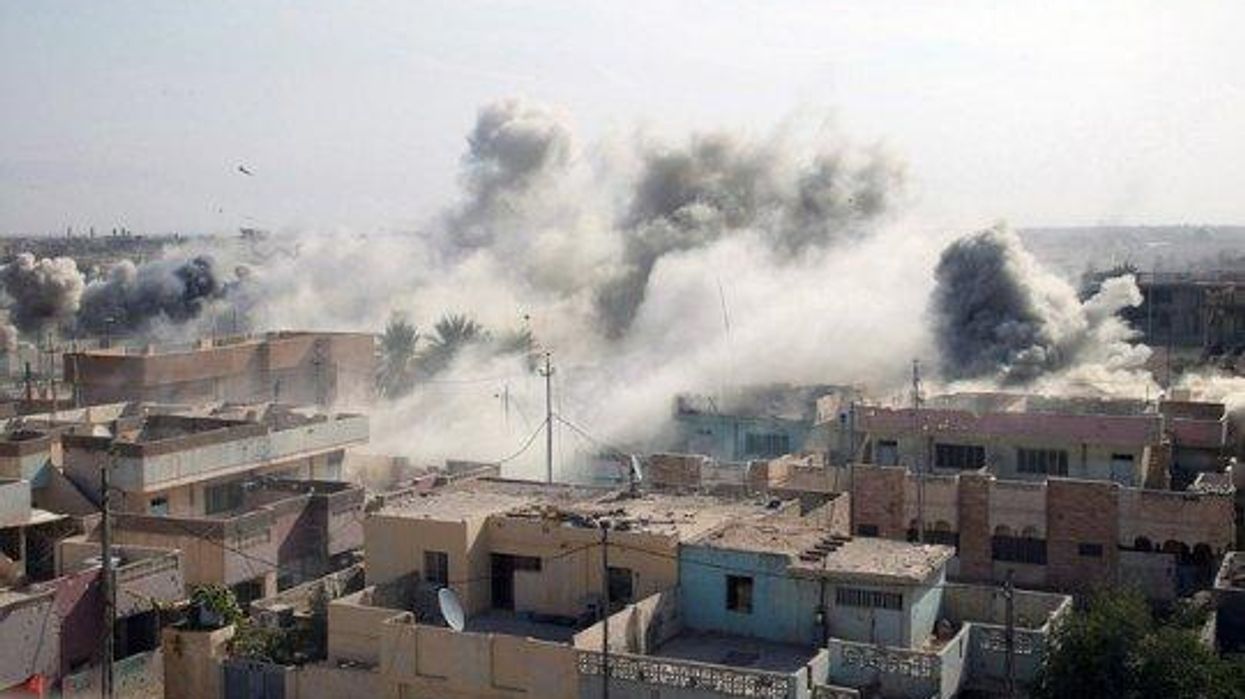
While it is impossible to say exactly how many civilians have been killed by US-led bombing over the past five years, SOHR has counted 4,036 Syrian civilians killed by coalition forces since the bombing began. That"s about 3.5 percent of all civilian deaths in Syria"s eight-year civil war. Airwars estimates at least 8,214 and as many as 13,125 Iraqi and Syrian civilians have been killed in more than 34,000 coalition attacks over the past five years. Earlier this year, the Iraqi High Commission for Human Rights (IHCR) said around 11,800 civilians, including some 2,300 children, had died in US-led strikes since 2014. Entire cities like Raqqa in Syria and Mosul, Iraq were destroyed in the US-led offensive to liberate them from IS, with almost no reporting on US corporate TV news and only somewhat better online reporting.
Why are US mainstream media outlets so loth to report civilians killed or wounded by US bombs and bullets? First, they"re American, and one of the many truths that Americans hold self-evident is that "we"re the good guys." This mythology is upheld by the US military, which in addition to undercounting civilian casualties--the Pentagon claims coalition forces have only killed about 1/10th as many civilians as Airwars" high-end estimate--always asserts that US troops take great pains to avoid harming innocents. US officials also often deny credible casualty reports until presented with overwhelming evidence. Casualty counting in active war zones is also a perilous undertaking, with many reported casualties difficult or sometimes impossible to verify.
The vast bulk of US mainstream media outlets are corporate-owned, with much of the American ownership class having vested interests in waging war.
Self-censorship is also at play here. Journalists who ask too many tough questions tend to lose access to the people making the most important decisions. During times of conflict, there is also a tendency to rally around the flag that can be taken to such extremes that some of the nation"s most vaunted publications shamefully act as mouthpieces for government talking points and even cheerleaders for war for the war du jour. This is by no means the exclusive province of conservative media--witness Brian Williams, the disgraced NBC Nightly News anchor turned MSNBC host who gushed how he was "guided by the beauty of our weapons" as Trump launched cruise missiles at Syria. Williams was misinterpreting lyrics by the late, great Leonard Cohen, who surely rolled over in his pine box coffin upon hearing Williams" words. Speaking of that cruise missile attack, so-called liberal media outlets across the nation approvingly asserted how, at long last, Trump was finally acting "presidential" by escalating an already dangerous conflict.
Finally, there"s the elephant in the room: the vast bulk of US mainstream media outlets are corporate-owned, with much of the American ownership class having vested interests in waging war. And so while reporting on individual wartime triumphs and tragedies is permitted, asking why the US has been at war for this entire century, or pointing out that the United States military has killed more foreign civilians than any other armed force on the planet since dropping two nuclear bombs on Japan in 1945, seems strictly verboten. There are exceptions. But on the whole, it"s as Keith Olbermann once said, "you can rock the boat, but you can never say that the entire ocean is in trouble. You cannot say... there"s something wrong with our system."
As the Turkey escalates its attack on America"s (yet again) abandoned Kurdish allies, you can expect to see heart-rending images and reports about the innocent men, women and children killed and maimed in the campaign. The same goes for the next time Syrian or Russian forces go on the offensive. However, if coverage of civilian casualties caused by US action is what you"re after, you"ll have to look to foreign or alternative media sources. After all, as US General Tommy Franks flippantly declared before the invasion of Iraq, "we don"t do body counts."
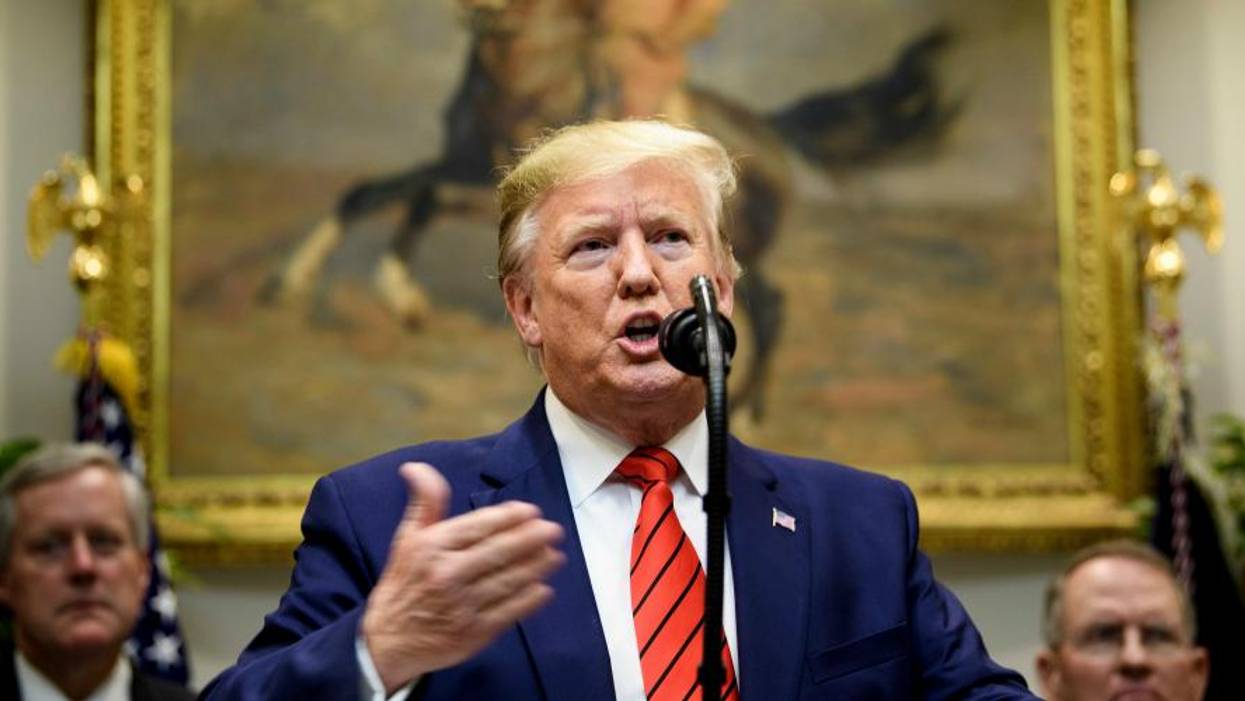
In remarks that sparked outrage and left some critics at a loss for words, President Donald Trump on Wednesday attempted to justify his decision to abandon Kurdish forces in Syria by criticizing Kurds for not assisting the United States in World War II.
"As somebody wrote in a very powerful article today, they didn't help us in the Second World War, they didn't help us with Normandy, as an example," Trump said during a signing ceremony for unrelated executive orders. "They're there to help us with their land, and that's a different thing."
As The Daily Beast's Will Sommer pointed out, Trump's remarks appear to have been inspired by a Tuesday article written by right-wing columnist Kurt Schlichter.
British historian Akil N. Awan was quick to point out on Twitter that Kurds "DID fight on the Allied side in WW2."
"They helped break the siege following the 1941 pro-Nazi coup d'etat in Iraq and were part of the (pro-Allied) Iraq Levies," said Awan. "By 1942 Kurds made up 25% of the force. By 1943, 10 of the 44 companies comprising the Iraq Levies were Kurdish."
In addition to condemning the president's historical ignorance, critics also slammed Trump's comments as unspeakably cruel:
U.S. President Donald Trump told Turkish President Recep Tayyip Erdogan on Sunday, October 6, that the United States troops inside Syria would not defend the Syrian Democratic Forces, which have built an enclave inside Syria along a section of the Turkish border. The Syrian Democratic Forces (SDF) are made up largely of Kurdish factions, who set up this armed force to defend the mainly Kurdish enclave in northern Syria. When the U.S. began its attack on the Islamic State (ISIS), the SDF became the ground forces beneath the U.S. bombers. Now, the U.S. has decided to betray the sacrifice of the SDF.
Turkey has previously threatened to attack the SDF and other Kurdish groups inside Syria east of the River Euphrates. In 2014 and 2015, Turkey signaled that it would invade Syria. In August 2016, the Turkish military crossed the border with U.S. air cover. Erdogan said--at that time--that Turkey was going to attack both ISIS and the Kurdish militia group, People's Protection Units (YPG). This operation, which was largely around the Syrian town of Jarabulus along the Syria-Turkey border, was known as Operation Euphrates Shield. The 2016 intervention opened the door to two further interventions in northern Idlib (2017) and in Afrin (2018), the last operation with an Orwellian name--Operation Olive Branch. These were targeted attacks and not an all-out war on the SDF and other Syrian forces.
Now, Erdogan's government is preparing to enter Syria for a major military operation against the SDF. The U.S. forces have already left the observation posts at Tel Abyad and Ras al-Ain--both key places where the U.S. monitored Turkish troops and shielded the SDF from Turkish attacks. That shield has now been removed. U.S. forces remain in the region, but there is every indication that they will remove themselves from the main hubs of the SDF.
The SDF is now vulnerable to the full might of the Turkish army. The political leaders of the SDF say that they would defend their enclave--known as Rojava--"at all costs." Over the past year, Ilham Ehmed, the co-chair of the Syrian Democratic Council, has warned that Turkey is determined to enter this "safe zone" (or what the U.S. calls a "security mechanism"). Ehmed said--before this recent announcement--that Turkey will invade Rojava, harshly attack the SDF, and re-settle the three million Syrian refugees who are now in Turkey. These refugees are not from the area east of the River Euphrates. Not only will the Turkish government wreck Rojava, but it will ethnically cleanse the area by bringing in large numbers of non-Kurdish Syrians. It is important to recall that the population of Syrian Kurds is around two million. Ehmed has expressed her worry about this attempt to render the Syrian Kurds of Rojava extinct.
What will a Turkish invasion mean for the area?
It is worthwhile to be alarmed by these developments. The United Nations has taken the correct assessment of the situation. The UN's Humanitarian Coordinator for Syria--Panos Moumtzis--said, "We don't know what is going to happen. ... We are preparing for the worst." So should the rest of us.
This article was produced by Globetrotter, a project of the Independent Media Institute.