

SUBSCRIBE TO OUR FREE NEWSLETTER
Daily news & progressive opinion—funded by the people, not the corporations—delivered straight to your inbox.
5
#000000
#FFFFFF
To donate by check, phone, or other method, see our More Ways to Give page.
Daily news & progressive opinion—funded by the people, not the corporations—delivered straight to your inbox.
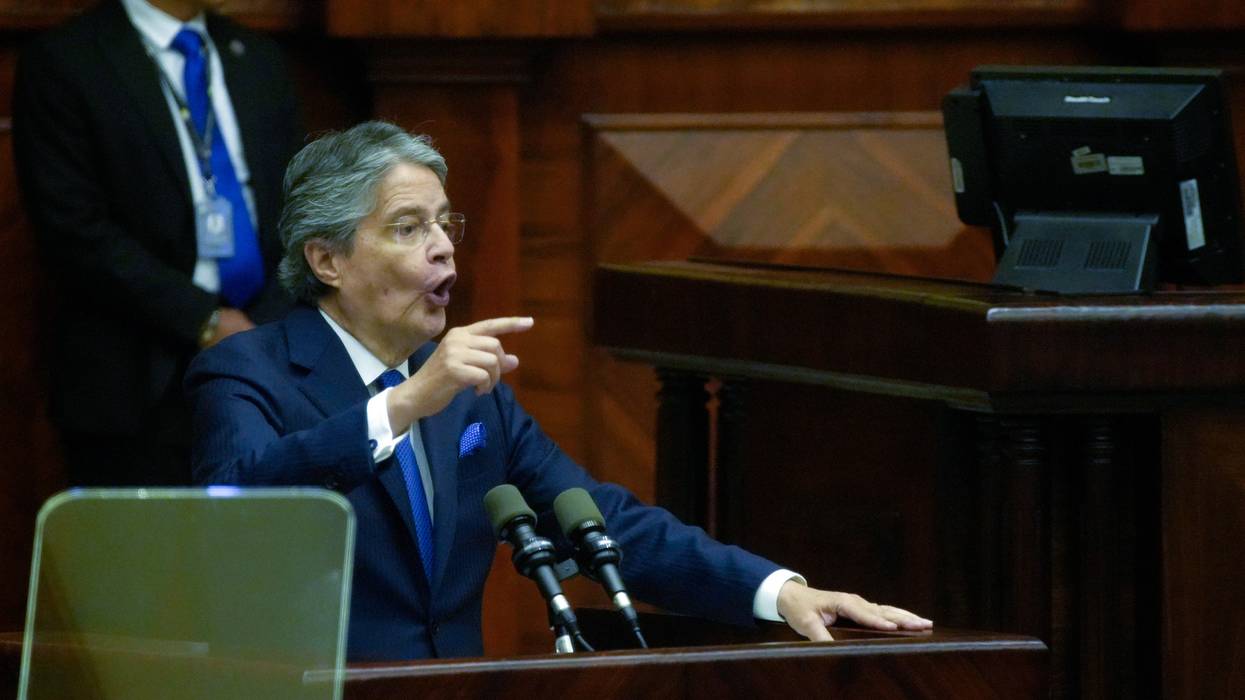
The head of the Andean nation's largest Indigenous rights group accused President Guillermo Lasso of launching a "cowardly self-coup" and pushing the country toward an "imminent dictatorship."
Days before Ecuadorian lawmakers were expected to vote on removing him from office, Guillermo Lasso, Ecuador's deeply unpopular right-wing president, dissolved the country's National Assembly, a move progressive critics called a bid to avoid impeachment.
For the first time ever, Lasso invoked Article 148 of the Ecuadorian Constitution, which gives presidents the power to dissolve the legislature under certain circumstances, including legislative overreach and a "severe political crisis and domestic unrest."
The move, popularly known as "muerte cruzada"—"the death cross"—will allow Lasso to rule by decree for six months. It came a day after the president defended himself before lawmakers during an impeachment trial for allegedly turning a blind eye toward embezzlement.
"Not having the necessary votes to save himself from his imminent dismissal, Lasso launched a cowardly self-coup with the help of the police and the armed forces, without citizen support, becoming an imminent dictatorship," Leonidas Iza, head of the Confederation of Indigenous Nationalities of Ecuador (CONAIE), the country's largest Indigenous rights group, said in denouncing the move.
As Will Freeman, Latin America specialist at the Council on Foreign Relations, explained last week:
The impeachment process originated in a scandal that erupted in January 2023. That month, Ecuadorian journalists denounced members of Lasso's inner circle for allegedly mismanaging public companies and maintaining ties to Albanian mafia groups that have come to dominate Ecuador's lucrative cocaine trafficking routes. The journalists say their information came from a police investigation, although Ecuador's attorney general has claimed the source material was doctored.
After the journalists published leaked audio clips corroborating aspects of their story, one top government appointee, Hernan Luque, became a fugitive from justice. Another businessman allegedly connected to the ring, Rubén Cherres, was found murdered. In March, a majority of Ecuador's National Assembly asked to start impeachment proceedings. Ecuador's Constitutional Court partially granted the request, allowing a vote on the corruption allegations to move forward.
Ousting Lasso from office would require the votes of 92 of the National Assembly's 137 members. The motion to proceed with the impeachment process received 88 votes.
Lasso denies both the corruption allegations and accusations that he dismissed lawmakers in order to derail the impeachment.
"Ecuador needs a new political and social pact that will allow it to get out of the political crisis in which it finds itself," Lasso said during a mandatory nationwide television and radio address, according to teleSUR. "We must move towards a solution that offers hope to families and puts an end to a useless and irrational confrontation."
Article 148 stipulates that the National Electoral Council (CNE) must call presidential and legislative elections within seven days of lawmakers' dismissal, although the electoral process is allowed to take up to six months.
The CNE came under fire during the 2021 presidential election—in which Lasso, a former banker, defeated progressive economist Andrés Arauz—for trying to prevent Arauz from running by, among other things, banning his political party and then outlawing another party he tried to form.
Arauz wanted to have progressive former Ecuadorian President Rafael Correa as his running mate, but the CNE banned him from the ticket. Electoral officials also blocked the Arauz campaign from using Correa's voice or image—but allowed Arauz's opponents to depict the former president in a negative manner.
Correa—who argued that what Lasso is doing is "illegal"—looms large during the current crisis. Although the former president fled Ecuador rather than face trial for what he claims are baseless corruption charges, he still controls the largest bloc of National Assembly lawmakers.
Lasso wasted no time in exercising his new powers.
"Starting today, the national government will issue decrees that will comply with the mandate that you gave me," he said during his address to the public. "I have signed a first decree to reduce taxes on families. It will be sent to the Constitutional Court for its review."
The president promised that "public services will operate normally," and that "the armed forces and the police continue to guarantee security."
As Lasso spoke, state security forces surrounded the National Assembly building to block anyone from entering or leaving the legislature, teleSUR reported.
Nelson Proaño, head of the Ecuadorian military's Joint Command, delivered a brief Wednesday morning address to the nation in which he endorsed Lasso's invocation of Article 148.
"Therefore, it is subject to a constitutional norm and must be fully and completely respected by all citizens," Proaño asserted. "I wish to remind Ecuadorians that the armed forces and the National Police are obedient and nondeliberative institutions and we fulfill our mission strictly abiding by the Constitution."
Freeman wrote last week that "Ecuador is likely headed for a period of increased instability."
"Given the acute challenges Ecuador is already facing—from surging crime to mass migration to a weak economy—that is something ordinary Ecuadorians can hardly afford," he added.
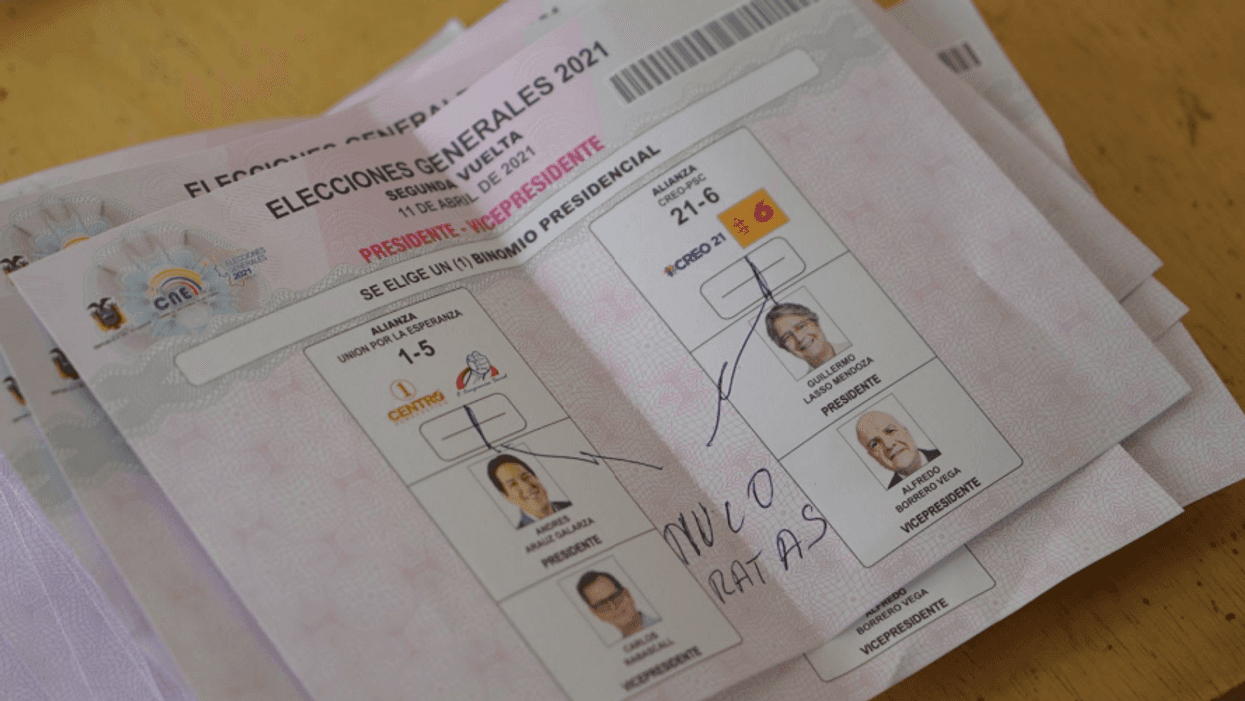
Ecuador's April 11 election that led to a 5-point victory by right-wing banker Guillermo Lasso over progressive candidate Andres Arauz was not what it appeared to be. On the surface, it was a surprisingly clean and professional election, as our CODEPINK official observer delegation witnessed. But a fraud-free process for casting and counting ballots does not mean that the election was free and fair. Behind the scenes was a monumentally unequal playing field and dirty campaign designed to quash an Arauz win.
For starters, Arauz--a 36-year-old follower of the political leanings of former president Rafael Correa and his Citizens Revolution--barely even got on the ballot. The political party he tried to run under was banned by the National Electoral Council (CNE). He and his supporters formed a new political party and that, too, was banned. Eventually they found a small party that let them borrow their slot, but by then it was late December and the first round of elections was on February 7. The other campaigns had a four or five month head start.
Arauz, who was virtually unknown, wanted to have Rafael Correa as his vice president, but the CNE banned Correa from being on the ticket. Even more astounding, the electoral authorities actually prohibited the Arauz campaign from even using Correa's voice or image. But in a show of blatant bias, they didn't banish Correa's image from being used in a negative way by his opponents.
Another intense obstacle was the role of the media. The corporate media dominate all the airwaves in Ecuador, and they were clearly in the Lasso camp. The media led a dirty campaign spreading fake news about Arauz, Correa and their supporters. They scared people by claiming that Arauz was going to de-dollarize the economy. Ecuador has been using the dollar as its currency since 2000, after a financial crisis saw the collapse of its former currency, the sucre. An economist, Arauz was well aware that dollarization had stabilized Ecuador's economy and he never even suggested going back to the sucre.
A particularly absurd accusation came from Colombia, where the country's right-wing attorney general claimed that the National Liberation Army, an armed insurgent group that has been operating in Colombia for decades, made an $80,000 loan to Arauz's campaign. Based on a doctored video that was proven to be false, this accusation nevertheless continued to circulate throughout the press to sully Arauz's character.
"The media smear campaign went hand-in-hand with attacks on the left that had been going on for the past four years under the presidency of Lenin Moreno."
A concerted smear campaign also attacked the legacy of Rafael Correa to scare people away from voting for Arauz. During his time in power from 2007 to 2017, Correa brought economic and political stability to a country that had had seven presidents in ten years. Correa, who has a Ph.D. in economics, completely transformed Ecuador into a modern democracy with a vibrant middle class. He also brought tremendous gains to the poor, reducing poverty from 37 percent to 22 percent, and built critical infrastructure, including highways, hospitals and schools. But the portrayal in the media made Correa out to be a corrupt authoritarian who was a threat to democracy, creating a dilemma for the Arauz campaign about how much to align itself with Correa's legacy.
The media smear campaign went hand-in-hand with attacks on the left that had been going on for the past four years under the presidency of Lenin Moreno. Ironically, Moreno had been Rafael Correa's vice president and ran on the ticket of Correa's Citizens Revolution. But once in power, he orchestrated a kind of "silent coup," betraying Correa, the Citizens Revolution and the progressive policies they stood for. Making common cause with the elites, including Guillermo Lasso, he imposed austerity policies and signed a terrible deal with the IMF that focused on budget cuts, deregulation and reducing workers' rights. In October 2019, there was an uprising against the elimination of a fuel subsidy that would have raised prices on everything from transportation to food. It was put down violently by Moreno's government and many of the protest leaders remain in prison today.
Lasso supported Moreno's austerity measures, the deal with the IMF and the violent crackdown on protesters, yet his campaign successfully managed to create distance between him and Moreno. The narrative spun in the media was that Arauz would continue in the footsteps of Moreno and Correa, as if Moreno had not betrayed the movement.
Moreno viciously lashed out at the left through the misuse of the legal system for political purposes, a tactic known as "lawfare." Jorge Glas, Moreno's vice president who spoke out against his betrayal of the Citizens Movement, was accused of corruption, convicted and put in jail, where he remains under dire conditions. Moreno's government attacked Correa himself, who went into exile in Belgium to avoid being thrown into prison. There are about 30 charges pending against Correa, including a farcical accusation that he had psychic influence over people that led them to become corrupt.
Other top party leaders were hounded and are now either jailed, under house arrest, or forced into exile. The decapitation of the Citizens Revolution meant that Arauz's campaign was significantly weaker than it would have been with their help.
Given all the strikes against Arauz, it is remarkable he did so well. Had it not been for lawfare, a biased CNE and a dirty campaign, he would have won. However, another major factor was the rift between the Citizens Revolution and the indigenous movement that happened under Correa's tenure, which led to calls for a "null vote."
The Confederation of Indigenous Nationalities of Ecuador (CONAIE) and its political party Pachikutik were represented in the first round of voting by Yaku Perez, who did well but didn't make the final cut. Feeling that neither of the two presidential candidates represented the indigenous community, Perez called for people to spoil their ballot by "voting null" (voting is mandatory in Ecuador so a spoiled ballot is the equivalent of boycotting the election).
There was some dissent from the "vote null" position--just days before the election, CONAIE President Jorge Vargas came out in favor of Arauz--but a significant percentage of indigenous peoples voted blank. Roughly 1.7 million Ecuadorians decided to either vote blank or to spoil their ballot. That was a critical factor in the election, given that Lasso won by only about 420,000 votes. Accused of enabling a right-wing victory, some members of Pachakutik argued that they voted null because they believe they can bring down the Lasso government through popular uprisings similar to what occurred in October 2019.
A victory by Arauz would have helped people struggling during this pandemic--Moreno so mismanaged the health situation that Ecuador has one of the world's worst COVID death rates and the economy has been devastated.
Arauz would have also strengthened the left throughout Latin America, promoting the kind of regional integration that took place during the so-called Pink Tide in the early 2000s when a succession of progressive governments took power in Latin America and the Caribbean. New institutions were created such as UNASUR, the Union of South American Nations, and CELAC, the Community of Latin American and Caribbean States. These became a counterbalance to the Organization of American States, which is used as a tool of the U.S. State Department to promote U.S. foreign policy throughout the region. These new regional organizations were part of a much broader vision of regional integration along the lines of the European Union.
If those organizations were as strong now as they had been several years ago, it's likely that Latin America would have been in a better position to deal with the pandemic because they could have bought vaccines together and cooperated on public health policies.
In the coming years, Ecuador's Citizens Revolution will have to use this time to regroup, repair frayed relations with indigenous and union groups, and build a strong social base of support. This social base is something they never really achieved, even under Correa's mandate. They do, however, still have a majority in the National Assembly. The second biggest assembly bloc is the indigenous party Pachakutik, which will undoubtedly be courted by Lasso's government but also has left tendencies. So there may be room to make alliances and fight back against Lasso's austerity policies.
On the regional level, it's a shame that Ecuador won't be helping to swell the ranks of the Pink Tide. But hopefully, other nations in Latin America--such as Peru, Chile, Brazil and even Colombia--have a chance in the coming years to keep the second wave of the Pink Tide afloat.
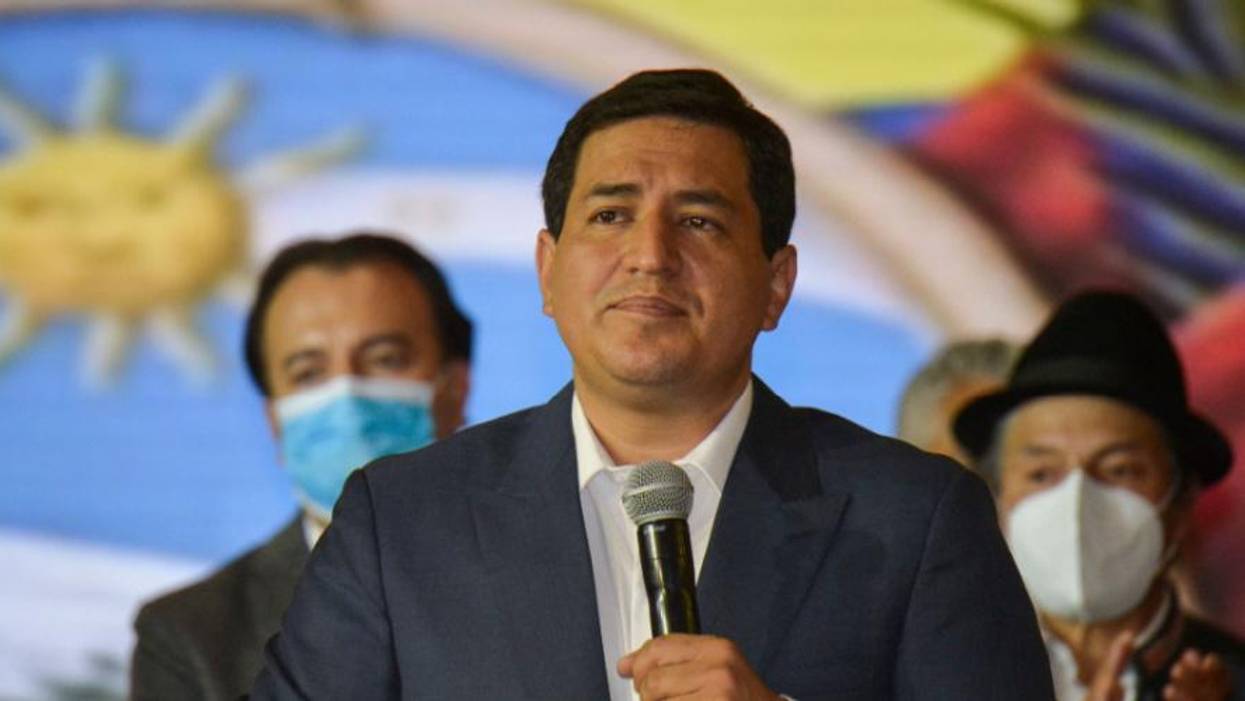
Following left-wing economist Andres Arauz's loss to right-wing former banker Guillermo Lasso in Ecuador's recent presidential election, Progressive International on Monday argued that the disappointing results reflect the unsettling "triumph of lawfare" and underscore the need for progressive forces of all stripes to unify behind an emancipatory vision in order to "defeat the reactionary right" worldwide.
"Only the strategic unity of progressive forces--leftist, Indigenous, feminist, ecologist, and beyond--is strong enough to defeat the reactionary right."
--Progressive International
In a contest that pitted Lasso's neoliberal agenda of privatization and upward redistribution against Arauz's social-democratic plans to improve the welfare of working-class Ecuadorians, many expected Arauz to emerge victorious.
Instead, Arauz--considered a protege of former President Rafael Correa, a champion of the left who implemented policies that increased standards of living for the poor when he governed Ecuador from 2007 to 2017--conceded defeat.
"I congratulate him on his electoral triumph today and I will show him our democratic convictions," Arauz said Sunday night in the wake of Lasso's surprising win. Lasso, a two-time runner-up in presidential elections, received about 53% of ballots to Arauz's 47%.
David Adler, co-founder of Progressive International, a global coalition seeking egalitarian change, commended Arauz for running on a "creative and compassionate" platform of "political-economic transformation that should inspire the world."
In the wake of Arauz's "devastating loss," Adler said, "now is the time for reflection."
According to Adler, "The triumph of lawfare should send a chill through the global community."
Last year, Steve Striffler, a professor of anthropology at University of Massachusetts Boston who studies labor history and Latin American politics, warned that the prosecution of Correa by a judiciary acting on behalf of Ecuador's then-President Lenin Moreno represented an expansion of "lawfare," which he defined as "a well-worn strategy" used by the region's "resurgent right" to sideline progressive political opponents through "manipulation of the judicial system."
"What is new in the case of Ecuador is the scale of this practice," wrote Striffler. "Perverting the legal system in order to subvert the democratic process has become the defining strategy--indeed, the essence--of [Moreno's] government, which is faced with plummeting popularity and an opposition that would win in any fair election. This is not good news for democracy in Ecuador or Latin America."
Striffler's warning looks prescient. Correa--who is now living in his wife's home country of Belgium after his politicized corruption conviction sent him into exile--backed Arauz, but years of right-wing attacks on Correa and his political allies appear to have hurt the leftist movement he spearheaded and his successor's campaign.
Some observers have also suggested that intraleft conflicts over extraction and Indigenous rights in Ecuador, where oil resources helped finance Correa's social programs, played a role in Arauz's defeat.
In February, Arauz led the first round of voting with more than 30% while Lasso barely made it into the final by beating Yaku Perez, an Indigenous candidate from the Pachakutik party, by roughly half a percentage point.
According to France24, "Pachakutik refused to back either candidate in the second round and promoted blank votes."
"Perez publicly annulled his own vote writing, 'Yaku president resistance' on his ballot," the news outlet reported. "Around 16% of votes were invalid, up from 9.55% in the first round."
Progressive International tweeted: "The key lesson of the Ecuadorian election is the core of our internationalist project."
"Only the strategic unity of progressive forces--leftist, Indigenous, feminist, ecologist, and beyond--is strong enough to defeat the reactionary right," the organization continued.
"United we win," the group said. "Divided we lose."
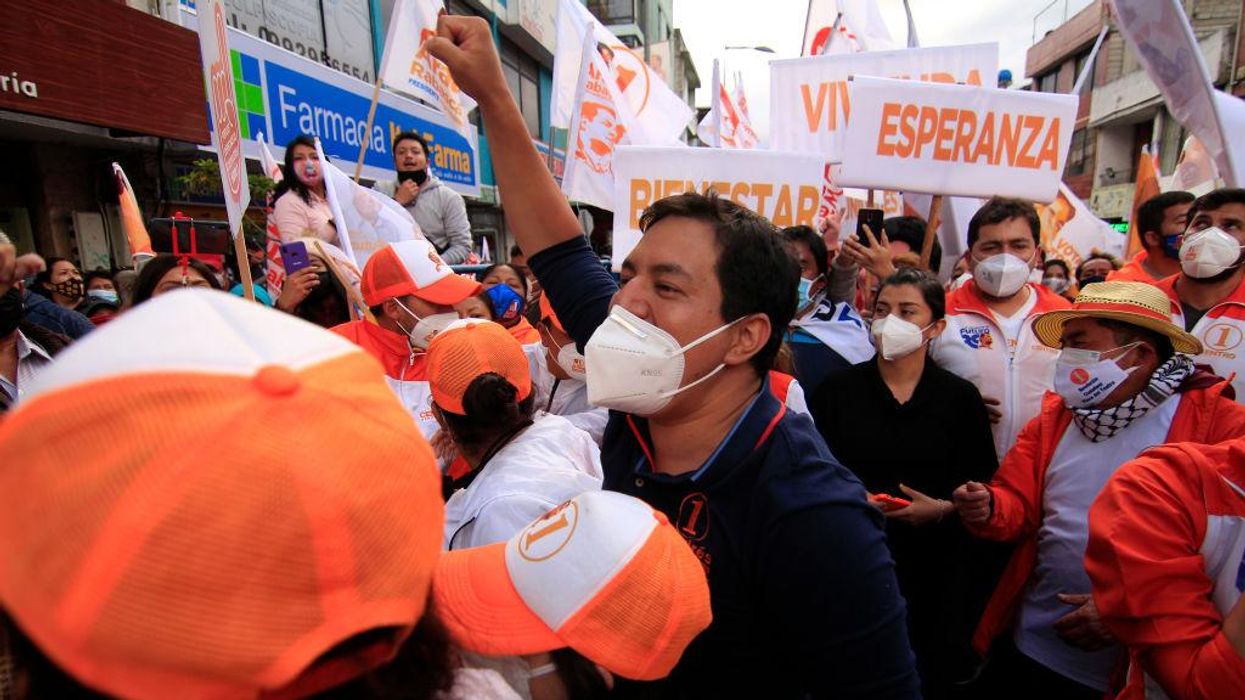
As economists, we share a general concern when economic issues are widely misunderstood in political debates that can determine policy, sometimes with lasting consequences. This appears to be a problem in Ecuador at the moment, in the heat of an election campaign.
"In the United States, we have seen the dangers of misinformation multiplied to dangerous levels during the past four years. We hope that Ecuador can avoid these kinds of problems in its upcoming election."
Media reports have repeated, without any evidence, false allegations about the economic program of one of the presidential candidates. Andres Arauz, a former minister and Director General of the Central Bank who is currently leading in most polls, has been accused of seeking to abandon the country's current use of the dollar as its national currency. There is no evidence that he or his political party would do anything at all in this direction.
A transition from the dollar back to a national currency would be costly and involve risks that would be exacerbated by the current dire and precarious economic situation. This false allegation is clearly an attempt to scare voters, and indeed those promoting it have warned of a resulting economic collapse if the dollar is abandoned.
In fact, not only has Arauz emphasized that he is committed to maintaining the dollar as the national currency, he and his party have a long track record of taking strong measures to make sure that dollarization did not come under threat. These included reforms which kept billions of dollars within Ecuador, such as taxing capital leaving the country, financial regulation--including regulations on foreign banks within the country--increased accountability of the Central Bank; and other reforms and policies that kept the economy stable and avoided crises for the 10 years of the Rafael Correa presidency (2007 to 2017).
These policies and reforms prevented even the slightest threat to Ecuador's commitment to the dollar, even when Ecuador was hit hard by the world recession of 2009, as well as other severe external shocks including a collapse of oil prices in 2014, and steep falls in remittances.
Voters need to have accurate information about the most important issues, including economic issues, that are facing the country when they choose a government.
As a result of this prudent economic management, the economy did very well during the Correa years, and the gains were widely distributed. Income per person rose by 20 percent and poverty fell by more than 38 percent from 2006 to 2017. The Gini coefficient for net household income (which measures inequality) fell by almost 15 percent between 2006 and 2017. During these years, social spending more than doubled as a percent of GDP. Much of this went to healthcare and education, with enrollment rates in secondary education increasing 26 percent; the number of people treated in public hospitals rose by 56 percent.
Ironically, it is some of Arauz's opponents who are proposing measures that could put Ecuador's dollarization at risk, by doing away with the necessary financial regulation. Guillermo Lasso--Arauz's main competitor--has called for the elimination of capital controls, which would make the country vulnerable to balance of payments crises that could threaten the dollar's place as Ecuador's currency.
In contrast to the previous presidency, the economy under the current government has run into serious trouble. GDP is estimated by the IMF to be over 10 percent lower in 2020 than it was in 2017. Of course, much of this was a result of the Covid-19 pandemic, but a large part of these losses were a result of bad decisions. GDP per capita fell 1.5 percent from 2017to 2019, even before the Covid-19 crisis hit. And in 2019, the government signed an IMF agreement committing to a fiscal tightening of 5 percent of GDP over the next three years.
Some of the required spending cuts provoked widespread protests, which were met with serious repression. This repression, which left at least 9 dead and over 1500 injured, was investigated by the United Nations Office of the High Commissioner for Human Rights, which called for further investigations into numerous reports of "unnecessary and disproportionate use of force" by security forces. Indigenous groups were especially affected, with Ecuador's largest indigenous organization filing a lawsuit against the Ecuadorian government for alleged "crimes against humanity."
Another false economic claim has been promoted in the current election cycle: that the Correa government ran up an unsustainable debt which the current government had to reduce. In fact, the Correa government left office with a debt of 45 percent of GDP. Under the current government, Ecuador's debt increased to 69 percent of GDP.
Voters need to have accurate information about the most important issues, including economic issues, that are facing the country when they choose a government. In the United States, we have seen the dangers of misinformation multiplied to dangerous levels during the past four years. We hope that Ecuador can avoid these kinds of problems in its upcoming election.
Original signers (in alphabetical order)
(name, affiliation for identification purposes)
James K. Galbraith, Lloyd M. Bentsen Jr. Chair in Government/Business Relations and Professor of Government, LBJ School of Public Affairs, University of Texas at Austin
Jayati Ghosh, Professor of Economics, University of Massachusetts Amherst
Mark Weisbrot, Co-Director, Center for Economic and Policy Research
Signers (in alphabetical order)
(name, affiliation for identification purposes)
Eileen Appelbaum, Co-Director, Center for Economic and Policy Research
Alan Aja, Professor & Chair, Dep. of Puerto Rican & Latino Studies, Brooklyn College (CUNY)
Michael Ash, Professor of Economics & Public Policy, UMass Amherst
Amiya Bagchi, Emeritus Professor, Institute of Development Studies Kolkata, Adjunct Professor, Monash University
Ron Baiman, Associate Professor of Economics
Dean Baker, Senior Economist, Center for Economic and Policy Research
Peter Bohmer, Faculty emeritus in Economics and Political Economy, The Evergreen State College
Korkut Boratav, Turkish Social Science Association
Manuel Branco, Professor, University of Evora, Portugal
Jim Campen, Professor of Economics, Emeritus, University of Massachusetts Boston
Anis Chowdhury, Adjunct Professor, Western Sydney University, Australia
Alan Cibils, Chair, Political Economy Departmente, Universidad Nacional de General Sarmiento, Argentina
Nathaniel Cline, Associate Professor, University of Redlands
Andrew Cornford, Geneva Finance Observatory
Dante Dallavalle, Adjunct Lecturer of Economics, John Jay College
Peter Dorman, Professor of Economics Emeritus, Evergreen State College
Jeff Faux, Distinguished Fellow, Economic Policy Institute
Sujatha Fernandes, Professor, Department of Sociology and Social Policy, The University of Sydney
Kevin Gallagher, Director, Global Development Policy Center, Boston University
Daphne T. Greenwood, Professor of Economics, University of Colorado-Colorado Springs
Fadhel Kaboub, Denison University
Mary C. King, Professor of Economics Emerita, Portland State University
Gabriele Kohler, Independent Development Consultant
Michael A. Lebowitz, Professor Emeritus, Economics Department, Simon Fraser University
Stephan Lefebvre, Assistant Professor, Bucknell University
Arthur MacEwan, Professor of Emeritus of Economics, University of Massachusetts Boston
Ann Markusen, Professor Emerita, Humphrey School, University of Minnesota
Michael Meeropol, Professor Emeritus of Economics, Western New England University
Lara Merling, Policy Advisor, ITUC
Mritiunjoy Mohanty, Professor, Indian Institute of Managment Calcutta, Kolkata, India
Isabel Ortiz, Director, Global Social Justice Program, IPD, Columbia University
Mustafa Ozer, Professor, Anadolu University
Christian Parenti, Associate Professor of Economics, John Jay College, CUNY
Mark Paul, Assistant Professor of Economics, New College of Florida
Alicia Puyans, Economics Ptoffeso Facultad Latinoamericana de Ciencias Socialed
Philippe Quirion, Senior scientist/Directeur de recherche, CNRS (France)
Miriam Rehm, Professor, University of Duisburg-Essen
Joseph Ricciardi, Associate Professor of Economics, Babson College
C. Saratchand, Assistant Professor, Department of Economics, Satyawati College, University of Delhi
Saskia Sassen, The Robert S. Lynd Professor of Sociology, Columbia University
Max B. Sawicky, Senior Research Fellow, Center for Economic and Policy Research
Stephanie Seguino, Professor of Economics, University of Vermont
Tazdait Tarik, Senior Researcher, CNRS (France)
Rolph van der Hoeven, Professor, Erasmus University, The Netherlands
Irene van Staveren, Professor of Pluralist Development Economics, International Institute of Social Studies of Erasmus University Rotterdam
Matias Vernengo, Professor, Bucknell University
Scott Weir, Economics (retired), Wake Technical Community College
John Willoughby, Professor, Department of Economics, American University
John Womack Jr., Robert Woods Bliss Professor of Latin American History and Economics, emeritus, Harvard University