
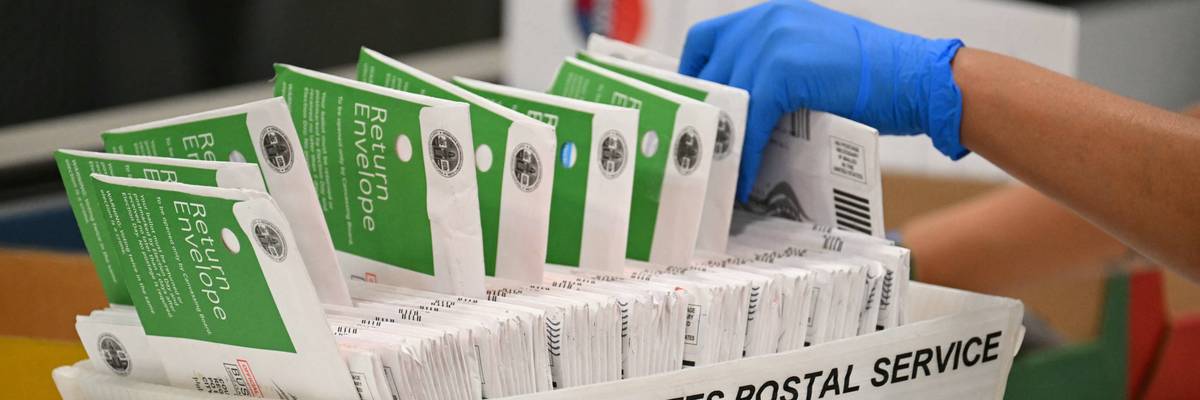
An election worker processes mail-in ballots at the Los Angeles County Ballot Processing Center during California's state primary election in the City of Industry, California, on June 2, 2026.
Failure Insurance: Trump’s New Electoral Strategy in America
The objective of President Trump's warnings about election integrity are no longer merely to challenge an outcome, but to suggest that only a result delivering victory to Trump or his movement is legitimate.
Less than 10 days after President Donald Trump described the electoral system as “dangerous and under threat,” a federal appeals court blocked his administration from enforcing an order tightening mail-in voting rules in 23 states. The ruling showed that the dispute is not only about cybersecurity or foreign threats, but also about the rules that will determine the legitimacy of the 2026 midterms. Democracies begin to erode when citizens no longer believe the ballot box reflects their genuine will. Electoral legitimacy depends less on a flawless voting process than on public acceptance of rules that allow even the losing side to accept the outcome.
Viewed from this perspective, the most significant element of Trump’s White House speech was not his claims about China, Russia, Iran, or North Korea, but the way he portrayed the American electoral system itself. Trump described it as “dangerous and under threat”—a characterization that goes beyond a warning about cybersecurity or foreign interference. It raises a fundamental question: Is the principal problem the external threats facing America’s electoral system, or the effort to persuade Americans that the system itself can no longer be trusted?
To support his claim, Trump presented a series of alleged threats. He said declassified intelligence documents showed that China obtained information from 220 million American voter-registration records and that intelligence officials concealed the matter. He also warned that China, Russia, Iran, and North Korea can penetrate America’s electoral infrastructure. Yet these countries are not the center of his narrative. Rather, they serve as evidence for a broader claim: that the US electoral system is vulnerable, insecure, and needs fundamental redesign.
The distinction between issuing a security warning and discrediting an electoral system becomes clear here. Few deny that foreign powers attempt to influence rival states’ political and information environments. Like many democracies, the United States faces cyber threats and influence operations. But there is a crucial difference between strengthening election security and cultivating the belief that the entire electoral process is fundamentally unreliable. The former protects democratic institutions; the latter erodes public trust.
If a society believes elections are valid only when they produce one faction’s preferred outcome, the problem is no longer a particular election; it is the erosion of democratic competition and the transformation of elections from a solution to political conflict into a source of crisis.
The significance becomes clearer when Trump’s remarks are placed within the US political context. The 2026 midterms are not an ordinary contest for the president. Declining approval ratings, public dissatisfaction with the consequences of the war with Iran and rising energy prices, and the risk of losing the House have placed Republicans in a difficult position. If Democrats regain the House, another effort to impeach Trump could follow—a possibility he has raised. For Trump, who refused to accept the outcome of the 2020 election, elections are not merely an institutional process; they are part of a struggle over his political legitimacy.
This backdrop helps explain the Trump administration’s effort to expand the federal role in election administration. The White House’s pressure on congressional Republicans to pass the SAVE America Act—which would require proof of citizenship at registration, photo identification when voting, and the sharing of voter information with the federal government—rests on a single assumption: that the existing system requires sweeping changes to improve security and public confidence. The question is not whether electoral reforms are open to debate, but how they are presented: as reforms to improve a functioning system, or an attempt to rescue one that has already failed?
Here the meaning of Trump’s speech becomes more apparent. Before the election, he is constructing a framework through which the outcome is interpreted. If Republicans prevail, the election will be presented as proof of the system’s integrity. But if the result contradicts White House expectations, explanations are already prepared: foreign governments, the intelligence community, structural weaknesses, or the electoral process itself. This is political failure insurance.
Failure insurance does not require conclusive proof of a conspiracy. It consists of building a narrative that reduces the political cost of defeat before it occurs. Within this framework, losing is no longer necessarily the consequence of voters’ choices; it can be attributed to a “dangerous and under threat” electoral system. This is the key difference from 2020. Then, Trump’s allegations emerged after the results were announced. Now, the narrative of distrust is being constructed before voting begins. The objective is no longer merely to challenge an outcome, but to suggest that only a result delivering victory to Trump or his movement is legitimate.
Democracies have never been built on the assumption that elections are flawless. They rest on the principle that political disputes can be resolved within a shared institutional framework and that even the losing side accepts the legitimacy of the process. If a society believes elections are valid only when they produce one faction’s preferred outcome, the problem is no longer a particular election; it is the erosion of democratic competition and the transformation of elections from a solution to political conflict into a source of crisis.
The irony is that, for decades, the United States applied this standard when assessing elections in other countries. Washington argued that without public trust, even legally conducted elections cannot enjoy political legitimacy. Today, however, the president is invoking the same logic to describe America’s own electoral system. This is more than a domestic dispute; it raises questions about the credibility of the democratic model America has long sought to project abroad.
Ultimately, the central question raised by Trump’s recent speech may not be whether China gained access to voter-registration data, or how capable Russia, Iran, and North Korea are of penetrating America’s electoral infrastructure. The fundamental question is why, on the eve of one of the most consequential elections of his presidency, the president of the United States has chosen to convince millions of Americans—before the first ballot is cast—that their electoral system is “dangerous and under threat.”
Placed alongside political realities, the implications are troubling. Trump’s speech cannot be understood as a warning about election security or dismissed as another chapter in the disputes following the 2020 election. It represents an attempt to redefine the relationship between the voter and the ballot box—a relationship in which electoral legitimacy derives not from public trust and established institutions, but from the narrative advanced by those in power. This is how democracy begins to erode from within, long before fraud or foreign interference damages it. The greatest threat to American elections may lie not in Beijing, Moscow, Tehran, or Pyongyang, but in the moment when the president, seeking to insure himself against defeat, persuades his own citizens that the ballot box can no longer be trusted.
An Urgent Message From Our Co-Founder
Dear Common Dreams reader, It’s been nearly 30 years since I co-founded Common Dreams with my late wife, Lina Newhouser. We had the radical notion that journalism should serve the public good, not corporate profits. It was clear to us from the outset what it would take to build such a project. No paid advertisements. No corporate sponsors. No millionaire publisher telling us what to think or do. Many people said we wouldn't last a year, but we proved those doubters wrong. Together with a tremendous team of journalists and dedicated staff, we built an independent media outlet free from the constraints of profits and corporate control. Our mission has always been simple: To inform. To inspire. To ignite change for the common good. Building Common Dreams was not easy. Our survival was never guaranteed. When you take on the most powerful forces—Wall Street greed, fossil fuel industry destruction, Big Tech lobbyists, and uber-rich oligarchs who have spent billions upon billions rigging the economy and democracy in their favor—the only bulwark you have is supporters who believe in your work. But here’s the urgent message from me today. It's never been this bad out there. And it's never been this hard to keep us going. At the very moment Common Dreams is most needed, the threats we face are intensifying. We need your support now more than ever. We don't accept corporate advertising and never will. We don't have a paywall because we don't think people should be blocked from critical news based on their ability to pay. Everything we do is funded by the donations of readers like you. When everyone does the little they can afford, we are strong. But if that support retreats or dries up, so do we. Will you donate now to make sure Common Dreams not only survives but thrives? —Craig Brown, Co-founder |
Less than 10 days after President Donald Trump described the electoral system as “dangerous and under threat,” a federal appeals court blocked his administration from enforcing an order tightening mail-in voting rules in 23 states. The ruling showed that the dispute is not only about cybersecurity or foreign threats, but also about the rules that will determine the legitimacy of the 2026 midterms. Democracies begin to erode when citizens no longer believe the ballot box reflects their genuine will. Electoral legitimacy depends less on a flawless voting process than on public acceptance of rules that allow even the losing side to accept the outcome.
Viewed from this perspective, the most significant element of Trump’s White House speech was not his claims about China, Russia, Iran, or North Korea, but the way he portrayed the American electoral system itself. Trump described it as “dangerous and under threat”—a characterization that goes beyond a warning about cybersecurity or foreign interference. It raises a fundamental question: Is the principal problem the external threats facing America’s electoral system, or the effort to persuade Americans that the system itself can no longer be trusted?
To support his claim, Trump presented a series of alleged threats. He said declassified intelligence documents showed that China obtained information from 220 million American voter-registration records and that intelligence officials concealed the matter. He also warned that China, Russia, Iran, and North Korea can penetrate America’s electoral infrastructure. Yet these countries are not the center of his narrative. Rather, they serve as evidence for a broader claim: that the US electoral system is vulnerable, insecure, and needs fundamental redesign.
The distinction between issuing a security warning and discrediting an electoral system becomes clear here. Few deny that foreign powers attempt to influence rival states’ political and information environments. Like many democracies, the United States faces cyber threats and influence operations. But there is a crucial difference between strengthening election security and cultivating the belief that the entire electoral process is fundamentally unreliable. The former protects democratic institutions; the latter erodes public trust.
If a society believes elections are valid only when they produce one faction’s preferred outcome, the problem is no longer a particular election; it is the erosion of democratic competition and the transformation of elections from a solution to political conflict into a source of crisis.
The significance becomes clearer when Trump’s remarks are placed within the US political context. The 2026 midterms are not an ordinary contest for the president. Declining approval ratings, public dissatisfaction with the consequences of the war with Iran and rising energy prices, and the risk of losing the House have placed Republicans in a difficult position. If Democrats regain the House, another effort to impeach Trump could follow—a possibility he has raised. For Trump, who refused to accept the outcome of the 2020 election, elections are not merely an institutional process; they are part of a struggle over his political legitimacy.
This backdrop helps explain the Trump administration’s effort to expand the federal role in election administration. The White House’s pressure on congressional Republicans to pass the SAVE America Act—which would require proof of citizenship at registration, photo identification when voting, and the sharing of voter information with the federal government—rests on a single assumption: that the existing system requires sweeping changes to improve security and public confidence. The question is not whether electoral reforms are open to debate, but how they are presented: as reforms to improve a functioning system, or an attempt to rescue one that has already failed?
Here the meaning of Trump’s speech becomes more apparent. Before the election, he is constructing a framework through which the outcome is interpreted. If Republicans prevail, the election will be presented as proof of the system’s integrity. But if the result contradicts White House expectations, explanations are already prepared: foreign governments, the intelligence community, structural weaknesses, or the electoral process itself. This is political failure insurance.
Failure insurance does not require conclusive proof of a conspiracy. It consists of building a narrative that reduces the political cost of defeat before it occurs. Within this framework, losing is no longer necessarily the consequence of voters’ choices; it can be attributed to a “dangerous and under threat” electoral system. This is the key difference from 2020. Then, Trump’s allegations emerged after the results were announced. Now, the narrative of distrust is being constructed before voting begins. The objective is no longer merely to challenge an outcome, but to suggest that only a result delivering victory to Trump or his movement is legitimate.
Democracies have never been built on the assumption that elections are flawless. They rest on the principle that political disputes can be resolved within a shared institutional framework and that even the losing side accepts the legitimacy of the process. If a society believes elections are valid only when they produce one faction’s preferred outcome, the problem is no longer a particular election; it is the erosion of democratic competition and the transformation of elections from a solution to political conflict into a source of crisis.
The irony is that, for decades, the United States applied this standard when assessing elections in other countries. Washington argued that without public trust, even legally conducted elections cannot enjoy political legitimacy. Today, however, the president is invoking the same logic to describe America’s own electoral system. This is more than a domestic dispute; it raises questions about the credibility of the democratic model America has long sought to project abroad.
Ultimately, the central question raised by Trump’s recent speech may not be whether China gained access to voter-registration data, or how capable Russia, Iran, and North Korea are of penetrating America’s electoral infrastructure. The fundamental question is why, on the eve of one of the most consequential elections of his presidency, the president of the United States has chosen to convince millions of Americans—before the first ballot is cast—that their electoral system is “dangerous and under threat.”
Placed alongside political realities, the implications are troubling. Trump’s speech cannot be understood as a warning about election security or dismissed as another chapter in the disputes following the 2020 election. It represents an attempt to redefine the relationship between the voter and the ballot box—a relationship in which electoral legitimacy derives not from public trust and established institutions, but from the narrative advanced by those in power. This is how democracy begins to erode from within, long before fraud or foreign interference damages it. The greatest threat to American elections may lie not in Beijing, Moscow, Tehran, or Pyongyang, but in the moment when the president, seeking to insure himself against defeat, persuades his own citizens that the ballot box can no longer be trusted.
- Trump Effort 'To Rig Our Elections Is Well Underway,' Experts Warn ›
- Fearing Midterm Loss, Trump Once Again Says 'We Shouldn't Even Have an Election' ›
- In Independence Eve Speech, Trump Warns of Communism Then Promotes One-Party Rule ›
- 'World's Most Famous Sore Loser': Ossoff Delivers Preemptive Smackdown of Trump's Election Speech ›
- 'Trump Is Trying to End Our Democracy': Alarm as President Attacks Elections Ahead of Midterms ›
- Sociopathic Trump Delivers Absurd—and Terrifying—Address to the Nation ›
Less than 10 days after President Donald Trump described the electoral system as “dangerous and under threat,” a federal appeals court blocked his administration from enforcing an order tightening mail-in voting rules in 23 states. The ruling showed that the dispute is not only about cybersecurity or foreign threats, but also about the rules that will determine the legitimacy of the 2026 midterms. Democracies begin to erode when citizens no longer believe the ballot box reflects their genuine will. Electoral legitimacy depends less on a flawless voting process than on public acceptance of rules that allow even the losing side to accept the outcome.
Viewed from this perspective, the most significant element of Trump’s White House speech was not his claims about China, Russia, Iran, or North Korea, but the way he portrayed the American electoral system itself. Trump described it as “dangerous and under threat”—a characterization that goes beyond a warning about cybersecurity or foreign interference. It raises a fundamental question: Is the principal problem the external threats facing America’s electoral system, or the effort to persuade Americans that the system itself can no longer be trusted?
To support his claim, Trump presented a series of alleged threats. He said declassified intelligence documents showed that China obtained information from 220 million American voter-registration records and that intelligence officials concealed the matter. He also warned that China, Russia, Iran, and North Korea can penetrate America’s electoral infrastructure. Yet these countries are not the center of his narrative. Rather, they serve as evidence for a broader claim: that the US electoral system is vulnerable, insecure, and needs fundamental redesign.
The distinction between issuing a security warning and discrediting an electoral system becomes clear here. Few deny that foreign powers attempt to influence rival states’ political and information environments. Like many democracies, the United States faces cyber threats and influence operations. But there is a crucial difference between strengthening election security and cultivating the belief that the entire electoral process is fundamentally unreliable. The former protects democratic institutions; the latter erodes public trust.
If a society believes elections are valid only when they produce one faction’s preferred outcome, the problem is no longer a particular election; it is the erosion of democratic competition and the transformation of elections from a solution to political conflict into a source of crisis.
The significance becomes clearer when Trump’s remarks are placed within the US political context. The 2026 midterms are not an ordinary contest for the president. Declining approval ratings, public dissatisfaction with the consequences of the war with Iran and rising energy prices, and the risk of losing the House have placed Republicans in a difficult position. If Democrats regain the House, another effort to impeach Trump could follow—a possibility he has raised. For Trump, who refused to accept the outcome of the 2020 election, elections are not merely an institutional process; they are part of a struggle over his political legitimacy.
This backdrop helps explain the Trump administration’s effort to expand the federal role in election administration. The White House’s pressure on congressional Republicans to pass the SAVE America Act—which would require proof of citizenship at registration, photo identification when voting, and the sharing of voter information with the federal government—rests on a single assumption: that the existing system requires sweeping changes to improve security and public confidence. The question is not whether electoral reforms are open to debate, but how they are presented: as reforms to improve a functioning system, or an attempt to rescue one that has already failed?
Here the meaning of Trump’s speech becomes more apparent. Before the election, he is constructing a framework through which the outcome is interpreted. If Republicans prevail, the election will be presented as proof of the system’s integrity. But if the result contradicts White House expectations, explanations are already prepared: foreign governments, the intelligence community, structural weaknesses, or the electoral process itself. This is political failure insurance.
Failure insurance does not require conclusive proof of a conspiracy. It consists of building a narrative that reduces the political cost of defeat before it occurs. Within this framework, losing is no longer necessarily the consequence of voters’ choices; it can be attributed to a “dangerous and under threat” electoral system. This is the key difference from 2020. Then, Trump’s allegations emerged after the results were announced. Now, the narrative of distrust is being constructed before voting begins. The objective is no longer merely to challenge an outcome, but to suggest that only a result delivering victory to Trump or his movement is legitimate.
Democracies have never been built on the assumption that elections are flawless. They rest on the principle that political disputes can be resolved within a shared institutional framework and that even the losing side accepts the legitimacy of the process. If a society believes elections are valid only when they produce one faction’s preferred outcome, the problem is no longer a particular election; it is the erosion of democratic competition and the transformation of elections from a solution to political conflict into a source of crisis.
The irony is that, for decades, the United States applied this standard when assessing elections in other countries. Washington argued that without public trust, even legally conducted elections cannot enjoy political legitimacy. Today, however, the president is invoking the same logic to describe America’s own electoral system. This is more than a domestic dispute; it raises questions about the credibility of the democratic model America has long sought to project abroad.
Ultimately, the central question raised by Trump’s recent speech may not be whether China gained access to voter-registration data, or how capable Russia, Iran, and North Korea are of penetrating America’s electoral infrastructure. The fundamental question is why, on the eve of one of the most consequential elections of his presidency, the president of the United States has chosen to convince millions of Americans—before the first ballot is cast—that their electoral system is “dangerous and under threat.”
Placed alongside political realities, the implications are troubling. Trump’s speech cannot be understood as a warning about election security or dismissed as another chapter in the disputes following the 2020 election. It represents an attempt to redefine the relationship between the voter and the ballot box—a relationship in which electoral legitimacy derives not from public trust and established institutions, but from the narrative advanced by those in power. This is how democracy begins to erode from within, long before fraud or foreign interference damages it. The greatest threat to American elections may lie not in Beijing, Moscow, Tehran, or Pyongyang, but in the moment when the president, seeking to insure himself against defeat, persuades his own citizens that the ballot box can no longer be trusted.
- Trump Effort 'To Rig Our Elections Is Well Underway,' Experts Warn ›
- Fearing Midterm Loss, Trump Once Again Says 'We Shouldn't Even Have an Election' ›
- In Independence Eve Speech, Trump Warns of Communism Then Promotes One-Party Rule ›
- 'World's Most Famous Sore Loser': Ossoff Delivers Preemptive Smackdown of Trump's Election Speech ›
- 'Trump Is Trying to End Our Democracy': Alarm as President Attacks Elections Ahead of Midterms ›
- Sociopathic Trump Delivers Absurd—and Terrifying—Address to the Nation ›