SUBSCRIBE TO OUR FREE NEWSLETTER
Daily news & progressive opinion—funded by the people, not the corporations—delivered straight to your inbox.
5
#000000
#FFFFFF
To donate by check, phone, or other method, see our More Ways to Give page.
Daily news & progressive opinion—funded by the people, not the corporations—delivered straight to your inbox.
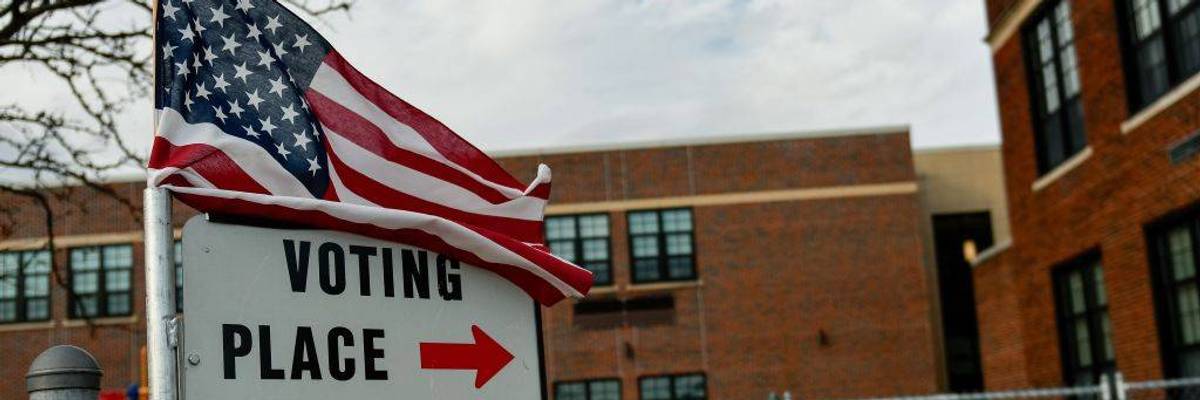
Voters walk in to cast their ballot for the US presidential and congressional elections at Dearborn High School in Dearborn, MIichigan on November 5, 2024.
One expert expressed fear that "something truly spectacular is going to happen in which our 2026 midterm elections are not administered like past elections have been."
A pair of experts warned this week that President Donald Trump is clearly telegraphing his intention to meddle in the 2026 midterm elections.
Stephen Richer, former recorder of Maricopa County, Arizona, said during an interview with The Atlantic published Wednesday that he's grown worried that "something truly spectacular is going to happen in which our 2026 midterm elections are not administered like past elections have been."
When asked to flesh out how Trump could potentially rig the upcoming elections, Richer said it was unlikely that he would deploy US Immigration and Customs Enforcement (ICE) agents to polling places across the country, if for no other reason than he lacks the manpower to accomplish such an operation.
However, Richer did express concern about the president's ability to muddy waters in tight races and put pressure on his Republican allies to refuse to seat Democratic winners when he is claiming there are disputes about the results.
"Where I think President Trump is most potent is still in the post-election procedures," he explained, "still in sowing doubt in the minds of enough Americans that they don’t think the elections are legitimate and, therefore... the Congress doesn’t have to seat its new members. That’s certainly a popular theory that’s floating about: that Speaker Mike Johnson (R-La.), the outgoing speaker, will choose not to seat the new members, because they’re in allegedly disputed elections."
Richer argued that California could be particularly vulnerable to this, since the state infamously takes so long to finish tallying its votes.
In a New York Times editorial published Thursday, Sean Morales-Doyle, director of the Brennan Center for Justice's voting rights and elections program, argued that Trump's "campaign to rig our elections is well underway," and he pointed to the president's mass pardon last year of rioters who violently stormed the US Capitol on January 6, 2021 as the beginning of his election subversion campaign.
"We have every reason to expect more actions like these in the coming months," wrote Morales-Doyle. "A few weeks ago, Mr. Trump reiterated his threats to prosecute election officials who ran the 2020 election. Just days later, FBI agents seized ballots and election records from 2020 in Fulton County, Georgia."
However, Morales-Doyle also said there was reason to believe that the American system can withstand the president's assault on its election integrity, and he gave a nod toward several efforts across the country to fight back, including states resisting Trump's demands to hand over their voter rolls and Democrats refusing to let new voter suppression legislation pass through Congress.
"We are already seeing how effective people can be in pushing back," he concluded, "whether on the streets of Minneapolis or at town halls hosted by their representatives in Congress. It will be incumbent on all of us—election officials, advocates, state law enforcement, and voters—to see the administration’s efforts for what they are and to fight back."
Dear Common Dreams reader, It’s been nearly 30 years since I co-founded Common Dreams with my late wife, Lina Newhouser. We had the radical notion that journalism should serve the public good, not corporate profits. It was clear to us from the outset what it would take to build such a project. No paid advertisements. No corporate sponsors. No millionaire publisher telling us what to think or do. Many people said we wouldn't last a year, but we proved those doubters wrong. Together with a tremendous team of journalists and dedicated staff, we built an independent media outlet free from the constraints of profits and corporate control. Our mission has always been simple: To inform. To inspire. To ignite change for the common good. Building Common Dreams was not easy. Our survival was never guaranteed. When you take on the most powerful forces—Wall Street greed, fossil fuel industry destruction, Big Tech lobbyists, and uber-rich oligarchs who have spent billions upon billions rigging the economy and democracy in their favor—the only bulwark you have is supporters who believe in your work. But here’s the urgent message from me today. It's never been this bad out there. And it's never been this hard to keep us going. At the very moment Common Dreams is most needed, the threats we face are intensifying. We need your support now more than ever. We don't accept corporate advertising and never will. We don't have a paywall because we don't think people should be blocked from critical news based on their ability to pay. Everything we do is funded by the donations of readers like you. When everyone does the little they can afford, we are strong. But if that support retreats or dries up, so do we. Will you donate now to make sure Common Dreams not only survives but thrives? —Craig Brown, Co-founder |
A pair of experts warned this week that President Donald Trump is clearly telegraphing his intention to meddle in the 2026 midterm elections.
Stephen Richer, former recorder of Maricopa County, Arizona, said during an interview with The Atlantic published Wednesday that he's grown worried that "something truly spectacular is going to happen in which our 2026 midterm elections are not administered like past elections have been."
When asked to flesh out how Trump could potentially rig the upcoming elections, Richer said it was unlikely that he would deploy US Immigration and Customs Enforcement (ICE) agents to polling places across the country, if for no other reason than he lacks the manpower to accomplish such an operation.
However, Richer did express concern about the president's ability to muddy waters in tight races and put pressure on his Republican allies to refuse to seat Democratic winners when he is claiming there are disputes about the results.
"Where I think President Trump is most potent is still in the post-election procedures," he explained, "still in sowing doubt in the minds of enough Americans that they don’t think the elections are legitimate and, therefore... the Congress doesn’t have to seat its new members. That’s certainly a popular theory that’s floating about: that Speaker Mike Johnson (R-La.), the outgoing speaker, will choose not to seat the new members, because they’re in allegedly disputed elections."
Richer argued that California could be particularly vulnerable to this, since the state infamously takes so long to finish tallying its votes.
In a New York Times editorial published Thursday, Sean Morales-Doyle, director of the Brennan Center for Justice's voting rights and elections program, argued that Trump's "campaign to rig our elections is well underway," and he pointed to the president's mass pardon last year of rioters who violently stormed the US Capitol on January 6, 2021 as the beginning of his election subversion campaign.
"We have every reason to expect more actions like these in the coming months," wrote Morales-Doyle. "A few weeks ago, Mr. Trump reiterated his threats to prosecute election officials who ran the 2020 election. Just days later, FBI agents seized ballots and election records from 2020 in Fulton County, Georgia."
However, Morales-Doyle also said there was reason to believe that the American system can withstand the president's assault on its election integrity, and he gave a nod toward several efforts across the country to fight back, including states resisting Trump's demands to hand over their voter rolls and Democrats refusing to let new voter suppression legislation pass through Congress.
"We are already seeing how effective people can be in pushing back," he concluded, "whether on the streets of Minneapolis or at town halls hosted by their representatives in Congress. It will be incumbent on all of us—election officials, advocates, state law enforcement, and voters—to see the administration’s efforts for what they are and to fight back."
A pair of experts warned this week that President Donald Trump is clearly telegraphing his intention to meddle in the 2026 midterm elections.
Stephen Richer, former recorder of Maricopa County, Arizona, said during an interview with The Atlantic published Wednesday that he's grown worried that "something truly spectacular is going to happen in which our 2026 midterm elections are not administered like past elections have been."
When asked to flesh out how Trump could potentially rig the upcoming elections, Richer said it was unlikely that he would deploy US Immigration and Customs Enforcement (ICE) agents to polling places across the country, if for no other reason than he lacks the manpower to accomplish such an operation.
However, Richer did express concern about the president's ability to muddy waters in tight races and put pressure on his Republican allies to refuse to seat Democratic winners when he is claiming there are disputes about the results.
"Where I think President Trump is most potent is still in the post-election procedures," he explained, "still in sowing doubt in the minds of enough Americans that they don’t think the elections are legitimate and, therefore... the Congress doesn’t have to seat its new members. That’s certainly a popular theory that’s floating about: that Speaker Mike Johnson (R-La.), the outgoing speaker, will choose not to seat the new members, because they’re in allegedly disputed elections."
Richer argued that California could be particularly vulnerable to this, since the state infamously takes so long to finish tallying its votes.
In a New York Times editorial published Thursday, Sean Morales-Doyle, director of the Brennan Center for Justice's voting rights and elections program, argued that Trump's "campaign to rig our elections is well underway," and he pointed to the president's mass pardon last year of rioters who violently stormed the US Capitol on January 6, 2021 as the beginning of his election subversion campaign.
"We have every reason to expect more actions like these in the coming months," wrote Morales-Doyle. "A few weeks ago, Mr. Trump reiterated his threats to prosecute election officials who ran the 2020 election. Just days later, FBI agents seized ballots and election records from 2020 in Fulton County, Georgia."
However, Morales-Doyle also said there was reason to believe that the American system can withstand the president's assault on its election integrity, and he gave a nod toward several efforts across the country to fight back, including states resisting Trump's demands to hand over their voter rolls and Democrats refusing to let new voter suppression legislation pass through Congress.
"We are already seeing how effective people can be in pushing back," he concluded, "whether on the streets of Minneapolis or at town halls hosted by their representatives in Congress. It will be incumbent on all of us—election officials, advocates, state law enforcement, and voters—to see the administration’s efforts for what they are and to fight back."