SUBSCRIBE TO OUR FREE NEWSLETTER
Daily news & progressive opinion—funded by the people, not the corporations—delivered straight to your inbox.
5
#000000
#FFFFFF
To donate by check, phone, or other method, see our More Ways to Give page.
Daily news & progressive opinion—funded by the people, not the corporations—delivered straight to your inbox.
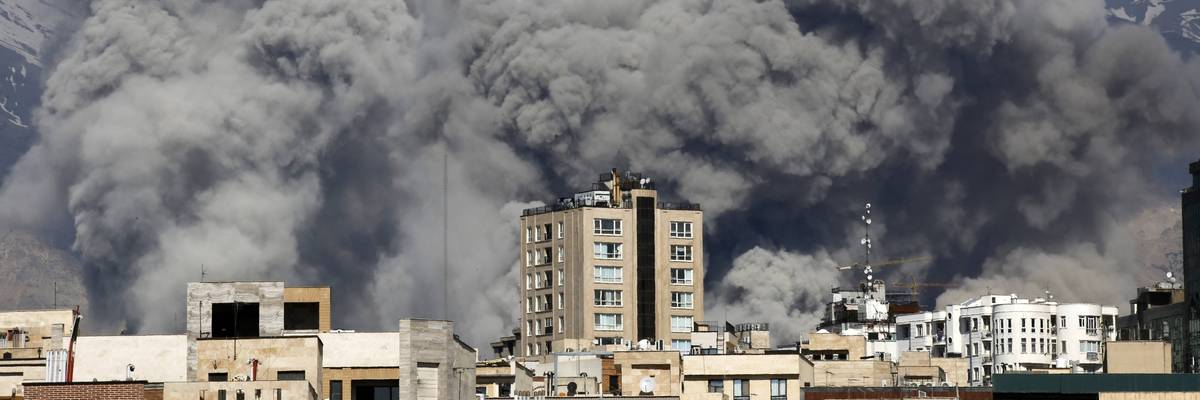
Smoke rises from an area after it was targeted in attacks as a series of explosions are heard in Tehran, Iran on March 1, 2026.
Trump and Netanyahu insist that Iran can never have a nuclear weapon. Yet perhaps the greatest irony of this war is that their senseless aggression is giving every country reason to develop nuclear arms.
At the 2026 meeting of the World Economic Forum, Canadian Prime Minister Mark Carney remarked that the “rules-based international order” has ended. In its place is a system where “the strong can do what they can, and the weak must suffer what they must.” Sovereignty is no longer safeguarded by international law, but rather “will increasingly be anchored in the ability to withstand pressure.”
The world Carney describes is quite familiar to the nations of Asia, Africa, and Latin America—the ones that never had the luxury of relying on international law. Where, for instance, were these rules during the decades of Israeli occupation of Palestine?
Still, while international law was always unevenly applied, the illegal war being waged by the US and Israel against Iran highlights the dangers of a world where superpowers can act without even those modest restraints.
A world where instead of just cause, the whims of the strong is enough cause for war. Israeli Prime Minister Benjamin Netanyahu says he has “longed” for this war “for 40 years.” President Donald Trump remarked, “We were having negotiations with these lunatics, and it was my opinion that they were going to attack first… I felt strongly about that.” Trump has even claimed that the war will end “when I feel it, feel it in my bones.”
What other lessons are countries to draw from this than that the US will engage in imperial violence against any non-nuclear power?
No congressional approval; no clear—or even consistent—justification provided to the public; no forewarning to America’s allies. When might makes right, why bother with the details?
Instead of the façade of proportionality, wars are deliberate exercises of international bullying. Secretary of War Pete Hegseth boosts that America “is unleashing the most lethal and precise air power campaign in history… with maximum authorities. No stupid rules of engagement, no nation-building quagmire, no democracy building exercise, no politically correct wars. We fight to win, and we don’t waste time or lives.” Trump openly jokes that military officials have told him it’s “a lot more fun” to sink Iranian ships than capture them.
Instead of any pretense of protecting civilians, the mighty strike with callous indifference. On the very first day of the war, the US struck a girl’s elementary school, killing more than 175 people—most of them small children. A US official reports that this was likely due to outdated intelligence. However, it is worth noting that the Trump administration effectively dissolved the Civilian Protection Center of Excellence, an initiative aimed precisely at reducing civilian harms during US military operations.
To date, the Iranian Deputy Health Minister Ali Jafarian reports that at least 1,255 people, mostly civilians, have been killed in the war. More than 12,000 people have been wounded, and 52 health centers and 29 clinical facilities have been either damaged or destroyed.
The cruelty is the point. Trump and Netanyahu want to make Iran into a failed state—an example of what happens to their enemies. As Trump puts it, “They really are a nation of terror and hate, and they’re paying a big price right now.” This is collective punishment with no plans or care for what comes next.
It is a war with no clear off-ramp. A peaceful resolution would be ideal, but why exactly would Iran entertain this option? Prior to these attacks, they were negotiating with the Trump administration. Omani Foreign Minister Badr bin Hamad Al Busaidi, who was mediating talks between the US and Iran, said that Tehran had made major concessions regarding its nuclear program. This included a willingness to reduce uranium levels below what it had agreed to under the Obama administration.
In a world where the pretense of international law has been unraveled, how can nations negotiate as equals? What guarantees could the world offer Iran that it will not be attacked again without provocation? This is, after all, the second war Israel has launched against them in nine months.
How will the world hold the US and Israel—two nuclear powers—responsible for their war crimes? Is it even possible? And if not, what precedent does it set?
Trump and Netanyahu insist that Iran can never have a nuclear weapon. Yet perhaps the greatest irony of this war is that their senseless aggression is giving every country reason to develop nuclear arms.
In a speech on March 2, French President Emmanuel Macron remarked, “The next 50 years will be an era of nuclear weapons.” He further announced that France will bolster their own nuclear arsenal, including the development of a new nuclear-armed submarine. On March 3, Polish Prime Minister Donald Tusk remarked that his administration is preparing “Poland for the most autonomous actions possible” with regards to nuclear security.
These moves, while dangerous, are unsurprising. In addition to war with Iran, Trump has threatened to annex Greenland and Canada; threatened to take the Panama Canal; kidnapped Venezuelan President Nicolás Maduro; launched military strikes in Venezuela, Somalia, Nigeria, Syria, Yemen, and Iraq; as well as imposed an oil embargo that is pushing Cuba to total collapse.
What other lessons are countries to draw from this than that the US will engage in imperial violence against any non-nuclear power? It will threaten Cuba for dealing with “hostile countries” like China and Russia, while also inviting President Xi Jinping and President Vladimir Putin to be part of Trump's Peace Board. The Trump administration will condemn human rights abuses in Iran, while also sharply scaling back its annual human rights report on North Korea.
This is the reality of Trump’s no-rules international order. If Iran had nuclear weapons, neither the US nor Israel would have dared attack them. Their sovereignty would be safe.
At Davos, Carney remarked that while the “great powers can afford for now to go it alone,” other nations must work together “because if we’re not at the table, we’re on the menu.” The precedent Trump has set is clear: A seat at the table is only guaranteed to nuclear powers. That is how nations will “withstand pressure.”
Importantly, this dynamic does not end with the Trump administration. Even if a competent leader is elected in 2028, no country can rest assured that another Trump is not on the horizon. The threat of unmitigated American violence will drive further nuclearization. It will make nuclear war increasingly more likely. That will be Trump’s legacy—one of death, destruction, and nuclearization.
Future presidents will inherit the terrible burden of repairing America’s image on the global stage. For now, we must do everything we can to end this war before Trump’s madness goes truly nuclear.
Dear Common Dreams reader, It’s been nearly 30 years since I co-founded Common Dreams with my late wife, Lina Newhouser. We had the radical notion that journalism should serve the public good, not corporate profits. It was clear to us from the outset what it would take to build such a project. No paid advertisements. No corporate sponsors. No millionaire publisher telling us what to think or do. Many people said we wouldn't last a year, but we proved those doubters wrong. Together with a tremendous team of journalists and dedicated staff, we built an independent media outlet free from the constraints of profits and corporate control. Our mission has always been simple: To inform. To inspire. To ignite change for the common good. Building Common Dreams was not easy. Our survival was never guaranteed. When you take on the most powerful forces—Wall Street greed, fossil fuel industry destruction, Big Tech lobbyists, and uber-rich oligarchs who have spent billions upon billions rigging the economy and democracy in their favor—the only bulwark you have is supporters who believe in your work. But here’s the urgent message from me today. It's never been this bad out there. And it's never been this hard to keep us going. At the very moment Common Dreams is most needed, the threats we face are intensifying. We need your support now more than ever. We don't accept corporate advertising and never will. We don't have a paywall because we don't think people should be blocked from critical news based on their ability to pay. Everything we do is funded by the donations of readers like you. When everyone does the little they can afford, we are strong. But if that support retreats or dries up, so do we. Will you donate now to make sure Common Dreams not only survives but thrives? —Craig Brown, Co-founder |
At the 2026 meeting of the World Economic Forum, Canadian Prime Minister Mark Carney remarked that the “rules-based international order” has ended. In its place is a system where “the strong can do what they can, and the weak must suffer what they must.” Sovereignty is no longer safeguarded by international law, but rather “will increasingly be anchored in the ability to withstand pressure.”
The world Carney describes is quite familiar to the nations of Asia, Africa, and Latin America—the ones that never had the luxury of relying on international law. Where, for instance, were these rules during the decades of Israeli occupation of Palestine?
Still, while international law was always unevenly applied, the illegal war being waged by the US and Israel against Iran highlights the dangers of a world where superpowers can act without even those modest restraints.
A world where instead of just cause, the whims of the strong is enough cause for war. Israeli Prime Minister Benjamin Netanyahu says he has “longed” for this war “for 40 years.” President Donald Trump remarked, “We were having negotiations with these lunatics, and it was my opinion that they were going to attack first… I felt strongly about that.” Trump has even claimed that the war will end “when I feel it, feel it in my bones.”
What other lessons are countries to draw from this than that the US will engage in imperial violence against any non-nuclear power?
No congressional approval; no clear—or even consistent—justification provided to the public; no forewarning to America’s allies. When might makes right, why bother with the details?
Instead of the façade of proportionality, wars are deliberate exercises of international bullying. Secretary of War Pete Hegseth boosts that America “is unleashing the most lethal and precise air power campaign in history… with maximum authorities. No stupid rules of engagement, no nation-building quagmire, no democracy building exercise, no politically correct wars. We fight to win, and we don’t waste time or lives.” Trump openly jokes that military officials have told him it’s “a lot more fun” to sink Iranian ships than capture them.
Instead of any pretense of protecting civilians, the mighty strike with callous indifference. On the very first day of the war, the US struck a girl’s elementary school, killing more than 175 people—most of them small children. A US official reports that this was likely due to outdated intelligence. However, it is worth noting that the Trump administration effectively dissolved the Civilian Protection Center of Excellence, an initiative aimed precisely at reducing civilian harms during US military operations.
To date, the Iranian Deputy Health Minister Ali Jafarian reports that at least 1,255 people, mostly civilians, have been killed in the war. More than 12,000 people have been wounded, and 52 health centers and 29 clinical facilities have been either damaged or destroyed.
The cruelty is the point. Trump and Netanyahu want to make Iran into a failed state—an example of what happens to their enemies. As Trump puts it, “They really are a nation of terror and hate, and they’re paying a big price right now.” This is collective punishment with no plans or care for what comes next.
It is a war with no clear off-ramp. A peaceful resolution would be ideal, but why exactly would Iran entertain this option? Prior to these attacks, they were negotiating with the Trump administration. Omani Foreign Minister Badr bin Hamad Al Busaidi, who was mediating talks between the US and Iran, said that Tehran had made major concessions regarding its nuclear program. This included a willingness to reduce uranium levels below what it had agreed to under the Obama administration.
In a world where the pretense of international law has been unraveled, how can nations negotiate as equals? What guarantees could the world offer Iran that it will not be attacked again without provocation? This is, after all, the second war Israel has launched against them in nine months.
How will the world hold the US and Israel—two nuclear powers—responsible for their war crimes? Is it even possible? And if not, what precedent does it set?
Trump and Netanyahu insist that Iran can never have a nuclear weapon. Yet perhaps the greatest irony of this war is that their senseless aggression is giving every country reason to develop nuclear arms.
In a speech on March 2, French President Emmanuel Macron remarked, “The next 50 years will be an era of nuclear weapons.” He further announced that France will bolster their own nuclear arsenal, including the development of a new nuclear-armed submarine. On March 3, Polish Prime Minister Donald Tusk remarked that his administration is preparing “Poland for the most autonomous actions possible” with regards to nuclear security.
These moves, while dangerous, are unsurprising. In addition to war with Iran, Trump has threatened to annex Greenland and Canada; threatened to take the Panama Canal; kidnapped Venezuelan President Nicolás Maduro; launched military strikes in Venezuela, Somalia, Nigeria, Syria, Yemen, and Iraq; as well as imposed an oil embargo that is pushing Cuba to total collapse.
What other lessons are countries to draw from this than that the US will engage in imperial violence against any non-nuclear power? It will threaten Cuba for dealing with “hostile countries” like China and Russia, while also inviting President Xi Jinping and President Vladimir Putin to be part of Trump's Peace Board. The Trump administration will condemn human rights abuses in Iran, while also sharply scaling back its annual human rights report on North Korea.
This is the reality of Trump’s no-rules international order. If Iran had nuclear weapons, neither the US nor Israel would have dared attack them. Their sovereignty would be safe.
At Davos, Carney remarked that while the “great powers can afford for now to go it alone,” other nations must work together “because if we’re not at the table, we’re on the menu.” The precedent Trump has set is clear: A seat at the table is only guaranteed to nuclear powers. That is how nations will “withstand pressure.”
Importantly, this dynamic does not end with the Trump administration. Even if a competent leader is elected in 2028, no country can rest assured that another Trump is not on the horizon. The threat of unmitigated American violence will drive further nuclearization. It will make nuclear war increasingly more likely. That will be Trump’s legacy—one of death, destruction, and nuclearization.
Future presidents will inherit the terrible burden of repairing America’s image on the global stage. For now, we must do everything we can to end this war before Trump’s madness goes truly nuclear.
At the 2026 meeting of the World Economic Forum, Canadian Prime Minister Mark Carney remarked that the “rules-based international order” has ended. In its place is a system where “the strong can do what they can, and the weak must suffer what they must.” Sovereignty is no longer safeguarded by international law, but rather “will increasingly be anchored in the ability to withstand pressure.”
The world Carney describes is quite familiar to the nations of Asia, Africa, and Latin America—the ones that never had the luxury of relying on international law. Where, for instance, were these rules during the decades of Israeli occupation of Palestine?
Still, while international law was always unevenly applied, the illegal war being waged by the US and Israel against Iran highlights the dangers of a world where superpowers can act without even those modest restraints.
A world where instead of just cause, the whims of the strong is enough cause for war. Israeli Prime Minister Benjamin Netanyahu says he has “longed” for this war “for 40 years.” President Donald Trump remarked, “We were having negotiations with these lunatics, and it was my opinion that they were going to attack first… I felt strongly about that.” Trump has even claimed that the war will end “when I feel it, feel it in my bones.”
What other lessons are countries to draw from this than that the US will engage in imperial violence against any non-nuclear power?
No congressional approval; no clear—or even consistent—justification provided to the public; no forewarning to America’s allies. When might makes right, why bother with the details?
Instead of the façade of proportionality, wars are deliberate exercises of international bullying. Secretary of War Pete Hegseth boosts that America “is unleashing the most lethal and precise air power campaign in history… with maximum authorities. No stupid rules of engagement, no nation-building quagmire, no democracy building exercise, no politically correct wars. We fight to win, and we don’t waste time or lives.” Trump openly jokes that military officials have told him it’s “a lot more fun” to sink Iranian ships than capture them.
Instead of any pretense of protecting civilians, the mighty strike with callous indifference. On the very first day of the war, the US struck a girl’s elementary school, killing more than 175 people—most of them small children. A US official reports that this was likely due to outdated intelligence. However, it is worth noting that the Trump administration effectively dissolved the Civilian Protection Center of Excellence, an initiative aimed precisely at reducing civilian harms during US military operations.
To date, the Iranian Deputy Health Minister Ali Jafarian reports that at least 1,255 people, mostly civilians, have been killed in the war. More than 12,000 people have been wounded, and 52 health centers and 29 clinical facilities have been either damaged or destroyed.
The cruelty is the point. Trump and Netanyahu want to make Iran into a failed state—an example of what happens to their enemies. As Trump puts it, “They really are a nation of terror and hate, and they’re paying a big price right now.” This is collective punishment with no plans or care for what comes next.
It is a war with no clear off-ramp. A peaceful resolution would be ideal, but why exactly would Iran entertain this option? Prior to these attacks, they were negotiating with the Trump administration. Omani Foreign Minister Badr bin Hamad Al Busaidi, who was mediating talks between the US and Iran, said that Tehran had made major concessions regarding its nuclear program. This included a willingness to reduce uranium levels below what it had agreed to under the Obama administration.
In a world where the pretense of international law has been unraveled, how can nations negotiate as equals? What guarantees could the world offer Iran that it will not be attacked again without provocation? This is, after all, the second war Israel has launched against them in nine months.
How will the world hold the US and Israel—two nuclear powers—responsible for their war crimes? Is it even possible? And if not, what precedent does it set?
Trump and Netanyahu insist that Iran can never have a nuclear weapon. Yet perhaps the greatest irony of this war is that their senseless aggression is giving every country reason to develop nuclear arms.
In a speech on March 2, French President Emmanuel Macron remarked, “The next 50 years will be an era of nuclear weapons.” He further announced that France will bolster their own nuclear arsenal, including the development of a new nuclear-armed submarine. On March 3, Polish Prime Minister Donald Tusk remarked that his administration is preparing “Poland for the most autonomous actions possible” with regards to nuclear security.
These moves, while dangerous, are unsurprising. In addition to war with Iran, Trump has threatened to annex Greenland and Canada; threatened to take the Panama Canal; kidnapped Venezuelan President Nicolás Maduro; launched military strikes in Venezuela, Somalia, Nigeria, Syria, Yemen, and Iraq; as well as imposed an oil embargo that is pushing Cuba to total collapse.
What other lessons are countries to draw from this than that the US will engage in imperial violence against any non-nuclear power? It will threaten Cuba for dealing with “hostile countries” like China and Russia, while also inviting President Xi Jinping and President Vladimir Putin to be part of Trump's Peace Board. The Trump administration will condemn human rights abuses in Iran, while also sharply scaling back its annual human rights report on North Korea.
This is the reality of Trump’s no-rules international order. If Iran had nuclear weapons, neither the US nor Israel would have dared attack them. Their sovereignty would be safe.
At Davos, Carney remarked that while the “great powers can afford for now to go it alone,” other nations must work together “because if we’re not at the table, we’re on the menu.” The precedent Trump has set is clear: A seat at the table is only guaranteed to nuclear powers. That is how nations will “withstand pressure.”
Importantly, this dynamic does not end with the Trump administration. Even if a competent leader is elected in 2028, no country can rest assured that another Trump is not on the horizon. The threat of unmitigated American violence will drive further nuclearization. It will make nuclear war increasingly more likely. That will be Trump’s legacy—one of death, destruction, and nuclearization.
Future presidents will inherit the terrible burden of repairing America’s image on the global stage. For now, we must do everything we can to end this war before Trump’s madness goes truly nuclear.