SUBSCRIBE TO OUR FREE NEWSLETTER
Daily news & progressive opinion—funded by the people, not the corporations—delivered straight to your inbox.
5
#000000
#FFFFFF
To donate by check, phone, or other method, see our More Ways to Give page.
Daily news & progressive opinion—funded by the people, not the corporations—delivered straight to your inbox.
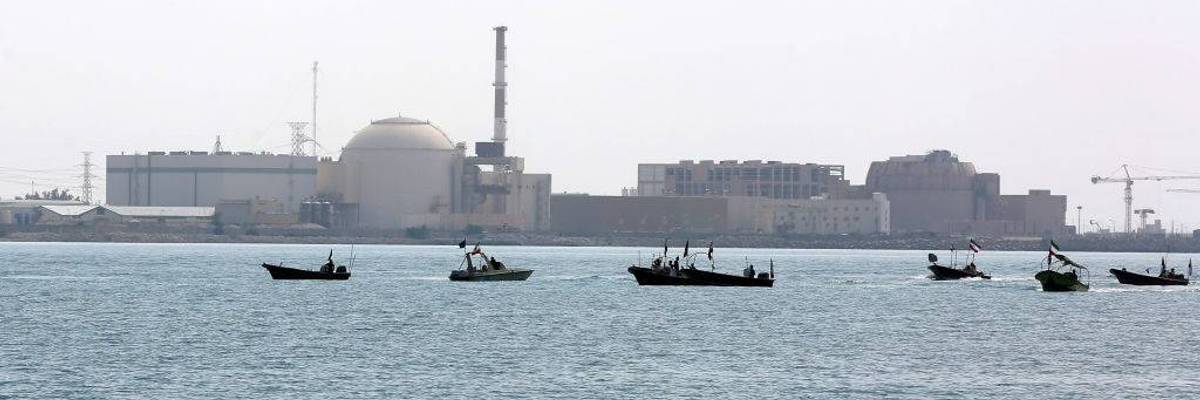
A view of Bushehr Nuclear Power Plant in Bushehr, Iran on April 28, 2024.
“To set up the possibility of another Chernobyl or Fukushima in the Middle East is criminally irresponsible,” said the head of Beyond Nuclear.
Sustainable energy watchdog Beyond Nuclear on Tuesday issued a dire warning about President Donald Trump potentially creating a "fatal nuclear disaster" by ordering military strikes on Iran's nuclear power plant in the port city of Bushehr.
The group noted that the 1,000-megawatt Russian-built water-water energetic reactor (VVER) at the Bushehr facility is the same design as nuclear reactors in Ukraine that the International Atomic Energy Agency (IAEA) has warned could spark a humanitarian catastrophe if struck by Russian missiles.
Beyond Nuclear commented that there hasn't been nearly as much attention paid by the international community to the risks posed by a US or Israeli strike on the Bushehr plant, which it cautioned has "highly radioactive uranium fuel inside the reactor" that is "stored in cooling pools and on-site casks."
"Any extended loss of power caused by an attack or a direct hit could see the fuel overheat and ignite, potentially leading to explosions," the group explained. "The resulting radiological releases would result in long-lasting radioactive fallout affecting vast areas in Iran, neighboring countries, and beyond, contaminating agricultural land as well as sea water, an essential drinking water source for a region that relies on desalination."
Beyond Nuclear's warning came days after the IAEA issued an assessment of military strikes that took place near the Bushehr reactor. Although the agency found that the facility itself so far has suffered no damage from US-Israeli strikes, it warned that any attack that even comes close to striking the nuclear reactor risks calamity.
Trump for the last several days has been threatening to attack Iran's energy infrastructure, which Linda Pentz Gunter, executive director of Beyond Nuclear, said "would be a war crime."
“The Geneva Convention specifically defines a war crime to include hitting facilities that, if damaged or destroyed, would result in extensive loss of noncombatant life,” Pentz Gunter said. “A commercial nuclear power plant certainly falls into this category.”
On Tuesday morning, the president delivered his most bloodthirsty threat to Iran yet, declaring that "a whole civilization will die tonight, never to be brought back again,” unless Iran met his demands to reopen the Strait of Hormuz, which has been closed to most ship traffic for the last several weeks after Trump and Israel launched an unprovoked war.
Ryan Goodman, professor at New York University School of Law, noted in a social media post that Trump's mere threat violates the Geneva Conventions, which prohibit "acts or threats of violence the primary purpose of which is to spread terror among the civilian population."
Pentz Gunter also took a shot at Trump's brazen threats against Iran's energy infrastructure.
"To set up the possibility of another Chernobyl or Fukushima in the Middle East is criminally irresponsible,” she said. “And even though we know Iran’s nuclear facilities were merely the pretext for the US-Israeli attack, we must remember that it was President Trump during his first term who effectively tore up a perfectly effective nuclear inspection and verification agreement—the Joint Comprehensive Plan of Action—that ensured Iran stayed within the boundaries of a civil nuclear program."
Three physicians organizations on Tuesday—Physicians for Social Responsibility, Physicians for Human Rights, and International Physicians for the Prevention of Nuclear War—issued a joint declaration condemning Trump's threats to bomb Iranian power plants, highlighting the particular dangers of any attack on nuclear facilities.
"The bombings of nuclear power plants are illegal under international law and risk harmful radioactive contamination of the environment, posing long-term danger to the health of surrounding communities and ecosystems," the groups said. "We unequivocally condemn this pattern of strikes near and on nuclear facilities, including attacks by Israel and Iran in late March and another deadly attack near Iran’s Bushehr Nuclear Power Plant this weekend."
This country and this world are at a monumental crossroads. US voters have an opportunity to beat back the forces of fascism and confront the billionaires who are rigging the economy, our media system, and our democracy, making it increasingly impossible for ordinary people to get by. We’re not just talking about the election. We’re talking about what must be done once these fascist elements are vanquished from power. We need a bolder set of solutions than what either major party has so far been willing to offer and a working-class movement ready to fight like hell for it. Trump didn't emerge from nowhere. The conditions that fueled MAGA authoritarianism were created by decades of radical neoliberal economic policies and a corrupt political system dominated by corporate interests. They slashed taxes on the super-rich, promising that the benefits would trickle down. They said giveaways to the corporate titans would make life more affordable for the rest of us. It was all bullshit. And when a bitter, betrayed populace searches for someone to blame, right-wing demagogues have little trouble finding scapegoats. People know when they're being lied to, but you won't hear any of this from the corporate media. Only independent journalism—powered and funded by people who believe in building a better world—can deliver truly trustworthy daily news. If you share our vision, please contribute whatever you can to sustain our work. |
Sustainable energy watchdog Beyond Nuclear on Tuesday issued a dire warning about President Donald Trump potentially creating a "fatal nuclear disaster" by ordering military strikes on Iran's nuclear power plant in the port city of Bushehr.
The group noted that the 1,000-megawatt Russian-built water-water energetic reactor (VVER) at the Bushehr facility is the same design as nuclear reactors in Ukraine that the International Atomic Energy Agency (IAEA) has warned could spark a humanitarian catastrophe if struck by Russian missiles.
Beyond Nuclear commented that there hasn't been nearly as much attention paid by the international community to the risks posed by a US or Israeli strike on the Bushehr plant, which it cautioned has "highly radioactive uranium fuel inside the reactor" that is "stored in cooling pools and on-site casks."
"Any extended loss of power caused by an attack or a direct hit could see the fuel overheat and ignite, potentially leading to explosions," the group explained. "The resulting radiological releases would result in long-lasting radioactive fallout affecting vast areas in Iran, neighboring countries, and beyond, contaminating agricultural land as well as sea water, an essential drinking water source for a region that relies on desalination."
Beyond Nuclear's warning came days after the IAEA issued an assessment of military strikes that took place near the Bushehr reactor. Although the agency found that the facility itself so far has suffered no damage from US-Israeli strikes, it warned that any attack that even comes close to striking the nuclear reactor risks calamity.
Trump for the last several days has been threatening to attack Iran's energy infrastructure, which Linda Pentz Gunter, executive director of Beyond Nuclear, said "would be a war crime."
“The Geneva Convention specifically defines a war crime to include hitting facilities that, if damaged or destroyed, would result in extensive loss of noncombatant life,” Pentz Gunter said. “A commercial nuclear power plant certainly falls into this category.”
On Tuesday morning, the president delivered his most bloodthirsty threat to Iran yet, declaring that "a whole civilization will die tonight, never to be brought back again,” unless Iran met his demands to reopen the Strait of Hormuz, which has been closed to most ship traffic for the last several weeks after Trump and Israel launched an unprovoked war.
Ryan Goodman, professor at New York University School of Law, noted in a social media post that Trump's mere threat violates the Geneva Conventions, which prohibit "acts or threats of violence the primary purpose of which is to spread terror among the civilian population."
Pentz Gunter also took a shot at Trump's brazen threats against Iran's energy infrastructure.
"To set up the possibility of another Chernobyl or Fukushima in the Middle East is criminally irresponsible,” she said. “And even though we know Iran’s nuclear facilities were merely the pretext for the US-Israeli attack, we must remember that it was President Trump during his first term who effectively tore up a perfectly effective nuclear inspection and verification agreement—the Joint Comprehensive Plan of Action—that ensured Iran stayed within the boundaries of a civil nuclear program."
Three physicians organizations on Tuesday—Physicians for Social Responsibility, Physicians for Human Rights, and International Physicians for the Prevention of Nuclear War—issued a joint declaration condemning Trump's threats to bomb Iranian power plants, highlighting the particular dangers of any attack on nuclear facilities.
"The bombings of nuclear power plants are illegal under international law and risk harmful radioactive contamination of the environment, posing long-term danger to the health of surrounding communities and ecosystems," the groups said. "We unequivocally condemn this pattern of strikes near and on nuclear facilities, including attacks by Israel and Iran in late March and another deadly attack near Iran’s Bushehr Nuclear Power Plant this weekend."