SUBSCRIBE TO OUR FREE NEWSLETTER
Daily news & progressive opinion—funded by the people, not the corporations—delivered straight to your inbox.
5
#000000
#FFFFFF
To donate by check, phone, or other method, see our More Ways to Give page.
Daily news & progressive opinion—funded by the people, not the corporations—delivered straight to your inbox.
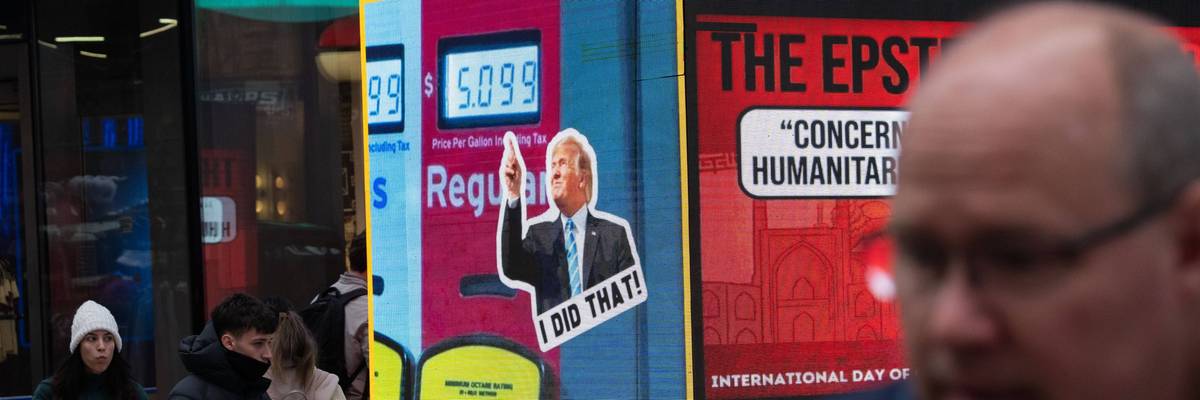
A truck with an image of US President Donald Trump and rising gas prices drives past during a rally for Al Quds Day on March 13, 2026 in New York City.
The basic story is that while the president is apparently having a good time, the rest of the country is paying a big price in the form of higher prices for gas, food, electricity, and many other items, as well as higher interest rates.
The interest rate on 30-year bonds rose to 5.4%, the highest rate since July of 2003. It’s not clear exactly why the rate rose, but expectations of higher inflation do not seem a plausible explanation. The interest rate on inflation-indexed bonds has been rising pretty much in tandem with the rise on 30-year bonds. This means we are looking at higher real interest rates.
There are several plausible reasons why real interest rates would increase. A standard explanation is higher government budget deficits. I have always been skeptical of any direct link between deficits and interest rates, but if investors believed that the Fed would respond to deficits by pushing the federal funds rate higher in future years, that would lead to higher interest rates, whether or not a larger deficit was directly the cause.
And we are certainly looking at larger budget deficits now than at the start of the year, due to the war on Iran. This has led to large expenditures to fund the war and will almost certainly lead to larger expenditures in the future, as President Donald Trump seeks to replenish depleted weapon stockpiles and reconstruct bases destroyed in the war. He is requesting a budget of $1.5 trillion, almost 5% of GDP, which would be $600 billion more than the last Biden budget.
There is also the Trump-crazy premium. There are many ways in which the world was reasonably predictable before Trump but no longer is.
The trillions of dollars that the hyperscalers plan to spend building data centers also creates huge demand for borrowing. This spending can also play a role in pushing up rates.
There is also the Trump-crazy premium. There are many ways in which the world was reasonably predictable before Trump but no longer is.
Under Trump, US trade agreements are no longer meaningful. He openly ignores them at will, saying they were signed by “dumb” presidents, including the agreements that he negotiated. Trump has also threatened wars or military actions all over the world, including against longstanding US allies like Denmark and Canada. And he has shown a lack of respect for domestic law, repeatedly violating orders from judges when he disagrees with them.
This erratic behavior almost certainly adds a substantial cost to borrowing. While under other presidents it would have been virtually inconceivable the United States would default on its debt, that is no longer the case. It is entirely plausible that Trump would at least selectively default, not paying off the interest and principal to bondholders he didn’t like. As Trump is fond of saying, he can do whatever he wants.
While that may be fun for him, Trump’s erratic behavior makes life more expensive for everyone else. He has pushed mortgage rates over 7%, making homeownership ever more unaffordable. Higher rates also mean that people have to pay more on car loans and credit card debt, as well as the interest rates businesses and state and local governments have to pay.
The basic story is that while Donald Trump is apparently having a good time, the rest of the country is paying a big price in the form of higher prices for gas, food, electricity, and many other items, as well as higher interest rates. Trump apparently hasn’t noticed this reality, and any of his aides who have are too scared to tell him. It’s very MAGA!
Dear Common Dreams reader, It’s been nearly 30 years since I co-founded Common Dreams with my late wife, Lina Newhouser. We had the radical notion that journalism should serve the public good, not corporate profits. It was clear to us from the outset what it would take to build such a project. No paid advertisements. No corporate sponsors. No millionaire publisher telling us what to think or do. Many people said we wouldn't last a year, but we proved those doubters wrong. Together with a tremendous team of journalists and dedicated staff, we built an independent media outlet free from the constraints of profits and corporate control. Our mission has always been simple: To inform. To inspire. To ignite change for the common good. Building Common Dreams was not easy. Our survival was never guaranteed. When you take on the most powerful forces—Wall Street greed, fossil fuel industry destruction, Big Tech lobbyists, and uber-rich oligarchs who have spent billions upon billions rigging the economy and democracy in their favor—the only bulwark you have is supporters who believe in your work. But here’s the urgent message from me today. It's never been this bad out there. And it's never been this hard to keep us going. At the very moment Common Dreams is most needed, the threats we face are intensifying. We need your support now more than ever. We don't accept corporate advertising and never will. We don't have a paywall because we don't think people should be blocked from critical news based on their ability to pay. Everything we do is funded by the donations of readers like you. When everyone does the little they can afford, we are strong. But if that support retreats or dries up, so do we. Will you donate now to make sure Common Dreams not only survives but thrives? —Craig Brown, Co-founder |
The interest rate on 30-year bonds rose to 5.4%, the highest rate since July of 2003. It’s not clear exactly why the rate rose, but expectations of higher inflation do not seem a plausible explanation. The interest rate on inflation-indexed bonds has been rising pretty much in tandem with the rise on 30-year bonds. This means we are looking at higher real interest rates.
There are several plausible reasons why real interest rates would increase. A standard explanation is higher government budget deficits. I have always been skeptical of any direct link between deficits and interest rates, but if investors believed that the Fed would respond to deficits by pushing the federal funds rate higher in future years, that would lead to higher interest rates, whether or not a larger deficit was directly the cause.
And we are certainly looking at larger budget deficits now than at the start of the year, due to the war on Iran. This has led to large expenditures to fund the war and will almost certainly lead to larger expenditures in the future, as President Donald Trump seeks to replenish depleted weapon stockpiles and reconstruct bases destroyed in the war. He is requesting a budget of $1.5 trillion, almost 5% of GDP, which would be $600 billion more than the last Biden budget.
There is also the Trump-crazy premium. There are many ways in which the world was reasonably predictable before Trump but no longer is.
The trillions of dollars that the hyperscalers plan to spend building data centers also creates huge demand for borrowing. This spending can also play a role in pushing up rates.
There is also the Trump-crazy premium. There are many ways in which the world was reasonably predictable before Trump but no longer is.
Under Trump, US trade agreements are no longer meaningful. He openly ignores them at will, saying they were signed by “dumb” presidents, including the agreements that he negotiated. Trump has also threatened wars or military actions all over the world, including against longstanding US allies like Denmark and Canada. And he has shown a lack of respect for domestic law, repeatedly violating orders from judges when he disagrees with them.
This erratic behavior almost certainly adds a substantial cost to borrowing. While under other presidents it would have been virtually inconceivable the United States would default on its debt, that is no longer the case. It is entirely plausible that Trump would at least selectively default, not paying off the interest and principal to bondholders he didn’t like. As Trump is fond of saying, he can do whatever he wants.
While that may be fun for him, Trump’s erratic behavior makes life more expensive for everyone else. He has pushed mortgage rates over 7%, making homeownership ever more unaffordable. Higher rates also mean that people have to pay more on car loans and credit card debt, as well as the interest rates businesses and state and local governments have to pay.
The basic story is that while Donald Trump is apparently having a good time, the rest of the country is paying a big price in the form of higher prices for gas, food, electricity, and many other items, as well as higher interest rates. Trump apparently hasn’t noticed this reality, and any of his aides who have are too scared to tell him. It’s very MAGA!
The interest rate on 30-year bonds rose to 5.4%, the highest rate since July of 2003. It’s not clear exactly why the rate rose, but expectations of higher inflation do not seem a plausible explanation. The interest rate on inflation-indexed bonds has been rising pretty much in tandem with the rise on 30-year bonds. This means we are looking at higher real interest rates.
There are several plausible reasons why real interest rates would increase. A standard explanation is higher government budget deficits. I have always been skeptical of any direct link between deficits and interest rates, but if investors believed that the Fed would respond to deficits by pushing the federal funds rate higher in future years, that would lead to higher interest rates, whether or not a larger deficit was directly the cause.
And we are certainly looking at larger budget deficits now than at the start of the year, due to the war on Iran. This has led to large expenditures to fund the war and will almost certainly lead to larger expenditures in the future, as President Donald Trump seeks to replenish depleted weapon stockpiles and reconstruct bases destroyed in the war. He is requesting a budget of $1.5 trillion, almost 5% of GDP, which would be $600 billion more than the last Biden budget.
There is also the Trump-crazy premium. There are many ways in which the world was reasonably predictable before Trump but no longer is.
The trillions of dollars that the hyperscalers plan to spend building data centers also creates huge demand for borrowing. This spending can also play a role in pushing up rates.
There is also the Trump-crazy premium. There are many ways in which the world was reasonably predictable before Trump but no longer is.
Under Trump, US trade agreements are no longer meaningful. He openly ignores them at will, saying they were signed by “dumb” presidents, including the agreements that he negotiated. Trump has also threatened wars or military actions all over the world, including against longstanding US allies like Denmark and Canada. And he has shown a lack of respect for domestic law, repeatedly violating orders from judges when he disagrees with them.
This erratic behavior almost certainly adds a substantial cost to borrowing. While under other presidents it would have been virtually inconceivable the United States would default on its debt, that is no longer the case. It is entirely plausible that Trump would at least selectively default, not paying off the interest and principal to bondholders he didn’t like. As Trump is fond of saying, he can do whatever he wants.
While that may be fun for him, Trump’s erratic behavior makes life more expensive for everyone else. He has pushed mortgage rates over 7%, making homeownership ever more unaffordable. Higher rates also mean that people have to pay more on car loans and credit card debt, as well as the interest rates businesses and state and local governments have to pay.
The basic story is that while Donald Trump is apparently having a good time, the rest of the country is paying a big price in the form of higher prices for gas, food, electricity, and many other items, as well as higher interest rates. Trump apparently hasn’t noticed this reality, and any of his aides who have are too scared to tell him. It’s very MAGA!