SUBSCRIBE TO OUR FREE NEWSLETTER
Daily news & progressive opinion—funded by the people, not the corporations—delivered straight to your inbox.
5
#000000
#FFFFFF
To donate by check, phone, or other method, see our More Ways to Give page.
Daily news & progressive opinion—funded by the people, not the corporations—delivered straight to your inbox.
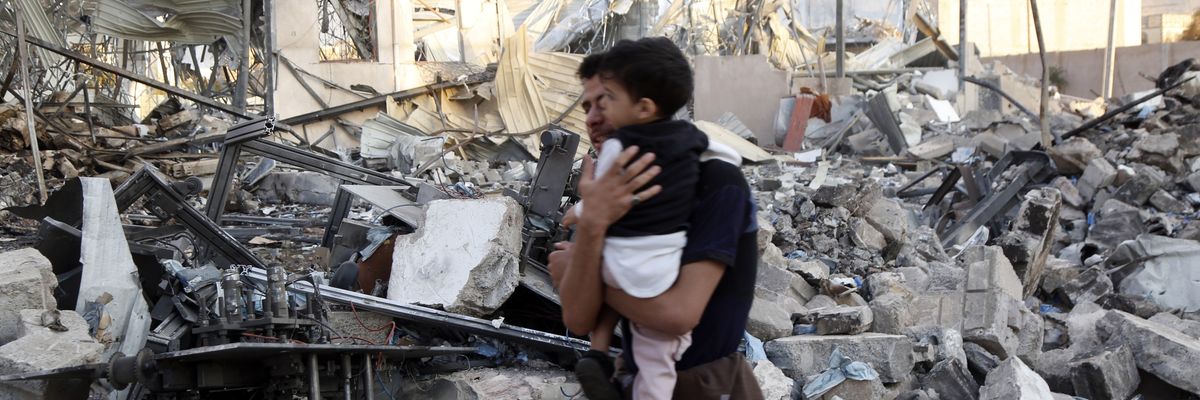
A man carries his child near the rubble of a building targeted by the United States' aerial attacks on March 20, 2025, in Sanaa, Yemen.
"President Trump has not only launched us into a new military escapade in the Middle East, he's done so in breach of our Constitution," said one advocate.
The leaked messages among top Trump administration officials about U.S. strikes in Yemen earlier this month, which were held via a private sector messaging app in breach of national security protocol and inadvertently included a journalist, sparked considerable discussion among political commentators and social media users—but as the initial shock regarding the Signal conversation faded, advocates and policy experts said lawmakers' attention should turn to the illegality of the attacks on Yemen.
The advocacy groups Just Foreign Policy, DAWN, and Action Corps released a joint statement Thursday calling on Congress to take action to stop U.S. military action in Yemen by upholding "its sole authority to declare war under Article I of the Constitution and the 1973 War Powers Resolution (WPR)."
The chat messages sent between officials including Vice President JD Vance, Defense Secretary Pete Hegseth, and National Security Adviser Michael Waltz stunned the public and Washington insiders this week because they had accidentally also been sent to Atlantic journalist Jeffrey Goldberg, but the three groups pointed out that they also included an admission from Vance that the strikes were not defensive—contrary to claims by President Donald Trump:
I think we are making a mistake… 3 percent of US trade runs through the suez. 40 percent of European trade does. There is a real risk that the public doesn't understand this or why it's necessary. The strongest reason to do this is, as POTUS said, to send a message…
Vance's comments bolster the three groups' position that "the strikes also violate Chapters I and VII of the United Nations Charter, which prohibit states from launching a war unless in self-defense or authorized by the U.N. Security Council."
Even before the chats were leaked, said the groups, it was clear that Trump had not sought congressional authorization for military strikes in Yemen, which have killed at least 53 people since the U.S. launched attacks on March 15.
The War Powers Resolution of 1973, which was introduced after former President Richard Nixon's secretive bombings of Cambodia, requires congressional authorization for "the introduction of the United States armed forces into hostilities, or into situations where imminent involvement in hostilities is clearly indicated by the circumstances," while Article I of the Constitution grants Congress the authority to declare war.
"Congress should demand an end to this reckless, unauthorized war that will both harm U.S. interests and continue to terrorize the Yemeni people who have already suffered years of U.S.-backed violence."
"President Trump has not only launched us into a new military escapade in the Middle East, he's done so in breach of our Constitution," said Isaac Evans-Frantz, director of Action Corps. "Congress should demand an end to this reckless, unauthorized war that will both harm U.S. interests and continue to terrorize the Yemeni people who have already suffered years of U.S.-backed violence."
The groups' comments echoed those of Michigan State University professor and Quincy Institute fellow Shireen Al-Adeimi, who is Yemeni-American.
"With all the noise about the Signal leak, is anyone in Congress or the media concerned that actually bombing Yemeni people and Yemen's infrastructure is unconstitutional?" she asked on Tuesday. "Anyone?"
The Trump administration claimed that the strikes in Yemen were made because the Houthis' blockade on Israeli ships—established in retaliation for Israel's breaking of a cease-fire in Gaza—was an attack on U.S. economic interests and economic security, but the three groups noted that "there is no evidence that Houthi forces attacked any U.S. ships or personnel from the beginning of the Gaza cease-fire in January 2025 through March 15."
The Houthis struck cargo ships they deemed to be tied to Israel starting in November 2023, in response to Israel's relentless assault on Gaza. They stopped the attacks for the duration of the cease-fire, which lasted nearly two months starting in mid-January.
"The cessation of Houthi attacks during the short-lived Gaza truce underscores their primary focus to defend Palestinians from genocide—a reality obscured by Trump's rhetoric to justify unauthorized military action and deepen U.S. aggression in a widening conflict," said Sarah Leah Whitson, executive director of DAWN. "The best way to protect global maritime navigation through the Red Sea is to ensure the Israeli government ends its genocidal violence in Gaza."
Along with Vance's apparent admission that the strikes were not in self-defense, the Signal discussion included what observers called a "confession" to alleged war crimes by Waltz, who said the residential building of the girlfriend of a Houthi leader had "collapsed" after a U.S. strike. As Common Dreams reported Wednesday, Waltz and Vance celebrated the strike.
Etan Mabourakh, a fellow at Action Corps, called on Congress to introduce a Yemen War Powers Resolution. The House and Senate both passed such a resolution in 2019 to bar the U.S. from participating in the Saudi war in Yemen.
"Congress should take the necessary step to stop these illegal, ineffective, and unauthorized airstrikes in Yemen," said Mabourakh. "Rather than debating the Trump administration's violation of security protocols in their Signal chats, they should do their job and challenge another unlawful new war in the region that is making everyone less safe."
Dear Common Dreams reader, It’s been nearly 30 years since I co-founded Common Dreams with my late wife, Lina Newhouser. We had the radical notion that journalism should serve the public good, not corporate profits. It was clear to us from the outset what it would take to build such a project. No paid advertisements. No corporate sponsors. No millionaire publisher telling us what to think or do. Many people said we wouldn't last a year, but we proved those doubters wrong. Together with a tremendous team of journalists and dedicated staff, we built an independent media outlet free from the constraints of profits and corporate control. Our mission has always been simple: To inform. To inspire. To ignite change for the common good. Building Common Dreams was not easy. Our survival was never guaranteed. When you take on the most powerful forces—Wall Street greed, fossil fuel industry destruction, Big Tech lobbyists, and uber-rich oligarchs who have spent billions upon billions rigging the economy and democracy in their favor—the only bulwark you have is supporters who believe in your work. But here’s the urgent message from me today. It's never been this bad out there. And it's never been this hard to keep us going. At the very moment Common Dreams is most needed, the threats we face are intensifying. We need your support now more than ever. We don't accept corporate advertising and never will. We don't have a paywall because we don't think people should be blocked from critical news based on their ability to pay. Everything we do is funded by the donations of readers like you. When everyone does the little they can afford, we are strong. But if that support retreats or dries up, so do we. Will you donate now to make sure Common Dreams not only survives but thrives? —Craig Brown, Co-founder |
The leaked messages among top Trump administration officials about U.S. strikes in Yemen earlier this month, which were held via a private sector messaging app in breach of national security protocol and inadvertently included a journalist, sparked considerable discussion among political commentators and social media users—but as the initial shock regarding the Signal conversation faded, advocates and policy experts said lawmakers' attention should turn to the illegality of the attacks on Yemen.
The advocacy groups Just Foreign Policy, DAWN, and Action Corps released a joint statement Thursday calling on Congress to take action to stop U.S. military action in Yemen by upholding "its sole authority to declare war under Article I of the Constitution and the 1973 War Powers Resolution (WPR)."
The chat messages sent between officials including Vice President JD Vance, Defense Secretary Pete Hegseth, and National Security Adviser Michael Waltz stunned the public and Washington insiders this week because they had accidentally also been sent to Atlantic journalist Jeffrey Goldberg, but the three groups pointed out that they also included an admission from Vance that the strikes were not defensive—contrary to claims by President Donald Trump:
I think we are making a mistake… 3 percent of US trade runs through the suez. 40 percent of European trade does. There is a real risk that the public doesn't understand this or why it's necessary. The strongest reason to do this is, as POTUS said, to send a message…
Vance's comments bolster the three groups' position that "the strikes also violate Chapters I and VII of the United Nations Charter, which prohibit states from launching a war unless in self-defense or authorized by the U.N. Security Council."
Even before the chats were leaked, said the groups, it was clear that Trump had not sought congressional authorization for military strikes in Yemen, which have killed at least 53 people since the U.S. launched attacks on March 15.
The War Powers Resolution of 1973, which was introduced after former President Richard Nixon's secretive bombings of Cambodia, requires congressional authorization for "the introduction of the United States armed forces into hostilities, or into situations where imminent involvement in hostilities is clearly indicated by the circumstances," while Article I of the Constitution grants Congress the authority to declare war.
"Congress should demand an end to this reckless, unauthorized war that will both harm U.S. interests and continue to terrorize the Yemeni people who have already suffered years of U.S.-backed violence."
"President Trump has not only launched us into a new military escapade in the Middle East, he's done so in breach of our Constitution," said Isaac Evans-Frantz, director of Action Corps. "Congress should demand an end to this reckless, unauthorized war that will both harm U.S. interests and continue to terrorize the Yemeni people who have already suffered years of U.S.-backed violence."
The groups' comments echoed those of Michigan State University professor and Quincy Institute fellow Shireen Al-Adeimi, who is Yemeni-American.
"With all the noise about the Signal leak, is anyone in Congress or the media concerned that actually bombing Yemeni people and Yemen's infrastructure is unconstitutional?" she asked on Tuesday. "Anyone?"
The Trump administration claimed that the strikes in Yemen were made because the Houthis' blockade on Israeli ships—established in retaliation for Israel's breaking of a cease-fire in Gaza—was an attack on U.S. economic interests and economic security, but the three groups noted that "there is no evidence that Houthi forces attacked any U.S. ships or personnel from the beginning of the Gaza cease-fire in January 2025 through March 15."
The Houthis struck cargo ships they deemed to be tied to Israel starting in November 2023, in response to Israel's relentless assault on Gaza. They stopped the attacks for the duration of the cease-fire, which lasted nearly two months starting in mid-January.
"The cessation of Houthi attacks during the short-lived Gaza truce underscores their primary focus to defend Palestinians from genocide—a reality obscured by Trump's rhetoric to justify unauthorized military action and deepen U.S. aggression in a widening conflict," said Sarah Leah Whitson, executive director of DAWN. "The best way to protect global maritime navigation through the Red Sea is to ensure the Israeli government ends its genocidal violence in Gaza."
Along with Vance's apparent admission that the strikes were not in self-defense, the Signal discussion included what observers called a "confession" to alleged war crimes by Waltz, who said the residential building of the girlfriend of a Houthi leader had "collapsed" after a U.S. strike. As Common Dreams reported Wednesday, Waltz and Vance celebrated the strike.
Etan Mabourakh, a fellow at Action Corps, called on Congress to introduce a Yemen War Powers Resolution. The House and Senate both passed such a resolution in 2019 to bar the U.S. from participating in the Saudi war in Yemen.
"Congress should take the necessary step to stop these illegal, ineffective, and unauthorized airstrikes in Yemen," said Mabourakh. "Rather than debating the Trump administration's violation of security protocols in their Signal chats, they should do their job and challenge another unlawful new war in the region that is making everyone less safe."
The leaked messages among top Trump administration officials about U.S. strikes in Yemen earlier this month, which were held via a private sector messaging app in breach of national security protocol and inadvertently included a journalist, sparked considerable discussion among political commentators and social media users—but as the initial shock regarding the Signal conversation faded, advocates and policy experts said lawmakers' attention should turn to the illegality of the attacks on Yemen.
The advocacy groups Just Foreign Policy, DAWN, and Action Corps released a joint statement Thursday calling on Congress to take action to stop U.S. military action in Yemen by upholding "its sole authority to declare war under Article I of the Constitution and the 1973 War Powers Resolution (WPR)."
The chat messages sent between officials including Vice President JD Vance, Defense Secretary Pete Hegseth, and National Security Adviser Michael Waltz stunned the public and Washington insiders this week because they had accidentally also been sent to Atlantic journalist Jeffrey Goldberg, but the three groups pointed out that they also included an admission from Vance that the strikes were not defensive—contrary to claims by President Donald Trump:
I think we are making a mistake… 3 percent of US trade runs through the suez. 40 percent of European trade does. There is a real risk that the public doesn't understand this or why it's necessary. The strongest reason to do this is, as POTUS said, to send a message…
Vance's comments bolster the three groups' position that "the strikes also violate Chapters I and VII of the United Nations Charter, which prohibit states from launching a war unless in self-defense or authorized by the U.N. Security Council."
Even before the chats were leaked, said the groups, it was clear that Trump had not sought congressional authorization for military strikes in Yemen, which have killed at least 53 people since the U.S. launched attacks on March 15.
The War Powers Resolution of 1973, which was introduced after former President Richard Nixon's secretive bombings of Cambodia, requires congressional authorization for "the introduction of the United States armed forces into hostilities, or into situations where imminent involvement in hostilities is clearly indicated by the circumstances," while Article I of the Constitution grants Congress the authority to declare war.
"Congress should demand an end to this reckless, unauthorized war that will both harm U.S. interests and continue to terrorize the Yemeni people who have already suffered years of U.S.-backed violence."
"President Trump has not only launched us into a new military escapade in the Middle East, he's done so in breach of our Constitution," said Isaac Evans-Frantz, director of Action Corps. "Congress should demand an end to this reckless, unauthorized war that will both harm U.S. interests and continue to terrorize the Yemeni people who have already suffered years of U.S.-backed violence."
The groups' comments echoed those of Michigan State University professor and Quincy Institute fellow Shireen Al-Adeimi, who is Yemeni-American.
"With all the noise about the Signal leak, is anyone in Congress or the media concerned that actually bombing Yemeni people and Yemen's infrastructure is unconstitutional?" she asked on Tuesday. "Anyone?"
The Trump administration claimed that the strikes in Yemen were made because the Houthis' blockade on Israeli ships—established in retaliation for Israel's breaking of a cease-fire in Gaza—was an attack on U.S. economic interests and economic security, but the three groups noted that "there is no evidence that Houthi forces attacked any U.S. ships or personnel from the beginning of the Gaza cease-fire in January 2025 through March 15."
The Houthis struck cargo ships they deemed to be tied to Israel starting in November 2023, in response to Israel's relentless assault on Gaza. They stopped the attacks for the duration of the cease-fire, which lasted nearly two months starting in mid-January.
"The cessation of Houthi attacks during the short-lived Gaza truce underscores their primary focus to defend Palestinians from genocide—a reality obscured by Trump's rhetoric to justify unauthorized military action and deepen U.S. aggression in a widening conflict," said Sarah Leah Whitson, executive director of DAWN. "The best way to protect global maritime navigation through the Red Sea is to ensure the Israeli government ends its genocidal violence in Gaza."
Along with Vance's apparent admission that the strikes were not in self-defense, the Signal discussion included what observers called a "confession" to alleged war crimes by Waltz, who said the residential building of the girlfriend of a Houthi leader had "collapsed" after a U.S. strike. As Common Dreams reported Wednesday, Waltz and Vance celebrated the strike.
Etan Mabourakh, a fellow at Action Corps, called on Congress to introduce a Yemen War Powers Resolution. The House and Senate both passed such a resolution in 2019 to bar the U.S. from participating in the Saudi war in Yemen.
"Congress should take the necessary step to stop these illegal, ineffective, and unauthorized airstrikes in Yemen," said Mabourakh. "Rather than debating the Trump administration's violation of security protocols in their Signal chats, they should do their job and challenge another unlawful new war in the region that is making everyone less safe."