SUBSCRIBE TO OUR FREE NEWSLETTER
Daily news & progressive opinion—funded by the people, not the corporations—delivered straight to your inbox.
5
#000000
#FFFFFF
To donate by check, phone, or other method, see our More Ways to Give page.

On June 4, 2026—after nearly 1,000 days of genocide in Gaza—Smith College asserted that the concern of Smith students and alumni about the college’s complicity in shipping weapons into the genocide, “is not directly aligned with the college’s core mission, values, operations, and strategic priorities.” This despite pride that Smith’s leadership takes in its divestment from companies doing business in apartheid South Africa in 1985-86.
This statement came from Smith’s Advisory Committee on Investor Responsibility (ACIR), a subcommittee of the Investment Committee of the Board of Trustees. The ACIR’s statement rejected a 32-page proposal (“Smith College Ethical Investment Policy & Procedure”), submitted in November 2025 by Smith Students for Justice in Palestine (SJP) and Alums for Justice in Palestine (AJP). The proposal requested that Smith divest its $2 billion endowment of stock in corporations supplying weapons and other support for Israel’s genocide of the Palestinian people and create an ethical and transparent investment policy.
This is the second time that Smith’s Board of Trustees has refused to divest from genocide. In 2024, after a 13-day occupation of the College Hall administration building by some 50 members of SJP, the ACIR ruled that SJP’s earlier divestment proposal, “did not meet the threshold for taking action.” (To see, in their entireties, the November 2025 AJP-SJP Ethical Investment Policy and the ACIR rejection of it, as well as an alum sign-on letter pledging to withhold donations to Smith until it divests, please visit the linktr.ee of Smith AJP.)
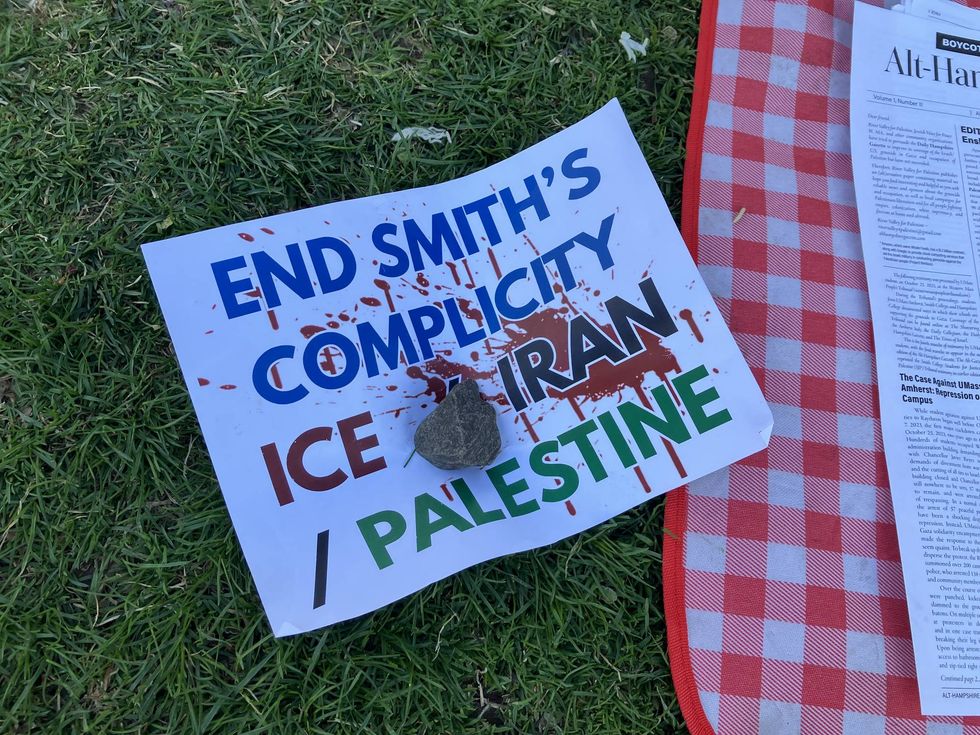 A sign is seen on the grass at Smith SJP's People's University, Chapin Lawn, April, 2026. (Photo by Jennifer Scarlott)
As Smith AJP and SJP pointed out in a June 10 press release, the ACIR’s denial came amid the US-Israeli war against Iran; ongoing strikes in Lebanon and Gaza in violation of ceasefire agreements; and land theft and violent displacement of Palestinians and Lebanese by Israel in Lebanon, Gaza, and the West Bank. Between February and June 2026, US-Israeli attacks have killed at least 3,468 people in Iran and 3,371 people in Lebanon, displacing over a million in Lebanon. Since October 2023, the US-Israeli genocide of Palestinians in Gaza has taken at least 100,000 lives and probably many more, a significant number of them women and children. New reports document Israel’s targeted killing of children in Gaza (under the age of 18) and deliberate reproductive genocide in Gaza. Between 9-10,000 Palestinians, including children, are imprisoned by Israel—often without charge or any legal recourse and under the direst of conditions including torture and rape. Earlier this year, the Israeli Knesset passed a racist death penalty law applying only to Palestinians.
Smith will celebrate its students, alumni, faculty, and staff who fought courageously for Smith’s future and for a just and safe future for Palestinians and all people. One day, Smith officialdom will cite it as a reason to attend the college.
Israel has damaged or eradicated more than 81% of built infrastructure in Gaza, including 22 of 38 university campuses. This scale of destruction is enabled by companies the AJP-SJP Ethical Investment Policy would have eliminated from Smith’s portfolio (see the United Nation’s list from 2025 for examples). Many of these entities are also guilty of human rights violations in the United States. Palantir, for example, is one of the largest contractors for the Department of Defense and Immigration and Customs Enforcement. Ending economic support for imperial violence around the world is “a necessary step to end the genocide and dismantle the global system that has allowed it,” explains Francesca Albanese, UN special rapporteur for the Palestinian Territories.
A close look at the June 4, 2026 ACIR statement rejecting the November 19, 2025 AJP-SJP Ethical Investment Policy provides a clear understanding of the failed leadership of Smith College:
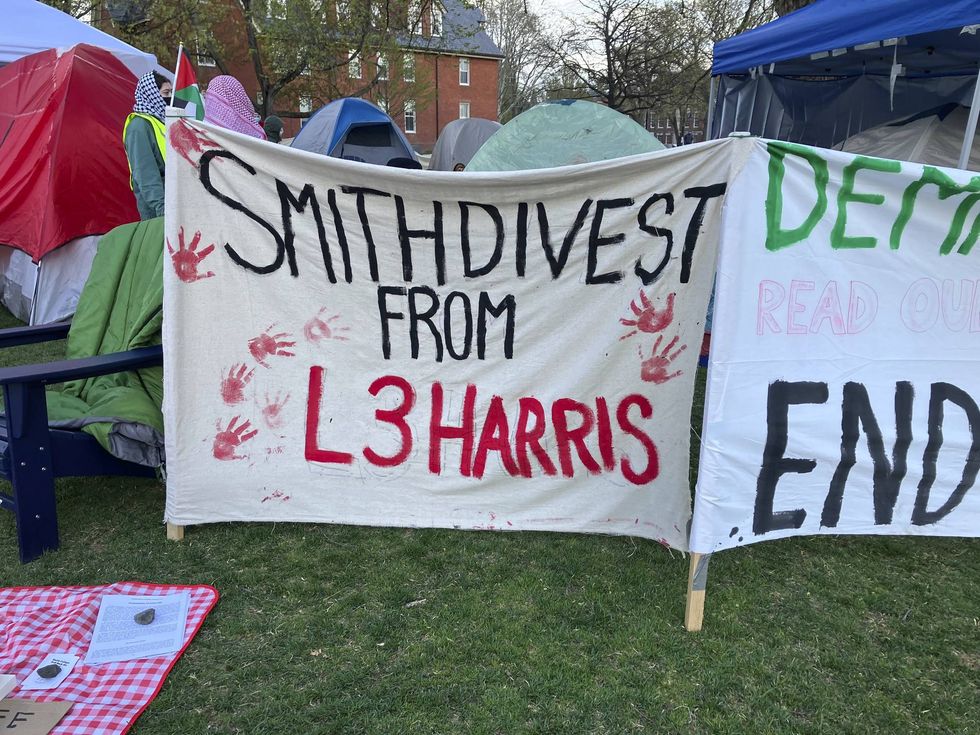 A sign is displayed at Smith SJP's People's University, Chapin Lawn, April, 2026. (Photo by Jennifer Scarlott)
Trustee claim: In one portion of its response regarding the “societal significance” of the AJP-SJP proposal, the ACIR stated:
In explaining the societal significance of the issue at the heart of their proposal, the petitioners cite the broad impacts of global human rights violations tied to weapons production and proliferation and the relationship to harming women. [We] concluded that such human rights violations are significant to society at large and can cause broad economic, environmental, health, or social impact. This is true not only of the violations occurring in Palestine, but of similar violations occurring throughout the globe. The proposal aligns with ACIR’s principles and guidelines on this matter.
Apparently not entirely comfortable with this ethical assertion, the ACIR then rushed to contradict itself by denying the AJP-SJP contention that “academic institutions carry an outsized symbolic and structural role capable of reshaping market demands.”
“While Smith’s endowment could be considered large in the context of higher education endowments,” the ACIR opined, “it is not large enough in the context of the broader investment arena to influence demand in any noticeable way… [therefore we] conclude that the proposed action would not measurably affect social change.”
Reality: In making this remarkably limp, amoral, and contradictory assertion, the ACIR ignores a common-sense argument presented to it in the AJP-SJP proposal:
Smith has a chance to make history by taking a principled stance against mass atrocities devastating racialized peoples worldwide and becoming the first historically women’s college and "Seven Sister" to do so—joining institutions such as King’s College, Cambridge; the California Institute of the Art; and the University of San Francisco in committing to an ethical investment policy.
A current student said, “You cannot be an institution that raises up the voice of activist alums, using them as examples of what this institution creates and stands for, and continue to invest in the war machine that these activists spend their lives advocating against.”
SJP noted that the ACIR recently added a new statement to its website: “The endowment is not a tool for responding to global events.” In fact, however, the ACIR itself was created because of student organizing to combat global climate change—which in turn led to Smith’s announcement in 2019 that it would divest from fossil fuel companies within 15 years.
And what about SJP-AJP’s expression of explicit concerns, throughout the Ethical Investment Policy, about the genocide in Gaza? Here, the ACIR doubled down on its hedging. While it acknowledged that SJP and AJP expressed concern about the genocide in Gaza, it deflected, noting that there are many human rights violations “occurring throughout the globe.” This is an all-too-familiar talking point used by Zionists trying to deflect attention from the Gaza genocide.
At this point, the ACIR threw on the brakes, refusing to refer to the Israeli-US slaughter in Gaza as a genocide at all. Instead, it referred to the genocide as "violations occurring in Palestine" and "the issue," and then stated that those “violations” and that “issue” fail to rise to a level of sufficient alignment with the “values” and “priorities” of the college.
The UN Special Committee on Israeli Practices, the UN Independent International Commission of Inquiry on the Occupied Palestinian Territory, the International Association of Genocide Scholars, the Lemkin Institute for Genocide Prevention, Genocide Watch, Amnesty International, Doctors Against Genocide, Human Rights Watch, Doctors Without Borders (Medecins Sans Frontieres), Physicians for Human Rights-Israel, B’Tselem, and other organizations have officially concluded that Israel is committing genocide in Gaza.
Is the leadership of the College unaware that numerous expert global organizations identify the war on Gaza as a genocide?
Do the Trustees know better than the organizations listed above?
Does the leadership of Smith College deny that genocide is occurring in Gaza?
Trustee claim: In the June 4 rejection, the ACIR argued that 1) because Smith’s weapons investments are commingled with other stocks, divestment “would force the college to exit premier, diversified commingled (investment) funds…; 2) “Additionally, the endowment does not include direct investments in any businesses, so divesting from specific businesses is not possible”…; and 3) [divestment] would impair the Investment Office’s ability to retain top-tier asset managers, a direct conflict with the board’s legal obligations to steward the financial health of the endowment in perpetuity.”
Reality: All three parts of the above statement are an obfuscation (arguably, deliberate attempts to mystify the investment process), amounting to outright falsehood. And, it would seem, Smith’s Trustees are laboring under outdated understandings of ethical investment practices—which they don’t seem to be laboring under where divestment from fossil fuels is concerned.
We interviewed an investment professional who confirmed what all honest investment professionals know and that can easily be researched—Smith’s assertion regarding commingled investments is a “red herring.” “A competent investment manager,” she said, “can readily create accounts that filter out weapons makers and other corporations that are complicit in genocide.”
In addition, the expert pointed out, “Investing in corporations implicated in ‘grave human rights abuses’ fails commonly accepted ESG (environmental, social, and governance) risk assessments intended to protect investors and society at large.”
Among the genocide-complicit companies Smith invests in through commingled funds are Lockheed Martin, Boeing, Raytheon RTX, L3Harris (now partnering with Palantir on various projects), Northrup Grumman, Hexcel, and General Dynamics. Case closed.
A further reality around financial-fiduciary ethics and responsibility must be grappled with by the Smith College community: In rejecting the November 2025 AJP-SJP Ethical Investment Policy, the ACIR failed to acknowledge that at least 10 of the 30 members of the Board of Trustees have financial connections with Israel. The following sample is indicative of this reality among at least one-third of the Trustees:
Trustee claim: In its June 4 rejection of the divestment proposal, the ACIR contended that it “does not meet the necessary threshold of community consensus,” apparently at least in part because some in the Smith community do not support it. This begs the question, how does one define consensus?
Reality: The Ethical Investment Policy was developed by Smith community members over the course of more than 14 months. This process was led by current and former students in direct consultation with faculty and other Smith community members, as well as via meetings with the administration throughout the summer of 2025. During the 14 months that the proposal was being developed, including in the six months after its submission in November of 25, Smith community members took many actions demonstrating support for it. In so doing, they established broad-based consensus for both divestment and for an ethical and transparent investment policy that culminated in an eight day People’s University on Chapin Lawn in May.
In the spring of 2024, after the SJP occupation of College Hall, a campus-wide student body referendum was held in which 89% voted for divestment. AJP circulated a statement among alums in which signatories pledged not to donate to the college until it agrees to divest—over 830 alums representing 50 years of graduating classes have signed the pledge thus far.
SJP circulated two petitions for divestment, one in November of 2025 and one in the spring of 2026. Each petition was signed by slightly more than 500 people. In the second spring 2026 round, 56 campus organizations also signed the petition.
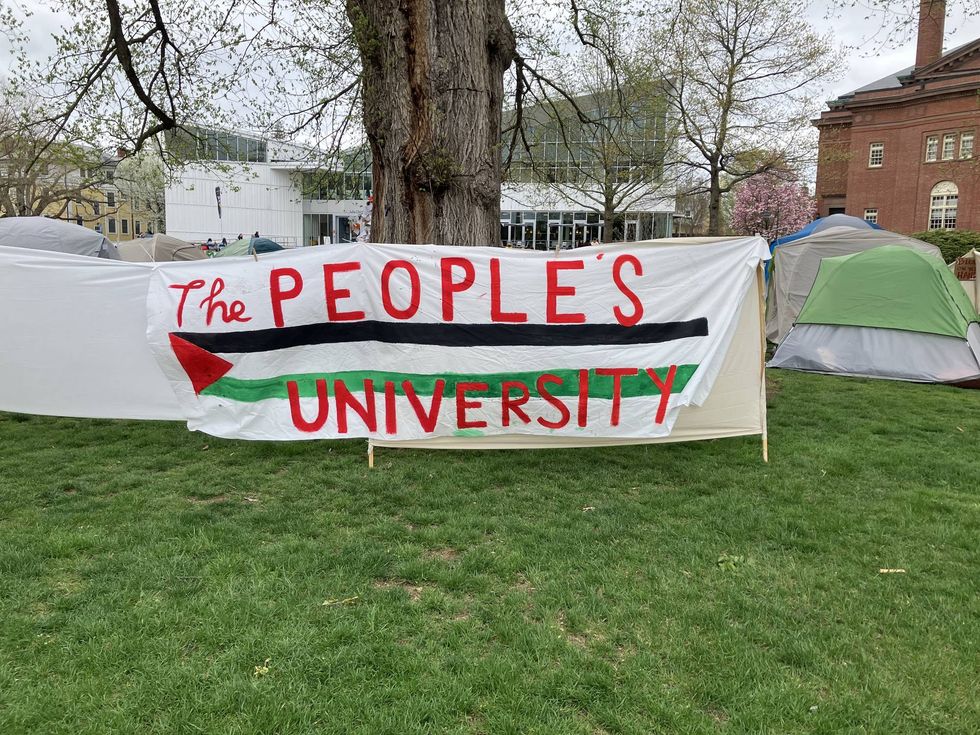 A sign announces Smith SJP's People's University, Chapin Lawn, April, 2026. (Photo by Jennifer Scarlott)
It is important to note that since the 2024 occupation of College Hall, the Smith administration and Board of Trustees joined with the leadership of many US colleges and universities angered by student activism for Palestine in the spring of 2024 by taking steps to limit speech and “expressive activity” on campus. In October of 2025, president Sarah Willie-LeBreton issued a new “Policy Governing Time, Place, and Manner of Expressive Activity.” The euphemistically titled policies are repressive and draconian. According to many at Smith, they were not developed in full consultation with the Smith community, as Willie-LeBreton claimed in a campus-wide message. Fourteen members of the editorial board of The Sophian objected to the policy and its manner of development and implementation.
The new policy, the impact of which the ACIR does not acknowledge in its rejection of the Ethical Investment Policy, has instilled fear among Smith students and the broader college community and dampened activism.
An example of the impact of the new policy: During the eight day SJP-established “People’s University” on Chapin Lawn in May of this year, students faced intimidation tactics by the college. Some Smith Campus Safety officers and administrators followed students entering and leaving the People’s University; used surveillance cameras, student card readers, and cell phone locators to track student movements; and addressed students by their names despite their use of face masks and head coverings to shield their identities from the administration and its Conduct Board.
One student stated: “We remain committed to pursuing change at Smith, despite efforts to silence us. The school has begun the process of punishing individuals and Smith SJP as a whole for the People’s University. On June 4, three minutes before communicating the ACIR’s rejection of the November 25 proposal, the school emailed SJP that we would be required to appear before Smith’s ‘Conduct Board’ in the fall to determine our punishment. The Conduct Board process is a very isolating experience, but we are working hard to protect our community in the face of administrative attacks.”
It is difficult not to conclude, both from Smith’s repeated rejections of divestment from genocide and from its punitive responses to student activists, that the leadership of the college hopes to produce graduates who will fit smoothly into the current US ruling class, with all of its racist, imperialist, militarist, extractivist, and even genocidal values.
We are horrified that the Smith administration and Board of Trustees are comfortable with limiting their students’ First Amendment rights and seeking to deter them from the justice- and human-rights-based consciousness and activism so deeply needed on campus and in the wider world the students will soon move into.
As residents of the Western Massachusetts communities in which Smith is embedded, we are profoundly concerned with the future of the college and its students. We are urgently committed to the popular uprisings—so often led, throughout history, by students—needed to end the mass killing by Israel and the US in Palestine, Lebanon, Iran, Yemen, and elsewhere. Tragically, however, through the June 4 ACIR statement, Smith College expresses,
We echo Katherine Sullivan, class of 1975:
I can’t think why a liberal arts institution like Smith College, founded on lofty ideals and now committed to such noble aims as equity, inclusion, diversity, and excellence, would want to be invested in weapons or technologies of war, genocide, and environmental devastation. Ever. Let’s put our money where our mouths are. Let’s invest in green technologies, innovative health and medical initiatives, and other activities that benefit humankind. Let’s be a light in this dark world.
Ultimately, we know, as author Omar El Akkad stated in the title of his 2025 book on Gaza’s genocide—One Day, Everyone Will Have Always Been Against This—that Smith will celebrate its students, alumni, faculty, and staff who fought courageously for Smith’s future and for a just and safe future for Palestinians and all people. One day, Smith officialdom will cite it as a reason to attend the college. May that day come soon.
But it will not come under the college’s current leadership. At this juncture, nearly 1,000 days into the current genocide in Gaza, we call on the Smith Board of Trustees to resign, and for the college to undertake a process that will lead to truly democratic and ethical governance and education.
On June 4, 2026—after nearly 1,000 days of genocide in Gaza—Smith College asserted that the concern of Smith students and alumni about the college’s complicity in shipping weapons into the genocide, “is not directly aligned with the college’s core mission, values, operations, and strategic priorities.” This despite pride that Smith’s leadership takes in its divestment from companies doing business in apartheid South Africa in 1985-86.
This statement came from Smith’s Advisory Committee on Investor Responsibility (ACIR), a subcommittee of the Investment Committee of the Board of Trustees. The ACIR’s statement rejected a 32-page proposal (“Smith College Ethical Investment Policy & Procedure”), submitted in November 2025 by Smith Students for Justice in Palestine (SJP) and Alums for Justice in Palestine (AJP). The proposal requested that Smith divest its $2 billion endowment of stock in corporations supplying weapons and other support for Israel’s genocide of the Palestinian people and create an ethical and transparent investment policy.
This is the second time that Smith’s Board of Trustees has refused to divest from genocide. In 2024, after a 13-day occupation of the College Hall administration building by some 50 members of SJP, the ACIR ruled that SJP’s earlier divestment proposal, “did not meet the threshold for taking action.” (To see, in their entireties, the November 2025 AJP-SJP Ethical Investment Policy and the ACIR rejection of it, as well as an alum sign-on letter pledging to withhold donations to Smith until it divests, please visit the linktr.ee of Smith AJP.)
A sign is seen on the grass at Smith SJP's People's University, Chapin Lawn, April, 2026. (Photo by Jennifer Scarlott)
As Smith AJP and SJP pointed out in a June 10 press release, the ACIR’s denial came amid the US-Israeli war against Iran; ongoing strikes in Lebanon and Gaza in violation of ceasefire agreements; and land theft and violent displacement of Palestinians and Lebanese by Israel in Lebanon, Gaza, and the West Bank. Between February and June 2026, US-Israeli attacks have killed at least 3,468 people in Iran and 3,371 people in Lebanon, displacing over a million in Lebanon. Since October 2023, the US-Israeli genocide of Palestinians in Gaza has taken at least 100,000 lives and probably many more, a significant number of them women and children. New reports document Israel’s targeted killing of children in Gaza (under the age of 18) and deliberate reproductive genocide in Gaza. Between 9-10,000 Palestinians, including children, are imprisoned by Israel—often without charge or any legal recourse and under the direst of conditions including torture and rape. Earlier this year, the Israeli Knesset passed a racist death penalty law applying only to Palestinians.
Smith will celebrate its students, alumni, faculty, and staff who fought courageously for Smith’s future and for a just and safe future for Palestinians and all people. One day, Smith officialdom will cite it as a reason to attend the college.
Israel has damaged or eradicated more than 81% of built infrastructure in Gaza, including 22 of 38 university campuses. This scale of destruction is enabled by companies the AJP-SJP Ethical Investment Policy would have eliminated from Smith’s portfolio (see the United Nation’s list from 2025 for examples). Many of these entities are also guilty of human rights violations in the United States. Palantir, for example, is one of the largest contractors for the Department of Defense and Immigration and Customs Enforcement. Ending economic support for imperial violence around the world is “a necessary step to end the genocide and dismantle the global system that has allowed it,” explains Francesca Albanese, UN special rapporteur for the Palestinian Territories.
A close look at the June 4, 2026 ACIR statement rejecting the November 19, 2025 AJP-SJP Ethical Investment Policy provides a clear understanding of the failed leadership of Smith College:
A sign is displayed at Smith SJP's People's University, Chapin Lawn, April, 2026. (Photo by Jennifer Scarlott)
Trustee claim: In one portion of its response regarding the “societal significance” of the AJP-SJP proposal, the ACIR stated:
In explaining the societal significance of the issue at the heart of their proposal, the petitioners cite the broad impacts of global human rights violations tied to weapons production and proliferation and the relationship to harming women. [We] concluded that such human rights violations are significant to society at large and can cause broad economic, environmental, health, or social impact. This is true not only of the violations occurring in Palestine, but of similar violations occurring throughout the globe. The proposal aligns with ACIR’s principles and guidelines on this matter.
Apparently not entirely comfortable with this ethical assertion, the ACIR then rushed to contradict itself by denying the AJP-SJP contention that “academic institutions carry an outsized symbolic and structural role capable of reshaping market demands.”
“While Smith’s endowment could be considered large in the context of higher education endowments,” the ACIR opined, “it is not large enough in the context of the broader investment arena to influence demand in any noticeable way… [therefore we] conclude that the proposed action would not measurably affect social change.”
Reality: In making this remarkably limp, amoral, and contradictory assertion, the ACIR ignores a common-sense argument presented to it in the AJP-SJP proposal:
Smith has a chance to make history by taking a principled stance against mass atrocities devastating racialized peoples worldwide and becoming the first historically women’s college and "Seven Sister" to do so—joining institutions such as King’s College, Cambridge; the California Institute of the Art; and the University of San Francisco in committing to an ethical investment policy.
A current student said, “You cannot be an institution that raises up the voice of activist alums, using them as examples of what this institution creates and stands for, and continue to invest in the war machine that these activists spend their lives advocating against.”
SJP noted that the ACIR recently added a new statement to its website: “The endowment is not a tool for responding to global events.” In fact, however, the ACIR itself was created because of student organizing to combat global climate change—which in turn led to Smith’s announcement in 2019 that it would divest from fossil fuel companies within 15 years.
And what about SJP-AJP’s expression of explicit concerns, throughout the Ethical Investment Policy, about the genocide in Gaza? Here, the ACIR doubled down on its hedging. While it acknowledged that SJP and AJP expressed concern about the genocide in Gaza, it deflected, noting that there are many human rights violations “occurring throughout the globe.” This is an all-too-familiar talking point used by Zionists trying to deflect attention from the Gaza genocide.
At this point, the ACIR threw on the brakes, refusing to refer to the Israeli-US slaughter in Gaza as a genocide at all. Instead, it referred to the genocide as "violations occurring in Palestine" and "the issue," and then stated that those “violations” and that “issue” fail to rise to a level of sufficient alignment with the “values” and “priorities” of the college.
The UN Special Committee on Israeli Practices, the UN Independent International Commission of Inquiry on the Occupied Palestinian Territory, the International Association of Genocide Scholars, the Lemkin Institute for Genocide Prevention, Genocide Watch, Amnesty International, Doctors Against Genocide, Human Rights Watch, Doctors Without Borders (Medecins Sans Frontieres), Physicians for Human Rights-Israel, B’Tselem, and other organizations have officially concluded that Israel is committing genocide in Gaza.
Is the leadership of the College unaware that numerous expert global organizations identify the war on Gaza as a genocide?
Do the Trustees know better than the organizations listed above?
Does the leadership of Smith College deny that genocide is occurring in Gaza?
Trustee claim: In the June 4 rejection, the ACIR argued that 1) because Smith’s weapons investments are commingled with other stocks, divestment “would force the college to exit premier, diversified commingled (investment) funds…; 2) “Additionally, the endowment does not include direct investments in any businesses, so divesting from specific businesses is not possible”…; and 3) [divestment] would impair the Investment Office’s ability to retain top-tier asset managers, a direct conflict with the board’s legal obligations to steward the financial health of the endowment in perpetuity.”
Reality: All three parts of the above statement are an obfuscation (arguably, deliberate attempts to mystify the investment process), amounting to outright falsehood. And, it would seem, Smith’s Trustees are laboring under outdated understandings of ethical investment practices—which they don’t seem to be laboring under where divestment from fossil fuels is concerned.
We interviewed an investment professional who confirmed what all honest investment professionals know and that can easily be researched—Smith’s assertion regarding commingled investments is a “red herring.” “A competent investment manager,” she said, “can readily create accounts that filter out weapons makers and other corporations that are complicit in genocide.”
In addition, the expert pointed out, “Investing in corporations implicated in ‘grave human rights abuses’ fails commonly accepted ESG (environmental, social, and governance) risk assessments intended to protect investors and society at large.”
Among the genocide-complicit companies Smith invests in through commingled funds are Lockheed Martin, Boeing, Raytheon RTX, L3Harris (now partnering with Palantir on various projects), Northrup Grumman, Hexcel, and General Dynamics. Case closed.
A further reality around financial-fiduciary ethics and responsibility must be grappled with by the Smith College community: In rejecting the November 2025 AJP-SJP Ethical Investment Policy, the ACIR failed to acknowledge that at least 10 of the 30 members of the Board of Trustees have financial connections with Israel. The following sample is indicative of this reality among at least one-third of the Trustees:
Trustee claim: In its June 4 rejection of the divestment proposal, the ACIR contended that it “does not meet the necessary threshold of community consensus,” apparently at least in part because some in the Smith community do not support it. This begs the question, how does one define consensus?
Reality: The Ethical Investment Policy was developed by Smith community members over the course of more than 14 months. This process was led by current and former students in direct consultation with faculty and other Smith community members, as well as via meetings with the administration throughout the summer of 2025. During the 14 months that the proposal was being developed, including in the six months after its submission in November of 25, Smith community members took many actions demonstrating support for it. In so doing, they established broad-based consensus for both divestment and for an ethical and transparent investment policy that culminated in an eight day People’s University on Chapin Lawn in May.
In the spring of 2024, after the SJP occupation of College Hall, a campus-wide student body referendum was held in which 89% voted for divestment. AJP circulated a statement among alums in which signatories pledged not to donate to the college until it agrees to divest—over 830 alums representing 50 years of graduating classes have signed the pledge thus far.
SJP circulated two petitions for divestment, one in November of 2025 and one in the spring of 2026. Each petition was signed by slightly more than 500 people. In the second spring 2026 round, 56 campus organizations also signed the petition.
A sign announces Smith SJP's People's University, Chapin Lawn, April, 2026. (Photo by Jennifer Scarlott)
It is important to note that since the 2024 occupation of College Hall, the Smith administration and Board of Trustees joined with the leadership of many US colleges and universities angered by student activism for Palestine in the spring of 2024 by taking steps to limit speech and “expressive activity” on campus. In October of 2025, president Sarah Willie-LeBreton issued a new “Policy Governing Time, Place, and Manner of Expressive Activity.” The euphemistically titled policies are repressive and draconian. According to many at Smith, they were not developed in full consultation with the Smith community, as Willie-LeBreton claimed in a campus-wide message. Fourteen members of the editorial board of The Sophian objected to the policy and its manner of development and implementation.
The new policy, the impact of which the ACIR does not acknowledge in its rejection of the Ethical Investment Policy, has instilled fear among Smith students and the broader college community and dampened activism.
An example of the impact of the new policy: During the eight day SJP-established “People’s University” on Chapin Lawn in May of this year, students faced intimidation tactics by the college. Some Smith Campus Safety officers and administrators followed students entering and leaving the People’s University; used surveillance cameras, student card readers, and cell phone locators to track student movements; and addressed students by their names despite their use of face masks and head coverings to shield their identities from the administration and its Conduct Board.
One student stated: “We remain committed to pursuing change at Smith, despite efforts to silence us. The school has begun the process of punishing individuals and Smith SJP as a whole for the People’s University. On June 4, three minutes before communicating the ACIR’s rejection of the November 25 proposal, the school emailed SJP that we would be required to appear before Smith’s ‘Conduct Board’ in the fall to determine our punishment. The Conduct Board process is a very isolating experience, but we are working hard to protect our community in the face of administrative attacks.”
It is difficult not to conclude, both from Smith’s repeated rejections of divestment from genocide and from its punitive responses to student activists, that the leadership of the college hopes to produce graduates who will fit smoothly into the current US ruling class, with all of its racist, imperialist, militarist, extractivist, and even genocidal values.
We are horrified that the Smith administration and Board of Trustees are comfortable with limiting their students’ First Amendment rights and seeking to deter them from the justice- and human-rights-based consciousness and activism so deeply needed on campus and in the wider world the students will soon move into.
As residents of the Western Massachusetts communities in which Smith is embedded, we are profoundly concerned with the future of the college and its students. We are urgently committed to the popular uprisings—so often led, throughout history, by students—needed to end the mass killing by Israel and the US in Palestine, Lebanon, Iran, Yemen, and elsewhere. Tragically, however, through the June 4 ACIR statement, Smith College expresses,
We echo Katherine Sullivan, class of 1975:
I can’t think why a liberal arts institution like Smith College, founded on lofty ideals and now committed to such noble aims as equity, inclusion, diversity, and excellence, would want to be invested in weapons or technologies of war, genocide, and environmental devastation. Ever. Let’s put our money where our mouths are. Let’s invest in green technologies, innovative health and medical initiatives, and other activities that benefit humankind. Let’s be a light in this dark world.
Ultimately, we know, as author Omar El Akkad stated in the title of his 2025 book on Gaza’s genocide—One Day, Everyone Will Have Always Been Against This—that Smith will celebrate its students, alumni, faculty, and staff who fought courageously for Smith’s future and for a just and safe future for Palestinians and all people. One day, Smith officialdom will cite it as a reason to attend the college. May that day come soon.
But it will not come under the college’s current leadership. At this juncture, nearly 1,000 days into the current genocide in Gaza, we call on the Smith Board of Trustees to resign, and for the college to undertake a process that will lead to truly democratic and ethical governance and education.
On June 4, 2026—after nearly 1,000 days of genocide in Gaza—Smith College asserted that the concern of Smith students and alumni about the college’s complicity in shipping weapons into the genocide, “is not directly aligned with the college’s core mission, values, operations, and strategic priorities.” This despite pride that Smith’s leadership takes in its divestment from companies doing business in apartheid South Africa in 1985-86.
This statement came from Smith’s Advisory Committee on Investor Responsibility (ACIR), a subcommittee of the Investment Committee of the Board of Trustees. The ACIR’s statement rejected a 32-page proposal (“Smith College Ethical Investment Policy & Procedure”), submitted in November 2025 by Smith Students for Justice in Palestine (SJP) and Alums for Justice in Palestine (AJP). The proposal requested that Smith divest its $2 billion endowment of stock in corporations supplying weapons and other support for Israel’s genocide of the Palestinian people and create an ethical and transparent investment policy.
This is the second time that Smith’s Board of Trustees has refused to divest from genocide. In 2024, after a 13-day occupation of the College Hall administration building by some 50 members of SJP, the ACIR ruled that SJP’s earlier divestment proposal, “did not meet the threshold for taking action.” (To see, in their entireties, the November 2025 AJP-SJP Ethical Investment Policy and the ACIR rejection of it, as well as an alum sign-on letter pledging to withhold donations to Smith until it divests, please visit the linktr.ee of Smith AJP.)
A sign is seen on the grass at Smith SJP's People's University, Chapin Lawn, April, 2026. (Photo by Jennifer Scarlott)
As Smith AJP and SJP pointed out in a June 10 press release, the ACIR’s denial came amid the US-Israeli war against Iran; ongoing strikes in Lebanon and Gaza in violation of ceasefire agreements; and land theft and violent displacement of Palestinians and Lebanese by Israel in Lebanon, Gaza, and the West Bank. Between February and June 2026, US-Israeli attacks have killed at least 3,468 people in Iran and 3,371 people in Lebanon, displacing over a million in Lebanon. Since October 2023, the US-Israeli genocide of Palestinians in Gaza has taken at least 100,000 lives and probably many more, a significant number of them women and children. New reports document Israel’s targeted killing of children in Gaza (under the age of 18) and deliberate reproductive genocide in Gaza. Between 9-10,000 Palestinians, including children, are imprisoned by Israel—often without charge or any legal recourse and under the direst of conditions including torture and rape. Earlier this year, the Israeli Knesset passed a racist death penalty law applying only to Palestinians.
Smith will celebrate its students, alumni, faculty, and staff who fought courageously for Smith’s future and for a just and safe future for Palestinians and all people. One day, Smith officialdom will cite it as a reason to attend the college.
Israel has damaged or eradicated more than 81% of built infrastructure in Gaza, including 22 of 38 university campuses. This scale of destruction is enabled by companies the AJP-SJP Ethical Investment Policy would have eliminated from Smith’s portfolio (see the United Nation’s list from 2025 for examples). Many of these entities are also guilty of human rights violations in the United States. Palantir, for example, is one of the largest contractors for the Department of Defense and Immigration and Customs Enforcement. Ending economic support for imperial violence around the world is “a necessary step to end the genocide and dismantle the global system that has allowed it,” explains Francesca Albanese, UN special rapporteur for the Palestinian Territories.
A close look at the June 4, 2026 ACIR statement rejecting the November 19, 2025 AJP-SJP Ethical Investment Policy provides a clear understanding of the failed leadership of Smith College:
A sign is displayed at Smith SJP's People's University, Chapin Lawn, April, 2026. (Photo by Jennifer Scarlott)
Trustee claim: In one portion of its response regarding the “societal significance” of the AJP-SJP proposal, the ACIR stated:
In explaining the societal significance of the issue at the heart of their proposal, the petitioners cite the broad impacts of global human rights violations tied to weapons production and proliferation and the relationship to harming women. [We] concluded that such human rights violations are significant to society at large and can cause broad economic, environmental, health, or social impact. This is true not only of the violations occurring in Palestine, but of similar violations occurring throughout the globe. The proposal aligns with ACIR’s principles and guidelines on this matter.
Apparently not entirely comfortable with this ethical assertion, the ACIR then rushed to contradict itself by denying the AJP-SJP contention that “academic institutions carry an outsized symbolic and structural role capable of reshaping market demands.”
“While Smith’s endowment could be considered large in the context of higher education endowments,” the ACIR opined, “it is not large enough in the context of the broader investment arena to influence demand in any noticeable way… [therefore we] conclude that the proposed action would not measurably affect social change.”
Reality: In making this remarkably limp, amoral, and contradictory assertion, the ACIR ignores a common-sense argument presented to it in the AJP-SJP proposal:
Smith has a chance to make history by taking a principled stance against mass atrocities devastating racialized peoples worldwide and becoming the first historically women’s college and "Seven Sister" to do so—joining institutions such as King’s College, Cambridge; the California Institute of the Art; and the University of San Francisco in committing to an ethical investment policy.
A current student said, “You cannot be an institution that raises up the voice of activist alums, using them as examples of what this institution creates and stands for, and continue to invest in the war machine that these activists spend their lives advocating against.”
SJP noted that the ACIR recently added a new statement to its website: “The endowment is not a tool for responding to global events.” In fact, however, the ACIR itself was created because of student organizing to combat global climate change—which in turn led to Smith’s announcement in 2019 that it would divest from fossil fuel companies within 15 years.
And what about SJP-AJP’s expression of explicit concerns, throughout the Ethical Investment Policy, about the genocide in Gaza? Here, the ACIR doubled down on its hedging. While it acknowledged that SJP and AJP expressed concern about the genocide in Gaza, it deflected, noting that there are many human rights violations “occurring throughout the globe.” This is an all-too-familiar talking point used by Zionists trying to deflect attention from the Gaza genocide.
At this point, the ACIR threw on the brakes, refusing to refer to the Israeli-US slaughter in Gaza as a genocide at all. Instead, it referred to the genocide as "violations occurring in Palestine" and "the issue," and then stated that those “violations” and that “issue” fail to rise to a level of sufficient alignment with the “values” and “priorities” of the college.
The UN Special Committee on Israeli Practices, the UN Independent International Commission of Inquiry on the Occupied Palestinian Territory, the International Association of Genocide Scholars, the Lemkin Institute for Genocide Prevention, Genocide Watch, Amnesty International, Doctors Against Genocide, Human Rights Watch, Doctors Without Borders (Medecins Sans Frontieres), Physicians for Human Rights-Israel, B’Tselem, and other organizations have officially concluded that Israel is committing genocide in Gaza.
Is the leadership of the College unaware that numerous expert global organizations identify the war on Gaza as a genocide?
Do the Trustees know better than the organizations listed above?
Does the leadership of Smith College deny that genocide is occurring in Gaza?
Trustee claim: In the June 4 rejection, the ACIR argued that 1) because Smith’s weapons investments are commingled with other stocks, divestment “would force the college to exit premier, diversified commingled (investment) funds…; 2) “Additionally, the endowment does not include direct investments in any businesses, so divesting from specific businesses is not possible”…; and 3) [divestment] would impair the Investment Office’s ability to retain top-tier asset managers, a direct conflict with the board’s legal obligations to steward the financial health of the endowment in perpetuity.”
Reality: All three parts of the above statement are an obfuscation (arguably, deliberate attempts to mystify the investment process), amounting to outright falsehood. And, it would seem, Smith’s Trustees are laboring under outdated understandings of ethical investment practices—which they don’t seem to be laboring under where divestment from fossil fuels is concerned.
We interviewed an investment professional who confirmed what all honest investment professionals know and that can easily be researched—Smith’s assertion regarding commingled investments is a “red herring.” “A competent investment manager,” she said, “can readily create accounts that filter out weapons makers and other corporations that are complicit in genocide.”
In addition, the expert pointed out, “Investing in corporations implicated in ‘grave human rights abuses’ fails commonly accepted ESG (environmental, social, and governance) risk assessments intended to protect investors and society at large.”
Among the genocide-complicit companies Smith invests in through commingled funds are Lockheed Martin, Boeing, Raytheon RTX, L3Harris (now partnering with Palantir on various projects), Northrup Grumman, Hexcel, and General Dynamics. Case closed.
A further reality around financial-fiduciary ethics and responsibility must be grappled with by the Smith College community: In rejecting the November 2025 AJP-SJP Ethical Investment Policy, the ACIR failed to acknowledge that at least 10 of the 30 members of the Board of Trustees have financial connections with Israel. The following sample is indicative of this reality among at least one-third of the Trustees:
Trustee claim: In its June 4 rejection of the divestment proposal, the ACIR contended that it “does not meet the necessary threshold of community consensus,” apparently at least in part because some in the Smith community do not support it. This begs the question, how does one define consensus?
Reality: The Ethical Investment Policy was developed by Smith community members over the course of more than 14 months. This process was led by current and former students in direct consultation with faculty and other Smith community members, as well as via meetings with the administration throughout the summer of 2025. During the 14 months that the proposal was being developed, including in the six months after its submission in November of 25, Smith community members took many actions demonstrating support for it. In so doing, they established broad-based consensus for both divestment and for an ethical and transparent investment policy that culminated in an eight day People’s University on Chapin Lawn in May.
In the spring of 2024, after the SJP occupation of College Hall, a campus-wide student body referendum was held in which 89% voted for divestment. AJP circulated a statement among alums in which signatories pledged not to donate to the college until it agrees to divest—over 830 alums representing 50 years of graduating classes have signed the pledge thus far.
SJP circulated two petitions for divestment, one in November of 2025 and one in the spring of 2026. Each petition was signed by slightly more than 500 people. In the second spring 2026 round, 56 campus organizations also signed the petition.
A sign announces Smith SJP's People's University, Chapin Lawn, April, 2026. (Photo by Jennifer Scarlott)
It is important to note that since the 2024 occupation of College Hall, the Smith administration and Board of Trustees joined with the leadership of many US colleges and universities angered by student activism for Palestine in the spring of 2024 by taking steps to limit speech and “expressive activity” on campus. In October of 2025, president Sarah Willie-LeBreton issued a new “Policy Governing Time, Place, and Manner of Expressive Activity.” The euphemistically titled policies are repressive and draconian. According to many at Smith, they were not developed in full consultation with the Smith community, as Willie-LeBreton claimed in a campus-wide message. Fourteen members of the editorial board of The Sophian objected to the policy and its manner of development and implementation.
The new policy, the impact of which the ACIR does not acknowledge in its rejection of the Ethical Investment Policy, has instilled fear among Smith students and the broader college community and dampened activism.
An example of the impact of the new policy: During the eight day SJP-established “People’s University” on Chapin Lawn in May of this year, students faced intimidation tactics by the college. Some Smith Campus Safety officers and administrators followed students entering and leaving the People’s University; used surveillance cameras, student card readers, and cell phone locators to track student movements; and addressed students by their names despite their use of face masks and head coverings to shield their identities from the administration and its Conduct Board.
One student stated: “We remain committed to pursuing change at Smith, despite efforts to silence us. The school has begun the process of punishing individuals and Smith SJP as a whole for the People’s University. On June 4, three minutes before communicating the ACIR’s rejection of the November 25 proposal, the school emailed SJP that we would be required to appear before Smith’s ‘Conduct Board’ in the fall to determine our punishment. The Conduct Board process is a very isolating experience, but we are working hard to protect our community in the face of administrative attacks.”
It is difficult not to conclude, both from Smith’s repeated rejections of divestment from genocide and from its punitive responses to student activists, that the leadership of the college hopes to produce graduates who will fit smoothly into the current US ruling class, with all of its racist, imperialist, militarist, extractivist, and even genocidal values.
We are horrified that the Smith administration and Board of Trustees are comfortable with limiting their students’ First Amendment rights and seeking to deter them from the justice- and human-rights-based consciousness and activism so deeply needed on campus and in the wider world the students will soon move into.
As residents of the Western Massachusetts communities in which Smith is embedded, we are profoundly concerned with the future of the college and its students. We are urgently committed to the popular uprisings—so often led, throughout history, by students—needed to end the mass killing by Israel and the US in Palestine, Lebanon, Iran, Yemen, and elsewhere. Tragically, however, through the June 4 ACIR statement, Smith College expresses,
We echo Katherine Sullivan, class of 1975:
I can’t think why a liberal arts institution like Smith College, founded on lofty ideals and now committed to such noble aims as equity, inclusion, diversity, and excellence, would want to be invested in weapons or technologies of war, genocide, and environmental devastation. Ever. Let’s put our money where our mouths are. Let’s invest in green technologies, innovative health and medical initiatives, and other activities that benefit humankind. Let’s be a light in this dark world.
Ultimately, we know, as author Omar El Akkad stated in the title of his 2025 book on Gaza’s genocide—One Day, Everyone Will Have Always Been Against This—that Smith will celebrate its students, alumni, faculty, and staff who fought courageously for Smith’s future and for a just and safe future for Palestinians and all people. One day, Smith officialdom will cite it as a reason to attend the college. May that day come soon.
But it will not come under the college’s current leadership. At this juncture, nearly 1,000 days into the current genocide in Gaza, we call on the Smith Board of Trustees to resign, and for the college to undertake a process that will lead to truly democratic and ethical governance and education.