SUBSCRIBE TO OUR FREE NEWSLETTER
Daily news & progressive opinion—funded by the people, not the corporations—delivered straight to your inbox.
5
#000000
#FFFFFF
To donate by check, phone, or other method, see our More Ways to Give page.
Daily news & progressive opinion—funded by the people, not the corporations—delivered straight to your inbox.
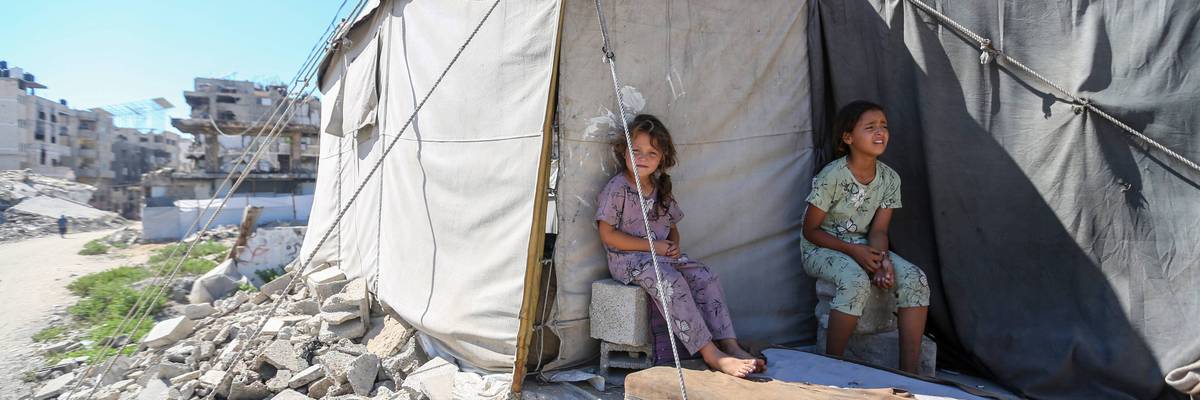
Displaced Palestinian children sit in front of their tent after their home was destroyed by Israeli airstrikes on July 2, 2026 in Gaza City, Gaza.
What we have gone through and are still going through is an entire history that needs to be documented and taught to entire future generations.
As a journalist from the Gaza Strip, I have lived through the conditions of genocide since the first day, and I am still trying to remain just as strong, not for myself, but for the message I believe I was created and born in the Gaza Strip for, a message that goes beyond individual pain to become testimony to an entire era in which the human being is being erased before the world.
We cannot reduce what we have gone through in the Gaza Strip since October 7, until today to a set of phrases or words or even a journalistic article. What we have gone through and are still going through is an entire history that needs to be documented and taught to entire future generations. Our resilience in Gaza is no longer just passing news; it has become a human condition mentioned in international forums, not as an exception, but as a harsh test of the very meaning of humanity itself.
No family in Gaza has gone through this without experiencing displacement, hunger, fear, pain, and loss. All homes in Gaza have been touched by grief, terror, and fear without exception, even those homes that once believed they would be safe. There is no family that has not lived in tents, and has not been burned by the fire of separation, the heat of summer, the cold of winter, and the weight of a long waiting that seems endless.
In Gaza, displacement is no longer an emergency event; it has become an entire life lived on the edge. Moving from one place to another is no longer about seeking safety alone, but about a fragile chance to survive. And every time we thought we had reached a "safer place," fear followed us like an ever-present shadow.
Israel in this war has crossed all red lines, not only in the scale of destruction, but in the very nature of targeting itself, and in the insistence on continuing this scene despite its full exposure before the world.
What Israel has done to us, before the eyes and ears of the world and the international community, has made us in Gaza reorder global concepts from the beginning, word by word and meaning by meaning. Silence and complicity have made the question even more painful and profound: What does justice mean? What do international laws mean? And for whom are they written if they do not protect those being crushed before their eyes?
In Gaza, these are no longer philosophical questions; they have become daily questions asked under bombardment, among the rubble, in bread and water lines, and inside tents that protect nothing. We have begun searching for the meaning of the world itself, not merely an explanation of what is happening in it.
Journalists, doctors, ambulance workers, children, civil defense personnel, the elderly, women, and people with Down syndrome… no one has been spared from this occupation. Everyone has been inside the circle of danger, as if life in Gaza has turned into an open target without exception.
In any place in the world, is it permitted to enter hospitals, vandalize them, destroy them, and burn them in front of cameras, and then ask the world to remain silent? In any place are doctors and hospital directors arrested and tried simply for trying to fulfill their humanitarian duty? And in what world are journalists killed, and even targeted in their homes with their families, because they carried a camera instead of a weapon?
Israel in this war has crossed all red lines, not only in the scale of destruction, but in the very nature of targeting itself, and in the insistence on continuing this scene despite its full exposure before the world. And it is still continuing, as if time means nothing, as if pain can be consumed without end.
In the whole world, we had never heard of a child dying of hunger. But Israel did it in Gaza. Hunger here was not a passing feeling, but a collective state seen in faces before words, in eyes before bodies. We walked through the streets barely able to hold ourselves together from the severity of hunger, and children cried day and night from a famine imposed on us, with no choice but patience or collapse.
We complied with their orders and went to the areas they called "humanitarian," and yet we were killed there, and the tents were burned with those inside them. As if the idea of a "refuge" itself was part of the illusion, as if safety was merely a word said in statements, not in reality.
Do you remember the little girl Warda Jalal Al-Sheikh, who appeared amid flames, fire, and bodies after her tent was burned by Israeli shelling, and all her family members were killed, while she tried to survive in an unbearable scene? An image that summarizes what it means for a human being to be born in the heart of fire without choosing it.
Do you remember our colleague journalist Ayman Al-Jadi, who was waiting for his wife in the delivery room to give birth to their child, when Israel killed him while he was waiting, in a moment that was supposed to be the beginning of life, not its end? How can the world comprehend that death has reached even these smallest details?
All of this is not exceptions, but repeated scenes in a time in which exception itself has become survival.
This legendary resilience after 1,000 days of genocide cannot be read as a news item, nor summarized in a report. It must be taught in history books, not only as a sad story, but as an open indictment of the entire world, and as testimony to a people who have not stopped living despite all attempts to erase them.
And in the end, we are still here… trying to write, to bear witness, and to say that what has not yet been told is far more than what has been said.
Dear Common Dreams reader, It’s been nearly 30 years since I co-founded Common Dreams with my late wife, Lina Newhouser. We had the radical notion that journalism should serve the public good, not corporate profits. It was clear to us from the outset what it would take to build such a project. No paid advertisements. No corporate sponsors. No millionaire publisher telling us what to think or do. Many people said we wouldn't last a year, but we proved those doubters wrong. Together with a tremendous team of journalists and dedicated staff, we built an independent media outlet free from the constraints of profits and corporate control. Our mission has always been simple: To inform. To inspire. To ignite change for the common good. Building Common Dreams was not easy. Our survival was never guaranteed. When you take on the most powerful forces—Wall Street greed, fossil fuel industry destruction, Big Tech lobbyists, and uber-rich oligarchs who have spent billions upon billions rigging the economy and democracy in their favor—the only bulwark you have is supporters who believe in your work. But here’s the urgent message from me today. It's never been this bad out there. And it's never been this hard to keep us going. At the very moment Common Dreams is most needed, the threats we face are intensifying. We need your support now more than ever. We don't accept corporate advertising and never will. We don't have a paywall because we don't think people should be blocked from critical news based on their ability to pay. Everything we do is funded by the donations of readers like you. When everyone does the little they can afford, we are strong. But if that support retreats or dries up, so do we. Will you donate now to make sure Common Dreams not only survives but thrives? —Craig Brown, Co-founder |
As a journalist from the Gaza Strip, I have lived through the conditions of genocide since the first day, and I am still trying to remain just as strong, not for myself, but for the message I believe I was created and born in the Gaza Strip for, a message that goes beyond individual pain to become testimony to an entire era in which the human being is being erased before the world.
We cannot reduce what we have gone through in the Gaza Strip since October 7, until today to a set of phrases or words or even a journalistic article. What we have gone through and are still going through is an entire history that needs to be documented and taught to entire future generations. Our resilience in Gaza is no longer just passing news; it has become a human condition mentioned in international forums, not as an exception, but as a harsh test of the very meaning of humanity itself.
No family in Gaza has gone through this without experiencing displacement, hunger, fear, pain, and loss. All homes in Gaza have been touched by grief, terror, and fear without exception, even those homes that once believed they would be safe. There is no family that has not lived in tents, and has not been burned by the fire of separation, the heat of summer, the cold of winter, and the weight of a long waiting that seems endless.
In Gaza, displacement is no longer an emergency event; it has become an entire life lived on the edge. Moving from one place to another is no longer about seeking safety alone, but about a fragile chance to survive. And every time we thought we had reached a "safer place," fear followed us like an ever-present shadow.
Israel in this war has crossed all red lines, not only in the scale of destruction, but in the very nature of targeting itself, and in the insistence on continuing this scene despite its full exposure before the world.
What Israel has done to us, before the eyes and ears of the world and the international community, has made us in Gaza reorder global concepts from the beginning, word by word and meaning by meaning. Silence and complicity have made the question even more painful and profound: What does justice mean? What do international laws mean? And for whom are they written if they do not protect those being crushed before their eyes?
In Gaza, these are no longer philosophical questions; they have become daily questions asked under bombardment, among the rubble, in bread and water lines, and inside tents that protect nothing. We have begun searching for the meaning of the world itself, not merely an explanation of what is happening in it.
Journalists, doctors, ambulance workers, children, civil defense personnel, the elderly, women, and people with Down syndrome… no one has been spared from this occupation. Everyone has been inside the circle of danger, as if life in Gaza has turned into an open target without exception.
In any place in the world, is it permitted to enter hospitals, vandalize them, destroy them, and burn them in front of cameras, and then ask the world to remain silent? In any place are doctors and hospital directors arrested and tried simply for trying to fulfill their humanitarian duty? And in what world are journalists killed, and even targeted in their homes with their families, because they carried a camera instead of a weapon?
Israel in this war has crossed all red lines, not only in the scale of destruction, but in the very nature of targeting itself, and in the insistence on continuing this scene despite its full exposure before the world. And it is still continuing, as if time means nothing, as if pain can be consumed without end.
In the whole world, we had never heard of a child dying of hunger. But Israel did it in Gaza. Hunger here was not a passing feeling, but a collective state seen in faces before words, in eyes before bodies. We walked through the streets barely able to hold ourselves together from the severity of hunger, and children cried day and night from a famine imposed on us, with no choice but patience or collapse.
We complied with their orders and went to the areas they called "humanitarian," and yet we were killed there, and the tents were burned with those inside them. As if the idea of a "refuge" itself was part of the illusion, as if safety was merely a word said in statements, not in reality.
Do you remember the little girl Warda Jalal Al-Sheikh, who appeared amid flames, fire, and bodies after her tent was burned by Israeli shelling, and all her family members were killed, while she tried to survive in an unbearable scene? An image that summarizes what it means for a human being to be born in the heart of fire without choosing it.
Do you remember our colleague journalist Ayman Al-Jadi, who was waiting for his wife in the delivery room to give birth to their child, when Israel killed him while he was waiting, in a moment that was supposed to be the beginning of life, not its end? How can the world comprehend that death has reached even these smallest details?
All of this is not exceptions, but repeated scenes in a time in which exception itself has become survival.
This legendary resilience after 1,000 days of genocide cannot be read as a news item, nor summarized in a report. It must be taught in history books, not only as a sad story, but as an open indictment of the entire world, and as testimony to a people who have not stopped living despite all attempts to erase them.
And in the end, we are still here… trying to write, to bear witness, and to say that what has not yet been told is far more than what has been said.
As a journalist from the Gaza Strip, I have lived through the conditions of genocide since the first day, and I am still trying to remain just as strong, not for myself, but for the message I believe I was created and born in the Gaza Strip for, a message that goes beyond individual pain to become testimony to an entire era in which the human being is being erased before the world.
We cannot reduce what we have gone through in the Gaza Strip since October 7, until today to a set of phrases or words or even a journalistic article. What we have gone through and are still going through is an entire history that needs to be documented and taught to entire future generations. Our resilience in Gaza is no longer just passing news; it has become a human condition mentioned in international forums, not as an exception, but as a harsh test of the very meaning of humanity itself.
No family in Gaza has gone through this without experiencing displacement, hunger, fear, pain, and loss. All homes in Gaza have been touched by grief, terror, and fear without exception, even those homes that once believed they would be safe. There is no family that has not lived in tents, and has not been burned by the fire of separation, the heat of summer, the cold of winter, and the weight of a long waiting that seems endless.
In Gaza, displacement is no longer an emergency event; it has become an entire life lived on the edge. Moving from one place to another is no longer about seeking safety alone, but about a fragile chance to survive. And every time we thought we had reached a "safer place," fear followed us like an ever-present shadow.
Israel in this war has crossed all red lines, not only in the scale of destruction, but in the very nature of targeting itself, and in the insistence on continuing this scene despite its full exposure before the world.
What Israel has done to us, before the eyes and ears of the world and the international community, has made us in Gaza reorder global concepts from the beginning, word by word and meaning by meaning. Silence and complicity have made the question even more painful and profound: What does justice mean? What do international laws mean? And for whom are they written if they do not protect those being crushed before their eyes?
In Gaza, these are no longer philosophical questions; they have become daily questions asked under bombardment, among the rubble, in bread and water lines, and inside tents that protect nothing. We have begun searching for the meaning of the world itself, not merely an explanation of what is happening in it.
Journalists, doctors, ambulance workers, children, civil defense personnel, the elderly, women, and people with Down syndrome… no one has been spared from this occupation. Everyone has been inside the circle of danger, as if life in Gaza has turned into an open target without exception.
In any place in the world, is it permitted to enter hospitals, vandalize them, destroy them, and burn them in front of cameras, and then ask the world to remain silent? In any place are doctors and hospital directors arrested and tried simply for trying to fulfill their humanitarian duty? And in what world are journalists killed, and even targeted in their homes with their families, because they carried a camera instead of a weapon?
Israel in this war has crossed all red lines, not only in the scale of destruction, but in the very nature of targeting itself, and in the insistence on continuing this scene despite its full exposure before the world. And it is still continuing, as if time means nothing, as if pain can be consumed without end.
In the whole world, we had never heard of a child dying of hunger. But Israel did it in Gaza. Hunger here was not a passing feeling, but a collective state seen in faces before words, in eyes before bodies. We walked through the streets barely able to hold ourselves together from the severity of hunger, and children cried day and night from a famine imposed on us, with no choice but patience or collapse.
We complied with their orders and went to the areas they called "humanitarian," and yet we were killed there, and the tents were burned with those inside them. As if the idea of a "refuge" itself was part of the illusion, as if safety was merely a word said in statements, not in reality.
Do you remember the little girl Warda Jalal Al-Sheikh, who appeared amid flames, fire, and bodies after her tent was burned by Israeli shelling, and all her family members were killed, while she tried to survive in an unbearable scene? An image that summarizes what it means for a human being to be born in the heart of fire without choosing it.
Do you remember our colleague journalist Ayman Al-Jadi, who was waiting for his wife in the delivery room to give birth to their child, when Israel killed him while he was waiting, in a moment that was supposed to be the beginning of life, not its end? How can the world comprehend that death has reached even these smallest details?
All of this is not exceptions, but repeated scenes in a time in which exception itself has become survival.
This legendary resilience after 1,000 days of genocide cannot be read as a news item, nor summarized in a report. It must be taught in history books, not only as a sad story, but as an open indictment of the entire world, and as testimony to a people who have not stopped living despite all attempts to erase them.
And in the end, we are still here… trying to write, to bear witness, and to say that what has not yet been told is far more than what has been said.