


The Washington Post published an article this week titled A Middle-Class Family’s Only Option: A $43,000 Health Insurance Premium about how the GOP’s refusal to extend ACA/Obamacare subsidies means that Stacy Newton’s family in Jackson Hole, Wyoming will have to pay $43,000 a year for health insurance if they want to stay covered.
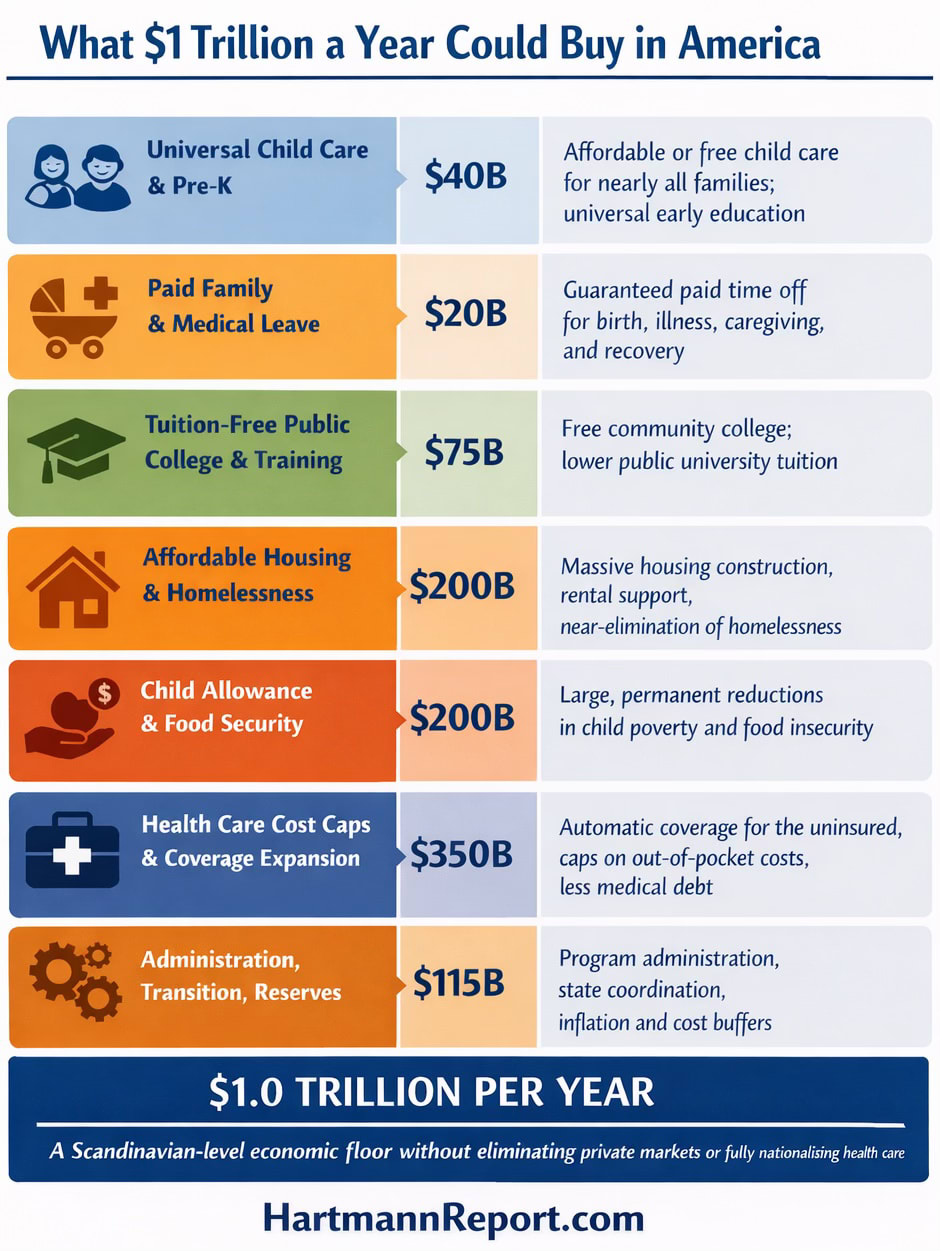
If, however, the United States had an extra trillion dollars a year — the amount we’re now spending every year on interest payments against the GOP’s $38 trillion national debt — the Newtons would only pay a few hundred dollars a month and we could also have Universal Childcare & Pre-K, Paid Family & Medical Leave, Tuition-Free College, Affordable Housing & No More Homelessness, End Child Poverty & Hunger, and, as mentioned, Affordable Healthcare for all Americans.
Which raises the question: where did our $38 trillion dollar national debt — that’s costing us $1 trillion a year in interest — come from? After all, when Reagan came into office in 1981 we’d been paying down the debt from WWI and WWII to the point where the entire national debt was only $800 billion (less than $1 trillion).
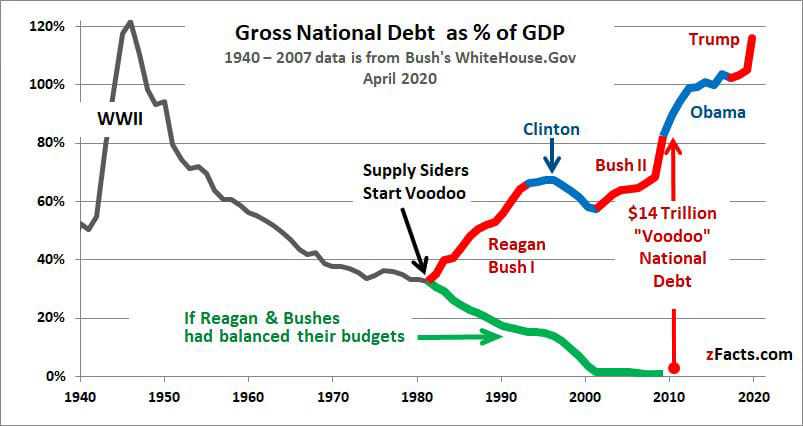
So, where the hell did all this debt come from? Turns out, you could call it a conspiracy: there’s an amazing backstory to our national debt with the unique name “Two Santas.”
This conspiracy/strategy was developed by a Republican strategist named Jude Wanniski back in the 1970s, and he quite literally transformed America and the GOP with it.
Here’s how it works, laid it out in simple summary:
The Two Santas strategy dictates that when Republicans control the White House they must spend money like a drunken Santa and massively cut taxes on the rich, all to intentionally run up the US debt as far and as fast as possible.
They started this during the Reagan presidency when he dropped the top income tax rate on the morbidly rich from 74% down to 28%, and the GOP tripled down on it with four subsequent massive tax cuts for the rich during the presidencies of Bush, Trump I, and Trump II.
Massive tax cuts for the rich and uncontrolled spending during those four Republican presidencies produced three results:
- They stimulated the economy with a sort of sugar high, making people think that the GOP can produce a good economy;
- They raised the national debt dramatically (it’s at $38 trillion today, 100% of which tracks back to Reagan’s, Bush Jr.’s, and Trump’s massive tax cuts and Bush’s two illegal $5 trillion off-the-books wars);
- They produced trillions in additional wealth for the richest families in America, who returned the favor by recycling billions into the campaign coffers of Republican candidates;
- And they made people think that Republicans are the “tax-cut Santa Clauses.”
Then comes part two of the one-two punch: when a Democrat gains the White House, Republicans and GOP-friendly media must scream about the national debt as loudly and frantically as possible, freaking out about how “our children will have to pay for it!” and “we have to cut spending to solve this crisis!”
The “debt crisis,” that is, that they themselves created with their massive tax cuts and wild spending.
Do whatever it takes to force Democrats to kill their own social programs: shut down the government, crash the stock market, and even damage US credibility around the world if necessary.
This, Wanniski argued back in the day, would force the Democrats in power to cut their own social safety net programs and even dial back the crown jewel of the New Deal, Social Security, thus shooting their welfare-of-the-American-people Santa Claus right in the face.
And, sure enough, here we are with Trump again in the White House having already added $1 trillion to the national debt just this year, with another $5 trillion to come from this year’s tax cuts for the rich, the only significant legislation passed by the GOP Congress all year.
It’s a cynical political and media effort devised by Republicans in the 1970s, fine-tuned in the ’80s and ’90s, and since then meticulously followed by every GOP presidency since.
And, politically, it’s been a brilliantly effective strategy that was hatched by a man most Americans have never heard of: economist and GOP partisan Jude Wanniski.
Wanniski first proposed his Two Santa Clauses strategy in The Wall Street Journal in 1974, after Richard Nixon resigned in disgrace and the future of the Republican Party was so dim that books and articles were widely suggesting the GOP was about to go the way of the Whigs.
There was genuine despair across the GOP back then, particularly when incumbent President Jerry Ford couldn’t even beat an unknown peanut farmer from rural Georgia for the presidency.
Wanniski argued back then that Republicans weren’t losing so many elections just because of Nixon’s corruption, but mostly because the Democrats had been viewed since the New Deal of the 1930s as the “Santa Claus party.”
On the other hand, the GOP, he said, was widely seen as the “party of Scrooge” because they publicly opposed everything from Social Security and Medicare to unemployment insurance and food stamps.
The Democrats, he noted, had gotten to play Santa Claus for decades when they passed out Social Security and unemployment checks — both programs of FDR’s Democratic Socialist New Deal — as well as their “big government” socialist projects like roads, bridges, public schools, public hospitals, and highways that gave a healthy union paycheck to workers and made our country shine.
Even worse, back in that day, Democrats kept raising taxes on businesses and rich people to pay for all that “free stuff” and Democrats’ 91% top tax rates on the morbidly rich — from the 1930s up to Reagan’s era — didn’t have any negative effect at all on working people (wages were steadily going up until the Reagan Revolution, in fact).
It all added, Wanniski theorized, to the public perception that the Democrats were the true party of Santa Claus, using taxes on the rich to fund programs for the poor and the working class.
Americans loved the Democrats back then. And every time Republicans railed against these “socialist” programs, they lost elections.
Therefore, Wanniski concluded, the GOP had to become a Santa Claus party, too. But, because Republicans hated the idea of helping out working people, they had to come up with a new way to convince average voters that the GOP, too, had the Santa spirit. But what?
“Tax cuts!” said Wanniski.
To make this work, the Republicans would first have to turn the classical world of economics — which had operated on a simple demand-driven equation for seven thousand years — on its head.
(Everybody then understood that “demand” — aka “working-class wages” — drove economies because working people spent most of the money they earned in the marketplace, producing “demand” for factory-output goods and services. Consumer spending, in fact, accounts for roughly 70% of the entire US economy.)
To lay the groundwork to roll out Two Santa Clauses, in 1974 Wanniski invented a new phrase — “Supply-Side Economics” — and said the reason economies grew and became robust wasn’t because people had good union jobs and thus enough money to buy things but, instead, because businesses made extra/new things available for sale, thus tantalizing people to part with their money.
The more products (supply) there were in the stores, he argued, the faster the economy would grow. And the more money we gave rich people and their corporations (via tax cuts) the more stuff (supply) they’d generously produce for us to think about buying.
At a glance, this 1981 adoption of Wanniski’s Two Santas strategy by the Reagan Republicans to “cut taxes while increasing spending” seems irrational, cynical and counterproductive. It certainly defies classic understandings of economics. But when you consider Jude Wanniski’s playbook, it makes complete sense.
To help, economist Arthur Laffer took that equation a step farther with the famous “Laffer Curve” napkin scribble he shared with Reagan over lunch. Not only was supply-side a rational concept, Laffer suggested, but as taxes went down, revenue to the government would magically go up!
Neither concept made any sense — and time has proven both to be colossal idiocies — but, Wanniski argued, if think tanks, rightwing media, and Republican politicians could convince Americans to buy into it, they offered the GOP a way out of the wilderness.
Ronald Reagan was the first national Republican politician to fully embrace the Two Santa Clauses strategy, although it’s been followed by every Republican in federal office ever since and still is today.
Jumping in with both feet, Reagan told the American people straight-out that if he could cut taxes on rich people and businesses, those “job creators” (also a then-newly-invented Republican phrase) would use their extra money to “build new factories” and “increase wages” so all that new stuff “supplying” the economy would produce faster economic growth.
George HW Bush — like most Republicans in 1980 who hadn’t read Wanniski’s piece in The Wall Street Journal — was initially horrified. Ronald Reagan was proposing “Voodoo Economics,” said Bush in the primary campaign, and Wanniski's supply-side and Laffer’s tax-cut theories would throw the nation into debt while producing, Bush said, nothing to benefit average American voters.
But Wanniski had done his homework, selling “Voodoo” supply-side economics to the wealthy elders and influencers of the Republican Party, so when Reagan took Bush on as his VP suddenly even Bush “saw the light.”
Democrats, Wanniski told Bush, had been “Santa Clauses” since 1933 by giving people things. From union jobs to food stamps, new schools to Social Security, the American people loved the “toys” and “free stuff” the Democratic Santas brought them every year, as well as the growing economy the increasing union wages and social programs produced in middle class hands.
But Republicans could stimulate the economy by throwing trillions at defense contractors and other fat-cat donor industries, Jude’s pitch to Bush went: spending could actually increase without negative repercussions and that money would trickle down to workers from billionaires and corporate CEOs buying new yachts and building new factories and mansions with middle-class labor.
Plus, Republicans could be double Santa Clauses by cutting everybody’s taxes!
For working people the tax cuts would, of course, only be a small token — a few hundred dollars a year at the most — but Republicans would heavily market them to the media and in political advertising. And the tax cuts for the rich, which weren’t to be discussed in public, would amount to trillions of dollars, parts of which would be recycled back to the GOP as campaign contributions from the morbidly rich beneficiaries of those very tax cuts.
There was no way, Wanniski said, if Republicans stuck to his strategy for a generation or more, that the Democrats could ever win again.
Democrats would be forced into the role of Santa-killers if they acted responsibly by raising taxes, or, even better, they’d be machine-gunning Santa by cutting spending on their own social programs.
Either choice would cause Democrats to lose elections, and, if Republicans executed the strategy right, they could force Democrats to do both!
Reagan took the federal budget deficit from under a trillion dollars when he and Bush were elected in 1980 to almost three trillion by 1988, and back then a dollar could buy far more than it buys today.
They embraced Wanniski’s theory with such gusto that Presidents Reagan and George HW Bush ran up more debt in their twelve years than every president in history up until that time, from George Washington to Jimmy Carter, combined.
Surely this would both “starve the beast” (another phrase invented by Wanniski in 1976) of the American government and force the Democrats to make the politically suicidal move of becoming deficit hawks.
And that’s just how it turned out.
Bill Clinton, the first Democrat they blindsided with Two Santas, had run in 1992 on an FDR-like platform of a “New Covenant” with the American people that would strengthen the democratic socialist institutions of the New Deal and Great Society, re-empower labor, and institute a national single-payer health care system.
A few weeks before his inauguration, however, Wanniski-insiders Alan Greenspan, Larry Sommers, and Goldman Sachs co-chairman Robert Rubin famously sat Clinton down and told him the facts of life: Reagan and Bush had run up such a huge deficit that he was going to have to both raise taxes and cut the size of government programs for the working class and poor.
Clinton took their advice to heart, raised taxes, balanced the budget, and cut numerous social programs. He declared an “end to welfare as we know it” and, in his second inaugural address, an “end to the era of big government.”
Clinton shot Santa Claus, and the result was an explosion of Republican wins across the country as GOP politicians campaigned on a “Republican Santa” platform of supply-side tax cuts and pork-rich spending increases.
Democrats had controlled the House of Representatives in almost every single year since the Republican Great Depression of the 1930s, but with Speaker Newt Gingrich rigorously enforcing Wanniski’s Two Santa Clauses strategy, they finally took it over and held it in the middle of Clinton’s 1990s presidency.
State after state turned red, and the Republican Party rose to take over, in less than a decade, every single lever of power in the federal government, from the Supreme Court to the White House.
Looking at the wreckage of the Democratic Party all around Clinton in 1999, Wanniski wrote a gloating memo that said, in part:
“We of course should be indebted to Art Laffer for all time for his Curve... But as the primary political theoretician of the supply-side camp, I began arguing for the ‘Two Santa Claus Theory’ in 1974. If the Democrats are going to play Santa Claus by promoting more spending, the Republicans can never beat them by promoting less spending. They have to promise tax cuts...”
Ed Crane, then-president of the Koch-funded Libertarian CATO Institute, noted in a memo that year:
“When Jack Kemp, Newt Gingrich, Vin Weber, Connie Mack and the rest discovered Jude Wanniski and Art Laffer, they thought they’d died and gone to heaven. In supply-side economics they found a philosophy that gave them a free pass out of the debate over the proper role of government. ... That’s why you rarely, if ever, heard Kemp or Gingrich call for spending cuts, much less the elimination of programs and departments.”
Two Santa Clauses had fully seized the GOP mainstream, and hasn’t let go to this day.
Never again would Republicans worry about the debt or deficit when in office; and they knew well how to scream hysterically about the debt to the economically naïve national media as soon as Democrats again took power.
When Jude Wanniski died, George Gilder celebrated the Reagan/Bush adoption of his Two Santas “Voodoo Economics” scheme — then still considered irrational by mainstream economists — in a Wall Street Journal eulogy:
“Unbound by zero-sum economics, Jude forged the golden gift of a profound and passionate argument that the establishments of the mold must finally give way to the powers of the mind. ... He audaciously defied all the Buffetteers of the trade gap, the moldy figs of the Phillips Curve, the chic traders in money and principle, even the stultifying pillows of the Nobel Prize.”
Republicans got what they wanted from Wanniski’s work.
They held power for forty years, transferred over $50 trillion from working class families into the money bins of the top one percent, and cut organized labor's representation in the workplace from around a third of workers when Reagan came into office to around 6 percent of the non-governmental workforce today.
Think back to Ronald Reagan, who more than tripled the US debt from a mere $800 billion to $2.4 trillion in his 8 years. That spending produced a massive stimulus to the economy, and the biggest non-wartime increase in America’s national debt in all of our history.
There was nary a peep from Republicans about that 218% increase in our debt in eight short years; they were just fine with it and to this day claim Reagan presided over a “great” economy.
When five corrupt Republicans on the Supreme Court gave the White House to George W. Bush in 2000, he instantly reverted to Wanniski’s “Two Santa” strategy and again nearly doubled the national debt, adding over two trillion in borrowed money to pay for his tax cut for billionaires, and tossing in two unfunded wars for good measure, which also added at least (long term) another $5 trillion.
Again, there was nary a peep about that debt from any high-profile in-the-know Republicans; in fact, Dick Cheney famously said, amplifying Wanniski’s strategy:
“Reagan proved deficits don't matter. We won the midterms. This is our due.”
Bush and Cheney’s tax cuts for the rich raised the debt by 86% to over $10 trillion (and additional trillions in war debt that wasn’t put on the books until Obama entered office, so it looked like it was his).
Then came Democratic President Barack Obama, and suddenly the GOP was hysterical about the debt again.
They — and the national media that amplified their message — were so good at it that they convinced a sitting Democratic president to propose a cut to Social Security (the “chained CPI”). Obama nearly shot the Democrats’ biggest Santa Claus, just like Wanniski predicted, until outrage from the Democratic base stopped him.
Next, Donald Trump raised our national debt by almost $7 trillion, but the GOP raised the debt ceiling without a peep every year for the first three years of his administration, and then suspended it altogether for 2020 (so, when Biden won, he had to justify raising the debt ceiling for 2 years’ worth of deficits, making it even more politically painful).
And now Republicans are once again spending like drunken sailors while doubling down on a fifth major round of tax cuts for billionaires since Reagan’s initial 1981 effort. After all, it worked against Clinton, Obama, and Biden and the media never caught on. Why wouldn’t they use it again?
In the meantime, though, interest has to be paid on the $38 trillion national debt Reagan, Bush, Bush, and Trump ran up, and the bill is now around a trillion a year, about the same as our entire Defense budget.
If Reagan had never adopted Wanniski’s Two Santas strategy, we could have a standard of living today much like the Scandinavian nations with just the trillion dollars a year we’re instead spending on interest payments.
Not to mention the trillions in surplus we’d have now if none of those tax cuts had happened, which could easily fully fund a national single-payer healthcare system.
Americans deserve to know how we’ve been manipulated and ripped off — and by whom — for the past 45 years.
Hopefully Democratic politicians and our media will, finally, call the GOP out on Wanniski’s Two Santas scam that’s been so enthusiastically adopted by Reagan, both Bush’s, and Trump.
Pass it along and wake up everybody you can!
The Washington Post published an article this week titled A Middle-Class Family’s Only Option: A $43,000 Health Insurance Premium about how the GOP’s refusal to extend ACA/Obamacare subsidies means that Stacy Newton’s family in Jackson Hole, Wyoming will have to pay $43,000 a year for health insurance if they want to stay covered.
If, however, the United States had an extra trillion dollars a year — the amount we’re now spending every year on interest payments against the GOP’s $38 trillion national debt — the Newtons would only pay a few hundred dollars a month and we could also have Universal Childcare & Pre-K, Paid Family & Medical Leave, Tuition-Free College, Affordable Housing & No More Homelessness, End Child Poverty & Hunger, and, as mentioned, Affordable Healthcare for all Americans.
Which raises the question: where did our $38 trillion dollar national debt — that’s costing us $1 trillion a year in interest — come from? After all, when Reagan came into office in 1981 we’d been paying down the debt from WWI and WWII to the point where the entire national debt was only $800 billion (less than $1 trillion).
So, where the hell did all this debt come from? Turns out, you could call it a conspiracy: there’s an amazing backstory to our national debt with the unique name “Two Santas.”
This conspiracy/strategy was developed by a Republican strategist named Jude Wanniski back in the 1970s, and he quite literally transformed America and the GOP with it.
Here’s how it works, laid it out in simple summary:
The Two Santas strategy dictates that when Republicans control the White House they must spend money like a drunken Santa and massively cut taxes on the rich, all to intentionally run up the US debt as far and as fast as possible.
They started this during the Reagan presidency when he dropped the top income tax rate on the morbidly rich from 74% down to 28%, and the GOP tripled down on it with four subsequent massive tax cuts for the rich during the presidencies of Bush, Trump I, and Trump II.
Massive tax cuts for the rich and uncontrolled spending during those four Republican presidencies produced three results:
- They stimulated the economy with a sort of sugar high, making people think that the GOP can produce a good economy;
- They raised the national debt dramatically (it’s at $38 trillion today, 100% of which tracks back to Reagan’s, Bush Jr.’s, and Trump’s massive tax cuts and Bush’s two illegal $5 trillion off-the-books wars);
- They produced trillions in additional wealth for the richest families in America, who returned the favor by recycling billions into the campaign coffers of Republican candidates;
- And they made people think that Republicans are the “tax-cut Santa Clauses.”
Then comes part two of the one-two punch: when a Democrat gains the White House, Republicans and GOP-friendly media must scream about the national debt as loudly and frantically as possible, freaking out about how “our children will have to pay for it!” and “we have to cut spending to solve this crisis!”
The “debt crisis,” that is, that they themselves created with their massive tax cuts and wild spending.
Do whatever it takes to force Democrats to kill their own social programs: shut down the government, crash the stock market, and even damage US credibility around the world if necessary.
This, Wanniski argued back in the day, would force the Democrats in power to cut their own social safety net programs and even dial back the crown jewel of the New Deal, Social Security, thus shooting their welfare-of-the-American-people Santa Claus right in the face.
And, sure enough, here we are with Trump again in the White House having already added $1 trillion to the national debt just this year, with another $5 trillion to come from this year’s tax cuts for the rich, the only significant legislation passed by the GOP Congress all year.
It’s a cynical political and media effort devised by Republicans in the 1970s, fine-tuned in the ’80s and ’90s, and since then meticulously followed by every GOP presidency since.
And, politically, it’s been a brilliantly effective strategy that was hatched by a man most Americans have never heard of: economist and GOP partisan Jude Wanniski.
Wanniski first proposed his Two Santa Clauses strategy in The Wall Street Journal in 1974, after Richard Nixon resigned in disgrace and the future of the Republican Party was so dim that books and articles were widely suggesting the GOP was about to go the way of the Whigs.
There was genuine despair across the GOP back then, particularly when incumbent President Jerry Ford couldn’t even beat an unknown peanut farmer from rural Georgia for the presidency.
Wanniski argued back then that Republicans weren’t losing so many elections just because of Nixon’s corruption, but mostly because the Democrats had been viewed since the New Deal of the 1930s as the “Santa Claus party.”
On the other hand, the GOP, he said, was widely seen as the “party of Scrooge” because they publicly opposed everything from Social Security and Medicare to unemployment insurance and food stamps.
The Democrats, he noted, had gotten to play Santa Claus for decades when they passed out Social Security and unemployment checks — both programs of FDR’s Democratic Socialist New Deal — as well as their “big government” socialist projects like roads, bridges, public schools, public hospitals, and highways that gave a healthy union paycheck to workers and made our country shine.
Even worse, back in that day, Democrats kept raising taxes on businesses and rich people to pay for all that “free stuff” and Democrats’ 91% top tax rates on the morbidly rich — from the 1930s up to Reagan’s era — didn’t have any negative effect at all on working people (wages were steadily going up until the Reagan Revolution, in fact).
It all added, Wanniski theorized, to the public perception that the Democrats were the true party of Santa Claus, using taxes on the rich to fund programs for the poor and the working class.
Americans loved the Democrats back then. And every time Republicans railed against these “socialist” programs, they lost elections.
Therefore, Wanniski concluded, the GOP had to become a Santa Claus party, too. But, because Republicans hated the idea of helping out working people, they had to come up with a new way to convince average voters that the GOP, too, had the Santa spirit. But what?
“Tax cuts!” said Wanniski.
To make this work, the Republicans would first have to turn the classical world of economics — which had operated on a simple demand-driven equation for seven thousand years — on its head.
(Everybody then understood that “demand” — aka “working-class wages” — drove economies because working people spent most of the money they earned in the marketplace, producing “demand” for factory-output goods and services. Consumer spending, in fact, accounts for roughly 70% of the entire US economy.)
To lay the groundwork to roll out Two Santa Clauses, in 1974 Wanniski invented a new phrase — “Supply-Side Economics” — and said the reason economies grew and became robust wasn’t because people had good union jobs and thus enough money to buy things but, instead, because businesses made extra/new things available for sale, thus tantalizing people to part with their money.
The more products (supply) there were in the stores, he argued, the faster the economy would grow. And the more money we gave rich people and their corporations (via tax cuts) the more stuff (supply) they’d generously produce for us to think about buying.
At a glance, this 1981 adoption of Wanniski’s Two Santas strategy by the Reagan Republicans to “cut taxes while increasing spending” seems irrational, cynical and counterproductive. It certainly defies classic understandings of economics. But when you consider Jude Wanniski’s playbook, it makes complete sense.
To help, economist Arthur Laffer took that equation a step farther with the famous “Laffer Curve” napkin scribble he shared with Reagan over lunch. Not only was supply-side a rational concept, Laffer suggested, but as taxes went down, revenue to the government would magically go up!
Neither concept made any sense — and time has proven both to be colossal idiocies — but, Wanniski argued, if think tanks, rightwing media, and Republican politicians could convince Americans to buy into it, they offered the GOP a way out of the wilderness.
Ronald Reagan was the first national Republican politician to fully embrace the Two Santa Clauses strategy, although it’s been followed by every Republican in federal office ever since and still is today.
Jumping in with both feet, Reagan told the American people straight-out that if he could cut taxes on rich people and businesses, those “job creators” (also a then-newly-invented Republican phrase) would use their extra money to “build new factories” and “increase wages” so all that new stuff “supplying” the economy would produce faster economic growth.
George HW Bush — like most Republicans in 1980 who hadn’t read Wanniski’s piece in The Wall Street Journal — was initially horrified. Ronald Reagan was proposing “Voodoo Economics,” said Bush in the primary campaign, and Wanniski's supply-side and Laffer’s tax-cut theories would throw the nation into debt while producing, Bush said, nothing to benefit average American voters.
But Wanniski had done his homework, selling “Voodoo” supply-side economics to the wealthy elders and influencers of the Republican Party, so when Reagan took Bush on as his VP suddenly even Bush “saw the light.”
Democrats, Wanniski told Bush, had been “Santa Clauses” since 1933 by giving people things. From union jobs to food stamps, new schools to Social Security, the American people loved the “toys” and “free stuff” the Democratic Santas brought them every year, as well as the growing economy the increasing union wages and social programs produced in middle class hands.
But Republicans could stimulate the economy by throwing trillions at defense contractors and other fat-cat donor industries, Jude’s pitch to Bush went: spending could actually increase without negative repercussions and that money would trickle down to workers from billionaires and corporate CEOs buying new yachts and building new factories and mansions with middle-class labor.
Plus, Republicans could be double Santa Clauses by cutting everybody’s taxes!
For working people the tax cuts would, of course, only be a small token — a few hundred dollars a year at the most — but Republicans would heavily market them to the media and in political advertising. And the tax cuts for the rich, which weren’t to be discussed in public, would amount to trillions of dollars, parts of which would be recycled back to the GOP as campaign contributions from the morbidly rich beneficiaries of those very tax cuts.
There was no way, Wanniski said, if Republicans stuck to his strategy for a generation or more, that the Democrats could ever win again.
Democrats would be forced into the role of Santa-killers if they acted responsibly by raising taxes, or, even better, they’d be machine-gunning Santa by cutting spending on their own social programs.
Either choice would cause Democrats to lose elections, and, if Republicans executed the strategy right, they could force Democrats to do both!
Reagan took the federal budget deficit from under a trillion dollars when he and Bush were elected in 1980 to almost three trillion by 1988, and back then a dollar could buy far more than it buys today.
They embraced Wanniski’s theory with such gusto that Presidents Reagan and George HW Bush ran up more debt in their twelve years than every president in history up until that time, from George Washington to Jimmy Carter, combined.
Surely this would both “starve the beast” (another phrase invented by Wanniski in 1976) of the American government and force the Democrats to make the politically suicidal move of becoming deficit hawks.
And that’s just how it turned out.
Bill Clinton, the first Democrat they blindsided with Two Santas, had run in 1992 on an FDR-like platform of a “New Covenant” with the American people that would strengthen the democratic socialist institutions of the New Deal and Great Society, re-empower labor, and institute a national single-payer health care system.
A few weeks before his inauguration, however, Wanniski-insiders Alan Greenspan, Larry Sommers, and Goldman Sachs co-chairman Robert Rubin famously sat Clinton down and told him the facts of life: Reagan and Bush had run up such a huge deficit that he was going to have to both raise taxes and cut the size of government programs for the working class and poor.
Clinton took their advice to heart, raised taxes, balanced the budget, and cut numerous social programs. He declared an “end to welfare as we know it” and, in his second inaugural address, an “end to the era of big government.”
Clinton shot Santa Claus, and the result was an explosion of Republican wins across the country as GOP politicians campaigned on a “Republican Santa” platform of supply-side tax cuts and pork-rich spending increases.
Democrats had controlled the House of Representatives in almost every single year since the Republican Great Depression of the 1930s, but with Speaker Newt Gingrich rigorously enforcing Wanniski’s Two Santa Clauses strategy, they finally took it over and held it in the middle of Clinton’s 1990s presidency.
State after state turned red, and the Republican Party rose to take over, in less than a decade, every single lever of power in the federal government, from the Supreme Court to the White House.
Looking at the wreckage of the Democratic Party all around Clinton in 1999, Wanniski wrote a gloating memo that said, in part:
“We of course should be indebted to Art Laffer for all time for his Curve... But as the primary political theoretician of the supply-side camp, I began arguing for the ‘Two Santa Claus Theory’ in 1974. If the Democrats are going to play Santa Claus by promoting more spending, the Republicans can never beat them by promoting less spending. They have to promise tax cuts...”
Ed Crane, then-president of the Koch-funded Libertarian CATO Institute, noted in a memo that year:
“When Jack Kemp, Newt Gingrich, Vin Weber, Connie Mack and the rest discovered Jude Wanniski and Art Laffer, they thought they’d died and gone to heaven. In supply-side economics they found a philosophy that gave them a free pass out of the debate over the proper role of government. ... That’s why you rarely, if ever, heard Kemp or Gingrich call for spending cuts, much less the elimination of programs and departments.”
Two Santa Clauses had fully seized the GOP mainstream, and hasn’t let go to this day.
Never again would Republicans worry about the debt or deficit when in office; and they knew well how to scream hysterically about the debt to the economically naïve national media as soon as Democrats again took power.
When Jude Wanniski died, George Gilder celebrated the Reagan/Bush adoption of his Two Santas “Voodoo Economics” scheme — then still considered irrational by mainstream economists — in a Wall Street Journal eulogy:
“Unbound by zero-sum economics, Jude forged the golden gift of a profound and passionate argument that the establishments of the mold must finally give way to the powers of the mind. ... He audaciously defied all the Buffetteers of the trade gap, the moldy figs of the Phillips Curve, the chic traders in money and principle, even the stultifying pillows of the Nobel Prize.”
Republicans got what they wanted from Wanniski’s work.
They held power for forty years, transferred over $50 trillion from working class families into the money bins of the top one percent, and cut organized labor's representation in the workplace from around a third of workers when Reagan came into office to around 6 percent of the non-governmental workforce today.
Think back to Ronald Reagan, who more than tripled the US debt from a mere $800 billion to $2.4 trillion in his 8 years. That spending produced a massive stimulus to the economy, and the biggest non-wartime increase in America’s national debt in all of our history.
There was nary a peep from Republicans about that 218% increase in our debt in eight short years; they were just fine with it and to this day claim Reagan presided over a “great” economy.
When five corrupt Republicans on the Supreme Court gave the White House to George W. Bush in 2000, he instantly reverted to Wanniski’s “Two Santa” strategy and again nearly doubled the national debt, adding over two trillion in borrowed money to pay for his tax cut for billionaires, and tossing in two unfunded wars for good measure, which also added at least (long term) another $5 trillion.
Again, there was nary a peep about that debt from any high-profile in-the-know Republicans; in fact, Dick Cheney famously said, amplifying Wanniski’s strategy:
“Reagan proved deficits don't matter. We won the midterms. This is our due.”
Bush and Cheney’s tax cuts for the rich raised the debt by 86% to over $10 trillion (and additional trillions in war debt that wasn’t put on the books until Obama entered office, so it looked like it was his).
Then came Democratic President Barack Obama, and suddenly the GOP was hysterical about the debt again.
They — and the national media that amplified their message — were so good at it that they convinced a sitting Democratic president to propose a cut to Social Security (the “chained CPI”). Obama nearly shot the Democrats’ biggest Santa Claus, just like Wanniski predicted, until outrage from the Democratic base stopped him.
Next, Donald Trump raised our national debt by almost $7 trillion, but the GOP raised the debt ceiling without a peep every year for the first three years of his administration, and then suspended it altogether for 2020 (so, when Biden won, he had to justify raising the debt ceiling for 2 years’ worth of deficits, making it even more politically painful).
And now Republicans are once again spending like drunken sailors while doubling down on a fifth major round of tax cuts for billionaires since Reagan’s initial 1981 effort. After all, it worked against Clinton, Obama, and Biden and the media never caught on. Why wouldn’t they use it again?
In the meantime, though, interest has to be paid on the $38 trillion national debt Reagan, Bush, Bush, and Trump ran up, and the bill is now around a trillion a year, about the same as our entire Defense budget.
If Reagan had never adopted Wanniski’s Two Santas strategy, we could have a standard of living today much like the Scandinavian nations with just the trillion dollars a year we’re instead spending on interest payments.
Not to mention the trillions in surplus we’d have now if none of those tax cuts had happened, which could easily fully fund a national single-payer healthcare system.
Americans deserve to know how we’ve been manipulated and ripped off — and by whom — for the past 45 years.
Hopefully Democratic politicians and our media will, finally, call the GOP out on Wanniski’s Two Santas scam that’s been so enthusiastically adopted by Reagan, both Bush’s, and Trump.
Pass it along and wake up everybody you can!
The Washington Post published an article this week titled A Middle-Class Family’s Only Option: A $43,000 Health Insurance Premium about how the GOP’s refusal to extend ACA/Obamacare subsidies means that Stacy Newton’s family in Jackson Hole, Wyoming will have to pay $43,000 a year for health insurance if they want to stay covered.
If, however, the United States had an extra trillion dollars a year — the amount we’re now spending every year on interest payments against the GOP’s $38 trillion national debt — the Newtons would only pay a few hundred dollars a month and we could also have Universal Childcare & Pre-K, Paid Family & Medical Leave, Tuition-Free College, Affordable Housing & No More Homelessness, End Child Poverty & Hunger, and, as mentioned, Affordable Healthcare for all Americans.
Which raises the question: where did our $38 trillion dollar national debt — that’s costing us $1 trillion a year in interest — come from? After all, when Reagan came into office in 1981 we’d been paying down the debt from WWI and WWII to the point where the entire national debt was only $800 billion (less than $1 trillion).
So, where the hell did all this debt come from? Turns out, you could call it a conspiracy: there’s an amazing backstory to our national debt with the unique name “Two Santas.”
This conspiracy/strategy was developed by a Republican strategist named Jude Wanniski back in the 1970s, and he quite literally transformed America and the GOP with it.
Here’s how it works, laid it out in simple summary:
The Two Santas strategy dictates that when Republicans control the White House they must spend money like a drunken Santa and massively cut taxes on the rich, all to intentionally run up the US debt as far and as fast as possible.
They started this during the Reagan presidency when he dropped the top income tax rate on the morbidly rich from 74% down to 28%, and the GOP tripled down on it with four subsequent massive tax cuts for the rich during the presidencies of Bush, Trump I, and Trump II.
Massive tax cuts for the rich and uncontrolled spending during those four Republican presidencies produced three results:
- They stimulated the economy with a sort of sugar high, making people think that the GOP can produce a good economy;
- They raised the national debt dramatically (it’s at $38 trillion today, 100% of which tracks back to Reagan’s, Bush Jr.’s, and Trump’s massive tax cuts and Bush’s two illegal $5 trillion off-the-books wars);
- They produced trillions in additional wealth for the richest families in America, who returned the favor by recycling billions into the campaign coffers of Republican candidates;
- And they made people think that Republicans are the “tax-cut Santa Clauses.”
Then comes part two of the one-two punch: when a Democrat gains the White House, Republicans and GOP-friendly media must scream about the national debt as loudly and frantically as possible, freaking out about how “our children will have to pay for it!” and “we have to cut spending to solve this crisis!”
The “debt crisis,” that is, that they themselves created with their massive tax cuts and wild spending.
Do whatever it takes to force Democrats to kill their own social programs: shut down the government, crash the stock market, and even damage US credibility around the world if necessary.
This, Wanniski argued back in the day, would force the Democrats in power to cut their own social safety net programs and even dial back the crown jewel of the New Deal, Social Security, thus shooting their welfare-of-the-American-people Santa Claus right in the face.
And, sure enough, here we are with Trump again in the White House having already added $1 trillion to the national debt just this year, with another $5 trillion to come from this year’s tax cuts for the rich, the only significant legislation passed by the GOP Congress all year.
It’s a cynical political and media effort devised by Republicans in the 1970s, fine-tuned in the ’80s and ’90s, and since then meticulously followed by every GOP presidency since.
And, politically, it’s been a brilliantly effective strategy that was hatched by a man most Americans have never heard of: economist and GOP partisan Jude Wanniski.
Wanniski first proposed his Two Santa Clauses strategy in The Wall Street Journal in 1974, after Richard Nixon resigned in disgrace and the future of the Republican Party was so dim that books and articles were widely suggesting the GOP was about to go the way of the Whigs.
There was genuine despair across the GOP back then, particularly when incumbent President Jerry Ford couldn’t even beat an unknown peanut farmer from rural Georgia for the presidency.
Wanniski argued back then that Republicans weren’t losing so many elections just because of Nixon’s corruption, but mostly because the Democrats had been viewed since the New Deal of the 1930s as the “Santa Claus party.”
On the other hand, the GOP, he said, was widely seen as the “party of Scrooge” because they publicly opposed everything from Social Security and Medicare to unemployment insurance and food stamps.
The Democrats, he noted, had gotten to play Santa Claus for decades when they passed out Social Security and unemployment checks — both programs of FDR’s Democratic Socialist New Deal — as well as their “big government” socialist projects like roads, bridges, public schools, public hospitals, and highways that gave a healthy union paycheck to workers and made our country shine.
Even worse, back in that day, Democrats kept raising taxes on businesses and rich people to pay for all that “free stuff” and Democrats’ 91% top tax rates on the morbidly rich — from the 1930s up to Reagan’s era — didn’t have any negative effect at all on working people (wages were steadily going up until the Reagan Revolution, in fact).
It all added, Wanniski theorized, to the public perception that the Democrats were the true party of Santa Claus, using taxes on the rich to fund programs for the poor and the working class.
Americans loved the Democrats back then. And every time Republicans railed against these “socialist” programs, they lost elections.
Therefore, Wanniski concluded, the GOP had to become a Santa Claus party, too. But, because Republicans hated the idea of helping out working people, they had to come up with a new way to convince average voters that the GOP, too, had the Santa spirit. But what?
“Tax cuts!” said Wanniski.
To make this work, the Republicans would first have to turn the classical world of economics — which had operated on a simple demand-driven equation for seven thousand years — on its head.
(Everybody then understood that “demand” — aka “working-class wages” — drove economies because working people spent most of the money they earned in the marketplace, producing “demand” for factory-output goods and services. Consumer spending, in fact, accounts for roughly 70% of the entire US economy.)
To lay the groundwork to roll out Two Santa Clauses, in 1974 Wanniski invented a new phrase — “Supply-Side Economics” — and said the reason economies grew and became robust wasn’t because people had good union jobs and thus enough money to buy things but, instead, because businesses made extra/new things available for sale, thus tantalizing people to part with their money.
The more products (supply) there were in the stores, he argued, the faster the economy would grow. And the more money we gave rich people and their corporations (via tax cuts) the more stuff (supply) they’d generously produce for us to think about buying.
At a glance, this 1981 adoption of Wanniski’s Two Santas strategy by the Reagan Republicans to “cut taxes while increasing spending” seems irrational, cynical and counterproductive. It certainly defies classic understandings of economics. But when you consider Jude Wanniski’s playbook, it makes complete sense.
To help, economist Arthur Laffer took that equation a step farther with the famous “Laffer Curve” napkin scribble he shared with Reagan over lunch. Not only was supply-side a rational concept, Laffer suggested, but as taxes went down, revenue to the government would magically go up!
Neither concept made any sense — and time has proven both to be colossal idiocies — but, Wanniski argued, if think tanks, rightwing media, and Republican politicians could convince Americans to buy into it, they offered the GOP a way out of the wilderness.
Ronald Reagan was the first national Republican politician to fully embrace the Two Santa Clauses strategy, although it’s been followed by every Republican in federal office ever since and still is today.
Jumping in with both feet, Reagan told the American people straight-out that if he could cut taxes on rich people and businesses, those “job creators” (also a then-newly-invented Republican phrase) would use their extra money to “build new factories” and “increase wages” so all that new stuff “supplying” the economy would produce faster economic growth.
George HW Bush — like most Republicans in 1980 who hadn’t read Wanniski’s piece in The Wall Street Journal — was initially horrified. Ronald Reagan was proposing “Voodoo Economics,” said Bush in the primary campaign, and Wanniski's supply-side and Laffer’s tax-cut theories would throw the nation into debt while producing, Bush said, nothing to benefit average American voters.
But Wanniski had done his homework, selling “Voodoo” supply-side economics to the wealthy elders and influencers of the Republican Party, so when Reagan took Bush on as his VP suddenly even Bush “saw the light.”
Democrats, Wanniski told Bush, had been “Santa Clauses” since 1933 by giving people things. From union jobs to food stamps, new schools to Social Security, the American people loved the “toys” and “free stuff” the Democratic Santas brought them every year, as well as the growing economy the increasing union wages and social programs produced in middle class hands.
But Republicans could stimulate the economy by throwing trillions at defense contractors and other fat-cat donor industries, Jude’s pitch to Bush went: spending could actually increase without negative repercussions and that money would trickle down to workers from billionaires and corporate CEOs buying new yachts and building new factories and mansions with middle-class labor.
Plus, Republicans could be double Santa Clauses by cutting everybody’s taxes!
For working people the tax cuts would, of course, only be a small token — a few hundred dollars a year at the most — but Republicans would heavily market them to the media and in political advertising. And the tax cuts for the rich, which weren’t to be discussed in public, would amount to trillions of dollars, parts of which would be recycled back to the GOP as campaign contributions from the morbidly rich beneficiaries of those very tax cuts.
There was no way, Wanniski said, if Republicans stuck to his strategy for a generation or more, that the Democrats could ever win again.
Democrats would be forced into the role of Santa-killers if they acted responsibly by raising taxes, or, even better, they’d be machine-gunning Santa by cutting spending on their own social programs.
Either choice would cause Democrats to lose elections, and, if Republicans executed the strategy right, they could force Democrats to do both!
Reagan took the federal budget deficit from under a trillion dollars when he and Bush were elected in 1980 to almost three trillion by 1988, and back then a dollar could buy far more than it buys today.
They embraced Wanniski’s theory with such gusto that Presidents Reagan and George HW Bush ran up more debt in their twelve years than every president in history up until that time, from George Washington to Jimmy Carter, combined.
Surely this would both “starve the beast” (another phrase invented by Wanniski in 1976) of the American government and force the Democrats to make the politically suicidal move of becoming deficit hawks.
And that’s just how it turned out.
Bill Clinton, the first Democrat they blindsided with Two Santas, had run in 1992 on an FDR-like platform of a “New Covenant” with the American people that would strengthen the democratic socialist institutions of the New Deal and Great Society, re-empower labor, and institute a national single-payer health care system.
A few weeks before his inauguration, however, Wanniski-insiders Alan Greenspan, Larry Sommers, and Goldman Sachs co-chairman Robert Rubin famously sat Clinton down and told him the facts of life: Reagan and Bush had run up such a huge deficit that he was going to have to both raise taxes and cut the size of government programs for the working class and poor.
Clinton took their advice to heart, raised taxes, balanced the budget, and cut numerous social programs. He declared an “end to welfare as we know it” and, in his second inaugural address, an “end to the era of big government.”
Clinton shot Santa Claus, and the result was an explosion of Republican wins across the country as GOP politicians campaigned on a “Republican Santa” platform of supply-side tax cuts and pork-rich spending increases.
Democrats had controlled the House of Representatives in almost every single year since the Republican Great Depression of the 1930s, but with Speaker Newt Gingrich rigorously enforcing Wanniski’s Two Santa Clauses strategy, they finally took it over and held it in the middle of Clinton’s 1990s presidency.
State after state turned red, and the Republican Party rose to take over, in less than a decade, every single lever of power in the federal government, from the Supreme Court to the White House.
Looking at the wreckage of the Democratic Party all around Clinton in 1999, Wanniski wrote a gloating memo that said, in part:
“We of course should be indebted to Art Laffer for all time for his Curve... But as the primary political theoretician of the supply-side camp, I began arguing for the ‘Two Santa Claus Theory’ in 1974. If the Democrats are going to play Santa Claus by promoting more spending, the Republicans can never beat them by promoting less spending. They have to promise tax cuts...”
Ed Crane, then-president of the Koch-funded Libertarian CATO Institute, noted in a memo that year:
“When Jack Kemp, Newt Gingrich, Vin Weber, Connie Mack and the rest discovered Jude Wanniski and Art Laffer, they thought they’d died and gone to heaven. In supply-side economics they found a philosophy that gave them a free pass out of the debate over the proper role of government. ... That’s why you rarely, if ever, heard Kemp or Gingrich call for spending cuts, much less the elimination of programs and departments.”
Two Santa Clauses had fully seized the GOP mainstream, and hasn’t let go to this day.
Never again would Republicans worry about the debt or deficit when in office; and they knew well how to scream hysterically about the debt to the economically naïve national media as soon as Democrats again took power.
When Jude Wanniski died, George Gilder celebrated the Reagan/Bush adoption of his Two Santas “Voodoo Economics” scheme — then still considered irrational by mainstream economists — in a Wall Street Journal eulogy:
“Unbound by zero-sum economics, Jude forged the golden gift of a profound and passionate argument that the establishments of the mold must finally give way to the powers of the mind. ... He audaciously defied all the Buffetteers of the trade gap, the moldy figs of the Phillips Curve, the chic traders in money and principle, even the stultifying pillows of the Nobel Prize.”
Republicans got what they wanted from Wanniski’s work.
They held power for forty years, transferred over $50 trillion from working class families into the money bins of the top one percent, and cut organized labor's representation in the workplace from around a third of workers when Reagan came into office to around 6 percent of the non-governmental workforce today.
Think back to Ronald Reagan, who more than tripled the US debt from a mere $800 billion to $2.4 trillion in his 8 years. That spending produced a massive stimulus to the economy, and the biggest non-wartime increase in America’s national debt in all of our history.
There was nary a peep from Republicans about that 218% increase in our debt in eight short years; they were just fine with it and to this day claim Reagan presided over a “great” economy.
When five corrupt Republicans on the Supreme Court gave the White House to George W. Bush in 2000, he instantly reverted to Wanniski’s “Two Santa” strategy and again nearly doubled the national debt, adding over two trillion in borrowed money to pay for his tax cut for billionaires, and tossing in two unfunded wars for good measure, which also added at least (long term) another $5 trillion.
Again, there was nary a peep about that debt from any high-profile in-the-know Republicans; in fact, Dick Cheney famously said, amplifying Wanniski’s strategy:
“Reagan proved deficits don't matter. We won the midterms. This is our due.”
Bush and Cheney’s tax cuts for the rich raised the debt by 86% to over $10 trillion (and additional trillions in war debt that wasn’t put on the books until Obama entered office, so it looked like it was his).
Then came Democratic President Barack Obama, and suddenly the GOP was hysterical about the debt again.
They — and the national media that amplified their message — were so good at it that they convinced a sitting Democratic president to propose a cut to Social Security (the “chained CPI”). Obama nearly shot the Democrats’ biggest Santa Claus, just like Wanniski predicted, until outrage from the Democratic base stopped him.
Next, Donald Trump raised our national debt by almost $7 trillion, but the GOP raised the debt ceiling without a peep every year for the first three years of his administration, and then suspended it altogether for 2020 (so, when Biden won, he had to justify raising the debt ceiling for 2 years’ worth of deficits, making it even more politically painful).
And now Republicans are once again spending like drunken sailors while doubling down on a fifth major round of tax cuts for billionaires since Reagan’s initial 1981 effort. After all, it worked against Clinton, Obama, and Biden and the media never caught on. Why wouldn’t they use it again?
In the meantime, though, interest has to be paid on the $38 trillion national debt Reagan, Bush, Bush, and Trump ran up, and the bill is now around a trillion a year, about the same as our entire Defense budget.
If Reagan had never adopted Wanniski’s Two Santas strategy, we could have a standard of living today much like the Scandinavian nations with just the trillion dollars a year we’re instead spending on interest payments.
Not to mention the trillions in surplus we’d have now if none of those tax cuts had happened, which could easily fully fund a national single-payer healthcare system.
Americans deserve to know how we’ve been manipulated and ripped off — and by whom — for the past 45 years.
Hopefully Democratic politicians and our media will, finally, call the GOP out on Wanniski’s Two Santas scam that’s been so enthusiastically adopted by Reagan, both Bush’s, and Trump.
Pass it along and wake up everybody you can!