SUBSCRIBE TO OUR FREE NEWSLETTER
Daily news & progressive opinion—funded by the people, not the corporations—delivered straight to your inbox.
5
#000000
#FFFFFF
To donate by check, phone, or other method, see our More Ways to Give page.
Daily news & progressive opinion—funded by the people, not the corporations—delivered straight to your inbox.
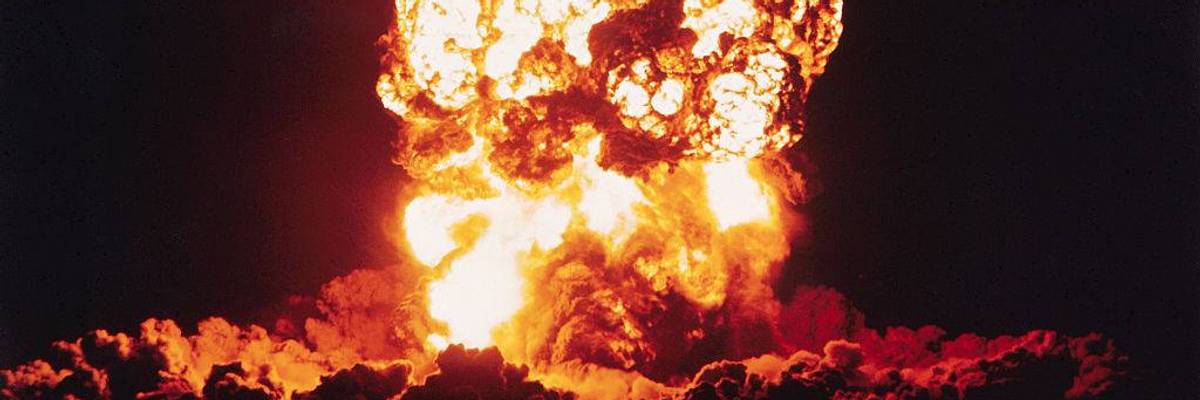
The detonation of the atomic bomb nicknamed "Smokey," part of Operation PLUMBBOB, is seen in the Nevada desert. in 1957.
Today we live as prisoners consigned to a permanent death row, having organized our world not around a commitment to collective sanity, safety, and security but around the perpetual preparation for collective destruction.
It has been 81 years since the atomic bombings delivered an unmistakable message. From the ruins of Hiroshima and Nagasaki, humanity was faced with a choice that Martin Luther King, Jr. would later describe as one between “non-violent coexistence or violent co-annihilation.” The intervening decades have made our answer painfully clear.
As a result, today we live as prisoners consigned to a permanent death row, having organized our world not around a commitment to collective sanity, safety, and security but around the perpetual preparation for collective destruction. The nuclear threat has predictably returned to the center of world politics, from Ukraine and Taiwan to Palestine and Iran.
American and Israeli officials have called for the use of nuclear weapons in Gaza, which during the ongoing genocide has already been subjected to equivalent of 13 Hiroshimas. And in the context of the second disastrous and criminal war in the region this century, waged ostensibly, and counterproductively, to preserve a system of nuclear apartheid, President Donald Trump has never disavowed his genocidal threat against Iran that “a whole civilization will die.”
It is therefore clear today that we can hardly take refuge in the comforting fiction that the collapse of the Soviet Union had consigned the specter of atomic holocaust to history. And it is our inability to confront nuclear weapons for what they truly are which has helped produce the present crisis. From their first use, the atomic bombs were immoral and illegal. Within a matter of years, such weapons would come to be described, in the words of their own architects, as a “weapon of genocide,” one which serves no military end beyond the slaughter of civilians.
The supreme irony is that the nuclear age and the postwar international order entered into force together, as the legal regime intended to prevent atrocities was born under the shadow of the mushroom cloud.
As such, states that possess nuclear weapons cannot be understood as guardians of the international order, represented by the five permanent members of the United Nations Security Council, but as its greatest threats, outcasts from law and humanity. They are, in the words of Daniel Ellsberg, adherents to no recognizable ethics other than perhaps “a form of Satanism, a worship of unbridled power that gives national leaders the right to gamble with forces that can undo creation.”
Yet instead of banning the bomb, the postwar international legal order accommodated it, failing to proscribe nuclear weapons, as it has for chemical and biological weapons. The result has been a world in which the capacity to exterminate millions, even billions, of people is treated not as the ultimate international crime but as the ultimate marker of international prestige and a currency of geopolitical power. So long as some states insist upon the legitimacy of their own atomic arsenals then, efforts to abolish them will remain, however well-intentioned, little more than “rearranging deck chairs on the Titanic.”
Why then, despite the obvious reality that nuclear weapons are prima facie illegal, that they violate the most fundamental tenets of international humanitarian law, making a mockery of its principles of distinction and proportionality, has the law failed even to signal its opposition to the bomb?
There have been numerous, often tepid, attempts to resolve the contradiction at the heart of the nuclear exception. The most significant came 30 years ago this summer, when the International Court of Justice (ICJ) issued its 1996 Advisory Opinion on the Legality of the Threat or Use of Nuclear Weapons. Although the Court affirmed that the threat or use of nuclear weapons would “generally be contrary” to international law, it ultimately preserved the nuclear status quo by declining to rule definitively on their legality “in an extreme circumstance of self-defense, in which the very survival of a State would be at stake.”
Nuclear states could therefore continue to justify their continued possession of these apocalyptic weapons through the familiar language of military necessity. The result was a legal ambiguity that left nuclear powers free to claim a right to initiate nuclear war in response to an asserted existential threat, as countries like the United States and Israel regularly inflate to advance their imperial policies. The law would then be left to determine, only after the fact, assuming any courts remained amid the ruins, whether the slaughter of millions of civilians had, in fact, been permissible.
But why did the World Court equivocate at such a critical historical juncture? The Cold War had recently ended, and with it seemingly the geopolitical and ideological confrontation that had long legitimized the logic of mutually assured destruction. Arms reduction agreements were underway, and several countries were abandoning their nuclear ambitions. A path toward the elimination of nuclear stockpiles appeared, however briefly, to be within reach.
Yet as scholars have argued, this was less a missed opportunity to challenge the nuclear powers than an ideological inability to confront the broader questions posed by nuclear weapons. A legal order ostensibly designed to restrain violence had, from its inception, collided with weapons that defy any standard of morality and legality. Faced with this contradiction, the court retreated into an act of institutional self-preservation. The effort has proved futile, as evidenced by the continuing impunity of powerful states and increasingly brazen attempts to dismantle the broader framework of international law.
Nonetheless, as Martti Koskenniemi has argued, had the ICJ actually declared nuclear weapons categorically illegal, it would have “put the court and the whole system of law it represents in a collision course with the politico-military system of the nuclear age.” In this confrontation, “the law could hardly prevail.” Recognizing this, “an opinion underwriting an absolute prohibition would have condemned the law to irrelevance already in advance.”
More fundamentally, the international legal system could scarcely have resolved the question. The imperatives of great-power politics had long stunted the court's ability to function. By elevating military necessity into a doctrine through which states could justify their actions, the law came to function not as a constraint but as a source of legitimacy for state violence. As Koskenniemi observes, citing philosopher Thomas Nagel, once mass violence can be deemed permissible under certain criteria, other considerations can then “be brought to bear to ease the consciences of those responsible for a certain number of charred babies.”
This failure was not the World Court’s alone. The problem had been embedded in the postwar legal order from the beginning. On August 8, 1945, the United States, the Soviet Union, the United Kingdom, and France ratified the London Charter establishing the International Military Tribunal at Nuremberg. Hours later, the United States destroyed Nagasaki with a second atomic bomb, just three days after Hiroshima. The supreme irony is that the nuclear age and the postwar international order entered into force together, as the legal regime intended to prevent atrocities was born under the shadow of the mushroom cloud.
Many of the earliest voices of conscience presenting the most forceful condemnations came from the political left. Those such as Albert Camus, Bertrand Russell, Dwight MacDonald, and Norman Cousins denounced the bombings in the days and weeks that followed. Yet opposition was by no means confined to one side of the political spectrum.
Conservative critics also challenged the decision. David Lawrence, editor of US News, rejected attempts to justify the bombings. Try as we might, he insisted, we can “never erase from our minds the simple truth that we, of all civilized nations, though hesitating to use poison gas, did not hesitate to employ the most destructive weapon of all times indiscriminately against men, women, and children.” Journalist Felix Morley similarly denounced this “act of atrocious revenge,” concluding that Hiroshima and Nagasaki constituted, in effect, an American Buchenwald.
If the law is to come to mean anything, it must bind the powerful before it punishes the powerless.
Religious leaders also lent their moral voices. A coalition of Christian clergy representing a range of denominations issued “unmitigated condemnation” of the “reckless and irresponsible” decision, warning that we “will receive judgment before God and before the conscience of humanity.” One of these signatories, A. J. Muste, would in subsequent years distill this sentiment into a single, provocative sentence: “If Dachau was a crime, Hiroshima is a crime.”
While public opinion, both domestically and internationally, increasingly moved toward abolition, culminating in the first resolution adopted by the UN General Assembly calling for the elimination of atomic weapons, US leaders had little intention of relinquishing their God-like powers. They brushed aside the warnings of scientists and statesmen who argued that this brief window, before other nations acquired the bomb, offered perhaps the only opportunity to prohibit nuclear weapons before catastrophe became permanent.
Instead of being prohibited, the bomb was rendered outside the law. At Nuremberg and Tokyo, the US established a legal exceptionalism that insulated nuclear weapons, and the strategic bombing that first made them conceivable, from meaningful scrutiny. Prosecutors opted to omit these crimes entirely, rendering them beyond the reach of law. Universal justice, in short, was subordinated to political expediency.
Many in the courtroom recognized the contradiction. At Tokyo, the atomic bombings loomed large over the proceedings. If individuals, rather than states, could be held criminally responsible for atrocities committed in war, as Nuremberg established, then American officials who ordered the bombing of Hiroshima and Nagasaki should face similar judgment. Otherwise, the tribunal would rest on an irreconcilable double standard. As the defense pointedly put it, “We know the name of every man whose hands loosed the atomic bomb on Hiroshima; we know the chief of staff who planned that act; we know the chief of the responsible state.”
American officials acknowledged that they had certainly been no strangers to criminality during the course of the war. In his opening statement, Chief Justice Robert Jackson remarked that “the Germans have taught us the horrors of modern warfare,” but the Allies were far from “dull pupils.” Telford Taylor, Allied chief prosecutor, similarly noted that prosecutors had deliberately avoided litigating the bombing of civilians because the scale of indiscriminate Allied bombing far exceeded any similar such forms of aerial warfare carried out by the Axis states.
Taylor later conceded that the bombings were war crimes but were rendered “tolerable in retrospect only because their malignancy pales in comparison to Dachau, Auschwitz, and Treblinka.” The physical and psychological distance afforded by aerial warfare, and the public apathy it cultivated, could hardly legitimize such violence, even as it was increasingly accepted by many Americans. To the contrary, Taylor wrote, had “Allied ground forces [entered] German and Japanese towns with guns blazing, and [killed] off the infants who survived the bombing,” few would have dared defend such policies.
The legal silence surrounding aerial and atomic bombing at Nuremberg and Tokyo has constrained efforts to impose meaningful legal limits on indiscriminate attacks against civilians ever since. In Gaza, Israeli officials have repeatedly invoked the Allied bombing campaigns to argue that if that was not deemed criminal, neither is Israel today. The precedent established in the aftermath of the Second World War has therefore continued to legitimize the laying waste to cities, reinforcing the logic that first made nuclear weapons conceivable.
While there have been additional efforts to challenge this exceptionalism, they too have fallen short in the face of US empire. The most significant was Japan’s 1963 Shimoda decision, in which the Tokyo District Court concluded that the atomic bombings had violated international law. By then, however, Japan had been pacified, first through occupation and then through its incorporation into the US Cold War order, leaving it with neither the political will nor the institutional means to pursue accountability.
This dynamic in postwar Japan reflects a broader reality: The bomb has long functioned as a tool of empire. As W.E.B. Du Bois warned at the dawn of the atomic age, if power could be maintained through atomic bombs, then “colonial peoples may never be free.” The nuclear order that emerged after 1945 has vindicated that position. It has always rested on an unmistakable hypocrisy. States that insist nuclear weapons are indispensable to their own security, many of them the colonial powers of yesterday and the imperial powers of today, simultaneously demand that the rest of the world accept permanent vulnerability at the hands of nuclear-armed states. Its governing principle is simple: Do as we say, not as we do.
But this blatant hypocrisy cannot coexist with a functioning international legal order, which, as has become increasingly clear in recent years, is crumbling before our eyes. At Nuremberg, Chief Justice Jackson warned that the only hope of those responsible for atrocities was “that international law will lag so far behind the moral sense of mankind that conduct which is crime in the moral sense must be regarded as innocent in law.” Eight decades later, his words have become an equal indictment of the nuclear age. If the law is to come to mean anything, it must bind the powerful before it punishes the powerless. The survival of international law, and perhaps life on Earth itself, depends on whether that principle is finally applied to the world’s most powerful states.
Dear Common Dreams reader, It’s been nearly 30 years since I co-founded Common Dreams with my late wife, Lina Newhouser. We had the radical notion that journalism should serve the public good, not corporate profits. It was clear to us from the outset what it would take to build such a project. No paid advertisements. No corporate sponsors. No millionaire publisher telling us what to think or do. Many people said we wouldn't last a year, but we proved those doubters wrong. Together with a tremendous team of journalists and dedicated staff, we built an independent media outlet free from the constraints of profits and corporate control. Our mission has always been simple: To inform. To inspire. To ignite change for the common good. Building Common Dreams was not easy. Our survival was never guaranteed. When you take on the most powerful forces—Wall Street greed, fossil fuel industry destruction, Big Tech lobbyists, and uber-rich oligarchs who have spent billions upon billions rigging the economy and democracy in their favor—the only bulwark you have is supporters who believe in your work. But here’s the urgent message from me today. It's never been this bad out there. And it's never been this hard to keep us going. At the very moment Common Dreams is most needed, the threats we face are intensifying. We need your support now more than ever. We don't accept corporate advertising and never will. We don't have a paywall because we don't think people should be blocked from critical news based on their ability to pay. Everything we do is funded by the donations of readers like you. When everyone does the little they can afford, we are strong. But if that support retreats or dries up, so do we. Will you donate now to make sure Common Dreams not only survives but thrives? —Craig Brown, Co-founder |
It has been 81 years since the atomic bombings delivered an unmistakable message. From the ruins of Hiroshima and Nagasaki, humanity was faced with a choice that Martin Luther King, Jr. would later describe as one between “non-violent coexistence or violent co-annihilation.” The intervening decades have made our answer painfully clear.
As a result, today we live as prisoners consigned to a permanent death row, having organized our world not around a commitment to collective sanity, safety, and security but around the perpetual preparation for collective destruction. The nuclear threat has predictably returned to the center of world politics, from Ukraine and Taiwan to Palestine and Iran.
American and Israeli officials have called for the use of nuclear weapons in Gaza, which during the ongoing genocide has already been subjected to equivalent of 13 Hiroshimas. And in the context of the second disastrous and criminal war in the region this century, waged ostensibly, and counterproductively, to preserve a system of nuclear apartheid, President Donald Trump has never disavowed his genocidal threat against Iran that “a whole civilization will die.”
It is therefore clear today that we can hardly take refuge in the comforting fiction that the collapse of the Soviet Union had consigned the specter of atomic holocaust to history. And it is our inability to confront nuclear weapons for what they truly are which has helped produce the present crisis. From their first use, the atomic bombs were immoral and illegal. Within a matter of years, such weapons would come to be described, in the words of their own architects, as a “weapon of genocide,” one which serves no military end beyond the slaughter of civilians.
The supreme irony is that the nuclear age and the postwar international order entered into force together, as the legal regime intended to prevent atrocities was born under the shadow of the mushroom cloud.
As such, states that possess nuclear weapons cannot be understood as guardians of the international order, represented by the five permanent members of the United Nations Security Council, but as its greatest threats, outcasts from law and humanity. They are, in the words of Daniel Ellsberg, adherents to no recognizable ethics other than perhaps “a form of Satanism, a worship of unbridled power that gives national leaders the right to gamble with forces that can undo creation.”
Yet instead of banning the bomb, the postwar international legal order accommodated it, failing to proscribe nuclear weapons, as it has for chemical and biological weapons. The result has been a world in which the capacity to exterminate millions, even billions, of people is treated not as the ultimate international crime but as the ultimate marker of international prestige and a currency of geopolitical power. So long as some states insist upon the legitimacy of their own atomic arsenals then, efforts to abolish them will remain, however well-intentioned, little more than “rearranging deck chairs on the Titanic.”
Why then, despite the obvious reality that nuclear weapons are prima facie illegal, that they violate the most fundamental tenets of international humanitarian law, making a mockery of its principles of distinction and proportionality, has the law failed even to signal its opposition to the bomb?
There have been numerous, often tepid, attempts to resolve the contradiction at the heart of the nuclear exception. The most significant came 30 years ago this summer, when the International Court of Justice (ICJ) issued its 1996 Advisory Opinion on the Legality of the Threat or Use of Nuclear Weapons. Although the Court affirmed that the threat or use of nuclear weapons would “generally be contrary” to international law, it ultimately preserved the nuclear status quo by declining to rule definitively on their legality “in an extreme circumstance of self-defense, in which the very survival of a State would be at stake.”
Nuclear states could therefore continue to justify their continued possession of these apocalyptic weapons through the familiar language of military necessity. The result was a legal ambiguity that left nuclear powers free to claim a right to initiate nuclear war in response to an asserted existential threat, as countries like the United States and Israel regularly inflate to advance their imperial policies. The law would then be left to determine, only after the fact, assuming any courts remained amid the ruins, whether the slaughter of millions of civilians had, in fact, been permissible.
But why did the World Court equivocate at such a critical historical juncture? The Cold War had recently ended, and with it seemingly the geopolitical and ideological confrontation that had long legitimized the logic of mutually assured destruction. Arms reduction agreements were underway, and several countries were abandoning their nuclear ambitions. A path toward the elimination of nuclear stockpiles appeared, however briefly, to be within reach.
Yet as scholars have argued, this was less a missed opportunity to challenge the nuclear powers than an ideological inability to confront the broader questions posed by nuclear weapons. A legal order ostensibly designed to restrain violence had, from its inception, collided with weapons that defy any standard of morality and legality. Faced with this contradiction, the court retreated into an act of institutional self-preservation. The effort has proved futile, as evidenced by the continuing impunity of powerful states and increasingly brazen attempts to dismantle the broader framework of international law.
Nonetheless, as Martti Koskenniemi has argued, had the ICJ actually declared nuclear weapons categorically illegal, it would have “put the court and the whole system of law it represents in a collision course with the politico-military system of the nuclear age.” In this confrontation, “the law could hardly prevail.” Recognizing this, “an opinion underwriting an absolute prohibition would have condemned the law to irrelevance already in advance.”
More fundamentally, the international legal system could scarcely have resolved the question. The imperatives of great-power politics had long stunted the court's ability to function. By elevating military necessity into a doctrine through which states could justify their actions, the law came to function not as a constraint but as a source of legitimacy for state violence. As Koskenniemi observes, citing philosopher Thomas Nagel, once mass violence can be deemed permissible under certain criteria, other considerations can then “be brought to bear to ease the consciences of those responsible for a certain number of charred babies.”
This failure was not the World Court’s alone. The problem had been embedded in the postwar legal order from the beginning. On August 8, 1945, the United States, the Soviet Union, the United Kingdom, and France ratified the London Charter establishing the International Military Tribunal at Nuremberg. Hours later, the United States destroyed Nagasaki with a second atomic bomb, just three days after Hiroshima. The supreme irony is that the nuclear age and the postwar international order entered into force together, as the legal regime intended to prevent atrocities was born under the shadow of the mushroom cloud.
Many of the earliest voices of conscience presenting the most forceful condemnations came from the political left. Those such as Albert Camus, Bertrand Russell, Dwight MacDonald, and Norman Cousins denounced the bombings in the days and weeks that followed. Yet opposition was by no means confined to one side of the political spectrum.
Conservative critics also challenged the decision. David Lawrence, editor of US News, rejected attempts to justify the bombings. Try as we might, he insisted, we can “never erase from our minds the simple truth that we, of all civilized nations, though hesitating to use poison gas, did not hesitate to employ the most destructive weapon of all times indiscriminately against men, women, and children.” Journalist Felix Morley similarly denounced this “act of atrocious revenge,” concluding that Hiroshima and Nagasaki constituted, in effect, an American Buchenwald.
If the law is to come to mean anything, it must bind the powerful before it punishes the powerless.
Religious leaders also lent their moral voices. A coalition of Christian clergy representing a range of denominations issued “unmitigated condemnation” of the “reckless and irresponsible” decision, warning that we “will receive judgment before God and before the conscience of humanity.” One of these signatories, A. J. Muste, would in subsequent years distill this sentiment into a single, provocative sentence: “If Dachau was a crime, Hiroshima is a crime.”
While public opinion, both domestically and internationally, increasingly moved toward abolition, culminating in the first resolution adopted by the UN General Assembly calling for the elimination of atomic weapons, US leaders had little intention of relinquishing their God-like powers. They brushed aside the warnings of scientists and statesmen who argued that this brief window, before other nations acquired the bomb, offered perhaps the only opportunity to prohibit nuclear weapons before catastrophe became permanent.
Instead of being prohibited, the bomb was rendered outside the law. At Nuremberg and Tokyo, the US established a legal exceptionalism that insulated nuclear weapons, and the strategic bombing that first made them conceivable, from meaningful scrutiny. Prosecutors opted to omit these crimes entirely, rendering them beyond the reach of law. Universal justice, in short, was subordinated to political expediency.
Many in the courtroom recognized the contradiction. At Tokyo, the atomic bombings loomed large over the proceedings. If individuals, rather than states, could be held criminally responsible for atrocities committed in war, as Nuremberg established, then American officials who ordered the bombing of Hiroshima and Nagasaki should face similar judgment. Otherwise, the tribunal would rest on an irreconcilable double standard. As the defense pointedly put it, “We know the name of every man whose hands loosed the atomic bomb on Hiroshima; we know the chief of staff who planned that act; we know the chief of the responsible state.”
American officials acknowledged that they had certainly been no strangers to criminality during the course of the war. In his opening statement, Chief Justice Robert Jackson remarked that “the Germans have taught us the horrors of modern warfare,” but the Allies were far from “dull pupils.” Telford Taylor, Allied chief prosecutor, similarly noted that prosecutors had deliberately avoided litigating the bombing of civilians because the scale of indiscriminate Allied bombing far exceeded any similar such forms of aerial warfare carried out by the Axis states.
Taylor later conceded that the bombings were war crimes but were rendered “tolerable in retrospect only because their malignancy pales in comparison to Dachau, Auschwitz, and Treblinka.” The physical and psychological distance afforded by aerial warfare, and the public apathy it cultivated, could hardly legitimize such violence, even as it was increasingly accepted by many Americans. To the contrary, Taylor wrote, had “Allied ground forces [entered] German and Japanese towns with guns blazing, and [killed] off the infants who survived the bombing,” few would have dared defend such policies.
The legal silence surrounding aerial and atomic bombing at Nuremberg and Tokyo has constrained efforts to impose meaningful legal limits on indiscriminate attacks against civilians ever since. In Gaza, Israeli officials have repeatedly invoked the Allied bombing campaigns to argue that if that was not deemed criminal, neither is Israel today. The precedent established in the aftermath of the Second World War has therefore continued to legitimize the laying waste to cities, reinforcing the logic that first made nuclear weapons conceivable.
While there have been additional efforts to challenge this exceptionalism, they too have fallen short in the face of US empire. The most significant was Japan’s 1963 Shimoda decision, in which the Tokyo District Court concluded that the atomic bombings had violated international law. By then, however, Japan had been pacified, first through occupation and then through its incorporation into the US Cold War order, leaving it with neither the political will nor the institutional means to pursue accountability.
This dynamic in postwar Japan reflects a broader reality: The bomb has long functioned as a tool of empire. As W.E.B. Du Bois warned at the dawn of the atomic age, if power could be maintained through atomic bombs, then “colonial peoples may never be free.” The nuclear order that emerged after 1945 has vindicated that position. It has always rested on an unmistakable hypocrisy. States that insist nuclear weapons are indispensable to their own security, many of them the colonial powers of yesterday and the imperial powers of today, simultaneously demand that the rest of the world accept permanent vulnerability at the hands of nuclear-armed states. Its governing principle is simple: Do as we say, not as we do.
But this blatant hypocrisy cannot coexist with a functioning international legal order, which, as has become increasingly clear in recent years, is crumbling before our eyes. At Nuremberg, Chief Justice Jackson warned that the only hope of those responsible for atrocities was “that international law will lag so far behind the moral sense of mankind that conduct which is crime in the moral sense must be regarded as innocent in law.” Eight decades later, his words have become an equal indictment of the nuclear age. If the law is to come to mean anything, it must bind the powerful before it punishes the powerless. The survival of international law, and perhaps life on Earth itself, depends on whether that principle is finally applied to the world’s most powerful states.
It has been 81 years since the atomic bombings delivered an unmistakable message. From the ruins of Hiroshima and Nagasaki, humanity was faced with a choice that Martin Luther King, Jr. would later describe as one between “non-violent coexistence or violent co-annihilation.” The intervening decades have made our answer painfully clear.
As a result, today we live as prisoners consigned to a permanent death row, having organized our world not around a commitment to collective sanity, safety, and security but around the perpetual preparation for collective destruction. The nuclear threat has predictably returned to the center of world politics, from Ukraine and Taiwan to Palestine and Iran.
American and Israeli officials have called for the use of nuclear weapons in Gaza, which during the ongoing genocide has already been subjected to equivalent of 13 Hiroshimas. And in the context of the second disastrous and criminal war in the region this century, waged ostensibly, and counterproductively, to preserve a system of nuclear apartheid, President Donald Trump has never disavowed his genocidal threat against Iran that “a whole civilization will die.”
It is therefore clear today that we can hardly take refuge in the comforting fiction that the collapse of the Soviet Union had consigned the specter of atomic holocaust to history. And it is our inability to confront nuclear weapons for what they truly are which has helped produce the present crisis. From their first use, the atomic bombs were immoral and illegal. Within a matter of years, such weapons would come to be described, in the words of their own architects, as a “weapon of genocide,” one which serves no military end beyond the slaughter of civilians.
The supreme irony is that the nuclear age and the postwar international order entered into force together, as the legal regime intended to prevent atrocities was born under the shadow of the mushroom cloud.
As such, states that possess nuclear weapons cannot be understood as guardians of the international order, represented by the five permanent members of the United Nations Security Council, but as its greatest threats, outcasts from law and humanity. They are, in the words of Daniel Ellsberg, adherents to no recognizable ethics other than perhaps “a form of Satanism, a worship of unbridled power that gives national leaders the right to gamble with forces that can undo creation.”
Yet instead of banning the bomb, the postwar international legal order accommodated it, failing to proscribe nuclear weapons, as it has for chemical and biological weapons. The result has been a world in which the capacity to exterminate millions, even billions, of people is treated not as the ultimate international crime but as the ultimate marker of international prestige and a currency of geopolitical power. So long as some states insist upon the legitimacy of their own atomic arsenals then, efforts to abolish them will remain, however well-intentioned, little more than “rearranging deck chairs on the Titanic.”
Why then, despite the obvious reality that nuclear weapons are prima facie illegal, that they violate the most fundamental tenets of international humanitarian law, making a mockery of its principles of distinction and proportionality, has the law failed even to signal its opposition to the bomb?
There have been numerous, often tepid, attempts to resolve the contradiction at the heart of the nuclear exception. The most significant came 30 years ago this summer, when the International Court of Justice (ICJ) issued its 1996 Advisory Opinion on the Legality of the Threat or Use of Nuclear Weapons. Although the Court affirmed that the threat or use of nuclear weapons would “generally be contrary” to international law, it ultimately preserved the nuclear status quo by declining to rule definitively on their legality “in an extreme circumstance of self-defense, in which the very survival of a State would be at stake.”
Nuclear states could therefore continue to justify their continued possession of these apocalyptic weapons through the familiar language of military necessity. The result was a legal ambiguity that left nuclear powers free to claim a right to initiate nuclear war in response to an asserted existential threat, as countries like the United States and Israel regularly inflate to advance their imperial policies. The law would then be left to determine, only after the fact, assuming any courts remained amid the ruins, whether the slaughter of millions of civilians had, in fact, been permissible.
But why did the World Court equivocate at such a critical historical juncture? The Cold War had recently ended, and with it seemingly the geopolitical and ideological confrontation that had long legitimized the logic of mutually assured destruction. Arms reduction agreements were underway, and several countries were abandoning their nuclear ambitions. A path toward the elimination of nuclear stockpiles appeared, however briefly, to be within reach.
Yet as scholars have argued, this was less a missed opportunity to challenge the nuclear powers than an ideological inability to confront the broader questions posed by nuclear weapons. A legal order ostensibly designed to restrain violence had, from its inception, collided with weapons that defy any standard of morality and legality. Faced with this contradiction, the court retreated into an act of institutional self-preservation. The effort has proved futile, as evidenced by the continuing impunity of powerful states and increasingly brazen attempts to dismantle the broader framework of international law.
Nonetheless, as Martti Koskenniemi has argued, had the ICJ actually declared nuclear weapons categorically illegal, it would have “put the court and the whole system of law it represents in a collision course with the politico-military system of the nuclear age.” In this confrontation, “the law could hardly prevail.” Recognizing this, “an opinion underwriting an absolute prohibition would have condemned the law to irrelevance already in advance.”
More fundamentally, the international legal system could scarcely have resolved the question. The imperatives of great-power politics had long stunted the court's ability to function. By elevating military necessity into a doctrine through which states could justify their actions, the law came to function not as a constraint but as a source of legitimacy for state violence. As Koskenniemi observes, citing philosopher Thomas Nagel, once mass violence can be deemed permissible under certain criteria, other considerations can then “be brought to bear to ease the consciences of those responsible for a certain number of charred babies.”
This failure was not the World Court’s alone. The problem had been embedded in the postwar legal order from the beginning. On August 8, 1945, the United States, the Soviet Union, the United Kingdom, and France ratified the London Charter establishing the International Military Tribunal at Nuremberg. Hours later, the United States destroyed Nagasaki with a second atomic bomb, just three days after Hiroshima. The supreme irony is that the nuclear age and the postwar international order entered into force together, as the legal regime intended to prevent atrocities was born under the shadow of the mushroom cloud.
Many of the earliest voices of conscience presenting the most forceful condemnations came from the political left. Those such as Albert Camus, Bertrand Russell, Dwight MacDonald, and Norman Cousins denounced the bombings in the days and weeks that followed. Yet opposition was by no means confined to one side of the political spectrum.
Conservative critics also challenged the decision. David Lawrence, editor of US News, rejected attempts to justify the bombings. Try as we might, he insisted, we can “never erase from our minds the simple truth that we, of all civilized nations, though hesitating to use poison gas, did not hesitate to employ the most destructive weapon of all times indiscriminately against men, women, and children.” Journalist Felix Morley similarly denounced this “act of atrocious revenge,” concluding that Hiroshima and Nagasaki constituted, in effect, an American Buchenwald.
If the law is to come to mean anything, it must bind the powerful before it punishes the powerless.
Religious leaders also lent their moral voices. A coalition of Christian clergy representing a range of denominations issued “unmitigated condemnation” of the “reckless and irresponsible” decision, warning that we “will receive judgment before God and before the conscience of humanity.” One of these signatories, A. J. Muste, would in subsequent years distill this sentiment into a single, provocative sentence: “If Dachau was a crime, Hiroshima is a crime.”
While public opinion, both domestically and internationally, increasingly moved toward abolition, culminating in the first resolution adopted by the UN General Assembly calling for the elimination of atomic weapons, US leaders had little intention of relinquishing their God-like powers. They brushed aside the warnings of scientists and statesmen who argued that this brief window, before other nations acquired the bomb, offered perhaps the only opportunity to prohibit nuclear weapons before catastrophe became permanent.
Instead of being prohibited, the bomb was rendered outside the law. At Nuremberg and Tokyo, the US established a legal exceptionalism that insulated nuclear weapons, and the strategic bombing that first made them conceivable, from meaningful scrutiny. Prosecutors opted to omit these crimes entirely, rendering them beyond the reach of law. Universal justice, in short, was subordinated to political expediency.
Many in the courtroom recognized the contradiction. At Tokyo, the atomic bombings loomed large over the proceedings. If individuals, rather than states, could be held criminally responsible for atrocities committed in war, as Nuremberg established, then American officials who ordered the bombing of Hiroshima and Nagasaki should face similar judgment. Otherwise, the tribunal would rest on an irreconcilable double standard. As the defense pointedly put it, “We know the name of every man whose hands loosed the atomic bomb on Hiroshima; we know the chief of staff who planned that act; we know the chief of the responsible state.”
American officials acknowledged that they had certainly been no strangers to criminality during the course of the war. In his opening statement, Chief Justice Robert Jackson remarked that “the Germans have taught us the horrors of modern warfare,” but the Allies were far from “dull pupils.” Telford Taylor, Allied chief prosecutor, similarly noted that prosecutors had deliberately avoided litigating the bombing of civilians because the scale of indiscriminate Allied bombing far exceeded any similar such forms of aerial warfare carried out by the Axis states.
Taylor later conceded that the bombings were war crimes but were rendered “tolerable in retrospect only because their malignancy pales in comparison to Dachau, Auschwitz, and Treblinka.” The physical and psychological distance afforded by aerial warfare, and the public apathy it cultivated, could hardly legitimize such violence, even as it was increasingly accepted by many Americans. To the contrary, Taylor wrote, had “Allied ground forces [entered] German and Japanese towns with guns blazing, and [killed] off the infants who survived the bombing,” few would have dared defend such policies.
The legal silence surrounding aerial and atomic bombing at Nuremberg and Tokyo has constrained efforts to impose meaningful legal limits on indiscriminate attacks against civilians ever since. In Gaza, Israeli officials have repeatedly invoked the Allied bombing campaigns to argue that if that was not deemed criminal, neither is Israel today. The precedent established in the aftermath of the Second World War has therefore continued to legitimize the laying waste to cities, reinforcing the logic that first made nuclear weapons conceivable.
While there have been additional efforts to challenge this exceptionalism, they too have fallen short in the face of US empire. The most significant was Japan’s 1963 Shimoda decision, in which the Tokyo District Court concluded that the atomic bombings had violated international law. By then, however, Japan had been pacified, first through occupation and then through its incorporation into the US Cold War order, leaving it with neither the political will nor the institutional means to pursue accountability.
This dynamic in postwar Japan reflects a broader reality: The bomb has long functioned as a tool of empire. As W.E.B. Du Bois warned at the dawn of the atomic age, if power could be maintained through atomic bombs, then “colonial peoples may never be free.” The nuclear order that emerged after 1945 has vindicated that position. It has always rested on an unmistakable hypocrisy. States that insist nuclear weapons are indispensable to their own security, many of them the colonial powers of yesterday and the imperial powers of today, simultaneously demand that the rest of the world accept permanent vulnerability at the hands of nuclear-armed states. Its governing principle is simple: Do as we say, not as we do.
But this blatant hypocrisy cannot coexist with a functioning international legal order, which, as has become increasingly clear in recent years, is crumbling before our eyes. At Nuremberg, Chief Justice Jackson warned that the only hope of those responsible for atrocities was “that international law will lag so far behind the moral sense of mankind that conduct which is crime in the moral sense must be regarded as innocent in law.” Eight decades later, his words have become an equal indictment of the nuclear age. If the law is to come to mean anything, it must bind the powerful before it punishes the powerless. The survival of international law, and perhaps life on Earth itself, depends on whether that principle is finally applied to the world’s most powerful states.